Living the Gospel

Feast of Saint Mark, evangelist
April 25, 2023

Today’s Readings:

https://bible.usccb.org/bible/readings/042523.cfm

Today, in God’s Lavish Mercy, on the feast of St. Mark, our readings instruct and nourish us on how to live the Gospel.

As devout lovers of the Gospel, we have heard this phrase a thousand times: “the Gospel according to Mark…”.

But who was this “Mark”, and how was he motivated to become one of the four Evangelists who have given the Gospel to the ages?

According to Eusebius of Caesarea (260-339 A.D.), Herod Agrippa I, in his first year of reign over the whole of Judea (AD 41), killed James, son of Zebedee and arrested Peter, planning to kill him after the Passover. Peter was saved miraculously by angels, and escaped out of the realm of Herod (Acts 12:1–19). Peter went to Antioch, then through Asia Minor (visiting the churches in Pontus, Galatia, Cappadocia, Asia, and Bithynia, as mentioned in 1 Peter 1:1), and arrived in Rome in the second year of Emperor Claudius (AD 42). Somewhere on the way, Peter encountered Mark and took him as travel companion and interpreter. Mark the Evangelist wrote down the sermons of Peter, thus composing the Gospel according to Mark, before he left for Alexandria in the third year of Claudius (AD 43).

Wikipedia on the Historia Ecclesiastica of Eusebius

Peter dictating the Gospel to Mark
This finely-carved ivory from the 7th century
is in the Victoria and Albert Museum in London.

Our first reading from Peter’s letters gives us an intimate insight into the conversations between Peter and Mark as they traveled those roads in Asia Minor. These were real people reflecting on their call to preach the Gospel to all the world:

Clothe yourselves with humility
in your dealings with one another, for:

God opposes the proud
but bestows favor on the humble.


So humble yourselves under the mighty hand of God,
that he may exalt you in due time.
Cast all your worries upon him because he cares for you.
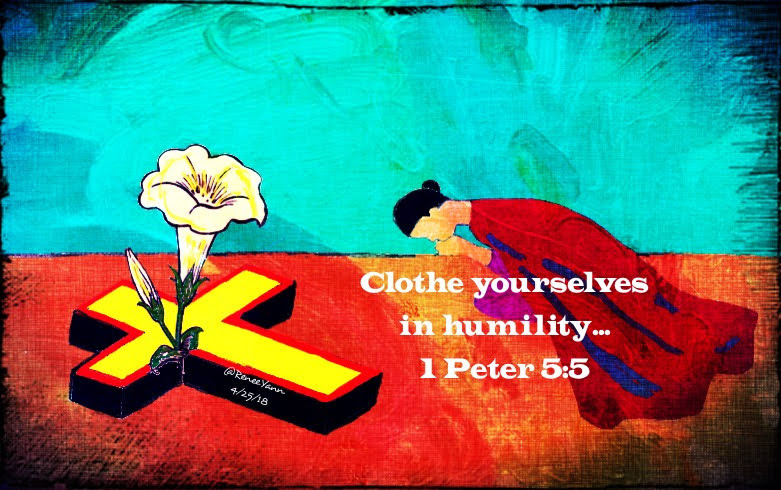
1 Peter :5-7

While Peter offers these words for the sake of the churches in Asia Minor, picture him sitting only with Mark as Mark diligently scribes Peter’s words. Mark is a young man, maybe still a teenager. His heart is fired with the story of Jesus to the point that he has left his home to travel and learn from this one man who was closest to Jesus himself.

Peter’s stories burn into Mark’s soul and inspire him. Eventually, his own preaching and discipleship will carry the Gospel to the church of Alexandria years after Peter has died, and to us through the written word he inspired.

Our devout and consistent prayer and study of the scriptures allows us to be transformed by that same Sacred Fire – the power of the Holy Spirit given at Pentecost. We, too, can sit beside Peter and Mark and learn from their ardent spirituality.


Dr. Mary Healy is professor of Scripture at Sacred Heart Major Seminary in Detroit. She is a general editor of the Catholic Commentary on Sacred Scripture and author of two of its volumes, The Gospel of Mark and Hebrews. She says this:

What we have not fully taken into account is the first evangelisation – the explosive growth of Christianity in the ancient world, when a handful of fishermen, tax collectors, and ordinary people turned the world upside down for Christ, even while undergoing waves of state-sanctioned persecution.

The beginnings of that story are told in the New Testament, and it’s there that we find the secret to becoming the missionary disciples we are called to be.


Jesus appeared to the Eleven and said to them:
“Go into the whole world
and proclaim the Gospel to every creature.
Whoever believes and is baptized will be saved;
whoever does not believe will be condemned.
These signs will accompany those who believe:
in my name they will drive out demons,
they will speak new languages.
They will pick up serpents with their hands,
and if they drink any deadly thing, it will not harm them.
They will lay hands on the sick, and they will recover.”

Mark 16:15-18

I think that most of us, when we read today’s Gospel, do not see ourselves standing with the Eleven, receiving the ability to “cast out demons, …speak new languages,… handle serpents, … and drink poison…”.

But think about it:

  • How are we called to respond with Gospel grace when we encounter the demon of injustice in our world?
  • How are we called to speak new languages of peace, kindness, and respect for human life in a culture that has normalized violence and deception?
  • How are we called to handle and confront meanness, prejudice, gossip, and hatred when these slither like snakes into our conversations and opinions?
  • How do we help ourselves and others recognize and avoid the poisons of a dishonest and manipulative culture when they threaten our familial, economic, political, educational, religious, and medicinal constructs?

Indeed, we are called to love, learn and live the Gospel in our own particular time and circumstances — just like Mark and Peter were. Let’s pray with them today and ask them to strengthen us in a courageous response to that glorious call.


Poetry: Mark – a sonnet by Malcolm Guite

A wingèd lion, swift, immediate
Mark is the gospel of the sudden shift
From first to last, from grand to intimate,
From strength  to weakness, and from debt to gift,
From a wide deserts haunted emptiness
To a close city’s fervid atmosphere,
From a voice crying in the wilderness
To angels in an empty sepulcher.
And Christ makes the most sudden shift of all;
From swift action as a strong Messiah
Casting the very demons back to hell
To slow pain, and death as a pariah.
We see our Saviour’s life and death unmade
And flee his tomb dumbfounded and afraid.

Music: My God, I Love Thee from St. Mark Passion by Charles Wood (lyrics below)

My God, I love Thee: not because
I hope for heaven thereby,
Nor yet because who love Thee not
Are lost eternally.
Thou, O my Jesus, Thou didst me
Upon the Cross embrace;
For me didst bear the nails, and spear,
And manifold disgrace,

And griefs and torments numberless,
And sweat of agony;
Yea, death itself; and all for me
Who wast Thine enemy.
Then why, most loving Jesus Christ,
Should I not love Thee well?
Not for the sake of winning heaven,
Or of escaping hell;
Not from the hope of gaining aught, 
Not seeking a reward;
But as Thyself has lovèd me,
O ever­loving Lord?
So do I love Thee, and will love,
Who such a love hast showed Only because
Thou art my King,
Because Thou art my God
… that you believe…

Monday of the Third Week of Easter
April 24, 2023

Today’s Readings:

https://bible.usccb.org/bible/readings/042423.cfm

Today, in God’s Lavish Mercy, our readings remind us that being a Christian is simple, but not easy.

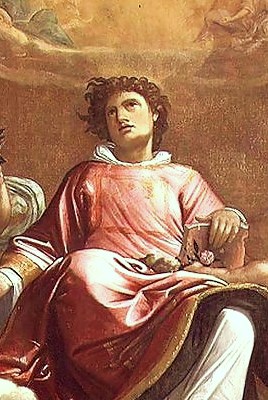
Stephen, presented to us in our reading from Acts, must have been a beautiful, simple person — almost angelic according to Acts’ description:

Stephen, filled with grace and power,
was working great wonders and signs among the people.

Acts 6:8

All those who sat in the Sanhedrin looked intently at him
and saw that his face was like the face of an angel.

Acts 6:15

St. Stephen – Giacomo Cavedone – c. 1601


Despite his goodness, Stephen became an object of hate and persecution by many:

Certain members of the so-called Synagogue of Freedmen,
Cyreneans, and Alexandrians,
and people from Cilicia and Asia,
came forward and debated with Stephen,
but they could not withstand the wisdom and the Spirit with which he spoke.
Then they instigated some men to say,
“We have heard him speaking blasphemous words
against Moses and God.”

Acts 6:9-11

This is such a revealing passage! Stephen’s persecutors cannot challenge his preaching themselves, so they create a web of poisonous lies and entangle some other men in its venom. They instigate these men to spread false allegations against Stephen which will eventually lead to his martyrdom.


There is a vital lesson here for us. Truth matters. Lies matter. They are the engines that drive not only our relationships and actions, but our very culture. And a hard look at our modern culture suggests that we are becoming a culture of lies.

I don’t need to give examples here. We know just from glancing at the newspaper, or perhaps – unfortunately – from reflecting on our own experiences.

We know the people who pretend they are what they are not.

We know who pretends that they are not what they actually are.


Jesus is a Truth Teller. In our Gospel, he gently confronts a bunch of people who are “pretending” their faith. Jesus tells them they’re not so much interested in the Truth he preaches as in the food he provided just yesterday. After all, everybody loves a good picnic!

Jesus answered them and said,
“Amen, amen, I say to you, you are looking for me
not because you saw signs
but because you ate the loaves and were filled.
Do not work for food that perishes
but for the food that endures for eternal life,
which the Son of Man will give you. 
For on him the Father, God, has set his seal.” 

John 6: 26-27

These bread seekers in our Gospel hear Jesus’s challenge so they ask him

“What can we do to accomplish the works of God?”
Jesus answered and said to them,

“This is the work of God,
that you believe in the one he sent.”

Just believe. Doing so will lead us to Truth and to a holy simplicity like that which radiated from Stephen. It’s that simple …. and that hard.


Poetry: A Christmas Hymn – by Richard Wilbur

Although the following poem is out of season, and does not mention Stephen, its refrain references his method of martyrdom: “every stone shall cry”. The poem is also a succinct and lyrical summary of the life of Christ and its meaning for us — a good thing to consider during this Eastertide.

A stable lamp is lighted
whose glow shall wake the sky;
the stars shall bend their voices,
and every stone shall cry.
And every stone shall cry,
and straw like gold shall shine;
a barn shall harbour heaven,
a stall become a shrine.
This child through David’s city
shall ride in triumph by;
the palm shall strew its branches,
and every stone shall cry.
And every stone shall cry,
though heavy, dull and dumb,
and lie within the roadway
to pave his kingdom come.
Yet he shall be forsaken,
and yielded up to die;
the sky shall groan and darken,
and every stone shall cry.
And every stone shall cry
for gifts of love abused;
God’s blood upon the spearhead,
God’s blood again refused.
But now, as at the ending,
the low is lifted high;
the stars shall bend their voices,
and every stone shall cry.
And every stone shall cry
in praises of the child
by whose descent among us
the worlds are reconciled.

Music: Every Stone Shall Cry – Steve Bell musically interprets Wilbur’s poem.

Water and Pork Chops

Saturday of the Second Week of Easter
April 22, 2023

Today’s Readings:

https://bible.usccb.org/bible/readings/042223.cfm

Today, in God’s Lavish Mercy, little “disruptions” pop up in the center of both our readings.

In Acts, some of the Greek Christians think they are getting the short end of the stick when it comes to food distribution.

Believe me, I can picture the situation using personal experience. When I was an 18 year old postulant, I was a tall, skinny athlete — and I ate a lot of food. I wasn’t used to living in community, and I hadn’t noticed how my voracious appetite might be affecting those around me at the table.

In those “olden days”, the fifty-two of us freshly minted mini-nuns sat “in rank”, i.e according to age. The food was passed down the table from oldest to youngest. When I came to supper one night, the sister below me in rank had moved up a seat to be before me. I thought she just got mixed up about where her chair was so I asked her about it.

She told me she moved up in order to get a pork chop before I took them all!


Well, that’s what the Hellenists are doing in today’s reading which illustrates that living in community is a practical exercise as well as a spiritual one. That practicality calls upon us to make prudent arrangements for the community such as the disciples did in appointing more presbyters led by Stephen.

For us in our various communities today, the reading reminds us to think about the “pork chops” – who needs what and are they getting what they need. This principle holds for both spiritual and material needs and goods. Like the new presbyters, we each have a part to play in achieving that equity within our communities – including families, neighborhoods, churches, workplaces, and the world we share with all Creation.


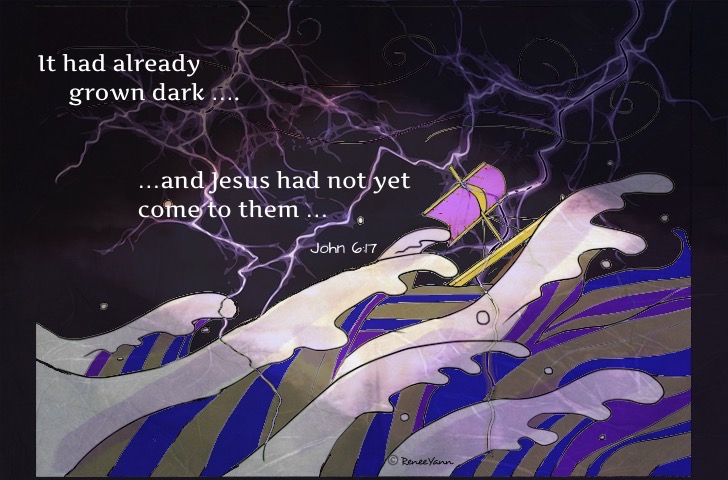
While our Gospel event is narrated in both Matthew and Mark, John gives us his own colorful version of the story of Jesus walking on the water. John highlights the conditions of the sea and atmosphere: darkness, the gusty wind, a turbulent ocean, and the absence of Jesus from the boat:

When it was evening, the disciples of Jesus went down to the sea,
embarked in a boat, and went across the sea to Capernaum.
It had already grown dark, and Jesus had not yet come to them.
The sea was stirred up because a strong wind was blowing.

John 6:16-18

So John makes it clear that it was the customary “dark and scary night“. But the disciples, tossed in the tumult, never express fear until they see Jesus walking across the water toward them. It seems they are less afraid of nature’s power than they are of the power of God!

Jesus sees their fear and tells them not to be afraid. In a phrase reminiscent of God’s self-revelation to Moses ( I am Who am), Jesus simply says, “It is I” — I am God. I am with you. Do not be afraid.


The disciples are still a little nervous and seem to prefer a less omnipotent Jesus . They ask him to get into the boat (in other words, “Be normal – not a Water-Walker”). But Jesus ignores the invitation and simply transports the boat to shore. One might picture the Twelve, tossed up on the shore, mouths agape and beginning to realize that their whole world was being turned upside-down in Christ!


Maybe we’re a little bit like the disciples sometimes. Sometimes we like God in small doses – not in a brilliant revelation or an irresistible call. Jesus snoozing beside us in the boat is comfortable. A radiant God coming to us in our life’s storms is a little harder to adjust to.

Our readings today remind us that God is present in every aspect of our lives – the daily practicalities and the topsy-turvy revelations. God may sit beside us in the boat, or might drag us stunned into another graced shore. But we should not be afraid in any case. Just prayerfully listen for the assurance, “It is I!”


Poetry: Walking on Water – Mark Jarmon

       Always the same message out of Matthew.
The water Jesus walks on is life’s turbulence.
        He calms our trouble and lifts us up again.

To walk on water? That’s what’s puzzling—
        that feat of antimatter, defeat of physics,
those beautiful unshod feet of cosmic truth

        for whom the whole performance is child’s play.
And unless one becomes as a little child
        the kingdom’s inaccessible by any route.

That water, then, its broken surface tension,
        collision of fracturing waves, apparent chaos,
its fractals turning infinite and weaving

        the netted skin between worlds, that web
of light and gravity which underpins our faith,
        water, a substance, stormy or pacific,

we know a myriad ways to get across it.
        But simply walking on it? Literally?
How far do you think you’d go before you fell

        through that convergence between time and space?
The water Jesus walked on wasn’t water
        only. It was the storm that made it rock.

Music: Walk on Water – Elevation Rhythm

A Good Heart, an “Easter-ed Heart”

Thursday of the Second Week of Easter
April 20, 2023

Today’s Readings:

https://bible.usccb.org/bible/readings/042023.cfm

Today, in God’s Lavish Mercy, the post-Resurrection Apostles continue their unstoppable testimony to Jesus Christ. Their persistence “infuriates” the Sanhedrin who fear the blood of Christ being called down upon them!

“We gave you strict orders did we not,
to stop teaching in that name.
Yet you have filled Jerusalem with your teaching
and want to bring this man’s blood upon us.”
But Peter and the Apostles said in reply,
“We must obey God rather than men. 
The God of our ancestors raised Jesus,
though you had him killed by hanging him on a tree.
God exalted him at his right hand as leader and savior
to grant Israel repentance and forgiveness of sins.
We are witnesses of these things,
as is the Holy Spirit whom God has given to those who obey him.”

Acts 5: 28-33

There is an interesting play in the words and concepts of this reading from Acts.

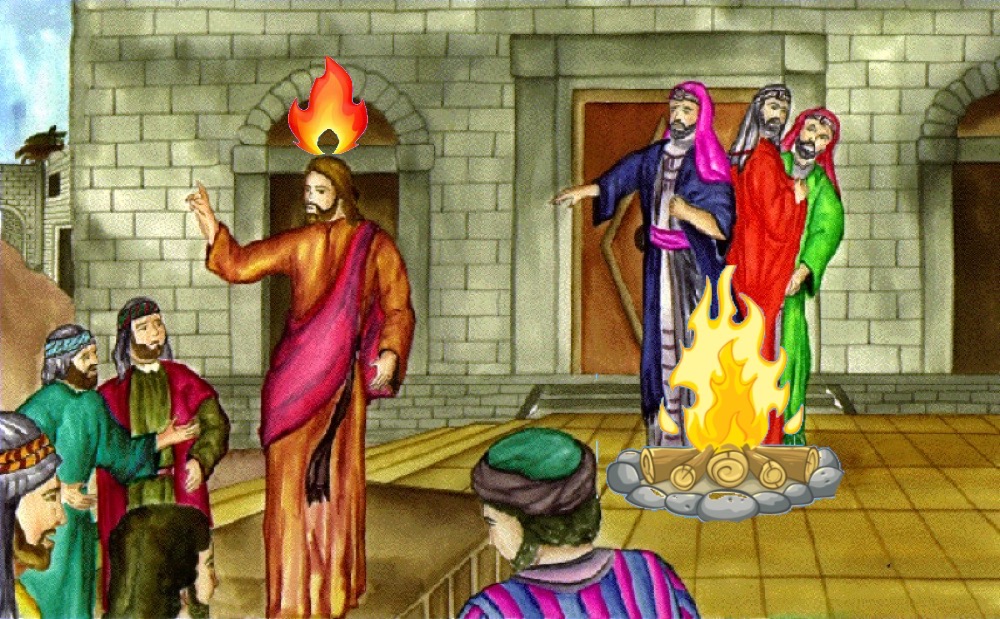
  • While the Sanhedrin are infuriated, or filled with the fire of denial and sin, the Apostles are inflamed with the unquenchable Fire of the Holy Spirit.
  • While the Sanhedrin fear the blood of Christ called down upon them, the disciples hearts are transformed by its power.

The contrast in their responses to God’s Word is stunning.


In our Gospel, John captures this contrast in a nutshell:

The one who comes from above is above all.
The one who is of the earth is earthly
and speaks of earthly things.

John 3:31

In other words, those transformed in the power of the Resurrection see the world with God’s eyes — “from above”. Those unconverted by that Power still see the world in godlessness.


Our Gospel calls us to be like the disciples not like the Sanhedrin.  It calls us to open our hearts:

  • to see the Truth Who is Jesus Christ
  • to believe that the Truth of his Resurrection lives in us
  • to become that Truth through the witness of our lives.

The Gospel calls us to live a whole-hearted faith which allows the Holy Spirit to be expressed in every aspect of our lives. Jesus does not ration the gift of the Spirit, nor should we:

Whoever does accept Christ’s testimony certifies that God is trustworthy.
For the one whom God sent speaks the words of God.
He does not ration his gift of the Spirit.

John 3:33-34

How do we live such a life of Christian witness? Do we have to shout the witness out loud with every action of our lives?  I don’t think so.

Brother David Steindl-Rast describes believers like this:

People who have faith in life are like swimmers who entrust themselves to a rushing river. They neither abandon themselves to its current nor try to resist it. Rather, they adjust their every movement to the watercourse, use it with purpose and skill, and enjoy the adventure.


And the great St. Teresa of Avila blesses believers with this prayer:

May today there be peace within.
May you trust God that you are exactly where you are meant to be.
May you not forget the infinite possibilities that are born of faith.
May you use those gifts that you have received,
and pass on the love that has been given to you.
May you be content knowing you are a child of God.
Let this presence settle into your bones,
and allow your soul the freedom to sing, dance, praise and love.
It is there for each and every one of us.


Poetry: Little Summer Poem Touching The Subject Of Faith by Mary Oliver

Every summer
I listen and look 
under the sun’s brass and even
into the moonlight, but I can’t hear

anything, I can’t see anything — 
not the pale roots digging down, nor the green 
stalks muscling up,
nor the leaves
deepening their damp pleats,

nor the tassels making,
nor the shucks, nor the cobs.
And still,
every day,

the leafy fields
grow taller and thicker — 
green gowns lofting up in the night,
showered with silk. 

And so, every summer,
I fail as a witness, seeing nothing — 
I am deaf too
to the tick of the leaves, 

the tapping of downwardness from the banyan feet — 
all of it
happening
beyond any seeable proof, or hearable hum. 

And, therefore, let the immeasurable come.
Let the unknowable touch the buckle of my spine.
Let the wind turn in the trees,
and the mystery hidden in the dirt

swing through the air.
How could I look at anything in this world
and tremble, and grip my hands over my heart?
What should I fear? 

One morning
in the leafy green ocean
the honeycomb of the corn’s beautiful body
is sure to be there.


Music: A Good Heart – Marc Enfroy

Impossible Not to Speak the Name

Saturday in the Octave of Easter
April 15, 2023

Today’s Readings:

https://bible.usccb.org/bible/readings/041523.cfm

Today, in God’s Lavish Mercy, the reasonable Sanhedrin try to deal with Peter and John’s “bold” testimony for Christ.

Observing the boldness of Peter and John
and perceiving them to be uneducated, ordinary men,
the leaders, elders, and scribes were amazed,
and they recognized them as the companions of Jesus.
Then when they saw the man who had been cured standing there with them,
they could say nothing in reply.

Acts 4: 13-14

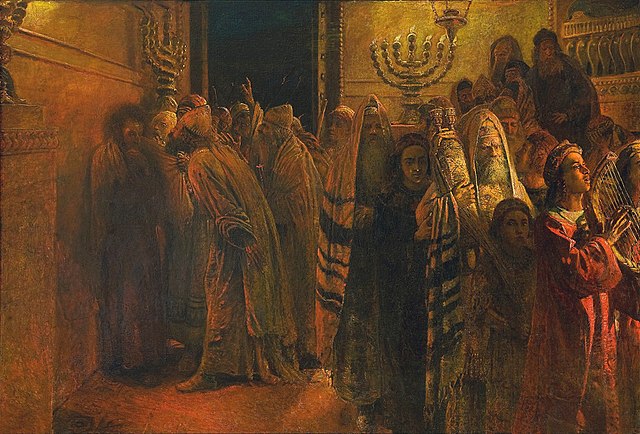
The Sanhedrin was an assembly of elders or rabbis appointed to sit as a tribunal in every city in the ancient Israel. As a body, they claimed powers that lesser Jewish courts did not have. As such, they were the only ones who could try the king, extend the boundaries of the Temple and Jerusalem, and were the ones to whom all questions of law were finally put.

from Wikipedia

Peter Before the Sanhedrin by Nikolai Ge (1892)

These men existed on the ultimate power they had over the people. It was the source of their influence, wealth and independence. Now this Jesus and his bold buddies come along trying to upset the apple cart. The old familiar, comfortable world is threatened and they don’t like it.

Their solution is overly simplistic. They tell Peter and John to just shut up:

The Sanhedrin conferred with one another, saying,
“What are we to do with these men?
Everyone living in Jerusalem knows that a remarkable sign
was done through them, and we cannot deny it.
But so that it may not be spread any further among the people,
let us give them a stern warning
never again to speak to anyone in this name.”
So they called them back
and ordered them not to speak or teach at all in the name of Jesus.

Acts 4: 15-17

Peter and John say “sorry guys”! Easter-inspired faith doesn’t work that way:

Peter and John, however, said to them in reply,
“Whether it is right in the sight of God
for us to obey you rather than God, you be the judges.
It is impossible for us not to speak about what we have seen and heard.

Acts 4:18

Peter and John make it sound simple too, don’t they. They tell us that it is impossible not to live our witness to the Gospel.

But I think we all know that it’s not that simple. Witnessing our faith in a morally complex world takes courage, insight, humility and wisdom. 

We are not passive participants in the often crippled world around us. Like Peter and John, we are called to pay attention to suffering, and to be healers. We are called to be witnesses to the Resurrection by the faithful generosity of our lives.


Prose: Marianne Williamson – from A Return to Love

Our deepest fear is not that we are inadequate. 
Our deepest fear is that we are powerful beyond measure. 
It is our light not our darkness that frightens us. 
We ask ourselves 'who am I to be brilliant, gorgeous, talented and fabulous?'
Actually, who are you not to be?

You are a child of God. 
You’re playing small doesn't serve the world. 
There's nothing enlightened about shrinking 
so that other people won't feel insecure around you. 
We were born to make manifest the glory of God that is within us.

It's not just in some of us; its in everyone. 
And as we let our own light shine, 
we unconsciously give other people permission to do the same.
As we are liberated from our own fear,
our presence automatically liberates others

Music: Speak the Name – Koryn Hawthorne 

Extra Song: I can’t help thinking of — Perry Como singing “Impossible”. Of course, this is a romantic song, but the same principles hold in our devotion to God, and God’s to us. Think about it 🙂

The Other Mary

Monday in the Octave of Easter
April 10, 2023

Today’s Readings:

https://bible.usccb.org/bible/readings/041023.cfm

Today, in God’s Lavish Mercy, our readings remind us that the witness of others, and their faithful companionship, are incalculable gifts to strengthen our faith.


In the passage from Acts, Peter summons the ancient witness of David in attestation to the Resurrection. David is the perfect exponent, because Peter is speaking to the Jews whose faith is built on David’s heritage.

My brothers and sisters, one can confidently say to you
about the patriarch David that he died and was buried,
and his tomb is in our midst to this day.
But since he was a prophet and knew that God had sworn an oath to him
that he would set one of his descendants upon his throne,
he foresaw and spoke of the resurrection of the Christ,
that neither was he abandoned to the netherworld
nor did his flesh see corruption.

Acts 2: 29-31

Our Responsorial Psalm recalls David’s Resurrection testimony, particularly these lines:

Therefore my heart is glad and my soul rejoices,
my body, too, abides in confidence;
Because you will not abandon my soul to the nether world,
nor will you suffer your faithful one to undergo corruption.

You will show me the path to life,
fullness of joys in your presence,
the delights at your right hand forever.

Psalm 16: 9-11

Matthew’s Gospel retells the witness scene John gave us, allowing us a slightly different slant on the story:

Mary Magdalene and the other Mary went away quickly from the tomb,
fearful yet overjoyed,
and ran to announce the news to his disciples.
And behold, Jesus met them on their way and greeted them.
They approached, embraced his feet, and did him homage.
Then Jesus said to them, “Do not be afraid.
Go tell my brothers to go to Galilee, 
and there they will see me.”

Matthew 28:7-10

The Two Marys Watch the Tomb – James Tissot


Matthew incorporates the “other Mary” as a first witness to the Resurrection. How wonderful for that faithful disciple whoever she was!

We may not know her full name but we can be rather certain of this – she was Mary Magdalen’s treasured friend. “Other Mary” was the one Magdalen went to when she was just a little too afraid to go find Jesus all by herself. And “Other Mary” was close enough to Jesus that he chose her too to be a “First Witness” of the Resurrection.

“Other Mary” didn’t have the notoriety that Mary Magdalen had. Magdalen was prominent enough that she carried the name of her hometown. “Other Mary” didn’t have such a designation. She was probably a quieter, less recognized, but nevertheless invaluable contributor to the early Christian community.

We know the kind of person “Other Mary” was. We may be blessed with such friends and companions in our own lives, always there, always supportive, always faithful.

Perhaps we want to spend a little time in prayer with “Other Mary”, asking her to help us gratefully recognize those who have companioned us in our faith life.

We might ask her too to help us deepen our own steadfast presence to others in faith, hope and love.


Poetry: An Easter Flower Gift – John Greenleaf Whittier

O dearest bloom the seasons know,
Flowers of the Resurrection blow,
Our hope and faith restore;
And through the bitterness of death
And loss and sorrow, breathe a breath
Of life forevermore!

The thought of Love Immortal blends
With fond remembrances of friends;
In you, O sacred flowers,
By human love made doubly sweet,
The heavenly and the earthly meet,
The heart of Christ and ours!

Music: Bridge Over Troubled Waters – Simon and Garfunkel

Don’t Be Afraid

Monday in the Octave of Easter
April 10, 2023

Today’s Readings:

https://bible.usccb.org/bible/readings/041023.cfm

Today, in God’s Lavish Mercy, we begin to read and relish the post-Resurrection stories.

As I begin my prayer with these stories, I am reminded of a sweet cartoon I recently saw on Facebook. The illustration showed an elderly couple relaxing outside a simple home. The woman is shelling peas; the man whittling some wood. The comment below the picture reads, “If only I could visit my grandparents one more time!”. 

Haven’t we all felt that way about someone dear who has died.  If only we could be with them one more time!


Well, that’s exactly what happens in these post-Resurrection stories. The disciples, and we, get to be with Jesus one more time:

  • to re-hear his Truth more clearly in the light of the Resurrection 
  • to get right the Gospel imperatives we might have missed in our distractions 
  • to heal the doubts which his suffering, and ours, may have caused us
  • to have our faith irrevocably affirmed by his real and transformed Presence

The Three Marys at the Tomb – WILLIAM-ADOLPHE BOUGUEREAU


Mary Magdalene and the other Mary went away quickly from the tomb,
fearful yet overjoyed,
and ran to announce the news to his disciples.
And behold, Jesus met them on their way and greeted them.
They approached, embraced his feet, and did him homage.
Then Jesus said to them, “Do not be afraid.
Go tell my brothers to go to Galilee, 
and there they will see me.”

Mark 28:8-10

Like Mary Magdalen and the “other Mary”, we too might be “fearful but overjoyed” at moments in our faith life – those moments when we are confronted with our own small Calvaries. 

But Jesus, filled with the glory of Resurrection, greets us on our way. He tells us too, “Do not be afraid” —— you will see me, risen in your life. And you will understand.


Prose: from Paula D’Arcy

Who would I be,
and what power

would be expressed in my life,
if I were not dominated by fear.


Music: Don’t Be Afraid – Mac Lynch

The Pretender

Wednesday of Holy  Week
April 5, 2023

Today’s Readings:

https://bible.usccb.org/bible/readings/040523.cfm

Today, in God’s Lavish Mercy, we stand beside Jesus in a tangled world of insults, violence,  plots, and dirty money. How sickening and painful such an atmosphere must have been to him who is Love and Divine Innocence. The psalmist describes the pain like this:

Insult has broken my heart, and I am weak,
I looked for sympathy, but there was none;
for consolers, not one could I find.
Rather they put gall in my food,
and in my thirst they gave me vinegar to drink.

Psalm 69: 21-22

Despite such trauma, we see Christ’s trust and holy determination to embrace the Father’s Will however it is revealed to him.

The Lord GOD is my help,
therefore I am not disgraced;
I have set my face like flint,
knowing that I shall not be put to shame.

Isaiah 50:7

As we look to Jesus’s fidelity to find courage in our own challenges, we must also be starkly aware of what opposing infidelity looks like. We see it in the face of Judas – the Pretender who reclines at the Lord’s table, still eats the sacred food, dissembles his innocence while the blood-coins jingle in his pocket.

Once again, as the Passion story unfolds before us, we can find ourselves somewhere – perhaps many places – in its lines. Wherever that is, let us pray there with Jesus to be open in trust and fidelity to its transformative grace.


Poetry: Slow through the Dark – Paul Lawrence Dunbar

Slow moves the pageant of a climbing race;
   Their footsteps drag far, far below the height,
   And, unprevailing by their utmost might,
Seem faltering downward from each hard won place.
No strange, swift-sprung exception we; we trace
   A devious way thro’ dim, uncertain light,—
   Our hope, through the long vistaed years, a sight
Of that our Captain’s soul sees face to face.

   Who, faithless, faltering that the road is steep,
Now raiseth up his drear insistent cry?
   Who stoppeth here to spend a while in sleep
Or curseth that the storm obscures the sky?
   Heed not the darkness round you, dull and deep;
The clouds grow thickest when the summit’s nigh.


Music: The Betrayal of Judas – George Sviridov

The Promise and Hope

Memorial of Saint Anthony, Abbott
January 17, 2023

Today’s Readings:

https://bible.usccb.org/bible/readings/011723.cfm

Today, in God’s Lavish Mercy, our passage from Hebrews is a strong encouragement to stay faithful to the hope that has been given us through our call.

eph1_17 call

Paul traces the evolution of that call by reminding his readers of Abraham who trusted God’s promise and patiently waited for its fulfillment. Paul says that God not only promised Abraham, God swore an oath to bless and multiply Abraham’s life.


This promise and oath of God’s faithful covenant is the root of our Christian hope, and the “anchor” of our life.

Green Rope

When we have been promised something by someone we trust, we are given the gift of freedom to move forward in confidence. I’ll give you a very simple and human example. When I had my first knee replacement, my very appropriately-named surgeon Dr. Good came and sat at my bedside immediately before surgery. He told me that he was going to perform the surgery himself and that he would support me until I was completely recovered. I can’t describe the freedom and confidence his promise gave me!

Now take that kind of promise up a notch — an infinite number of notches — to a promise made by God.

So when God wanted to give the heirs of his promise
an even clearer demonstration of the immutability of his purpose,
he intervened with an oath,
so that by two immutable things,
in which it was impossible for God to lie,
we who have taken refuge might be strongly encouraged
to hold fast to the hope that lies before us.
This we have as an anchor of the soul,
sure and firm, which reaches into the interior behind the veil,
where Jesus has entered on our behalf as forerunner…

Hebrews 6:17-18

Paul’s language might seem a little dense to us but basically he is saying that God has promised to be with us forever and to bring us to the fullness of eternal life. Thinking about that, the image of Dr. Good pops up in my memory.

In your own prayer, you might recall a circumstance that gave you the same kind of promised confidence and peace… perhaps a parent who consoled your young doubts, or a friend who promised support in a difficulty. Imagine that feeling multiplied infinitely by the loving promise of God to sustain us with Eternal Life.


Poetry: Anchored to the Infinite – Edwin Markham was popular American literary figure during the first half of the 20th century whose works espoused progressive social and spiritual beliefs.

The builder who first bridged Niagara’s gorge,
Before he swung his cable, shore to shore,
Sent out across the gulf his venturing kite
Bearing a slender cord for unseen hands
To grasp upon the further cliff and draw
A greater cord, and then a greater yet;
Till at the last across the chasm swung
The cable then the mighty bridge in air!
So we may send our little timid thought
Across the void, out to God’s reaching hands—
Send out our love and faith to thread the deep—
Thought after thought until the little cord
Has greatened to a chain no chance can break,
And we are anchored to the Infinite!

Music: Blessed Assurance – written by Fanny Crosby (1820 – 1915) an American mission worker, poet, lyricist, and composer. She was a prolific hymnist, writing more than 8,000 hymns and gospel songs, with more than 100 million copies printed. She is also known for her teaching and her rescue mission work. By the end of the 19th century, she was a household name. Crosby was known as the “Queen of Gospel Song Writers” and as the “Mother of modern congregational singing in America”, with most American hymnals containing her work.

Heart-Softening

Thursday of the First Week in Ordinary Time
January 12, 2023

Today’s Readings:

https://bible.usccb.org/bible/readings/011223.cfm

psalm 95 copy

Today, in Mercy, our first reading quotes at length from Psalm 95, and the message is reprised in the Responsorial Psalm.

Harden not your hearts.

We all know what it feels like to harden our hearts. We do it out of anger, fear, exhaustion, frustration and so many other reasons. We feel like the only way to protect ourselves and our space is to build a wall! Put up those bricks made out of our stony faces, curt words, numbing silence, distancing indifference – our hardened hearts.


Today’s reading tells us that this is never God’s way.

The way to freedom, peace, self-respect, joy and fullness of life is always found in relationship – as God is in relationship with all Creation.

Jesus demonstrates that relationship in today’s Gospel by connecting with the leper. This leper has been walled off from society by illness and disfigurement. Most people’s hearts are hardened against him, but Jesus is “moved by pity” at the leper’s isolation.

The leper, too, has built a bridge by reaching through his own hardened heart in faith and trust. Surely all the years of mistreatment had made him wary of trust, had immobilized him in self-protection. But he allows himself a courageous plea to Jesus, and he is heard.

Jesus Cures a Leper – Rembrandt


It is no easy challenge to soften a hardened heart. Some of our walls are very high, some of our bricks very heavy. But, one by one, we can choose opportunities for forgiveness, kindness, understanding, patience, encouragement, listening and companionship – even, and especially, toward those estranged in any way from us or from themselves. And we can do this even toward ourselves when we have become hardened to our own beauty and goodness.

To begin might take only a smile, a prayer, a phone call, a small kindness, an invitation, a moment of ordinary conversation…. just these might start to crumble a wall, to soften a heart.

Let’s ask God’s grace today to do this heart-softening wherever we might need it. Let’s ask this grace for others in need as well.


Poetry: The Altar by George Herbert – Herbert wrote this poem in the shape of an altar. He describes the spiritual process of allowing his “hard heart” to be built into an altar for God’s praise.

A broken ALTAR, Lord, thy servant rears,

 Made of a heart and cemented with tears:

  Whose parts are as thy hand did frame;

No workman’s tool hath touch’d the same.

                   A HEART alone

                   Is such a stone,

                  As nothing but

                  Thy pow’r doth cut.

                  Wherefore each part

                  Of my hard heart

                  Meets in this frame,

                  To praise thy name:

       That if I chance to hold my peace,

 These stones to praise thee may not cease.

   Oh, let thy blessed SACRIFICE be mine,

     And sanctify this ALTAR to be thine.


Music: Soften My Heart, Lord (and adding a second song, just because I think you’ll like it.)