Today, in God’s Lavish Mercy, we pray with Psalm 98, the scripture which inspired “Joy to the World”.
Psalm 98 describes God’s redemption of Israel and the jubilation that will ensue. In other words, it is a song of “rejoicing in the future tense”. When the community sang it for their great occasions, they had not yet seen the Savior. But their profound faith allowed them to celebrate in spirit what they believed would be accomplished – as the psalm’s concluding verse asserts:
In righteousness shall God judge the world and the peoples with equity.
Psalm 98:8
We too are called to let our lives sing to the Lord in hope and confidence because we know that what we believe is true. That kind of faith in action is called “witness”. And we, my dears, in ALL circumstances of our lives, are charged to be WITNESSES!
Like the seas who sing in either still or storm
Like rivers who clap in ebb or the neap
Like the mountains who sing in all seasons
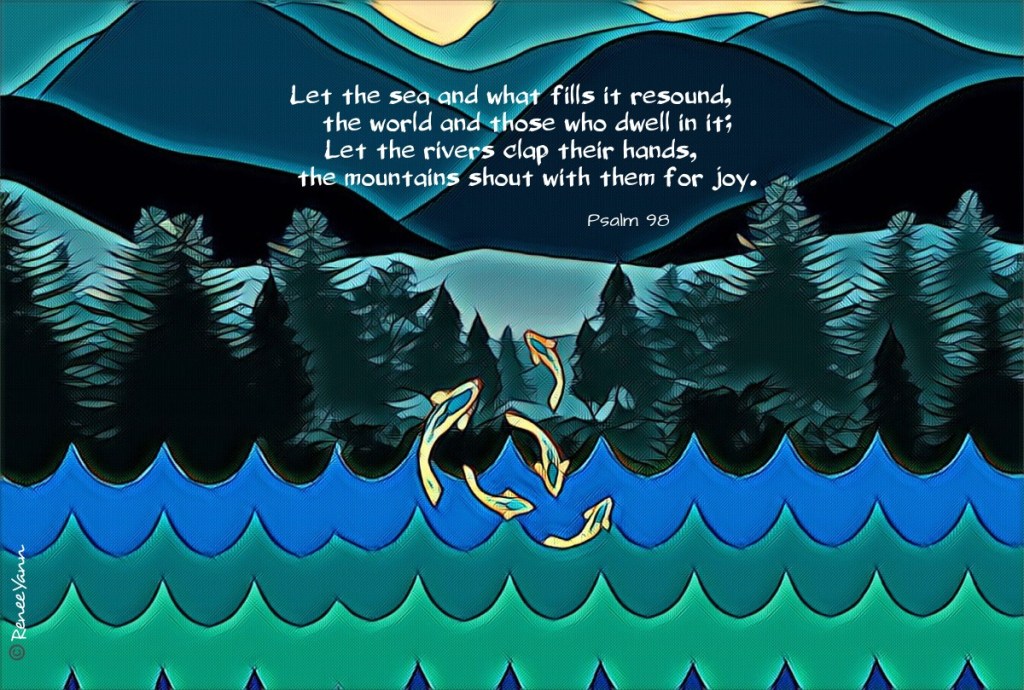
Let the sea and what fills it resound, the world and those who dwell in it; Let the rivers clap their hands, the mountains shout with them for joy.
Psalm 98:7-8
Like our hearts that believe even through life’s intermingled joys and sorrows
This is your life, joys and sorrow mingled, one succeeding the other.
Catherine McAuley: Letter to Frances Warde (May 28, 1841)
Poetry: Flickering Mind – Denise Levertov
Lord, not you
it is I who am absent.
At first
belief was a joy I kept in secret,
stealing alone
into sacred places:
a quick glance, and away -- and back,
circling.
I have long since uttered your name
but now
I elude your presence.
I stop
to think about you, and my mind
at once
like a minnow darts away,
darts
into the shadows, into gleams that fret
unceasing over
the river's purling and passing.
Not for one second
will my self hold still, but wanders
anywhere,
everywhere it can turn.  Not you,
it is I am absent.
You are the stream, the fish, the light,
the pulsing shadow.
You the unchanging presence, in whom all
moves and changes.
How can I focus my flickering, perceive
at the fountain's heart
the sapphire I know is there?
Today, in God’s Lavish Mercy, as we pray with Psalm 34, our Sunday readings present us with spiritual ultimatums.
In our first reading, sensing his impending death, Joshua gathers the tribes on the Great Plains of Shechem – the land of their father Abraham. Joshua requires a commitment from the people:
“If it does not please you to serve the LORD, decide today whom you will serve … As for me and my household, we will serve the LORD.”
Joshua 24:15
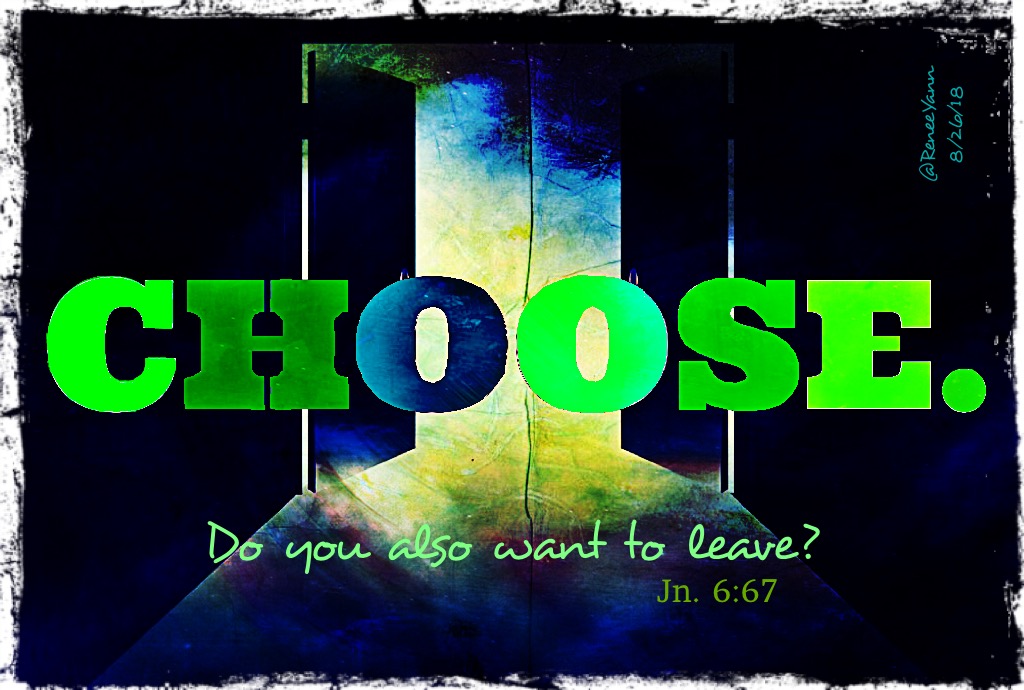
In other words, “fish or cut bait” – you’re either with God, or you’re not. And your lives should reflect the choice.
In our Gospel, Jesus too feels death’s approach. His teachings have become more intense and direct, particularly regarding the Eucharist. This intensity has caused some of his listeners to waver. They’re not sure they can accept his words. Some drift away.
Jesus challenges the Twelve, those on whom he depends to carry his message after his death.
“Do you also want to leave?
These readings talk about the big choices, the soul’s orientation, either:
to seek and respond to God in our daily interactions
to be indifferent toward God’s Presence in our lives
Jesus’s question is before us all the time? Do we hear it?
(As for the unfortunate and contested second reading from Ephesians, this long but superb article from Elizabeth Johnson is worth your time.)
You see, I want a lot.
Perhaps I want everything:
The darkness that comes with every infinite fall
And the shivering blaze of every step up.
So many live on and want nothing
And are raised to the rank of prince
By the slippery ease of their light judgments
But what you love to see are faces
That do work and feel thirst…
You have not grown old,
And it is not too late to dive
Into your increasing depths where life
Calmly gives out its own secret.
Today, in God’s Lavish Mercy, we pray with Psalm 146, chosen today to complement our first reading which is a rare lectionary passage from the Book of Ruth. In it, we meet Naomi who is, at one point, widowed and alone.
The fatherless and the widow the Lord sustains, but the way of the wicked is thwarted.
Psalm 146:9
Ruth Carries Her Gleanings – James Tissot
The Book of Ruth is familiar to many of us because some of its charming story and verses seem a lovely fit for weddings and anniversaries. But in some ways, that isolated use tends to trivialize the powerful messages embedded in this short volume.
If we have a limited view of the Book of Ruth, Psalm 146 can help us widen it. The psalm points to elements central to a hopeful and just community, to a community in right relationship with God. This too is a core message of Ruth.
It is a community strengthened by compassion, loyalty, inclusivity, trust, hope and grateful praise. Each character, at some point in the story’s unfolding, exhibits some aspect of God’s merciful nature and steadfast attachment to us. They put flesh on the psalm’s Antiphons:
Happy are they who have the God of Jacob for their help!
For their hope is in the Lord their God,
who made heaven and earth,
the seas, and all that is in them;
who keeps promises for ever;
who gives justice to those who are oppressed,
food to those who hunger
and sets the prisoners free.
The Lord opens the eyes of the blind!
The Lord lifts up those who are bowed down
and loves the righteous.
The Lord cares for the stranger
and sustains the orphan and widow,
but frustrates the way of the wicked.
The Lord shall reign for ever,
your God, O Zion, throughout all generations.
Hallelujah!
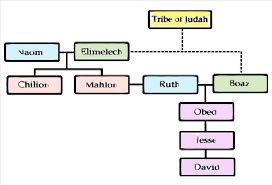
Ruth was the great-grandmother of David and blood ancestor of Jesus. Her story, and the tender mercy it declares, foretells the character of the Beloved Community Christ will establish.
The heart of that community – our community – is aptly described in today’s Gospel. When the Pharisees ask Jesus what is most important, he replies:
You shall love the Lord, your God, with all your heart, with all your soul, and with all your mind. This is the greatest and the first commandment. The second is like it: You shall love your neighbor as yourself. The whole law and the prophets depend on these two commandments.
Ruth already knew what was most important. May we learn it deeply from her story.
Poem: Ruth and Naomi by Frances Ellen Watkins Harper (1825-1911), an African American abolitionist and poet. Born free in Baltimore, Maryland, she had a long and prolific career, publishing her first book of poetry at twenty and her first novel, the widely praised Iola Leroy, at age 67.
"Turn my daughters, full of woe,
Is my heart so sad and lone?
Leave me children — I would go
To my loved and distant home.

From my bosom death has torn
Husband, children, all my stay,
Left me not a single one,
For my life's declining day

Want and woe surround my way,
Grief and famine where I tread;
In my native land they say
"God is giving Jacob bread.”

Naomi ceased, her daughters wept,
Their yearning hearts were filled;
Falling upon her withered neck,
Their grief in tears distill'd.

Like rain upon a blighted tree,
The tears of Orpah fell
Kissing the pale and quivering lip,
She breathed her sad farewell.

But Ruth stood up, on her brow
There lay a heavenly calm;
And from her lips came, soft and low
Words like a holy charm.

"I will not leave thee, on thy brow
Are lines of sorrow, age and care;
Thy form is bent, thy step is slow,
Thy bosom stricken, lone and sear.

Oh! when thy heart and home were glad,
I freely shared thy joyous lot;
And now that heart is lone and sad,
Cease to entreat — I'll leave thee not.

Oh! if a lofty palace proud
Thy future home shall be;
Where sycophants around thee crowd,
I'll share that home with thee.

And if on earth the humblest spot,
Thy future home shall prove;
I'll bring into thy lonely lot
The wealth of woman's love.

Go where thou wilt, my steps are there,
Our path in life is one;
Thou hast no lot I will not share,
'Till life itself be done.

My country and my home for thee,
I freely, willingly resign,
Thy people shall my people be,
Thy God he shall be mine.

Then, mother dear, entreat me not
To turn from following thee;
My heart is nerved to share thy lot,
Whatever that may be.”
Music: Ruth’s Song – Marty and Misha Goetz
(Verse 1) All my life, I have wondered Wondered where I might belong Feeling lost, like a stranger Wandering far all on my own (Verse 2) Without a home. Without a people Without a hope, without a prayer Without a way, that I could follow Then I turned, and you were there (Chorus) Where you go, I will go Where you stay, I will stay forever Where you lead, I will follow So I can know the one you know (Verse 3) Under his wings, you found a shelter You have no fear, you have no shame And when you call, he seems to answer He even seems to know your name (Chorus) (Bridge) Then somehow should I find his favor I won’t look back on all I’ve known Your people then will be my people And Your God my God alone (Chorus) Where you go, I will go And you know I will never leave you Not even death, will ever part us Now that I know the one you know I will go now, where you go
Today, in God’s Lavish Mercy, we meet the rich young man of Mark 19. Since the first reading and psalm would be challenging to pray with, I would like to offer this homily I wrote some years ago on our Gospel for today
Christ and the Rich Young Man by Heinrich Hoffmann
Most had come to the rolling hills beyond the Jordan because of the miracles: the crippled walking, the dead raised, the demons cast out. Who wouldn’t take an afternoon hike to witness such amazing things? They came with their blankets and lunch baskets. They came to see.
But today, Jesus is not about miracles. He is about teaching. And it is hard to listen to him. The words are gentle but incisive. Like small scalpels, they deftly strip away the listeners’ harbored illusions. He says things like this:
Become humble like a child.
The last will be first and the first last.
If your hand or foot causes you to sin, cut it off.
Forgive seventy times seven.
His words challenge everything they had learned, believed, based their lives on! Nobody got anywhere in life by behaving the way he described! Jesus can see their consternation. What they had relied on – all that had justified their self-satisfied successes – lay now at his feet like a sculptor’s remnants.
Jesus pauses to allow a long silence to envelop their startled hearts. Quietly, he retires to a shaded grove to let his own heart settle. On the hillside, it is lunchtime. The large crowd bundles into small neighborly bands. They open their baskets and uncork their water-skins while the curative words begin the hard transformation of their souls.
But one man is not hungry – at least not for earthly food. He slowly approaches Jesus in his solitude, perhaps with a shy glance that asks, “May I come closer?” Jesus nods for the young man to join him. Settling beside Jesus, he asks, “Master, what must I do to gain eternal life?”
There is no lack of directness in this man. He comes bluntly to the point. But there is, nonetheless, a blindness in him. Jesus has already taken its measure even as the young man approached. His garments distinguish him from the rest of the crowd. His robe is fine linen not rude camel hair. He is not unshod, but rather wears sandals of expertly tooled leather. He carries no basket; it is held by a servant standing off at a modest but ready distance. He is so accustomed to his privilege that he is unaware of his difference from all those who surround him. He no longer sees his wealth, just as he no longer sees their poverty.
Commemorative Cross for the 150th Anniversary of the Philadelphia Sisters of Mercy, featuring the Works of Mercy. Designed by the late Robert McGovern
Jesus at once pities his obliviousness yet loves his sincerity. He tests the young man even though he already reads his heart. The questions are not intended to derail the man. Instead, Jesus leads him by a rabbinical path through the levels of spiritual commitment.
Do you understand true goodness?
Do you then keep the commandments?
Do you then seek perfection?
Will you then give everything you have to embrace it?
At this final question, the young man goes away sad, “for he had many possessions”.
Here Jesus defines for us the ultimate sticking point for a nearly committed person: “All you possess”. In other words, can we give everything in Christlike love?
The Christian ethic teaches us that this kind of self-donation is the only path to joy and salvation. Yet, it is a perfection few achieve. This failure in achievement leads to broken marriages, fractured families, rescinded vows and unfulfilled hopes. What is the secret to meeting its challenge?
Jesus may have given an answer two chapters earlier in Matthew’s Gospel. A desperate father has brought his possessed son to the disciples, but they are unable to cast out the demon. Jesus is frustrated with their impotence, saying, “How long must I be with you (before you learn)?” What is it that these disciples have yet to learn? Jesus goes on to tell them that if their faith were even the size of a tiny mustard seed, they would have the power, not only to cast out this demon, but to move mountains.
To live fully by faith is to live in the understanding that we possess nothing. Everything we think we have, including life itself, is a pure gift of God’s mercy to us. Abandonment to such understanding makes us truly rich and renders us divinely powerful. This is the continuing lesson Jesus is teaching his beloved disciples. This is the secret of eternal life to which Jesus tries to lead the rich young man. This is the daily invitation God places before us within the circumstances of our lives. Will we embrace it or will we go away sad?
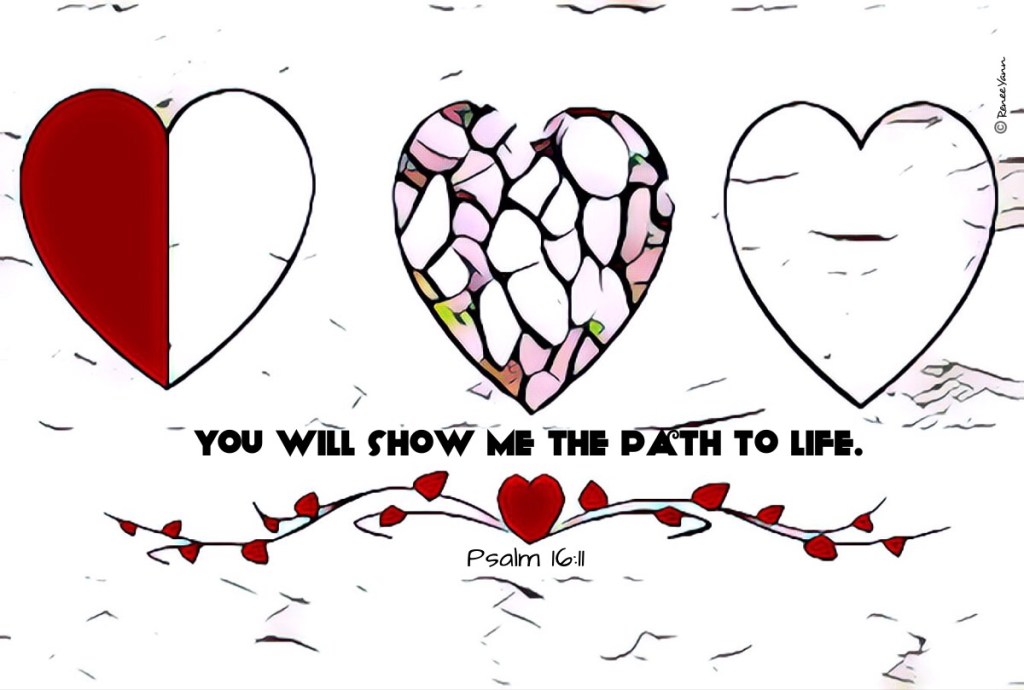
Today, in God’s Lavish Mercy, we pray with Psalm 16, a prayer for God’s protection and blessing on the path of life. It is the prayer of one whose heart is committed to God, and recognizes God as the Source of All Life.
Keep me, O God, for in you I take refuge; I say to the LORD, “My Lord are you.” O LORD, my allotted portion and my cup, you it is who hold fast my lot.
Psalm 16: 1-2
In our first reading, as Israel takes possession of the Promised Land, Joshua gathers the people in a recommitment reflective of Moses’ call to the people at Sinai. Joshua says that there is no either/or. Today is the day to choose and commit to the One God of your life:
Fear the LORD and serve him completely and sincerely. Cast out the gods your fathers served beyond the River and in Egypt, and serve the LORD. If it does not please you to serve the LORD, decide today whom you will serve, the gods your fathers served beyond the River or the gods of the Amorites in whose country you are dwelling. As for me and my household, we will serve the LORD
Joshua 24: 14-15
Like those ancient Israelites, we need faith and courage not to fall back on our false gods — half-heartedness, hard-heartedness, heartlessness. This beautiful offering of Psalm 16 by the Dameans is a prayer for protection and grace for our commitment.
Music: And to give Joshua stage time, here is another song
As for Me and My House – Pat Barrett, Chris Tomlin
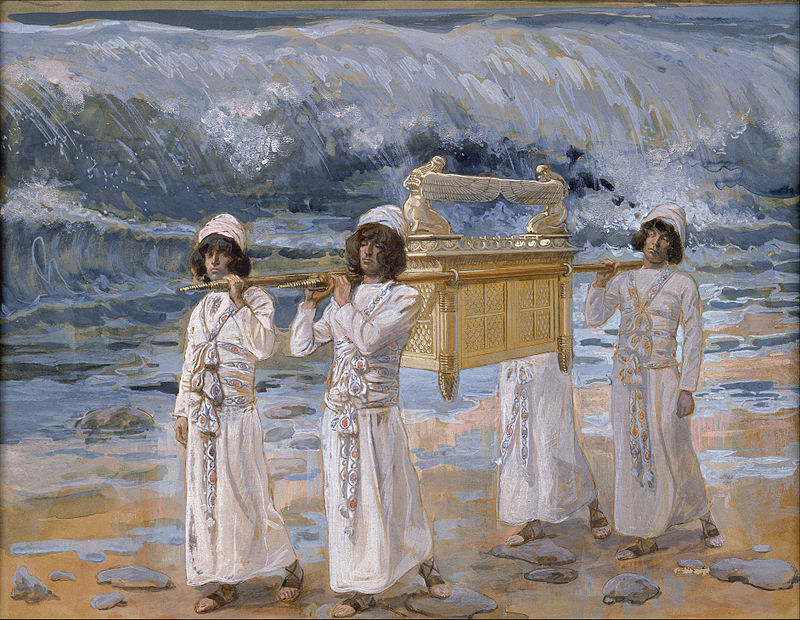
Today, in God’s Lavish Mercy, we pray with Psalm 114, eight short but extremely powerful verses. They summarize the entire faith journey of Israel, a People born in the Exodus and coming to full promise as they pass over the Jordan.
Crossing the Jordan by James Tissot
Our first reading describes that Jordan passage which mirrors the miraculous passage through the Red Sea. Joshua becomes the new Moses leading the people, finally, into the Promised Land
As early as the 6th century, Psalm 114 was included in funeral and burial liturgies in order to emphasize the triumphant and joyful character of our final passage into heaven.
It’s hard for us to think of death that way. On a purely human level, death feels sad – like an end or a loss. But our faith says differently.
Even throughout life, in all our smaller losses, frustrations and failures, our faith encourages us to see things differently. Faith calls us to see each “exodus” , each “crossing”, as the beginning of a journey to a new promise. It calls us to remember that the seas and rivers will part – that God always makes a way.
Faith calls us to receive life’s contradictions and impasses as opportunities to learn a different way.
In Psalm 114, the poet-psalmist uses natural metaphors to remind us of God’s transformative presence in our lives. The Red Sea disappears. The Jordan River opens a path. Mountains skip and hills leap out of our way.
Why was it, sea, that you fled? Jordan, that you turned back? Mountains, that you skipped like rams? You hills, like lambs?
Psalm 114: 5-6
When we face turbulent seas, overwhelming passages, exoduses from the comfortable places, may we find courage in remembering God’s faithfulness as Psalm 114 encourages us to do.
Poetry: The Valley of Vision – Taken from The Valley of Vision: A Collection of Puritan Prayers & Devotions, edited by Arthur Bennett.
Lord, high and holy, meek and lowly,
Thou hast brought me to the valley of vision,
where I live in the depths but see Thee in the heights;
hemmed in by mountains of sin I behold Thy glory.
Let me learn by paradox that the way down is the way up,
that to be low is to be high,
that the broken heart is the healed heart,
that the contrite spirit is the rejoicing spirit,
that the repenting soul is the victorious soul,
that to have nothing is to possess all,
that to bear the cross is to wear the crown,
that to give is to receive,
that the valley is the place of vision.
Lord, in the daytime stars can be seen from deepest wells,
and the deeper the wells the brighter Thy stars shine;
let me find Thy light in my darkness,
Thy life in my death,
Thy joy in my sorrow,
Thy grace in my sin,
Thy riches in my poverty,
Thy glory in my valley.
Today, in God’s Lavish Mercy, our readings assure us that God cares about our hungry spirits and will satisfy them.
Both the prophet Elisha and Jesus respond to the needs of the hungry crowds by the power of their faith. In each story, there is only a small amount of food to meet the overwhelming need of the people. But those small amounts, given selflessly and gratefully, renew themselves until all are satisfied.
Our spiritual hungers are deep, and much harder to fill than our physical ones. Sometimes, we don’t even know what we are longing for. Thus we may end up filling our emptiness with distractions and junk.
Today’s readings encourage us to turn our soul’s needs toward God. St. Augustine said this:
You have made us for yourself, O Lord, and our hearts are restless (hungry) until they rest in You.
Notice that in Jesus’s miracle of the loaves and fishes, there is one key action before the multiplication occurs.
Then Jesus took the loaves, gave thanks, and distributed them to those who were reclining, and also as much of the fish as they wanted.
Let’s sift through both the large and the small sustenances of our life for the things that we are grateful for. When we lift these up in thanksgiving, glimpsing the loving face of God, other graces will begin unexpectedly to multiply around and within us.
Today, in God’s Lavish Mercy, we pray with a selection from Exodus which you will probably recognize from the Easter Vigil on Holy Saturday night. It describes one of the most astounding displays of power in the Hebrew Scriptures.
by Frederick Arthur Bridgman
Stand with the author on the other side of the Red Sea and feel the pounding exultation:
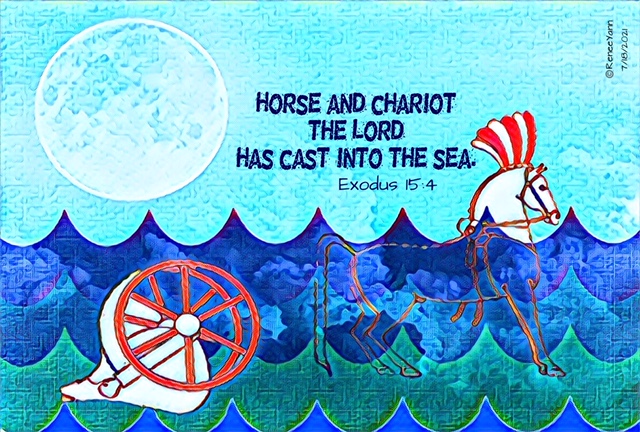
I will sing to the LORD who is gloriously triumphant; horse and chariot casting into the sea. My strength and my courage is the LORD, who has been my savior. my God, whom I praise; the God of my father, whom I extol.
It is a beautifully cadenced victory chant, and I have always loved hearing it at the vigil as we celebrate our deliverance from death through Christ’s Resurrection.
Imagine those “chariots and charioteers”, ancient symbols of power and oppression!
So Pharaoh made his chariots ready and mustered his soldiers six hundred first-class chariots and all the other chariots of Egypt, with warriors on them all.
Exodus 14: 6-7
What chance did the unarmed, rag tag horde of fleeing Israelites hold against such power?
The power they held was this – faith in God’s promise and obedience to its unfolding in their lives.
It wasn’t easy for them! Moses had to bolster them in their fear and hesitation.
But Moses answered the people, “Fear not! Stand your ground, and you will see the victory the LORD will win for you today. For these Egyptians whom you see today you will never see again. The LORD will fight for you; you have only to keep still.”
Exodus 14: 13-14
Within these readings, the parallels to our own lives are abundant. If not now, at least at some time, we will have overwhelming forces pursue us. We will be afraid. Our faith will be tested. We will doubt.
If we can “be still”, bolstering our trust in prayer, God will reveal our particular deliverance. It may not look like what we imagined, nor exactly fit what we might have prayed for.
But in trusting prayer, the flood waters of grace release and resurrect us from all that threatens our souls.
The flood waters covered them, they sank into the depths like a stone. Your right hand, O LORD, magnificent in power, your right hand, O LORD, has shattered the enemy.
Exodus 15: 5-6
Poetry: I think the psalm is its own poem today.😉
Music: Horse and Chariot – let these kids wake up our faith today!
Today, in God’s Lavish Mercy, we pray with Psalm 136 in which the psalmist remembers in detail Israel’s long experience of God’s enduring fidelity.
The cadence of the psalm creates an underlying drumbeat to our prayer, a chant of gratitude and confidence. Reading it, I was reminded of two things.
The first is a scene from the movie “Glory” where the troops pray the night before battle. They pray in the classic style of the Black spiritual call-and-response song.
You may have seen it:
The prayer of these men, like the prayer of ancient Israel, is not just a walk down memory lane. No. Each proclamation is an act of of faith – and of gratitude for the past, courage for the present, and hope for the future.
Secondly, I was reminded of the simple and methodical cadence of a childhood ditty – S/he loves me S/he loves me not. Didn’t many of us try that magic practice at least once, maybe at our first young crush?
Well, God does love us – daisy or not. The proof is not in the petals, but in the story of our lives.
Today might be a good day to “chant” gratefully through our own catalogue with God – remembering, thanking, believing,and hoping.
Poetry: I thank you, God – e.e.cummings
i thank You God for most this amazing
day:for the leaping greenly spirits of trees
and a blue true dream of sky;and for everything
which is natural which is infinite which is yes
(i who have died am alive again today,
and this is the sun’s birthday;this is the birth
day of life and of love and wings:and of the gay
great happening illimitably earth)
how should tasting touching hearing seeing
breathing any—lifted from the no
of all nothing—human merely being
doubt unimaginable You?
(now the ears of my ears awake and
now the eyes of my eyes are opened)
Music: Swing Low, Sweet Chariot – Etta James sings a classical example of the call-and-response spiritual
Today, in God’s Lavish Mercy, we pray with Psalm 124 which is a raw remembering of how bad things could have been without God’s help.
The psalm opens with these lines:
Had not the LORD been with us, let Israel say, Had not the LORD been with us, when all rose against us, Then we would have been swallowed alive, for fury blazed against us.
Psalm 124: 1-3
Have you been there? What flares up to swallow your life, your hope, can wear many disguises:
or the many forms of hunger and dying.
The psalm calls us to remember these things for two reasons:
so that we don’t get caught again
and that if – sadly – we do, we remember who freed us
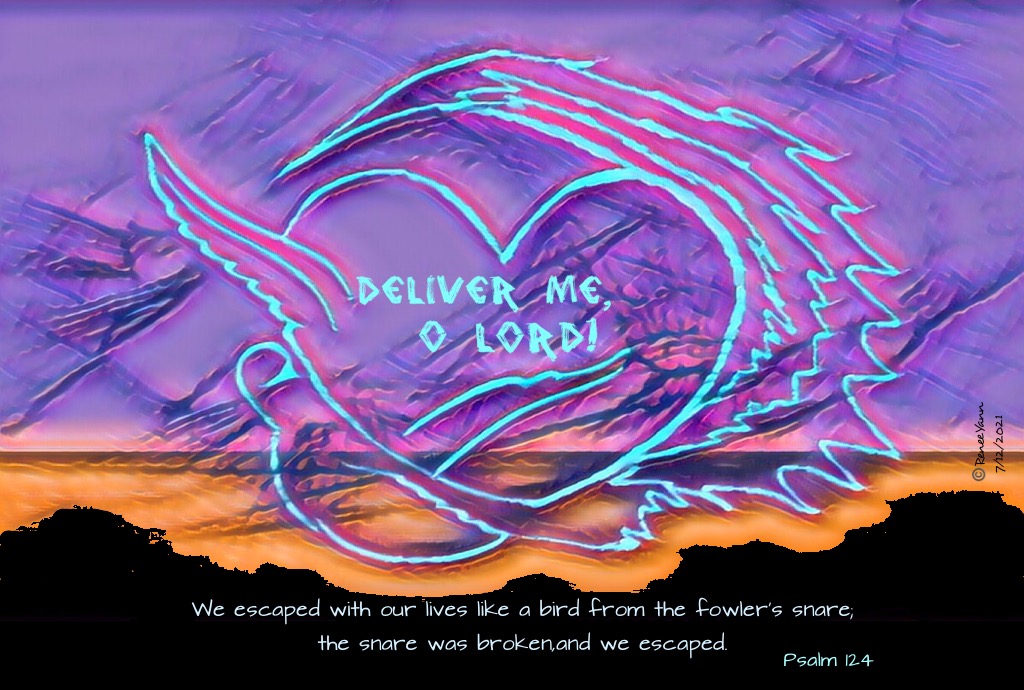
We were rescued like a bird from the fowlers’ snare; Broken was the snare, and we were freed. Our help is in the name of the LORD, who made heaven and earth.
Psalm 124: 7-8
The release from such snares does not return us to the way things were. There will be wounds and wisdom to change us. It depends on us which we choose to cherish.
“Re-membering” ourselves, pulling our new selves together in God, releases us to fuller, deeper life.
Our help is in the name of the LORD, the maker of heaven and earth.
… so surely that Omnipotent God can heal and remake us.
Remember, this and a few other of my images have been set beautifully into cards by Sister Judy Ward, RSM. You can contact her at
Poetry: The Fowler by Wilfrid Wilson Gibson (1868-1962)
A wild bird filled the morning air
With dewy-hearted song;
I took it in a golden snare
Of meshes close and strong.
But where is now the song I heard?
For all my cunning art,
I who would house a singing bird
Have caged a broken heart.











 Lavish Mercy