Who Will Stand in the End?

Thirty-third Sunday in Ordinary Time

November 17, 2019

Click he for readings

Today, in Mercy, our readings carry the full flavor of the “end times” warnings, those repeated annually as we move closer to Advent ( which is only two weeks away!)

Malachi is very direct:

Lo, the day is coming, blazing like an oven,
 when all the proud and all evildoers will be stubble…

Wow! Really? Our reaction might range from “Good! Go get ‘em, God!” to “Oh, dear God, I hope it’s not me!!!”.

But Paul resets us on the right track. He says something like this:

Listen! You must imitate your teachers in Christ.
Live with integrity, justice and generous mercy.
Navigate the world with these as your compass.
Then you will welcome the end times.


Lk21_19 perseverance

In our world, we see the opposing forces of good and evil clearly pulling against one another. In our decisions and attitudes, we are confronted with the choice between sin and selflessness.

The “elephant in the room” this week for many of us is the impeachment hearings. How do we view this event as people of Gospel faith? How do we respond?

elephant

While some of us believe strongly in separation of Church and State, still we acknowledge that our FAITH is exercised in a political world. We pursue our full conversion in Christ through “polity“:  our just and compassionate interactions with all Creation.

Right in front of us this week, we have seen  amazing displays of courage and morality standing against venal self-interests. How does what we see align with our own living of justice and mercy?

Political scientist Harold Lasswell defined politics as “who gets what, when, and how“. If this isn’t the same challenge tackled in the Gospel, I don’t know what is! Jesus said that the poor and disenfranchised should be the first to “get” – through peace, love and mercy. Making that happen is our Christian call.

However, it is likely impossible to communicate God’s vision for the world in the language of politics.  Walter Brueggemann says this:

The prophet’s task is to imagine the world as though Yahweh, the God of Israel and the creator of heaven and earth, were a real character and a lively agent in the life of the world.  I believe that such a claim, then and now, has to be articulated poetically in order not to be co-opted by political absolutism or theological orthodoxy.
~Walter Brueggemann 

Our readings today give us this poetic vision and challenge. Read them with great longing to hear God’s voice for our times. The world so sorely needs the answer that will grow in our souls.

Music:  Let Justice Roll

Midnight Miracle

Saturday of the Thirty-second Week in Ordinary Time

November 16, 2019

Click here for readings

Today, in Mercy, we are blessed with some of the most gloriously imaginative images in Scripture:

wis18_midnight

Although the passage is a poetic recounting of the Exodus experience, it always makes me think of Christmas. 

  • Midnight on a starry night
  • Peaceful stillness over the earth
  • The all-powerful Word transformed 
  • Appearing among us like a comet in our darkness
  • Hope renewed for an otherwise doomed land

Praying with the passage this morning, I realize that my “Christmas lens” on the reading is right on target.

The Christmas event begins our Exodus story, a story completed in the Passion, Death and Resurrection of Christ.

Just as the God of Moses reached into ancient Israel’s life to free them, transform them and make them God’s People, so God reaches into our lives. God does this not only on Christmas, but in every moment of our experience.

As our media and consumer culture bombards us, all too early, with all the secularized images of Christmas, let today’s verses bring us back to the true startling grace of our own Christ/Exodus stories:

We are not alone in the midnights of our lives.
Listen underneath all the distractions
to the, at first, softly emerging sound of Love
humming under all things.
Watch for the small lights of heaven
longing to break into our human darkness.
Give yourself to their Light.

No matter where we are in our lives right now,
no matter the joy or pain of our present circumstances,
God wants to use these realities to be with us
and to teach us Love.
Let us invite God
into our willingness
to learn that Love,

to become that Love.


Music: Winter Cold Night – John Foley, SJ

Lyrics below (yes, it is an Advent/ Christmas song. But it fits so perfectly. Please forgive me if I am rushing the season too.🤗)

Dark, dark, the winter cold night. Lu-lee-lay.
Hope is hard to come by. Lu-lee-lay.
Hard, hard, the journey tonight. Lu—lee-lay.
Star, guide, hope, hide our poor, winter cold night.

And on earth, peace, good will among men.

Lean, lean, the livin’ tonight. Lu-lee-lay.
Star seems darker sometimes. Lu-lee-lay.
Unto you is born this day a Savior.
Pain, yes, in the bornin’ tonight. Lu lee—lay.
Star, guide, hope, hide our poor, winter cold night.

Vultures Forecasted!

Friday of the Thirty-second Week in Ordinary Time

November 15, 2019

Click here for readings

Today, in Mercy, our scripture message is blunt. If yesterday’s sweet words from Wisdom were like “rich toffee for the spirit”, today’s are more like a double shot of bourbon for the mind.

toffeebourbon

Basically our first reading says “Yes”- creation is magnificent, but not as magnificent as its Creator! You, learned humans, how could you have gotten stuck only half-way to that truth? How did you end up making gods from the very things that were supposed to show you the one true God?

In our Gospel, Jesus speaks even more starkly. He describes the “end times” when “one will be taken and the other left”. That reading  always scared me as a child and, to be honest, still scares me a little. The popular “rapture literature” has monopolized on that fear. Nobody likes the idea of their buddy, sitting right beside them eating ice cream, suddenly disappearing, right?

vultureAnd I guess Jesus actually was trying to strike a little healthy fear into his listeners too. He told them the vultures were already gathering. It’s late in the game. Get your act together.
Early Christians thought a lot about the end times. They expected them to come quickly after the Resurrection. Well, 2000 years later, our obsession may have cooled somewhat. 

Nevertheless, an end will come to this life as we know it. And wouldn’t it be a shame if we had spent our precious worship on false and distracting gods like money, fame, power, luxury and self-aggrandizement?

“Wouldn’t it be a shame”, as one of our dear Sisters once said, “to come to the end of your life and realize you had missed the whole point?”

 Music: One True God – Mark Harris

The Hearings

Memorial of Saint Frances Xavier Cabrini, Virgin

November 13, 2019

Click here for readings

Today, in Mercy, as the first public impeachment hearings begin, our readings seem eerily in synch with current events.

First of all, the hearings begin on the date we celebrate Frances Xavier Cabrini, first naturalized citizen of the United States to be canonized by the Roman Catholic Church. 

As I write about her, the US Supreme Court opens the DACA hearings, testing three cases against the Trump administration’s decision in 2017 to end deportation protections for so-called Dreamers. The Court will decide whether the decision to end the program was based on legally sound reasons.
(The Deferred Action for Childhood Arrivals (DACA) program, which grants deferral from deportation and work permits to nearly 700,000 undocumented immigrants who arrived in the country as children.)

Col3_14 put on love

Our first reading from the Book of Wisdom is crystal clear about the moral responsibilities of leaders to act with justice tempered by mercy, and always to exhibit special concern for the poor and marginalized.

Using these scripture verses, Pope Leo XIII wrote two of his many compelling encyclicals. His writings, and the entire legacy of Catholic Social teaching, guide us as we discern who, how, and why to use our voting power to advance justice for all people.

The following excerpts, though a little long, are well worth our attention to provide a foundation for our prayer during these strained partisan times. Perhaps we might pray them in short doses over the course of these hearings.

from: Encyclical Letter Immortale Dei, Pope Leo XIII

immortale

They, therefore, who rule should rule
with evenhanded justice, not as masters,
but rather as parents,
for the rule of God over humanity is most just,
and is tempered always with a parent’s kindness.

Government should, moreover, be administered
for the well-being of the citizens,
because they who govern others possess authority
solely for the welfare of the State.
Furthermore, the civil power must not be subservient to
the advantage of any one individual or of some few persons,
inasmuch as it was established for the common good of all. 

But, if those who are in authority rule unjustly,
if they govern overbearingly or arrogantly,
and if their measures prove hurtful to the people,
they must remember that the Almighty
will one day bring them to account,
the more strictly in proportion to the sacredness of their office
and preeminence of their dignity.


Diurturnum

from: Encyclical Letter of Pope Leo XIII, Diuturnum

But in order that justice may be retained in government,
it is of the highest importance that those who rule States
should understand that political power
was not created for the advantage of any private individual;
and that the administration of the State
must be carried on to the profit of those
who have been committed to their care,
not to the profit of those to whom it has been committed. 

On this account
they are warned in the oracles of the sacred Scriptures,
that they will have themselves some day to render an account
to the King of kings and Lord of lords;
if they shall fail in their duty,
that it will not be possible for them in any way
to escape the severity of God:
“The Most High will examine your work
and search out your thoughts:
because being ministers of his kingdom
you have not judged rightly…
Horribly and speedily will he appear to you,
for a most severe judgment shall be for them that bear rule…
For God will not accept any man’s person,
neither will he stand in awe of any man’s greatness;
for he made the little and the great,
and he hath equally care of all.
But a greater punishment is ready for the more mighty”


Music: O Lord, the Clouds Are Gathering – Graham Kendrick

Want to Shine?

Memorial of Saint Josaphat, Bishop and Martyr

November 12, 2019

Click here for readings

Today, in Mercy, as we remember St. Josephat, our readings instruct us on what it means to be God’s faithful servant.

Josephat was. 

A 17th century saint born in Lithuania, Josephat was a humble and self-sacrificing Bishop. But his life was embroiled in the social and religious unrest subsequent to the Union of Brest.

(The Union of Brest, was the 1595-96 decision of the Ruthenian Orthodox Church eparchies (dioceses) in the Polish-Lithuanian Commonwealth to break relations with the Eastern Orthodox Church and to enter into communion with, and place itself under the authority of, the Roman Catholic Pope. – Wikipedia)

To a much greater degree than it would today, such a decision carried immense political import, creating the deadly oppositions to which Josephat ultimately lost his life.

Read Josephat’s story here.


Our first reading today, which is so familiar from the funerals we’ve attended, reminds us that all our lives will eventually return to God (hopefully not so dramatically as Josephat’s did).

Our Gospel too enjoins us to live humble, grateful lives of service, recognizing that everything we have and are belongs to God:

Is the Master grateful to that servant
because he did what was commanded?

So should it be with you.
When you have done all you have been commanded, say,
“We are unprofitable servants;
we have done what we were obliged to do.”

If we do this, we shall be blessed as described in Wisdom:

Those who trust in him shall understand truth,
and the faithful shall abide with him in love:
Because grace and mercy are with his holy ones,
and his care is with his elect.

Wisdom3_7 sparksJPG


These are sobering but necessary thoughts. As I write today (on November 11th), I think of the humble servant Catherine McAuley who died on this date in 1841. She has certainly sent sparks through the stubble. On this Veterans’ Day, I think of all who have died in war. I think of our Sister-veterans, Sister Bernard Mary Buggelein and Sister Dorothy Hillenbrand who served in WWII and now rest in our community cemetery. All of their lives have been called into the great embrace of our Eternal God. May all our lives inspire one another to humble service and praise.


Music: The Souls of the Righteous – Geraint Lewis, sung by Jesus Choir- Cambridge

The souls of the righteous are in the hands of God,
and the pain of death shall not touch them.
To the eyes of the foolish, they seemed to perish,
but they are in peace.

Wisdom 3:1-3

Let Wisdom Show Us

Memorial of Saint Martin of Tours, Bishop

Monday, November 11, 2019

Click here for readings


Today, in Mercy, On this Memorial of St. Martine of Tours, we begin a week of readings from the Book of Wisdom. Written in the century surrounding the birth of Christ, Wisdom is the work of a poet, theologian, philosopher, and moralist. Whether the writer was one person or several is uncertain. It was written in Greek and based on the Hebrew Scriptures which marks its composer as learned.

Today’s passage is part of the initial Exhortation to Pagan Kings: Rule according to divine justice and seek wisdom! (1:1-11).

For wisdom is a kindly spirit,
yet she acquits not the blasphemer of his guilty lips;
Because God is the witness of his inmost self
and the sure observer of his heart
and the listener to his tongue.
For the Spirit of the Lord fills the world,
is all-embracing, and knows what man says.

I can think of a few people to whom I would like to tweet this passage, can’t you? 

The erudite Wisdom writer realizes that faith and politics MUST mix in an ever more complex world because the goal of both disciplines is the wholeness and freedom of the human person.

Reading this passage today, let us pray for all who hold any responsibility for the welfare of others that they may be responsive to the inspiration of Wisdom in their leadership.

millstoneJPG
Dorieo [CC BY-SA 4.0 (https://creativecommons.org/licenses/by-sa/4.0)%5D
For as our Gospel tells us today:

Jesus said to his disciples,
“Things that cause sin will inevitably occur,
but woe to the one through whom they occur.  
It would be better for him if a millstone were put around his neck
and he be thrown into the sea
than for him to cause one of these little ones to sin.”

MUSIC: Kristyn and Keith Getty


The Land of the Living

Thursday of the Thirty-first Week in Ordinary Time

November 7, 2019

Click here for readings

Today, in Mercy, our scripture passages are all about confidence in our salvation.

Psalm27- land of living

Do you ever wonder if you’re going to get to heaven? Maybe even worry about it a little? If so, today’s readings are for you.

Paul tells the faithful:

For if we live, we live for the Lord,
and if we die, we die for the Lord;
so then, whether we live or die, we are the Lord’s.

And Jesus, using the symbol of a lost sheep, counsels the critical Pharisees:

I tell you, in just the same way
there will be more joy in heaven over one sinner who repents
than over ninety-nine righteous people
who have no need of repentance.

Key to both readings is the call to a repentant, Christian life.

Our beautiful Responsorial Psalm captures the joy of the repentant sinner, the very ones for whom Christ died:

R. I believe that I shall see the good things of the Lord in the land of the living.

The LORD is my light and my salvation;
whom should I fear?
The LORD is my life’s refuge;
of whom should I be afraid?

R. I believe that I shall see the good things of the Lord in the land of the living.

One thing I ask of the LORD;
this I seek:
To dwell in the house of the LORD
all the days of my life,
That I may gaze on the loveliness of the LORD
and contemplate his temple.

R. I believe that I shall see the good things of the Lord in the land of the living.

I believe that I shall see the bounty of the LORD
in the land of the living.
Wait for the LORD with courage;
be stouthearted, and wait for the LORD.

R. I believe that I shall see the good things of the Lord in the land of the living.

We might want to turn toward the searching Shepherd today while praying this Psalm of repentance and faith.

Music:  In the Land of the Living – Eric Becker

Love or Hate? Huh?

Wednesday of the Thirty-first Week in Ordinary Time

November 6, 2019

Click here for readings

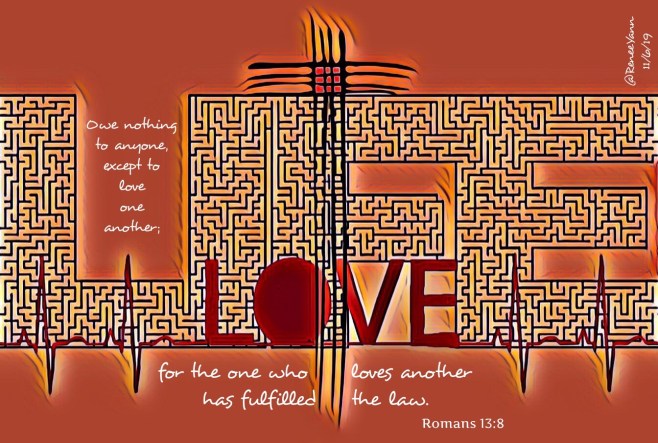
Roman13_8 owe nothing

Today, in Mercy, Paul and Jesus seem to give us contradictory messages. Paul talks about love, and Jesus tells us what we must “hate” – a bit of a challenge to untangle the core message.

Here’s one way.

We don’t like Jesus telling us to hate anything, as in:

If anyone comes to me without hating his father and mother,
wife and children, brothers and sisters,

and even his own life,
he cannot be my disciple.

Come on, Jesus! You don’t mean that do you – my sweet mom, my precious kids???

No, the scholars say, Jesus doesn’t mean “hate” the way we interpret it in modern English. He is using the common, hyperbolic language of the ancient East which, in this circumstance, would mean “love less”.

So what is Jesus really saying? 

This.

We love many people and things in our lives. But we must love God, and God’s dream for all people, above and within all things. 

And that’s not easy! Life is a maze of relationships and situations that can get us very confused about what is most important. That’s why Jesus uses such strong language to remind us that there is only one way through the maze: to love as God loves. This is the heartbeat of our life in God!

Paul says this too, indicating as well how to negotiate the maze by keeping Love’s commandments.

If we love with God’s love, of course we will love those we cherish. But we will love them selflessly, with an infinite generosity that always chooses their eternal good. And we will try always to love all Creatures in the same way. This is the kind of love Jesus taught us on the Cross. May God give us the courage to learn.

Music: Ubi Caritas performed by Stockholm University Choir (texts below)

Latin Text

Ubi caritas et amor, Deus ibi est.
Congregavit nos in unum Christi amor.
Exsultemus, et in ipso jucundemur.
Timeamus, et amemus Deum vivum.
Et ex corde diligamus nos sincero.
Ubi caritas et amor, Deus ibi est.
Simul ergo cum in unum congregamur:
Ne nos mente dividamur, caveamus.
Cessent iurgia maligna, cessent lites.
Et in medio nostri sit Christus Deus.
Ubi caritas et amor, Deus ibi est.
Simul quoque cum beatis videamus,
Glorianter vultum tuum, Christe Deus:
Gaudium quod est immensum, atque probum,
Saecula per infinita saeculorum. Amen.

English Translation
Where charity and love are, God is there.
Love of Christ has gathered us into one.
Let us rejoice in Him and be glad.
Let us fear, and let us love the living God.
And from a sincere heart let us love one.
Where charity and love are, God is there.
At the same time, therefore, are gathered into one:
Lest we be divided in mind, let us beware.
Let evil impulses stop, let controversy cease.
And in the midst of us be Christ our God.
Where charity and love are, God is there.
At the same time we see that with the saints also,
Thy face in glory, O Christ our God:
The joy that is immense and good,
Unto the World without end. Amen.

Pray for Priests

Memorial of Saint Charles Borromeo, Bishop

November 4, 2019

Click here for readings

Romans11_33 depth of wisdom

Today, in Mercy, we remember the life of a good priest, Charles Borromeo who refused the perks of status and wealth in preference for the poor. Praying with him today, we may include all the good priests who have kindled our faith throughout the years.

I unexpectedly encountered one such priest yesterday after a hiatus of nearly forty years. He had come to McAuley Convent, our health and retirement facility, to visit his longtime assistant. She is now a stately 96 years old, but living with the compromises of advanced years. Himself in his late eighties, he walked very slowly down the corridor toward me, and I paused to see if I could help.

Greeting him, I recognized something about his eyes, but could not really place him. He paused, catching some labored breaths, and studied my eyes. “Give me a minute,” he said, quickly following it with “Nathaniel”, my old religious name.

He had the advantage over me, so I just honestly requested, “Help me out with your name.” He simply replied, “Maginnis”. As a wealth of memory and understanding opened in my mind, I smiled and said, “How good to see you again, Maginnis, after all these years.”

You see, this was: Robert Patrick Maginnis, an American prelate of the Roman Catholic Church who served as Auxiliary Bishop of the Archdiocese of Philadelphia from 1996 to 2010. (Wikipedia)

But who I saw, as soon as he said his name, was a humble, good man who had served God’s people with generosity and grace. I hadn’t seen him face to face since he was simply “Father”- when I was green with youth and he was just a shade or two deeper! 

But I knew, the way a local Church knows its shepherds, that he had never abandoned his gentle simplicity for the exalted trappings of episcopacy. He had remained a man who fulfilled Pope Francis’s best hopes for priests:

“Always have before your eyes the example of the Good Shepherd, who did not come to be served, but to serve and to seek and save what was lost…

Conscious of having been chosen among men and elected in their favor to attend to the things of God, exercise in gladness and sincere charity the priestly work of Christ, solely intent on pleasing God and not yourselves or human beings, other interests.”
(Pope Francis in a homily before the ordination of 16 priests during Mass in St. Peter’s Basilica April 22, 2018)

And here “Maginnis” was last Saturday, having endured his own challenges with aging, making the effort necessary to visit his faithful friend. As I left them in the warm light by her window, my spirit was confirmed by a grace neither one of them realized they were continuing to give, so natural was their witness to Christian love and service.

Let’s pray for all our priests today. These troubled times have been so hard on good priests like this beloved bishop. May they be strengthened and confirmed in their desire to serve Christ through serving his People. May the aged among them realize how grateful we are for the gift they have given.

Music: Who Has Known – John Foley, SJ ( Lyrics below)

O the depth of the riches of God;
and the breadth of the wisdom and knowledge of God!

For who has known the mind of God?
To God be glory forever.

A virgin will carry a child and give birth,
and his name shall be called Emmanuel.

For who has known the mind of God?
To God be glory forever.

The people in darkness have seen a great light; f
or a child has been born; his dominion is wide.

For who has known the mind of God?
To God be glory forever.

Climb the Tree! Ignore the Haters!

Thirty-first Sunday in Ordinary Time

November 3, 2019

Click here for readings

Today, in Mercy, our readings are all rooted in Mercy. The beautifully literate Book of Wisdom delights us with its poetry and heartfelt understanding of God’s “imperishable “ love for us. Think about it! The passage, written very near the time of Christ, is intended to assure us that God’s mercy will save and embrace us.

In our second reading, Paul assures the Thessalonians that this mercy has indeed been given to them in the person of Jesus Christ. Through Christ they are, as we are, called to be Mercy in the world in Christ’s name.

But Paul adds a little warning. Apparently there are some conspiracy theorists floating around trying to scare people about the final coming. (Oh, Lord — ever present!) They are even forging Paul’s name to spread their crazy havoc.

Religion will always have distorters who pull out and exaggerate certain threads of doctrine, often opposed to the core message of Mercy. They do this to gain control over others and to advance themselves. Every sacred religion, from Catholicism to Islam, has been manhandled by opportunists who use it to advance their own agendas.

But Paul says to cling to the truth: our ever-merciful God loves us, no matter our deficiencies, and welcomes our repentance.

Zaccheus, whom we meet in today’s Gospel, did not succumb to the distorters who branded him an irredeemable sinner. He opened his heart to Jesus in sincerity and enthusiasm. He changed his life because he believed in the full truth of the Gospel: Christ came for us sinners.

zccheusJPG
Notice how Zaccheus in hidden in the tree. Are there ways in which we re hiding form the full truth and love of Christ?

Like Zaccheus, a man “deficient” in height, maybe we need to “climb a tree” of prayer and repentance today to take a full-hearted look at the power of God passing through our lives. May we never let the opportunity for Mercy – either to receive or to give it – pass us by.

Music:  Zaccheus – Medical Mission Sisters (Oldie but goodie — love the dedicated nuns! How much good they have done in a suffering world!)