Today, in God’s Lavish Mercy, we pray with Psalm 102 which, together with our first reading from Zechariah, paints a picture of enduring love and hope:
the desperate yet hopeful prayer of one overwhelmed by life
Let this be written for the generation to come, and let future creatures praise the Lord: “The LORD looked down from the holy height, from heaven beheld the earth, To hear the groaning of the prisoners, to release those doomed to die.”
Psalm 102: 19-21
2. the response of a faithful God, overwhelmed by love
Thus says the LORD of hosts: I am intensely jealous for Zion, stirred to jealous wrath for her. Thus says the LORD: I will return to Zion, and I will dwell within Jerusalem; Jerusalem shall be called the faithful city, and the mountain of the LORD of hosts, the holy mountain.
Zechariah 8:1-3
The “jealous love” described here is an infinite and divine Love – the only Love entitled to be possessive because It has created us.
It is a jealousy unlike our human pettiness, rooted instead in God’s desire for our free response to the gift of our creation.
God loves us so much as to continually bring us home to Love despite any detours we take.
Lo, I will rescue my people from the land of the rising sun, and from the land of the setting sun. I will bring them back to dwell within Jerusalem. They shall be my people, and I will be their God, with faithfulness and justice.
Zechariah 8:8
In our prayer today, we might allow ourselves to be aware of God’s “jealousy” for us throughout our lives, never giving up on turning us toward Love – even when the turning may have been “like a hurricane”.
Poetry: GOD OF SHELTER, GOD OF SHADE (ISAIAH 4:6) by Irene Zimmerman, OSF
God of shelter from the rain,
God of shade from the heat,

I run from You
through the muddy street
of my uncommitted heart
till wild winds beat
against my doors,
blasting sand
through all my walls,
and I stand
without retreat,
hear Your command
to be the wheat.

Sweet the giving!
Sweet this land!

God of shelter from the rain.
God of shade from the heat.
Today, in God’s Lavish Mercy, we pray with Psalm 149, a call to praise God in festive celebration because God will enjoy that!
Praying with that thought today, I ask myself:
Is my God a happy God?
Our psalm says “Yes!” – a Lover of song, joy, praise, dance, timbrel and harp!
Hallelujah! Sing to the Lord a new song; sing the praises of God in the company of the faithful. Let Israel rejoice in their maker; let the children of Zion be joyful in their sovereign. Let them praise the name of the Lord in the dance; let them sing praise to God with timbrel and harp. For the Lord takes pleasure in this people.
Psalm 149:1-4
Only a happy God could have imagined the beautiful gift of Creation we have been given. Stop today to listen, watch, and feel that happiness in sun, rain, wood scent, birdsong, cat purr, baby breath, child play, elder eyes, or the thousand other ways God will try to touch your soul today.
( Praying for the safety of all our friends in Australia with the earthquakes and for people of the Canary Islands.❤️🙏)
Poetry: The Creation of Birds – Renee Yann, RSM
O, the wonderful mood that seized You,
God, as you created birds;
you dancing there, twirling in light,
flinging your crystal arms to infinite music,
flicking your hands like magic fountains,
feathers and colors splashing out from your fingertips,
chattering, rainbowed profusions
of your Boundless Life.

Your inexhaustible, joy-filled soul laughing out
the soaring beings into the still universe,
peals of you infusing them each
to their measure with notes of your inner song.
O, I see your Holy Eyes flash color to them
as they fly, strobing their feathers
with shards of your prismed white light.

This morning, seeing only one,
free and jubilant in a thin sycamore,
I consume it as part of your Delightful Essence,
this day’s communion with you,
grey and orange wafer filling me
with mysteries of the primal dance
from which we both were born.
Today, in God’s Lavish Mercy, as we mark the Autumn Equinox, we pray with a verse from our Responsorial Psalm:
Bless the Lord, all you chosen ones, and may all of you praise God’s majesty. Celebrate days of gladness, give God praise.
Tobit 13: 7-8
"EQUINOX"
- the beautiful heft of the word!
Four malleable vowels and
two steely consonants,
softened slightly by a third.
On the fulcrum of a middle "i","equ" pushes for balance
against the pressure of "nox",
whose mass bears
winter's weighted threat.
However we may read the word “equinox”, it spells “change“. Trees put away their lithesome summer greens, like sleeveless tops folded on September’s shelf. Slowly, they wrap themselves within autumn’s deep gold and umber sweaters, trimmed in warm magenta.
We too return to the enterprise of warmth, of fueling fires, of lighting lamps. What nature gave, and we heedlessly received in bright July, is spent. Some chilled memory of solstice motivates us to prepare.
Our hearts too, in synch or out with seasons, cycle through such changes. This inner rhythm of need and abundance is the music through which the Holy Spirit shapes our understanding of God. As in all graceful dances, there must be a yielding. There must be abandon to the mystery into which each passing step dissolves.
God hums the infinite song in our souls, if we will listen. It is deeper than any single note of joy or sorrow. It is the fluid under-beat of Love which recreates and sustains us in every shifting moment of our lives. We belong to it as the waves belong to the Sea, as the leaves belong to the Seasons.
In Philadelphia, it is a glorious day – a perfect vestibule to a season of amazing beauty. Nature prepares to shed the showy accretions of summer in a multi-colored ritual of leave-taking. It is time to return to the essentials – back to the branch, back to the buried root, back to the bare, sturdy reality that will anchor us in the coming winter.
On each of the coming days, some new layer of green will ignite in a blaze of scarlet or gold then turn out its light for a long winter’s sleep. Nature knows when things are finished. It knows when it has had enough. It knows its need for a season of emptying, for a clearing of the clutter, for the deep hibernation of its spirit.
But we humans often ignore the need for an “autumning” of our spirits. We try to live every moment in the high energy of summer – producing, moving, anticipating, and stuffing our lives with abundance.
But simplicity, solitude and clarity are necessary for our spirit to renew itself. Autumn is the perfect time to prayerfully examine the harvest of our lives – reaping the essentials and sifting out the superfluous. In the quiet shade of a crimson maple tree, we may discover what we truly love, deeply believe and really need to be fully happy.
Take time on these crystal days to ask yourself what is really essential in your life. Nurture those things with attention and care. Don’t take them for granted. After the flare of the summer has passed, these are the things that will sustain you: a strong faith, a faithful love and a loving compassion. Tend them in this season of harvest.
Music: Autumn from The Four Seasons by Antonio Vivaldi
Today, in God’s Lavish Mercy, our Sunday readings each address, in some way, the motivations and judgments of the heart.
Most of us are good people, or at least we want to be. But life can still get us mixed up in situations and decisions which test our character and challenge our moral fortitude. A few characters from today’s readings seem beset with such dilemmas.
The voice within the Wisdom passage belongs to a hard-hearted and jealous person who finds the just person obnoxious. The speaker can’t stand being shown up by the good person’s character. It challenges the complainer’s comfortable, self-absorbed existence.
In our epistle, James gives us the powerful admonitions, “Where jealousy and selfish ambition exist, there is disorder and every foul practice.” He tells us that our hearts should be filled instead with the wisdom from above, yielding peace, gentleness and Mercy.
When I watch the news, or observe the day’s political dramas, I long for the honest, sincere and decent world James describes. I long for a world where we respect and honor each other beyond politics, gender, color, nation, religion, and sexual orientation – for a world where we make choices FOR one another, not against.
How can we help realize a world like that by the choices we make in our personal lives? How can we minimize the jealousy and hatred that are born of self-interest and prejudice?
In the Gospel, Jesus tells us the way. His disciples are busy trying to figure out which of them is the greatest, missing -as they so often do- the whole point of discipleship.
Jesus is gentle with them. He tells them to look at a little child. There they will find what is most important – in simplicity, vulnerability, openness, innocence. They will see that this is the way Jesus is with them.
If we can approach and receive one another with just an ounce of such selflessness, we might begin to change the world – to do our part to make it even more beautiful.
Poetry:The Beautiful World by W. Lomax Childress (1867-1936)
Here's a song of praise for a beautiful world,
For the banner of blue that's above it unfurled,
For the streams that sparkle and sing to the sea,
For the bloom in the glade and the leaf on the tree;
Here's a song of praise for a beautiful world.

Here's a song of praise for the mountain peak,
Where the wind and the lightning meet and speak,
For the golden star on the soft night's breast,
And the silvery moonlight's path to rest;
Here's a song of praise for a beautiful world.

Here's a song of praise for the rippling notes
That come from a thousand sweet bird throats,
For the ocean wave and the sunset glow,
And the waving fields where the reapers go;
Here's a song of praise for a beautiful world.

Here's a song of praise for the ones so true,
And the kindly deeds they have done for you;
For the great earth's heart, when it's understood,
Is struggling still toward the pure and good;
Here's a song of praise for a beautiful world.

Here's a song of praise for the One who guides,
For He holds the ships and He holds the tides,
And underneath and around and above.
The world is lapped in the light of His love;
Here's a song of praise for a beautiful world.
Music: Two pieces today
Ubi Caritas ~ Taizé Community
Ubi caritas et amor, ubi caritas, Deus ibi est. Where there is charity and love, God abides.
Today, in God’s Lavish Mercy, we pray with Psalm 150, an all-out summons to praise God.
Psalm 150, with its four predecessors, creates a rousing chorus of praise to God. As the closing piece of the Book of Psalms, Psalm 150 summons all Creation to unbounded praise.
The prayer of praise may not come as easily to us as other types of prayer. We find the prayer of supplication easy – asking God for something. Even the prayer of thanks is natural to us. But even Pope Francis says that the prayer of praise might not come so readily:
The prayer of praise is quite different than the prayer we normally raise to God, the Pope continued, when “we ask something of the Lord” or even “thank the Lord”.
“We often leave aside the prayer of praise”. It doesn’t come so easily to us, he said. Some might think that this kind of prayer is only “for those who belong to the renewal in the spirit movement, not for all Christians.
The prayer of praise is a Christian prayer for all of us. Each day during Mass, when we sing: ‘Holy, Holy…’, this is the prayer of praise. We praise God for his greatness, for he is great. And we tell him beautiful things, because we like it to be so”.
And it does not matter if we are good singers, the Pope remarked. In fact, he said, it is impossible to imagine that “you are able to shout out when your team scores a goal and you cannot sing the Lord’s praises, and leave behind your composure a little to sing.
Praising God is “totally gratuitous”, Pope Francis continued. “We do not ask, we do not thank. We praise: you are great. ‘Glory be to the Father, and to the Son, and to the Holy Spirit…’.
L’ Osservatore Romano
Psalm 150 calls us to a prayer of pure praise:
Hallelujah! Praise the Lord in the holy temple; praise God in the firmament of divine power. Praise the Lord for mighty acts; praise God for excellent greatness. Praise the Lord with the blast of the ram’s-horn; praise God with lyre and harp. Praise the Lord with timbrel and dance; praise God with strings and pipe. Praise the Lord with resounding cymbals; praise God with loud-clanging cymbals. Let everything that has breath praise the Lord. Hallelujah!
Psalm 150
By the culmination of the sequence in Psalm 150, there is a total lack of any specificity, and users of the psalm are invited to dissolve in a glad self-surrender that is to be enacted in the most lyrical way imaginable. Such praise is a recognition that the wonder and splendor of this God—known in the history of Israel and in the beauty of creation—pushes beyond our explanatory categories so that there can be only a liturgical, emotive rendering of all creatures before the creator.
Walter Brueggemann
We might try to offer this type of prayer in a simple manner, by naming God’s goodness – the goodness that we love and adore. We can do this in the same way that we tell any beloved being that we love them. Some prayer phrases might be:
You are beautiful in all Creation – in this morning’s dawn, this evening’s sunset.
You are just yet everlastingly kind.
Your power is stunningly gentle in a bird’s wing; it is overwhelming in the storm’s roar.
You are so humble to live within and among us.
You are infinitely loving through the gift of Jesus
Thoughts like these might also inspire us to a silent awe in which we offer wordless praise to our awesome God.
Music: No poem today, but two very different musical interpretations of Psalm 150 to inspire your prayer of praise
Today, in God’s Lavish Mercy, we pray with Psalm 96. Following as it does on our first reading from Thessalonians, the psalm is an encouragement to trust God completely and to demonstrate that trust in unconditional praise.
The tone of Paul’s letter to the Thessalonians suggests that, since his last visit, many of their community have died. The people are grieving, and they are unsure of what their new faith offers them.
Reading this passage today, I was taken back a few months to the first wave of COVID through our local Mercy community. Several of our sisters died. Their deaths came relentlessly, one after the other. There was a painful point at which we hated to hear the phone ring in the morning because it carried so many daily losses to us.
When, after weeks of bereavement, we were unlocked to visit one another again, there was a stunning emptiness in so many of the beloved spaces of our community!
We, who loved these sisters and the brave beauty of their generous lives, felt a grief reminiscent of the emotions in this plaintive song from Les Miserables.
That same kind of grief ripped though our nation this week with the murders of thirteen service members and nearly 200 Afghans at the Kabul airport as they sought freedom and peace.
from PBS.org
Death is cruel, and when it comes in a ravenous cluster, it is overwhelming. It was to such an overwhelmed community that Paul wrote these words:
We do not want you to be unaware, brothers and sisters, about those who have fallen asleep, so that you may not grieve like the rest, who have no hope. For if we believe that Jesus died and rose, so too will God, through Jesus, bring with him those who have fallen asleep.
1 Thessolonians 4:13-14
This remarkable hope, this blessed assurance, is the defining character of the Christian heart. It is the power that lifts us out of darkness and gives us the courage to praise God in all circumstances.
Sing to the Lord a new song; sing to the Lord, all the whole earth. Sing to the Lord and bless the divine name; proclaim the good news of our salvation from day to day. Declare the glory of the Lord among the nations and the wonders of God among all peoples. For great is the Lord and greatly to be praised, more awesome than all other gods….
Psalm 96: 1-4
… “more awesome than all our gods”…
even the false gods of death and war …
We are a people called to believe the declaration of today’s Gospel, that Jesus Christ is among us to restore Creation to eternal life:
He stood up to read and was handed a scroll of the prophet Isaiah.
He unrolled the scroll and found the passage where it was written: The Spirit of the Lord is upon me, because he has anointed me to bring glad tidings to the poor. He has sent me to proclaim liberty to captives and recovery of sight to the blind, to let the oppressed go free, and to proclaim a year acceptable to the Lord.
Rolling up the scroll, he handed it back to the attendant and sat down, and the eyes of all in the synagogue looked intently at him.
He said to them, “Today this Scripture passage is fulfilled in your hearing.”
Luke 4:17-21
And it is fulfilled every day, in our lights and even in our shadows, if we but believe.
Bring us, O Lord, at our last awakening into the house and gate of heaven, to enter into that gate and dwell in that house, where there shall be no darkness nor dazzling, but one equal light; no noise nor silence, but one equal music; no fears nor hopes, but one equal possession; no ends nor beginning, but one equal eternity; in the habitation of thy glory and dominion, world without end.
Prayer of John Donne
Poetry: John Donne (1572–1631)- Death Be Not Proud (Holy Sonnet X)
Death, be not proud, though some have called thee
Mighty and dreadful, for thou are not so;
For those whom thou think'st thou dost overthrow
Die not, poor Death, nor yet canst thou kill me.

From rest and sleep, which but thy pictures be,
Much pleasure; then from thee much more must flow,
And soonest our best men with thee do go,
Rest of their bones, and soul's delivery.

Thou'art slave to fate, chance, kings, and desperate men,
And dost with poison, war, and sickness dwell,
And poppy'or charms can make us sleep as well
And better than thy stroke; why swell'st thou then?

One short sleep past, we wake eternally,
And death shall be no more; Death, thou shalt die.
Today, in God’s Lavish Mercy, we read from James who writes elegantly to his community. He reminds them and us that all gifts originate in our changeless, loving God Who breathed us into life from Infinite and Lavish Mercy.
Then James just so simply enjoins us:
So hear God’s Word of Love in your hearts
Be good by doing good for the afflicted
James says that doing this is “religion pure and undefined”.
James 1:27
In our Gospel, Jesus reinforces this truth. The Pharisees want to condemn Jesus and the disciples for breaking a ritual hand-washing rule. Jesus says those human rules are lip-worship. What God wants is a loving and sincere heart proven by loving and sincere deeds.
On this last Sunday of August, let us rejoice in the gifts God has given us- life, faith, the ability to love and hope. Let us reach out by prayer and service to those who might be blessed by our sharing.
That reach can be so simple: a smile, a phone call, a small courtesy, a solitary prayer. Or it can be huge: a long-delayed forgiveness, a turning from unhealthy or unholy behaviors, a commitment to faith and service. We ask the Creator of Lights to inspire us.
Poetry – excerpt from George MacDonald’s poem “Light”. I’ll post the entire poem separately today – long and very beautiful. Many of you may enjoy it.
Gentle winds through forests calling;
    Big waves on the sea-shore falling;
    Bright birds through the thick leaves glancing;
    Light boats on the big waves dancing;
    Children in the clear pool laving;
    Mountain streams glad music giving;
    Yellow corn and green grass waving;
    Long-haired, bright-eyed maidens living;
    Light on all things, even as now--
    God, our Father, it is Thou!
    Light, O Radiant! thou didst come abroad,
    To mediate 'twixt our ignorance and God;
    Forming ever without form;
    Showing, but thyself unseen;
    Pouring stillness on the storm;
    Making life where death had been!
    If thou, Light, didst cease to be,
    Death and Chaos soon were out,
    Weltering o'er the slimy sea,
    Riding on the whirlwind's rout;
    And if God did cease to be,
    O Beloved! where were we?

Father of Lights, pure and unspeakable,
    On whom no changing shadow ever fell!
    Thy light we know not, are content to see;
    And shall we doubt because we know not Thee?
    Or, when thy wisdom cannot be expressed,
    Fear lest dark vapors dwell within thy breast?
    Nay, nay, ye shadows on our souls descending!
    Ye bear good witness to the light on high,
    Sad shades of something 'twixt us and the sky!
    And this word, known and unknown radiant blending,
    Shall make us rest, like children in the night,--
    Word infinite in meaning: God is Light.
    We walk in mystery all the shining day
    Of light unfathomed that bestows our seeing,
    Unknown its source, unknown its ebb and flow:
    Thy living light's eternal fountain-play
    In ceaseless rainbow pulse bestows our being--
    Its motions, whence or whither, who shall know?
    O Light, if I had said all I could say
    Of thy essential glory and thy might,
    Something within my heart unsaid yet lay,
    And there for lack of words unsaid must stay:
    For God is Light.
Today, in God’s Lavish Mercy, we pray with Psalm 98, the scripture which inspired “Joy to the World”.
Psalm 98 describes God’s redemption of Israel and the jubilation that will ensue. In other words, it is a song of “rejoicing in the future tense”. When the community sang it for their great occasions, they had not yet seen the Savior. But their profound faith allowed them to celebrate in spirit what they believed would be accomplished – as the psalm’s concluding verse asserts:
In righteousness shall God judge the world and the peoples with equity.
Psalm 98:8
We too are called to let our lives sing to the Lord in hope and confidence because we know that what we believe is true. That kind of faith in action is called “witness”. And we, my dears, in ALL circumstances of our lives, are charged to be WITNESSES!
Like the seas who sing in either still or storm
Like rivers who clap in ebb or the neap
Like the mountains who sing in all seasons
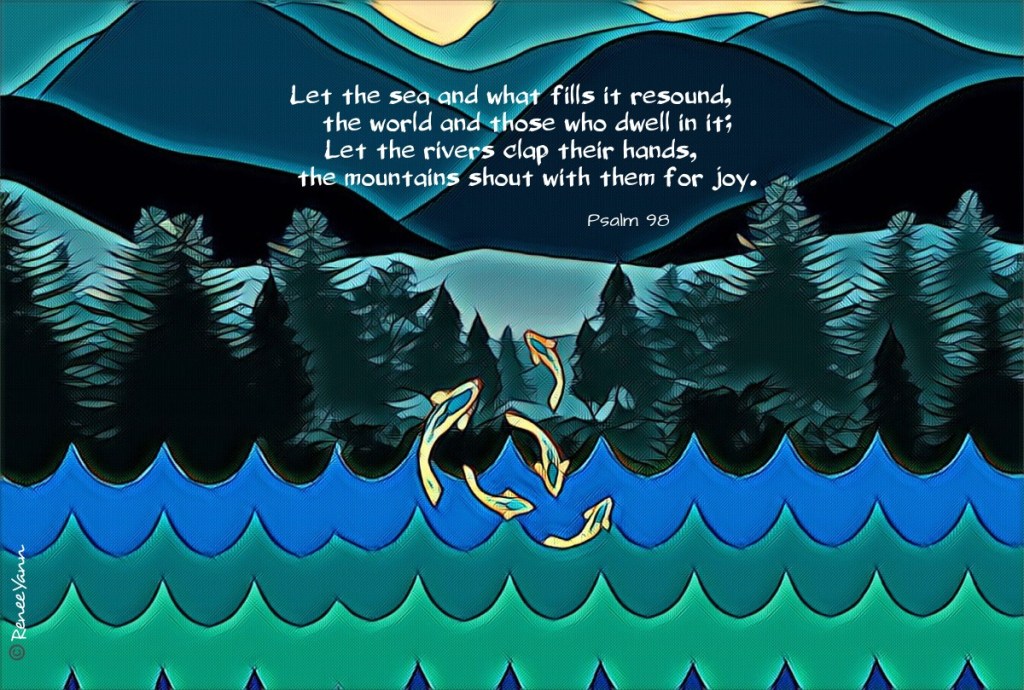
Let the sea and what fills it resound, the world and those who dwell in it; Let the rivers clap their hands, the mountains shout with them for joy.
Psalm 98:7-8
Like our hearts that believe even through life’s intermingled joys and sorrows
This is your life, joys and sorrow mingled, one succeeding the other.
Catherine McAuley: Letter to Frances Warde (May 28, 1841)
Poetry: Flickering Mind – Denise Levertov
Lord, not you
it is I who am absent.
At first
belief was a joy I kept in secret,
stealing alone
into sacred places:
a quick glance, and away -- and back,
circling.
I have long since uttered your name
but now
I elude your presence.
I stop
to think about you, and my mind
at once
like a minnow darts away,
darts
into the shadows, into gleams that fret
unceasing over
the river's purling and passing.
Not for one second
will my self hold still, but wanders
anywhere,
everywhere it can turn.  Not you,
it is I am absent.
You are the stream, the fish, the light,
the pulsing shadow.
You the unchanging presence, in whom all
moves and changes.
How can I focus my flickering, perceive
at the fountain's heart
the sapphire I know is there?
Today, in God’s Lavish Mercy, we pray with Psalm 97, one of several psalms categorized as “enthronement psalms”. These psalms celebrate God as king, a king exponentially greater than any human sovereign.
But Psalm 97 shows us that this Divine Ruler is also exponentially different from the flawed and often oppressive human rulers Israel (and others throughout history)has/have experienced.
For that reason, God is the only one who should rule our lives, and all human authority should mirror God’s perfect balance of love, mercy, and justice.
The psalm indicates how God is uniquely supreme:
JUSTICE – God’s reign is founded on justice, not domination
The LORD is king; let the earth rejoice; let the many isles be glad. Justice and judgment are the foundation of his throne.
97:1-2
UNIVERSALITY – God’s power moves earth and heaven, beyond any human ability
The mountains melt like wax before the LORD, before the LORD of all the earth. The heavens proclaim his justice, and all peoples see his glory.
97:5-6
GOODNESS – God loves goodness, not evil; uprightness, not power plays
The LORD loves those who hate evil; he guards the lives of his faithful ones; from the hand of the wicked he delivers them.
97:10
JOY – God’s reign brings universal joy, not subjugation. It inspires gratitude, not fear:
Light dawns for the just; and gladness, for the upright of heart. Be glad in the LORD, you just, and give thanks to God’s holy name
97:11-12
Psalm 97, though constructed on a metaphor that doesn’t speak to many of us, still has much to teach us.
How do we image God?
How does that image inspire, define, or control our behaviors and choices?
In whatever form we exercise authority, how do we reflect God’s authority?
Especially in our influence over younger, or vulnerable persons, what image of God would they learn from us?
For Christians, Psalm 97 points to a most contradictory “king”, one who loves the “beatitude person” and is willing to suffer and die for them. The psalm so clearly foreshadows Christ that it is the psalm prayed at Mass on Christmas Day.
In Christmas the Church does not simply celebrate the birth of a wondrous baby. Through that birth we celebrate the cosmic reality that God has entered the process of the world in a decisive way that changes everything toward life. The entry of God into the process of the world is the premise of the poem in Psalm 97.
Walter Brueggemann, Psalm 97: Psalm for Christmas Day
Poetry: The Kingdom – R. S. Thomas
                 It’s a long way off but inside it
                 There are quite different things going on:
                 Festivals at which the poor man
                 Is king and the consumptive is
                 Healed; mirrors in which the blind look
                 At themselves and love looks at them
                 Back; and industry is for mending
                 The bent bones and the minds fractured
                 By life. It’s a long way off, but to get
                 There takes no time and admission
                 Is free, if you will purge yourself
                 Of desire, and present yourself with
                 Your need only and the simple offering
                 Of your faith, green as a leaf.
Today, in God’s Lavish Mercy, we pray with Psalm 67 which calls on God to bless all people.
O God, be merciful to us and bless us, show us the light of your countenance and come to us. So may your way be known upon earth; among all nations, your salvation.
Psalm 67: 1-2
This psalm is notable for its inclusiveness of nations outside of Israel. Most psalms focus inwardly on Israel’s needs, hopes and memories. But Psalm 67 calls on God to gather and bless universally:
May the nations be glad and exult because you rule the peoples in equity; the nations on the earth you guide.
For this reason, Psalm 67 has been called “the missionary psalm”, and is such a fitting prayer on this feast of St. Ignatius who founded a community which has carried the faith throughout the world.
As we pray our psalm today, we might examine how our own faith reaches out, includes and blesses others.
Our final verses today point back to our first reading from Leviticus. While the math and calendar counting could get me pretty mixed up, the message is clear. It is a Jubilee message:
Stop.
Take a good look at your life and the harvest of your years.
Be grateful.
Be just.
Share.
Bring others into your bounty because it all belongs to God, not you.
When we do these things, Psalm 67 becomes our prayer:
Let the nations be glad and sing for joy, for you judge the peoples with equity and guide all the nations upon earth. Let the peoples praise you, O God; let all the peoples praise you. The earth has brought forth its increase; may you, O God our God, bless us. May you bless us, and may all the ends of the earth stand in awe of you.
Poetry: This Is My Song by Lloyd Stone and Georgia Harkness
This is my song, O God of all the nations,
a song of peace for lands afar and mine;
this is my home, the country where my heart is;
here are my hopes, my dreams, my holy shrine:
but other hearts in other lands are beating
with hopes and dreams as true and high as mine.

My country’s skies are bluer than the ocean,
and sunlight beams on cloverleaf and pine;
but other lands have sunlight too, and clover,
and skies are everywhere as blue as mine:
O hear my song, thou God of all the nations,
a song of peace for their land and for mine.

May truth and freedom come to every nation;
may peace abound where strife has raged so long;
that each may seek to love and build together,
a world united, righting every wrong;
a world united in its love for freedom,
proclaiming peace together in one song.
Music: Finlandia, Opus 26
The above poem is sung to the tune of the final hymn in this work by Jean Sibelius. I think you will enjoy this beautiful video, especially the young ducks about midway through. Be sure to click the little arrowhead under the right side of the video to read the great history of this musical composition.
















 Lavish Mercy