Psalm 65: Word-Seed

Fifteenth Sunday in Ordinary Time
July 12, 2020

From 2017:

Today, in Mercy, we pray with the powerful and mysterious readings of today’s liturgy. They tell us that God breathes eternal inspiration into us and all Creation. The gift, like seed, is intended to bear fruit that is returned to God in love and praise. By participating in that return, we become children of God. May the seed of God’s Word fall on good ground in our spirits.

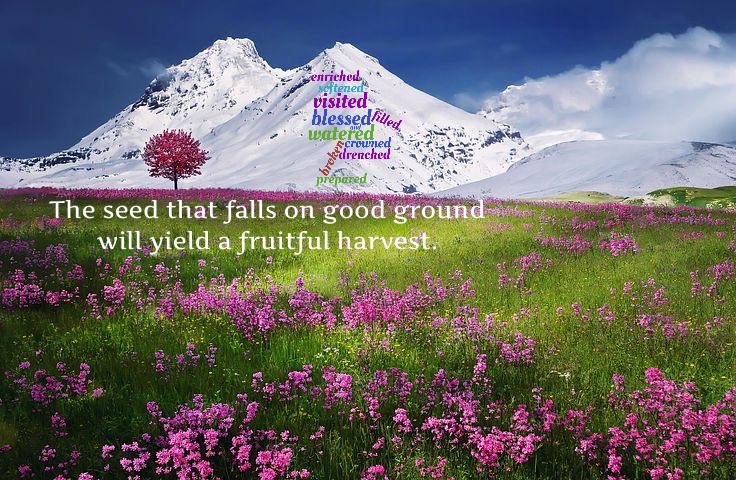
Today, in God’s Lavish Mercy, we pray with Psalm 65, a song poem probably written to celebrate the harvest season. The psalm describes an abundantly fruitful earth, filled with life and produce.

Though humans labor for these blessings, God is the bounty’s true agent. The power of that agency is found in the array of words used to describe God’s actions.

God has: 

  • visited 
    • watered
      • enriched
        • filled
          • prepared
  • drenched
    • broken up
      • softened
        • blessed and
          • crowned

What is it that has drawn all this intervention from God? Our readings tell us. It is the Word-Seed which is God’s own life.

Just as from the heavens
the rain and snow come down….
so shall my Word be. (Isaiah 55)
For creation awaits with eager expectation
the revealing Word of the children of God… (Romans 8)
The seed sown on rich soil
is the one who hears the Word and understands it,
who indeed bears fruit and 
yields a hundred or sixty or thirtyfold. (Matthew 13)

By our dedicated prayer with scripture and trusted spiritual reading, the Word works on our spirits just as the psalm describes.  Our understanding, too, is visited, watered, enriched, filled, prepared, drenched, broken up, softened and ultimately blessed and crowned.

As we pray with Psalm 65 today, we can picture David looking out from hilltop over the abundance of his fields. His heart is filled with awe and praise for God’s generosity.

We all want to live in a spiritual landscape akin to the psalm’s bountiful picture. Inviting God’s Word, in humility, gratitude, and awe is a true path to such blessing.


Poetry: A Word Is Dead – Emily Dickinson


Music: Aria by Secret Garden

Psalm 93: Nestle in God’s Robe

Memorial of Saint Benedict, Abbot

July 11, 2020

Today, in God’s Lavish Mercy, we pray with Psalm 93, the first of the royal psalms (93-99) which praise God as King.

As we pray with today’s verses, we can easily feel the psalmist stretching for a description of God Who is, of course, indescribable. Never having seen God, we can only imagine the Divine Being in human terms. This writer imagines God as a King beyond even the greatness of human kings, and it is a beautiful image:

The LORD is king, in splendor robed;
robed is the LORD and girt about with strength.


Like the psalmist, we may tend to paint God in the colors of those who have had greatest influence in our lives

  • those with power over us, like parents and teachers
  • those who have loved us, or failed to
  • those in positions of success, and strength

Because all human models are flawed in some way, this tendency can give us a blurry, if not distorted picture of God.


Jesus came to correct our perspective.


A beautiful extra hymn for today. Just love this one.

Jesus showed us that, while we live on this earth, the glory of God is a hidden glory. It is robed in the suffering of the poor and abandoned. Its splendor is in the innocence of children. Its strength is in the hope of the sick and weak. Its beauty shines out to us in the vulnerability of our sisters and brothers.


In today’s Gospel, Jesus gives us the tender image of God as One who cherishes every hair on our heads. As we pray today, we might let that gentle God reach down and caress any pain, exhaustion or fear, like a Mother brushing her child’s hair. Just be with God Who knows our needs. Be cradled in the splendrous robe.


Poetry:  God’s True Cloak – Rainer Maria Rilke

We must not portray you in king’s robes,
you drifting mist that brought forth the morning.
Once again from the old paintboxes
we take the same gold for scepter and crown
that has disguised you through the ages.
Piously we produce our images of you
till they stand around you like a thousand walls.
And when our hearts would simply open,
our fervent hands hide you.

Music: George Frideric Handel – Chandos Anthem, #4/ Psalm 93 – O Sing Unto the Lord

Psalm 80: Restore Us!

Thursday of the Fourteenth Week in Ordinary Time

July 9, 2020

Today, in God’s Lavish Mercy, we pray with Psalm 80, a powerful song poem written by a desperate and suffering poet.

Psalm 80 seems to have been written as a plea for deliverance of the northern kingdom of Israel just before the Assyrian armies conquered it. The psalmist pleads with God to remember God’s earlier kindness and to restore Israel’s wholeness.

Once again, O LORD of hosts,
look down from heaven, and see:
Take care of this vine,
and protect what your right hand has planted,
the son of man whom you yourself made strong.


When I read this psalm, I hear something like the plea of a confused child, asking a parent: 

  • What happened to upset things? 
  • I thought you loved me? 
  • Why am I so afraid now? 
  • Why are you so unconcerned about my fear?
  • Please remember and give me back your love and blessings.
  • Please make things all right again.

It is a prayer not unlike my own in this time of pandemic, profound loss, and moral confusion. There is so much to be mourned in these painful times, and yet so much to be learned. This video, shared with me by a dear Franciscan friend, captures both the mourning and the hope within these past months:


As we experience the continued spread of COVID 19, coupled with confused leadership and astounding popular ignorance, a plea like the psalmist’s might arise in our own hearts.

Much about our lives on and with the Earth has been broken. Let us pray from our brokenness today. May Creation be restored to its sacred vitality. May our human family be renewed with transformed integrity and reverence for Creation and for one another.


Poetry: I Am the Vine – Malcolm Guite

How might it feel to be part of the vine?
Not just to see the vineyard from afar
Or even pluck the clusters, press the wine,
But to be grafted in, to feel the stir
Of inward sap that rises from our root,
Himself deep planted in the ground of Love,
To feel a leaf unfold a tender shoot,
As tendrils curled unfurl, as branches give
A little to the swelling of the grape,
In gradual perfection, round and full,
To bear within oneself the joy and hope
Of God’s good vintage, till it’s ripe and whole.
What might it mean to bide and to abide
In such rich love as makes the poor heart glad?


Music: You Are the Vine- Divine Hymns

Psalm 145: Is All Right with the World?

Fourteenth Sunday in Ordinary Time

July 5, 2020


From 2017: Today, in Mercy, we  ask God to bless our country and all its people – to give us the grace to live in justice, peace and mutuality; to give us the insight to elect decent leaders who will forge these values; to give us the courage to model these values among nations; to teach us to use our freedom humbly, responsibly and mercifully.

Today, in God’s Lavish Mercy, we pray with Psalm 145, a hymn psalm which is the last numerically to mention David in its origin.

The psalm is one of equilibrium and gratitude where the one praying is at peace within God’s generous fidelity.  By observing nature’s magnificent permanence, the psalmist both praises God and assures himself that things will be alright in the world.

Let all your works give you thanks, O LORD,
and let your faithful ones bless you.
Let them discourse of the glory of your kingdom
and speak of your might.


Reading the psalm today, I thought of Robert Browning’s famous verses from his poetic drama Pippa Passes:

The year's at the spring
And day's at the morn;
Morning's at seven;
The hill-side's dew-pearled;
The lark's on the wing;
The snail's on the thorn:
God's in his heaven—
All's right with the world!
— from Act I: Morning

The verse, though it has endured, was considered naïve when published, due to an undercurrent of civil unrest in England and the rest of Europe. Times were not as peachy as the poem pretended.


With only a superficial glance, one might tend to feel similarly about Psalm 145. Times were tough for the Israelites, as many of the Psalms make clear. These lamenting psalms often ask for deliverance, and all kinds of retribution on enemies.

Psalm 145, and some other hymns, do not. They convey a sense of contentment with the status quo. We might ask ourselves, “Did the same people compose both these kinds of songs? Did this literature, in fact, arise out of the same national experience?


I think these are perfect questions as we, in the United States, continue to celebrate Fourth of July weekend. As we pray for our country, and for the world of which we are part, contrapuntal feelings surely enter our prayer.

  • a deep love of country countered with as deep a concern for its civic health and morality
  • an appreciation for our foremothers and fathers balanced with an awareness of their failures and limitations
  • a pride in our history tinged with shame and regret for its sins
  • a desire to honor civil servants and leaders tested by a realistic concern about their values and agenda
  • a profound gratitude for our national blessings pained by the realization that not all Americans share equitably in them

As is often the case, praying the psalm offers some guidance for our questions. Our third verse in today’s responsorial selection recognizes where God’s faithful generosity wants to be focused. Despite any personal equanimity, there are those who are falling. There are among us those who are bowed down:

The LORD is faithful in all his words
and holy in all his works.
The LORD lifts up all who are falling
and raises up all who are bowed down.

A nation – an earthly community – which sees and attends to those who are so burdened will be blessed by God with the same justice and balance that renders “all right in the heavens”.

Music: The Eyes of All Wait Upon Thee – Syracuse University Singers

Psalm 117: Praise the Lord

Feast of Saint Thomas, Apostle

July 3, 2020

One of my favorite past reflections on faith vs. doubt – for this Feast of Saint Thomas


Today, in God’s Lavish Mercy, we pray with Psalm 117 which is the shortest of all the Psalms. But 117, also called the Laudate Dominum, still packs a huge spiritual punch.

The psalm is called a “doxology” which simply means it is a short prayer of praise, the type we often add at the end of longer prayers. We are very familiar with the following doxology:

Glory be to the Father, and to the Son, and to the Holy Spirit.
As it was in the beginning, is now, and ever shall be
,
world without end. Amen


Psalm 117 follows the same pattern in that it has two complementary parts.

The first invites us to praise God:
Praise the LORD, all you nations;
glorify God, all you peoples!

The second tells us why God deserves our praise:
For steadfast is God’s kindness for us,
and the fidelity of the LORD endures forever.

Notable about Psalm 117 is the fact that this Old Testament invitation to praise goes out “to ALL nations”. Scholars interpret this as pointing to the fulfillment, in Jesus, of God’s promise that Abraham would be the father in faith of many nations. Psalm 117 is a treasured and often repeated prayer throughout the Judea-Christian traditions.


Practicing this pattern of prayer can enrich our personal prayer life as well. I like to pray like this as soon as I wake each morning. Glancing out my window, I might say,

“I praise You in the sunrise, my Beautiful Creator.
Thank you for the gift of my life.”

Beginning the day with our own “doxology” gives us a head start on living joyfully and gratefully in the Presence of God for our next circuit of the sun.


Poetry: Morning Poem – Mary Oliver

Every morning 
the world 
is created. 
Under the orange
sticks of the sun 
the heaped 
ashes of the night 
turn into leaves again
and fasten themselves to the high branches— 
and the ponds appear 
like black cloth 
on which are painted islands
of summer lilies. 
If it is your nature 
to be happy 
you will swim away along the soft trails
for hours, your imagination 
alighting everywhere. 
And if your spirit 
carries within it
the thorn 
that is heavier than lead— 
if it's all you can do 
to keep on trudging—
there is still 
somewhere deep within you 
a beast shouting that the earth 
is exactly what it wanted—
each pond with its blazing lilies 
is a prayer heard and answered 
lavishly, 
every morning,
whether or not 
you have ever dared to be happy, 
whether or not 
you have ever dared to pray

Music: Laudate Dominum – Mozart, sung by Barbara Hendricks

Psalm 5: You Are God’s Flute

Tuesday of the Thirteenth Week in Ordinary Time

June 30, 2020

A Brief Prayer on Today’s Gospel from 2016
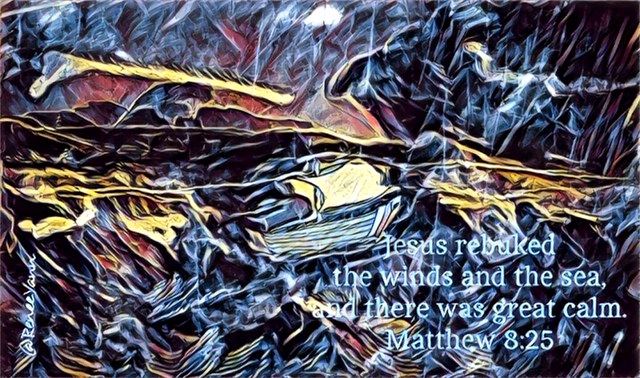
Today, in Mercy, we pray for all those tossed on a stormy sea, like Christ’s disciples. For all who are alone, in darkness or full of fear. There is no storm through which God cannot come to us. May we always trust that God is taking us to a new grace beyond the storm.


Today, in God’s Lavish Mercy, we pray with Psalm 5, the first one of several to mention “the Name of God” as a theme.  The psalm, a morning prayer to be “accompanied by a flute”, is a mix of lament and exaltation – like many of our own morning prayers, no doubt.

At dawn I bring my plea expectantly before you.
For you, O God, delight not in wickedness;

the evil one does not remain with you;
the arrogant may not stand in your sight.


Now, first off in the morning, we’re probably not going to talk to God about wickedness, evil, and arrogance unless we went to bed pretty upset the night before. The psalmist apparently has “slept on” his troubles without complete resolution.

We had a dear, wise Directress of Postulants who, on many an evening, patiently listened to our various vocational waverings. We were young. Just like the disciples in Matthew’s boat, we really weren’t as sure of our calls as we would like to have been. Sister Inez’s repeated advice soothed a lot of our growing pains, “Just give it to God and get a good night’s sleep. Things will be clearer in the morning.” And they always were.


As the psalmist prays this morning prayer, things clear as well. After a brief diatribe, the prayer realizes:

But I, through the abundance of your mercy,
will enter into your house.
I will bow down toward your holy sanctuary

in awe of your greatness.


Psalm 5 beautifully complements today’s Gospel. Jesus is in the storm-tossed boat peacefully “sleeping on it”. The disciples, on the other hand, cannot just “give” their terror over to God. When they wake Jesus, terrified, he gently reprimands them, “O ye of little faith”.

Jesus wants them and us, to realizes what the psalmist realizes in verse 12:

All who trust in God will be glad
and forever shout for joy.
God protects them 
and their lives are a melody
to God’s beloved Name


Poetry: A Hole in a Flute ~ Hafiz

I am a hole in a flute
that the Christ's breath moves through; 
listen to this music.

I am the concert 
from the mouth of every creature 
singing with the myriad chorus.

I am a hole in a flute 
that the Christ's breath moves through; 
listen to this music.

Music: The Edge of Night by a group called “Siyotanka” which is actually the Lakota name for this type of flute.

Psalm 139: God of Our Secrets

Solemnity of the Nativity of Saint John the Baptist

June 24; 2020

Psalm 139 (stained glass window by Ted Felen)

Today, in God’s Lavish Mercy, on the great feast of John the Baptist, we pray with Psalm 139, the prayer of awed gratitude.

June 24th is a pivotal date in my life. It became so in 1966 on the day I was first professed as a Sister of Mercy. Our then Mother General, who chose our Profession date, had deep devotion to John, and often spoke to us wide-eyed novices about his holiness.


In one such lecture, she solemnly pronounced the core of his sanctity – how he considered himself in relation to his cousin Jesus:

He must increase and I must decrease. 

Mother Bernard told us that this was the key to the spiritual life: let God grow in you as self recedes.


It was a beautiful lesson but a hard one to swallow. We were a gaggle of 20-somethings fired up to find our adulthoods. We were all about growing – making our statement in the world! 

Learning to discover, rely on, and magnify the hidden omnipresence of God within would – at least for some of us – takes a lifetime, just as it probably should.


Psalm 139 is a prayer that can lead us to God’s powerful secrets in our hearts, ready to be unfolded as the years pass. These treasures include:

  • that we are made of earth and stars and must find vigor in harmony with them
  • that we are woven of both the dances and the dyings of our mothers, fathers, and ancestors – each a mysterious blessing
  • that as we live our lives, it is God living within us
  • that God knows, loves, and redeems everything about us

June 24, 1966 came clothed in noontime sun and trumpet blasts all those years ago – shouting youth, hope, and a good deal of ambition.

The date’s passing iterations have gently mellowed the song God sings to me. Now it goes something like this:


Autumn Colors – Zamfir

Today, the date’s rising carries the sustained melody of a gentle pan flute. Within its breathy music, I cherish the gift of years, how intimately accompanied and tenderly cared for I have been … even from my mother’s womb until now.

May each of us today – in whatever season and sound of the journey – pray with our hidden, ever-present God who cherishes our being.


Called to Become
From Edwina Gateley, There Was No Path So I Trod One (1996, 2013)

You are called to become
A perfect creation.
No one is called to become
Who you are called to be.
It does not matter
How short or tall
Or thick-set or slow
You may be.
It does not matter
Whether you sparkle with life
Or are as silent as a still pool.
Whether you sing your song aloud
Or weep alone in darkness.
It does not matter
Whether you feel loved and admired
Or unloved and alone
For you are called to become
A perfect creation.
No one's shadow
Should cloud your becoming.
No one's light
Should dispel your spark.
For the Lord delights in you.
Jealously looks upon you
And encourages with gentle joy
Every movement of the Spirit
Within you.
Unique and loved you stand.
Beautiful or stunted in your growth
But never without hope and life.
For you are called to become
A perfect creation.
This becoming may be
Gentle or harsh.
Subtle or violent.
But it never ceases.
Never pauses or hesitates.
Only is—
Creative force—
Calling you
Calling you to become
A perfect creation.

Music: If I Take the Wings of Morning – John Rutter

Psalm 97: Who’s in Charge Here?

Thursday of the Eleventh Week in Ordinary Time

June 17, 2020

Today, in God’s Lavish Mercy, we pray with Psalm 97, one of the six “enthronement psalms”.  These hymns identify God as “king” whose power is above all. Such power evokes awe and praise which form the repeated acclamations of the psalm.

The “enthronement” of God in Israel’s worship means that all other “gods” (power, prestige, influence, money, etc.) are now subject to the policies, attitudes and judgments of Yahweh – Who REIGNS and Who is covenanted to us with irrevocable love.

Everything we encounter in life is to be received with that understanding.


We know how the psalmist feels – what it’s like to be awed by God’s power – and left with nothing but stunned silence or quiet whispering praise.

  • Both magnificent and delicate natural phenomena can inspire such a prayer. 
  • Life events over which we have no control can also bring us to humble praise like this.
  • The intricacies of a newborn’s face, the graced windings of an elder’s life story, the unfathomable reality of death, the mystery of a human love that mirrors God’s…. All such mysteries and miracles can cause us to proclaim with the psalmist:

The LORD is king; let the earth rejoice;
let the many islands be glad! …
Light dawns for the righteous, 
and joy for the upright in heart. 

Rejoice in the LORD, O you righteous, 
and give thanks to his holy name

(Ps. 97:2, 10–12)

Or, as transliterated by Minister Christine Robinson:

Highest in Heaven
Deepest in Nature
Holy One

Be Glad
Lights up the world
Purifies the heart
Gathers the peoples
Rejoice.


Whether or not we’re comfortable with “king” language, may we still embrace the image of God, invited to our heart, made at home, praised and unfailingly worshipped. Enthroned!

Today, let us praise our King, Lord, Dear One or however we inadequately attempt to name our Divine Creator.

Poetry: I Am Bending My Knee from the Carmina Gadelica, the work of Alexander Carmichael. Carmina Gadelica is a compendium of prayers, hymns, charms, incantations, blessings, literary-folkloric poems and songs, proverbs, lexical items, historical anecdotes, natural history observations, and miscellaneous lore gathered in the Gaelic-speaking regions of Scotland between 1860 and 1909. (Wikipedia)

I am bending my knee
In the eye of the Father who created me,
In the eye of the Son who purchased me,
In the eye of the Spirit who cleansed me,
In friendship and affection.
Through Thine own Anointed One, O God,
Bestow upon us fullness in our need,
Love towards God,
The affection of God,
The smile of God,
The wisdom of God,
The grace of God,
The fear of God,
And the will of God
To do on the world of the Three,
As angels and saints
Do in heaven;
Each shade and light,
Each day and night,
Each time in kindness,
Give Thou us Thy Spirit.

Music: Our God Reigns – Studio Musicians


Paul’s Great Sermon

Wednesday of the Sixth Week of Easter

May 20, 2020

Click here for readings

Today, in Mercy, Paul gives a magnificent oration at the Areopagus in Athens. It was a big deal billing!

V&A_-_Raphael,_St_Paul_Preaching_in_Athens_(1515)
St. Paul at the Areopagus by Raphael (c.1515)

Areopagus, earliest aristocratic council of ancient Athens. The name was taken from the Areopagus (“Ares’ Hill”), a low hill northwest of the Acropolis, which was its meeting place.

In pre-classical times (before the 5th century BC), the Areopagus was the council of elders of the city, similar to the Roman Senate. Like the Senate, its membership was restricted to those who had held high public office.

The Areopagus, like most city-state institutions, continued to function in Roman times, and it was from this location, drawing from the potential significance of the Athenian altar to the Unknown God that Paul is said to have delivered the famous speech, “Now what you worship as something unknown I am going to proclaim to you. The God who made the world and everything in it is the Lord of heaven and earth and does not live in temples built by hands.” (Wikipedia)


diamonds
The sermon has so many beautiful lines, like glorious diamonds that can be turned over and over in prayer. Here are a few that glistened for me:


God … does not dwell in sanctuaries made by human hands
(Instead, God dwells within us)


God is not served by human hands because God needs nothing.
(Instead, our everything comes from God)


God made from one the whole human race to dwell on the entire surface of the earth.
(We are all connected in the One Creation)


God fixed the ordered seasons and the boundaries of their regions,
so that people might seek God,
even perhaps grope for him and find him,
though indeed he is not far from any one of us.
(We do grope, sometimes in darkness.)


God has overlooked the times of ignorance,
but now he demands that all people everywhere repent…
(Without Christ, we were in shadows of unknowing. With Christ, we are in Light.)


And my favorite:

Acts17_24 everything

What is the “everything” that God is giving you today? What is the abundance of grace, or hope, or longing in your heart as you pray today? Let God’s fullness embrace any emptiness as you offer God your silence and waiting.

Music: Everything – Lauren Daigle

The Challenge to Believe

Thursday of the Second Week of Easter

April 23, 2020

Click here for readings

Today, in Mercy, our readings demonstrate how hard it is for some people to believe – because deepening belief usually requires a soul-change.

disputebeforesanhedrin1700
Fra Angelico, Dispute before Sanhedrin, Cappella Niccolina, Palazzi Pontifici, Vatican

In our first reading, the high priest and Sanhedrin just don’t get it. No matter how severe the oppression, Peter and the Apostles are not going to stop sharing the Good News. Even miracles and inexplicable prison escapes do not convince them that maybe the Apostles have some special blessing to offer them.

Why won’t the Sanhedrin listen? Why are they in such denial about what they are witnessing?

The Sanhedrin were members of a privileged class. They had things set up nicely to their material benefit. Jesus was a bombshell turning their comfortable world upside down. So they resorted to any tool possible to eradicate him: denial, oppression, persecution, even murder.

But the Good News of Jesus Christ is ineradicable.

Jn3_believe

In our Gospel, John minces no words about the fate of unbelievers:

The Father loves the Son
and has given everything over to him.

Whoever believes in the Son has eternal life,
but whoever disobeys the Son will not see life,
but the wrath of God remains upon him.

When I look at our world, I see a lot of that “wrath”, don’t you? I see situations of pain, injustice, greed, and irreverence for Creation that could not exist in a truly believing world.

Seeing these things, I examine my own life for the places where faith has not converted me, for the kinds of resistant behaviors that prevented the Sanhedrin from receiving the greatest gift possible – a fully faithful and compassionate heart.


Here’s a little extra thought from Shakespeare whose birth we celebrate today. The quote from Henry V seems appropriate for the topic.

Henry V

Music: A Faithful Heart – Libera
(I imagine that this lovely song is usually interpreted as a marriage canticle, but I think it perfectly describes the sacred covenant between God and the faithful believer.)