Today, in God’s Lavish Mercy, pray with Psalm 91 from the readings for the Mass of the Guardian Angels – those magnificent beings who carry God’s Presence to us in every situation of our lives.
The Lord shall deliver you from the snare of the hunter and from the deadly pestilence. The wings of the Lord shall cover you, and you shall find refuge under them; the faithfulness of God shall be a shield and buckler.
Psalm 91: 3-4
Maybe the only angels we ever think about are chubby little cherubs on Christmas cards. The cultural tendency to represent angels in that way diminishes the real power of these mighty and loving beings to inspire and guide us. Today might be a day to rethink our relationship with our Guardian Angels – to talk with them and to listen to the good things they tell us even without words.
Praying with the angels requires the unembarrassed simplicity of deep faith. Our culture has painted the angels with a patina of childishness, but that is far from their biblical representation. Angels are supernaturally powerful beings throughout both the Hebrew and Christian scriptures. If you meet a personal block in praying with your own guardian angels, pick one of the only three named in the Bible and consider that angel’s dynamic presence.
Gabriel: The angel Gabriel is an angel of God who is mentioned by name three times in the Bible when he brought messages from God to Daniel, Zechariah, and Mary.
Michael: the only one called “archangel” in the Bible. In the books of Daniel, Jude, and Revelation, Michael is described as a warrior angel who engages in spiritual combat.
Raphael: mentioned only in the Catholic canon of the Bible, Raphael has a key role in the Book of Tobit
Poem: Touched by an Angel by Maya Angelou
We, unaccustomed to courage, exiles from delight, live coiled in shells of loneliness until love leaves its high holy temple and comes into our sight to liberate us into life. Love arrives and in its train come ecstasies old memories of pleasure ancient histories of pain. Yet if we are bold, love strikes away the chains of fear from our souls. We are weaned from our timidity In the flush of love’s light we dare be brave And suddenly we see that love costs all we are and will ever be. Yet it is only love which sets us free
Today, in God’s Lavish Mercy, we pray with Psalm 145, a luxuriant song of praise to a God who overwhelms us with generosity.
I will extol you, my God and king; I will bless your name forever and ever.
Every day I will bless you; I will praise your name forever and ever.
Great is the LORD and worthy of much praise, whose grandeur is beyond understanding.
Psalm 145: 1-3
Citing verses 13-20 which are structured around the word “all”, Walter Brueggemann says:
The image is an overflow of limitless blessing given without reservation to all who are in need and turn to the Creator.
… Which brings us to Nathaniel and how this prayer might have sung in his heart.
I got to be friends with Nathaniel sixty years ago when, at my reception into our community, Mother Bernard decided to give me his name. And after an initial shock, I came to love it.
Nathaniel and I have spent countless hours under his fig tree sharing both our lives. I’ve asked him many times what he was thinking about when Philip came to invite him to meet Jesus. Nathaniel always has a different answer… one amazingly similar to whatever happens to be preoccupying me at the time.😇
a favorite old book that started some of my conversations with Nathaniel
One element remains constant in every circumstance: in his quiet moments, Nathaniel sought God’s Light. As our Gospel shows, that Luminous Word came to him and he responded.
I think that in our “fig tree moments”, we have finally sifted through all that we are capable of in order to find Grace in our lives. Now we wait, in the shade and quiet of prayer, for the True Answer to invite us into Its Mystery.
When that answering Word comes, it shatters our doubts and pretenses like eggshells. And through the shattered shells, the Word releases new life in us. We move deeper into the unbreakable Wholeness and Infinity. Like Nathaniel, even in our ordinary lives, we begin to “see greater things” than we had ever imagined.
Nathanael said to him, “How do you know me?” Jesus answered and said to him, “Before Philip called you, I saw you under the fig tree.” Nathanael answered him, “Rabbi, you are the Son of God; you are the King of Israel.” Jesus answered and said to him, “Do you believe because I told you that I saw you under the fig tree? You will see greater things than this.” And he said to him, “Amen, amen, I say to you, you will see heaven opened and the angels of God ascending and descending on the Son of Man.”
John 1:48-51
After that momentous afternoon when he was drawn from his figgy shade into the Light, Nathaniel’s life became a hymn of praise and thanksgiving.
Let all your works give you thanks, O LORD, and let your faithful ones bless you. Let them discourse of the glory of your Kingdom and speak of your might.
Psalm 145:10-11
Poem-Prayer from Christine Robinson
Psalm 145 – Opening Heart
I exalt you, Holy One, and open my heart to you
by remembering your great love.
Your expansiveness made this beautiful world
in a universe too marvelous to understand.
Your desire created life, and you nurtured
that life with your spirit.
You cherish us all—and your prayer
in us is for our own flourishing.
You are gracious to us
slow to anger and full of kindness
You touch us with your love—speak to us
with your still, small voice, hold us when we fall.
You lift up those who are oppressed
by systems and circumstances.
You open your hand
and satisfy us.
You ask us to call on you—
and even when you seem far away, our
longings call us back to you.
Hear my cry, O God, for some days, it is all I have.
Music: I Will Praise Your Name – Bob Fitts
Lord I will praise your name I will praise your name I will praise your name and extol You
I will praise Your name (I will praise Your name) I will praise Your name I will praise Your name As I behold You
I will magnify, I will glorify I will lift on high Your name, Lord Jesus I will magnify, I will glorify I will lift on high Your name, Lord Jesus
For Your love is never ending And Your mercy ever true I will bless Your name Lord Jesus For my heart belongs to You
I will praise Your name I will praise Your name I will praise Your name and extol you
I will magnify, I will glorify I will lift on high Your name, Lord Jesus For Your love is never ending And Your mercy ever true
I will bless Your name Lord Jesus For my heart belongs to You I will praise Your name I will praise Your name I will praise Your name and extol you I will magnify, I will glorify I will lift on high Your name, Lord Jesus
Today, in God’s Lavish Mercy, Moses recounts for the people God’s immense generosity toward them.
Have you ever heard yourself, or someone dear to you, saying, “God has been so good to me!” Such a statement rises out of our awe at God’s love and mercy to us.
The deeper our faith, the clearer our insight into these gifts. I have heard people in the sparest of circumstances utter such a prayer. How can they do that, we might ask?
In all cases, there is a beautiful humility, trust, and generosity emanating from their spirits. Gratitude has transformed them. Hope, not wishing, has freed them.
Moses wants his People to be like that. He says:
Think! The heavens, even the highest heavens, belong to the LORD, your God, as well as the earth and everything on it. Yet in his love for your fathers the LORD was so attached to them as to choose you, their descendants …
This is your glory, he, your God, who has done for you those great and awesome things which your own eyes have seen.
I want to be that kind of grateful, faith-filled person too. Don’t you?
Today’s profound advice from Moses can help us as we pray its words into our own lives.
Poetry: Praying the whole of today’s Responsorial Psalm 147 can also help us recognize our blessings. I love this transliteration by Christine Robinson.
Psalm 147 - Mother of All Creation
It is good to sing praises to you,
Mother of all creation.
And to recognize the touch of your love.
You bring us home, help us heal,
You love your creation
You call every one of your stars by name.
You bless the young, the poor, the ill
You wait forever for the lost to turn to you.
Your love is music to our hearts, and we sing.
You are in the clouds that darken the sky
You send the rain which gives us life.
The cycles of the seasons and the growth of the plants
are your delight.
You provide food for the wild animals
even the young ravens when they cry.
You love the horse’s proud strength
and the athlete’s prowess.
You crave our love and attention.
And so we pray.
We give thanks for life, for children, for the beauty of the snow
that lies soft in the morning.
We give thanks for the storm,
the hail, scattered like popcorn on the grass.
We are in awe of your power.
When the seasons turn, the growing warmth
reminds us of your warmth
The flowing waters remind us
of the life which comes from you.
Thank you, Mother of us all, help us
to keep your love in our hearts and to love your creation.
Music: Your Grace Still Amazes Me – Philips, Craig and Dean
Today, in God’s Lavish Mercy, on this glorious Feast of the Transfiguration, we pray with Psalm 97 which prophesies the messianic era when God will reign supreme over the earth. Its verses announce God’s sovereignty, the establishment of justice, and universal joy.
Transfiguration by Giovanni Bellini
Our Gospel describes the moment when Jesus gave his three disciples a glimpse of that future glory in order to sustain them through the sufferings to come.
Jesus took Peter, James, and his brother, John, and led them up a high mountain by themselves. And he was transfigured before them; his face shone like the sun and his clothes became white as light…
Matthew 17:1-2
As we pray Psalm 97 today, we might think of our experiences of God’s beauty, tenderness, and joy. Remembering and storing these small, accumulated revelations helps us to hold faith in times of darkness or trouble.
In Martin Luther King’s final speech the night before he was assassinated, he spoke of his own transfiguring moments and the courageous faith they inspired in him:
Well, I don’t know what will happen now. We’ve got some difficult days ahead. But it doesn’t matter with me now. Because I’ve been to the mountaintop. And I don’t mind. Like anybody, I would like to live a long life. Longevity has its place. But I’m not concerned about that now. I just want to do God’s will. And He’s allowed me to go up to the mountain. And I’ve looked over. And I’ve seen the promised land. I may not get there with you. But I want you to know tonight, that we, as a people, will get to the promised land. And I’m happy, tonight. I’m not worried about anything. I’m not fearing any man. Mine eyes have seen the glory of the coming of the Lord.
Also in our prayer today, we are mindful of the anniversary of the atomic bombings of Hiroshima and Nagasaki, events which represent the complete inversion of God’s will for the Peaceful Kingdom.
Majesty, turned inside out by our sin, becomes terror.
Oppenheimer is a popular film showing in theaters right now. Robert Oppenheimer, one of the designers of the atomic bomb, reflecting on the bomb’s first test, said that as he watched the huge blast wave ripple out over the New Mexico desert, a line from the Hindu scripture Bhagavad Gita came to mind: “Now I am become Death the Destroyer of Worlds.”
Psalm 97 reminds us that all Creation belongs to God:
The LORD is king; let the earth rejoice; let the many islands be glad. Clouds and darkness are round about him, justice and judgment are the foundation of his throne.
Psalm 97:1-2
If, by faith, we learn to see and reverence God’s glory in all things, we can be delivered from the terrors of war, racism, and every other deathly weapon which threatens us. As Psalm 97 so encouragingly closes:
You who love the LORD, hate evil, God protects the souls of the faithful, rescues them from the hand of the wicked. Light dawns for the just, and gladness for the honest of heart. Rejoice in the LORD, you just, and give thanks at the remembrance of his holiness.
Psalm 97:10-12
Poetry: Origami by Joyce Sutphen
In Hiroshima’s Peace Park there is a statue of Sadako Sasaki lifting a crane in her arms. Sadako was two years old when the atomic bomb was dropped; she was diagnosed with leukemia ten years later. The Japanese believe that folding a thousand origami cranes brings good fortune. Sadako spent the last months of her young life folding hundreds of paper cranes. She folded 644 before she died.
Origami
It starts with a blank sheet, an undanced floor,
air where no sound erases the silence. As soon as
you play the first note, write down a word, step onto the empty stage,
you've moved closer to the creature inside. Remember—
a square can end up as frog, cardinal, mantis, or fish.
One in a series of 60 paintings by Jacob Lawrence which captures the journeys of millions of African-Americans who left the Jim Crow South in search of better lives elsewhere.
Today, in God’s Lavish Mercy, Leviticus offers us a reading critical to our moral clarity.
This fiftieth year you shall make sacred by proclaiming liberty in the land for all its inhabitants. It shall be a jubilee for you, when every one of you shall return to his own property, every one to his own family estate.
Leviticus 25:10
Leviticus 25 is the account of Jubilee which, for the Mosaic community, was the quintessential practice of justice.
When the Israelites came to the Promised Land, they came as an emancipated people to share in the abundance to which God had delivered them. There was initial equity in the sharing. But over time, power, influence and wealth were hoarded – endangerments that threaten all communities.
In the proclamation of Jubilee, God directs the people to return to an original justice in which all persons are freed from indebtedness of any kind in order to live in communal harmony.
Consider the hypothetical example of an Israelite family that lost their land twelve years before the Jubilee Year. On the tenth day of the seventh month, the entire community participates in the Day of Atonement and its ritual purging of sin. On this very same day, the trumpet is blown and the Jubilee year is announced; in this year, both sins and debts are forgiven, and the family that had been forced to live and work in another’s household for more than a decade regain possession of their land.
Imagine the joy of this moment! Imagine the dreams and desires! After having served as hired hands for a generation, now to be restored to a position of social and economic strength!
Michael J. Rhodes – Jubilee Formation: Cultivating Desire and Dependence in Leviticus 25
The concept of this type of justice is alien to our capitalist and consumerist orientations. We may have heard the attitude expressed, or we may hold it ourselves, that some people have and some people don’t. And the ones who “have” earned it and deserve it.
“Jubilee” instructs us that this is a false context for fulfilling God’s Will for the wholeness of Creation. In such a false context, reward ensues from avarice, dominance, possessiveness, and aggression, yielding a continually deeper gap between those who have and those who do not, between those who influence and those who cannot, between those who thrive and those who do not.
“Jubilee” resets the game board and in so doing resets attitudes about who owns what and how they must use it to enact the Reign of God.
I recently heard a story which speaks of forgetting to whom things belong. A very proper lady went to a tea shop. She sat at a table for two, ordered a pot of tea, and prepared to eat some cookies which she had in her purse. Because the tea shop was crowded, a man took the other chair and also ordered tea. As it happened, he was a Jamaican black, though that is not essential to the story. The woman was prepared for a leisurely time, so she began to read her paper. As she did so, she took a cookie from the package. As she read, she noticed that the man across also took a cookie from the package. This upset her greatly, but she ignored it and kept reading. After a while she took another cookie. And so did he. This unnerved her and she glared at the man. While she glared, he reached for the fifth and last cookie, smiled and offered her half of it. She was indignant. She paid her money and left in a great hurry, enraged at such a presumptuous man. She hurried to her bus stop just ouside. She opened her purse to get a coin for her bus ticket. And then she saw, much to her distress, that in her purse was her package of cookies unopened. The lady is not different from all of us. Sometimes we possess things so long that do not really belong to us that we come to think they are ours. Sometimes, by the mercy of God, we have occasion to see to whom these things in fact belong.
Walter Brueggemann, “Voices of the Night—Against Justice,” in To Act Justly, Love Tenderly, Walk Humbly: An Agenda for Ministers
The applications are abundant, obvious, and profound for our own lives in the various communites in which we live. But they are not easy applications to confront or practice. They pose the ultimate question to us: where do we place our security? The answer determines how fully we understand “Jubilee”.
You have two meaningful prose passages to consider today so let’s just add a little music for your prayer time.
Gabriel’s Oboe – Ennio Morricone played by Henrik Chaim Goldschmidt
Today, in God’s Lavish Mercy, we hear the familiar tones of the central Exodus story.
Waiting forEaster Vigil
As we prayerfully read this passage, we may be carried back to the many Holy Saturday liturgies we have attended in our lives. In our memories, it is early spring, the evenings are still dark, and chapel is barely lit. We know the momentous story we are about to hear and re-enact. We believe it is brought to fruition in the sacramental liturgy we are about to offer. And, within all the memories, all the rituals, and all the words, one phrase stands out:
It is the Passover of the Lord.
“This is how you are to eat the lamb: with your loins girt, sandals on your feet and your staff in hand, you shall eat like those who are in flight. It is the Passover of the LORD.
Walter Brueggemann says that, in the act of “passover”, the community chooses to move on from its prohibitive existence to a new way of being. It chooses an alternative that requires “departure”:
That alternative is not easy or obvious or automatic. It requires a departure, an intentional departure from that system that the Bible terms “exodus.” In that ancient narrative the Israelites did not want to go, and once they had gone they wished to resubmit to Pharaoh. The departure is a piece of demanding, sustained work. The capacity to think and imagine and act and live beyond that system requires imagination that has dimensions of the psychological, the economic, and the liturgical. Indeed, the core liturgy of Israel (Passover) and the derivative liturgies of the church are practiced departures that now and then take on reality in the world.
Walter Brueggemann: Journey to the Common Good
In our reading from Matthew, and continually throughout the Gospel, Jesus invites his community to a profound “departure” – to a new understanding of the Law as love not requirement.
When the Pharisees criticize the hungry disciples for plucking and eating grain heads on the Sabbath, Jesus confronts them:
I say to you, something greater than the temple is here. If you knew what this meant, I desire mercy, not sacrifice, you would not have condemned these innocent men. For the Son of Man is Lord of the sabbath.”
Matthew 12:7-8
Something greater than the Temple?????? The Pharisees stare at Jesus in stunned amazement! Could such a thing be possible?
Our Gospel tells us that not only is it possible, it is reality. The “Temple” and the old Law had lost their heart to the belief that personal power and affluence trumped human need. Their “systems” for becoming holy had become vacuous.
Jesus teaches that gaining sanctity requires that we live in mercy toward ourselves and others. Rituals, Temples, Churches and codes of conduct are meaningless unless they direct us always to act in mercy. When these same institutions and practices contradict God’s Mercy, we must have the courage for “departure” and “passover”.
“Departure” though does not mean abandonment. It means ceasing the merciless practices condoned by institutionalization, and having the courageous perseverance to build new paths to meaning.
It is clear in the Jewish practice of Passover that the exodus memory became a paradigmatic narrative through which all social reality is described and re-experienced. That is, the narrative pertains to a one-time remembered social upheaval caused by God’s holiness; but the narrative looks beyond that one-time memory to see that the same transactions of oppression and emancipation continue everywhere to evoke holy power.
Walter Brueggemann, Journey to the Common Good
Every day of our lives, we are called to “passover” into greater spiritual awareness, merciful practice, and just living. We may hear the call in small personal interactions, or in the larger context of our fragmented world.
We are faced constantly with alternatives between (just to name a few):
selfishness or generosity
forgiveness or vengefulness
honesty or pretense
peacemaking or rabble-rousing
addiction or freedom
informed decision-making or arrogant ignorance
gossip or respect
action for the poor or indifferent comfort
political and economic elitism or social justice
respect fro Creation or utilitarian ignorance
The sacred bridge in each of these passovers is the Gospel of Jesus Christ. Choosing it wholeheartedly, we will arrive on the right side of God.
Poetry: Journey – by Mary Oliver
One day you finally knew
what you had to do, and began,
though the voices around you
kept shouting
their bad advice--
though the whole house
began to tremble
and you felt the old tug
at your ankles.
"Mend my life!"
each voice cried.
But you didn't stop.
You knew what you had to do,
though the wind pried
with its stiff fingers
at the very foundations,
though their melancholy
was terrible.
It was already late
enough, and a wild night,
and the road full of fallen
branches and stones.
But little by little,
as you left their voices behind,
the stars began to burn
through the sheets of clouds,
and there was a new voice
which you slowly
recognized as your own,
that kept you company
as you strode deeper and deeper
into the world,
determined to do
the only thing you could do--
determined to save
the only life you could save.
Music: Took Me Out of Egypt – David Baroni (lyrics below)
Lord I’m feel so empty seems like we’re so far apart Even tho’ some may applaud me You alone can see my heart You don’t look at my achievements or my ability All You really wants is all of me And though it frightens me to give my control There is only room for one King In the throne room of my soul
Lord You took me out of Egypt Now take Egypt out of me You delivered me from Pharaoh now set me free from me Let my heart become a promised land Where the desert used to be Lord You took me out of Egypt Now take Egypt out of me
Blessed are the pure in heart For they shall see the Lord But eyes that only look to earth Will lose the rich reward Of the fellowship eternal the blissful unity Of the ones who live in Jesus And no longer serve King Me
Lord You took me out of Egypt…….
Lord I love the gifts You’ve given me But I love the Giver more And to worship You more perfectly That’s what those gifts are for
Today, in God’s Lavish Mercy, silence plays a role in both our readings, but they are silences that differ profoundly from each other.
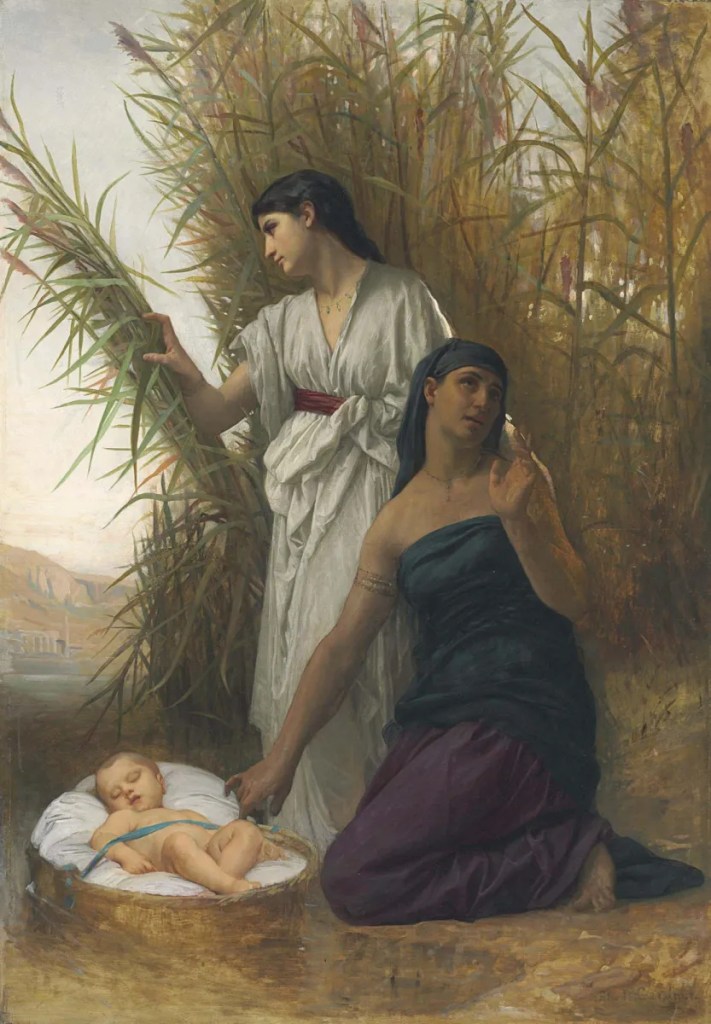
Moses in the Bulrushes – by Elizabeth Jane Gardner
In Exodus, we see the power of silent resistance to turn the tide of history. It is the resistance of righteousness.
Pharaoh, out of fear, has ordered all Hebrew boy babies drowned at birth. But Moses’s mother (Jochebed), aided by his sister (Miriam), silently resists.
A certain man of the house of Levi married a Levite woman, who conceived and bore a son. Seeing that he was a goodly child, she hid him for three months. When she could hide him no longer, she took a papyrus basket, daubed it with bitumen and pitch, and putting the child in it, placed it among the reeds on the river bank. His sister stationed herself at a distance to find out what would happen to him.
Her resistance, though silent, was nonetheless active. Look at all the intricate steps she took to assure the success of her plot.
The resistance cited in Matthew is of a different nature entirely. It reflects a hard heart not a determined heart. It is the resistance of indifference.
Christ Preaching at Capernaum – by Maurycy Gottlieb
Capernaum had become Jesus’s own home town. He had moved there as a young adult in order to begin his ministry after his own neighborhood had rejected him. But despite Jesus’s miracles and witness, Capernaum resisted the call of the Gospel:
Jesus began to reproach the towns where most of his mighty deeds had been done, since they had not repented.
And as for you, Capernaum:
Will you be exalted to heaven? You will go down to the netherworld.
For if the mighty deeds done in your midst had been done in Sodom, it would have remained until this day. But I tell you, it will be more tolerable for the land of Sodom on the day of judgment than for you.
We might find ourselves anywhere in these stories. We all experience resistances within, around, and toward us – sometimes for good reasons, sometimes not. We just have to fill in the blank to imagine all the resistances we are capable of:
I tend to resist ______________________________.
What did you come up with? Maybe some of these?
change
work
quiet
commitment
injustice
direction
strangers
programming
affection
cronyism, and on and on and on……
Jesus wanted to break through the negative resistance of his dearest communities.
Jocebed and her courageous women companions used positive resistance to break through abusive domination.
In our spiritual lives, we must, by prayer and informed reflection, lower our resistance to God’s transforming Word.
We must, at the same time, assume our role in resisting the injustice and violence of our times. Like Jocebed, we might consider our precious world and its peoples as if they were our own children, threatened by fear-blinded tyranny. In that case, what determined steps would we be willing to take to preserve its sacred life?
Poetry: Rosa Parks by Nikki Giovanni
This is for the Pullman Porters who organized when people said they couldn’t. And carried the Pittsburgh Courier and the Chicago Defender to the Black Americans in the South so they would know they were not alone. This is for the Pullman Porters who helped Thurgood Marshall go south and come back north to fight the fight that resulted in Brown v. Board of Education because even though Kansas is west and even though Topeka is the birth- place of Gwendolyn Brooks, who wrote the powerful “The Chicago Defender Sends a Man to Little Rock,” it was the Pullman Porters who whispered to the traveling men both the Blues Men and the “Race” Men so that they both would know what was going on. This is for the Pullman Porters who smiled as if they were happy and laughed like they were tickled when some folks were around and who silently rejoiced in 1954 when the Supreme Court announced its 9—0 decision that “sepa- rate is inherently unequal.” This is for the Pullman Porters who smiled and welcomed a fourteen-year-old boy onto their train in 1955. They noticed his slight limp that he tried to disguise with a doo-wop walk; they noticed his stutter and probably understood why his mother wanted him out of Chicago during the summer when school was out. Fourteen-year-old Black boys with limps and stutters are apt to try to prove themselves in dangerous ways when mothers aren’t around to look after them. So this is for the Pullman Porters who looked over that fourteen-year-old while the train rolled the reverse of the Blues Highway from Chicago to St. Louis to Memphis to Mississippi. This is for the men who kept him safe; and if Emmett Till had been able to stay on a train all summer he would have maybe grown a bit of a paunch, certainly lost his hair, probably have worn bifocals and bounced his grand- children on his knee telling them about his summer riding the rails. But he had to get off the train. And ended up in Money, Mississippi. And was horribly, brutally, inexcusably, and unac- ceptably murdered. This is for the Pullman Porters who, when the sheriff was trying to get the body secretly buried, got Emmett’s body on the northbound train, got his body home to Chicago, where his mother said: I want the world to see what they did to my boy. And this is for all the mothers who cried. And this is for all the people who said Never Again. And this is about Rosa Parks whose feet were not so tired, it had been, after all, an ordi- nary day, until the bus driver gave her the opportunity to make history. This is about Mrs. Rosa Parks from Tuskegee, Alabama, who was also the field secretary of the NAACP. This is about the moment Rosa Parks shouldered her cross, put her worldly goods aside, was willing to sacrifice her life, so that that young man in Money, Mississippi, who had been so well protected by the Pullman Porters, would not have died in vain. When Mrs. Parks said “NO” a passionate movement was begun. No longer would there be a reliance on the law; there was a higher law. When Mrs. Parks brought that light of hers to expose the evil of the system, the sun came and rested on her shoulders bringing the heat and the light of truth. Others would follow Mrs. Parks. Four young men in Greensboro, North Carolina, would also say No. Great voices would be raised singing the praises of God and exhorting us “to forgive those who trespass against us.” But it was the Pullman Porters who safely got Emmett to his granduncle and it was Mrs. Rosa Parks who could not stand that death. And in not being able to stand it. She sat back down.
Today, in God’s Lavish Mercy, Jacob wrestles with an angel and Jesus cures a man muted by demons.
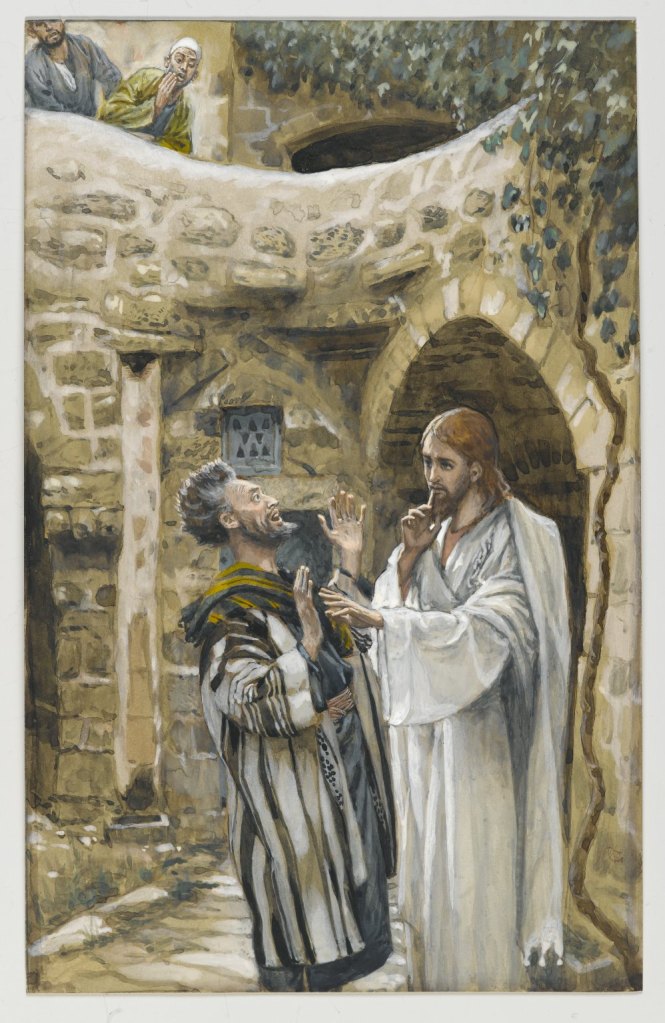
Jesus Cures a Deaf Mute – Tissot Jacob Wrestles with an Angel – Bonnat
Thinking of these two figures this morning, I was reminded of one of my all-time most influential books, “Womanspirit Rising“. In the late 1970s, I first read this now classic anthology of feminist theology. It changed the whole framework of how I saw the world.
A key concept in the collection is a phrase written by theologian Nelle Morton which describes how women, despite the obstructions of patriarchy, can help one another to self-realization by practicing deep listening to one another. Morton calls this ministry:
“hearing one another into speech”
The point is that when our pain and struggles are truly listened to, we can begin to name and explore our own healing.
I think this is exactly what Jesus did for the man muted by demons. Jesus heard this man’s pain before the man could speak it. The Spirit of Jesus was one so attuned to all Creation that he could hear the “Sound beyond sound” within this man’s suffering.
Jesus’ unspoken response to the speechless man is the same that he offers to all of us …. Infinite, Lavish Mercy:
At the sight of the crowds, his heart was moved to breaking for them because they were troubled and abandoned, like sheep without a shepherd.
Matthew 9:32-36
In our Genesis passage, Jacob is fighting his own form of “demons” — one that, in this case, turns out to be an angel, a giver of blessing!
Some man wrestled with him until the break of dawn. When the man saw that he could not prevail over him, he struck Jacob’s hip at its socket, so that the hip socket was wrenched as they wrestled. The man then said, “Let me go, for it is daybreak.” But Jacob said, “I will not let you go until you bless me.” The man asked, “What is your name?” He answered, “Jacob.” Then the man said, “You shall no longer be spoken of as Jacob, but as Israel, because you have contended with divine and human beings and have prevailed.”
Genesis 32:25-29
The entire night’s struggle is executed in silence. It is not until dawn that the combatants speak. Like the Gosple mute, Jacob’s true self is liberated by a silent hearing. As a result, he is blessed with a new identity and a new name – “Israel”.
When we were very young nuns, our Mistress of Postulants was filled with unexpected, old-fashioned wisdom. For example, her recommendation to our vocational doubts was to “sleep on them”. She counseled that “everything looks better in the morning.” Simplistic though it may have sounded, she was right!
Some of the turbulent adjustments, which could not be articulated in the dark hours, found expression and resolve in morning light – when we could see one another clearly and listen heartily to each other’s confusions. Such listening helped to either evaporate the troubles or to suggest a clear path through them.
That early experience was a simple time for me of growing in self-understanding. But it offered a more complex truth – that, not only we, but all the suffering world needs to be “heard into speech“. This is the work of Mercy as we see it so tenderly expressed in today’s Gospel.
In such times of deep listening and new naming, the God of miracles is with us. These times in our lives can help us become deep listeners to the world’s pain, re-christeners of the world’s hope, humble architects of God’s tender design for our wholeness:
For Professor Nelle Morton, the hearing to speech is not just a human phenomenon, but one that occurs because of a prior divine hearing and listening. We are able to hear one another into speech (and thus, perhaps, into full humanity) because we are first heard by “a prior great Listening Ear . . . an ear that hears . . . our own”
Dr. Elaine Graham – Professor of Social and Pastoral Theology at the University of Manchester.
Poetry: Listening – from Rumi
What is the deep listening? Sama is
a greeting from the secret ones inside
the heart, a letter. The branches of
your intelligence grow new leaves in
the wind of this listening. The body
reaches a peace. Rooster sound comes,
reminding you of your love for dawn.
The reed flute and the singer's lips:
the knack of how spirit breathes into
us becomes as simple and ordinary as
eating and drinking. The dead rise with
the pleasure of listening. If someone
can't hear a trumpet melody, sprinkle
dirt on his head and declare him dead.
Listen, and feel the beauty of your
separation, the unsayable absence.
There's a moon inside every human being.
Learn to be companions with it. Give
more of your life to this listening. As
brightness is to time, so you are to
the one who talks to the deep ear in
your chest. I should sell my tongue
and buy a thousand ears when that
one steps near and begins to speak.
Today, in God’s Lavish Mercy, both our readings express a desire for equanimity and reasonableness in our dealings with fellow human beings.
Rich old Abraham and rich young Lot can’t seem to get there unless they move away from each other. As we know from life, that’s sometimes the only and best route to peace (even though Lot ended up in a pretty bad neighborhood!)
Thus they separated from each other; Abram stayed in the land of Canaan, while Lot settled among the cities of the Plain, pitching his tents near Sodom (uh oh!).
Genesis 13:11-12
In our Gospel, Jesus gives us some snippets of common sense and mutuality too:
Do not give what is holy to dogs, or throw your pearls before swine, lest they trample them underfoot, and turn and tear you to pieces.
Do to others whatever you would have them do to you. This is the Law and the Prophets.
Matthew 7: 6;12
However, the even-steven tone of these passages is countered by the Gospel’s closing verse:
Enter through the narrow gate; for the gate is wide and the road broad that leads to destruction, and those who enter through it are many. How narrow the gate and constricted the road that leads to life. And those who find it are few.
Matthew 7:13-14
Jesus seems to be telling us that “even-steven” is not so “easy-peasy”!
It is a huge challenge to live in sacred balance with our sisters and brothers, and with all Creation. That Balance was lost in Eden but redeemed on Calvary. For us to allow its redemption in our own lives, we must live in the pattern of Christ’s sacrificial love. That pattern is “the narrow gate”. May we be among the few who find it!
Poem: The Narrow Way – Anne Brontë, one of the noted three sisters in a famous literary family. Their stories attracted attention for their passion and originality immediately following their publication. Charlotte’s Jane Eyre was the first to know success, while Emily’s Wuthering Heights, Anne’s The Tenant of Wildfell Hall and other works were accepted as masterpieces of literature later. Anne’s famous poem The Narrow Way, while seeped in the weighty tones of Victorian literature, makes a powerful point for any generation. (ref:Wikipedia)
The Narrow Way
Believe not those who say
The upward path is smooth,
Lest thou shouldst stumble in the way,
And faint before the truth.
It is the only road
Unto the realms of joy;
But he who seeks that blest abode
Must all his powers employ.
Bright hopes and pure delights
Upon his course may beam,
And there, amid the sternest heights
The sweetest flowerets gleam.
On all her breezes borne,
Earth yields no scents like those;
But he that dares not grasp the thorn
Should never crave the rose.
Arm—arm thee for the fight!
Cast useless loads away;
Watch through the darkest hours of night,
Toil through the hottest day.
Crush pride into the dust,
Or thou must needs be slack;
And trample down rebellious lust,
Or it will hold thee back.
Seek not thy honor here;
Waive pleasure and renown;
The world’s dread scoff undaunted bear,
And face its deadliest frown.
To labor and to love,
To pardon and endure,
To lift thy heart to God above,
And keep thy conscience pure;
Be this thy constant aim,
Thy hope, thy chief delight;
What matter who should whisper blame,
Or who should scorn or slight?
What matter, if thy God approve,
And if, within thy breast,
Thou feel the comfort of His love,
The earnest of His rest?
Today, in God’s Lavish Mercy, we begin a pilgrimage with the ancient believers who first received God’s call into a community of faith.
Today’s liturgy initiates a seven-week reading of the Pentateuch (the first five books of the Bible), starting with three weeks of Genesis.
Walter Brueggemann, renowned Hebrew Scriptures scholar, writes that Genesis tells the story of two Divine calls:
the call of Creation as God’s handiwork (Genesis 1-11)
the call of the faith community as God’s witness (Genesis 12-50)
Gen. 1—11 concerns the affirmation that God calls the world into being to be God’s faithful world. Gen. 12—50 concerns the affirmation that God calls a special people to be faithfully God’s people. Genesis is a reflection upon and witness to these two calls. It is concerned with the gifts given in these calls, the demands announced in them, and the various responses evoked by them.
Walter Brueggemann – Genesis: Interpretation: A Bible Commentary for Teaching and Preaching
Our three weeks of readings, from Genesis 12 to 50, focus on that second call of the faith community and can offer us graced insights into our life in the Church and in the world.
As Genesis 11 closes, the condition of the world is rather dire. The descendants of Adam and Noah had been wandering around the Middle East, finally trying to settle down in ancient Babylonia. There they decide to build a city and a tower which they think will make them self-sufficient enough to avoid a second flood. God isn’t pleased. God wants them to be faithful and depend on God not themselves.
So the LORD scattered them from there over all the earth, and they stopped building the city. That is why it was called Babel, because there the LORD confused the speech of all the world.
Genesis 11:8-9
Then, in Genesis 12 (our reading today), God reaches into the scattered chaos with an astounding promise for two elderly, barren, and probably hopeless people. It is a call to renewed and deeper relationship, a call that God has been offering again and again since the beginning of time:
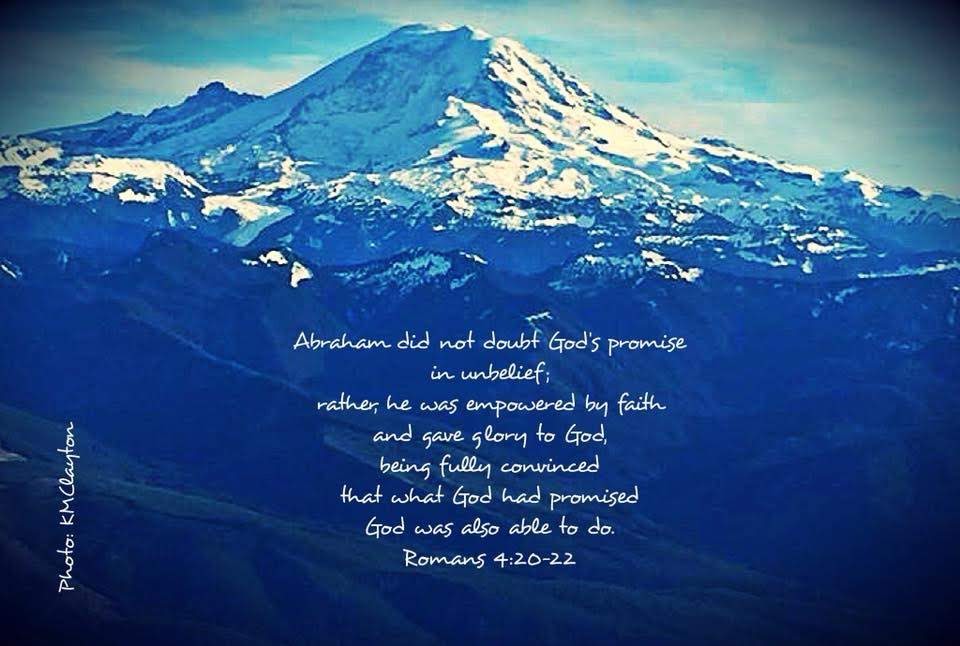
The LORD said to Abram: “Go forth from the land of your kinsfolk and from your father’s house to a land that I will show you.
“I will make of you a great nation, and I will bless you; I will make your name great, so that you will be a blessing. I will bless those who bless you and curse those who curse you. All the communities of the earth shall find blessing in you.”
Genesis 12:1-3
In prayer, we can take any scripture passage and separate its wordy threads to find ourselves. Each one of us, at least at some time in our lives, has been Abraham or Sarah – maybe a little bit alone, confused, feeling disconnected from God and neighbor. Or maybe feeling the weight of aging, tangled in familial labyrinths, or wounded from accumulated miscalculations in our life’s wanderings.
In whatever scattered chaos we may find ourselves, today’s first reading tells us to listen. God’s irrevocable promises are encircling and guiding us to renewed stability. Hearing God’s voice, “Abram went as the LORD directed him”. As we begin these weeks with Genesis, we are invited to do the same.
Poetry: from Selected Poetry of Jessica Powers
    I love Abraham, that old weather-beaten
unwavering nomad; when God called to him,
no tender hand wedged time into his stay.
His faith erupted him into a way
far-off and strange.  How many miles are there
from Ur to Haran?  Where does Canaan lie,
or slow mysterious Egypt sit and wait?
How could he think his ancient thigh would bear
nations, or how consent that Isaac die,
with never an outcry or an anguished prayer?
I think, alas, how I manipulate
dates and decisions, pull apart the dark,
dally with doubts here and with counsels there,
take out old maps and stare.
Was there a call at all, my fears remark.
I cry out: Abraham, old nomad you,
are you my father?  Come to me in pity.
Mine is a far and lonely journey too.














 Lavish Mercy