Parable of the Trees

Wednesday of the Twentieth Week in Ordinary Time
August 23, 2023

Today’s Readings:

https://bible.usccb.org/bible/readings/082323.cfm


Today, in God’s Lavish Mercy, our first reading delivers a powerful message if we can decipher it. The passage, sometimes known as “Jotham’s Fable”, depicts the rise of Jotham’s felonious brother Abimelech as leader of Israel.

Abimelech was a bad guy, and the story of his tenure is so full of treacherous violence that it would be an “X” movie if shown in theaters today. Jotham, the only surviving brother of Abimelech’s fratricide, preaches his fable to warn the people against his murderous brother.

Jotham went to the top of Mount Gerizim and, standing there,
cried out to them in a loud voice:
“Hear me, citizens of Shechem, that God may then hear you!
Once the trees went to anoint a king over themselves.

Judges 9:7-8

Let’s take a look at the fable. What significance might it have for us today?

The fable describes humanized trees who seek a strong leader from among the most revered trees in Israel: the olive, the fig, and the grapevine. Each of the three trees is asked to assume leadership because each has proven honest and true in sustaining the people. However each, when asked, refuses because they are committed to the current success of their own chosen work. As a result, a vacuum of leadership is left. This vacuum allows the “bramble”, a self-absorbed, non-productive weed to slip in and grasp control over the people. It doesn’t turn out well.


Walter Bruggemann interprets the parable in this way:

The point of the parable is not obscure. The parable is simply a clever way to assert that if good people with positive political potential default on governing responsibility, then rule will be exercised by less desirable, more dangerous alternatives. The point is clear; nonetheless there is merit in lining out the parable. Not only is it entertaining in its imagery, but the repetition of patterned speech reinforces the danger and the possibility concerning governance. In the case of this narrative, the parable implies that Abimelech came to power because better candidates refused to have their productive lives interrupted by public responsibility.

It takes no great imagination for us to see the contemporaneity of the parable for us. If responsible people eschew public responsibility, the way is open for those who would misuse power in a governing space.

Walter Brueggemann: “Refusing the Bramble” from churchanew.org

It takes both generous courage and insightful self-examination to answer a call to true leadership which is a ministry of God’s merciful love. Every one of us will hear that call in some way in our lives – not necessarily to be President, Queen, or Pope – but as parent, teacher, coach, counselor, minister, board member, supervisor, or simply a true friend … and all the other ways we have the power to influence another’s life.


On the flip side, it takes reflective awareness to choose and support good leaders. In our complex society, we must be intentional not to be caught in the “brambles” of a self-absorbed wannabe who, like Jotham’s combustible weed, cannot nourish the community. Achieving that awareness is not as easy as it might seem. Potential leaders, at any level, can fool us by subtly appealing to our own unexamined “brambles” – those flashpoints which exploit our fears and prejudices rather than leading to a communally successful way through them.


In our Gospel, Jesus tells us what God’s “leadership” is like. God is like the selfless landowner who meets his people’s need with unmeasured generosity. Whether we come early or late to God’s vineyard, we are fully embraced and rewarded. Jesus’s parable suggests that we should be wary of “leaders” who divide communities into “them” and “us” in order to ration God’s Mercy.

Instead, the Gospel-inspired community is amazingly able to embrace each member at the place where they can best be led to wholeness. A sound, selfless leader is essential to building that kind of community whether it be civic or religious.

In reply, the landowner said to one of the complainers,
‘My friend, I am not cheating you.
Did you not agree with me for the usual daily wage?
Take what is yours and go.
What if I wish to give this last one the same as you?
Or am I not free to do as I wish with my own money?
Are you envious because I am generous?’
Thus, the last will be first, and the first will be last.”

Matthew 20:13-16

Praying with these passages, we might ask for “justice-eyes” and a “mercy-heart” as we navigate our world as both leaders and as those who discern leaders.


Poetry: Nobility by Alice Cary (1820-1871)

True worth is in being, not seeming,-
In doing, each day that goes by,
Some little good, not in the dreaming
Of great things to do by and by.
For whatever men say in their blindness,
And spite of the fancies of youth,
There’s nothing so kingly as kindness,
And nothing so royal as truth.


Music: Song for the Journey – not the greatest music ever written, but still the song captures the message of servant leadership.

Idolatry

Memorial of Saint Pius X, Pope
Monday of the Twentieth Week in Ordinary Time
August 21, 2023

Today’s Readings:

https://bible.usccb.org/bible/readings/082123.cfm


Today, in God’s Lavish Mercy, our two readings connect to remind us of an essential truth: stay faithful to God’s Word in order to live in peace, justice, and joy.


The passage from Judges recounts the topsy-turvy history of Israel around 800 years before Christ. It was a time when various Judges served as leaders before the eventual establishment of the kingdom under Samuel.

The Twelve Judges of Israel (in technicolor!)

These were tough times for Israel. One after another, hostile forces rose against them. During each threat, someone would emerge as a deliverer and, with their heroic success, endure for a while as the Judge.


The writer equates Israel’s ups and downs with God’s pleasure or displeasure with the people. When the people broke faith, God punished them with political turmoil. When the people were repentant, God provided a deliverer.

Of course, this is an overly simplified interpretation of events. By infusing God with the human qualities of anger and appeasement, the writer explains complex history as a simple quid pro quo: You’re bad, you get zapped. You’re good, you get rewarded.


We know that our God does not vacillate between angry punishment and satisfied recompense. God is always loving, forgiving, and nurturing. So what can this passage teach us about our own faith life and the spiritual culture of our times?

I found a key reflection point in the passage’s initial phrase: The children of Israel offended the LORD by serving the Baals.

The “Baals” are false gods erected by those who manipulate “faith” to advance their self-absorbed agendas. In the time of the Judges, these Baals might have been represented by carved idols, or natural phenomena such as the moon or stars. In the end, this idolatry – like all idolatries – rewarded some hidden promoter with money, power, or influence.


But what are the “Baals” of our culture? What is our modern idolatry?

Britannica Dictionary offers this definition of idolatry: “A person becomes guilty of a more subtle idolatry, however, when, although overt acts of adoration are avoided, he attaches to a creature the confidence, loyalty and devotion that properly belong only to the Creator.”

As we pray with this passage, we might look to our own society with its infectious materialism, nationalism, consumerism, racism, sexism. These and other imposed societal shackles serve to bind some in order to exalt others to idol status. As it is with any communicable disease, some of these systems – acknowledged or not – may be lurking within us.


Worship of these “isms” falsly legitimizes:

  • the usurpation of the poor in a credit-bound economic system
    (e.g. how many times have you been offered “revolving credit” which makes money on ever-increasing interest rates)
  • the armed control of the defenseless
    (e.g. the insurmountable influence of the gun lobby to produce weapons of mass destruction despite the repeated massacres of our children)
  • the supersession of the haves over the have-nots
    (e.g. college placement of moneyed descendants over academically superior disadvantaged applicants)
  • the veiled acquiescence to white-advantage
    (e.g. entrenched indifference to colorless board rooms, executive suites, and other decision-making forums)
  • the subtle second-classism toward and objectification of women
    (e.g. the range of systemic oppressions suffered by women, from Taliban terrors and sex trafficking to indefensible Church exclusions)

Our Gospel clearly states the antidote to such idolatry:

Jesus answered the young man:

There is only One who is good.
If you wish to enter into life,

keep the commandments:
(Love God above all things,
and your neighbor as yourself.)

Jesus tells him further that if he wishes to be perfect, he will:

  • dispossess himself of anything that distracts him from God
  • follow Jesus and the Gospel with all his heart

I never read that Gospel without realizing that, just like that young man, I have a lot of work to do on my own often idolatrous soul.


Poetry: Sell All You Have – Malcolm Guite

To whom, exactly, are you speaking Lord?
I take it you’re not saying this to me,
But just to this rich man, or to some saint
Like Francis, or to some community,
The Benedictines maybe, their restraint
Sustains so much. But I can’t bear this word!
I bought the deal, the whole consumer thing,
Signed up and filled my life with all this stuff,
And now you come, when I’ve got everything,
And tell me everything is not enough!
But that one thing I lack, I cannot get.
Sell everything I have? That’s far too hard
I can’t just sell it all… at least not yet,
To whom exactly, are you speaking Lord?

Music: Simple Living (A Rich Young Man) – Keith & Kristyn Getty, Stuart Townend

Remember and Love Generously

Memorial of Saint Clare, Virgin
August 11, 2023
Friday of the Eighteenth Week in Ordinary Time

Today’s Readings:

https://bible.usccb.org/bible/readings/081123.cfm


Today, in God’s Lavish Mercy, our readings continue to take us through Deuteronomy, and for the next two weeks, through Joshua, Judges, and Ruth.

The word “Deuteronomy” means “second law” because the book is a reiteration and refinement of the Law given in Exodus. The Book of Deuteronomy is basically three big speeches by Moses, the commissioning of Joshua as Israel’s next leader, and a recounting of the death of Moses.


Today’s speech is powerful and beautiful. Moses calls on the people to remember and give thanks for the immense blessings they have received at the hand of God.

Ask now of the days of old, before your time,
ever since God created man upon the earth;
ask from one end of the sky to the other:
Did anything so great ever happen before?
Was it ever heard of? 
Did a people ever hear the voice of God
speaking from the midst of fire, as you did, and live?

Deuteronomy 4:32-33

At length, Moses recounts the sacred history of the people and tells them that, because of it, they are called to respond in covenanted fidelity.

This is why you must now know, and fix in your heart,
that the LORD is God in the heavens above and on earth below,
and that there is no other.
You must keep his statutes and commandments which I enjoin on you today,
that you and your children after you may prosper,
and that you may have long life on the land
which the LORD, your God, is giving you forever.”

Deuteronomy 4: 39-40

Moses offered these encouraging and directive speeches because he sensed he was near the end of his life and that Israel was moving into a new phase of its life.

In our Gospel, Jesus feels the same way. In the section immediately preceding today’s reading, Matthew says this:

From that time on, Jesus began to show his disciples that he must go to Jerusalem and suffer greatly from the elders, the chief priests, and the scribes, and be killed and on the third day be raised


In today’s passage, Jesus calls his disciples to live in covenanted fidelity by imitating his life.

Whoever wishes to come after me must deny himself,
take up his cross, and follow me.
For whoever wishes to save his life will lose it,
but whoever loses his life for my sake will find it.
What profit would there be for one to gain the whole world
and forfeit his life?
Or what can one give in exchange for his life?

Matthew 16: 25-26

I’ve read this Gospel passage a thousand times in the past sixty or seventy years. And I ask myself each time, “Do you really take this seriously? Do you really understand that your life is not for yourself but for God and all of God’s beloved creatures?”

It takes radical courage to live that kind of understanding. But continually remembering God’s Presence and Promises throughout our own lives strengthens us. That’s what Moses was trying to tell his people. That’s what Jesus is encouraging his disciples to recognize.

Jesus promises that, at the end of time, each will be repaid according to the level of their generosity. But the repayment doesn’t wait for the end times. Remembering our lives in grateful prayer will convince us of this: there is no true happiness, no deep joy, unless we learn to live beyond our own self-interests.


Poetry: Unless a Grain of Wheat Falls into the Ground and Dies – Malcolm Guite

Oh let me fall as grain to the good earth
And die away from all dry separation,
Die to my sole self, and find new birth
Within that very death, a dark fruition,
Deep in this crowded underground, to learn
The earthy otherness of every other,
To know that nothing is achieved alone
But only where these other fallen gather.

If I bear fruit and break through to bright air,
Then fall upon me with your freeing flail
To shuck this husk and leave me sheer and clear
As heaven-handled Hopkins, that my fall
May be more fruitful and my autumn still
A golden evening where your barns are full.

Music: Unless a Grain of Wheat – Bernadette Farrell


Unless a grain of wheat shall fall upon the ground and die,
it remains but a single grain with no life.

If we have died with him then we shall live with him;
if we hold firm, we shall reign with him.
Unless a grain of wheat shall fall upon the ground and die,
it remains but a single grain with no life.

If anyone serves me then they must follow me;
wherever I am my servants will be.
Unless a grain of wheat shall fall upon the ground and die,
it remains but a single grain with no life.

Make your home in me as I make mine in you;
those who remain in me bear much fruit.
Unless a grain of wheat shall fall upon the ground and die,
it remains but a single grain with no life.

If you remain in me and my word lives in you,
then you will be my disciples.
Unless a grain of wheat shall fall upon the ground and die,
it remains but a single grain with no life.

Those who love me are loved by my Father;
we shall be with them and dwell in them.
Unless a grain of wheat shall fall upon the ground and die,
it remains but a single grain with no life.

Peace I leave with you, my peace I give to you;
peace which the world cannot give is my gift.
Unless a grain of wheat shall fall upon the ground and die,
it remains but a single grain with no life.

But Not Yet

Monday of the Eighteenth Week in Ordinary Time
August 7, 2023

Today’s Readings:

https://bible.usccb.org/bible/readings/080723.cfm


Today, in God’s Lavish Mercy, with passages from Numbers and Deuteronomy, we begin a week and a half of readings that complete our scriptural journey through the Pentateuch.

The Book of Numbers, so named because of the two censuses within it, draws the Exodus journey to a close. The people are nearly at the edge of the Promised Land – but not yet. They are tired and frustrated and they let Moses know it:

The children of Israel lamented,
“Would that we had meat for food!
We remember the fish we used to eat without cost in Egypt,
and the cucumbers, the melons, the leeks,
the onions, and the garlic.
But now we are famished;
we see nothing before us but this manna.”


“Not Yet” is one of the hardest times in a journey. Driving from Philly to Knoxville to visit my family, I marveled at how the last two hours seemed so much longer than the eight which had preceded them! If there are kids in the car, the point is painfully driven home:

Are we there yet? x 1000!= Frustration


In today’s reading, the Israelites frustrate Moses with their “Are we there yet” attitude. Moses begs God to give him a break because his leadership is crumbling in the hungry unrest of the people:

“Why do you treat your servant so badly?” Moses asked the LORD.
“Why are you so displeased with me
that you burden me with all this people?
Was it I who conceived all this people? 
Or was it I who gave them birth,
that you tell me to carry them at my bosom,
like a foster father carrying an infant,
to the land you have promised under oath to their fathers?

Numbers 11:11-12

A core message from today’s Numbers passage is that the people need to be “fed” or they will not continue on the journey. Jesus acknowledges this universal fact in today’s Gospel. The story recounts the miracle of a physical feeding of the crowds, but the real miracle is the resuscitation of their faith because they witness the power of God in Christ.


We, individually and as a Church, need to be fed in order to continue our journey of faith. It is important for each of us to build into our lives those practices which will nourish our faith and spirituality: reflective prayer, enlivening spiritual reading, and merciful service. It is also critical for us to assess the kind of communal nourishment we receive within our faith communities and, where that nourishment is lacking, to acknowledge distress and seek alternatives as the hungry Israelites did in the desert.

Recently I was with a group of deeply faithful Christians where this shocking phrase was spoken and acknowledged: “The Catholic Church is dead“. What the phrase connotes is that, in light of the clerical abuse and other institutional scandals, coupled with the absence of inspirational Church leadership, many Catholics are starving for nourishment on the journey. Clearly, the same may be said of other Christian Churches.


To varying degrees, we may be familiar with the Synod 2021-24 initiated by Pope Francis in October 2021.

The word synod comes from the Greek: σύνοδος [ˈsinoðos], meaning “assembly” or “meeting”; the term is analogous with the Latin word concilium meaning “council”.

The word synod comes from the Greek meaning “assembly” or “meeting”; the term is analogous with the Latin word concilium meaning “council”.

Traditionally, we are familiar with such gatherings being constituted primarily by the hierarchy of the Church. Synod 2021-24 is different.


The Synod on Synodality represents a new and exciting phase in the life of the Church. This phase deepens the ecclesiology of the People of God developed at the Second Vatican Council and invites us to generate processes of conversion and reform of relationships, communicative dynamics and structures in the Church. This will require a process of common discernment and formation in the short, medium and long term to stimulate the awareness of a Church lived and understood in a synodal key.

Boston College – School of Theology and Ministry

Many of us are old enough to remember the intense enthusiasm and hope which sprang from the Second Vatican Council a half-century ago. The inspired Vatican II documents fueled a dynamic revitalization for the People of God.

But over the course of 5o years, the Church’s landscape has changed:

  • plummeting numbers in religious and priestly vocations
  • scars from the sexual abuse scandal
  • misalignment between practice and teaching on sexuality, gender, and marriage
  • disaffection of women and young adults with the Church
  • widespread persecution of the missionary Church in totalitarian and extremist Islamic states

These are issues that must be addressed by the whole Church acting in a synodal manner similar to that of the inaugural Christian community:

At that time, as the number of disciples continued to grow, the Hellenists complained against the Hebrews because their widows were being neglected in the daily distribution.

So the Twelve called together the community of the disciples and said, “It is not right for us to neglect the word of God to serve at table.* Select from among you seven reputable disciples, filled with the Spirit and wisdom, whom we shall appoint to this task.

… The proposal was acceptable to the whole community.

Acts 6:1-5

The aim of the current synodal process is not to provide a temporary or one-time experience of synodality, but rather to provide an opportunity for the entire People of God to discern together how to move forward on the path towards being a more synodal Church in the long-term.
A basic question prompts and guides us: How does this journeying together allow the Church to proclaim the Gospel in accordance with the mission entrusted to Her; and what steps does the Spirit invite us to take in order to grow as a synodal Church?

Vatican Commentary on the Synodal Process

The prayers, participation, and support of faithful people are critical to the success of this Synod because it is truly a synod of the people. It is important for us to pray for the Church, for the Pope, and assess the level of our own contribution to the life of the community. I know I need to take my awareness and attention up a notch, and I thought perhaps some of my readers might too. Many of us may look to this synod as the sign of hope we need in deeply challenging times.


Prose: from Pope Francis on World Youth Day

We recall that the purpose of the Synod 
is not to produce documents,
but to plant dreams,
draw forth prophecies and visions,
allow hope to flourish,
inspire trust,
bind up wounds,
weave together relationships,
awaken a dawn of hope,
learn from one another
and create a bright resourcefulness
that will enlighten minds, warm hearts,
give strength to our hands.

Music: I Am the Bread of Life – Suzanne Toolan, RSM

Outside the Lines

Memorial of Saint John Vianney, Priest
Friday of the Seventeenth Week in Ordinary Time
August 4, 2023

Today’s Readings:

https://bible.usccb.org/bible/readings/080423.cfm


Today, in God’s Lavish Mercy, we dip our toes into the Book of Leviticus which is basically a set of instructions on how to live a good life.

Leviticus 23 establishes five holy times of prayer, reflection, and action for the people to grow in friendship with God.

  • the Sabbath (vv. 1–3)
  • the Feast of the Unleavened Bread, or Passover (vv. 4–14)
  • the Feast of Weeks, or Pentecost (vv. 15–23);
  • on the Day of Atonement (vv. 26-32)
  • the Feast of the Tabernacles (vv.33-44)

As Christians, we may be more familiar with Sabbath and Passover because their patterns are embodied in our Sunday and Easter celebrations. In the other less familiar feasts, we might recognize harvest sharing (Weeks), repentance (Atonement), reflection and recommitment (Tabernacles).


The Book of Leviticus is a formation manual for Israel’s spiritual life. Realizing that fact this morning, I thought about my Novitiate and early formation experiences in religious life. Readers who are religious sisters or brothers might share my experience, and those who are lay can probably think of their own comparisons. What were our earliest steps in our journey into God?

I wasn’t completely clueless when I came to the convent at 18 years of age. I did have a vigorous spiritual life and a deep desire to grow in relationship with God. What I needed was spiritual discipline and a quiet reverence in my whole being. And, in those early years, I received abundant amounts of both from multiple sources. It was my “Leviticus Time”.


But our “Leviticus Time” is only a launchpad. If we refuse to leave it, we will never fly. What we must move on to is a personal relationship with God, grounded in loving faith and Gospel commitment. While enhanced by exterior resources, the power of that relationship springs from an interior intimacy with God, as realized so clearly by our saint for today, John Vianney.


Today’s Gospel shows us a group of people unable to take that next step – beyond rules and practices into committed relationship. (“beyond” not “without” rules and practices – more on that in tomorrow’s reflection)

Jesus came to his native place and taught the people in their synagogue.
They were astonished and said,
“Where did this man get such wisdom and mighty deeds?
Is he not the carpenter’s son?
Is not his mother named Mary
and his brothers James, Joseph, Simon, and Judas?
Are not his sisters all with us?
Where did this man get all this?”
And they took offense at him.
But Jesus said to them,
“A prophet is not without honor except in his native place
and in his own house.”
And he did not work many mighty deeds there
because of their lack of faith.

Matthew 13:54-58

This is such a sad Gospel! Here God was right in the midst of these people! They could see him and hear him. He personally invited them to believe. But they refused to see God in Jesus. All they could see was their stagnated prejudgments and inert definitions.

These were probably good people. They more than likely kept all the Leviticus regulations. They colored within the lines, so to speak. Then Jesus came and asked them to step outside the lines. He asked them to believe that the poor are blessed and the persecuted happy. He asked them to cast their nets again into a sea that had denied them all night. He asked them to walk to him across the water. He asked them to sell everything they had and follow. He asked them to fall into the ground and die, as he would.

Only a courageous few set their safe scroll of Leviticus aside to give Jesus a wholehearted “Yes”.

What might we have done — what are we doing — when Jesus invites us outside the lines?


Poetry: Of Being – Denise Levertov

I know this happiness
is provisional:

the looming presences --
great suffering, great fear --

withdraw only
into peripheral vision:
but ineluctable this shimmering
of wind in the blue leaves:
this flood of stillness
widening the lake of sky:
this need to dance,
this need to kneel:
this mystery:

Music: Only You

Something a little different this morning – a picture to contemplate while you listen to a beautiful song. Just click the little white arrowhead in the grey bar below. Let the song take you where it will in your own spiritual landscape.

image by David Mark from Pixabay

Shekhinah – Indwelling Presence

Thursday of the Seventeenth Week in Ordinary Time
August 3, 2023

Today’s Readings:

https://bible.usccb.org/bible/readings/080323.cfm


Today, in God’s Lavish Mercy, our scripture passages focus on how God dwells with us and calls us to ever greater intimacy.

In Exodus, Moses meticulously performs God’s instructions to build a holy dwelling place – the Ark of the Covenant. When Moses’s work is finished, God settles in among the Israelites and begins the new work of leading them to the promised land. It is a “Finished. What’s Next” scenario.

The “next” is this: by manipulating a visible cloud, God signals when it is time to rest and when it is time to move forward on the journey.

Whenever the cloud rose from the Dwelling,
the children of Israel would set out on their journey.
But if the cloud did not lift, they would not go forward;
only when it lifted did they go forward.

Exodus 40:35-36

Verse 33, not included in today’s selection, says this:

Finally, Moses set up the court around the tabernacle and the altar and hung the curtain at the gate of the court.
Thus Moses finished all the work.

Exodus 40:33

The italicized phrase should ring a bell with us. It is reminiscent of this familiar phrase in Genesis:

By the seventh day God had finished the work he had been doing; so on the seventh day he rested from all his work.

Genesis 2:2

And it is predictive of this solemn phrase in John’s Gospel:

When he had received the sour wine, Jesus said, ‘It is finished,’ and he bowed his head and gave up his spirit.

John 19:30

Praying with Exodus today, we might consider how God continually finishes chapters in history and in our lives. With each completion, a new dynamic is initiated which reveals God’s deeper Presence to us. If our hearts are open, God always invites us deeper – that is the journey.


God enacts this ever-renewing revelation in the Scriptures as well as in our lives.

  • In Genesis, God comes to dwell in the Creation.
  • In Exodus, God comes to dwell in Presence.
  • In the Incarnation, God comes to dwell in our flesh.
  • In Pentecost, God comes to dwell in our spirits, giving us the capabilty of opening ourselves to the inexhaustible bounty of God’s Love.

God keeps coming to us anew, not with a new Face, but with a Face that, earlier, we may not have had the depth to recognize.


A word from the Hebrew, first encountered in ancient rabbinic literature, captures the concept of the eternal generative Presence dwelling among us: Shekhinah. The word means “dwelling” or “settling” and denotes the presence of God, as it were, in a particular place.


In today’s Gospel passage, Jesus finishes a significant chapter of his ministry. In five succinct parables, Jesus has painted a picture of our “next” – the Kingdom of Heaven.

  • the mustard seed
  • yeast
  • the hidden treasure
  • the merchant
  • the net

Image by chanwit whanset from Pixabay


Closing today’s lesson, Jesus charges the future teachers of the faith to remember the whole history of God’s indwelling as they guide the people to God’s penultimate revelation. As we move forward to a Parousia we can only imagine, we can be encouraged and consoled by the stories of God’s Presence in the past, and imaged for us in the parables.

“Then every scribe who has been instructed in the Kingdom of heaven
is like the head of a household who brings from his storeroom
both the new and the old.”

Matthew 13:52

Image by chanwit whanset from Pixabay


Before today, we may never have thought of ourselves as God’s “scribes”. But just as God used our first parents, and Moses, and the early disciples, God is using us to write the current and future story of God’s love for all Creation.

The chapter with your name will not be included in the Bible, but it will be written large in the Book of Life. It will be read by those who love you, depend on you, work with you, or need you. Each of our lives, in its own way, is a scipture for our times.


Poetry: Wellfleet Shabbat – Marge Piercy

The hawk eye of the sun slowly shuts.
The breast of the bay is softly feathered
dove grey. The sky is barred like the sand
when the tide trickles out.

The great doors of Shabbat are swinging
open over the ocean, loosing the moon
floating up slow distorted vast, a copper
balloon just sailing free.

The wind slides over the waves, patting
them with its giant hand, and the sea
stretches its muscles in the deep,
purrs and rolls over.

The sweet beeswax candles flicker
and sigh, standing between the phlox
and the roast chicken. The wine shines
its red lantern of joy.

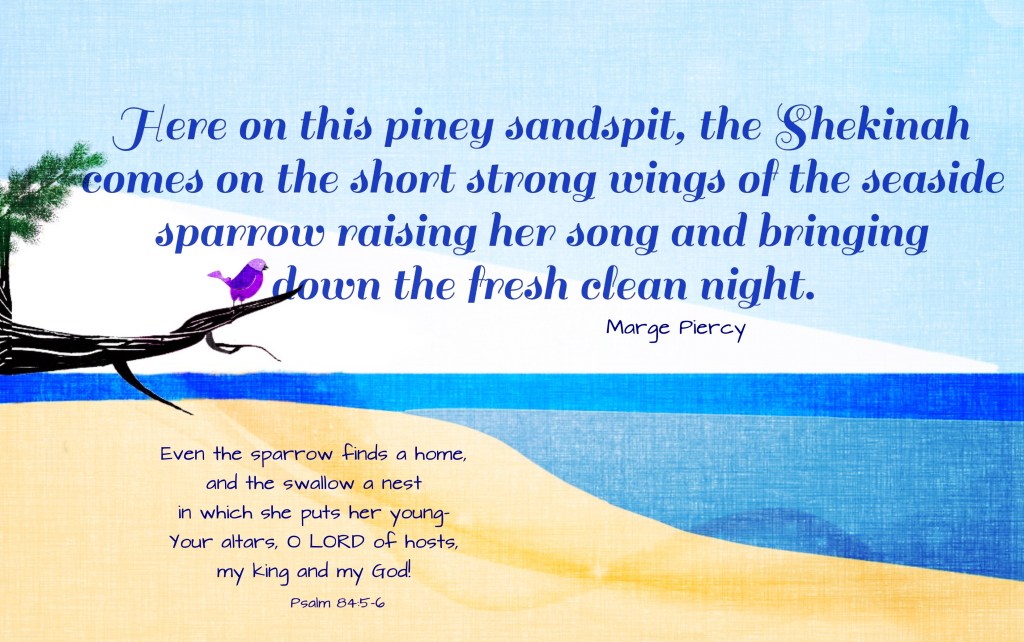
Here on this piney sandspit, the Shekinah
comes on the short strong wings of the seaside
sparrow raising her song and bringing
down the fresh clean night.

Music: Dwelling Place – John Foley, SJ

Shine!

Wednesday of the Seventeenth Week in Ordinary Time
August 2, 2023

Today’s Readings:

https://bible.usccb.org/bible/readings/080223.cfm


Today, in God’s Lavish Mercy, Moses descends the mountain and returns to the people, his face shining with the glory of God.

As Moses came down from Mount Sinai
with the two tablets of the commandments in his hands,
he did not know that the skin of his face had become radiant
while he conversed with the LORD.

Exodus 34:29

Moses’s appearance frightened the Israelites. They weren’t accustomed to being this close to “The God Effect”. Moses had to veil his face until the people became a little more comfortable with his transformed self.


People who are close to God do have a certain “shine”. I know, because I live with a houseful of them! Most of these wonderful women are well into their years, and will moan occasionally about their ever-increasing wrinkles. Like most of us, they don’t see their own beauty, nor the fact that an inimitable loveliness radiates from their fundamental goodness.


Once again in today’s Gospel, as in this past Sunday’s, Jesus encourages his followers to live in that irradiating Presence. Finding that Presence is like finding a treasure or a pearl of great price. The Gospel searcher is filled with abundant “joy” upon the discovery. That joy, no doubt, lit up that finder the way Moses was fired by God’s Glory.


We all want to have that kind of joy. It is the true fulfillment of life. Jesus wants us to have it too as recorded in today’s Alleluia Verse:

I call you my friends, says the Lord,
for I have made known to you all that the Father has told me.

John 15:15

By studying, praying with, and imitating the life of Christ, we too – like the moon emblazoned by the Sun – will come to reflect an Immense Love.


Poetry: As Kingfishers Catch Fire – Gerard Manley Hopkins

As kingfishers catch fire, dragonflies draw flame;
As tumbled over rim in roundy wells
Stones ring; like each tucked string tells, each hung bell's
Bow swung finds tongue to fling out broad its name;
Each mortal thing does one thing and the same:
Deals out that being indoors each one dwells;
Selves — goes itself; myself it speaks and spells,
Crying Whát I dó is me: for that I came.
I say móre: the just man justices;
Keeps grace: thát keeps all his goings graces;
Acts in God's eye what in God's eye he is —
Chríst — for Christ plays in ten thousand places,
Lovely in limbs, and lovely in eyes not his
To the Father through the features of men's faces.

Music: Variations on a Theme From Pachelbel’s Canon in D Major – David Lanz

Thunderous Son!

Feast of Saint James, Apostle
July 25, 2023

Today’s Readings:

https://bible.usccb.org/bible/readings/072523.cfm


Today, in God’s Lavish Mercy, we celebrate St. James the Greater. As you know, there were two Aposltes named James. It can get confusing. I know because about half the men in my family are named James. It’s hard to call out to one of them at a family reunion because four or five people will answer when you yell, “Hey, Jim!”

So tradition has solved the St. James name problem by designating one as “the Greater” and one as “the Less”, descriptors based on age not importance. Today we celebrate James the Greater.


Mary Salome and Zebedee with Sons James and John
according to Hans Seuss Kolmback – c.1511
(Love the hat, or what? And, baby John is already holding the “cup”!)


James and his brother John were sons of Zebedee. In Mark 17, Jesus nicknames the two of them “Sons of Thunder”, so he must have had some early insight into their fiery nature. That nature was clearly displayed after the Transfiguration when Jesus began his final journey to Jerusalem. He had sent the disciples ahead to prepare an overnight stay in a Samaritan village, but the villagers rejected Jesus. This made the Zebedee boys mad so they asked Jesus:

… the people there did not welcome him, because he was heading for Jerusalem. 
When the disciples James and John saw this, they asked,
“Lord, do you want us to call fire down from heaven to destroy them?” 
But Jesus turned and rebuked them.
Then he and his disciples went to another village.

Luke 9:53-56

You know what, I really like these guys! James and his brother John were all-in to Jesus and the Gospel. Their thundery enthusiasm got convoluted at times but, by word and example, Jesus continued to redirect their immense energy toward God’s Will.

I like their mother too. She had her own kind of fire and wanted the best for her boys as today’s Gospel indicates:

The mother of the sons of Zebedee approached Jesus with her sons
and did him homage, wishing to ask him for something.
He said to her,
“What do you wish?”
She answered him,
“Command that these two sons of mine sit,
one at your right and the other at your left, in your Kingdom.”

Matthew 20:20-21

With a surface reading of this passage, we might consider Mrs. Zebedee a little dense or arrogant. But Jesus simply responded by reminding her that her sons too, like him, would experience suffering before any heavenly reward.

The Gospel does not record Mrs. Zebedee’s response, whether she was miffed, chastened, frightened, or apologetic. What later chapters do record is that she got the message and embraced it. Of all the disciples she, with only a few other brave women and her boy John, showed up at the foot of the cross.

Where our man James the Greater was on that Good Friday we do not know. But he certainly stuck with Jesus in the long run.


The Zebedee Family, with its many Gospel appearances, can teach us so much about relationship with Jesus, about maturing slowly – sometimes haltingly – in Gospel faith, and about long-term fidelity to God’s Will. Let us pray with them today.


Poetry: from The Parables of Our Lord and Savior Jesus Christ, c.1763

PARABLE LXIII.

The two Sons of Zebedee.
The spouse of Zebedee, that bare
The sons of Thunder, made a pray'r,
As she to Christ adoring came;
And Jesus said, What would the dame?
‘Grant me, O Lord, that either son
‘Be with thee in thy kingdom; one
‘Upon thy right hand to appear,
‘The other on the left as near.’
But Jesus answer'd their desire,
‘Ye know not what ye would require.
‘Do ye yourselves of strength believe.
‘The cup I drink of to receive?
‘And in that baptism be baptiz'd,
‘Which is for Christ himself devis'd?’
O Lord, we do, they answer make.
‘Ye shall indeed my cup partake,
‘Be baptiz'd in my baptism too;
‘But 'tis not of my gifts to you,
‘On right or left to place, but theirs
‘For whom my heav'nly Sire prepares’
But when this thing was told the ten,
They were enrag'd at both the men:
But Jesus call'd them all, and said,
‘Ye know the Gentiles chuse a HEAD,
‘And that great prince that holds the reins,
‘Will plead a merit for his pains:
‘But with you it shall not be so;
‘Who would be great, he shall be low,
‘And he th'aspiring chief of all
‘A lord at ev'ry servant's call.
‘'Tis with the Son of Man the same,
‘To serve, and not be serv'd, he came;
‘A minister of no esteem,
‘Which dies the myriads to redeem.’
When Christ the multitudes had fed
With God's good fishes and his bread,
At once so great was his renown,
The people proffer'd him a crown,
From which in haste the Lord withdrew
To better points he had in view.
Christians must honour and obey
Such men as bear the sov'reign sway.
But, in respect of each to each,
The Lord and his apostles teach,
That we should neither load nor bind,
But be distributive and kind

Music: Congaudeant Catholici from the Codex Calixtinus – Music for the Feast of St. James the Apostle

The Codex Calixtinus (or Codex Compostellus) is a manuscript that is the main element of the 12th-century Liber Sancti Jacobi (‘Book of Saint James’), a pseudepigraph whose likely author is the French scholar Aymeric Picaud. The codex was intended as an anthology of background detail and advice for pilgrims following the Way of Saint James to the shrine of the apostle Saint James the Great, located in the cathedral of Santiago de Compostela, Galicia. The collection includes sermons, reports of miracles and liturgical texts associated with Saint James, and a set of polyphonic musical pieces. In it are also found descriptions of the route, works of art to be seen along the way, and the customs of the local people.

Three parts of the Codex Calixtinus include music: Book I, Appendix I, and Appendix II. These passages are of great interest to musicologists as they include early examples of polyphony. (Wikipedia)

Today’s selection is the Congaudeant Catholici. I could not find an English translation of the lyrics but, for the Latin scholars reading here, go to it with the text below! For the rest of us, it’s just a beautiful ancient melody to pray with.

Latin text

Congaudeant catholici,
letentur cives celici

Refrain: die ista

Clerus pulcris carminibus
studeat atque cantibus.

Hec est dies laudabilis,
divina luce nobilis.

Vincens herodis gladium,
accepit vite bravium.

Qua iacobus palatia,
ascendit ad celestia.

Ergo carenti termino
benedicamus domino.

Magno patri familias
solvamus laudis gratias.

No Sign Will Be Given Except…..

Monday of the Sixteenth Week in Ordinary Time
July 24, 2023

Today’s Reading:

https://bible.usccb.org/bible/readings/072423.cfm


Today, in God’s Lavish Mercy, Jesus is pestered by scribes and Pharisees who want him to prove himself by a sign.

Jesus answers their jibing in a kind of spiritual code.

Some of the scribes and Pharisees said to Jesus,
“Teacher, we wish to see a sign from you.”
He said to them in reply,
“An evil and unfaithful generation seeks a sign,
but no sign will be given it
except the sign of Jonah the prophet.
Just as Jonah was in the belly of the whale three days and three nights,
so will the Son of Man be in the heart of the earth
three days and three nights.

Matthew 12:38-40

So what exactly is “The Sign of Jonah”? Sounds like the title of a Dan Brown novel, doesn’t it?

Well, it is the title of a wonderful book, but not one by Dan Brown.


When I was in high school, I was obsessed with the writings of Thomas Merton. The fire was ignited by my freshman homeroom teacher who gave me a copy of his “Seeds of Contemplation” — another book that changed my life. Inspired by that first read, I slowly made my way through Seven Storey Mountain, No Man is an Island, Thoughts in Solitude … finally coming, in a veil of limited understanding, to “The Sign of Jonas”.

I didn’t understand the title. What I did begin to understand, as Merton journaled his daily life in the Abbey of Gethsemane, was that we discover God not by any external revelation or intellectual acquisition, but by our choices for love in the pattern of Jesus.

In today’s Gospel, the scribes and Pharisees seek an external demonstration that Jesus is all powerful. But their seeking is an insincere attempt at self-satisfaction, not a choice for Gospel love.


So what does Jonah have to do with the Pharisees’ insincerity? Jonah, given a mission by God, could not initially align himself with God’s call. At God’s irresistable invitation, Jonah spent three days of solitude in a whale’s belly contemplating his circumstances. By the graces gained in his solitude, Jonah emerged as a prophet for God.


As recounted in his book, the whale’s belly for Merton was his life in Gethsemane Abbey where he found the profound meaning and deep awareness of his vocation.

Let me rest in Your will and be silent.
Then the light of Your joy will warm my life.
Its fire will burn in my heart
and shine for Your glory.
This is what I live for. Amen, amen.


It may not sound all that inviting, but every one of us is called to the “whale’s belly”. Our transformation there is accomplished by our congruity with Christ’s sojourn in the tomb. Like Jesus, we must die to self for the sake of others. Like Jonah, we must abandon our fears and conveniences to become signs of God’s love in the world.


The Pharisees didn’t get it. And, God help them, I understand. It’s hard to get it! Life seems so much easier if we run away from this deep call like Jonah did at first. But the call remains: to be God’s Word in the world – to “shine for God’s glory“.


The editorial staff of the National Catholic Reporter wrote this about Merton’s Sign of Jonas:

Thomas Merton wrote in his early journals that the “sign of Jonas” — the mystery of Christ’s death and resurrection — is “burned into the roots of our being.” Sooner or later, everyone faces the universal truth that only through death to self do we find life. Merton embraced this sign and described himself as one like Jonah, because “I find myself traveling toward my destiny in the belly of a paradox.”


We may need to choose a little “whale-belly” time to get our hearts straight with this astounding yet universal call to be “for God” in our paradoxical world.


Poetry: two poems from “You! Jonah!” by Thomas John Carlisle

THE GREAT INTRUDER
It is exasperating
to be called
so persistently
when the last thing
we want to do
is get up and go
but God
elects
to keep on
haunting
like some
holy ghost.

———————–

COMING AROUND
And Jonah stalked
to his shaded seat
and waited for God
to come around
to his way of thinking.
And God is still waiting
for a host of Jonahs
in their comfortable houses
to come around
to His way of loving.

Music: Jonah and the Whale – Louis Armstrong – lyrics below

Jonah was a man who got a word from the Lord
Go and preach the Gospel to the sinful land‿
But he got on a ship and he tried to get away
And he ran into a storm in the middle of the sea

Now the Lord, He made the waves just roll so high
The ship begin to sink and they all begin to cry
So they pulled ole Jonah out of the hole
And they jumped him in the water just to lighten up the load

Now the Lord made a whale, long and wide Lord, Lord waddnat a fish
And he swallowed up Jonah, hair and hide Lord, Lord waddnat a fish,
Mmm, Lord, mmm, Lord

Now Jonah started to pray in the belly of the whale
Lord, Lord waddnat a fish
He repented of his sins like a man in jail
Lord, Lord waddnat a fish
Mmm, Lord, mmm, Lord

Now Jonah must o’ been a bad man, he must o’ been a sinner
Lord, Lord waddnat a fish
Cos when the whale got him down, he didn’t like his dinner
Lord, Lord waddnat a fish
Mmm, Lord, mmm, Lord

Well he swum around the ocean, sick as he could be
Lord, Lord waddnat a fish
And after three days, whoops! he had to set him free
Lord, Lord waddnat a fish, mmm

So the whale spit Jonah out onto dry land
Lord, Lord waddnat a fish
And went on to preaching like a righteous man
Lord, Lord waddnat a fish

Then the people quit their sins when they heard him the town
Lord, Lord waddnat a fish
So when you hear the call, don’t you turn the Gospel down
Lord, Lord waddnat a fish, mmm?

Magdalene, Disciple of Christ

Feast of Saint Mary Magdalene
July 22, 2023

Today’s Readings:

https://bible.usccb.org/bible/readings/072223.cfm


(This is a “repeat post”, but I think it’s worth the repeat. I hope you agree.)

Today, in God’s Lavish Mercy, we pray with St. Mary Magdalene, disciple of Christ.

Massimo_Stanzione,_Mary-Magdalene_in_meditation
Magdalen in Meditation by Massimo Stanzione

Modern scripture scholarship recognizes Mary Magdalene as a disciple and companion of Jesus.  She is present in stories throughout all four Gospels, and most notably, as one who remained with Jesus at the foot of the Cross. Mary is the first witness to the Resurrection who then announces the Good News to the other disciples.

Over the centuries, Mary Magdalene has been confused with the many other Marys in the Gospel, as well as with the unnamed repentant woman who washes Jesus’ feet with her tears. These confusions have inclined us to think of Mary Magdalene as a reformed prostitute. This erroneous concept has supported a diminished understanding of the role of women in the ministry of Jesus and done a huge disservice to Mary’s vital role as beloved disciple.

The Gospel passage for the feast captures the powerful moment when the Resurrected Jesus is first revealed to the world. The scene also portrays the deep love, trust and friendship between Jesus and Mary Magdalene – a relationship which serves as a model for all of us who want to be Christ’s disciples. I imagined the scene like this in an earlier Easter reflection:

 Rabbouni

 The Upper Room on Holy Saturday evening: a place filled with sadness, silence and seeking. Jesus was dead. Jerusalem, scattered to their various houses to keep Shabbat, murmur their shocked questions under their shaky prayers.

 We have all been in rooms like this. They enclose a special kind of agony – one teetering between hope and doubt, between loss and restoration. It may have been a surgical waiting room or the hallway outside the courtroom. Sometimes, such a space is not bricks and mortar.  It is the space between a sealed envelope and the news inside. It is the hesitant pause between a heartfelt request and the critical response. In each of these places, we exist as if in a held breath, hoping against hope for life, freedom, and wholeness.

 It was from such a room that Mary Magdalene stole away in the wee hours. A woman unafraid of loneliness, she walked in tearful prayer along the path to Jesus’ tomb. Scent of jasmine rose up on the early morning mist. Hope rose with it that his vow to return might be true. Then she saw the gaping tomb, the alarm that thieves had stolen him to sabotage his promise. She ran to the emptiness seeking him. She was met by angels clothed in light and glory, but they were not enough to soothe her.

 Turning from them, she bumped against a gardener whom she begged for word of Jesus, just so she might tend to him again. A single word revealed his glory, “Mary”. He spoke her name in love.

 As we seek the assurance of God’s presence in our lives, we too may be unaware that God is already with us. The deep listening of our spirit, dulled with daily burdens, may not hear our name lovingly spoken in the circumstances of our lives. God is standing behind every moment. All we need do is turn to recognize him.

 Turn anger into understanding. Turn vengeance into forgiveness. Turn entitlement into gratitude. Turn indifference into love. All we need do is turn to recognize him.


For a comprehensive and enlightening lecture on the current theological and scriptural thinking on Mary Magdalen, follow this link to an Elizabeth Johnson, CSJ lecture at Fordham.

Click here for lecture


Music: I Know That My Redeemer Liveth