Today, in God’s Lavish Mercy, Moses descends the mountain and returns to the people, his face shining with the glory of God.
As Moses came down from Mount Sinai with the two tablets of the commandments in his hands, he did not know that the skin of his face had become radiant while he conversed with the LORD.
Exodus 34:29
Moses’s appearance frightened the Israelites. They weren’t accustomed to being this close to “The God Effect”. Moses had to veil his face until the people became a little more comfortable with his transformed self.
People who are close to God do have a certain “shine”. I know, because I live with a houseful of them! Most of these wonderful women are well into their years, and will moan occasionally about their ever-increasing wrinkles. Like most of us, they don’t see their own beauty, nor the fact that an inimitable loveliness radiates from their fundamental goodness.
Once again in today’s Gospel, as in this past Sunday’s, Jesus encourages his followers to live in that irradiating Presence. Finding that Presence is like finding a treasure or a pearl of great price. The Gospel searcher is filled with abundant “joy” upon the discovery. That joy, no doubt, lit up that finder the way Moses was fired by God’s Glory.
We all want to have that kind of joy. It is the true fulfillment of life. Jesus wants us to have it too as recorded in today’s Alleluia Verse:
I call you my friends, says the Lord, for I have made known to you all that the Father has told me.
John 15:15
By studying, praying with, and imitating the life of Christ, we too – like the moon emblazoned by the Sun – will come to reflect an Immense Love.
Poetry: As Kingfishers Catch Fire – Gerard Manley Hopkins
As kingfishers catch fire, dragonflies draw flame;
As tumbled over rim in roundy wells
Stones ring; like each tucked string tells, each hung bell's
Bow swung finds tongue to fling out broad its name;
Each mortal thing does one thing and the same:
Deals out that being indoors each one dwells;
Selves — goes itself; myself it speaks and spells,
Crying Whát I dó is me: for that I came.
I say móre: the just man justices;
Keeps grace: thát keeps all his goings graces;
Acts in God's eye what in God's eye he is —
Chríst — for Christ plays in ten thousand places,
Lovely in limbs, and lovely in eyes not his
To the Father through the features of men's faces.
Music: Variations on a Theme From Pachelbel’s Canon in D Major – David Lanz
Today, in God’s Lavish Mercy, we celebrate St. James the Greater. As you know, there were two Aposltes named James. It can get confusing. I know because about half the men in my family are named James. It’s hard to call out to one of them at a family reunion because four or five people will answer when you yell, “Hey, Jim!”
So tradition has solved the St. James name problem by designating one as “the Greater” and one as “the Less”, descriptors based on age not importance. Today we celebrate James the Greater.
Mary Salome and Zebedee with Sons James and John according to Hans Seuss Kolmback – c.1511 (Love the hat, or what? And, baby John is already holding the “cup”!)
James and his brother John were sons of Zebedee. In Mark 17, Jesus nicknames the two of them “Sons of Thunder”, so he must have had some early insight into their fiery nature. That nature was clearly displayed after the Transfiguration when Jesus began his final journey to Jerusalem. He had sent the disciples ahead to prepare an overnight stay in a Samaritan village, but the villagers rejected Jesus. This made the Zebedee boys mad so they asked Jesus:
… the people there did not welcome him, because he was heading for Jerusalem. When the disciples James and John saw this, they asked, “Lord, do you want us to call fire down from heaven to destroy them?” But Jesus turned and rebuked them. Then he and his disciples went to another village.
Luke 9:53-56
You know what, I really like these guys! James and his brother John were all-in to Jesus and the Gospel. Their thundery enthusiasm got convoluted at times but, by word and example, Jesus continued to redirect their immense energy toward God’s Will.
I like their mother too. She had her own kind of fire and wanted the best for her boys as today’s Gospel indicates:
The mother of the sons of Zebedee approached Jesus with her sons and did him homage, wishing to ask him for something. He said to her, “What do you wish?” She answered him, “Command that these two sons of mine sit, one at your right and the other at your left, in your Kingdom.”
Matthew 20:20-21
With a surface reading of this passage, we might consider Mrs. Zebedee a little dense or arrogant. But Jesus simply responded by reminding her that her sons too, like him, would experience suffering before any heavenly reward.
The Gospel does not record Mrs. Zebedee’s response, whether she was miffed, chastened, frightened, or apologetic. What later chapters do record is that she got the message and embraced it. Of all the disciples she, with only a few other brave women and her boy John, showed up at the foot of the cross.
Where our man James the Greater was on that Good Friday we do not know. But he certainly stuck with Jesus in the long run.
The Zebedee Family, with its many Gospel appearances, can teach us so much about relationship with Jesus, about maturing slowly – sometimes haltingly – in Gospel faith, and about long-term fidelity to God’s Will. Let us pray with them today.
Poetry: from The Parables of Our Lord and Savior Jesus Christ, c.1763
PARABLE LXIII.
The two Sons of Zebedee.
The spouse of Zebedee, that bare
The sons of Thunder, made a pray'r,
As she to Christ adoring came;
And Jesus said, What would the dame?
‘Grant me, O Lord, that either son
‘Be with thee in thy kingdom; one
‘Upon thy right hand to appear,
‘The other on the left as near.’
But Jesus answer'd their desire,
‘Ye know not what ye would require.
‘Do ye yourselves of strength believe.
‘The cup I drink of to receive?
‘And in that baptism be baptiz'd,
‘Which is for Christ himself devis'd?’
O Lord, we do, they answer make.
‘Ye shall indeed my cup partake,
‘Be baptiz'd in my baptism too;
‘But 'tis not of my gifts to you,
‘On right or left to place, but theirs
‘For whom my heav'nly Sire prepares’
But when this thing was told the ten,
They were enrag'd at both the men:
But Jesus call'd them all, and said,
‘Ye know the Gentiles chuse a HEAD,
‘And that great prince that holds the reins,
‘Will plead a merit for his pains:
‘But with you it shall not be so;
‘Who would be great, he shall be low,
‘And he th'aspiring chief of all
‘A lord at ev'ry servant's call.
‘'Tis with the Son of Man the same,
‘To serve, and not be serv'd, he came;
‘A minister of no esteem,
‘Which dies the myriads to redeem.’
When Christ the multitudes had fed
With God's good fishes and his bread,
At once so great was his renown,
The people proffer'd him a crown,
From which in haste the Lord withdrew
To better points he had in view.
Christians must honour and obey
Such men as bear the sov'reign sway.
But, in respect of each to each,
The Lord and his apostles teach,
That we should neither load nor bind,
But be distributive and kind
Music: Congaudeant Catholici from the Codex Calixtinus – Music for the Feast of St. James the Apostle
The Codex Calixtinus (or Codex Compostellus) is a manuscript that is the main element of the 12th-century Liber Sancti Jacobi (‘Book of Saint James’), a pseudepigraph whose likely author is the French scholar Aymeric Picaud. The codex was intended as an anthology of background detail and advice for pilgrims following the Way of Saint James to the shrine of the apostle Saint James the Great, located in the cathedral of Santiago de Compostela, Galicia. The collection includes sermons, reports of miracles and liturgical texts associated with Saint James, and a set of polyphonic musical pieces. In it are also found descriptions of the route, works of art to be seen along the way, and the customs of the local people.
Three parts of the Codex Calixtinus include music: Book I, Appendix I, and Appendix II. These passages are of great interest to musicologists as they include early examples of polyphony. (Wikipedia)
Today’s selection is the Congaudeant Catholici. I could not find an English translation of the lyrics but, for the Latin scholars reading here, go to it with the text below! For the rest of us, it’s just a beautiful ancient melody to pray with.
Today, in God’s Lavish Mercy, Jesus is pestered by scribes and Pharisees who want him to prove himself by a sign.
Jesus answers their jibing in a kind of spiritual code.
Some of the scribes and Pharisees said to Jesus, “Teacher, we wish to see a sign from you.” He said to them in reply, “An evil and unfaithful generation seeks a sign, but no sign will be given it except the sign of Jonah the prophet. Just as Jonah was in the belly of the whale three days and three nights, so will the Son of Man be in the heart of the earth three days and three nights.
Matthew 12:38-40
So what exactly is “The Sign of Jonah”? Sounds like the title of a Dan Brown novel, doesn’t it?
Well, it is the title of a wonderful book, but not one by Dan Brown.
When I was in high school, I was obsessed with the writings of Thomas Merton. The fire was ignited by my freshman homeroom teacher who gave me a copy of his “Seeds of Contemplation” — another book that changed my life. Inspired by that first read, I slowly made my way through Seven Storey Mountain, No Man is an Island, Thoughts in Solitude … finally coming, in a veil of limited understanding, to “The Sign of Jonas”.
I didn’t understand the title. What I did begin to understand, as Merton journaled his daily life in the Abbey of Gethsemane, was that we discover God not by any external revelation or intellectual acquisition, but by our choices for love in the pattern of Jesus.
In today’s Gospel, the scribes and Pharisees seek an external demonstration that Jesus is all powerful. But their seeking is an insincere attempt at self-satisfaction, not a choice for Gospel love.
So what does Jonah have to do with the Pharisees’ insincerity? Jonah, given a mission by God, could not initially align himself with God’s call. At God’s irresistable invitation, Jonah spent three days of solitude in a whale’s belly contemplating his circumstances. By the graces gained in his solitude, Jonah emerged as a prophet for God.
As recounted in his book, the whale’s belly for Merton was his life in Gethsemane Abbey where he found the profound meaning and deep awareness of his vocation.
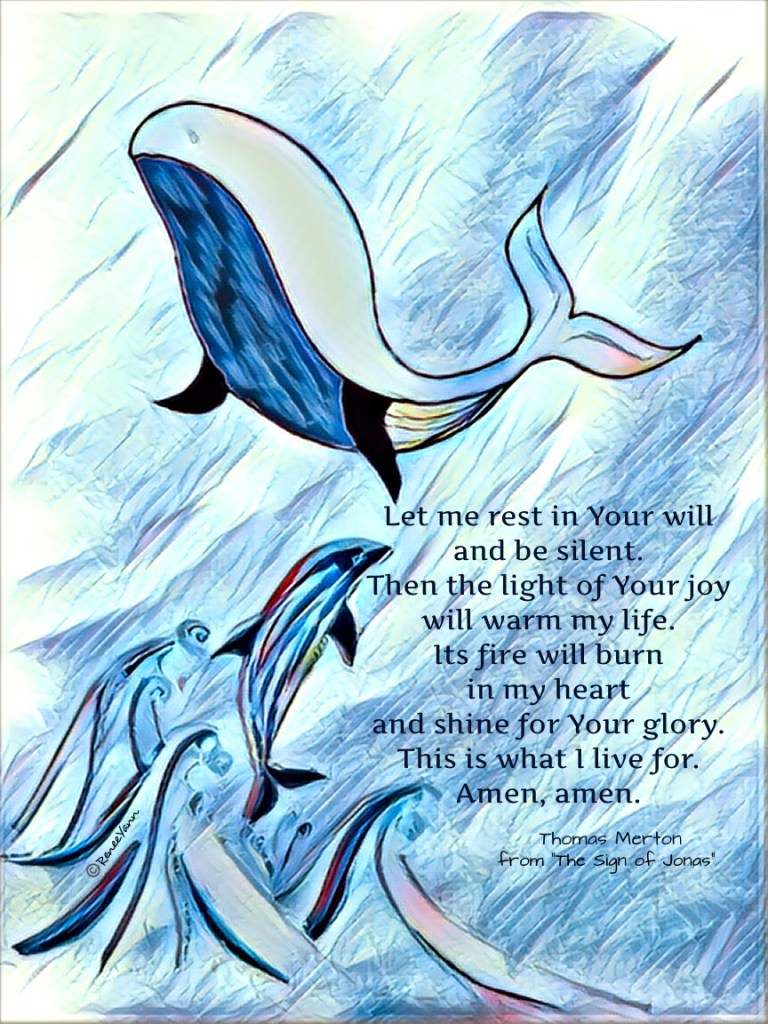
Let me rest in Your will and be silent. Then the light of Your joy will warm my life. Its fire will burn in my heart and shine for Your glory. This is what I live for. Amen, amen.
It may not sound all that inviting, but every one of us is called to the “whale’s belly”. Our transformation there is accomplished by our congruity with Christ’s sojourn in the tomb. Like Jesus, we must die to self for the sake of others. Like Jonah, we must abandon our fears and conveniences to become signs of God’s love in the world.
The Pharisees didn’t get it. And, God help them, I understand. It’s hard to get it! Life seems so much easier if we run away from this deep call like Jonah did at first. But the call remains: to be God’s Word in the world – to “shine for God’s glory“.
The editorial staff of the National Catholic Reporter wrote this about Merton’s Sign of Jonas:
Thomas Merton wrote in his early journals that the “sign of Jonas” — the mystery of Christ’s death and resurrection — is “burned into the roots of our being.” Sooner or later, everyone faces the universal truth that only through death to self do we find life. Merton embraced this sign and described himself as one like Jonah, because “I find myself traveling toward my destiny in the belly of a paradox.”
We may need to choose a little “whale-belly” time to get our hearts straight with this astounding yet universal call to be “for God” in our paradoxical world.
Poetry: two poems from “You! Jonah!” by Thomas John Carlisle
THE GREAT INTRUDER
It is exasperating
to be called
so persistently
when the last thing
we want to do
is get up and go
but God
elects
to keep on
haunting
like some
holy ghost.
———————–
COMING AROUND
And Jonah stalked
to his shaded seat
and waited for God
to come around
to his way of thinking.
And God is still waiting
for a host of Jonahs
in their comfortable houses
to come around
to His way of loving.
Music: Jonah and the Whale – Louis Armstrong – lyrics below
Jonah was a man who got a word from the Lord Go and preach the Gospel to the sinful land‿ But he got on a ship and he tried to get away And he ran into a storm in the middle of the sea
Now the Lord, He made the waves just roll so high The ship begin to sink and they all begin to cry So they pulled ole Jonah out of the hole And they jumped him in the water just to lighten up the load
Now the Lord made a whale, long and wide Lord, Lord waddnat a fish And he swallowed up Jonah, hair and hide Lord, Lord waddnat a fish, Mmm, Lord, mmm, Lord
Now Jonah started to pray in the belly of the whale Lord, Lord waddnat a fish He repented of his sins like a man in jail Lord, Lord waddnat a fish Mmm, Lord, mmm, Lord
Now Jonah must o’ been a bad man, he must o’ been a sinner Lord, Lord waddnat a fish Cos when the whale got him down, he didn’t like his dinner Lord, Lord waddnat a fish Mmm, Lord, mmm, Lord
Well he swum around the ocean, sick as he could be Lord, Lord waddnat a fish And after three days, whoops! he had to set him free Lord, Lord waddnat a fish, mmm
So the whale spit Jonah out onto dry land Lord, Lord waddnat a fish And went on to preaching like a righteous man Lord, Lord waddnat a fish
Then the people quit their sins when they heard him the town Lord, Lord waddnat a fish So when you hear the call, don’t you turn the Gospel down Lord, Lord waddnat a fish, mmm?
(This is a “repeat post”, but I think it’s worth the repeat. I hope you agree.)
Today, in God’s Lavish Mercy, we pray with St. Mary Magdalene, disciple of Christ.
Magdalen in Meditation by Massimo Stanzione
Modern scripture scholarship recognizes Mary Magdalene as a disciple and companion of Jesus. She is present in stories throughout all four Gospels, and most notably, as one who remained with Jesus at the foot of the Cross. Mary is the first witness to the Resurrection who then announces the Good News to the other disciples.
Over the centuries, Mary Magdalene has been confused with the many other Marys in the Gospel, as well as with the unnamed repentant woman who washes Jesus’ feet with her tears. These confusions have inclined us to think of Mary Magdalene as a reformed prostitute. This erroneous concept has supported a diminished understanding of the role of women in the ministry of Jesus and done a huge disservice to Mary’s vital role as beloved disciple.
The Gospel passage for the feast captures the powerful moment when the Resurrected Jesus is first revealed to the world. The scene also portrays the deep love, trust and friendship between Jesus and Mary Magdalene – a relationship which serves as a model for all of us who want to be Christ’s disciples. I imagined the scene like this in an earlier Easter reflection:
Rabbouni
The Upper Room on Holy Saturday evening: a place filled with sadness, silence and seeking. Jesus was dead. Jerusalem, scattered to their various houses to keep Shabbat, murmur their shocked questions under their shaky prayers.
We have all been in rooms like this. They enclose a special kind of agony – one teetering between hope and doubt, between loss and restoration. It may have been a surgical waiting room or the hallway outside the courtroom. Sometimes, such a space is not bricks and mortar. It is the space between a sealed envelope and the news inside. It is the hesitant pause between a heartfelt request and the critical response. In each of these places, we exist as if in a held breath, hoping against hope for life, freedom, and wholeness.
It was from such a room that Mary Magdalene stole away in the wee hours. A woman unafraid of loneliness, she walked in tearful prayer along the path to Jesus’ tomb. Scent of jasmine rose up on the early morning mist. Hope rose with it that his vow to return might be true. Then she saw the gaping tomb, the alarm that thieves had stolen him to sabotage his promise. She ran to the emptiness seeking him. She was met by angels clothed in light and glory, but they were not enough to soothe her.
Turning from them, she bumped against a gardener whom she begged for word of Jesus, just so she might tend to him again. A single word revealed his glory, “Mary”. He spoke her name in love.
As we seek the assurance of God’s presence in our lives, we too may be unaware that God is already with us. The deep listening of our spirit, dulled with daily burdens, may not hear our name lovingly spoken in the circumstances of our lives. God is standing behind every moment. All we need do is turn to recognize him.
Turn anger into understanding. Turn vengeance into forgiveness. Turn entitlement into gratitude. Turn indifference into love. All we need do is turn to recognize him.
For a comprehensive and enlightening lecture on the current theological and scriptural thinking on Mary Magdalen, follow this link to an Elizabeth Johnson, CSJ lecture at Fordham.
Today, in God’s Lavish Mercy, God is actively at work in both our scripture passages.
In our reading from Exodus, God instructs Moses in the Divine plan for Israel’s deliverance. It’s as if they’re sitting together at a drawing table laying out the course of history! Moses has some trepidation about how the people will accept this audacious plan. He asks for more detail on the game plan and God gives him a powerful answer:
Moses, hearing the voice of the LORD from the burning bush, said to him, “When I go to the children of Israel and say to them, ‘The God of your fathers has sent me to you,’ if they ask me, ‘What is his name?’ what am I to tell them?” God replied, “I am who am.” Then he added, “This is what you shall tell the children of Israel: I AM sent me to you.”
Forever after God’s revelation to Moses, Moses is tied heart-to-heart with God in the unfolding plan of Creation. It is an image similar to the one Jesus uses in today’s Gospel.
Jesus asks us to be tied heart-to-heart with him, yoked to him as we seek our salvation. Jesus assures us that in that unity we will find rest and peace. The assumption might be that Jesus carries most of the weight and labor while we, conjoined with him in trust, benefit from his salvific action. The yoke is the sacred discipline of sincere openness to God’s Will wrought by prayer and Gospel living.
Jesus says all this within another “I am” statement – but this time God’s Name is given in descriptors rather than nomenclature: I ammeek and humble of heart …
Jesus said: “Come to me, all you who labor and are burdened, and I will give you rest. Take my yoke upon you and learn from me, for I am meek and humble of heart; and you will find rest for yourselves. For my yoke is easy, and my burden light.”
Matthew 11:28-30
Poem Prayer: from Prayer Seeds by Joyce Rupp
Unnameable God, I feel you with me at every moment. You are my food, my drink, my sunlight, and the air I breath. (Psalm 16; Stephen Mitchell)
with each refreshing rain each slant of sunshine each beam of moonlight each whisper of wind
in every spiraling thought every turning of the heart every spoken and written word every action large and small
you stead, you lead you encourage, you guide you embrace, you never let go
one with my soul, one with my life one with me in the first breath one with me in the last
you know me now you will know me always and forever
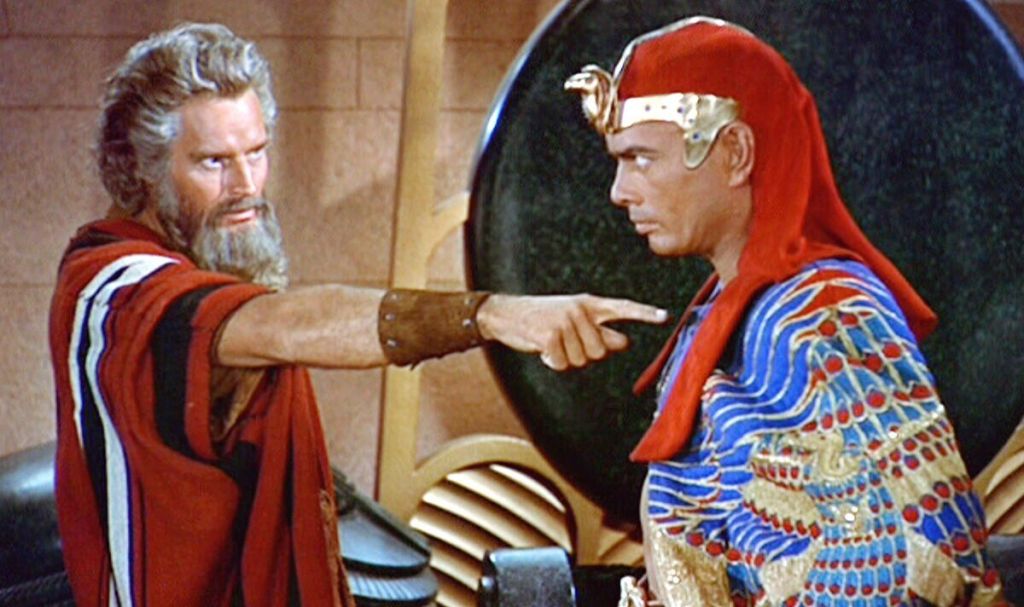
Today, in God’s Lavish Mercy, as we continue with Matthew, we begin a nearly three-week engagement with the Book of Exodus. Our companion along the way will be Moses (and, on occasion, Charlton Heston).
The Book of Exodus, a literary masterpiece, has profoundly influenced religion and culture for over 3000 years. Finally written down about 300 years before Christ, it is a gathering of the rich oral traditions and salvation history of the Judea-Christian faith. A total of forty chapters, the Book can be divided into two key parts: the liberation from Egyptian enslavement and the formation of a new, life-giving Covenant with God.
The Book’s enduring influence can be ascribed to these two themes. They reflect the universal life cycles in all of nature and in each one of our lives. The totality of human culture as well as our individual biographies are stories of breaking forth from whatever binds us into the call and promise of fuller life.
Today’s chapter is an introduction or bridge from the time of Joseph, (when Israel thrived in Egypt), to just before the emergence of Moses, (when Israel suffered in Egypt).
A new king, who knew nothing of Joseph, came to power in Egypt. He said to his subjects, “Look how numerous and powerful the people of the children of Israel are growing, more so than we ourselves! Come, let us deal shrewdly with them to stop their increase; otherwise, in time of war they too may join our enemies to fight against us, and so leave our country.”
Accordingly, taskmasters were set over the children of Israel to oppress them with forced labor.
Exodus 1:8-11
The theme of suffering also anchors our passage from Matthew:
Jesus said to his Apostles: “Do not think that I have come to bring peace upon the earth. I have come to bring not peace but the sword.
Matthew 10:34
The suffering imposed upon both “the children of Israel” and true disciples of Jesus generates from the same source – fear:
Pharaoh is afraid of what he will lose should the growing Israelite community turn on him.
The fear of losing one’s life in Christ inhibits the heart from true discipleship.
As we pray and study these next few weeks with the Book of Exodus, we may be moved to consider the fears both within and around us that prevent us from growing to fuller life.
Our world is full of the fears that induce violence and retribution. Our own spirits may be restrained with the fear of what we might lose by falling deeper into a Gospel life.
Our journey through Exodus offers us a time to consider and examine the fears we perceive. These fears may not necessarily be big spiritual impediments. They may be as simple as the fear of not being right, first, liked, included, or successful. But those very simple fears, left moldering in our hearts, are the seeds of the isolation, domination, and dissolution we see so rampant in our current culture.
Praying with Exodus, may we ask for courage to name and expose our personal and societal fears to God’s healing grace. We might begin with this thought from Paula D’Arcy:
Who would I be, and what power would be expressed in my life, if I were not dominated by fear?
Israel finally answered that question by coming into Covenant with God and Community with one another. The path is much the same for us in our lives.
Poetry: Immortality by Lisel Mueller
In Sleeping Beauty’s castle the clock strikes one hundred years and the girl in the tower returns to the world. So do the servants in the kitchen, who don’t even rub their eyes. The cook’s right hand, lifted an exact century ago, completes its downward arc to the kitchen boy’s left ear; the boy’s tensed vocal cords finally let go the trapped, enduring whimper, and the fly, arrested mid-plunge above the strawberry pie fulfills its abiding mission and dives into the sweet, red glaze. As a child I had a book with a picture of that scene. I was too young to notice how fear persists, and how the anger that causes fear persists, that its trajectory can’t be changed or broken, only interrupted. My attention was on the fly: that this slight body with its transparent wings and life-span of one human day still craved its particular share of sweetness, a century later.
Music: Fear is a Liar by Zach Williams – in this song, Williams images God as Fire, a Fire upon Whom we can cast our fears for a return of Love.
Today, in God’s Lavish Mercy, our readings lead us to a converted understanding of life, one that couterposes war and peace, flesh and spirit, labor and rest.
Zechariah describes it. He shall banish the chariot from Ephraim, and the horse from Jerusalem; the warrior’s bow shall be banished, and he shall proclaim peace to the nations.
Paul preaches it. We are not debtors to the flesh, to live according to the flesh. For if you live according to the flesh, you will die, but if by the Spirit you put to death the deeds of the body, you will live.
Jesus invites us to it. Come to me, all you who labor and are burdened, and I will give you rest. Take my yoke upon you and learn from me, for I am meek and humble of heart; and you will find rest for yourselves. For my yoke is easy, and my burden light.
What do the prophet, the preacher, and the Messiah ask of us in these readings? What does the Church ask by grouping them for this Fourteenth Sunday?
These readings ask us to turn our lives upside down. By describing what the Reign of God is like, these readings challenge us to confront the commonly accepted misperceptions of our world and turn them inside out.
Zechariah tells us that the Reign of God is not accomplished by war or any other expression of human power over Creation. It is accomplished by the meek and humble justice which pours mercy over all of us:
Rejoice heartily, O daughter Zion, shout for joy, O daughter Jerusalem! See, your king shall come to you; a just savior is he, meek, and riding on a donkey, on a colt, the foal of a donkey.
Zechariah 9:9
Paul tells us that the Reign of God blossoms from the Spirit of Christ within us and not from any material appearance of success – be it beauty, wealth, physical strength, or wrested power.
If the Spirit of the one who raised Jesus from the dead dwells in you, the one who raised Christ from the dead will give life to your mortal bodies also, through his Spirit that dwells in you. Consequently, brothers and sisters, we are not debtors to the flesh, to live according to the flesh. For if you live according to the flesh, you will die, but if by the Spirit you put to death the deeds of the body, you will live.
Romans 8: 11-13
Jesus, reminiscent of Zechariah, invites us to rest in the mystery of God’s humble love for us – expressed in the very Person of Christ given for our redemption.
Come to me, all you who labor and are burdened, and I will give you rest. Take my yoke upon you and learn from me, for I am meek and humble of heart; and you will find rest for yourselves. For my yoke is easy, and my burden light.
Matthew 11:28-30
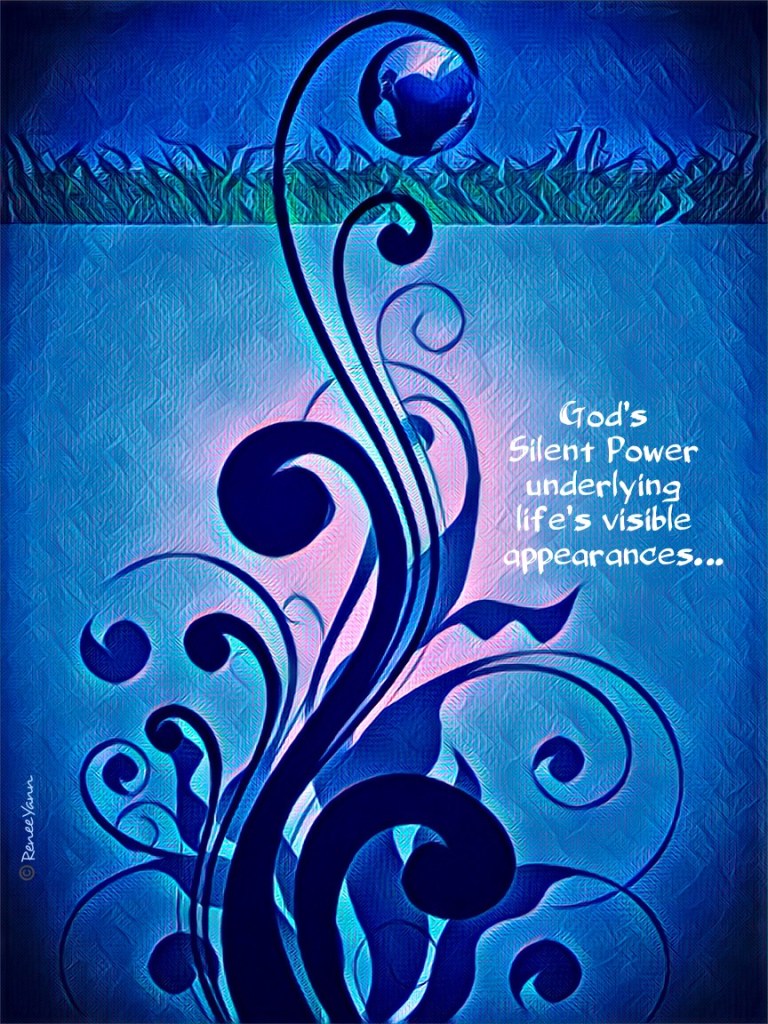
These passages are dense with meaning and mystery. In holy contradiction to a soulless world, they call us to live in, and witness to God’s Silent Power underlying life’s visible appearances. Within this Power, the peacful are the conquerers, the spiritual are the fulfilled, and those bearing the yoke of Christ are freed.
Poetry: The Ponds ― Mary Oliver, from House of Light
Every year
the lilies
are so perfect
I can hardly believe

their lapped light crowding
the black,
mid-summer ponds.
Nobody could count all of them --

the muskrats swimming
among the pads and the grasses
can reach out
their muscular arms and touch

only so many, they are that
rife and wild.
But what in this world
is perfect?

I bend closer and see
how this one is clearly lopsided --
and that one wears an orange blight --
and this one is a glossy cheek

half nibbled away --
and that one is a slumped purse
full of its own
unstoppable decay.

Still, what I want in my life
is to be willing
to be dazzled --
to cast aside the weight of facts

and maybe even
to float a little
above this difficult world.
I want to believe I am looking

into the white fire of a great mystery.
I want to believe that the imperfections are nothing --
that the light is everything -- that it is more than the sum
of each flawed blossom rising and fading. And I do.
Today, in God’s Lavish Mercy, each of our readings presents a story of vocation and how it is fulfilled in a lifespan.
Our reading from Genesis describes four people at different stages of their life’s vocation: Abraham and Sarah in its fulfillment, Isaac and Rebekah in its initial hope.
For my prayer, I focused on Abraham who is closing out his story in peace, prosperity, and active hope for a future he will not see:
Abraham had now reached a ripe old age, and the LORD had blessed him in every way. Abraham said to the senior servant of his household, who had charge of all his possessions: “Put your hand under my thigh, and I will make you swear by the LORD, the God of heaven and the God of earth, … … that you will go to my own land and to my kindred to get a wife for my son Isaac.”
Genesis 24:1-4
Both Abraham and Sarah lived long and fruitful lives, matured in faith, and died in peace. Through the extensive history of their lives, they listened to and trusted God (on and off!), acted for God’s glory, and guided their household in God’s way.
They listened, responded and connected their lives irrevocably to God’s vision. It is at once a simple and a challenging formula for spiritual fulfillment.
In our Gospel, Matthew is called to the same formula which is the underpinning of any vocation:
As Jesus passed by, he saw a man named Matthew sitting at the customs post. He said to him, “”Follow me.”” And he got up and followed him. While he was at table in his house, many tax collectors and sinners came and sat with Jesus and his disciples. The Pharisees saw this and said to his disciples, “”Why does your teacher eat with tax collectors and sinners?”” He heard this and said, “Those who are well do not need a physician, but the sick do. Go and learn the meaning of the words, I desire mercy, not sacrifice.”
Matthew 9:9-12
Matthew listens to Jesus’ call, responds, and connects his life irrevocably to Jesus’ vision.
The continuing call for each of us is clear. Each of our lives offers us a particular expression of “vocation”. It may be as religious, priest, parent, spouse, family member, teacher, caregiver, public servant, or any other role that places us in loving and responsible relationship with our neighbor.
In that role, can we/do we:
listen for God in every circumstance
respond in faith, hope, and love
witness a Christ-rooted life by our actions for Gospel justice and mercy
Poetry: Vocation by William E. Stafford
This dream the world is having about itself
includes a trace on the plains of the Oregon trail,
a groove in the grass my father showed us all
one day while meadowlarks were trying to tell
something better about to happen.

I dreamed the trace to the mountains, over the hills,
and there a girl who belonged wherever she was;
but then my mother called us back to the car:
she was afraid; she always blamed the place,
the time, anything my father planned.

Now both of my parents, the long line through the plain,
the meadowlarks, the sky, the world's whole dream
remain, and I hear him say while I stand between the two,
helpless, both of them part of me:
"Your job is to find what the world is trying to be."
Music: The Call – Celtic Women sing a song written by Anthony Downes
Today, in God’s Lavish Mercy, we pray with Psalm 117. We do so in the spirit of Thomas, who now offers his unquestioning faith to our patient and forgiving Jesus.
Praise the LORD, all you nations; glorify him, all you peoples! For steadfast is his kindness for us, and the fidelity of the LORD endures forever
Psalm 117: 1-2
Faith is not a commodity or an achievement. Faith is relationship and a journey.
It is a gift and an exercise of grace. Never stretched, it withers like a brittle ligament.
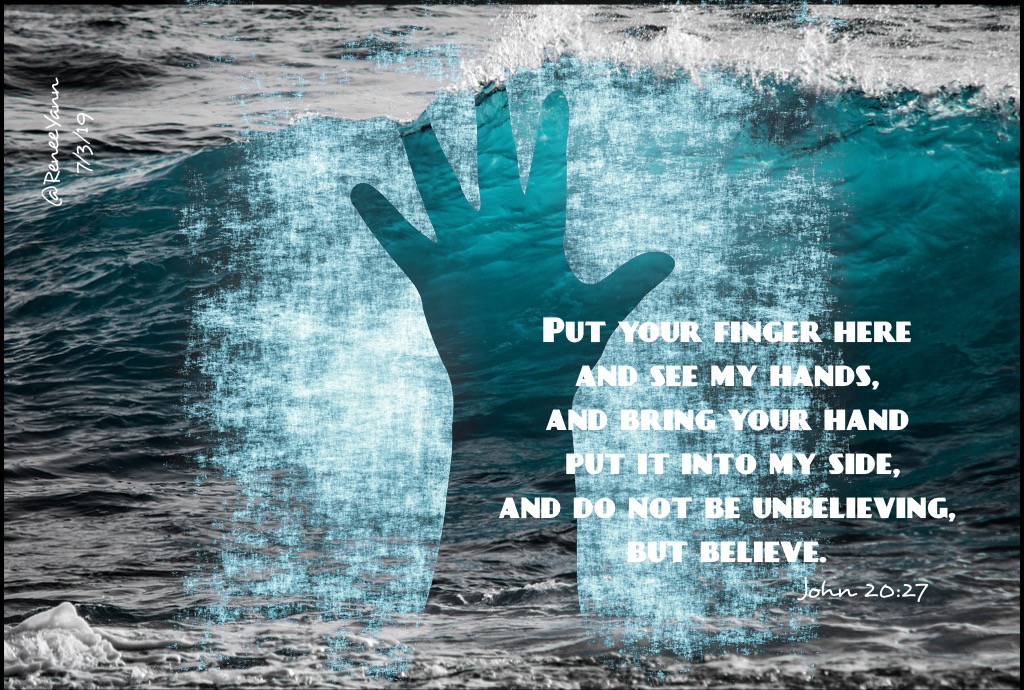
It ebbs and flows with our personal and communal dramas. It deepens with prayer, silent reaching, and a listening obedience to our lives. It shallows with our demands, like Thomas’s, only to see and to touch.
It is fed by the Lavish Mercy of God Who never cuts its flow to our souls if we but take down the seawall around our heart.
On this day when we celebrate the power of tested and proven faith, may we bring our needs into the circle gathered in that Upper Room.
Standing beside Thomas today in our prayer, may we place our trust in the glorified wounds of Christ.
A video today for our prayer: Blessed Are They That Have Not Seen
Music: Healing Touch – Deuter
As we reach out in faith with Thomas to touch Christ’s wounds, let us open our hearts to receive the returning touch of God’s Lavish Mercy.
Today, in God’s Lavish Mercy, our readings instruct us on the nature of prophecy.
Walter Bruggemann, in his transformational book “The Prophetic Imagination” writes about prophets. He indicates that prophets emerge in the context of “totalism” – those paralyzing systems which attempt to control and dominate all freedom and possibility.
Totalism kills ideas, hope, freedom, choice, self-determination, and creativity for the sake of controlling reality for its own advantage. Totalism is the ultimate “abusive relationship“. Examples in our society include cults, hate groups, mob rule, or any relationship that subjugates another’s free will.
Brueggemann defines the prophet as one engaged in these three tasks to restore hope and freedom:
the prophet is clear on the force and illegitimacy of the totalism.
the prophet pronounces the truth about the force of the totalism that contradicts the purpose of God.
the prophet articulates the alternative world that God has promised, and that God is actually creating within the chaos around us.
Our first reading comes from the Second Book of Kings which was written about 600 years before Christ. The Jewish people experienced the totalism of the Babylonian Captivity.. First and Second Kings was written to help the people understand their situation, to remain faithful to God, and to move toward freedom.
These two books are full of powerful figures pulling the people both toward and away from God – biblical Baddies and Goodies who carried profound messages about faith or its abandonment.
One of the Goodies is Elisha the Prophet whom we meet in today’s verses. Elisha confronts barrenness and death with the transformative power of faith. The Summanite woman is able to benefit from this power because she believes.
In our second reading, Paul doesn’t use the word “prophet” but he talks about the Resurrection Power we receive through our Baptism. This power calls us and confirms us as bearers of God’s transformative Word in a hostile and unfree world.
In our Gospel, Jesus is direct with his disciples about the rewards which fall to those who have prophetic faith:
“Whoever receives you receives me, and whoever receives me receives the one who sent me. Whoever receives a prophet because he is a prophet will receive a prophet’s reward, and whoever receives a righteous man because he is a righteous man will receive a righteous man’s reward. And whoever gives only a cup of cold water to one of these little ones to drink because the little one is a disciple— amen, I say to you, he will surely not lose his reward.”
Matthew 10:40-42
So, are we actually called to be prophets? The answer is YES. We are called by the Gospel and through our Baptism to do what Walter Brueggemann describes above:
to name the structures of unfreedom in our lives and in our world
to speak truth and stand against those things which contradict God’s Mercy and Love
to witness hope and courage by the joyous, generous service of our lives
You are not surprised at the force of the storm— you have seen it growing. The trees flee. Their flight sets the boulevards streaming. And you know: he whom they flee is the one you move toward. All your senses sing him, as you stand at the window.
The weeks stood still in summer. The trees’ blood rose. Now you feel it wants to sink back into the source of everything. You thought you could trust that power when you plucked the fruit: now it becomes a riddle again and you again a stranger.
Summer was like your house: you know where each thing stood. Now you must go out into your heart as onto a vast plain. Now the immense loneliness begins.
The days go numb, the wind sucks the world from your senses like withered leaves.
Through the empty branches the sky remains. It is what you have. Be earth now, and evensong. Be the ground lying under that sky. Be modest now, like a thing ripened until it is real, so that he who began it all can feel you when he reaches for you.
Music: When the Prophet Speaks – Van Morrison (lyrics below)
When the prophet speaks, mostly no one listens
When the prophet speaks and no one hears
Only those who have ears to listen
Only those that are trained to hear

Come closer now, I'll tell you what they whisper
Closer now, we'll whisper it in your ear
What big ears you've got when you get the details
Do you understand, do I make it clear?

When the prophet speaks, yeah, no one listens
When the prophet speaks, mostly no one hears
Only those that are trained to listen
Only those who have ears to hear

When the prophet speaks, yeah, no one listens
Baby, baby, baby, baby, baby
Don't you have no fear
You gotta get the truth on what is happening

When the prophet speaks, have to make it clear
Come closer now and I will whisper
Whisper the secret in your ear
What thick ears you've got when you get all the details

Do you understand, do I make myself clear?
When the prophet speaks, you've got to listen
When the prophet speaks, you've got to get the truth
When the prophet speaks, don't need no explanation

When the prophet speaks, have to make it move
Prophet speaks, no one listens
When the prophet speaks, mainly nobody hears
Only those that are trained to listen

Only those who have ears to hear















 Lavish Mercy