The Only Road

Wednesday of the Thirtieth Week in Ordinary Time
October 26, 2022

Today, in God’s Lavish Mercy, Jesus sets out a stringent formula for entrance into the Kingdom of Heaven.

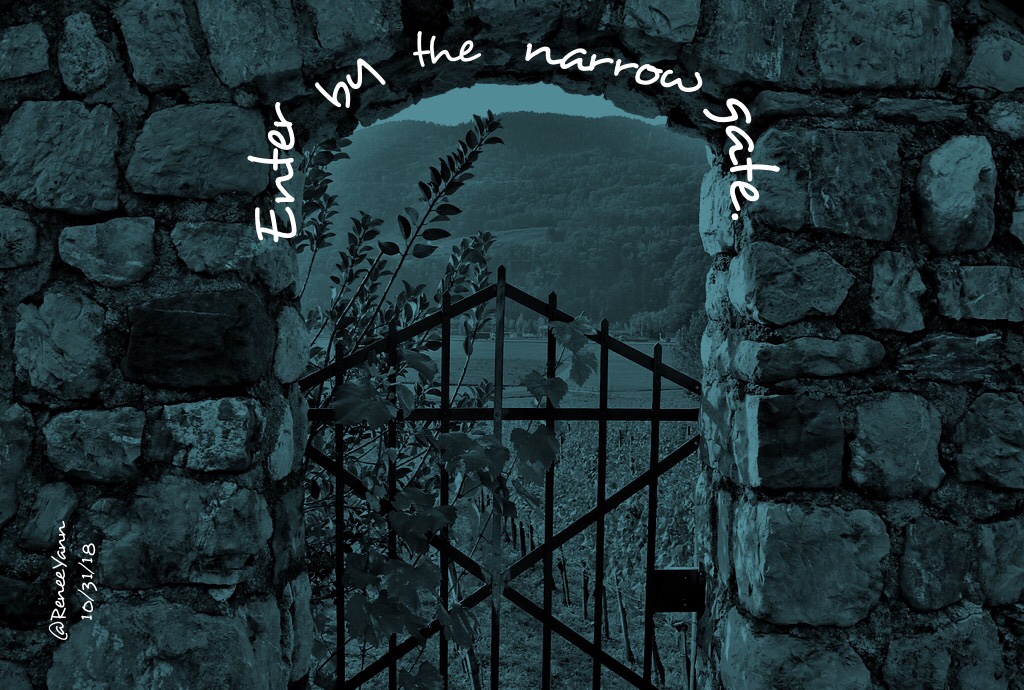
Strive to enter through the narrow gate,
for many, I tell you, will attempt to enter
but will not be strong enough.

Jesus goes on to say that some will get to the threshold of the kingdom and be denied entrance because they are not recognized. These petitioners will be shocked, saying, “But we ate and drank in your company and you taught in our streets.


The passage teaches us that there is more to faith than religion, more to prayer than words, more to relationship than ritual. We may be the most observant Catholic, Lutheran, or Jew. We may stay praying in church longer than anyone else. We may know the catechism by heart. But if our deep heart hasn’t touched God’s, we will not be recognized at the narrow gate.


Where will we find God’s heart? The Gospel seems to suggest that we would do best to look among those who are considered “last” – those who are poor, humble, suffering, marginalized. At “the gate”, they will be “first” – so they must have the secret to that stringent formula.

There is little or nothing between these blessed ones and the touch of God – no power, pride or wealth. Their strength lies in their utter dependence on God – God knows them in that dependence.


It is hard for us to reach that place of trust and unity with God. Our possessions and accomplishments get in the way. Our independence and self-reliance get in the way. Our pride and penchant for control get in the way. It is a very narrow gate through these things that lets us find God – our God Who is not far … Who waits in the spaces between our self-importance.


Poetry: The Narrow Way – Anne Bradstreet

Believe not those who say
     The upward path is smooth,
Lest thou shouldst stumble in the way,
     And faint before the truth.
It is the only road
     Unto the realms of joy;
But he who seeks that blest abode
     Must all his powers employ.
Bright hopes and pure delights
     Upon his course may beam,
And there, amid the sternest heights
     The sweetest flowerets gleam.
On all her breezes borne,
     Earth yields no scents like those;
But he that dares not grasp the thorn
     Should never crave the rose.
Arm—arm thee for the fight!
     Cast useless loads away;
Watch through the darkest hours of night,
     Toil through the hottest day.
Crush pride into the dust,
     Or thou must needs be slack;
And trample down rebellious lust,
     Or it will hold thee back.
Seek not thy honor here;
     Waive pleasure and renown;
The world’s dread scoff undaunted bear,
     And face its deadliest frown.
To labor and to love,
     To pardon and endure,
To lift thy heart to God above,
     And keep thy conscience pure;
Be this thy constant aim,
     Thy hope, thy chief delight;
What matter who should whisper blame,
     Or who should scorn or slight?
What matter, if thy God approve,
     And if, within thy breast,
Thou feel the comfort of His love,
     The earnest of His rest?

Music: Enter the Narrow Gate! – John Michael Talbot


Enter the narrow gate
The gate that leads to life
His yoke is easy and His burden is light.
Pray for your enemies Those who abuse you
Love them and do not hate And love will follow you.
Enter the narrow gate
The gate that leads to life
His yoke is easy and His burden is light.
Forgive those who offend And seek their forgiveness And when you bring your gift You will be forgiven.
Enter the narrow gate
The gate that leads to life
His yoke is easy and His burden is light.

Power in Fragility

Memorial of Saints John de Brébeuf and Isaac Jogues, Priests, and Companions, Martyrs
October 19, 2022

Today’s Readings:

https://bible.usccb.org/bible/readings/101922.cfm

Today, in God’s Lavish Mercy,  Paul proclaims his mission to the Gentiles, announcing that through the Gospel, salvation is offered to all people. He says that, by grace, he became a minister of this Gospel – called to preach “the inscrutable riches of Christ”.

Lk12_48 much given

And Paul certainly did an extraordinary job. He had been given much by God, and he gave it back wholeheartedly.

In the Gospel, Jesus talks about that same kind of investment. In answer to Peter’s confusion about the call to be ready for God, Jesus tells the story of wily steward.

This servant had been given much: trust, responsibility, power and probably higher pay. But when the master is away, the trusted servant fails him, acting cruelly and greedily in his own interest.

Jesus ends the story with a pronouncement that has always shaken me a little: 

For unto whomever much is given,
much will be required. 

I know I’ve been given a stunning abundance by God: faith, family, friends and a thousand other graces.  But my will and ability to give back sometimes feels as fragile as a decaying leaf. Ever feel like that?

It turns out that even Paul, great Apostle to the Gentiles, felt that way too. He says so in his letter to the Corinthians. Paul asks God to remove his fragility.

But He said to me,
“My grace is sufficient for you, 
for my power is made perfect in weakness.” 

Let’s pray today to be good stewards of the amazing riches God has given us – in Creation, Faith, Grace and Community. Let us invite God’s power to perfect our weakness, all for the sake of God’s glory.

Even a lacy leaf can be beautiful when it is filled with Light.


Poetry: To Autumn – John Keats

Season of mists and mellow fruitfulness,
  Close bosom-friend of the maturing sun;
Conspiring with him how to load and bless
  With fruit the vines that round the thatch-eves run;
To bend with apples the moss'd cottage-trees,
  And fill all fruit with ripeness to the core;
    To swell the gourd, and plump the hazel shells
  With a sweet kernel; to set budding more,
And still more, later flowers for the bees,
Until they think warm days will never cease,
    For summer has o'er-brimm'd their clammy cells.
Who hath not seen thee oft amid thy store?
  Sometimes whoever seeks abroad may find
Thee sitting careless on a granary floor,
  Thy hair soft-lifted by the winnowing wind;
Or on a half-reap'd furrow sound asleep,
  Drowsed with the fume of poppies, while thy hook
    Spares the next swath and all its twined flowers:
And sometimes like a gleaner thou dost keep 
  Steady thy laden head across a brook;
  Or by a cider-press, with patient look,
    Thou watchest the last oozings, hours by hours.
Where are the songs of Spring? Ay, where are they?
  Think not of them, thou hast thy music too,--
While barred clouds bloom the soft-dying day,
  And touch the stubble-plains with rosy hue;
Then in a wailful choir the small gnats mourn
  Among the river sallows, borne aloft
    Or sinking as the light wind lives or dies;
And full-grown lambs loud bleat from hilly bourn;
  Hedge-crickets sing; and now with treble soft
  The redbreast whistles from a garden-croft,
    And gathering swallows twitter in the skies.

Music: My Grace is Sufficient for You – Keith and Amy Amano 

Beautiful Luke

Feast of St. Luke, evangelist
October 18, 2022

Today’s Readings:

https://bible.usccb.org/bible/readings/101822.cfm

Today, in God’s Lavish Mercy, we celebrate the Feast of St. Luke, evangelist, writer of the Gospel and the Acts of the Apostles, and devoted missionary companion of Paul.

Ps145 Luke

Luke’s Gospel is unique in several ways. 

Six miracles appear only in Luke:

  • the miraculous catch of fish
  • the raising of the widow’s only son
  • healing a possessed, crippled woman
  • healing a man with dropsy
  • cleansing of ten lepers 
  • healing the man’s ear in Gethsemane

Eighteen parables are unique to Luke, including the beloved stories of the Good Samaritan and the Prodigal Son.

vangogh_samaritaan_grt
Van Gogh’s Good Samaritan

While both Matthew and Luke contain the story of Christ’s birth, only Luke includes those beautiful passages which now comprise the joyful mysteries of the rosary: Annunciation, Visitation, Nativity, Presentation, and Finding in the Temple.

Only Luke gives us the Magnificat and the cherished words of the Hail Mary.

Think of all that we would not be able to visualize without Luke’s blessed writings. No Gabriel. No Elizabeth, Zachary, Anna or Simeon. No tender Samaritan or merciful loving Prodigal Father to show us God’s face.

300px-Rembrandt_Harmensz_van_Rijn_-_Return_of_the_Prodigal_Son_-_Google_Art_Project
Rembrandt’s Prodigal Son

Maybe some of your favorite passages are among these Lucan treasures. You might want to choose one to accompany you throughout your day.

Poetry: A Sonnet for St. Luke – Malcolm Guite

His gospel is itself a living creature
A ground and glory round the throne of God,
Where earth and heaven breathe through human nature
And One upon the throne sees it is good.
Luke is the living pillar of our healing,
A lowly ox, the servant of the four,
We turn his page to find his face revealing
The wonder, and the welcome of the poor.
He breathes good news to all who bear a burden
Good news to all who turn and try again,
The meek rejoice and prodigals find pardon,
A lost thief reaches paradise through pain,
The voiceless find their voice in every word
And, with Our Lady, magnify Our Lord.

The music today is a country song, not really about St. Luke’s Gospel, but certainly reflecting its love and respect for those who are poor.

Music: The Gospel According to Luke ~ Skip Ewing

Mary, Vessel of Grace

Memorial of Our Lady of the Rosary
October 7, 2022

Today’s Readings:

https://bible.usccb.org/bible/readings/100722.cfm

Today, in God’s Lavish Mercy, we encounter readings that are probably not among anyone’s favorites. In the epistle, Paul is trying to demonstrate to the Galatians how blessed they are to have inherited the promise given to Abraham. 

In the Gospel, there is a lot of talk about evil spirits, divided kingdoms, and good old Beelzebub. It’s not really a day when you’ll say, “Gosh, those readings inspired me!”

Is it worth sticking with the daily readings in such a case?  I think so.

Ps111_grateful heart

There is always a string lying among these sacred words that we can tie to our own hearts. For me today, that string is wrapped around the Responsorial Psalm:

I will give thanks to the Lord with all my heart.

Just as the Galatians have inherited God’s promise, so have we. Just as the Kingdom of God has come upon Jesus’ followers, it has come upon us. God’s fidelity remains with us through all the “demons” that might annoy or threaten us. God’s graciousness has already redeemed us for an eternal life beyond their reach.

So let’s have intentionally grateful hearts today. Everything – yes, everything – in our lives is a gift, if we but have the grace to unwrap it with humility, openness and gratitude.

On this day when we pray in a special way to Our Lady of the Rosary, we can take the opportunity, while fingering our beads, to relive her life with her. We talk with her about the major mysteries of our own lives which have invited us to birth Christ into our own times and experiences.

Poetry: Theotokos – Malcolm Guite

You bore for me the One who came to bless
And bear for all and make the broken whole.
You heard His call and in your open ‘yes’
You spoke aloud for every living soul.
Oh gracious Lady, child of your own child,
Whose mother-love still calls the child in me,
Call me again, for I am lost, and  wild
Waves suround me now. On this dark sea
Shine as a star and call me to the shore.
Open the door that all my sins would close
And hold me in your garden. Let me share
The prayer that folds the petals of the Rose.
Enfold me too in Love’s last mystery
And bring me to the One you bore for me.

Music: Give Thanks ~Don Moen

Learn What’s Important

Memorial of Saint Francis of Assisi
October 4, 2022

Today’s Readings:

https://bible.usccb.org/bible/readings/100422.cfm

Today, in God’s Lavish Mercy, we pray with Martha and Mary. These sisters are the personification of the Benedictine motto: Ora et labora: Pray and work – the two essentials that we all struggle to balance in our lives.

They, with their brother Lazarus, are dear friends of Jesus. The scriptures show us that Jesus felt comfortable at their home, and that they loved to have him stay with them.

As all of us do with our closest friends, Jesus understood the lights and shadows of their personalities – and they of his. He knew that Martha was the organizer, the one who planned and worried about the incidentals. Mary was deeply spiritual, but maybe had her head in the clouds a bit when it came to getting things done. 

Perhaps these personality differences caused some tensions between the sisters, as they might between us and our family members or close friends. Sometimes these little, unnoticed frictions can suddenly become chasms between us and those we love. 

How and why does it happen?

Jesus gives us the answer in this Gospel passage. He hears Martha’s simmering frustration. He calms her, as one might a child – “Martha, Martha…”. We can hear his gentle tone. Jesus tells her that worry and anxiety are signs that we are not spiritually free. He tells her that Mary has focused on the important thing.

This may sound repetitious, but just think about it a while:

It is so important to know what is important. 

It is so freeing to agree on what matters with those closest to us. Talking with each other in openness, respect, and unconditional love is the only path to that freedom.

Maybe Martha and Mary slipped off that path a bit in this situation. But with Jesus’ help, they righted their relationship. 

That’s the best way for us to do it too. Let Jesus show us what is most important through sharing our faith, and even our prayer, with those closest to us. Let him show us where our self-interests, need for control, fears and anxieties are blocking us from love and freedom.

It is the same way that we, like Mary, can strengthen our relationship with God. It is not sufficient for our prayer to consist of incidentals — pretty words and empty practices. 

We must sit open-hearted at the feet of Jesus and let him love us, let him change us. Even in the midst of our responsibilities and duties, we must balance “the better part”.


Poetry: Bethany Decisions – Irene Zimmerman, OSF – How appropriate to have this wonderful Franciscan poet speak to us on this Feast of St. Francis. Let us thank God today for the wonderful charism of this saint from Assisi, and for the amazingly gifted women and men who carry it to us today.

As Jesus taught the gathered brothers
and Martha boiled and baked their dinner,
Mary eavesdropped in the anteroom
between the great hall and the kitchen.
Her dying mother’s warning words
clanged clearly in her memory—
“Obey your sister. She has learned
the ways and duties of a woman.”

She’d learned her sister’s lessons well
and knew a woman’s place was not
to sit and listen and be taught.
But when she heard the voice of Jesus
call to her above the din
of Martha’s boiling pots and pans,
she made her choice decisively—
took off her apron and traditions,
and walked in.


Music: a charming little song by Peg Angell which leaves me with same practical question I always have when reading this passage: who actually did get the dinner ready?

Your Life Spells It Out!

Twenty-seventh Sunday in Ordinary Time
October 2, 2022

Today’s Readings:

https://bible.usccb.org/bible/readings/100222.cfm

Today, in God’s Lavish Mercy,  our readings combine to offer us a powerful message: we are the translators of God’s Word for our time. Our choices and actions for justice and mercy make the vision “readable” – visible for our sisters and brothers.

Hab2_2 vision

Habakkuk starts our challenge. He is in a bit of a struggle with God, asking repeatedly how long God is going to allow the people to suffer. ( I have had similar conversations with God, especially during these charged political times).

In so many words, God tells Habakkuk to look to his faith – his vision through God’s eyes. God sees that “the just one, because of his faith, shall live.” God tells him to “write the vision down”, to make it apparent in his own choices and actions for justice and mercy. In other words, Habakkuk, I’ve done what I am going to do. The rest is up to you, Buddy!


In a similar way, Paul reminds Timothy to “stir up the flame” – the gift of God given at his profession of faith. Paul reminds Timothy that, by grace, he knows what is right and just. He must not be chicken about living and speaking that Truth – to write the vision down by his choices and actions for justice and mercy.


In our Gospel, the disciples seem to want their faith increased because the commitment to witness is scary. They think they might feel a little better about it all if their faith consoled them more. But “writing the vision with our lives” takes guts, and the disciples seem a little lacking in today’s reading.

Jesus tells them to buck up. They are blessed to serve the Word of God by the witness of their lives. It won’t always feel good, safe or successful. Still they, and we, must unfailingly write the vision down by our choices and actions for justice and mercy, because even …

When you have done all you have been commanded,
say, ‘We are unprofitable servants;
we have done what we were obliged to do.

Jesus calls it like it is today. We are blessed to be God’s translators. We have an undeniable call to live God’s just and merciful vision. No excuses. Get it together. Keep the pencil sharp. No asking God when He’s going to make things better. The legible (just and merciful) translation depends on us!

Poetry: Abou Ben Adhem – Leigh Hunt

Abou Ben Adhem (may his tribe increase!) 
And saw, within the moonlight in his room, 
Making it rich, and like a lily in bloom, 
An angel writing in a book of gold:— 
Exceeding peace had made Ben Adhem bold, 
And to the presence in the room he said, 
“What writest thou?”—The vision raised its head, 
And with a look made of all sweet accord, 
Answered, “The names of those who love the Lord.” 
“And is mine one?” said Abou. “Nay, not so,” 
Replied the angel. Abou spoke more low, 
But cheerly still; and said, “I pray thee, then, 
Write me as one that loves his fellow men.” 

The angel wrote, and vanished. The next night 
It came again with a great wakening light, 
And showed the names whom love of God had blest, 
And lo! Ben Adhem’s name led all the rest.

Music: The Vision – Patrick Love

The Spread of the Gospel

Feast of Saint Matthew, Apostle and evangelist
September 21, 2022

Today’s Readings:

https://bible.usccb.org/bible/readings/092122.cfm

Today, in God’s Lavish Mercy, on this feast of St. Matthew, Apostle and Evangelist, we are blessed with an inspiring reading from Ephesians. We are reminded that each of us is called in God according to our particular gifts. Paul encourages us to live “in a manner worthy of the call we have received” in our Baptism.

evangel Matthew

For most of us, it has been quite a while since we were washed in the waters of our Baptism. A lot of other waters have passed under the bridge since then. We may, or may not, have recognized and responded to our call, continually carried to us on those life waters.

Each moment, each choice, each act and decision asks us once again to choose Christ – over sin, over self, over meaninglessness. Each life opportunity calls us closer to Jesus, to the pattern of his Cross, to the witness of his Resurrection.


Matthew heard such a call as he sat, perhaps dulled by the unconscious disengagement of his life, by the failure to live with intention and openness to grace. As He passed by Matthew, Jesus reached into that ennui, calling Matthew to evangelize all the future generations by his Gospel.

Jesus calls us to be evangelists too – every moment, every day. Our “Yes” to our particular call writes its own Gospel, telling the Good News through our faith, hope and love.


Pope Francis says this:

The spread of the Gospel is not guaranteed either by the number of persons, or by the prestige of the institution, or by the quantity of available resources. What counts is to be permeated by the love of Christ, to let oneself be led by the Holy Spirit and to graft one’s own life onto the tree of life, which is the Lord’s Cross.


Poetry: The Calling of Matthew by James Lasdun

Not the abrupt way, frozen
In the one glance of a painter’s frame
Christ in the doorway pointing. Matthew’s face
Bright with perplexity, the glaze
Of a lifetime at the countinghouse
Cracked in the split second’s bolt of being chosen.
But over the years, slowly,
Hinted at, an invisible curve;
Persistent bias always favoring
Backwardly the relinquished thing
Over the kept, the gold signet ring
Dropped in a beggar’s bowl, the eye not fully
Comprehending the hand, not yet;
Heirloom damask thrust in a passing
Stranger’s hand, the ceremonial saddle
(Looped coins, crushed clouds of inline pearl)
Given on an irresistible
impulse to a servant. Where it sat
A saddle-shaped emptiness
Briefly, obscurely brimming … Flagons
Cellars of wine, then as impulse steadied
into habit, habit to need,
Need to compulsion, the whole vineyard
The land itself, graves, herds, the ancestral house,
Given away, each object’s
Hollowed-out void successively
More vivid in him than the thing itself,
As if renouncing merely gave
Density to having; as if
He’s glimpsed in nothingness a derelict’s
Secret of unabated,
Inverse possession … And only then,
Almost superfluous, does the figure
Step softly to the shelter door;
Casual, foreknown, almost familiar,
Calmly received, like someone long awaited.

Music: When You Call My Name ~ Brian Doerksen & Steve Mitchinson

Presence

Memorial of Saints Andrew Kim Tae-gŏn, Priest, and
Paul Chŏng Ha-sang, and Companions, Martyrs
September 20, 2022

Today’s Readings:

https://bible.usccb.org/bible/readings/092022.cfm

Today, in God’s Lavish Mercy, our readings instruct us on what it means to belong to God – heart and soul.

Proverbs tosses out a series of minstrel-like two-liners that, because of their simplicity, might be overlooked for their beauty and depth. For example, the first couplet says: 

Like a stream is the king’s heart
in the hand of the LORD;

wherever it pleases God, God directs it.

Would we all not desire that kind of heart, where our thoughts and choices are so directed by God’s power and grace – held and guided into freedom by God’s loving hand? How confident, peaceful and joyful our lives would be!

Psalm 199 discern

Today’s Psalm 119 is a passionate prayer to be guided through an entangling world by our deep loyalty to God’s own truth, learned by meditating day and night on God’s goodness.


Our Gospel, in an often misinterpreted incident, shows us how Jesus considers his true disciples as close to him as his own mother and family.

So today, to deepen our own closeness to God, let us practice making our ordinary life into a constant prayer – allowing it to flow, like water, over God’s tender, guiding hand. 

We can do this by gratefully noticing God’s Presence in nature, in our companions, in the opportunities for kindness, honesty and service  that come to us today. 

Or, sadly, our experiences today might cause us to notice God’s absence in these places. This offers us an incentive to invite, beg and pester God to transform the desert places in our lives and world.

Whichever approach we take, it will open up a constant conversation with God about our life as we experience it at each moment. We begin to listen better to the Word of God revealing itself in our daily life. We begin to live more consciously in God’s Presence… in God’s dear family.

God’s Law is already written deep in the fabric of our lives. We pray for discernment to discover that guiding grace by opening our hearts to God’s Presence in our every experience.


Poetry: All Things – by Hadewijch

All things
are too small
to hold me,
I am so vast
In the Infinite
I reach
for the Uncreated
I have
touched it,
it undoes me
wider than wide
Everything else
is too narrow
You know this well,
you who are also there.

Music: Morning Prayer – Kitaro

Lessons in Love and Light

Monday of the Twenty-fifth Week in Ordinary Time
September 19, 2022

Today’s Readings

https://bible.usccb.org/bible/readings/091922.cfm

Today, in God’s Lavish Mercy, our readings encourage us to live lives of Charity and Light.

Today’s first reading opens two weeks of inspiration from the Wisdom Literature of the Hebrew Scriptures. These books include Job, Proverbs, Ecclesiastes, Song of Solomon, and parts of Psalms.

Wisdom literature differs from other books in the Old Testament in that the authors were sages rather than prophets or priests. Priests and prophets typically dealt with religious and moral concerns whereas sages generally focused on the practical aspects of how to live and the intellectual challenges that arise when contemplating the human experience. 

from: compellingtruth.org

Our passage from Proverbs offers a good dose of that sage advice with these basics of mutual charity:

  • Refuse no one the good on which they have a claim
  • Plot no evil against your neighbor,
  • Quarrel not with someone without cause,
  • Envy not lawless persons
  • Choose not their ways …

If we all followed that list, the world would be in pretty good shape. And, in Luke’s Gospel, Jesus says that once we get that shaped-up, we can take it up a notch — into the Light:

No one who lights a lamp conceals it with a vessel
or sets it under a bed;
rather, you place it on a lampstand
so that those who enter may see the light.

Matthew’s version adds this line:

Let your light shine before others,
that they may see your good deeds 
and glorify God in heaven.

So how do I let Charity kindle God’s Light in me? The list from Proverbs can get me started, but what might my own “Charity Challenges” look like?

Poetry: Charity — The Greatest of All Three – Robert Morris

The soul serene, impenetrably just, 
Is first in CHARITY; we love to muse 
On such a model; knit in strictest bonds 
Of amity with spirits like disposed; 
Aiming at truth for her own sake, this one 
Passes beyond the golden line of Faith, 
Passes beyond the precious line of Hope, 
And sets foot unmoved on CHARITY . 
“A soul so softly radiant and so white, 
The track it leaves seems less of fire than light.”


Music: Lampstand – Ben Bigelow

(Spoiler alert: Those who are still able may want to dance by the end of this video!🤩 I just did a very good finger-snapping routine)

Earthshine & Bling!

Twenty-fifth Sunday in Ordinary Time
September 18, 2022

Today’s Readings:

https://bible.usccb.org/bible/readings/091822.cfm

Today, in God’s Lavish Mercy, our readings make one thing very clear: we cannot serve both God and “mammon”.

The problem is that we have a hard time figuring out what mammon is. Experience tells us that it’s a lot more than just money, because there are people with money who do a good job serving God.

It seems to me that “mammon” is more the illusion that we are only our “possessions” — our money, house, car, looks, degrees, physical abilities — and that we (or anybody else) is nothing without them.

This misperception is so intrinsic to our inability to live the Gospel that it cripples our souls. The love of “mammon” becomes an overwhelming, incurable addiction that feeds on the well-being of our neighbor.

As our first reading tells us, living by this addiction invokes God’s eternal anger. Describing the abuse heaped upon the poor, God warns the abusers:

The LORD has sworn by the pride of Jacob:
Never will I forget a thing they have done!

Amos 8:7

Our Gospel tells us that we can’t have it both ways. We either live within the generosity and inclusivity of God, or we’re outside it:

No servant can serve two masters.
He will either hate one and love the other,

or be devoted to one and despise the other.

Luke 16:13

This is a challenging but fundamental teaching of the Gospel. It is essential that we consider how we live it.

Walter Bruggemann, in his book Money and Possessions says this:

Jesus said it … succinctly. You cannot serve God and mammon. You cannot serve God and do what you please with your money or your sex or your land. And then he says, “Don’t be anxious, because everything you need will be given to you.” But you must decide. Christians have a long history of trying to squeeze Jesus out of public life and reduce him to a private little Savior. But to do this is to ignore what the Bible really says. Jesus talks a great deal about the kingdom of God—and what he means by that is a public life reorganized toward neighborliness. . . .

Let’s have the courage to pray with that thought today. Although challenging, the question is rather simple: how do we use what we have to live a Gospel life, the essence of which Jesus stated like this:

Love God above all things

and your neighbor as yourself.

Mark 12:30-31


Poetry: Cullen in the Afterlife – P. K. Page

(This poet is new to me. She is a Canadian poet whose work is noted for its vibrant images. I liked this poem in which she imagines the experience of finding oneself in the afterlife. She notes the difficulty of embracing Love when hampered by “mammon” which she called “Earthshine”.

And how partake of such a gift when he
was handicapped by Earthshine—wore the stars,
badges and medals of privilege and success?
Desensitizers, brutalizers—all 
the tricks that mammon plays to make one sleep.


Cullen in the Afterlife – P. K. Page

He found it strange at first. A new dimension.  
One he had never guessed. The fourth? The fifth? 
How could he tell, who’d only known the third?
Something to do with eyesight, depth of field.
Perspective quite beyond him. Everything flat
or nearly flat. The vanishing point 
they’d tried to teach at school was out of sight
and out of mind. A blank.

Now, this diaphanous dimension—one
with neither up nor down, nor east nor west,
nor orienting star to give him north.
Even his name had left him. Strayed like a dog. 
Yet he was bathed in some unearthly light,
a delicate no-color that made his flesh
transparent, see-through, a Saran-Wrap self.
His body without substance and his mind
with nothing to think about—although intact—
was totally minus purpose. He must think.

Think of a Rubens, he said to himself. But where
Rubens had been there was a void, a vast
emptiness—no opulence. And then
Cézanne who broke all matter up—
made light of it, in fact. And mad Van Gogh
who, blinded by the light, cut off his ear.
Gone—that shadowy assembly—vanished, done. 
Gone without substance. Like himself. A shell.
Insensate in a flash. (What was that flash—
bereft of all but essence?) Was it death?
He wondered about the word, so filled with breath
yet breathless, breathless, breathless. A full stop.

“Divino Espirito Santo,” he had said
once in Brazil, “Soul of my very soul.”
He’d prayed in Portuguese, an easier tongue—
for newly agnostic Anglos—than his own,
burdened with shibboleths and past beliefs.
“Alma de minha alma”—liquid words
that made a calm within him. Where within?
Was there a word for it? Was it his heart?

Engulfed by love. Held in a healing beam
of love-light. Had he earned such love?
And how partake of such a gift when he
was handicapped by Earthshine—wore the stars,
badges and medals of privilege and success?
Desensitizers, brutalizers—all 
the tricks that mammon plays to make one sleep.
He must wake up. He must expose and strip
successive layers to find his soul again.
Where had the rubble come from? He was like
a junkyard—cluttered, filled with scrap iron, tin.
As dead as any metal not in use.
So he must start once more. He had begun
how many times? Faint glimmerings and dim
memories of pasts behind the past
recently lived—the animal pasts and vague
vegetable pasts—those climbing vines and fruits;
and mineral pasts (a slower pulse) the shine
of gold and silver and the gray of iron.
The “upward anguish.”
                                   What a rush of wings
above him as he thought the phrase and knew 
angels were overhead, and over them
a million suns and moons.

Music: a simple mantra, but powerful if we can live it: Love God, Love Neighbor by Dale Sechrest