Today, in God’s Lavish Mercy, we pray with Psalm 145 in which the psalmist, filled with gratitude and joy, makes a prodigious promise:
Every day will I bless you, and I will praise your name forever and ever. Everyday! Forever and ever!
Psalm 145:2
Such a promise requires all one’s attention, discipline and practice. We must learn to see all experience in God’s Light so that everything becomes a reason for praise.
Paul, guiding the Colossians to live that kind of life, tells them:
As you received Christ Jesus the Lord, walk in him, rooted in him and built upon him and established in the faith as you were taught, abounding in thanksgiving.
Colossians 2:6-7
Powerful words: ~ walk in Christ ~ be rooted and built in Christ ~ be established in faith ~ be abundant in thanksgiving
God is gracious and merciful toward us as we pray for the psalmist’s prayer to be fulfilled in us and in our lives:
Let all your works give you thanks, O LORD, and let your faithful ones bless you. Let them discourse of the glory of your Kingdom and speak of your might.
Psalm 145:10-11
Poetry: from the Book of Hours – Rainer Maria Rilke
You are the future, the great sunrise red
above the broad plains of eternity.
You are the cock-crow when time’s night has fled,
You are the dew, the matins, and the maid,
the stranger and the mother, you are death.

You are the changeful shape that out of Fate
rears up in everlasting solitude,
the unlamented and the unacclaimed,
beyond describing as some savage wood.

You are the deep epitome of things
that keeps its being’s secret with locked lip,
and shows itself to others otherwise:
to the ship, a haven — to the land, a ship.
Today, in God’s Lavish Mercy, we pray with Psalm 62 and the heart of its prayer of confidence, verses 6-9.
Carroll Stuhlmueller, revered Old Testament scholar, places Psalm 62 among the Wisdom psalms – those which “seek the harmonious, stable order of life”. They do this by presenting a kind of curriculum for spiritual happiness.
That teaching is clear in Psalm 62: we find our soul’s fulfillment “only in God”.
Does that mean nothing else in our lives matter? That we should push all but God to the margins? No. The psalm encourages us to look deeply at all of life and to find God in every aspect.
Often, a spiritual director will ask this question of the directee:
“Where is God in this situation, in this moment?”
The question points us to the realization that we can’t compartmentalize God to our “prayer time”, or Sundays, or “religious experiences”.
God lives within us, and lives every moment of our lives with us. Until we align ourselves with God’s loving Presence, we will not find complete peace.
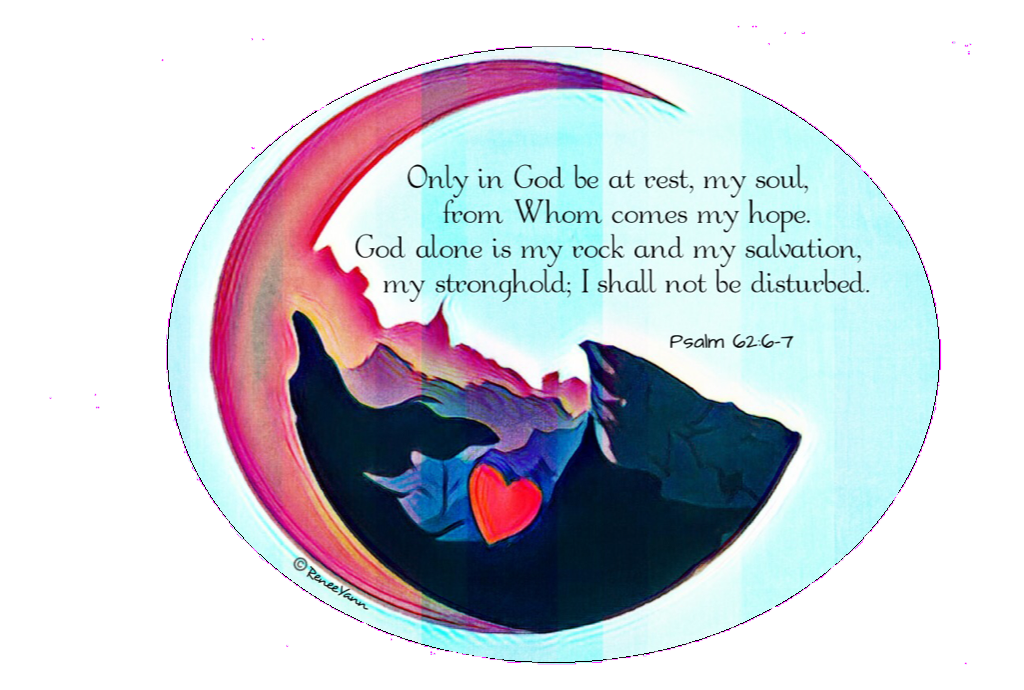
Trust in God at all times, O my people! Pour out your hearts before God; God is our refuge!
Psalm 62:9
Prose: from the Confessions of St. Augustine, Book 1, Chapter 1
Great are You, O Lord, and greatly to be praised;
great is Your power,
and of Your wisdom there is no end.
And we, being a part of Your creation,
desire to praise You….
You move us to delight in praising You;
for You have made us for Yourself,
and our hearts are restless until they rest in You.
Cor nostrum inquietum est donec requiescat in Te.
Lord, teach me to know and understand
which of these should be first:
to call on You, or to praise You;
and likewise to know You, or to call on You.
But who calls upon You without knowing You?
For the one that knows You not
may call upon You as other than You are.
Or perhaps we call on You
that we may know You.
But how shall they call on Him in whom they have not believed? Or how shall they believe without a preacher?
Romans 10:14
And those who seek the Lord shall praise the Lord. For those who seek shall find God,
Matthew 7:7
and those who find God shall praise God.
Let me seek You, Lord, in calling on You,
and call on You in believing in You;
for You have been preached unto us.
O Lord, my faith calls on You —
that faith which You have imparted to me,
which You have breathed into me
through the incarnation of Your Son,
through the ministry of Your preacher 1.
1 (Here Augustine is referring to St. Ambrose, his mentor)
Today, in God’s Lavish Mercy, we pray with Psalm 100 which both invites and commands:
Come with joy into the Presence of the Lord.
Psalm 100:2
To know and honor this Presence is the sole pursuit of the Christian life.
Understanding is the reward of faith. Therefore, seek not to understand that you may believe, but believe that you may understand.
Augustine of Hippo
Our first reading from Colossians offers a beautiful hymn for our meditation as we pray to open ourselves to a deepening awareness of Jesus, present in our lives:
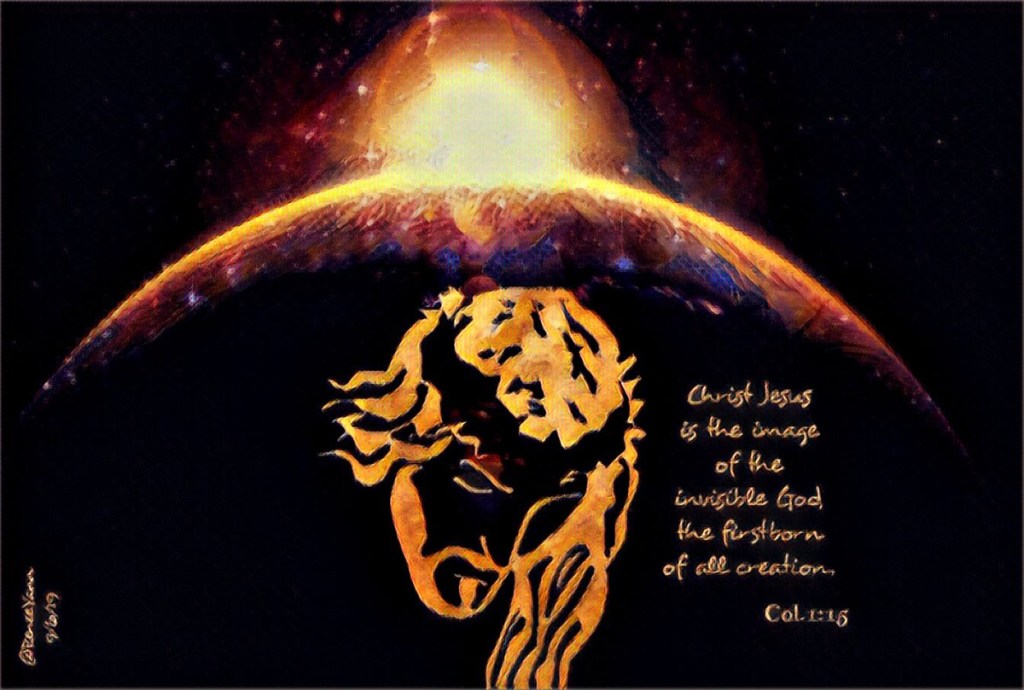
Christ Jesus is the image of the invisible God, the firstborn of all creation. For in him were created all things in heaven and on earth, the visible and the invisible, whether thrones or dominions or principalities or powers; all things were created through him and for him. He is before all things, and in him all things hold together. He is the head of the Body, the Church. He is the beginning, the firstborn from the dead, that in all things he himself might be preeminent. For in him all the fullness was pleased to dwell, and through him to reconcile all things for him, making peace by the Blood of his cross through him, whether those on earth or those in heaven.
Colossians 1:15-20
Prose: Jesus Prayer – John Henry Newman
Dear Jesus, Help me to spread Your fragrance everywhere I go. Flood my soul with Your spirit and life. Penetrate and possess my whole being so utterly, that my life may only be a radiance of Yours. Shine through me, and be so in me that every soul I come in contact with may feel Your presence in my soul. Let them look up and see no longer me but only Jesus! Stay with me and then I shall begin to shine as You shine, so to shine as to be a light to others; The light, O Jesus will be all from You; none of it will be mine; It will be you shining on others through me.
Today, in God’s Lavish Mercy, we pray with Psalm 98 which we reflected on just this past Saturday on the feast of St. Augustine. Here’s a refresher if you’d care to glance back.
Because they proclaim God’s faithfulness, today’s psalm verses ready us to receive the Gospel’s expansive injunction:
As we pass through the waters of life, we each meet our own “deeps”. Sometimes we do not recognize them as the sacred places where we are to meet God’s call.
Sometimes we see only their choppy surface, their tangled riptides, their frightening shadows.
Sometimes we miss the bounty held in the mystery of these moments. We fold our nets and try to sail away.
As he did for the weary disciples, Jesus
lovingly contradicts our fear,
releases our hope,
fills the flimsy net of our faith to bursting …
… if we will just trust his Word, and cast out with him over the waters of our lives.
Today, in God’s Lavish Mercy, we pray with Psalm 98, the scripture which inspired “Joy to the World”.
Psalm 98 describes God’s redemption of Israel and the jubilation that will ensue. In other words, it is a song of “rejoicing in the future tense”. When the community sang it for their great occasions, they had not yet seen the Savior. But their profound faith allowed them to celebrate in spirit what they believed would be accomplished – as the psalm’s concluding verse asserts:
In righteousness shall God judge the world and the peoples with equity.
Psalm 98:8
We too are called to let our lives sing to the Lord in hope and confidence because we know that what we believe is true. That kind of faith in action is called “witness”. And we, my dears, in ALL circumstances of our lives, are charged to be WITNESSES!
Like the seas who sing in either still or storm
Like rivers who clap in ebb or the neap
Like the mountains who sing in all seasons
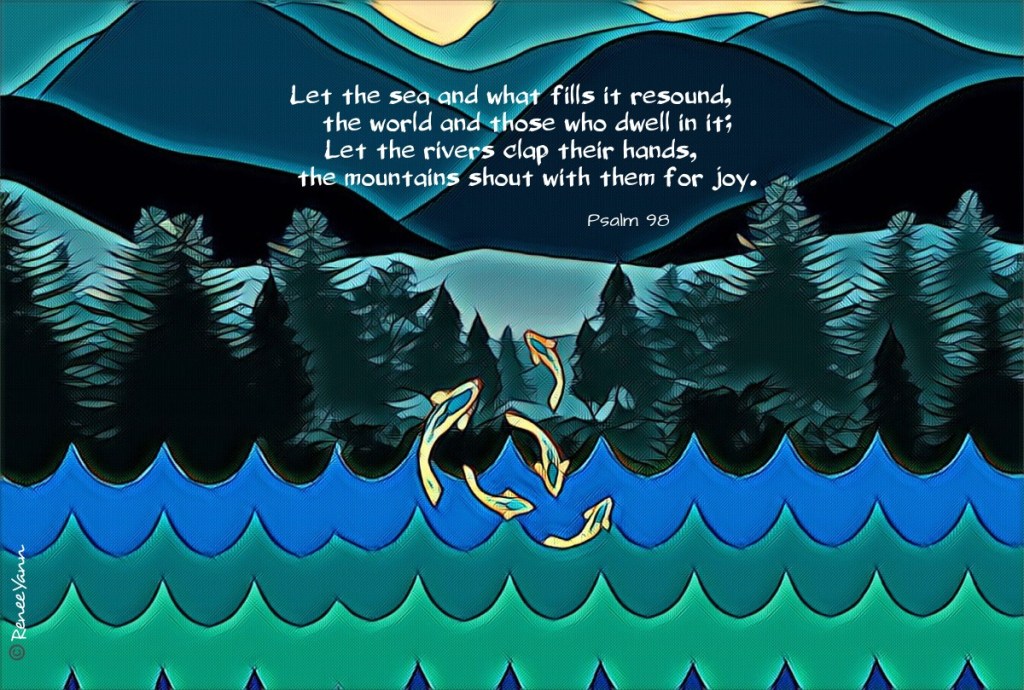
Let the sea and what fills it resound, the world and those who dwell in it; Let the rivers clap their hands, the mountains shout with them for joy.
Psalm 98:7-8
Like our hearts that believe even through life’s intermingled joys and sorrows
This is your life, joys and sorrow mingled, one succeeding the other.
Catherine McAuley: Letter to Frances Warde (May 28, 1841)
Poetry: Flickering Mind – Denise Levertov
Lord, not you
it is I who am absent.
At first
belief was a joy I kept in secret,
stealing alone
into sacred places:
a quick glance, and away -- and back,
circling.
I have long since uttered your name
but now
I elude your presence.
I stop
to think about you, and my mind
at once
like a minnow darts away,
darts
into the shadows, into gleams that fret
unceasing over
the river's purling and passing.
Not for one second
will my self hold still, but wanders
anywhere,
everywhere it can turn.  Not you,
it is I am absent.
You are the stream, the fish, the light,
the pulsing shadow.
You the unchanging presence, in whom all
moves and changes.
How can I focus my flickering, perceive
at the fountain's heart
the sapphire I know is there?
Today, in God’s Lavish Mercy, we pray with Psalm 97, one of several psalms categorized as “enthronement psalms”. These psalms celebrate God as king, a king exponentially greater than any human sovereign.
But Psalm 97 shows us that this Divine Ruler is also exponentially different from the flawed and often oppressive human rulers Israel (and others throughout history)has/have experienced.
For that reason, God is the only one who should rule our lives, and all human authority should mirror God’s perfect balance of love, mercy, and justice.
The psalm indicates how God is uniquely supreme:
JUSTICE – God’s reign is founded on justice, not domination
The LORD is king; let the earth rejoice; let the many isles be glad. Justice and judgment are the foundation of his throne.
97:1-2
UNIVERSALITY – God’s power moves earth and heaven, beyond any human ability
The mountains melt like wax before the LORD, before the LORD of all the earth. The heavens proclaim his justice, and all peoples see his glory.
97:5-6
GOODNESS – God loves goodness, not evil; uprightness, not power plays
The LORD loves those who hate evil; he guards the lives of his faithful ones; from the hand of the wicked he delivers them.
97:10
JOY – God’s reign brings universal joy, not subjugation. It inspires gratitude, not fear:
Light dawns for the just; and gladness, for the upright of heart. Be glad in the LORD, you just, and give thanks to God’s holy name
97:11-12
Psalm 97, though constructed on a metaphor that doesn’t speak to many of us, still has much to teach us.
How do we image God?
How does that image inspire, define, or control our behaviors and choices?
In whatever form we exercise authority, how do we reflect God’s authority?
Especially in our influence over younger, or vulnerable persons, what image of God would they learn from us?
For Christians, Psalm 97 points to a most contradictory “king”, one who loves the “beatitude person” and is willing to suffer and die for them. The psalm so clearly foreshadows Christ that it is the psalm prayed at Mass on Christmas Day.
In Christmas the Church does not simply celebrate the birth of a wondrous baby. Through that birth we celebrate the cosmic reality that God has entered the process of the world in a decisive way that changes everything toward life. The entry of God into the process of the world is the premise of the poem in Psalm 97.
Walter Brueggemann, Psalm 97: Psalm for Christmas Day
Poetry: The Kingdom – R. S. Thomas
                 It’s a long way off but inside it
                 There are quite different things going on:
                 Festivals at which the poor man
                 Is king and the consumptive is
                 Healed; mirrors in which the blind look
                 At themselves and love looks at them
                 Back; and industry is for mending
                 The bent bones and the minds fractured
                 By life. It’s a long way off, but to get
                 There takes no time and admission
                 Is free, if you will purge yourself
                 Of desire, and present yourself with
                 Your need only and the simple offering
                 Of your faith, green as a leaf.
Today, in God’s Lavish Mercy, we pray with Psalm 145, a luxuriant song of praise to a God who overwhelms us with generosity.
I will extol you, my God and king; I will bless your name forever and ever.
Every day I will bless you; I will praise your name forever and ever.
Great is the LORD and worthy of much praise, whose grandeur is beyond understanding.
Psalm 145: 1-3
Citing verses 13-20 which are structured around the word “all”, Walter Brueggemann says:
The image is an overflow of limitless blessing given without reservation to all who are in need and turn to the Creator.
Which brings us to Nathaniel and how this prayer might have sung in his heart.
I got to be friends with Nathaniel over 50 years ago when, at my reception in our community, Mother Bernard decided to give me his name. And after an initial shock, I came to love it.
Nathaniel and I have spent countless hours under his fig tree sharing both our lives. I’ve asked him many times what he was thinking about when Philip came to invite him to meet Jesus. Nathaniel always has a different answer… one amazingly similar to whatever happens to be preoccupying me at the time.😇
a favorite old book that started some of my conversations with Nathaniel
One element remains constant in every circumstance: in his quiet moment, Nathaniel sought God’s Light. As our Gospel shows, that Luminous Word came to him and he responded.
I think that in our “fig tree moments”, we have finally sifted through all that we are capable of in order to find Grace in our lives. Now we wait, in the shade and quiet of prayer, for the True Answer.
When that answering Word comes, it shatters our doubts and pretenses like an egg. And like a shattered egg, the Word releases new life in us. We move deeper into the unbreakable Wholeness and Infinity. Like Nathaniel, even in our ordinary lives, we begin to “see greater things” than we had ever imagined.
Nathanael said to him, “How do you know me?” Jesus answered and said to him, “Before Philip called you, I saw you under the fig tree.” Nathanael answered him, “Rabbi, you are the Son of God; you are the King of Israel.” Jesus answered and said to him, “Do you believe because I told you that I saw you under the fig tree? You will see greater things than this.” And he said to him, “Amen, amen, I say to you, you will see heaven opened and the angels of God ascending and descending on the Son of Man.”
After that momentous afternoon when he was drawn from the shade into the Light, Nathaniel’s life became a hymn of praise and thanksgiving.
Let all your works give you thanks, O LORD, and let your faithful ones bless you. Let them discourse of the glory of your Kingdom and speak of your might.
Poem-Prayer from Christine Robinson
Psalm 145 – Opening Heart
I exalt you, Holy One, and open my heart to you
by remembering your great love.
Your expansiveness made this beautiful world
in a universe too marvelous to understand.
Your desire created life, and you nurtured
that life with your spirit.
You cherish us all—and your prayer
in us is for our own flourishing.
You are gracious to us
slow to anger and full of kindness
You touch us with your love—speak to us
with your still, small voice, hold us when we fall.
You lift up those who are oppressed
by systems and circumstances.
You open your hand
and satisfy us.
You ask us to call on you—
and even when you seem far away, our
longings call us back to you.
Hear my cry, O God, for some days, it is all I have.
Today, in God’s Lavish Mercy, as we pray with Psalm 34, our Sunday readings present us with spiritual ultimatums.
In our first reading, sensing his impending death, Joshua gathers the tribes on the Great Plains of Shechem – the land of their father Abraham. Joshua requires a commitment from the people:
“If it does not please you to serve the LORD, decide today whom you will serve … As for me and my household, we will serve the LORD.”
Joshua 24:15
In other words, “fish or cut bait” – you’re either with God, or you’re not. And your lives should reflect the choice.
In our Gospel, Jesus too feels death’s approach. His teachings have become more intense and direct, particularly regarding the Eucharist. This intensity has caused some of his listeners to waver. They’re not sure they can accept his words. Some drift away.
Jesus challenges the Twelve, those on whom he depends to carry his message after his death.
“Do you also want to leave?
These readings talk about the big choices, the soul’s orientation, either:
to seek and respond to God in our daily interactions
to be indifferent toward God’s Presence in our lives
Jesus’s question is before us all the time? Do we hear it?
(As for the unfortunate and contested second reading from Ephesians, this long but superb article from Elizabeth Johnson is worth your time.)
You see, I want a lot.
Perhaps I want everything:
The darkness that comes with every infinite fall
And the shivering blaze of every step up.
So many live on and want nothing
And are raised to the rank of prince
By the slippery ease of their light judgments
But what you love to see are faces
That do work and feel thirst…
You have not grown old,
And it is not too late to dive
Into your increasing depths where life
Calmly gives out its own secret.
Today, in God’s Lavish Mercy, we pray with Psalm 128. It describes the blessed scene that might ensue from the kind of hopeful and just community described in yesterday’s reflection. Because of its final verse, I like to think of it as a “Grandparents’ Blessing”.
Happy are they all who fear the Lord, and who follow in the ways of God! You shall eat the fruit of your labor; happiness and prosperity shall be yours. Your beloved shall be like a fruitful vine within your house, your children like olive shoots round about your table. The one who fears the Lord shall thus indeed be blessed. The Lord bless you from Zion, and may you see the prosperity of Jerusalem all the days of your life.
May you live to see your children’s children; may peace be upon your household.
In our Gospel, Jesus tells us that we achieve such blessedness by actions, not simply by words.
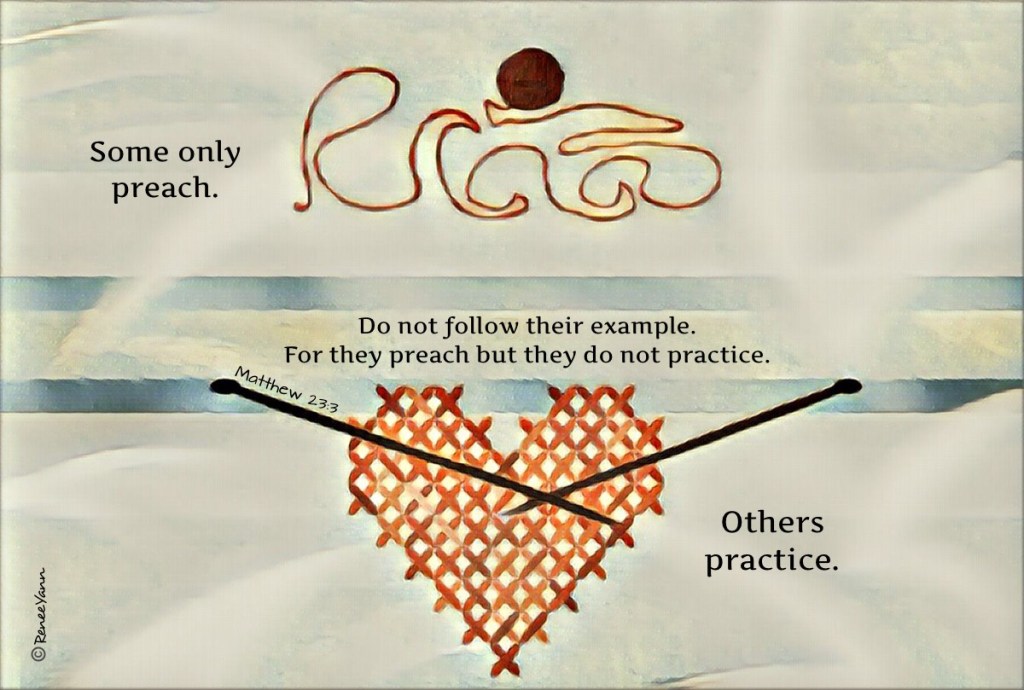
Jesus spoke to the crowds and to his disciples, saying, “The scribes and the Pharisees have taken their seat on the chair of Moses. Therefore, do and observe all things whatsoever they tell you, but do not follow their example. For they preach but they do not practice.
Matthew 23: 1-3
I took that admonition to heart today. I do a lot of “preaching” on these pages. Following the example of Jesus, I need to see if those words come to life in my actions.
Are you with me?
Poetry: The Words We Speak – Hafiz
The words
We speak
Become the house we live in.
Who will want to sleep in your bed
If the roof leaks
Right above
It?
Look what happens when the tongue
Cannot say to kindness,
“I will be your slave.”
The moon
Covers her face with both hands
And can’t bear
To look.
Music: Without Words – Bethel Music
Just a pretty cool instrumental to reflect with today.
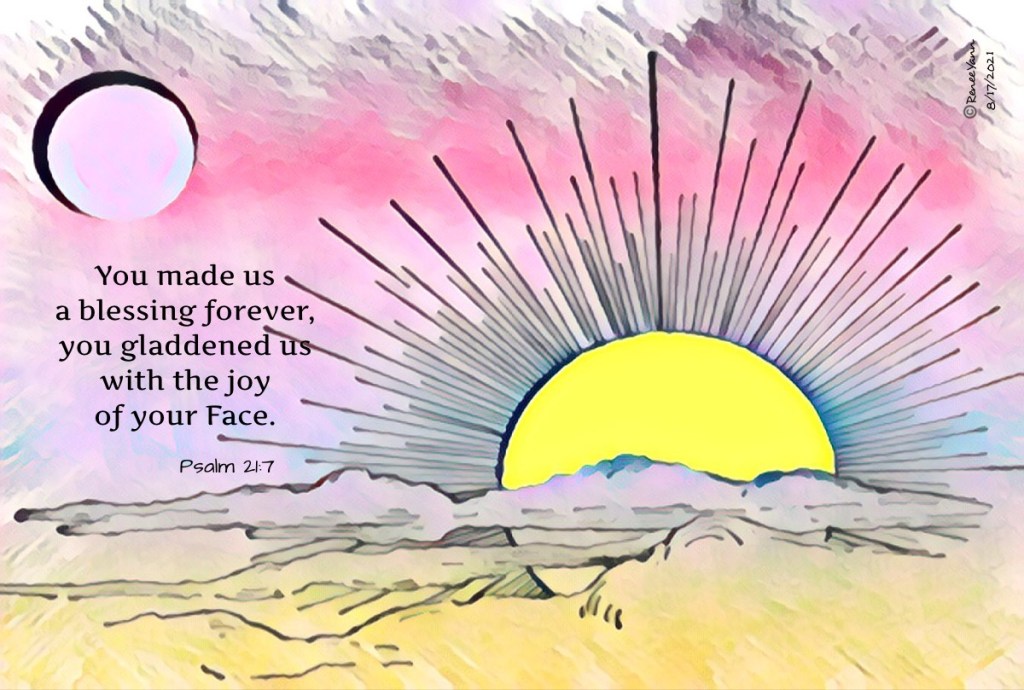
Today, in God’s Lavish Mercy, we pray with Psalm 21, a companion piece to Psalm 20. In these verses, the king asks for victory, receives it, and rejoices in domination over his enemies. The psalm follows our first reading from Judges which is a parable that criticizes Abimelech’s seizure of kingship over Israel by treacherous means.
Without getting too deep into the complex exegesis of these passages, suffice it to say that they invite us to consider the nature of leadership – its source, exercise, and meaning relative to our spiritual and moral life.
St. Augustine, in his commentary on the Psalms, teaches that Psalm 21 foretells the kingship of Jesus. This kingship (as opposed to that of Abimelech) is marked by humility, mercy, and obedience to the Creator.
We see a wide and confusing range of “leadership” in our world today, from figures like Pope Francis to Kim Jong-Un. But in our prayer today, we are given a very clear picture of what true leadership looks like.
A perfect leader is to God like the moon is to the sun. The leader only reflects the True Light given to them as a gift.
Recognizing fruitful leadership as a gift, they dispense it graciously to others as in our Gospel parable, imparting mercy even to those considered last in line for it.
In various circumstances, we can be either leader and follower. How do we invite Grace to inform us in either case?
Poetry-Prayer: A Leader’s Prayer – from xavier.edu
Leadership is hard to define.
Lord, let us be the ones to define it with justice.
   Leadership is like a handful of water.
   Lord, let us be the people to share it with those who thirst.
Leadership is not about watching and correcting.
Lord, let us remember it is about listening and connecting.
   Leadership is not about telling people what to do.
   Lord, let us find out what people want.
Leadership is less about the love of power,
and more about the power of love.
   Lord, as we continue to undertake the role of leader let us be
   affirmed by the servant leadership we witness in your son Jesus.
Let us walk in the path He has set and let those who will, follow.
Let our greatest passion be compassion.
   Our greatest strength love.
   Our greatest victory the reward of peace.
In leading let us never fail to follow.
In loving let us never fail.














 Lavish Mercy