Today, in God’s Lavish Mercy, we pray with Psalm 86, a very personal prayer. The kingdom, the nation, the people are not mentioned. It is a plea from one aching heart to its merciful God.
Each one of us has been that person on occasion. We may not have employed the exact words of Psalm 86, but we have prayed its sentiments in our own way.
HARKEN!
For me, that prayer is grounded in two powerful verbs, intimate requests made to a God Who might otherwise seem distant in our times of trouble.
Incline and Harken
Let’s just walk and talk with our listening God today. Feel God bend near to listen. Listen in return.
Poetry: Listen, can you hear it? by Rabindranath Tagore
Listen, can you hear it?God’s bamboo flute speaksthe pure language of love.The moon enlightens the trees,the path, the sinuous River.Oblivious of the jasmine's scentI stagger around,disheveled heart bereft of modesty,eyes wet with angst and delight.Tell me, dear friend, say it aloud:is God not my own Dark Lord?Is it not my name God’s flute poursinto the empty evening?For eons I longed for God,I yearned to know the Holy One.That's why God has come to me now,deep emerald Lord of my breath.O Lord, whenever your faraway flute thrillsthrough the dark, I say your name,only your name, and will my body to dissolvein your luminous River.
Hear me, Lord, in this moment.
What's stopping you?
The earth drowns in sleep.
Let's go. I'll walk with you, talk with you.
Today, in God’s Lavish Mercy, we pray with Psalm 1, a familiar reminder of what a working relationship with God looks like:
Blessed the one who follows not the counsel of the wicked Nor walks in the way of sinners, nor sits in the company of the insolent, But delights in the law of the LORD and meditates on God’s law day and night.
Psalm 1:1-2
The phrases in that little verse are so powerful!
We have seen all too clearly what happens when people “follow the counsel of the wicked”. We know how easily we can be infected by the negativity of “the insolent”. There is a spiritual distemper in us when these fractious humors fill the atmosphere.
Instead, we seek the peace and delight of being right with God. We embrace God’s law as a support and inspiration to guide us.
When we think of God’s Law, we might rightly think of the Commandments, the Beatitudes, the Torah, the Gospel – those places where we find the Law codified in words.
But we might also think of God’s Law as that silent omnipotent force that lifts the sun from darkness and sets it down again, that holds the seas in their global bowl, that lights the night with fiery stars.
Affinity with God’s Law is that loving practice which, by intrinsic prayer and reflection, gives over every moment of our lives to God’s order. That alignment, rooting us in God’s “due season”, allows goodness to blossom in us like a fruitful tree – an unfading, abundant harvest …
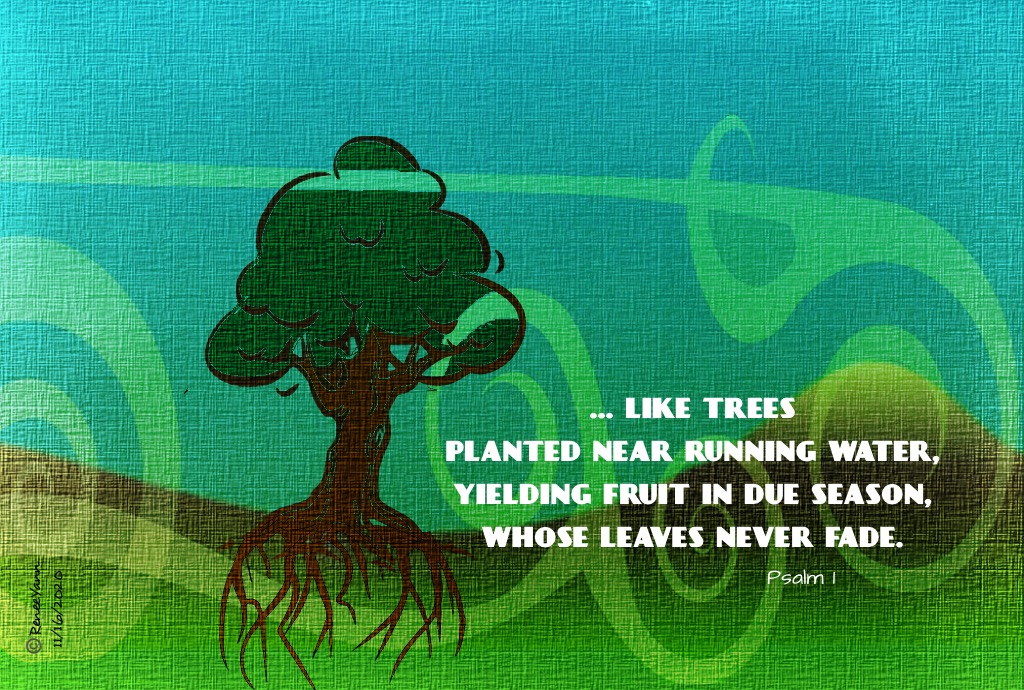
Like a tree planted near running water, That yields its fruit in due season, and whose leaves never fade, ever prospering.
Psalm 1:3
Poetry: Onto a Vast Plain – Rainer Maria Rilke
Listen.
You are not surprised at the force of the storm—
you have seen it growing.
The trees flee. Their flight
sets the boulevards streaming. And you know:
he whom they flee is the one
you move toward. All your senses
sing him, as you stand at the window.

The weeks stood still in summer.
The trees’ blood rose. Now you feel
it wants to sink back
into the source of everything. You thought
you could trust that power
when you plucked the fruit:
now it becomes a riddle again
and you again a stranger.

Summer was like your house: you know
where each thing stood.
Now you must go out into your heart
as onto a vast plain. Now
the immense loneliness begins.

The days go numb, the wind
sucks the world from your senses like withered leaves.

Through the empty branches the sky remains.
It is what you have.
Be earth now, and evensong.
Be the ground lying under that sky.
Be modest now, like a thing
ripened until it is real,
so that he who began it all
can feel you when he reaches for you.
Today, in God’s Lavish Mercy, we pray with Psalm 23, that lovingly familiar song which, over the ages, has comforted so many.
Beside Still Waters by Greg Olsen
We may wish to simply pray this psalm gently and slowly, remembering the many times it has comforted us.
(Below is the inclusive language translation from the Inclusive Language Liturgical Psalter of the Canadian Anglican Synod. Other inclusion collections include Evangelical Lutheran Worship, the Psalter for the Christian People, The Saint Helena Psalter and the Canadian publication, Songs for the Holy One.)
Psalm 23 (Dominus regit me) The Lord is my shepherd; I shall not be in want. You make me lie down in green pastures and lead me beside still waters. You revive my soul and guide me along right pathways for your name’s sake. Though I walk through the valley of the shadow of death, I shall fear no evil; for you are with me; your rod and your staff, they comfort me. You spread a table before me in the presence of those who trouble me; you have anointed my head with oil, and my cup is running over. Surely goodness and mercy shall follow me all the days of my life, and I will dwell in the house of the Lord for ever.
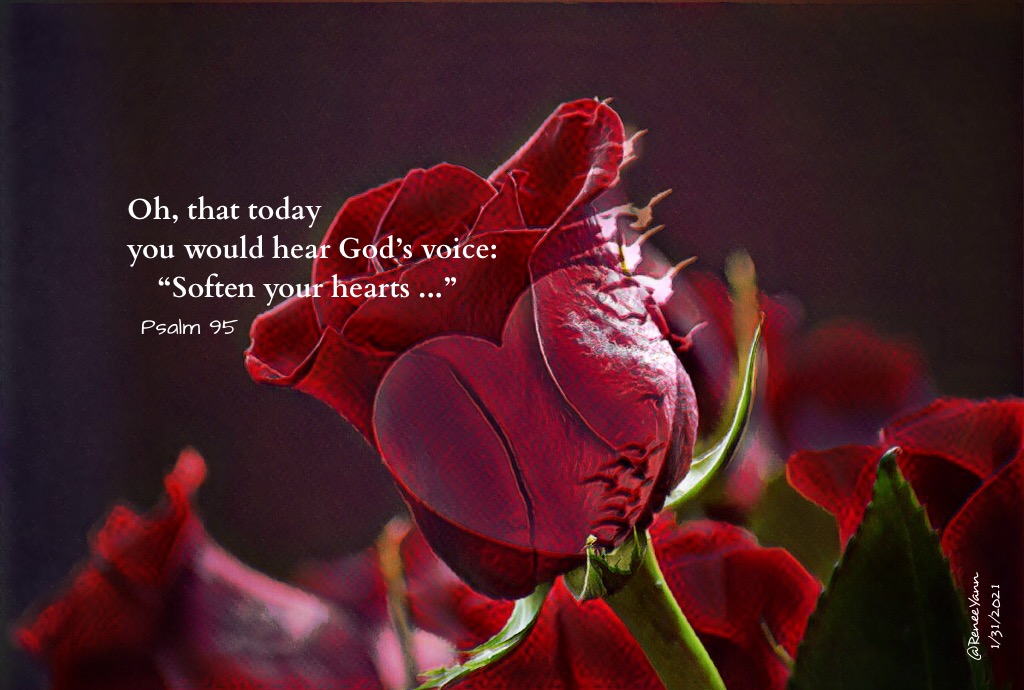
Today, in God’s Lavish Mercy, we pray with Psalm 95, once again a call to a holy tenderheartedness – that mix of love, discernment, and generosity that magnetizes us into dynamic relationship with God.
Oh, that today you would hear his voice: “Harden not your hearts as at Meribah, as in the day of Massah in the desert, Where your fathers tempted me; they tested me though they had seen my works.”
Psalm 95: 7-9
Our other Sunday readings, which Psalm 95 anchors, clarify the reason we seek this tenderheartedness. It is so that we might not only hear, but really listen and respond to the Truth of God in our lives.
Those who will not listen to my words which a prophet speaks in my name, I myself will make them answer for it.
Deuteronomy 18:18
In our first reading from Deuteronomy, the people were confused. They were passing into a new land with lots of rivaling religions and spiritualities. Moses was nearing the end of his life and leadership over them. They wanted to know who to listen to and how to behave in order to stay in God’s favor.
God promises that God’s voice will come through a prophet like Moses:
I will raise up for them a prophet like you from among their kin, and will put my words into his mouth; he shall tell them all that I command him.
Deuteronomy 18: 19
In our Gospel, we see Jesus – the fulfillment of the Deuteronomic Promise. The people witnessing his power are amazed. They struggle with whether they can believe in him when he seems just one of them, a Nazarene, Joseph’s son.
But some could believe – readily. Some, like the disciples, discerned quickly the Truth Jesus was. They heard, listened, believed and obeyed the Word.
Our psalm suggests that such readiness, such tenderheartedness comes from the consistent practice of relationship with God through praise, witness, thanksgiving, prayer, worship, humility, and obedience.
To me, it boils down to this:
let your life unfold in God’s Presence
be silent under God’s loving gaze
thank God for all you have been given
realize you are nothing without God
listen to your life as God speaks it to you
act on what you hear
Come, let us sing joyfully to the LORD;
    let us acclaim the rock of our salvation.
Let us come into God’s presence with thanksgiving;
    let us joyfully sing psalms to the Lord.
R. If today you hear God’s voice, harden not your hearts.
Come, let us bow down in worship;
    let us kneel before the LORD who made us.
For the Lord is our God,
    and we are the people God shepherds, the flock God guides.
Poetry: Rumi
I keep telling my heart,
“Go easy now.
I am submerged in golden treasure.”
It replies,
“Why should I be afraid of love?”
Today, in God’s Lavish Mercy, we pray with Psalm 110, but through the lens of our first reading from Hebrews.
We have prayed with this psalm a few times recently, exploring its links to priesthood, ministry, and good old Melchizedek. When I saw it again this morning, I was at little exhausted by it. Then I read Hebrews and got a new perspective on Psalm 110.
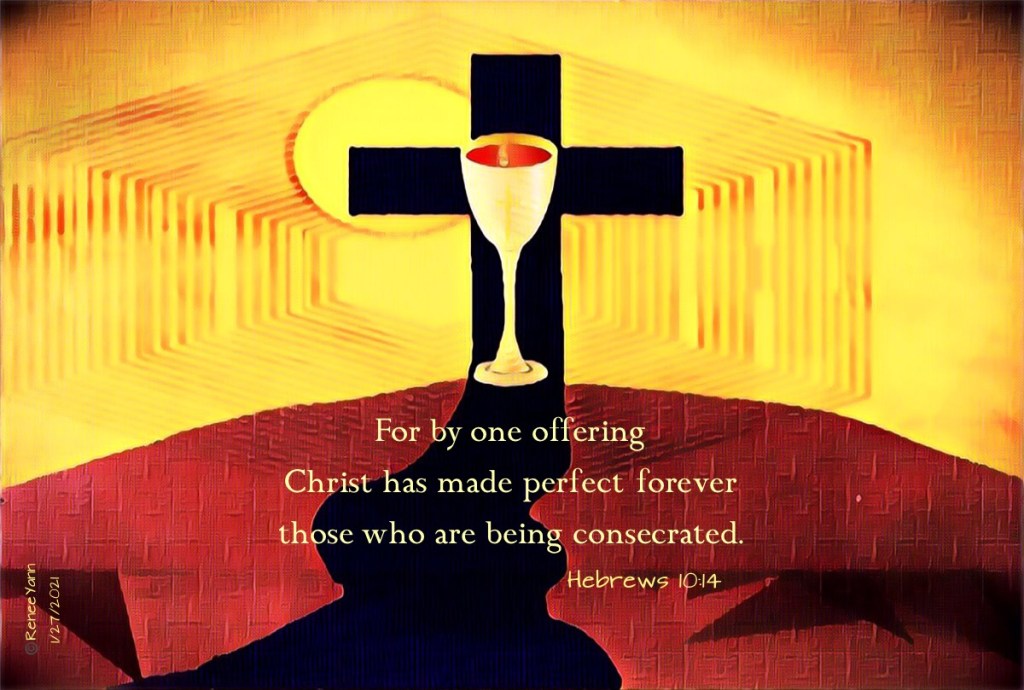
For by one offering Christ has made perfect forever those who are being consecrated. The Holy Spirit also testifies to us, for after saying: This is the covenant I will establish with them after those days, says the Lord: “I will put my laws in their hearts, and I will write them upon their minds,”
Hebrews 10:14-16
This passage from Hebrews is a testament to Jesus Christ, the ultimate High Priest, the Complete Melchizedek. That which Christ sanctifies or consecrates is us – his Body, the Church.
This consecration places in our hearts the covenant once spoken of by Jeremiah:
See, days are coming says the LORD— when I will make a new covenant with the house of Israel and the house of Judah. It will not be like the covenant I made with their ancestors the day I took them by the hand to lead them out of the land of Egypt. They broke my covenant, though I was their master. But this is the covenant I will make with the house of Israel after those days. I will place my law within them, and write it upon their hearts; I will be their God, and they shall be my people.
Jeremiah 31:31-33
Praying with Psalm 110 in this light, I give thanks for the Covenant expressed in my own life:
for my Baptism into Christ,
for the grace to witness to Christ’s law of love
for my inclusion into Christ’s ongoing ministry through the Holy Spirit
Poetry: The Covenant Prayer of John Wesley (1703–1791)
I am no longer my own, but thine.
Put me to what thou wilt, rank me with whom thou wilt.
Put me to doing, put me to suffering.
Let me be employed for thee or laid aside for thee,
exalted for thee or brought low for thee.
Let me be full, let me be empty.
Let me have all things, let me have nothing.
I freely and heartily yield all things to thy pleasure and disposal.
And now, O glorious and blessed God, Father, Son and Holy Spirit,
thou art mine, and I am thine.
So be it.
And the covenant which I have made on earth,
let it be ratified in heaven.
Amen.
Music: A New and Living Way – Michael Card
Year after year there the priest would stand
 An offering of blood held out in in his hand
 Before the curtain there he would stand in fright
 It hung there to hold in the holy ~ to keep in the light

A new and living way
 Through the curtain that was torn
 The climax of the cross
 The moment our hope was born
 By a new and living way

 And when time was full another Priest came to save
 He would offer forgiveness for He was the Offering He gave
 From the sacrifice ~ from that dark disgrace
 Came the power to make anywhere a Most Holy Place

 A new and living way
 Through the curtain that was torn
 The climax of the cross
Today, in God’s Lavish Mercy, we pray with Psalm 117, a psalm used for the feast of an Apostle, reflecting his/her role to:
Luke tells us how Jesus summarized the “Good News”:
The Spirit of the Lord God is upon me, because the Lord has anointed me to bring good news to the poor; he has sent me to bind up the brokenhearted, to proclaim liberty to the captives, and the opening of the prison to those who are oppressed, to proclaim the year of the Lord’s favor. Luke 4:18-19
from the Palatine Chapel in Sicily
As we celebrate St. Paul, the Apostle to the Gentiles, Psalm 117 gives voice to the indescribable gratitude we feel for the call we share with the Apostles to live and witness to the “Good News”.
Praise the LORD, all you nations; glorify him, all you peoples! For steadfast is God’s Mercy toward us, and the fidelity of the Lord endures forever.
Psalm 117: 1
Praying with Psalm 117, and with Saint Paul today, we may find inspiration in Paul’s self-description as an Apostle – a “servant”:
Paul, a servant of Christ Jesus, called to be an apostle and set apart for the gospel of God— the gospel he promised beforehand through his prophets in the Holy Scriptures regarding his Son, who as to his earthly life was a descendant of David, and who through the Spirit of holiness was appointed the Son of God in power by his resurrection from the dead: Jesus Christ our Lord.
Romans 1: 1-4
Poetry: A Thanksgiving -John Henry Newman (1801-1890) I think this poem by Newman expresses sentiments similar to some of Paul’s thoughts on his life and vocation as found in his letters and in Acts.
LORD , in this dust Thy sovereign voice
First quicken’d love divine;
I am all Thine,–Thy care and choice,
My very praise is Thine.

I praise Thee, while Thy providence
In childhood frail I trace,
For blessings given, ere dawning sense
Could seek or scan Thy grace;

Blessings in boyhood’s marvelling hour,
Bright dreams, and fancyings strange;
Blessings, when reason’s awful power
Gave thought a bolder range;

Blessings of friends, which to my door
Unask’d, unhoped, have come;
And, choicer still, a countless store
Of eager smiles at home.

Yet, LORD , in memory’s fondest place
I shrine those seasons sad,
When, looking up, I saw Thy face
In kind austereness clad.

I would not miss one sigh or tear,
Heart-pang, or throbbing brow;
Sweet was the chastisement severe,
And sweet its memory now.

Yes! let the fragrant scars abide,
Love-tokens in Thy stead,
Faint shadows of the spear-pierced side
And thorn-encompass’d head.

And such Thy tender force be still,
When self would swerve or stray,
Shaping to truth the froward will
Along Thy narrow way.

Deny me wealth; far, far remove
The lure of power or name;
Hope thrives in straits, in weakness love,
And faith in this world’s shame
Music: Saul’s Transformation – one of many lovely pieces from the film, Paul Apostle of Christ by Jan A. P. Kaczmarek
Today, in God’s Lavish Mercy, we pray with Psalm 25, a simple, heartfelt plea to learn God’s ways and to be blessed by that learning.
Your ways, O LORD, make known to me; teach me your paths, Guide me in your truth and teach me, for you are God my savior.
Psalm 25: 4-5
The psalmist’s prayer is so fitting for this special Sunday which is dedicated as the “Sunday of the Word of God”.
Pope Francis called for this commemoration with his Apostolic Letter “Aperuit illis”. The Latin words come from Luke 24:45, referring to Jesus’s post-Resurrection appearance to his confused disciples.
Then he opened their minds to understand the scriptures.
While they were still speaking about this, he stood in their midst and said to them, “Peace be with you.” But they were startled and terrified and thought that they were seeing a ghost. Then he said to them, “Why are you troubled? And why do questions arise in your hearts? Look at my hands and my feet, that it is I myself. Touch me and see, because a ghost does not have flesh and bones as you can see I have.” And as he said this, he showed them his hands and his feet.
While they were still incredulous for joy and were amazed, he asked them, “Have you anything here to eat?” They gave him a piece of baked fish; he took it and ate it in front of them. He said to them, “These are my words that I spoke to you while I was still with you, that everything written about me in the law of Moses and in the prophets and psalms must be fulfilled.” Then he opened their minds to understand the scriptures.
Luke 24: 36-45
The Pope’s letter institutes the annual observance of the 3rd Sunday of Ordinary Time as “Sunday of the Word of God”, devoted to the celebration, study and dissemination of the Word of God.
Pope Francis wrote this:
A profound bond links sacred Scripture and the faith of believers. Since faith comes from hearing, and what is heard is based on the word of Christ (cf. Rom 10:17), believers are bound to listen attentively to the word of the Lord, both in the celebration of the liturgy and in their personal prayer and reflection.
Aperuit Illis, 7
If you are reading this blog, you already seek an ever deeper, more loving relationship with God through sacred scripture. But with our Infinite God, there is always more.
Let us use today’s Psalm 25 to reflect on and reaffirm that core relationship in our lives. Let’s re-examine the dedicated time we give to scriptural prayer and “lectio divina” to make it more intentional, quiet, and consistent.
For a good explanation of lectio divina, see the Transforming Center’s website:
In the spirit of Psalm 25, we pray to always be held in God’s merciful attention, and to hold God in ours through prayer and desire.
Remember that your compassion, O LORD, and your love are from of old. In your kindness remember me, because of your goodness, O LORD.
Psalm 25: 6-7
These are two books that I love, and have mentioned before, to help deepen our scriptural prayer:
Too Deep for Words – Thelma Hall
The Flowing Grace of Now – Macrina Wiederkehr – (Kindle edition on sale now for just $2.99)
Poetry: The Opening of Eyes – David Whyte
That day I saw beneath dark clouds
the passing light over the water
and I heard the voice of the world speak out,
I knew then, as I had before
life is no passing memory of what has been
nor the remaining pages in a great book
waiting to be read.
It is the opening of eyes long closed.
It is the vision of far off things
seen for the silence they hold.
It is the heart after years
of secret conversing
speaking out loud in the clear air.
It is Moses in the desert
fallen to his knees before the lit bush.
It is the man throwing away his shoes
as if to enter heaven
and finding himself astonished,
opened at last,
fallen in love with solid ground.
Today, in God’s Lavish Mercy, we pray with Psalm 110 where we are re-introduced to Melchizedek, the first priest mentioned in Genesis 14.
Yours is princely power in the day of your birth, in holy splendor; before the daystar, like the dew, I have begotten you.” The LORD has sworn, and will not repent: “You are a priest forever, according to the order of Melchizedek.”
Psalm 110: 3-4
And our two readings today show us Jesus, the one High Priest, through whom we are fully redeemed.
In the days when he was in the Flesh, Jesus offered prayers and supplications with loud cries and tears to the one who was able to save him from death, and he was heard because of his reverence. Son though he was, he learned obedience from what he suffered; and when he was made perfect, he became the source of eternal salvation for all who obey him.
Hebrews 5: 7-9
It is so appropriate to consider the meaning of priesthood as we commemorate the life of Rev. Dr. Martin Luther King. In the image of Christ, Dr. King wore a chasuble of justice for our time.
A priest is one :
who is set apart
who mediates the Divine
who bears witness
who ministers
who offers sacrifice
who transforms through prophetic hope
As a Catholic priest vests with the chasuble for Mass, this prayer is said:
Domine, qui dixisti: Jugum meum suave est et onus meum leve: fac, ut istud portare sic valeam, quod consequar tuam gratiam.
Lord, you have said: My yoke is sweet and my burden is light. Grant that I may carry your yoke well so as to obtain your grace.
Indeed, Martin Luther King “carried the yoke well” to obtain the grace of justice for all of us.
Poetry: two poems in which the poet, Margaret Walker, uses the persona of Amos the Prophet to describe Martin Luther King. One poem is written before, and one after, Dr. King’s assassination.
Amos, 1963 – Margaret Walker – 1914-1997
Amos is a Shepherd of suffering sheep;
A pastor preaching in the depths of Alabama
Preaching social justice to the Southland
Preaching to the poor a new gospel of love
With the words of a god and the dreams of a man
Amos is our loving Shepherd of the sheep
Crying out to the stricken land
“You have sold the righteous for silver
And the poor for a pair of shoes.
My God is a mighty avenger
And He shall come with His rod in His hand.”
Preaching to the persecuted and the disinherited millions
Preaching love and justice to the solid southern land
Amos is a Prophet with a vision of brotherly love
With a vision and a dream of the red hills of Georgia
“When Justice shall roll down like water
And righteousness like a mighty stream.”
Amos is our Shepherd standing in the Shadow of our God
Tending his flocks all over the hills of Albany
And the seething streets of Selma and of bitter Birmingham.
Amos (Postscript, 1968)
From Montgomery to Memphis he marches
He stands on the threshold of tomorrow
He breaks the bars of iron and they remove the signs
He opens the gates of our prisons.
He speaks to the captive hearts of America
He bares raw their conscience
He is a man of peace for the people
Amos is a Prophet of the Lord
Amos speaks through Eternity
The glorious Word of the Lord!
Today, in God’s Lavish Mercy, we pray with Psalm 40, the prayer of one at home with God:
I delight to do your will, my God; your law is in my inner being!
Psalm 40:9
We are reminded that we find this kind of peace by believing and listening to our experience:
Throughout our readings today, God leans over heaven’s edge to whisper into human experience.
Samuel’s Call by Joshua Reynolds
In our first reading, that whisper comes in a sacred call to a listening Samuel:
When Samuel went to sleep in his place, the LORD came and revealed his presence, calling out as before, “Samuel, Samuel!” Samuel answered, “Speak, for your servant is listening.”
1 Samuel 3: 9-10
In our second reading, Paul reminds us that the Whispering Spirit is already resident within us:
Do you not know that your body is a temple of the Holy Spirit within you, whom you have from God, and that you are not your own?
1 Corinthians 6: 19
In our Gospel, Jesus – the Word, the Divine Whisper – invites us to come to him, to see his power with us in our ordinary lives.
The two disciples said to Jesus, “Rabbi, where do you live?” He said to them, “Come, and you will see.”
John 1: 39
Praying with Psalm 40 can turn our hearts to listening for God’s voice under and within our experiences.
It can wake us up, as Samuel was awakened.
It can attune us to the melody deep within our hearts.
It can reiterate God’s invitation to live our lives so fully in the Beloved’s Presence that, even without a sound, we know each other’s thoughts.
Poetry: from Whispers of the Beloved by Rumi
Do you know what the music is saying? “Come follow me and you will find the way. Your mistakes can also lead you to the Truth. When you ask, the answer will be given.”
Today, in God’s Lavish Mercy, we pray with Psalm 105 celebrating God’s covenanted faithfulness to us.
Give thanks to the LORD, invoke God’s name; make known among the nations God’s deeds. Sing, sing God’s praise, proclaim all God’s wondrous deeds. (because…) The Lord remembers the covenant for ever.
Psalm 105: 1-2, 8
We certainly can spend some time in prayer today remembering God’s faithfulness to us personally. A grateful review of our life journey can always offer new insights into God’s love and generosity.
But more specifically, our psalm calls us to plumb the two readings which it connects.
Hebrews reminds us that God’s love is so extreme that God took Flesh in Jesus to teach us, in terms we could understand, the degree of God’s love.
In Mark, we see the early expression of that love, as Jesus reveals his healing power to the wretchedly suffering crowds.
In these readings, we learn that God’s promise endures to each generation:
God remembers the covenant forever which was made binding for a thousand generations– Which was entered into with Abraham and by God’s oath to Isaac.
Psalm 105: 8
In Chronos Time, this enduring covenant was enfleshed in Jesus. It continues in Kairos Time through each person’s Baptism into Christ through the Holy Spirit.
In other words, we are the agents of God’s covenant with the world. Our lives must enflesh God’s Mercy for our times.
In his letter to Titus, Paul puts this clearly:
But when the kindness and love of God our Savior appeared, we were saved not because of righteous things we had done, but because of God’s mercy. God saved us through the washing of rebirth and renewal by the Holy Spirit, poured out on us generously through Jesus Christ our Savior, so that, having been justified by God’s grace, we might become heirs having the hope of eternal life.
Titus 3: 4-7
May the message of these readings free us, inspire us, and impel us to a grace-filled response.
Poetry: Grace by Jill Peláez Baumgartner
Is it the transparency
and lift of air?
Is it release
as when the pebble
flings out of the slingshot
or the tethered dog
suddenly is without lead?

Or is it more like standing
on a dark beach
at midnight,
the surf loud
with its own revolution,
the horizon invisible,
the entire world the threat
of rushing water?

No one who swims
at night in the ocean
feels weightless
embracing armfuls of water
against the ballast
of the waves’ fight.

Swimming:
toward the shore lights
or out into the vast bed
of the sea's white fires?
Music: Confitemini Domino – Psalm 105 – Orlando di Lasso (first published in 1562)















 Lavish Mercy