My niece Maureen took this picture at the Biltmore in Asheville, NC
Today, in God’s Lavish Mercy, we pray with Psalm 19 which, according to the famous Baptist preacher Charles Spurgeon, is “the study of God’s two great books—nature and Scripture”.
The verses chosen for today’s Responsorial focus on the Law as we receive it in the words of Scripture.
The law of the LORD is perfect, refreshing the soul; The decree of the LORD is trustworthy, giving wisdom to the simple.
Psalm 19:8
St. Andrew, whose feast we celebrate today, was a simple fisherman made wise by the Living Word of God. He received the Gospel as it was first uttered in the life and preaching of his dear friend Jesus.
DUCCIO DI BUONINSEGNA The Calling of the Apostles Peter and Andrew, 1308-1311
Andrew decided to retell that precious Word in his own life and preaching.
He joyfully accepted the call to radical discipleship, allowing his inner vision to be enlightened by the Christ’s vision for the world.
The precepts of the LORD are right, rejoicing the heart; The command of the LORD is clear, enlightening the eye.
Psalm 19: 9
Andrew’s whole life and death gave witness to his total investment in God’s Word. That apostolic commitment sweetened not only Andrew’s life, but the life of the whole faith community to whom he transmitted the Living Word… including us.
Your words, Lord, are Spirit and life. They are more precious than gold, than a heap of purest gold; Sweeter also than syrup or honey from the comb.
Psalm 19: 10;11
Let’s pray this Psalm today with a simplicity and faith like Andrew’s.
Prayer: from daily-prayers.org
O Glorious St. Andrew, you were the first to recognize and follow the Son of God. With your friend, St. John, you remained with Jesus, for your entire life, and now throughout eternity. Just as you led your brother, St Peter, to Christ and many others after him, draw us also to Him. Teach us how to lead them, solely out of love for Jesus and dedication to His service. Help us to learn the lesson of the Cross and carry our daily crosses without complaint, so that they may carry us to God the Almighty Father. Amen.
Music: from Bach – Die Himmel erzählen die Ehre Gottes, BWV 76
Today, in God’s Lavish Mercy, we pray with Psalm 96, a royal psalm praising God as the King of all Creation.
The psalm’s first verses, not included in today’s passage, call us to sing and dance before the King.
Sing to the LORD a new song; sing to the LORD, all the earth.
Sing to the LORD, bless his name; proclaim his salvation day after day.
Tell his glory among the nations; among all peoples, his marvelous deeds.
Psalm 96: 1-3
We might pray this psalm with deep consciousness of our place in Creation, in the divine handiwork of this generous King. We have been given life alongside a panoply of beautiful creatures in order that we might, together, sing God’s song.
We sing in a choir of evening stars and morning sunrises, beside choristers of great redwoods and lofty mountains. We join in the prayerful music of the rainbow of animal and human voices rising to praise God.
A dear friend posted this yesterday. I thought it was delightful.
Let the heavens be glad and the earth rejoice; let the sea and what fills it resound; let the plains be joyful and all that is in them! Then shall all the trees of the forest exult.
Psalm 96: 11-12
As we continue to draw down the curtain on the final days of this liturgical year, the daily readings draw our attention to the end of time – when all God’s created munificence will be finally gathered to the Eternal Presence.
Once, on a retreat with the Wernersville Jesuits, I went to their recreation room and played a 331⁄3 rpm record (yes, it was that long ago!). It was Wagner’s triumphant Ride of the Valkyries. You can listen to the music by clicking below.
The music engaged my spirit and no words were needed for my prayer. I imagined a Glorious Light rising over time’s darkness, a rider on the Dawn’s steed.
I pictured us all coming to that Light in waves of praise, one order of creation after the other, over the hills of time and into a merciful, eternal Brilliance.
Each wave rose out of any darkness, pain, or death that might have hindered them. They broke on to God’s merciful shore and were embraced in Light.
…. the meanest souls of history first, bowing repentant before God’s forgiveness. Then one wave after another, finally coming to the most innocent, the poor and the humble. These heroes of the Beatitudes marched triumphant, their places beside God already prepared, their faces already redeemed by God’s justice
The Lord comes to rule the earth. to rule the world with justice and the peoples with constancy.
Psalm 96:13
The prayer of imagination can open the heart in a way far beyond words. It does take time to place ourselves in the quiet peace that welcomes such prayer. But I think it is so worth it. Our psalm might be inviting us to that kind of prayer today.
Reflective Reading: Prayer of Imagination for Anna the Prophetess from Twelve Women of the Chalice – Leddy Hammock and Sue K. Riley
Now, in this moment I close my outer eyes and look within with my inner eyes. I see a vision of wonder, for I am the daughter of the vision of God, of the tribe of the blessed ones, a soul under grace.
I judge not by appearances. I believe in God’s promises. I fast from shadows and I live on light. From my youth, I have served at the temple, a vessel to a holy purpose.
Prayer is the temple where I dwell Here I behold the image of the Lord.
I close my eyes and behold that image, the eyes of the Infinite beholding me all through the ages, so tenderly gazing with love and compassion, enfolding me.
Prayer is the temple where I dwell. Here, I behold the image of the Lord.
The thoughts held in mind are mirrored in kind all around me, reflecting through all that I see.
Now, I behold with inner vision the wonders that will be in the fullness of time. The dreams of all my days and nights are incensed in the inner sanctum.
My thoughts of truth are flowers on the altar of light. In the presence of the Holy of Holies, I keep the high watch. Gifted with the inner sight, I see beyond the present.
I am an old, old soul, yet ageless in eternity. Though outer eyes may seem to dim with time, the inner eyes are crystal clear.
Though outer vision may seem obscured by time and place, or clouded by the sorrows and the slavery of sense, another world’s revealed so clear. And what I see will be.
My thoughts are giving form, And held in mind, shall reproduce in kind. O Lord, I take a long loving look at the real. I prophesy.
Christ is here. I have seen the Lord, Thine image, and held that image to my own heart. I am the Spirit of Imagination. I am Anna, the prophetess, woman of power.
Today, in God’s Lavish Mercy, we pray with Psalm 149 which calls the community to sing and dance because God has delivered them.
This happy, celebratory summons is set, contrastingly, between two readings that mention weeping.
Then I saw a mighty angel who proclaimed in a loud voice, “Who is worthy to open the scroll and break its seals?” But no one in heaven or on earth or under the earth was able to open the scroll or to examine it. I shed many tears because no one was found worthy to open the scroll or to examine it.
Revelation 5:2-4
As Jesus drew near Jerusalem, he saw the city and wept over it, saying, “If this day you only knew what makes for peace– but now it is hidden from your eyes.
Luke 19; 41-42
The readings leave us with a sense that there is a secret to eternal life – a secret to which only grace can open our eyes and hearts.
John writes that “the Lion of Judah” has the key:
One of the elders said to me, “Do not weep. The lion of the tribe of Judah, the root of David, has triumphed, enabling him to open the scroll with its seven seals.”
Revelation 5:5-6
Jesus, Uncreated Grace, is the Lion of Judah. He has incarnated the sacred key in his Life, Death, and Resurrection. For those who receive him and share his life, the door is opened, the scroll unrolled.
So what is the path to such union with Jesus?
Our psalm contains a brief line tucked at its center which foreshadows the entire message of the Gospel.
Let them praise God’s name in the festive dance, let them sing praise with timbrel and harp. For the LORD loves us, and adorns the lowly with victory.
We will find a dancing, singing joy when we give ourselves to these truths:
God loves us irrevocably
We can fully receive this great love to the degree that we become like Christ whose image we find among the poor, lowly, and suffering.
Poetry: Dance from Rumi
Come to me, and I shall dance with you In the temples, on the beaches, through the crowded streets Be you man or woman, plant or animal, slave or free I shall show you the brilliant crystal fires, shining within I shall show you the beauty deep within your soul I shall show the path beyond Heaven. Only dance, and your illusions will blow in the wind Dance, and make joyous the love around you Dance, and your veils which hide the Light Shall swirl in a heap at your feet.
Today, in God’s Lavish Mercy, we pray with Psalm 15 which often is called an ‘entrance liturgy’, where a worshipper asks the conditions of entering the worship place and a priest answers.
The psalm’s first line, not included in today’s verses, asks that question of the Lord:
LORD, who may abide in your tent? Who may dwell on your holy mountain?
Psalm 15:1
Reading this line immediately reminded me of Jesus’s first encounter with his chosen twelve. Upon meeting Jesus, and obviously struck with his unique charisma, the disciples ask, “Lord, where do you live?”. They want to be with him, to learn about him. We do too.
It’s a gift to be invited to someone’s home – to see where and how they live, to share their dailyness. It is a first portal to the intimacy of friendship, a gift beyond price when it proves mutual and true.
In today’s Gospel, in a sort of reverse proposal, Jesus invites himself to dinner at Zaccheus’s home. Throughout all the Gospels, we often see Jesus inviting and accepting invitations which prove to be conversions and calls for his followers.
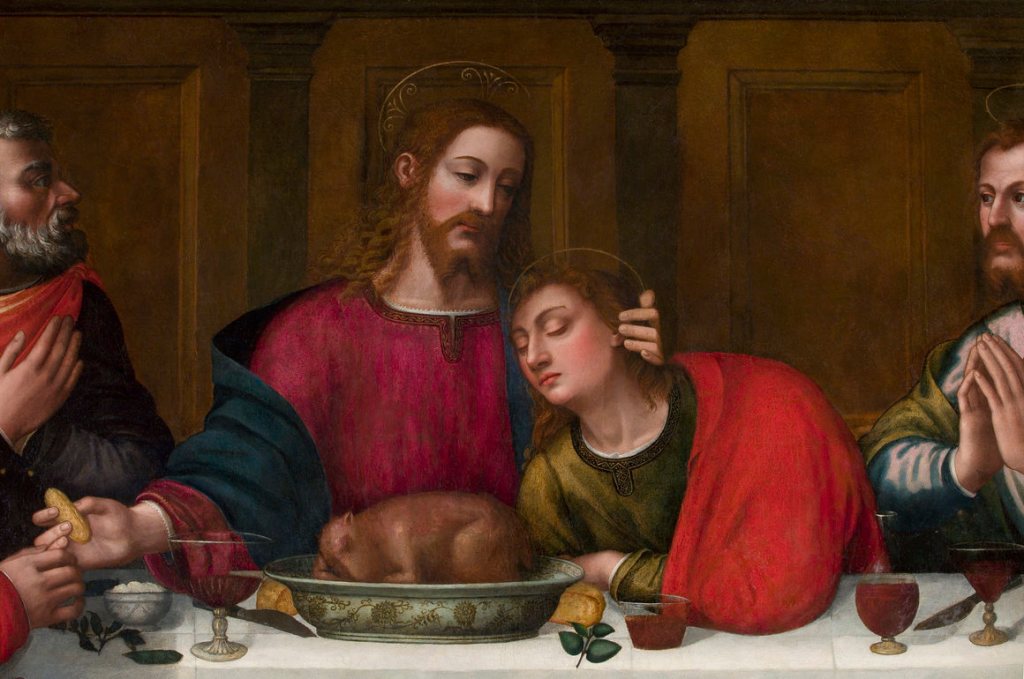
by Plautilla Nelli, an Italian nun who is said to have taught herself to paint in the 16th century. This is a section of her “Last Supper,” painted around 1568, and now newly installed in the old refectory of the Santa Maria Novella Museum.Of course, it shows Jesus with the “beloved” disciple.
In the reading from Revelation, the invitation takes an apocalyptic and corrective tone, but its heart is the same. In essence, God invites us to an intimacy of which we are capable only under certain conditions, i.e. “if you hear my voice“:
Behold, I stand at the door and knock. If you hear my voice and open the door, then I will enter and dine with you, and you with me. I will give the victor the right to sit with me on my throne, as I myself first won the victory and sit with my Father on his throne.
Today’s segment from Psalm 15 tells us what some of those conditions look like. It says to be someone who:
walks blamelessly and does justice
thinks the truth in your heart
slanders not with your tongue.
harms not your fellow human beings,
takes up no reproach against your neighbor
despises not the reprobate
honors those who fear the LORD
lends not your money at usury
accepts no bribe against the innocent
Our challenge from the psalm is to meditate on that list to see what such behavior looks like in modern terms. Beneath the psalmist’s ancient language, we might discover our attitudes and examine our conscience toward issues like:
criminal justice
capital punishment
war
poverty
immigration policy
refugee resettlement
propagandist media
economic equity
felon rehabilitation
respect for other religions
political oppression
– just to suggest a few.
Psalm 15 tells us, and our other readings affirm, that the one who gets these things right not only gets invited, but gets to remain in God’s house, God’s “tent”.
The one who does these things shall never be disturbed.
I know that’s Who I want to go eternally camping with! How about you?
Poem: Rainer Maria Rilke, Poems from the Book of Hours
You, neighbor God, if sometimes in the night
I rouse you with loud knocking, I do so
only because I seldom hear you breathe
and know: you are alone.
And should you need a drink, no one is there
to reach it to you, groping in the dark.
Always I hearken. Give but a small sign.
I am quite near.
Between us there is but a narrow wall,
and by sheer chance; for it would take
merely a call from your lips or from mine
to break it down,
and that without a sound.
The wall is builded of your images.
They stand before you hiding you like names.
And when the light within me blazes high
that in my inmost soul I know you by,
the radiance is squandered on their frames.
And then my senses, which too soon grow lame,
exiled from you, must go their homeless ways.
Today, in God’s Lavish Mercy, we pray with Psalm 37, a song of promise and encouragement to live a good life. Although I don’t usually choose to write a subjective reflection, a life-shaping memory keeps rising up from this psalm today.
I was nineteen years old, kneeling on an antique prie-dieu in front of the Superior General. She was about to rename me “Sister Something” for the rest of my life. You know, something like this picture – except that novice couldn’t sing quite as well as I did! 🙂
We postulants had been able to submit three suggestions, so I was expecting a name in honor of my mother or father, or my own baptismal name. How stunned was I when Mother intoned, “God bless you, Sister Mary Nathaniel”- a name I had heard maybe once in American Lit class! (You remember Hawthorne, right?)
But my shock is not the point of the story. Later, Mother took me aside and told me that she gave me the name because I reminded her of Nathaniel in the Gospel – the guileless one. Being guileless I guess, I told her I didn’t know what “guileless” meant. She said, “It means whole hearted. Be wholehearted, without pretense.”
The LORD watches over the lives of the wholehearted; their inheritance lasts forever. By the LORD are your steps made firm, as the Lord blesses your way.
Psalm 37 gave me the gift of that word, and that memory, again today. I realized that it is still taking me a lifetime to live into Mother’s long-ago challenge.
Trust in the LORD and do good, that you may dwell in the land and be fed in security. Take delight in the LORD, and God will grant you your heart’s requests.
Even though, after Vatican II, I eventually returned to my baptismal name, my heart has remained “Nathaniel”. Like the disciple under the fig tree, I am still trying to weave a true and loving life out of life’s tangled threads – still trying to do so wholeheartedly and without guile.
Gratefully and humbly, I thank God for watching over me. But God is not the only one. Mother Bernard came once more this morning, borne on memory’s beloved wing, to bless me with renewed hope and challenge.
As we pray this psalm today, let us call on the memory of those who have blessed us by their confidence and hope in us. Let us call on the God who watches over our desire to be truly wholehearted disciples.
Poem: Desiderata by Max Ehrmann (1927) – a writing I loved in my youth and have often passed on to those just beginning the glorious journey.
GO PLACIDLY amid the noise and the haste,
and remember what peace there may be in silence.
As far as possible, without surrender,
be on good terms with all persons.
Speak your truth quietly and clearly; and listen to others,
even to the dull and the ignorant; they too have their story.
Avoid loud and aggressive persons; they are vexatious to the spirit.
If you compare yourself with others, you may become vain or bitter,
for always there will be greater and lesser persons than yourself.
Enjoy your achievements as well as your plans.
Keep interested in your own career, however humble;
it is a real possession in the changing fortunes of time.
Exercise caution in your business affairs,
for the world is full of trickery.
But let this not blind you to what virtue there is;
many persons strive for high ideals,
and everywhere life is full of heroism.
Be yourself. Especially do not feign affection.
Neither be cynical about love;
for in the face of all aridity and disenchantment,
it is as perennial as the grass.
Take kindly the counsel of the years,
gracefully surrendering the things of youth.
Nurture strength of spirit to shield you in sudden misfortune.
But do not distress yourself with dark imaginings.
Many fears are born of fatigue and loneliness.
Beyond a wholesome discipline, be gentle with yourself.
You are a child of the universe no less than the trees and the stars;
you have a right to be here.
And whether or not it is clear to you,
no doubt the universe is unfolding as it should.
Therefore be at peace with God, whatever you conceive God to be.
And whatever your labors and aspirations,
in the noisy confusion of life, keep peace in your soul.
With all its sham, drudgery and broken dreams,
it is still a beautiful world.
Be cheerful. Strive to be happy.
( A bit late today in publishing as I was distracted by the breaking U.S. election results! I would like to say one word on that before the reflection. Here is that word:
Today, in God’s Lavish Mercy, we pray with Psalm 63, a prayer of deep longing and faithful intimacy.
The psalm is complemented by the lyrical passage from the Book of Wisdom which immediately reminded me of my favorite verse for the Christmas season:
For while gentle silence enveloped all things, and night had now run half its swift course, Wisdom’s all-powerful Word leapt down from heaven, from the royal throne, into the midst of the shadowed land.
Wisdom 18: 14-15
Using delicate feminine images, our first reading from Wisdom describes the God for whom we long – a God who longs for us as eagerly:
Resplendent and unfading is Wisdom, and she is readily perceived by those who love her, and found by those who seek her. She hastens to make herself known in anticipation of their desire –
This reading forms a sort of dance with our Psalm – the first describing God’s desire, the second describing ours:
O God, you are my God whom I seek; for you my flesh pines and my soul thirsts like the earth, parched, lifeless and without water.
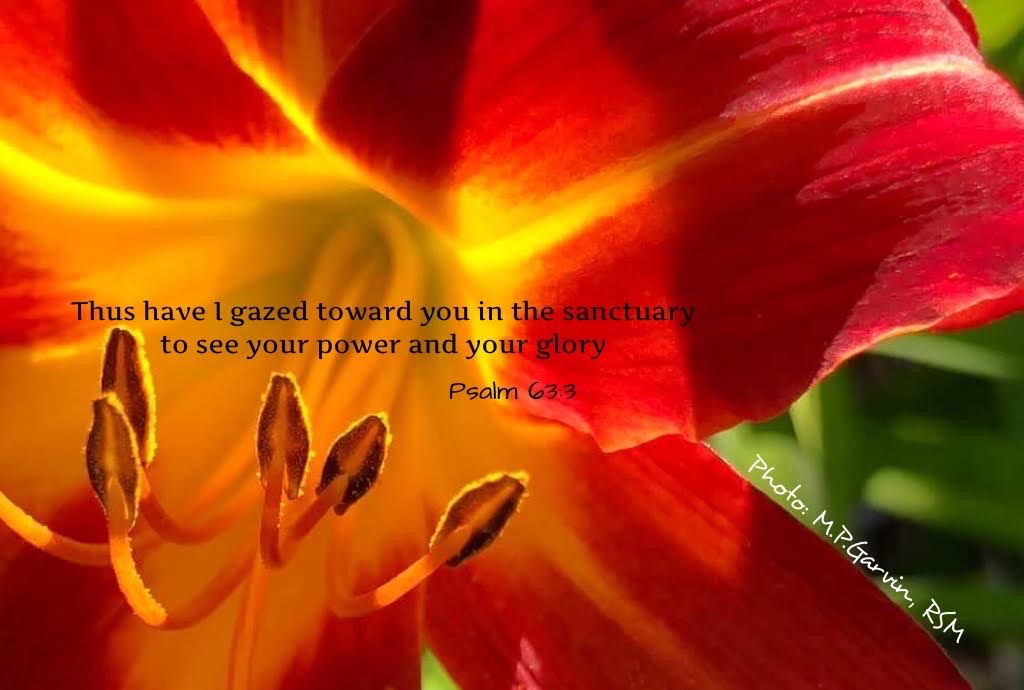
Thus have I gazed toward you in the sanctuary to see your power and your glory, For your kindness is a greater good than life; my lips shall glorify you.
Our reading assures us that God readily meets our gaze:
Whoever watches for Wisdom at dawn shall not be disappointed, for they shall find her sitting by their heart’s gate. For taking thought of wisdom is the perfection of prudence, and whoever for her sake keeps vigil shall quickly be free from care; because she makes her own rounds, seeking those worthy of her, and graciously appears to them in the ways, and meets them with all solicitude.
In our prayer today, let us open our deepest hearts to this Wisdom God who seeks us. Let our thirsty souls be satisfied in that loving Sacred Bliss.
Thus will I bless you while I live; lifting up my hands, I will call upon your name. As with the riches of a banquet shall my soul be satisfied, and with exultant lips my mouth shall praise you.
Music: I Long for You, O Lord – The Dameans
I long for you, O Lord With all my soul, I thirst for You.
God, my God, you I seek for You my soul is thirsting, Like a dry and weary land, my spirit longs for You.
I have sought for Presence, Lord to see your power and your glory. Lord, your love means more than life. I shall sing your praise.
Thus will I bless you while I live, and I will call your name, O Lord. As with the riches of a feast shall my soul be satisfied.
Through the night, I remember You for You have been my Savior. In the shadow of your wings, I will shout for joy.
Today, in God’s Lavish Mercy, we pray again with Psalm 112, placed between two interestingly complementary readings.
Psalm 112 is basically a guide to what constitutes a happy life. The psalm tells us this:
Blessed and happy is the one:
who fears the LORD,
who greatly delights in God’s commands.
who is gracious and lends
who conducts affairs with justice
who gives to the poor
The psalmist tells us that this kind of humble, grateful generosity is its own reward.
Such a person
shall have a posterity which is mighty upon the earth
shall never be moved;
shall be in everlasting remembrance
shall be steadfast; shall not fear.
shall be remembered for enduring generosity
shall have a “horn” exalted in glory. ( “horn” = strength and power)
If we translate the biblical language here, what is Psalm 112 telling us.
This. True happiness comes from:
loving God
living within the law of love
being just, merciful, and generous
taking care of the vulnerable
Such happiness looks like this:
others can look up to you, especially the young
you stay faithful to goodness and righteousness
your faithfulness nourishes those who come after you
you are strong and courageous
your generosity inspires generosity in others
you are respected and loved for your goodness, even long after you’re gone
These are the kind of people Paul is depending on in our first reading to keep his ministry afloat. It sounds like he didn’t find too many of them, except finally in his Philippian community! Actually, under his eloquence, I think Paul sounds a little ticked off!😉
Jesus was looking for this kind of people too, but he certainly didn’t find them in the Pharisees of today’s Gospel. And Jesus let’s them have it in a dose of their own medicine.
What does Jesus, who “knows our hearts”, find when he looks at us? Let’s pray Psalm 112 today asking for the grace to grow in true, generous, faith so we can look back at Jesus with deep peace and HAPPINESS!
Poem: The Work of Happiness by May Sarton
I thought of happiness, how it is woven Out of the silence in the empty house each day And how it is not sudden and it is not given But is creation itself like the growth of a tree. No one has seen it happen, but inside the bark Another circle is growing in the expanding ring. No one has heard the root go deeper in the dark, But the tree is lifted by this inward work And its plumes shine, and its leaves are glittering.
So happiness is woven out of the peace of hours And strikes its roots deep in the house alone: The old chest in the corner, cool waxed floors, White curtains softly and continually blown As the free air moves quietly about the room; A shelf of books, a table, and the white-washed wall— These are the dear familiar gods of home, And here the work of faith can best be done, The growing tree is green and musical.
For what is happiness but growth in peace, The timeless sense of time when furniture Has stood a life’s span in a single place, And as the air moves, so the old dreams stir The shining leaves of present happiness? No one has heard thought or listened to a mind, But where people have lived in inwardness The air is charged with blessing and does bless; Windows look out on mountains and the walls are kind.
Music: Psalm 112 – 4Him
We only get so many times
To ride around this sun
And so many times to see a full moon shine
When day is done if anything's worth doing
Then it's worth doing right
So I looked for wisdom on how to
Best live this brief life I have found
Blessed is he who fears the Lord
Who finds delight in His commands
Blessed is he who fears the Lord
Who finds delight in His commands
I guess that we all gamble on some
Truth to guide our days
And we trust that it will bring us joy and meaning
On the way
I've got friends who feel betrayed by all the things
They once believed
So with everything I've seen I've gotta say
It seems to me
Blessed is he who fears the Lord
Who finds delight in His commands
Blessed is he who fears the Lord
Who finds delight in His commands
Please hear this from a humble heart
But I feel like Exhibit A
In the evidence that God is good to those
Who live by faith, that's why I believe
Blessed is he who fears the Lord
Who finds delight in His commands
Blessed is he who fears the Lord
Who finds delight in His commands
He will not be shaken
He will have no fear
He will then remember
Today, in God’s Lavish Mercy, we pray with Psalm 18
I love you, O LORD, my strength, O LORD, my rock, my fortress, my deliverer.
Psalm 18: 2-3
The psalm is almost a mirror reflection of 2 Samuel 22, and has been interpreted as a song that David sang throughout his life to praise God’s goodness to him.
Today the psalm connects several readings, which together give us:
a command
and a hint about how to fulfill that command.
Bottom line, our readings tell us this:
First, Love God
And, second, here’s where to find the God you desire to love.
If we trust the hint, and act on the command, we will be able to sing – like David – throughout our lives.
"You shall love the Lord, your God,
with all your heart,
with all your soul,
and with all your mind.
This is the greatest and the first commandment.
The second is like it:
You shall love your neighbor as yourself.
Here is a beautiful poetic interpretation of Psalm 18:
I open my heart to you, O God
for you are my strength, my fortress,
the rock on whom I build my life.
I have been lost in my fears and my angers
caught up in falseness, fearful, and furious.
I cried to you in my anguish.
You have brought me to an open space.
You saved me because you took delight in me.
I try to be good, to be just, to be generous
to walk in your ways.
I fail, but you are my lamp.
You make my darkness bright
With your help, I continue to scale the walls
and break down the barriers that fragment me.
I would be whole, and happy, and wise
and know your love
Always.
~ Christine Robinson
Today, in God’s Lavish Mercy, we pray with Psalm 122, one of my favorites.
I rejoiced when they said to me “Let us go to the house of the LORD And now our feet are standing within your gates, O Jerusalem.
The year 1963 was a dynamic time in the Church. The landmark Second Vatican Council was reaching full steam.
Several changes resulted from the Council, including the renewal of consecrated life with a revised charism, ecumenical efforts towards dialogue with other religions, and the universal call to holiness which, according to Pope Paul VI, was “the most characteristic and ultimate purpose of the teachings of the Council”.
Wikipedia
Simultaneously, a love and engagement with sacred scripture was blossoming throughout the Church. International scholars were completing their response to Pius XII’s 1943 call, in the encyclical Divino Afflante Spiritu, to translate scriptures from the ancient Hebrew and Greek texts. The incomparable Jerusalem Bible was the fruit of these endeavors. It had already been published in French, and was nearing its 1966 English publication.
One of these gifted Bible scholars was a French Jesuit priest, Joseph Gelineau. Gelineau was himself part of the working group for the French Jerusalem Bible, and he developed a revised version of that psalter which respected the rhythms of the Hebrew original.
In my senior year in high school, 1962-63, we were introduced to the Gelineau Psalms. That introduction came at a perfect time for me, as I discerned a call to religious life. In that discernment, Gelineau Psalm 122 became a central part of my prayer.
Jerusalem, built as a city with compact unity. To it the tribes go up, the tribes of the LORD.
I felt rising in me a passionate desire to find and engage my “Jerusalem”, that journey which would pattern my life on the life of Jesus.
The outlines of the journey, the distant vision of “Jerusalem”, were so surreal and indefinite. And yet they were compelling. I came to believe and trust that I would find my path to holiness, my Jerusalem, as a Sister of Mercy.
Like Jesus, I was given the grace and courage to “steadfastly set my face toward Jerusalem” ( Luke 9:51) And it has been an indescribably amazing journey ever since!
As Vatican II so beautifully stated in the document Lumen Gentium, chapter 5, we all share in the universal call to holiness. We all have our own path to that one, glorious Jerusalem.
I know these Documents of Vatican II are over a half century old. But they are priceless classics that I never tire of studying. Here are some passages that might enrich our prayer today as we each consider our own call and response to God.
Therefore in the Church, everyone whether belonging to the hierarchy, or being cared for by it, is called to holiness, according to the saying of the Apostle: “For this is the will of God, your sanctification” (I Thes. 4:3; df. Eph. 1:4).
The classes and duties of life are many, but holiness is one-that sanctity which is cultivated by all who are moved by the Spirit of God, and who obey the voice of the Father and worship God the Father in spirit and in truth. These people follow the poor Christ, the humble and cross-bearing Christ in order to be worthy of being sharers in His glory. Every person must walk unhesitatingly according to his or her own personal gifts and duties in the path of living faith, which arouses hope and works through charity.
Finally all Christ’s faithful, whatever be the conditions, duties and circumstances of their lives-and indeed through all these, will daily increase in holiness, if they receive all things with faith from the hand of their heavenly Father and if they cooperate with the divine will. In this temporal service, they will manifest to all humanity the love with which God loved the world.
Poem: The Neophyte – Alice Meynell
Who knows what days I answer for to-day:
Giving the bud I give the flower. I bow
This yet unfaded and a faded brow;
Bending these knees and feeble knees, I pray.
Thoughts yet unripe in me I bend one way,
Give one repose to pain I know not now,
One leaven to joy that comes, I guess not how.
I dedicate my fields when Spring is grey.
Oh, rash! (I smile) to pledge my hidden wheat.
I fold to-day at altars far apart
Hands trembling with what toils? In their retreat
I seal my love to-be, my folded art.
I light the tapers at my head and feet,
And lay the crucifix on this silent heart.
Music: Jerusalem, My Destiny – Rory Cooney (All lyrics below)
Refrain: I have fixed my eyes on your hills, Jerusalem, my Destiny.
Though I cannot see the end for me I cannot turn away.
We have set our hearts for the way; this journey is our destiny.
Let no one walk alone. The journey makes us one.
1. Other spirits, lesser gods, have courted me with lies.
Here among you I have found a truth that bids me rise. Refrain
2. See, I leave the past behind; a new land calls to me.
Here among you now I find a glimpse of what might be. Refrain
3. In my thirst, you let me drink the waters of your life,
Here among you I have met, the Savior, Jesus Christ. Refrain
4. All the worlds I have not seen you open to my view.
Here among you I have found a vision bright and new. Refrain
5. To the tombs I went to mourn the hope I thought was gone,
Here among you I awoke to unexpected dawn. Refrain
Today, in God’s Lavish Mercy, we pray with Psalm 24 which has been described as “an entrance psalm” for the Temple liturgies.
Praying Psalm 24 invites us to consider how we enter and meet God in the Holy Space of our lives.
That space, first of all, belongs to God Who created all things. We do not create it. God opens it.
The LORD’s are the earth and its fullness; the world and those who dwell in it. For the Lord founded it upon the seas and established it upon the rivers.
Psalm 24: 1-2
Everything within us and around us — that “fullness” of life — belongs to God. When we acknowledge this truth in humble faith and loving awareness, we realize that we already exist within God’s sanctuary:
Who can ascend the mountain of the LORD? or who may stand in his holy place? The one whose hands are sinless, whose heart is clean, who desires not what is vain.
Psalm 24: 3-4
The journey of the spiritual life is about finding that still point in our souls where we see God’s Face in all things. That sacred stillness holds us in God’s Presence until we let go of ourselves within that Love. The Lord blesses that letting go with a “reward”:
That person shall receive a blessing from the LORD, a reward from God the savior. Such is the race that seeks the Lord, that seeks the face of the God of Jacob.
Psalm 24: 5-6
The psalm doesn’t clearly state what that “reward” is, but I think it might be the grace, insight, passion, and courage to live as Paul describes in our first reading:
to live in a manner worthy of the call you have received, with all humility and gentleness, with patience, bearing with one another through love, striving to preserve the unity of the spirit through the bond of peace; one Body and one Spirit, as you were also called to the one hope of your call; one Lord, one faith, one baptism; one God and Father of all, who is over all and through all and in all.
Poem: The light shouts in your tree-top, and the face — Rainer Maria Rilke, Poems from the Book of Hours
The light shouts in your tree-top, and the face of all things becomes radiant and vain; only at dusk do they find you again. The twilight hour, the tenderness of space, lays on a thousand heads a thousand hands, and strangeness grows devout where they have lain. With this gentlest of gestures you would hold the world, thus only and not otherwise. You lean from out its skies to capture earth, and feel it underneath your mantle’s folds. You have so mild a way of being. ……………………………………………They who name you loudly when they come to pray forget your nearness. From your hands that tower above us, mountainously, lo, there soars, to give the law whereby our senses live, dark-browed, your wordless power.
Music: I Have Loved You – Michael Joncas
I Have Loved You
I have loved you with an everlasting love, I have called you and you are mine;
I have loved you with an everlasting love, I have called you and you are mine.
Seek the face of the Lord and long for him: He will bring you his light and his peace.
I have loved you with an everlasting love, I have called you and you are mine;
I have loved you with an everlasting love, I have called you and you are mine.
Seek the face of the Lord and long for him: He will bring you his joy and his hope.
I have loved you with an everlasting love, I have called you and you are mine;
I have loved you with an everlasting love, I have called you and you are mine.
Seek the face of the Lord and long for him: He will bring you his care and his love.
I have loved you with an everlasting love, I have called you and you are mine;
I have loved you with an everlasting love, I have called you and you are mine.