Psalm 37: Be Wholehearted

Memorial of Saint Leo the Great, Pope and Doctor of the Church

November 10, 2020


Today, in God’s Lavish Mercy, we pray with Psalm 37, a song of promise and encouragement to live a good life. Although I don’t usually choose to write a subjective reflection, a life-shaping memory keeps rising up from this psalm today.

I was nineteen years old, kneeling on an antique prie-dieu in front of the Superior General. She was about to rename me “Sister Something” for the rest of my life. You know, something like this picture – except that novice couldn’t sing quite as well as I did! 🙂

We postulants had been able to submit three suggestions, so I was expecting a name in honor of my mother or father, or my own baptismal name. How stunned was I when Mother intoned, “God bless you, Sister Mary Nathaniel”- a name I had heard maybe once in American Lit class! (You remember Hawthorne, right?)


But my shock is not the point of the story. Later, Mother took me aside and told me that she gave me the name because I reminded her of Nathaniel in the Gospel – the guileless one. Being guileless I guess, I told her I didn’t know what “guileless” meant. She said, “It means whole hearted. Be wholehearted, without pretense.”

The LORD watches over the lives of the wholehearted;
their inheritance lasts forever.
By the LORD are your steps made firm,
as the Lord blesses your way.


Psalm 37 gave me the gift of that word, and that memory, again today. I realized that it is still taking me a lifetime to live into Mother’s long-ago challenge. 

Trust in the LORD and do good,
that you may dwell in the land and be fed in security.
Take delight in the LORD,
and God will grant you your heart’s requests.


Even though, after Vatican II, I eventually returned to my baptismal name, my heart has remained “Nathaniel”. Like the disciple under the fig tree, I am still trying to weave a true and loving life out of life’s tangled threads – still trying to do so wholeheartedly and without guile.

Gratefully and humbly, I thank God for watching over me. But God is not the only one. Mother Bernard came once more this morning, borne on memory’s beloved wing, to bless me with renewed hope and challenge.

As we pray this psalm today, let us call on the memory of those who have blessed us by their confidence and hope in us. Let us call on the God who watches over our desire to be truly wholehearted disciples.

Poem: Desiderata by Max Ehrmann (1927) – a writing I loved in my youth and have often passed on to those just beginning the glorious journey.

GO PLACIDLY amid the noise and the haste, 
and remember what peace there may be in silence. 
As far as possible, without surrender, 
be on good terms with all persons.
Speak your truth quietly and clearly; and listen to others, 
even to the dull and the ignorant; they too have their story.

Avoid loud and aggressive persons; they are vexatious to the spirit. 
If you compare yourself with others, you may become vain or bitter, 
for always there will be greater and lesser persons than yourself.
Enjoy your achievements as well as your plans. 

Keep interested in your own career, however humble; 
it is a real possession in the changing fortunes of time.
Exercise caution in your business affairs, 
for the world is full of trickery. 
But let this not blind you to what virtue there is; 
many persons strive for high ideals, 
and everywhere life is full of heroism.

Be yourself. Especially do not feign affection. 
Neither be cynical about love; 
for in the face of all aridity and disenchantment, 
it is as perennial as the grass.

Take kindly the counsel of the years, 
gracefully surrendering the things of youth.
Nurture strength of spirit to shield you in sudden misfortune. 
But do not distress yourself with dark imaginings. 
Many fears are born of fatigue and loneliness.
Beyond a wholesome discipline, be gentle with yourself. 

You are a child of the universe no less than the trees and the stars; 
you have a right to be here.
And whether or not it is clear to you, 
no doubt the universe is unfolding as it should. 

Therefore be at peace with God, whatever you conceive God to be. 
And whatever your labors and aspirations, 
in the noisy confusion of life, keep peace in your soul. 

With all its sham, drudgery and broken dreams, 
it is still a beautiful world. 
Be cheerful. Strive to be happy.

Music: Tenderhearted – Jeanne Cotter

Psalm 63: So Thirsty!

Thirty-second Sunday in Ordinary Time

November 8, 2020

( A bit late today in publishing as I was distracted by the breaking U.S. election results! I would like to say one word on that before the reflection. Here is that word:

ALLELUIA!


Today, in God’s Lavish Mercy, we pray with Psalm 63, a prayer of deep longing and faithful intimacy. 

The psalm is complemented by the lyrical passage from the Book of Wisdom which immediately reminded me of my favorite verse for the Christmas season:

For while gentle silence enveloped all things,
and night had now run half its swift course,
Wisdom’s all-powerful Word leapt down from heaven, 
from the royal throne,
into the midst of the shadowed land.

Wisdom 18: 14-15

Using delicate feminine images, our first reading from Wisdom describes the God for whom we long – a God who longs for us as eagerly:

Resplendent and unfading is Wisdom,
and she is readily perceived by those who love her,
and found by those who seek her.
She hastens to make herself known in anticipation of their desire –


This reading forms a sort of dance with our Psalm – the first describing God’s desire, the second describing ours:

O God, you are my God whom I seek;
for you my flesh pines and my soul thirsts
like the earth, parched, lifeless and without water.

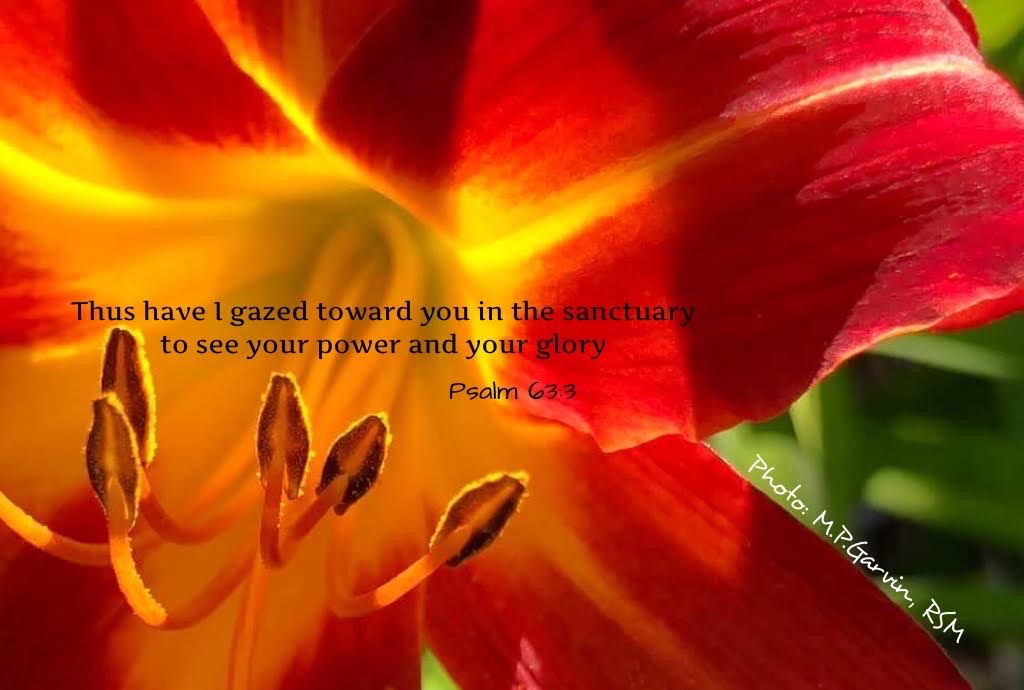
Thus have I gazed toward you in the sanctuary
to see your power and your glory,
For your kindness is a greater good than life;
my lips shall glorify you.


Our reading assures us that God readily meets our gaze:

Whoever watches for Wisdom at dawn shall not be disappointed,
for they shall find her sitting by their heart’s gate.
For taking thought of wisdom is the perfection of prudence,
and whoever for her sake keeps vigil
shall quickly be free from care;
because she makes her own rounds, seeking those worthy of her,
and graciously appears to them in the ways,
and meets them with all solicitude.


In our prayer today, let us open our deepest hearts to this Wisdom God who seeks us. Let our thirsty souls be satisfied in that loving Sacred Bliss.

Thus will I bless you while I live;
lifting up my hands, I will call upon your name.
As with the riches of a banquet shall my soul be satisfied,
and with exultant lips my mouth shall praise you.


Music: I Long for You, O Lord – The Dameans

I long for you, O Lord
With all my soul, I thirst for You.

God, my God, you I seek
for You my soul is thirsting,
Like a dry and weary land,
my spirit longs for You.

I have sought for Presence, Lord
to see your power and your glory.
Lord, your love means more than life.
I shall sing your praise.

Thus will I bless you while I live,
and I will call your name, O Lord.
As with the riches of a feast
shall my soul be satisfied.

Through the night, I remember You
for You have been my Savior.
In the shadow of your wings,
I will shout for joy.

Psalm 112: Don’t Worry; Be Happy

Saturday of the Thirty-first Week in Ordinary Time

November 7, 2020


Today, in God’s Lavish Mercy, we pray again with Psalm 112, placed between two interestingly complementary readings.

Psalm 112 is basically a guide to what constitutes a happy life. The psalm tells us this:

Blessed and happy  is the one:

  • who fears the LORD,
  • who greatly delights in God’s commands.
  • who is gracious and lends
  • who conducts affairs with justice
  • who gives to the poor

The psalmist tells us that this kind of humble, grateful generosity is its own reward.

Such a person

  • shall have a posterity which is mighty upon the earth
  • shall never be moved;
  • shall be in everlasting remembrance
  • shall be steadfast; shall not fear.
  • shall be remembered for enduring generosity
  • shall have a “horn” exalted in glory. ( “horn” = strength and power)

If we translate the biblical language here, what is Psalm 112 telling us.

This. True happiness comes from:

  • loving God
  • living within the law of love
  • being just, merciful, and generous
  • taking care of the vulnerable

Such happiness looks like this:

  • others can look up to you, especially the young
  • you stay faithful to goodness and righteousness 
  • your faithfulness nourishes those who come after you
  • you are strong and courageous 
  • your generosity inspires generosity in others
  • you are respected and loved for your goodness, even long after you’re gone

These are the kind of people Paul is depending on in our first reading to keep his ministry afloat. It sounds like he didn’t find too many of them, except finally in his Philippian community! Actually, under his eloquence, I think Paul sounds a little ticked off!😉

Jesus was looking for this kind of people too, but he certainly didn’t find them in the Pharisees of today’s Gospel. And Jesus let’s them have it in a dose of their own medicine. 


What does Jesus, who “knows our hearts”, find when he looks at us? Let’s pray Psalm 112 today asking for the grace to grow in true, generous, faith so we can look back at Jesus with deep peace and HAPPINESS!


Poem: The Work of Happiness by May Sarton

I thought of happiness, how it is woven
Out of the silence in the empty house each day
And how it is not sudden and it is not given
But is creation itself like the growth of a tree.
No one has seen it happen, but inside the bark
Another circle is growing in the expanding ring.
No one has heard the root go deeper in the dark,
But the tree is lifted by this inward work
And its plumes shine, and its leaves are glittering.

So happiness is woven out of the peace of hours
And strikes its roots deep in the house alone:
The old chest in the corner, cool waxed floors,
White curtains softly and continually blown
As the free air moves quietly about the room;
A shelf of books, a table, and the white-washed wall—
These are the dear familiar gods of home,
And here the work of faith can best be done,
The growing tree is green and musical.

For what is happiness but growth in peace,
The timeless sense of time when furniture
Has stood a life’s span in a single place,
And as the air moves, so the old dreams stir
The shining leaves of present happiness?
No one has heard thought or listened to a mind,
But where people have lived in inwardness
The air is charged with blessing and does bless;
Windows look out on mountains and the walls are kind.


Music: Psalm 112 – 4Him

We only get so many times
To ride around this sun
And so many times to see a full moon shine
When day is done if anything's worth doing
Then it's worth doing right

So I looked for wisdom on how to
Best live this brief life I have found
Blessed is he who fears the Lord
Who finds delight in His commands
Blessed is he who fears the Lord

Who finds delight in His commands
I guess that we all gamble on some
Truth to guide our days
And we trust that it will bring us joy and meaning
On the way

I've got friends who feel betrayed by all the things
They once believed
So with everything I've seen I've gotta say
It seems to me

Blessed is he who fears the Lord
Who finds delight in His commands
Blessed is he who fears the Lord
Who finds delight in His commands
Please hear this from a humble heart

But I feel like Exhibit A
In the evidence that God is good to those
Who live by faith, that's why I believe

Blessed is he who fears the Lord
Who finds delight in His commands
Blessed is he who fears the Lord
Who finds delight in His commands
He will not be shaken
He will have no fear
He will then remember

Psalm 18: I Love You, Lord

Thirtieth Sunday in Ordinary Time

October 25, 2020


Today, in God’s Lavish Mercy, we pray with Psalm 18

I love you, O LORD, my strength,
O LORD, my rock, my fortress, my deliverer.

Psalm 18: 2-3

The psalm is almost a mirror reflection of 2 Samuel 22, and has been interpreted as a song that David sang throughout his life to praise God’s goodness to him.


Today the psalm connects several readings, which together give us:

  • a command 
  • and a hint about how to fulfill that command. 

Bottom line, our readings tell us this:

  • First, Love God
  • And, second, here’s where to find the God you desire to love.

If we trust the hint, and act on the command,
we will be able to sing – like David –
throughout our lives. 

"You shall love the Lord, your God,
with all your heart,
with all your soul,
and with all your mind.
This is the greatest and the first commandment.
The second is like it:
You shall love your neighbor as yourself. 

Here is a beautiful poetic interpretation of Psalm 18:

I open my heart to you, O God
  for you are my strength, my fortress, 
  the rock on whom I build my life.
I have been lost in my fears and my angers
   caught up in falseness, fearful, and furious.
I cried to you in my anguish.
You have brought me to an open space.
   You saved me because you took delight in me.

I try to be good, to be just, to be generous
   to walk in your ways.
I fail, but you are my lamp.
  You make my darkness bright
With your help, I continue to scale the walls
  and break down the barriers that fragment me.
I would be whole, and happy, and wise
  and know your love
Always.
~ Christine Robinson

Music: Overcome – Psalm 18 by James Block

Psalm 122: The Journey

Saturday of the Twenty-ninth Week in Ordinary Time

October 24, 2020


Today, in God’s Lavish Mercy, we pray with Psalm 122, one of my favorites.

I rejoiced when they said to me
“Let us go to the house of the LORD
And now our feet are standing
within your gates, O Jerusalem.


The year 1963 was a dynamic time in the Church. The landmark Second Vatican Council was reaching full steam.

Several changes resulted from the Council, including the renewal of consecrated life with a revised charism, ecumenical efforts towards dialogue with other religions, and the universal call to holiness which, according to Pope Paul VI, was “the most characteristic and ultimate purpose of the teachings of the Council”.

Wikipedia


Simultaneously, a love and engagement with sacred scripture was blossoming throughout the Church.  International scholars were completing their response to Pius XII’s 1943 call, in the encyclical Divino Afflante Spiritu, to translate scriptures from the ancient Hebrew and Greek texts. The incomparable Jerusalem Bible was the fruit of these endeavors. It had already been published in French, and was nearing its 1966 English publication.

One of these gifted Bible scholars was a French Jesuit priest, Joseph Gelineau. Gelineau was himself part of the working group for the French Jerusalem Bible, and he developed a revised version of that psalter which respected the rhythms of the Hebrew original.

In my senior year in high school, 1962-63, we were introduced to the Gelineau Psalms. That introduction came at a perfect time for me, as I discerned a call to religious life. In that discernment, Gelineau Psalm 122 became a central part of my prayer.

Jerusalem, built as a city
with compact unity.
To it the tribes go up,
the tribes of the LORD.


I felt rising in me a passionate desire to find and engage my “Jerusalem”, that journey which would pattern my life on the life of Jesus.

The outlines of the journey, the distant vision of “Jerusalem”, were so surreal and indefinite. And yet they were compelling. I came to believe and trust that I would find my path to holiness, my Jerusalem, as a Sister of Mercy. 

Like Jesus, I was given the grace and courage to “steadfastly set my face toward Jerusalem” ( Luke 9:51) And it has been an indescribably amazing journey ever since!


As Vatican II so beautifully stated in the document Lumen Gentium, chapter 5, we all share in the universal call to holiness. We all have our own path to that one, glorious Jerusalem. 

I know these Documents of Vatican II are over a half century old. But they are priceless classics that I never tire of studying. Here are some passages that might enrich our prayer today as we each consider our own call and response to God.

Therefore in the Church, everyone whether belonging to the hierarchy, or being cared for by it, is called to holiness, according to the saying of the Apostle: “For this is the will of God, your sanctification” (I Thes. 4:3; df. Eph. 1:4).

The classes and duties of life are many, but holiness is one-that sanctity which is cultivated by all who are moved by the Spirit of God, and who obey the voice of the Father and worship God the Father in spirit and in truth. These people follow the poor Christ, the humble and cross-bearing Christ in order to be worthy of being sharers in His glory. Every person must walk unhesitatingly according to his or her own personal gifts and duties in the path of living faith, which arouses hope and works through charity.

Finally all Christ’s faithful, whatever be the conditions, duties and circumstances of their lives-and indeed through all these, will daily increase in holiness, if they receive all things with faith from the hand of their heavenly Father and if they cooperate with the divine will. In this temporal service, they will manifest to all humanity the love with which God loved the world.


Poem: The Neophyte – Alice Meynell

Who knows what days I answer for to-day:
  Giving the bud I give the flower.  I bow
  This yet unfaded and a faded brow;
Bending these knees and feeble knees, I pray.

Thoughts yet unripe in me I bend one way,
  Give one repose to pain I know not now,
  One leaven to joy that comes, I guess not how.
I dedicate my fields when Spring is grey.

Oh, rash! (I smile) to pledge my hidden wheat.
  I fold to-day at altars far apart
Hands trembling with what toils?  In their retreat
  I seal my love to-be, my folded art.
I light the tapers at my head and feet,
  And lay the crucifix on this silent heart.

Music: Jerusalem, My Destiny – Rory Cooney (All lyrics below)

Refrain: I have fixed my eyes on your hills, Jerusalem, my Destiny. 
Though I cannot see the end for me I cannot turn away. 
We have set our hearts for the way; this journey is our destiny. 
Let no one walk alone. The journey makes us one.
1. Other spirits, lesser gods, have courted me with lies. 
Here among you I have found a truth that bids me rise. Refrain
2. See, I leave the past behind; a new land calls to me. 
Here among you now I find a glimpse of what might be. Refrain
3. In my thirst, you let me drink the waters of your life, 
Here among you I have met, the Savior, Jesus Christ. Refrain
4. All the worlds I have not seen you open to my view. 
Here among you I have found a vision bright and new. Refrain
5. To the tombs I went to mourn the hope I thought was gone, 
Here among you I awoke to unexpected dawn. Refrain

Psalm 24: God’s Face

Friday of the Twenty-ninth Week in Ordinary Time

October 23, 2020


Today, in God’s Lavish Mercy, we pray with Psalm 24 which has been described as “an entrance psalm” for the Temple liturgies.

Praying Psalm 24 invites us to consider how we enter and meet God in the Holy Space of our lives. 

That space, first of all, belongs to God Who created all things. We do not create it. God opens it.

The LORD’s are the earth and its fullness;
the world and those who dwell in it.
For the Lord founded it upon the seas
and established it upon the rivers.

Psalm 24: 1-2

Everything within us and around us — that “fullness” of life — belongs to God. When we acknowledge this truth in humble faith and loving awareness, we realize that we already exist within God’s sanctuary:

Who can ascend the mountain of the LORD?
or who may stand in his holy place?
The one whose hands are sinless, whose heart  is clean,
who desires not what is vain.

Psalm 24: 3-4

The journey of the spiritual life is about finding that still point in our souls where we see God’s Face in all things. That sacred stillness holds us in God’s Presence until we let go of ourselves within that Love. The Lord blesses that letting go with a “reward”:

That person shall receive a blessing from the LORD,
a reward from God the savior.
Such is the race that seeks the Lord,
that seeks the face of the God of Jacob.

Psalm 24: 5-6

The psalm doesn’t clearly state what that “reward” is, but I think it might be the grace, insight, passion, and courage to live as Paul describes in our first reading:

to live in a manner worthy of the call you have received,
with all humility and gentleness, with patience,
bearing with one another through love,
striving to preserve the unity of the spirit
through the bond of peace;  
one Body and one Spirit,
as you were also called to the one hope of your call;
one Lord, one faith, one baptism;
one God and Father of all,
who is over all and through all and in all.

Poem: The light shouts in your tree-top, and the face
— Rainer Maria Rilke, Poems from the Book of Hours

The light shouts in your tree-top, and the face
of all things becomes radiant and vain;
only at dusk do they find you again.
The twilight hour, the tenderness of space,
lays on a thousand heads a thousand hands,
and strangeness grows devout where they have lain.
With this gentlest of gestures you would hold
the world, thus only and not otherwise.
You lean from out its skies to capture earth,
and feel it underneath your mantle’s folds.
You have so mild a way of being.
……………………………………………They
who name you loudly when they come to pray
forget your nearness. From your hands that tower
above us, mountainously, lo, there soars,
to give the law whereby our senses live,
dark-browed, your wordless power.

Music: I Have Loved You – Michael Joncas 

I Have Loved You

I have loved you with an everlasting love, I have called you and you are mine;
I have loved you with an everlasting love, I have called you and you are mine.
Seek the face of the Lord and long for him: He will bring you his light and his peace.

I have loved you with an everlasting love, I have called you and you are mine;
I have loved you with an everlasting love, I have called you and you are mine.
Seek the face of the Lord and long for him: He will bring you his joy and his hope.

I have loved you with an everlasting love, I have called you and you are mine;
I have loved you with an everlasting love, I have called you and you are mine.
Seek the face of the Lord and long for him: He will bring you his care and his love.

I have loved you with an everlasting love, I have called you and you are mine;
I have loved you with an everlasting love, I have called you and you are mine.

Psalm 119: Come, Sweet Mercy!

Tuesday of the Twenty-eighth Week in Ordinary Time

October 13, 2020


Today, in God’s Lavish Mercy, we pray with Psalm 119 whose refrain is beautiful to the ears of those who love Mercy.


We can invite Mercy in many ways.

One way is to ask Mercy to heal the fractured circumstances of our lives – the outside of the cup, if we would borrow an image from today’s Gospel:

  • to strengthen us against any pain or fear in our own lives
  • to deliver us and those we love from all that overwhelms
  • to forgive our inexcusable retreats into selfishness
  • to repair that which seems irrevocably broken 

But another, deeper way is to invite Mercy to the inside of our “cup”:

  • to indwell our hearts
  • to transform, within us, the place where we encounter life
  • to inspire us to respond always with the heart of Jesus
  • to flow from us in continual witness to God’s Mercy

Today, in our prayer, let’s spend some time with Mercy, the most beautiful Face of God.


Poem:  Blest are the undefiled in heart (Psalm 119)
by Isaac Watts (1674 – 1748) was an English Christian minister (Congregational), hymn writer, theologian, and logician. He was a prolific and popular hymn writer and is credited with some 750 hymns. He is recognized as the “Godfather of English Hymnody”; many of his hymns remain in use today and have been translated into numerous languages.

Blest are the undefiled in heart,
whose ways are right and clean;
who never from your law depart,
but flee from every sin.

Blest are the ones that keep your word,
and serve you with their hands;
with their whole heart they seek you, Lord,
obeying your commands.

Great is their peace who love your law;
how firm their souls abide!
Nor can a bold temptation draw
their steady feet aside.

Then shall my heart have inward joy!
I’ll keep my steps from shame;
your statutes help me to obey,
and glorify your name.

Music- Sanctuary by Secret Garden

Psalm 105: God at the Center

Saturday of the Twenty-seventh Week in Ordinary Time

October 10, 2020


Today, in God’s Lavish Mercy, we pray with Psalm 105, a recounting of the marvelous works God has done from the Abrahamic covenant to the Exodus.

Sing to God, sing praise,
proclaim all God’s wondrous deeds.
Glory in the Holy Name;
rejoice, O hearts that seek the LORD!

Psalm 105: 2-3

Our psalm today enjoins us to remember God’s faithful mercy to us and to praise God as we remember.

Such sacred “remembering” is an act of radical faith which, first, recognizes God as the Center of our life, and second, acts from that radical awareness.


The word “obedience”, so commonly misconstrued as subservience, is another way of describing this radical faith which hears, listens, acknowledges, responds and centers itself on the voice of God. The word “obedience” comes from the same root as the word “listen”.

This freely-given and continually deepened obedience allows us to hear and discern the loving truth God weaves through our lives.

The counter-world of the Psalms contradicts our closely held world of amnesia and mediates to us a world of lively remembering….
… In Psalm 105, a long recital of the great deeds climaxes, “in order that they might keep his statutes and observe his laws” (v. 45). The purpose of remembering is thus to evoke a contemporary practice of obedience in the wake of the memory. The implied negative is that when the inventory of miracles is forgotten, there will be no contemporary obedience .

Walter Brueggemann, From Whom No Secrets Are Hid

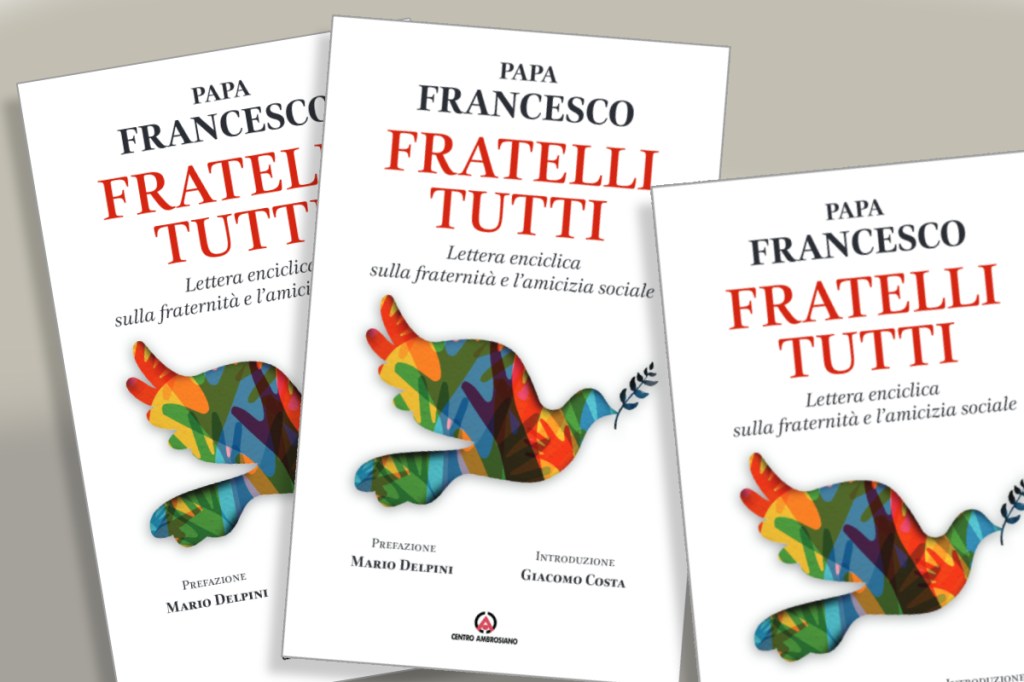
In the encyclical Fratelli Tutti, Pope Francis points out how this obedience, (this holy remembering, listening and acting), is tied to the course of human affairs. Francis quotes JPII here:

In this regard, I wish to cite the following memorable statement: “If there is no transcendent truth, in obedience to which the human person achieves full identity, then there is no sure principle for guaranteeing just relations between people. Their self-interest as a class, group or nation would inevitably set them in opposition to one another. If one does not acknowledge transcendent truth, then the force of power takes over, and each person tends to make full use of the means at their disposal in order to impose personal interests or opinion, with no regard for the rights of others… The root of modern totalitarianism is to be found in the denial of the transcendent dignity of the human person who, as the visible image of the invisible God, is therefore by very nature the subject of rights that no one may violate – no individual, group, class, nation or state.

St. John Paul II, Encyclical Letter Centesimus Annus (1 May 1991)

Rootedness in this “remembering obedience” begins with each person’s own sincere prayer. With the psalmist, let us remember God’s loving fidelity to us and, in grateful response, live that Love faithfully into our conflicted world:

Look to the LORD’s strength;
seek to serve the Lord constantly.
Recall the wondrous deeds that God has wrought,
the signs, and the graces God has spoken in your life.

Psalm 105: 4-5

Poem: Called to Become – Edwina Gateley

You are called to become
A perfect creation.
No one else is called to become
Who you are called to be.
It does not matter
How short or tall
Or thick-set or slow
You may be.
It does not matter
Whether you sparkle with life
Or are as silent as a still pool.
Whether you sing your song aloud
Or weep alone in darkness.
It does not matter
Whether you feel loved and admired
Or unloved and alone
For you are called to become
A perfect creation.
No one's shadow
Should cloud your becoming.
No one's light
Should dispel your spark.
For the Lord delights in you.
Jealously looks upon you
And encourages with gentle joy
Every movement of the Spirit
Within you.
Unique and loved you stand.
Beautiful or stunted in your growth
But never without hope and life.
For you are called to become
A perfect creation.
This becoming may be
Gentle or harsh.
Subtle or violent.
But it never ceases.
Never pauses or hesitates.
Only is—
Creative force—
Calling you
Calling you to become
A perfect creation.

Music: Psalm 105 – Give Thanks – Sean Dayton

Fratelli Tutti

Celebrating the Feast of St. Francis of Assisi
October 4-5, 2020

This year, in normal liturgical custom, our Sunday celebration supersedes the Feastday of Francis. But I can’t let this special day go by without notice. Therefore, I am publishing tomorrow’s reflection early, hoping that you will read some of it today. I write with warmest greeting to all Franciscans, especially my dear Sisters in Aston. PA. (The Franciscan Spiritual Center has designed some wonderful programs and made them accessible even during the pandemic. Here is a link to explore their wonderful offerings.)


St. Francis Preaches to the Birds – Giotto

For reflection, I plan to spend this evening and tomorrow morning with Pope Francis’s new encyclical Fratelli Tutti (Brothers and Sisters All), issued on this feast. St. Francis inspired the world with a renewed Gospel vision. Our Holy Father seeks to do the same with this ground-breaking teaching.

These will be the first of many prayerful days with this powerful document which Michael Sean Winters, in the National Catholic Reporter, describes:

What is clear is that Pope Francis has given the church a testament of authentic solidarity at a time when our president — and his nationalistic allies abroad — offers a counterfeit of solidarity. Both varieties of solidarity are responses to the excesses and the poverties created by neo-liberalism. Yes, poverties, it is clear, … that the material wealth neoliberal economies generate is precisely coincident with the generation of spiritual and moral poverty. The whole world groans to move beyond the moral slovenliness of laissez-faire ideas. But only the pope’s version represents an authentically Christian version of solidarity and, I would add, an authentically human version. This text challenges Christians in unique ways, but it challenges all….
…. If this pandemic does not shake us out of our post-modern cultural and moral and spiritual lethargy, what will? Pope Francis is throwing the Catholic Church and the whole world a lifeline. Will we grab it?


If you would like to pray with this profound and challenging instruction from Pope Francis, here is a link to it.


A second opportunity for prayer over today and tomorrow comes from our Mercy Sister Eileen Dooling. On our Sisters of Mercy blog, Eileen offers a lovely reflection on the Franciscan-Mercy connection. I’m sure you will enjoy it.


As you can see, there are so many ways to reflect, pray and grow on this beautiful feast. May your prayer be blessed by Francis (both of them) and by this amazing music!

Music: St. Francis Preaching to the Birds by Franz Liszt, played by Kotaro Fukuma 

Psalm 25: God’s Will?

Twenty-sixth Sunday in Ordinary Time

September 27, 2020


Today, in God’s Lavish Mercy, we pray with Psalm 25, set perfectly in the midst of a few readings that speak to us about, among other things , “the Father’s Will”.

I think there is no greater spiritual mystery than the meaning of  “God’s Will”, (and not wanting to show up Thomas Aquinas, I’ll resist explaining it here. 😂🧐)

But we’ve all heard attempts at explaining it, haven’t we, especially as it relates to suffering— as in:

  • everything that happens is God’s Will, so we must accept it
  • God wills our suffering to test us
  • if God wills that we suffer, He will give us the strength to endure it

I just don’t think so … not the God I love and Who loves me.

But these attempts to explain suffering are understandable because we want to rationalize the things we fear. Most of us, I think, struggle with the problem of evil and suffering in the world. We want to know what to do when, as Rabbi Kushner wrote, “… Bad Things Happen to Good People”.


Our first reading from Ezekiel shows us that even the ancient peoples met this struggle. The prophet seems to suggest that if you’re bad, you’ll suffer. If you repent, you won’t. Well, we all know that’s not quite the reality! But nice try, Ezekiel.

Our psalm gently leads to another way of facing suffering as the psalmist prays for wisdom, compassion and divine guidance. In the Garden of Gethsemane, Jesus himself prayed like this as he confronted his impending suffering.


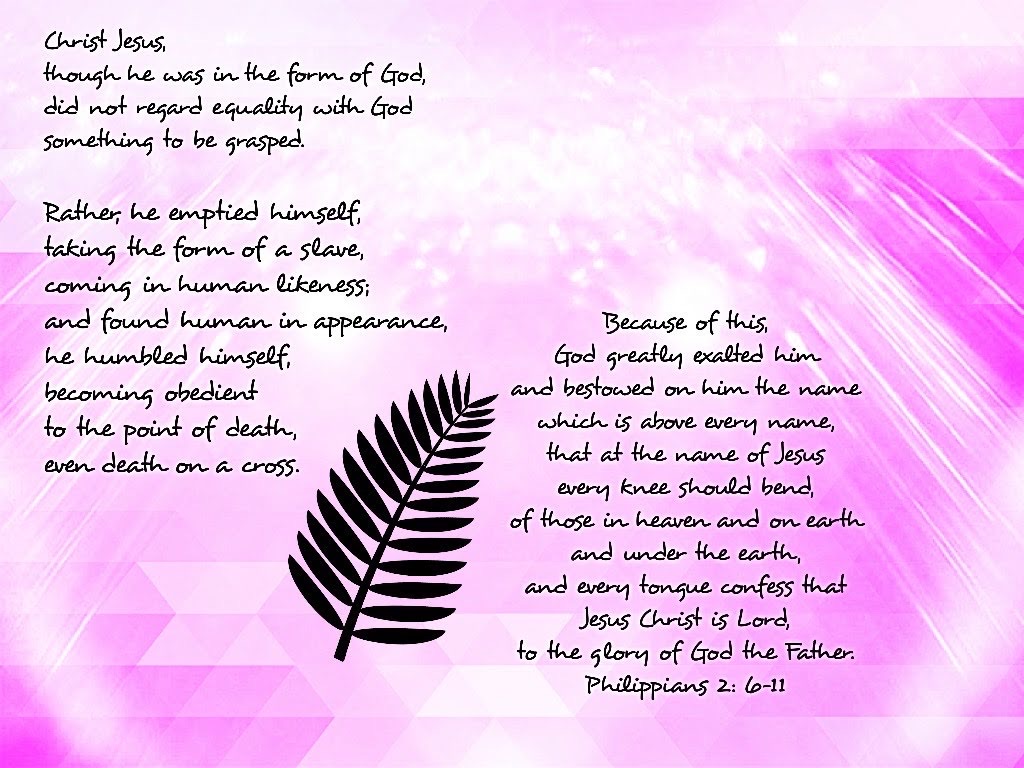
In our second reading, Paul places before us the example of Jesus who, in the face of suffering, was transformed by love:

Praying with these readings, each one of us must come to our own peace with the mystery of suffering. What we can be sure of is this: God’s Will is always for our wholeness and joy as so simply taught to us when we were little children:

God made me to know, love, and serve God, 
and to be happy with God in this world and forever.

Our Gospel tells us that such happiness comes through faith and loving service, through responding to “the Father’s Will”.  May we have the insight, the love and the courage!


Poetry: Of Being by Denise Levertov 

I know this happiness
is provisional:

       the looming presences—
       great suffering, great fear—

       withdraw only
       into peripheral vision:

but ineluctable this shimmering
of wind in the blue leaves:

this flood of stillness
widening the lake of sky:

this need to dance,
this need to kneel:

       this mystery:

Music: To You, O Lord (Psalm 25) Graham Kendrick