Psalm 69: Stuck!

Memorial of Saint Alphonsus Liguori, Bishop and Doctor of the Church

August 1, 2020

Today, in Mercy, we pray for the light of God’s Word in our hearts. God speaks to us in all things. Sometimes, all we need to do is ask God, “What are You saying to me in this circumstance?” Then listen for Love. The answer is always wrapped in Love – and Love is not always easy.

Thought from 2016, Friday of the 17th Week

Today, in God’s Lavish Mercy, we pray again with Psalm 69.  In today’s accompanying readings, Jeremiah and John the Baptist are living out the meaning.of the psalm.

Each of these great prophets has been ensnared by the civic evil of their times, personified in Old Testament princes and New Testament Herod and Herodias. The power structure surrounding each prophet stood in direct contradiction to their witness to God’s Word. Those structures, when confronted with a sacred truth, tried to overwhelm the messenger, like quicksand swallows an innocent traveler.

Rescue me out of the mire; may I not sink!
may I be rescued from my foes,
and from the watery depths.
Let not the flood-waters overwhelm me,
nor the abyss swallow me up,
nor the pit close its mouth over me.


The psalm raises to our prayer the reality that such struggles continue in our time. We live in a wonderful but still sinful world where every person decides, everyday, where he or she will stand in the contest between good and evil.

The decision is sometimes very clear. At other times, the waters are so muddied with lies, propaganda, greed, fear, bias. and unexamined privilege that we feel mired in confusion or resistance.

But I am afflicted and in pain;
let your saving help, O God, protect me.
I will praise the name of God in song,
and I will glorify him with thanksgiving.

Psalm 69 throws us a rescue line in today’s final verse:

See, you lowly ones, and be glad;
you who seek God, may your hearts revive!
For the LORD hears the poor,
and his own who are in bonds God spurns not.

The steady path to truth lies with those who seek God among the humble and poor. The humble are the ones through whom the Lord speaks. They are God’s own. Jeremiah and the Baptist understood this truth and preached it by their lives.

We might examine our lives today in the light of their witness and the message of this challenging psalm.


Poetry:  Beginners – Denise Levertov


‘From too much love of living,
Hope and desire set free,
Even the weariest river
Winds somewhere to the sea—‘


But we have only begun
to love the earth.
We have only begun
to imagine the fullness of life.
How could we tire of hope?
—so much is in bud.
How can desire fail?
—we have only begun
to imagine justice and mercy,
only begun to envision
how it might be
to live as siblings with beast and flower,
not as oppressors.
Surely our river
cannot already be hastening
into the sea of nonbeing?
Surely it cannot
drag, in the silt,
all that is innocent?
Not yet, not yet—
there is too much broken
that must be mended,
too much hurt we have done to each other
that cannot yet be forgiven.
We have only begun to know
the power that is in us if we would join
our solitudes in the communion of struggle.
So much is unfolding that must
complete its gesture,
so much is in bud.

Music:  The Cry of the Poor – John Foley, SJ
Psalm 69: Answer Me, O Lord

Memorial of Saint Ignatius of Loyola, Priest

July 31, 2020


Today, in God’s Lavish Mercy, we pray with Psalm 69, a heart-felt lament whose verses are often paralleled with the sufferings of Jesus.

I have become an outcast to my brothers,
a stranger to my mother’s sons,
Because zeal for your house consumes me,
and the insults of those who blaspheme you fall upon me.

Psalm 69: 9

Christ did not please Himself; but as it is written,
“The reproaches of those who reproached You fell on Me”.

Roman 15: 3

Praying with Psalm 69 this morning, and in the light of both our first reading and Gospel, I am aware of how God’s prophets suffer to proclaim mercy, justice, and truth.

Jeremiah suffered in the hope and conviction that God imagined a future of justice for all God’s people. He stood in the midst of the Temple worshippers and condemned their pretense of righteousness.

Jesus stood at the center of his hometown synagogue to proclaim that the long hoped-for redemption had come. But like Jeremiah’s listeners, Jesus’s neighbors also turned on him.

In our own lifetimes, we see the persecution and hatred which is leveled at modern prophets who call the world to justice and mercy. Even within our own Church, we see how Pope Francis is vilified by those whose privileged excesses are threatened by his charity.


As I write this reflection, our country celebrates the life of one of its noblest prophets, the sainted John Lewis. In the image of all the great Justice Witnesses, John endured incredible suffering for the sake of people’s dignity and freedom. He was able to do so because, like Jeremiah and Jesus, he didn’t look inward at his wounds. He looked outward for the redemption of others … the prize of justice:

Never give up, never give in, never give out. 
Keep the faith, and keep your eyes on the prize. 
Together, we can redeem the soul of America.

John Lewis

Let us pray today that the voices of true prophets may be heard and heeded. In this age when technology and social media can quickly disseminate vitriol, hatred, and conspiracy, let us pray for discerning hearts and courageous wills.

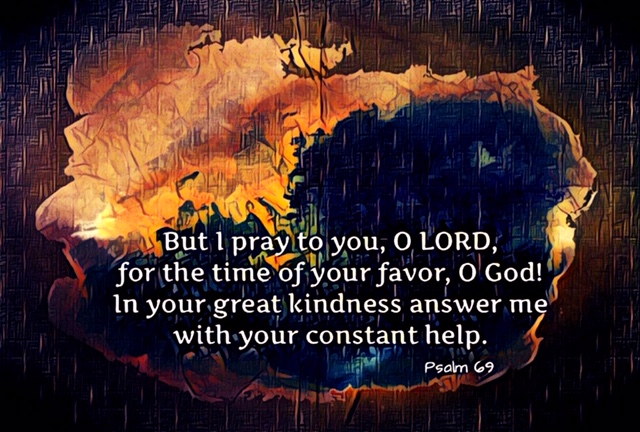
But I pray to you, O LORD,
for the time of your favor, O God!
In your great kindness answer me
with your constant help.

Psalm 69; 14

Poetry: Prophet by Carl Dennis

Prophet
You'll never be much of a prophet if, when the call comes
To preach to Nineveh, you flee on the ship for Tarshish
That Jonah fled on, afraid like him of the people's outrage
Were they to hear the edict that in thirty days
Their city in all its glory will be overthrown.

The sea storm that harried Jonah won't harry you.
No big fish will be waiting to swallow you whole
And keep you down in the dark till your mood
Shifts from fear to thankfulness and you want to serve.
No. You'll land safe at Tarshish and learn the language
And get a job in a countinghouse by the harbor
And marry and raise a family you can be proud of
In a neighborhood not too rowdy for comfort.

If you're going to be a prophet, you must listen the first time.
Setting off at sunrise, you can't be disheartened
If you arrive at Nineveh long past midnight,
On foot, your donkey having run off with your baggage.
You'll have to settle for a room in the cheapest hotel
And toss all night on the lice-ridden mattress
That Jonah is spared. In the space of three sentences
He jumps from his donkey, speaks out, and is heeded, while you,

Preaching next day in the rain on a noisy corner,
Are likely to be ignored, outshouted by old-clothes dealers
And fishwives, mocked by schoolboys for your accent.
And then it's a week in jail for disturbing the peace.
There you'll have time, as you sit in a dungeon
Darker than a whale's belly, to ask if the trip
Is a big mistake, the heavenly voice mere mood,

The mission a fancy. Jonah's biggest complaint
Is that God, when the people repent and ask forgiveness,
Is glad to forgive them and cancels the doomsday
Specified in the prophecy, leaving his prophet
To look like a fool. So God takes time to explain
How it's wrong to want a city like this one to burn,
How a prophet's supposed to redeem the future,
Not predict it. But you'll be left with the question
Why your city's been spared when nobody's different,

Nobody in the soup kitchen you open,
Though one or two of the hungriest
May be grateful enough for the soup to listen
When you talk about turning their lives around.
It will be hard to believe these are the saving remnant
Kin to the ten just men that would have sufficed
To save Gomorrah if Abraham could have found them.

You'll have to tell them frankly you can't explain
Why Nineveh is still standing though you hope to learn
At the feet of a prophet who for all you know
May be turning his donkey toward Nineveh even now.
[from Practical Gods (2001)

Music: Lord, in Your Great Love – Orchard Enterprises

Psalm 59: Did Martha Pray It?

Memorial of Saint Martha

July 29, 2020


Today, in God’s Lavish Mercy, on this feast of St. Martha, we pray with Psalm 59.

The psalm is introduced with an interesting phrase: a miktam of David, when Saul sent people to watch his house and kill him. 

The meaning of the word mitkam is unclear, but the meaning of the rest of the phrase is abundantly evident. David felt threatened by the forces of King Saul who surrounded his house day and night awaiting an opportunity to attack him.

The psalm bemoans that situation. In two complementary stanzas, the psalmist asks God for victory and deliverance. Each ends with a refrain of praise and gratitude.


As I pray this psalm today, my mind goes to a house in Bethany. Three siblings live there who are friends of Jesus. Each loves Jesus in her or his own way, according to their personalities. 

The Gospels give us a vivid perception of Mary’s love. We can easily imagine the immensely grateful love of resurrected Lazarus. 

Then there is Martha of whom we know so little. A woman who found comfort in creating a hospitable home. A woman who commanded a well-functioning kitchen. A woman who, silent except for her famous sisterly complaint, let her works speak her love.

As their friendship with Jesus grew, and as Jesus became more notorious to the Jewish leaders, their little house no doubt became the object of inimical fascination.

Jesus’s enemies watched him, but that also watched his friends, frightening many away from Jesus’s side.

As this reality intensified, perhaps phrases of Psalm 59 rose in Martha’s heart as she prayed:

Rescue me from my enemies, O my God;
from my adversaries defend me….
… For behold, they lie in wait for my life;
mighty men come together against me,
Not for any offense or sin of mine, O LORD.

We can only guess what this little family suffered in order to be Jesus’s friends, both during his lifetime and by their witness in the subsequent early Christian Church. But by faith, we can be certain they rejoiced in the Divine Gift these sufferings brought them.

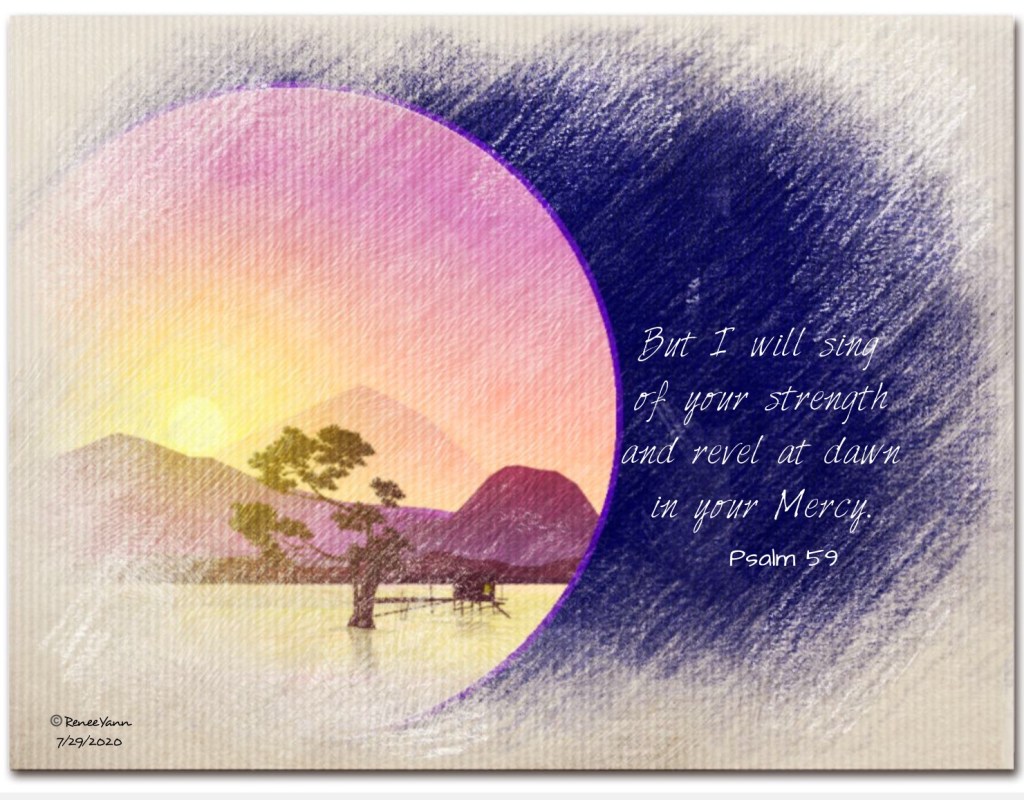
But I will sing of your strength
and revel at dawn in your mercy;
You have been my stronghold,
my refuge in the day of distress.
O my strength! your praise will I sing;
for you, O God, are my stronghold,
my merciful God!

Let us pray today to be, like Martha of Bethany, devoted friends of God.

Poetry:  You, neighbor God – Rainer Maria Rilke

You, neighbor god, if sometimes in the night
I rouse you with loud knocking, I do so
only because I seldom hear you breathe
and know: you are alone.
And should you need a drink, no one is there
to reach it to you, groping in the dark.
Always I hearken. Give but a small sign.
I am quite near.
Between us there is but a narrow wall,
and by sheer chance; for it would take
merely a call from your lips or from mine
to break it down,
and that without a sound.
The wall is builded of your images.
They stand before you hiding you like names.
And when the light within me blazes high
that in my inmost soul I know you by,
the radiance is squandered on their frames.
And then my senses, which too soon grow lame,
exiled from you, must go their homeless ways.

Music: Psalm 59 – Esther Mui

Deuteronomy 32: Moses’ Psalm

Monday of the Seventeenth Week in Ordinary Time

July 26, 2020

Today, in God’s Lavish Mercy, we pray with Deuteronomy 32, commonly referred to as the Song of Moses. Most biblical scholars agree that the selection was composed long after Moses died and inserted in Deuteronomy perhaps at the time of the prophet Samuel.

As literature, the poem shows Moses prophesying the troubles that will come upon the people because of their faithlessness. As history, these troubles have already occurred and are referenced as a lesson for the future.


The verses highlighted today are unhappy ones. With exaggerated anthropomorphism, God is characterized as really mad and passive-aggressive with Israel. It’s not a nice picture of how God relates to us. It’s not real either.

Still, the writer was a human being searching for some rational way to understand the trauma Israel was experiencing at the hands of their enemies. The logic, or illogic, goes something like this:

  • things are a mess
  • it must be our fault
  • we did bad things
  • so God’s mad and did bad things back
  • we better straighten up
  • then God might relent

We are all tempted to reason like this when we experience misfortune, pain, and trauma. We think evil should make sense. It doesn’t. The interplay of good and evil is a mystery we will never understand in this life.


What we can understand is faithfulness – God’s to us, and ours to God.

God, you are my Rock—how faultless are your deeds,
how right all your ways!
You are faithful God, without deceit,
You are Justice, Righteousness, and Mercy

This is the true message of the Song of Moses: Our merciful God is always faithful. When we experience suffering in life, – even the kind we bring on ourselves and one another – let our sorrow draw us ever closer to God’s Mercy which abides with us in all our troubles. Within the sacred mystery of grace, that Mercy seeks to transform us into Mercy ourselves.


Poetry:  Possible Answers to Prayer by Scott Cairns
The poem gives a wake up call about self-absorption in our prayers, and – with its own touch of anthropomorphism – images how God might perceive narrow prayers. The poem encourages us to accompany others in their greater sufferings.

Your petitions—though they continue to bear
just the one signature—have been duly recorded.
Your anxieties—despite their constant,

relatively narrow scope and inadvertent
entertainment value—nonetheless serve
to bring your person vividly to mind.

Your repentance—all but obscured beneath
a burgeoning, yellow fog of frankly more
conspicuous resentment—is sufficient.

Your intermittent concern for the sick,
the suffering, the needy poor is sometimes
recognizable to me, if not to them.

Your angers, your zeal, your lipsmackingly
righteous indignation toward the many
whose habits and sympathies offend you— 
      
these must burn away before you’ll apprehend
how near I am, with what fervor I adore
precisely these, the several who rouse your passions.

Music: Audite Caeli – Michel Richard Delalande

This motet captures the opening words of the Song of Moses, Deuteronomy 32.

Audite, caeli, quae loquor: audiat terra verba oris mei.
Concrescat ut pluvia doctrina mea, fluat ut ros eloquium meum,
quasi imber super herbam, et quasi stillae super gramina.
Quia nomen Domini invocabo: date magnificentiam Deo nostro.
Dei perfecta sunt opera, et omnes viae ejus judicia.

Hear, O ye heavens, the things I speak,
let the earth give ear to the words of my mouth.Let my doctrine gather as the rain, let my speech distil as the dew,
as a shower upon the herb, and as drops upon the grass.
Because I will invoke the name of the Lord: give ye magnificence to our God.
The works of God are perfect, and all his ways are judgments.

Psalm 119:Acrostic Prayer

Seventeenth Sunday in Ordinary Time

July 26, 2020


Today, in Mercy, we pray with young Solomon, as God asks him to carry the weight of leadership. Of all that Solomon might have asked from God, he requested only wisdom, which is described in James 3:17. “But the wisdom that comes from heaven is first of all pure; then peace-loving, considerate, teachable, full of mercy and good fruit, impartial and sincere.” We pray for wisdom for ourselves in the discharge of our responsibilities. We pray for this gift for all who hold power in our world.

from 2017 – 17th Sunday in Ordinary Time

Today, in God’s Lavish Mercy, we pray with Psalm 119, the longest psalm, and a meticulously constructed poem. It is one of about twelve acrostic poems in the Bible, employing the twenty-two characters of the Hebrew alphabet to teach a lesson about love of the Torah, the Law.

Acrostic poems have been popular throughout history because they let the reader examine a theme from multiple, memorable perspectives. Although often tricky to compose, they are simple to read, and sometimes so commonplace as to be transparent.

Here is an example of an acrostic poem from 19th century America


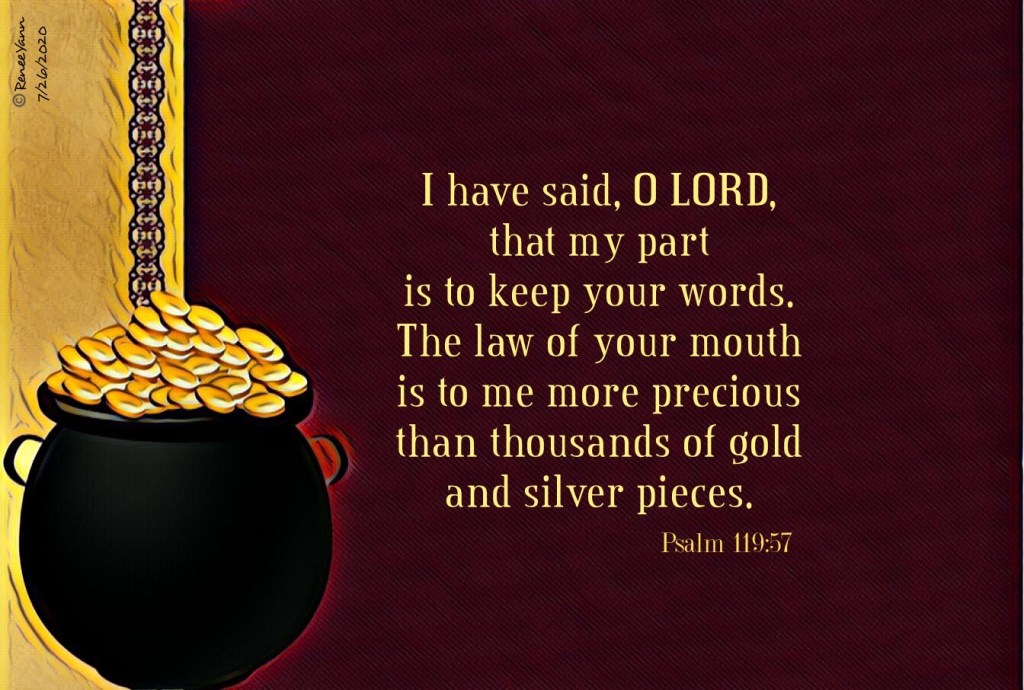
So why did the psalmist take the trouble to compose a complicated verse like Psalm 119? The answer seems apparent, I think. The love of the Law was that important to the writer. It was the one true treasure, and he wanted others to share the treasure.

The theme of “treasure” ties together all of our Sunday readings.

In our first reading, young Solomon could have asked God for anything. But Solomon already treasures the Wisdom of God:

The LORD was pleased that Solomon made this request.
So God said to him:
“Because you have asked for this—
not for a long life for yourself,
nor for riches,
nor for the life of your enemies,
but for understanding so that you may know what is right—
I do as you requested.


Our second reading confirms that those who love God, like Solomon did, are blessed with the treasure of confidence and peace:

We know that all things work for good
for those who love God.


Matthew’s Gospel tells us to seek that treasure buried in the field of our lives. When we find it, we should give everything to make it our own:

When he finds a pearl of great price,
he goes and sells all that he has and buys it.


Praying Psalm 119 allows us to appreciate the treasure of God’s Law, God’s heartbeat, in our lives. It holds the Word up before us, facet by facet, the way we would lift a diamond to the Light. When we come to love Wisdom/Word/Law as Solomon did, we give everything to possess it fully.


Poetry: Last Hike Before Leaving Montana by Patricia Traxler.
In this poem, the poet is ostensibly talking about a bear, but listen a little deeper and she is talking about God.

Late winter, almost spring. It's like finding a diamond;
now I don't want to leave. I sit in the dirt and put my hands
in your tracks. For the first time in a long time I don't
doubt. Now I know I always knew you were here. You
are the beginning of disclosure, the long-felt presence

Suddenly incarnate. Behind me my friend warns, If we
see the bear, get into a fetal position. No problem,
I tell her, I'm always in a fetal position—I was born
in a fetal position. Did you know, she says, the body
of a shaved bear looks exactly like a human man?
I skip a stone, feel a sudden bloat of grief, then laugh.
I ask her, Who would shave a bear? We climb

Farther up Rattlesnake Creek, watch winter sun glitter
off dark water. No matter how high we go I look higher.
Sometimes absence can prove presence. That's not exactly
faith, I know. All day, everywhere, I feel you near at hand.
There's so much to understand, and everything to prove.
Up high the air is thin and hard, roars in the ears like love.

Music: Lord, You Are More Precious Than Silver – Divine Hymns

Psalm 63 A Passionate Prayer

Feast of Saint Mary Magdalen

July 22, 2020

Today, in God’s Lavish Mercy, we pray with Psalm 63, a perfect prayer for the Feast of Saint Mary Magdalen, who longed for and loved God with all her heart.

My soul is thirsting for you, O Lord my God.

Psalm 63, in the verses quoted today, is a love song. The psalmist longs for God, body and soul. Experience has taught her that without God her whole being is a desert.

O God, you are my God whom I seek;
for you my flesh pines and my soul thirsts
like the earth, parched, lifeless and without water.

And so she fixes her eyes on God, her heart on God. She looks for God’s Presence in the sanctuary of her life, in the temple of her soul.

Thus have I gazed toward you in the sanctuary
to see your power and your glory,
For your kindness is a greater good than life;
my lips shall glorify you.

The psalmist promises to bless God – to be grateful and attentive to God’s affectionate grace in all the circumstances of her life:

Thus will I bless you while I live;
lifting up my hands, I will call upon your name.
As with the riches of a banquet shall my soul be satisfied,
and with exultant lips my mouth shall praise you.

In her serene and confident prayer, she is like the fragile hatchling, protected under her Divine Mother’s wing. She clings to God’s merciful hand, no doubt kissing it in a prayer of grateful love.

You are my help,
and in the shadow of your wings I shout for joy.
My soul clings fast to you;
your right hand upholds me.


Poetry: The Living Flame Of Love – St. John of the Cross
Some find John of the Cross’s poetry challenging, if not shocking because, as well as being deeply mystical, it is often clearly erotic. But we are both mystical and erotic human beings made so by God in Whom Love has infinite dimensions. John channeled all his mystical erotic power into his profound love for God. His poems may help us to open that holy power to God as well.

Songs of the soul in the intimate communication of loving union with God.

O living flame of love
that tenderly wounds my soul
in its deepest center! Since
now you are not oppressive,
now consummate! if it be your will:
tear through the veil of this sweet encounter!

O sweet cautery,
O delightful wound!
O gentle hand! O delicate touch
that tastes of eternal life
and pays every debt!
In killing you changed death to life. 

O lamps of fire!
in whose splendors
the deep caverns of feeling,
once obscure and blind,
now give forth, so rarely, so exquisitely,
both warmth and light to their Beloved.

How gently and lovingly
you wake in my heart,
where in secret you dwell alone;
and in your sweet breathing,
filled with good and glory,
how tenderly you swell my heart with love.

Music:  Living Flame of Love – John Michael Talbot

Oh, Living Flame of Love
Tenderly wound my soul
To its deepest inner heart
Without oppression!

Come consumate our love
Tear through the veil of our union
If it be your will, come and rend
The veil of the temple!

Oh, lamps of fire
In deep caverns of feeling
Once obscured and blind
Are now leading
In the warmth and the passion
Of your love
(x2)

Yet gently Your hand does wound
As You rend through the veil of my temple
Come and take this life that I give
So that I might come to live in this our dying

Oh, Living Flame of Love
Tenderly wound my soul
To its deepest inner heart
Without oppression!

Psalm 95: The Real Voice

Monday of the Sixteenth Week in Ordinary Time

July 20, 2020

From this liturgical date in 2016:  

Monday, July 18, 2016: Today, in Mercy, we pray to do as the prophet Micah says. As our intense political season begins, we pray that our leaders – and we citizens – may do right, show real goodness, and find the courage to be humble. May we have the insight to shun a democracy built on values opposite to these. May God bless and inspire all who would lead us and may God bless and heal our country.


Today, in God’s Lavish Mercy, we will pray with Psalm 95, our Alleluia Verse. Today’s Responsorial is Psalm 50, which we have reflected on twice recently.

The verse from Psalm 95 is an often repeated one, and presents us with a clear ultimatum:

But how do we do that?
How do we hear God’s voice?
How do we avoid a hardened heart?


When I was a little girl, I loved to read the stories of the saints. I was particularly impressed by the life of the brave St. Joan of Arc, not only because she got to ride a horse, but because she heard heavenly voices. I thought it was very nice of God to tell Joan exactly what to do to be holy.

I waited a few years, probably from age six to nine, for God – or at least St. Michael, my parish patron – to speak to me. You know, just in case God had anything important for me to do, like take a small army over to New Jersey or something like that.

When I was 9 or 10, I fell in love with Jimmy Danvers and put my saint books in my bottom drawer. I still listened for God, but started not to expect an audible conversation.


What I failed to realize at that young age was that the conversation had already begun. I thought about God, prayed and tried to be a pretty good person. I went to Mass every day since 5th grade. I began to serve others in the way I thought Jesus would want to do it. With the help of my parents and teachers, I had made the choice to invite God’s heart into my heart.

Finally, I came to understand that God was speaking to me, and to everyone else, all the time. My job was to keep my heart’s ear open, softened, by my choices for Love.


Prayer is the communication of the soul with God. 
God is love, and love is goodness giving itself away. 
It is a fullness of being 
that does not want to remain enclosed in itself, 
but rather to share itself with others.

Saint Edith Stein

When we do this, each day brings us deeper and deeper into the Silent Word Who breathes forth the story of our lives. That sacred breath takes as many forms as there are creatures. Joan of Arc was one holy form. So am I. So are you.


Literature:  from Saint Joan by George Bernard Shaw

Charles VII:  Oh, your voices, your voices. Why don’t the voices come to me? I am king, not you!

Joan: They do come to you, but you do not hear them. You have not sat in the field in the evening listening for them. When the angelus rings, you cross yourself and have done with it. But if you prayed from your heart and listened to the thrilling of the bells in the air after they stopped ringing, you would hear the voices as well as I do.


Music: Holy Ground – John Michael Talbot

Verse 1
This is holy ground
We’re standing on holy ground
For the Lord is present
And where He is is holy
This is holy ground
We’re standing on holy ground
For the Lord is present
And where He is is holy

Verse 2
These are holy hands
He’s given us holy hands
He works through these hands
And so these hands are holy
These are holy hands
He’s given us holy hands
He works through these hands
And so these hands are holy

Verse 3
These are holy lips
He’s given us holy lips
He speaks through these lips
And so these lips are holy
These are holy lips
He’s given us holy lips
He speaks through these lips
And so these lips are holy

Psalm 48: You’re Upheld

Memorial of Saint Kateri Tekakwitha, Virgin

July 14, 2020


From 2016 

Today in Mercy, on this feast of St. Kateri, we pray for the grace to love others while still wisely discerning their words. May we listen, and allow our spirits to be formed, only by those words that reflect the love of God, respect for all God’s creation, and compassion toward all people. May we consistently eliminate from our life all words of hate, prejudice, indifference, and disrespect for ourselves and others.


Today, in God’s Lavish Mercy, we pray with Psalm 48 which describes God’s greatness, especially as enshrined in the magnificent Holy City. Even enemy kings were so stunned by the city’s splendor that they fled before attacking, trembling in their stirrups.

I like to think about that trembling. When we were the youngest of nuns, about three months out of high school, we learned to say the Little Office of the Virgin Mary. This psalm was part of the Office and contained my favorite line:

Quaking seizes them there;
anguish, like a woman’s in labor,
As though a wind from the east
were shattering ships of Tarshish.

Go ahead. You try saying it! It struck a few of us funny and gave us “church giggles”. Ever had them?

We were young. Everything was so new, and a little funny to us. It would take years of praying before God’s awesome magnificence – revealed in the long unfolding of life – to understand that “Tarshish” kind of soul-shaking.


But those years also have proven true the exultant refrain of today’s Responsorial:

God upholds his city for ever.

My dears, we are God’s beloved City. Let’s look back today at God’s merciful upholding of our lives through our many “Tarshishes” (dare you to say that one 😂)

We praise and thank you, Awesome Mercy!


Poem: Tyre – by Bayard Taylor who was an American poet, literary critic, translator, travel author, and diplomat. Taylor was born on January 11, 1825, in Kenneth Square in Chester County, PA. For my readers from other parts of the world, that’s about 30 minutes from where I live.❤️

A wonderful poem, not necessarily religious. But it is so beautifully crafted and will certainly help you imagine those “ships of Tarshish”.

THE wild and windy morning is lit with lurid fire;
The thundering surf of ocean beats on the rocks of Tyre, -- 
Beats on the fallen columns and round the headland roars, 
And hurls its foamy volume along the hollow shores,
And calls with hungry clamor, that speaks its long desire: 
‘Where are the ships of Tarshish, the mighty ships of Tyre?'


Within her cunning harbor, choked with invading sand,
No galleys bring their freightage, the spoils of every land, 
And like a prostrate forest, when autumn gales have blown, 
Her colonnades of granite lie shattered and o'erthrown; 
And from the reef the pharos no longer flings its fire,
To beacon home from Tarshish the lordly ships of Tyre.


Where is thy rod of empire, once mighty on the waves, --
Thou that thyself exalted, till Kings became thy slaves?
Thou that didst speak to nations, and saw thy will obeyed, --
Whose favor made them joyful, whose anger sore afraid, --
Who laid'st thy deep foundations, and thought them strong and sure, 
And boasted midst the waters, Shall I not aye endure?


Where is the wealth of ages that heaped thy princely mart? 
The pomp of purple trappings; the gems of Syrian art;
The silken goats of Kedar; Sabæa's spicy store;
The tributes of the islands thy squadrons homeward bore, 
When in thy gates triumphant they entered from the sea 
With sound of horn and sackbut, of harp and psaltery?


Howl, howl, ye ships of Tarshish! the glory is laid waste: 
There is no habitation; the mansions are defaced.
No mariners of Sidon unfurl your mighty sails;
No workmen fell the fir-trees that grow in Shenir's vales 
And Bashan's oaks that boasted a thousand years of sun, 
Or hew the masts of cedar on frosty Lebanon.


Rise, thou forgotten harlot! take up thy harp and sing: 
Call the rebellious islands to own their ancient king:
Bare to the spray thy bosom, and with thy hair unbound, 
Sit on the piles of ruins, thou throneless and discrowned!


There mix thy voice of wailing with the thunders of the sea, 
And sing thy songs of sorrow, that thou remembered be!
Though silent and forgotten, yet Nature still laments
The pomp and power departed, the lost magnificence:
The hills were proud to see thee, and they are sadder now; 
The sea was proud to bear thee, and wears a troubled brow, 
And evermore the surges chant forth their vain desire: 
‘Where are the ships of Tarshish, the mighty ships of Tyre?'

Music: I Will Carry You – Sean Clive

Psalm 50 Redux: Sacrifice of Praise

Monday of the Fifteenth Week in Ordinary Time

July 13, 2020

I have no past reflection on today’s readings since in 2016 they came on the Feast of Our Lady of Mt. Carmel, and in 2018 on the Feast of St. Benedict – both of whom I chose to highlight on those days. So here is a reflection from the Creighton University archives:


Today, in God’s Lavish Mercy, we pray again with Psalm 50. Today’s passage is what I call the “empty words” section where God leaves no doubt about what does and does not please him.

Why do you recite my statutes,
and profess my covenant with your mouth,
Though you hate discipline
and cast my words behind you?


We all know people who talk a good game about religion but they’re mean, selfish, and miserable to be around (present company excluded of course 🙄) And we all know people who actually distort religion to promote themselves while debasing and marginalizing others.

In Psalm 50, God says, “Cut it out!”. God doesn’t want burnt offerings or empty words. God wants “a sacrifice of praise”. So what exactly might that mean?


Walter Brueggemann, in talking about the similar Psalm 51, describes a sacrifice of praise like this:

It must be an intimate, yielding act of trustful submission of “spirit and heart,” not “sacrifice and burnt offerings”. The speaker (psalmist), now situated in glad praise, can imagine an intimacy and communion in which contact between God and self is available and in which the distinction between the two parties is clear and acknowledged—God in splendor, the self in “brokenness”.


When we pray from a humble understanding such as Bruggemann describes, our souls open to God’s love for us and for all Creation. We move from being the center of an insecure, self-absorbed universe to seeing ourselves in inextricable communion with all Life whose Center and Source is Love itself.

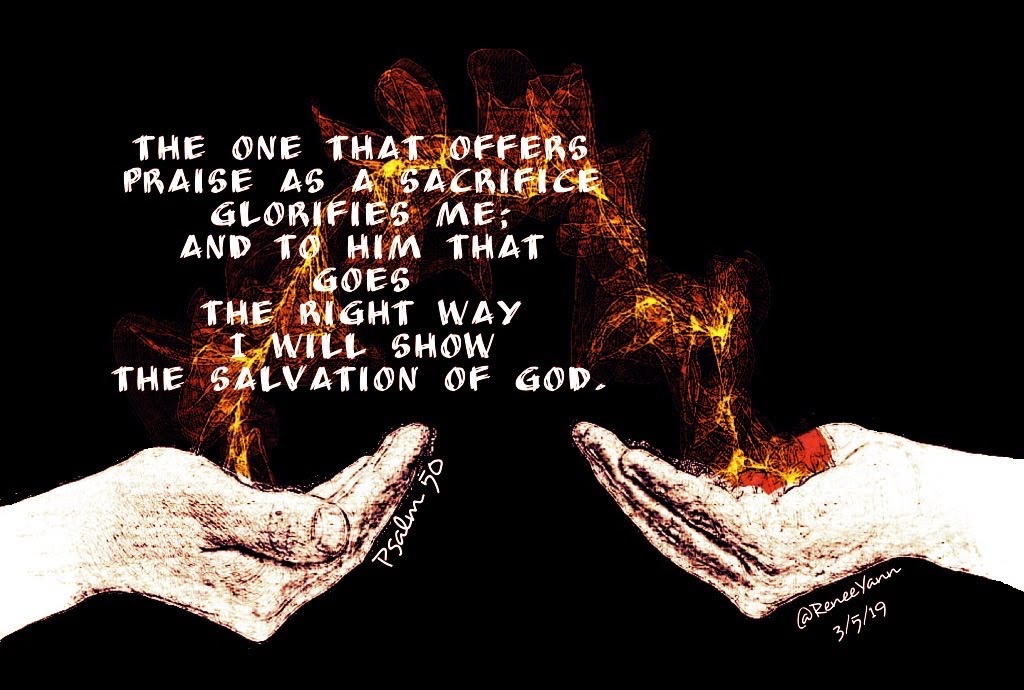
The one that offers praise as a sacrifice glorifies me;
and to the one who goes the right way I will show the salvation of God.


Poetry: one of mine today.

Praise
is the place
where I am lost
in You,
the exchange 
that
has only 
You speaking
without sound, with nothing
but my awed
silence.

Music: Alvin Slaughter – Sacrifice of Praise

Lord I lift a song of worship
For Your glory and Your grace
Let my heart reveal all my words fail to say
Lord receive this sacrifice of praise
(Repeat)
On the mountains, in the valley
As I wait in my secret place
I will trust,trust in the name of the Lord
Now receive this sacrifice of praise
You're my shield You're my shelter
From the storm and from the rain
Cover me beneath the shadow of Your wings
Lord receive this sacrifice of praise
Hallelujah hallelujah
Hallelujah to Your name
For all You've done
You are and evermore will be
Lord receive this sacrifice of praise
Of praise
Of praise----

Psalm 85: The Kiss

Saturday of the Thirteenth Week in Ordinary Time

July 4, 2020

Today, in God’s Lavish Mercy, we pray with Psalm 85, a testament to hope for the future. Couldn’t we all use a dose of the right now?

Glancing through Twitter last night, I came across a tweet asking for prayers because the writer had “begun to lose hope in the future”. I thought of and prayed for that person this morning when I read Psalm 85, a song of unmitigated hope and trust.


Despite the destruction of the Temple and their exile into Babylonian captivity, the Israelites remained convinced that God had promised them a future of blessedness.

I will hear what God proclaims;
the LORD–for he proclaims peace to his people.

Near indeed is his salvation to those who fear him,
glory dwelling in our land.

Trusting in God’s fidelity, they are freed to imagine and wait for that future’s slow and mysterious fulfillment. Note the future tense of the verbs in these verses:

Mercy and truth shall meet;
justice and peace shall kiss.
Truth shall spring out of the earth,
and justice shall look down from heaven.

Early 16th C. depiction of the Four Daughters of God: Mercy, Truth, Justice, and Peace (Angel in the middle)

The Israelites trusted God’s desire and will for their good. They so strongly believed in a blessed future that they were able to access it even in the midst of a disappointing present.

By faith, we too enter the timelessness of God’s love, finding – even in life’s challenges – the path to joy and peace. The “shalls” in the above verse are achieved through our belief in, and action for them. This is the power of the covenant between God and us.


Our faithful lives invite: 

  • God’s kiss of justice and peace
  • God’s springing forth in truth
  • God’s gaze of justice and mercy over Creation

God and we walk beside one another on the way to a sacred future where the journey is also the destination.

The LORD himself will give his benefits;
our land shall yield its increase.
Justice shall walk before him,
and salvation, along the way of his steps.


May we be given
the grace to believe
that we already live
within the wholeness of God.
May our life be
a hopeful and joyful witness
to that wholeness.


Poetry: Grace – Wendell Berry

Even though written as an autumn poem, these verses fit today’s reflection. Wendell Berry’s thoughts grace evoke a sense of hope and patience.

The woods is shining this morning.
Red, gold and green, the leaves
lie on the ground, or fall,
or hang full of light in the air still.
Perfect in its rise and in its fall, it takes
the place it has been coming to forever.
It has not hastened here, or lagged.
See how surely it has sought itself,
its roots passing lordly through the earth.
See how without confusion it is
all that it is, and how flawless
its grace is. Running or walking, the way
is the same. Be still. Be still.
“He moves your bones, and the way is clear.”

Music:  Mercy Like Rain, written by Rory Cooney, sung here by Alma deRojas

Let me taste your mercy like rain on my face;
here in my life, show me your peace.
Let us see with our own eyes your day breaking bright.
Come, O Morning; come, O Light!
 
What God has spoken I will declare:
Peace to the people of God everywhere.
God's saving presence is close at hand:
glory as near as our land!
 
Here faithful love and truth will embrace;
here peace and justice will come face to face.
God's truth shall water the earth like a spring,
while  justice will bend down and sing.
 
God will keep the promise indeed;
our land will yield the food that we need.
Justice shall walk before you that day,
clearing a path, preparing your way.
 
Let me taste your mercy like rain on my face;
here in my life,  show me your peace.
Let us see with our own eyes your day breaking bright.
Come, O Morning; come, O Light!