Representation of St. Stephen from The Demidoff Altarpiece by Carlo Crivelli, an Italian Renaissance painter of the late fifteenth century. This many-panelled altarpiece or polyptic painted by Crivelli in 1476, sat on the high altar of the church of San Domenico in Ascoli Piceno, east central Italy. It is now in the National Gallery in London, England.
Today, in Mercy, we celebrate the Feast of St. Stephen, first martyr for the Christian faith.
The commemoration and readings are a drastic turn from singing angels and worshiping shepherds.The Liturgy moves quickly from welcoming a cooing baby to weeping at the death of innocence. Why?
One thought might be to keep us practical and focused on what life in Christ truly means.
Stephen, like Jesus, “was filled with grace and power, … working great wonders and signs among the people.” He, as Jesus would, met vicious resistance to his message of love and reconciliation. He, as Jesus would, died a martyr’s death while forgiving his enemies.
The Church turns us to the stark truth for anyone who lets Christ truly be born in their hearts. WE will suffer as Jesus did – as Stephen did. The grace and power of Christ in our life will be met with resistance, or at least indifference.
We may not shed blood but, in Christ, we will die to self. When we act for justice for the poor and mercy for the suffering, we will be politically frustrated and persecuted. When we forgive rather than hate, we will be mocked. Powerful people, like the yet unconverted Saul in today’s second reading, may catalyze our suffering by their determined hard-heartedness.
Our Gospel confirms the painful truth:
“You will be hated by all because of my name,
but whoever endures to the end will be saved.”
Tomorrow, the liturgy picks up the poetic readings from John’s letters. These are delights to the soul.
But for today, it is a hard look, with Stephen, at what Christmas ultimately invites us to.
Music: Gabriel’s Oboe from the movie “The Mission”, played by Henrik Chaim Goldschmidt, principal oboist of The Royal Danish Orchestra in Copenhagen, Denmark.
Today, in Mercy, we are struck with Revelation’s images of the end time!
a crowned Christ wielding a sharp sickle
angels commanding the final harvest of the earth
and perhaps the most powerful
the earth’s vintage thrown into the great winepress of God’s fury!
This author could write! We can almost imagine the scene, filmed with all the pyro-technics of today’s computer age.
But besides the amazing imagery, what does the passage say to our hearts?
In Biblical symbolism, the winepress almost always stands for judgment. The passage reminds us that we all will be judged.The divine winepress will compress the sinful gaps that plague our human existence.In the end time, there will be no “other” — no judgmental spaces separating us from one another.We will all be one, like wine mingled.
We will be judged on how we lived that oneness in this life, on where we have stood in the gap between the:
rich and poor
well and sick
citizen and refugee
abled and disabled
powerful and vulnerable
Do we live in ignorance or indifference to those who suffer on the other side of the human scale? Have we been impervious to the imbalances of justice and charity in this world?
And how do we respond? The passage suggests that we do some weeding of our spiritual gardens before the harvest of our souls. The intention of this fiery writer is to tell us that we still have a little time.
Music:The Day Is Surely Drawing Near – written by the prolific 16th century Lutheran hymnist Bartholomaüs Ringwaldt. This piece is a majestic instrumental rendering, but if you would like to see the words, they are below.
1 The day is surely drawing near
When Jesus, God’s anointed,
In all His power shall appear
As judge whom God appointed. Then fright shall banish idle mirth,
And flames on flames shall ravage earth
As Scripture long has warned us.
2 The final trumpet then shall sound
And all the earth be shaken,
And all who rest beneath the ground
Shall from their sleep awaken.
But all who live will in that hour,
By God’s almighty, boundless pow’r,
Be changed at His commanding.
3 The books are opened then to all,
A record truly telling
What each has done, both great and small,
When he on earth was dwelling,
And ev’ry heart be clearly seen,
And all be known as they have been
In thoughts and words and actions.
4 Then woe to those who scorned the Lord
And sought but carnal pleasures,
Who here despised His precious Word
And loved their earthly treasures!
With shame and trembling they will stand
And at the judge’s stern command
To Satan be delivered.
5 My Savior paid the debt I owe
And for my sin was smitten;
Within the Book of Life I know
My name has now been written.
I will not doubt, for I am free,
And Satan cannot threaten me;
There is no condemnation!
6 May Christ our intercessor be
And through His blood and merit
Read from His book that we are free
With all who life inherit.
Then we shall see Him face to face,
With all His saints in that blest place
Which He has purchased for us.
7 O Jesus Christ, do not delay,
But hasten our salvation;
We often tremble on our way
In fear and tribulation.
O hear and grant our fervent plea;
Come, mighty judge, and make us free
From death and ev’ry evil.
Today, in Mercy, we remember the beloved Holy Souls who have gone before us. They are never far from us. Some of us may visit cemeteries today. Some will place a list of names upon the altar. But all of us will whisper their names: grandparents, parents, spouses, children, brothers, sisters and beloved friends — meeting each name in a sacred memory.
May those memories, whatever they contain, be transformed by our loving prayers. May whatever grief remains in us be blessed by the grace of faith and thanksgiving. And may the Holy Ones we honor today brighten us with some of their overwhelming Eternal Light in God.
Music: Lux Aeterna- Eternal Light – Michael Hoppé
Lux aeterna Lux aeterna luceat eis, Domine, cum sanctis tuis in aeternum, quia pius es.
Requiem aeternam dona eis, Domine, et lux perpetua luceat eis.
May light eternal shine upon them, O Lord, with Your saints forever,
for You are Mercy.
Eternal rest
give to them, O Lord,
and let perpetual light shine upon them.
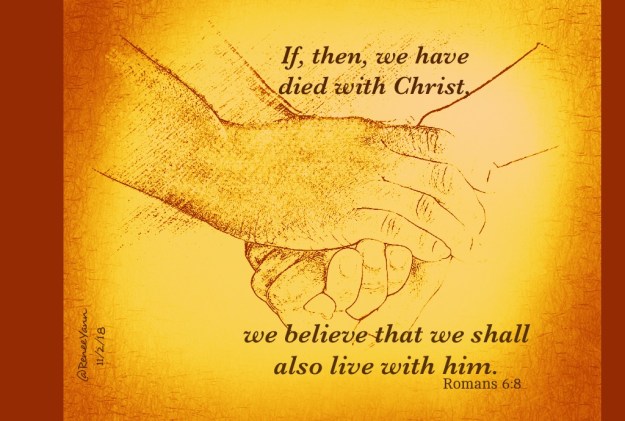
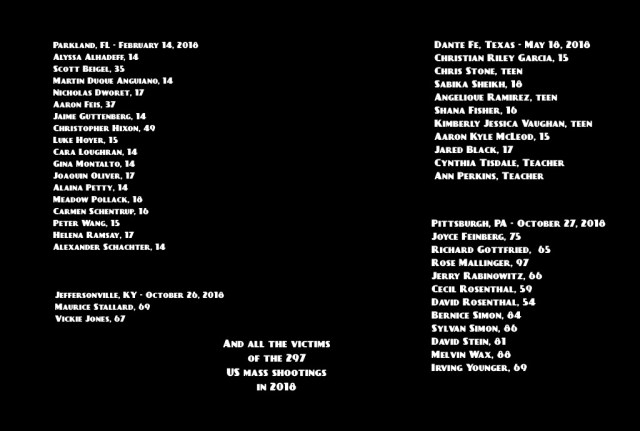
Today, in Mercy, on this Solemnity of All Saints, let us pray especially for our recent saints and martyrs – victims of hate, violence and irresponsible policy. Let us know them to be now in the arms of Love, a Love Whom we beg to heal us who remain, impelling us to true justice and mercy.
As we pray, let us reflect on the following hymn for the Holy Innocents, resolving to protect sacred life in ALL its manifold ages and expressions.
1.Salvete, flores Martyrum,
In lucis ipso lumine
Quos sevus ensis messuit,
Ceu turbo nascentes rosas.
2.Vos prima Christi victima,
Grex immolatorum tener,
Aram sub ipsam simplices
Palma et coronis luditis.
3.Qui natus es de Virgine
Jesu, tibi sit gloria,
Cum Patre, cumque Spiritu,
In sempiterna secula.
1. Flowers of martyrdom, all hail!
Smitten by the tyrant foe On life’s threshold – as the gale Strews the roses ere they blow.
2. First to bleed for God, sweet lambs! In innocence you died!
Rising with your wreath and palms At the very altar-side!
3. Honor, glory, virtue, merit, Be to Thee, O Living God, With Creator, and the Spirit While eternal ages run. – Amen.
Music: Salvete, Flores Martyrum -Tomás Luis de Victoria · Lluis Vich
Today, in Mercy, our readings from Isaiah and Mark sound almost Lenten in tone. Isaiah gives us the image of a broken Jesus, crushed by a “suffering that justifies many”.
Mark recounts the story of the two rather oblivious disciples asking to sit in glory beside Jesus. They do not realize that the path to this glory is through Gethsemane and Calvary.
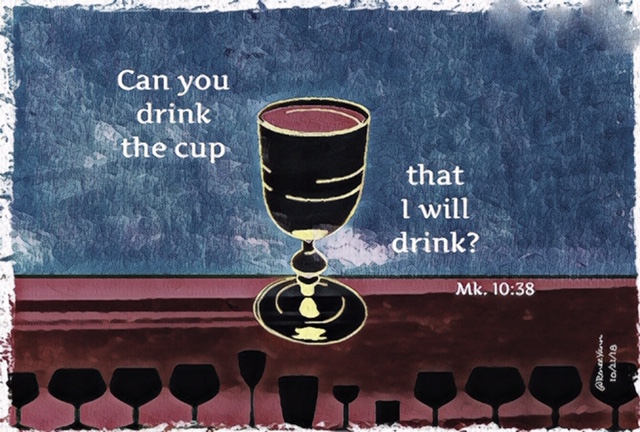
Jesus asks them the same question he asks us throughout our lives:
“Can you drink the cup that I will drink?”
We know that there are sacrificial cups of many sizes and shapes among us. Just this past week, with the canonization of St. Oscar Romero, we were reminded of the immense sacrifices of Romero and the Salvador people to practice their faith in dignity.
Each of our sufferings and sacrifices may seem so much smaller by comparison. But when they are united with Christ in faith and hope, they too are redemptive.
We will be asked, as Jesus was, to lay down our life.
It may be in the unselfish raising of a family, or the humble pastoring of a church community.
It may be in the long-term care of an elderly parent or neighbor.
It may be in a ministry of healing, teaching, or encouragement where another requires our labor, patience and mercy.
It may be as a public servant who actually serves, or as a private nurse who tenderly nurses.
It may be as a community member who builds life by respect, responsibility, and mutuality.
We will come to realize, as did the ambitious sons of Zebedee, that true discipleship is not flash and glam. It is the daily choice to quietly lift the cup we have been given, and raise it to the honor of God – in openness, trust, joy and delight that we are called to share in the life of Christ.
Music: The Cup of Salvation ~Shane & Shane (Lyrics below.)
I love the Lord for He heard my voice
And answered my cry for mercy
Because He listened to me
I will call upon Him as long as I live
CHORUS
What shall I render to the Giver of life and who all things are made What shall I render to the One who paints the oceans blue Jesus Christ
I will lift up a cup of salvation Call on the Name of the Lord How do I repay the life that You gave I’ll call on the Name of the Lord Lift up a cup, You have already poured
What kind of rendering is found in this taking
Found in this drinking of love
Love so abundant He meets me in depravity
With one thing to give
CHORUS
You have delivered my soul from death
My eyes from tears
My feet from stumbling
And I will walk before the Lord
In the land of the living
Yesterday in Vatican City, St. Oscar Romero was canonized. This holy man was Archbishop of San Salvador from 1977 until his assassination while offering Mass on March 24, 1980. After Archbishop Romero’s death, a twelve-year civil war ensued in El Salvador, killing an estimated 75,000 people.
The Catholic Church in El Salvador, during these years, became deeply involved in protecting the lives and land rights of the poor who were severely oppressed by a militaristic government. This corrupt government engaged the assistance of the United States to suppress the people by interpreting their struggle as “communism”.
For years, the Salvadoran government received US supplied arms and military training at the School of the Americas in Ft. Benning, Georgia.It was someone trained with these arms who martyred St. Oscar Romero – and thousands of his poor, over many years.
Romero was not a politician. He averted confrontation wherever possible. But he could not stand by as thousands of his flock were slaughteredbecause their human rights threatened the status and greed of the powerful.
Sometimes we hear the empty adage that religion should never mix with politics.
St. Oscar Romero is one of hundreds of women and men who became saints because they believed the opposite.
Our faith is irrevocably entwined with the rest of our lives. Our Gospel demands that we embrace and honor the poor, the oppressed and the marginalized. We may not be called to the level of witness that Oscar Romero was. But we, each in our own way, are called to understand issues of justice, and to act as Jesus would.
We are called to challenge our government, as did many activists during these years, when it is blind to its own sins. The USA is still selling arms to oppressive governments, still supporting regimes and practices that ignore human rights. Our voices and our votes need to be informed, clear, and faith-filled. I find Network and excellent source of education for me on these issues:
Please read the lyrics below first, as they are a little difficult to understand. The images in the video are painful to view, but offer testament to the gross injustices the Salvadoran people endured.
There’s a sunny little country south of Mexico Where the winds are gentle and the waters flow But breezes aren’t the only things that blow In El Salvador
If you took the little lady for a moonlight drive Odds are still good you’d come back alive But everyone is innocent until they arrive In El Salvador
If the rebels take a bus on the grand highway The government destroys a village miles away The man on the radio says ‘now we’ll play South of the Border’
And in the morning the natives say, We’re happy you have lived another day Last night a thousand more passed away In El Salvador
There’s a television crew here from ABC Filming Rio Lempe and the refugees Calling murdered children the ‘tragedy’ Of El Salvador
Before the government cameras 20 feet away Another man is asking for continued aid Food and medicine and hand grenades For El Salvador
There’s a thump, a rumble, and the buildings sway A soldier fires the acid spray The public address system starts to play South of the Border
You run for cover and hide your eyes You hear the screams from paradise They’ve fallen further than you realize In El Salvador
Just like Poland is ‘protected’ by her Russian friends The junta is ‘assisted’ by Americans And if 60 million dollars seems too much to spend In El Salvador
They say for half a billion they could do it right Bomb all day, burn all night Until there’s not a living thing upright In El Salvador
They’ll continue training troops in the USA And watch the nuns that got away And teach the military bands to play South of the Border
And kill the people to set them free Who put this price on their liberty? Don’t you think it’s time to leave El Salvador? Songwriters: Jim Wallis / Noel Paul Stookey
Today, in Mercy, we meet the first of a few readings from Ecclesiastes, written by an author who calls himself Qoheleth – Teacher. The book contains many loved and oft-repeated phrases that we might recognize:
There is a time for everything, and a season for every activity under heaven
He has made everything beautiful in its time.
And today’s kick-off thought:
Vanity of vanities ….All is vanity.
Reading Ecclesiastes places us in the presence of a writer who is a realist at best, and a cynic at worst. Parts of the book can be downright depressing; other parts, elegant in their spare beauty.
We can finish a passage like today’s and hear echoes around us of Star Trek’s Borg mantra:
Resistance is futile.
Qoheleth says as much:
What has been will be again,
what has been done will be done again;
there is nothing new under the sun.
The phrase carries at least a little tinge of hopelessness. But I think a lot depends on the way we read it.
Realizing that “things are the way they are” can give us a sense of stability and trust. It can release us from struggling needlessly against realities that will not be moved. It can encourage us to find within these “immovables” the hidden path to a new grace. It can remind us that others have endured; so can we.
One of our Wisdom Sisters taught us that by naming and accepting our reality, we can move from fighting it into growing from it. She always said, “What is, is” – implying “now deal with it”.
It sounds spartan, but it actually can be very freeing. We can’t change so many things – the weather, the tides, the hearts of others. The years will pass, friendships blossom and fade. We will get old, if we are blessed with that gift. We’ll lose our jump shot and probably some of our hair – maybe a few others things too.🤗
But God will always love us, abide with us and cherish us for eternity.
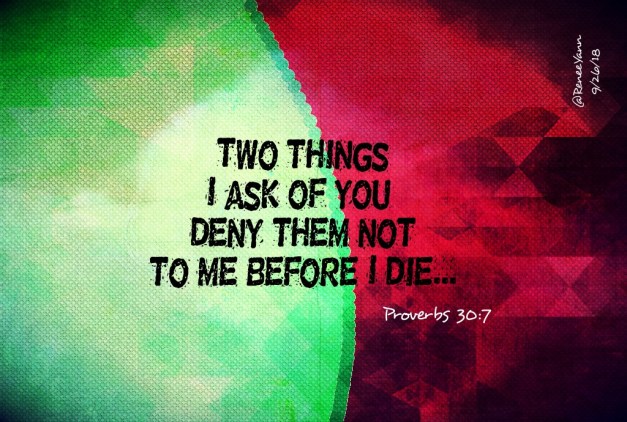
Today, in Mercy, what an interesting prayer we find in Proverbs! The speaker beseeches God to grant him two things before death:
to be surrounded by truth and
to be neither rich nor poor
A fascinating and radical request, don’t you think? And we get eavesdrop on it.
The supplicant fears riches because they may cause him to forget his need for God.
He fears poverty because it might cause him to steal and thus betray God’s law.
All he wants is a nice, even life with not too much drama. I get it, don’t you!
In our Gospel, Jesus sends his disciples out, telling them to let go of drama too. If people don’t engage you, move on he says. He instructs them not to be caught up in material possessions, but to leave all behind that for the sake of the truth they will be preaching.
Both these readings are really about truth and freedom, two gifts that allow us to live in grace, hope and joy. They are about not being bound by our possessions, our pretenses, our success, or what people think of us. They are about being at peace with who we really are before God and others.
The Proverbs passage makes me wonder—if someone were eavesdropping on our most radical prayer, what things they might they hear us asking for? What is it that would free us to be our truest selves before God?
She is known throughout the town for the woman she is – no ordinary, unknown panderer of her body’s wares. She is a true “madam”, and a few of her customers already sit, silent and furtive, at the Pharisee’s table.
She wears an elegant robe, for her fees are steep. Gem-encrusted bracelets encircle her wrists and ankles. But it is her hair that crowns her beauty. Flowing like a sable river, it is wound in deep waves around her lovely face and shoulders. It is scented with a small bit of the precious ointment she now carries in her alabaster jar.
Among her many assets, it is her hair that sets her apart. Some women see it through green eyes; some men through black hearts. But she, even in the confusion of her choices, has always known it to be a gift.
How to use the gift has been her life long challenge. Ultimately, would it prove to be her salvation or her damnation?Is it not so with every special gift, with every leverage that makes us singular among our peers?
These gifts may take the form of possessions, power, position, favor or myriad other shapes. They may reside in a clever wit, and incisive mind, and agile body, a profound spirit. They may rest in a dogged perseverance, an adhesive memory or a dynamic imagination. Whatever our unique power, it is the key to our self-definition. It speaks our particular presence in the world.
At some point in her soul’s journey, this gorgeous gospel woman decided that her superior beauty would serve Jesus. What might have caused that dramatic conversion in her life?
Some versions of the story say that seven devils were once cast from her by Jesus’s merciful hand. Whatever the moment might have been, we can see from today’s Gospel scene that it was profound, intimate, and complete.
Her luxuriant hair has become a sacrament of healing, offered on this night to a friend about to suffer death for the sake of Love. Because her own love is so great, she understands this suffering in Jesus long before his other followers.
This reading leaves us with so much to consider about our own gifts and how we use them; about the depth of our relationship with Jesus and how we show him our love; about what is in our alabaster jar and where we choose to pour its treasure.
Music: Pour My Love on You – Philips, Craig, and Dean
Today, in Mercy, our Sunday readings increase in dramatic tone.The passage from Isaiah describes a Savior bent on his mission despite mounting resistance and expressed hatred.
Psalm 116 describes a person set upon by suffering and death threats, still trusting in the Lord’s saving grace.
In the Epistle, James says we must demonstrate our faith by our works — by putting our money where our mouth is.
And in our Gospel, Jesus says we do this by following him, denying ourselves and taking up our cross.
This is heavy stuff. Jesus wants us to be like him — and it would be so much easier not to be!It would be so much easier to think that our life is all about ourselves, and that we have no responsibility for Beloved Creation.
It would be so much easier not to give our lives to Christ to allow Him to bless the world through our love.
But if we wish to “save” our lives like this, we will — in the end — lose them for eternity.
Let us pray today for the grace to take our life and lay it down over the Cross of Christ.
In that laying down, to conform ourselves to the pattern of his love, to place the weight of our burdens and hopes on the crossbeam of his strength
Let us ask for the strength to live
for God
for others
for good in the world
and never for self when it injures or lessens others or our Sacred Home.