Last week, a great tree was felled at the edge of our Motherhouse lawn. Having stood for decades near the Guardian Angel, it had shaded many generations on their way to Mercy: students, staff, visitors, and the Sisters themselves on their many ins and outs to this common home.
The whole community which gathers here daily felt a pang at the hewing, knowing that we had shared the very breath of this tree for so long. Its leafy embrace offered us a place to cool in the present, a way to remember the beauty of the past, and a security about the future. Seeing it disassembled by necessity gave a bittersweet pain. But there was a peace in knowing that our tree had come to completion with honor and dignity.
We drew so much from the presence of that tree, but perhaps we can draw even more from its absence. The lines of Gregory Norbet’s hymn “Hosea” come to mind:
Trees do bend, though straight and tall. So must we to others’ call Long have I waited for your coming home to me, And living deeply our new life.
Our tree, even in its retreat, still speaks to us – a truth becoming profoundly evident these days as we mourn the passing of our sister and friend Marie Ann Ellmer. She stood straight and tall among us, but another call came precipitously in the early morning last week.
When a beloved dies, one with whom we drew the same breath and hope, part of us dies. Whether a great tree or a magnanimous soul, they take something with them of the life we shared. When we mourn them, it is that which is taken that we pine for. But as we fold their lives under Love’s eternal blanket, it is that which they have left us that gives joyful peace.
That glorious tree and dear Marie Ann seem to be one now in the solemn aura that follows death. Both, in rare beauty, brought others to the precious gift of Mercy. Both remain treasured in its Everlasting Power. And both have given back to Creation the blessed graces that made them shine among us.
Mary took a liter of costly perfumed oil made from genuine aromatic nard and anointed the feet of Jesus and dried them with her hair; the house was filled with the fragrance of the oil…
… Jesus said, “Leave her alone. Let her keep this for the day of my burial.
John 12: 3;7
Mary knows. Even though theories bounce back and forth about how Jesus will be received in Jerusalem, Mary knows.
She knows that someone she loves is on the brink of a desperate confrontation, and she cannot change it. What she can do is to cherish his presence by a silent act of love that strengthens both of them with a holy grace.
Today, in God’s Lavish Mercy:
We know. We know what Jesus did for us – still does for us. And there are no words adequate for our thanks. But our quiet prayer as we absorb the astounding mystery of Christ’s love – may it be an anointing of gratitude.
Poetry: Anointing at Bethany – Malcolm Guite
Come close with Mary, Martha, Lazarus
so close the candles stir with their soft breath
and kindle heart and soul to flame within us,
lit by these mysteries of life and death.
For beauty now begins the final movement
in quietness and intimate encounter.
The alabaster jar of precious ointment
is broken open for the world’s true Lover.

The whole room richly fills to feast the senses
with all the yearning such a fragrance brings.
The heart is mourning but the spirit dances,
here at the very center of all things,
here at the meeting place of love and loss,
we all foresee, and see beyond the cross.
Music: Pour My Love on You – written by Craig and Dean Phillips
… We proclaim Christ crucified, … … Christ the power of God and the wisdom of God. For the foolishness of God is wiser than human wisdom, and the weakness of God is stronger than human strength.
1 Corinthians 1: 22-25
This is a great mystery of our faith: that the all-powerful One chose to redeem us by assuming our human weakness, suffering torment, and dying an ignominious death.
When my three-year-old grand-niece visited our convent, she enjoyed walking through the huge motherhouse pointing out every statue of Our Lady of Mercy.
With each discovery she would pronounce the title: “Jeezie and his Mommy”. At the end of a very long corridor, we came to a life-size wooden carving of Jesus Crucified. Little Claire studied it, looked up at me and asked, “Who is that?”.
I simply said, “I don’t know” because her sweet little heart could not bear to learn, or to possibly understand, what happened to her “Jeezie”.
Today, in God’s Lavish Mercy:
Lent is the time to deepen our understanding of what happened to Jesus because of the “foolishness of God”. That Omnipotent Love suffered, died, and rose for us so that we would understand and embrace the meaning of Love in our own lives.
Let’s pray today for a fuller awareness that our lives are a continuing participation in the Great Love. Let us use these Lenten days to find the pattern of the Cross in our world, and to look within it for the Light of the Resurrection.
Poetry: The Foolishness of God – Luci Shaw
Perform impossibilities
or perish. Thrust out now
the unseasonal ripe figs
among your leaves. Expect
the mountain to be moved.
Hate parents, friends, and all
materiality. Love every enemy.
Forgive more times than seventy-
seven. Camel-like, squeeze by
into the kingdom through
the needle’s eye. All fear quell.
Hack off your hand, or else,
unbloodied, go to hell.
Thus the divine unreason.
Despairing now, you cry
with earthy logic – How?
And I, your God, reply:
Leap from your weedy shallows.
Dive into the moving water.
Eyeless, learn to see
truly. Find in my folly your
true sanity. Then Spirit-driven,
run on my narrow way, sure
as a child. Probe, hold
my unhealed hand, and
bloody, enter heaven.
Music: The Cross is Foolishness – John Michael Talbot (lyrics below)
CHORUS: The Cross is foolishness to those who perish But for us it has become the wisdom of God The Cross is foolishness to those who perish But for us it is salvation and power from God
Some look for miracles, some look for wisdom But we preach only Jesus crucified It seems absurdity, it seems so foolish But to us it is the wisdom of God
(CHORUS)
(CHORUS)
Eye has never seen, ear has never heard Nor has it dawned on the limits of the mind What God has surely prepared For those who love Him He reveals this wisdom through the Spirit of God
Today, in God’s Lavish Mercy, as February’s deep season unrolls, we are just about two weeks away from the beginning of Lent. Our first readings during this time will give a little taste of 1 Kings and then briefly shift to James’s epistle before we pick up the treasured readings of the Lenten Season.
The passage today bears a royal gravity. After preparing his son Solomon for kingship, David solemnly dies.
Keep the mandate of the LORD, your God, following his ways and observing his statutes, commands, ordinances, and decrees as they are written in the law of Moses, that you may succeed in whatever you do, wherever you turn, and the LORD may fulfill the promise he made on my behalf….
… David rested with his ancestors and was buried in the City of David. The length of David’s reign over Israel was forty years: he reigned seven years in Hebron and thirty-three years in Jerusalem.
Solomon was seated on the throne of his father David, with his sovereignty firmly established.
1 Kings 2; 3-4;10-12
David’s advice to Solomon is basically this: there is work to be done for God and God’s People. And now it’s your responsibility. Keep the course!
In our Gospel, Jesus gives the same sort of mandate to this disciples:
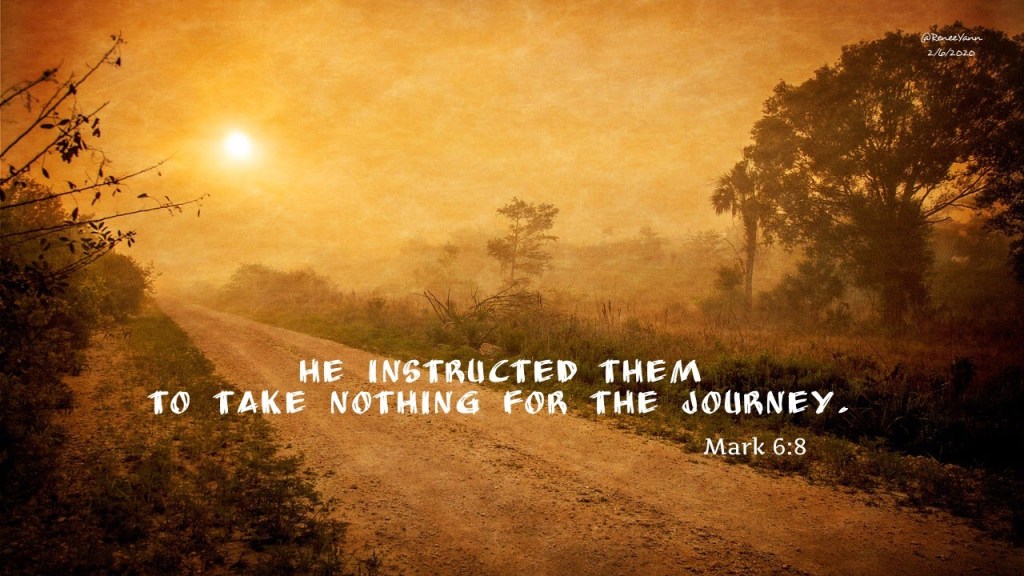
Jesus summoned the Twelve and began to send them out two by two and gave them authority over unclean spirits. He instructed them to take nothing for the journey but a walking stick –no food, no sack, no money in their belts.
Mark 6:7-8
The disciples are ready. It is now their turn to spread the Gospel and to continue the ministry that they have learned at Jesus’s side:
So they went off and preached repentance. The Twelve drove out many demons, and they anointed with oil many who were sick and cured them.
Mark 6:12-13
If any of us are wondering what we are supposed to do today for the Reign of God, our answer may be somewhere in these readings as we pray them with an open heart.
Poetry: The Poem of Tecumseh – Tecumseh (1768 –1813) was a Shawnee chief and warrior who promoted resistance to the expansion of the United States onto Native American lands. A persuasive orator, Tecumseh traveled widely, forming a Native American confederacy and promoting intertribal unity. Even though his efforts to unite Native Americans ended with his death in the War of 1812, he became an iconic folk hero in American, Indigenous, and Canadian popular history. (Wikipedia)
Today, in God’s Lavish Mercy, we read one of the saddest lines in Scripture.
You have followed the story in these daily passages. Absalom rebels, designing to usurp his father’s throne. A massive battle rises between them. David, as commander-in-chief, remains behind, but gives instructions to his generals to spare Absalom’s life. Joab ignores the command, killing Absalom in a moment of vulnerability.
David is devastated.
David Mourning Absalom’s Death – Jean Colombe
I think there is no more wrenching human emotion than regret. When I ministered for nearly a decade as hospice chaplain, and later in the hospital emergency room, I saw so much regret.
People who had waited too long to say “I’m sorry”, “I forgive you”, “Let’s start over”, ” It was my fault too..”, “Thank you for all you did for me”, “I love you”…..
Instead, these people stood at lifeless bedsides saying things like, “I should have”, “I wish…”, “If only…”
Life is complex and sometimes difficult. We get hurt, and we hurt others — sometimes so hurt that we walk away from relationship, or stay but wall ourselves off.
We might think that what is missing in such times is love. But I think it is more likely truth. In times of painful conflict, if we can hear and speak our truth to ourselves and one another, we open the path to healing.
If you want the truth, I’ll tell you the truth. Listen to the secret sound, the real sound, which is inside you. ~ Kabir
That healing may demand adjustments, agreements, even a willingness to step apart in mutual respect. But if the changes emerge from shared truth, restoration and wholeness are possible.
David and Absalom never found that path because they were so absorbed in their own self-interests. Theirs was the perfect formula for regret – that fruitless stump that perpetually sticks in the heart.
I remember a trauma surgeon leaving the hospital late one night after an unsuccessful effort to save a young boy who had been shot. The doctor carried the loss so heavily as he walked into the night saying to me, “I’m just going to go home and hug my kids.”
As we pray over David and Absalom today, let us examine our lives for the still healable fractures and act on them. Let us “hug” the life we have. Regret is a useless substitute.
Poetry: The Eyes of My Regret – Angelina Weld Grimké
Angelina Weld Grimké was born in Boston on February 27, 1880. She was the daughter of Archibald Grimké, who had been born a slave in Charleston, South Carolina, and Sarah Stanley Grimké, a white woman and the daughter of an abolitionist. Named after her great-aunt, the abolitionist and suffragist, Angelina Grimké Weld, Grimké grew up in liberal, aristocratic Boston society. She attended the best preparatory schools in Massachusetts, including Cushing Academy and the now defunct Carleton School.
My readers might be interested in Sue Monk Kidd’s excellent historical novel “The Invention of Wings” which tells the story of the poet’s abolitionist great-aunts, the Grimké sisters.
The Eyes of My Regret
Always at dusk, the same tearless experience,
The same dragging of feet up the same well-worn path
To the same well-worn rock;
The same crimson or gold dropping away of the sun
The same tints—rose, saffron, violet, lavender, grey
Meeting, mingling, mixing mistily;
Before me the same blue black cedar rising jaggedly to a point;
Over it, the same slow unlidding of twin stars,
Two eyes, unfathomable, soul-searing,
Watching, watching—watching me;
The same two eyes that draw me forth, against my will dusk after dusk;
The same two eyes that keep me sitting late into the night, chin on knees
Keep me there lonely, rigid, tearless, numbly miserable,
—The eyes of my Regret.
Music: When David Heard – Eric Whitaker (The piece builds. Be patient. Lyrics below)
When David heard that Absalom was slain, he went up into his chamber over the gate and wept, and thus he said;
My son, my son, O Absalom my son, would God I had died for thee!
When David heard that Absalom was slain, he went up into his chamber over the gate and wept, and thus he said;
Today, in God’s Lavish Mercy, Jesus tells us the parable of the sower and the seed.
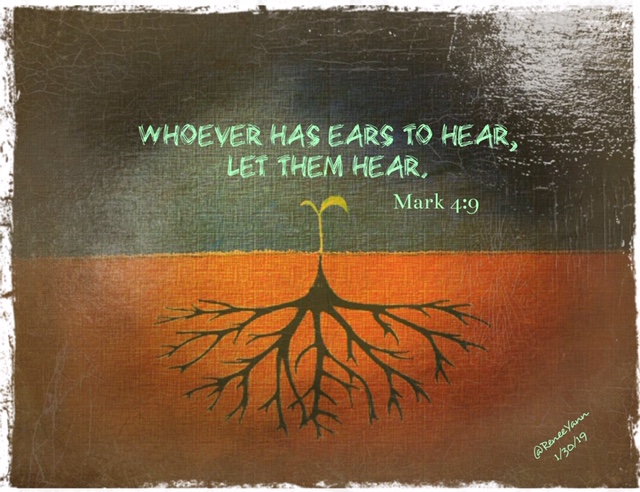
And he taught them at length in parables, and in the course of his instruction he said to them, “Hear this! A sower went out to sow. And as he sowed, some seed fell on the path, and the birds came and ate it up. Other seed fell on rocky ground where it had little soil. It sprang up at once because the soil was not deep. And when the sun rose, it was scorched and it withered for lack of roots. Some seed fell among thorns, and the thorns grew up and choked it and it produced no grain. And some seed fell on rich soil and produced fruit. It came up and grew and yielded thirty, sixty, and a hundredfold.” He added, “Whoever has ears to hear ought to hear.”
Mark 4: 2-9
How many times have we heard or read this passage over the years? Maybe so many times that we’ve become a little impervious to it. Maybe we can hear something too much.
For example, as a group of us watched the 76ers basketball game last night, the commercials seemed endless. At one point Anne Marie asked me, “Would you ever buy that?”. Although I was staring at the commercial, I had no idea what it was saying. I had tuned it out and was looking right through it!
Here’s the thing: I could hear the commercial, but I wasn’t listening to it.
I think it’s like that with today’s parable and other scripture passages as well.
We’re probably not farmers. If you’re like me, the best you’ve done is to plant an orange seed in a ten-cent flower pot when you were kindergartners! So the parable might not catch our hearts when we hear it for the 100th time unless we have learned to listen as well as hear!
But when we listen to this parable we might realize that, maybe, for us:
the seed fell on the path and got devoured by birds that time when we let up on our dedicated prayer time and took up some useless distraction
the seed fell on rocky ground when we failed to study a politically charged issue in the light of the Gospel and instead got caught in a media-spun theory
the seed fell among thorns when we allowed our morality to be influenced by gossip, cheap judgments, self-serving agendas, or biased opinion
the seed fell on rich ground when we gave our spirits quiet time, prayer, good spiritual reading, the companionship of graced friends, and all the other holy kindnesses that can make us better persons
As I write this blog, it’s so cold where I live that, unless you had a jackhammer, you couldn’t even plant a seed. We don’t want our hearts to be like that. We want supple hearts, ready for the amazing graces God scatters over our lives daily. Let’s do the work to be ready.
Poetry: The Sower – William Cowper (1731 – 1800) was an English poet and Anglican hymnwriter.
One of the most popular poets of his time, Cowper changed the direction of 18th-century nature poetry by writing of everyday life and scenes of the English countryside. In many ways, he was one of the forerunners of Romantic poetry. Samuel Taylor Coleridge called him “the best modern poet”, whilst William Wordsworth particularly admired his poem “Yardley-Oak”.
Cowper’s religious sentiment and association with John Newton (who wrote the hymn “Amazing Grace”) led to much of the poetry for which he is best remembered, and to the series of Olney Hymns. His poem “Light Shining out of Darkness” gave English the phrase: “God moves in a mysterious way/ His wonders to perform.” (Wikipedia)
Ye child of earth prepare the plough,
Break up your fallow ground;
The sower is gone forth to sow,
And scatter blessings round.
The seed that finds a stony soil
Shoots forth a hasty blade;
But ill repays the sower's toil,
Soon wither'd, scorch'd, and dead.
The thorny ground is sure to balk
All hopes of harvest there;
We find a tall and sickly stalk,
But not the fruitful ear.
The beaten path and highway side,
Receive the trust in vain;
The watchful birds the spoil divide,
And pick up all the grain.
But where the Lord of grace and power
Has bless'd the happy field,
How plenteous is the golden store
The deep-wrought furrows yield!
Father of mercies, we have need
Of thy preparing grace;
Let the same Hand that give me seed
Provide a fruitful place!
Today, in God’s Lavish Mercy, each of our readings speaks to us of time.
The concept of time has always fascinated me. I remember being aware of the fascination as a very little girl walking beside my mother and aunt along the Wildwood boardwalk arcade.
Some of you who live locally may remember the spot, an extension of the seaside boardwalk at Oak Avenue. Its main attractions were bumper cars and a booth where little piglets ran along a path, picking a random door that, for a nickel, might earn you a stuffed animal.
On that particular summer day, about 1950, there was a new booth – Miranda, the Fortune Teller. Miranda read Tarot cards, an exercise Mom and Aunt Peg were unfamiliar with. Nevertheless, they decided to try it, and each went separately into the tiny veiled room to learn her future as I stood completely entranced by the piglet race.
Later, as the three of us sauntered side-by-side in the salted air, I heard Aunt Peg ask Mom, “Did she tell you how old you will be when you die?”. My ears leaped to attention! What? My mom could die???? And that lady knew when????
I heard my thirty-three year old mother answer, “She said when I am seventy-two.”
“Oh, God! How soon is that?”, I wondered. My little five-year-old mind tried to calculate the expanse of time but failed. However, the prediction planted itself inextricably in my heart.
Decades later, when Mom did pass away (just before her 72nd year) the memory returned to me. And the nearly forty years in between seemed compressed into an incomprehensible moment that had passed as quickly as that sweet seaside breeze.
How many times do we ask the Universe this unanswerable question, “Where did the time go?” It is a question that has a thousand answers and no answer, much like the question, “Who is God?”.
In our readings today, Jonah, Paul, and John the Baptist want us to think about time in relationship to God.
For Jonah, time is captured in the forty days of grace to seek repentance.
For Paul, time – in the worldly sense – is running out, requiring us to turn our attention to eternity.
For Jesus, it is the time of fulfillment – a fulfillment that can be achieved by living the Gospel.
Praying with today’s readings, we might ask ourselves, “What time is it for me?
Are there places in my life requiring “repentance“, a turning of my heart away from selfishness and toward the mercy of God?
Do I need to widen my perspective with a deeper awareness of eternal rather than worldly values?
Am I making a choice every day to live a life patterned on the Gospel?
Poetry: Endless Time – Rabindranath Tagore
Time is endless in thy hands, my lord.
There is none to count thy minutes.
Days and nights pass and ages bloom and fade like flowers.
Thou knowest how to wait.
Thy centuries follow each other perfecting a small wild flower.
We have no time to lose,
and having no time we must scramble for a chance.
We are too poor to be late.
And thus it is that time goes by
while I give it to every querulous person who claims it,
and thine altar is empty of all offerings to the last.
At the end of the day I hasten in fear lest thy gate be shut; but I find that yet, with you, there is always time.
Music: What’s It All About, Alfie? – written by Burt Bacharach, sung by Dionne Warwick this modern song seems to deal with the timeless questions.
What’s it all about Alfie Is it just for the moment we live
What’s it all about When you sort it out, Alfie Are we meant to take more than we give Or are we meant to be kind?
And if, if only fools are kind, Alfie Then I guess it is wise to be cruel And if life belongs only to the strong, Alfie What will you lend on an old golden rule?
As sure as I believe there’s a heaven above Alfie, I know there’s something much more Something even non-believers can believe in
I believe in love, Alfie Without true love we just exist, Alfie Until you find the love you’ve missed You’re nothing, Alfie
When you walk let your heart lead the way And you’ll find love any day Alfie, Alfie
Today, in God’s Lavish Mercy, our first reading offers us John’s perfect honesty and simplicity:
Whoever says, “I know him,” but does not keep his commandments is a liar, and the truth is not in him. But whoever keeps his word, the love of God is truly perfected in him. This is the way we may know that we are in union with him: whoever claims to abide in him ought to walk just as he walked.
1 John 1:3-6
Yes, it’s that simple and that hard!
Then, in our Gospel, we meet Simeon who speaks with the holy confidence of a long and well-lived life. His lifelong dream was that he might not die before seeing the Messiah. That dream now fulfilled, Simeon intones one of the most beautiful prayers in Scripture, the Nunc Dimittis:
Lord, now let your servant go in peace; your word has been fulfilled: my own eyes have seen the salvation which you prepared in the sight of every people, a light to reveal you to the nations and the glory of your people Israel.
Luke 2:29-32
If we live in the Light, we too will see the Messiah within our life’s experiences. We too will come to our final days confident and blessed by that enduring recognition.
For as John also assures us:
Whoever says he is in the light, yet hates his brother or sister is still in the darkness. But whoever loves his brother and sister remains in the light …
1 John 1:9-10
Let’s pray today for those who are dying, that they may know this kind of peace.
Let us pray for ourselves, that when our time comes, we too may experience this confidence.
Poetry: Song Silence By Madeleva Wolff, CSC
Yes, I shall take this quiet house and keep it With kindled hearth and candle-lighted board, In singing silence garnish it and sweep it For Christ, my Lord.
My heart is filled with little songs to sing Him— I dream them into words with careful art— But this I think a better gift to bring Him, Nearer his heart.
The foxes have their holes, the wise, the clever; The birds have each a safe and secret nest; But He, my lover, walks the world with never A place to rest.
I found Him once upon a straw bed lying; (Once on His mother’s heart He laid His head) He had a bramble pillow for His dying, A stone when dead.
I think to leave off singing for this reason, Taking instead my Lord God’s house to keep, Where He may find a home in every season To wake, to sleep.
Do you not think that in this holy sweetness Of silence shared with God a whole lifelong Both he and I shall find divine completeness Of perfect song?
Music: Nyne Otpushchayeshi ~Sergei Rachmaninoff (translated Nunc Dimittis, Now Let Your Servant Go). This was sung at Rachmaninoff’s funeral, at his prior request. (For musicians among you, point of interest: Nunc dimittis (Nyne otpushchayeshi), has gained notoriety for its ending in which the low basses must negotiate a descending scale that ends with a low B-flat (the third B-flat below middle C).
Church Slavonic text Ныне отпущаеши раба Твоего, Владыко, по глаголу Твоему, с миром; яко видеста очи мои спасение Твое, еже еси уготовал, пред лицем всех людей, свет во откровение языков и славу людей Твоих Израиля
English translation Now let Your servant depart in peace, Lord, by Your word; My eyes have seen Your salvation, Which You have prepared, In view of all the people, A light revealed to all tongues and to the glory of Your people, Israel
Today, in God’s Lavish Mercy, our readings share a common theme of “worthiness“.
In a passage familiar to us from the many funeral Masses we have attended in our lives, the Wisdom writer assures us that God will find us worthy if we are just:
But the souls of the just are in the hand of God, and no torment shall touch them. They seemed, in the view of the foolish, to be dead; and their passing away was thought an affliction and their going forth from us, utter destruction. But they are in peace. For if before observers, indeed, they be punished, yet is their hope full of immortality; Chastised a little, they shall be greatly blessed, because they have been tested and found worthy by God.
Wisdom 3: 1-5
The Wisdom writer seems to be so practical! He imagines life as a test, but one that God assures us we will pass if we live justly.
The word “just” comes from the Latin word meaning law, or right. To be just, in the sense of our first reading, is to be in alignment with the Divine Balance Who created us … to be “in the hand of God”.
But life does test our balance, doesn’t it! And if, by the poor use of our free will, we have climbed or tumbled out of God’s hand, the test can upend us.
Still, Wisdom instructs us that all is never lost. God loves us too much not to pick us up again into the palm of grace and mercy:
Those who trust in God shall understand truth, and the faithful shall abide with God in love: Because grace and mercy are with God’s holy ones, God cares tenderly for us beloved.
Wisdom 3:9
In our Gospel reading from Luke, Jesus gives us some advice about how to keep that graceful balance which aligns us with God. He compares us to devoted servants who, so deep is their gratitude, cannot do enough for the master who loves them:
When you have done all you have been commanded, say, ‘We are unprofitable servants; we have done what we were obliged to do.”
Luke 17:10
Indeed, as grateful creatures, we are obliged to love the God who deigned to create us. But the more we deepen in that love, the less it is an obligation. It becomes a delight, a reciprocal exchange, a sustaining source of the grace and mercy that justifies us.
Poetry: from Ode: Intimations of Immortality from Recollections of Early Childhood – William Wordsworth.
I cite only a section here. If you would like to read it in its beautiful context, click here. This poem is so worth your time!:
                      O joy! that in our embers
                     Is something that doth live,
                      That Nature yet remembers
What was so fugitive!
The thought of our past years in me doth breed
Perpetual benediction: not indeed
For that which is most worthy to be blest;
Delight and liberty, the simple creed
Of Childhood, whether busy or at rest,
With new-fledged hope still fluttering in his breast:—
                      Not for these I raise
                      The song of thanks and praise
                But for those obstinate questionings
                Of sense and outward things,
                Fallings from us, vanishings;
                Blank misgivings of a Creature
Moving about in worlds not realised,
High instincts before which our mortal Nature
Did tremble like a guilty thing surprised:
                      But for those first affections,
                      Those shadowy recollections,
                Which, be they what they may
Are yet the fountain-light of all our day,
Are yet a master-light of all our seeing;
                Uphold us, cherish, and have power to make
Our noisy years seem moments in the being
Of the eternal Silence: truths that wake,
                To perish never;
Which neither listlessness, nor mad endeavour,
                      Nor Man nor Boy,
Nor all that is at enmity with joy,
Can utterly abolish or destroy!
                Hence in a season of calm weather
                      Though inland far we be,
Our Souls have sight of that immortal sea
                      Which brought us hither,
                Can in a moment travel thither,
And see the Children sport upon the shore,
And hear the mighty waters rolling evermore
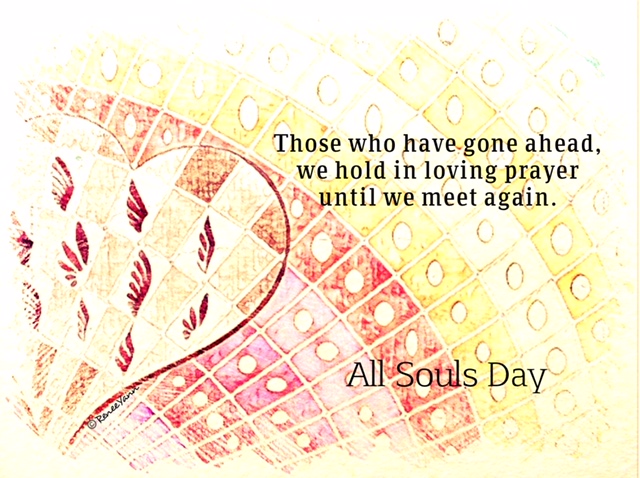
Today, in God’s Lavish Mercy, the whole Church joins in praying for the wholeness of the Communion of Saints. We all desire to be together again, with everyone we have loved, in eternal life.
This morning, as I prepare the reflection for All Souls Day, I consider how much religious practice can change in one’s lifetime. The Church and we are always growing in understanding and truth if we have open hearts. This graced understanding is exactly what the Church seeks in the current Synod on Synodality. Yet, as with all growth, we may tend to resist.
Today, I am taken (waaay) back to how All Souls Day was commemorated in my youth. My teachers impressed me with the idea that this special day was a time when repentant souls could be released from Purgatory if I prayed hard enough. I thought the process was similar to Amazon Prime Day where costs/penalties dropped and the early and persistent pray-er could snag a lot of souls for heaven.
(not us, but close enough)
We always had off from school on All Souls Day, so Janie McFadden and I would meet up about 5:45 AM to begin our marathon of Masses. We had four parish priests so at three Masses a piece, Janie and I were set for the next few hours of liberating prayer. About 7:00 AM, Harry diNicolo finally showed up but he certainly didn’t get full credit like me and Janie!
The scene was somber. The priests wore black vestments then, spoke mostly in Latin, and turned their backs to the participating congregation. There were a lot of candles and not very much real light that early in the morning. You guessed it – Janie and I took turns falling asleep. About every 10 minutes, one would punch the other in an effort to rev up purgatorial releases. Still not sure if any of that worked. Harry, by the way, went back home about 7:15 because he was hungry for breakfast.
One year, after the third Nicene Creed or so, Janie fainted. Sister Eucharistica told her not to do the All Souls Marathon again without drinking “a wee bit of milk before you come to Church”. Given our understanding of Divine Law at the time, requiring total fasting, we fourth graders were pretty sure Sr. Eucharistica would be the next soul we were praying out of Purgatory!
But as I think of her now, she was exactly the kind of person we need today for a “synodal Church”. She was a woman full of wisdom, courage, and common sense. She knew how to prioritize human needs long before the institutional Church figured it out. She knew Jesus desired communion with someone who wasn’t in a dead faint!
I think she probably knew too that we hadn’t come to Mass on that cold 1955 morning just to help “release” folks from purgatory. We had come to remember people we loved who had gone ahead of us, to reflect on their lives, to miss them, love them, and to learn from both their lights and their shadows.
We were young kids who, in our own small way, wanted to honor and face the meaning of death in human life. We wanted to know that God cared about our sadness over losing Grandmom or Uncle Joe. We wanted to know that God cared about us even though we too would face the same mysterious completion of our earthly lives.
Unfortunately, the Tridentine Mass didn’t provide much of that spiritual enrichment. But Sr. Eucharistica did. God bless her!
Today, in a language still very heavy with 16th-century concepts, the Catholic Encyclopedia defines purgatory as a place or condition of temporal punishment for those who, departing this life in God’s grace, are, not entirely free from venial faults, or have not fully paid the satisfaction due to their transgressions.
That language doesn’t do much for me either. I choose to think that most of us do the best we can with our lifetimes, but maybe there are a few who don’t. They don’t quite create the space in themselves to receive and eternally embrace God. “Purgatory” is their second chance, a “time out” God gives them to get their heads together and realize how much they have been missing. Then, violà, they like all the saints are flooded with glory.
My dear friend Janie has long ago gone to the heavenly understanding. I’m not sure what happened to Harry, even though we dated off and on well into high school. I think he finally found somebody who liked to eat more than she liked to go to Mass. Meanwhile, my likes were going in a different direction.
Prose: from Pope Francis’s homily on November 2, 2022
Brother and sisters, let us feed our expectation for Heaven, let us exercise the desire for paradise. Today it does us good to ask ourselves if our desires have anything to do with Heaven. Because we risk continuously aspiring to passing things, of confusing desires with needs, of putting expectations of the world before expectation of God. But losing sight of what matters to follow the wind would be the greatest mistake in life.
Remembering Our Merion Mercy Family – lyrics below
We lovingly remember these dear Sisters and Associates who shared Mercy life with us and who have gone home to God in 2023.
One day in the love of Christ we’ll meet once again We’ll laugh as we celebrate a life with no end Where death has been overcome by our Risen Lord
And there are no more goodbyes, no more tears, no more loneliness, and no more fear
Our pain turns to joy darkness to light in God’s heaven there are no more goodbyes
No words tell the gratitude we have for the gift your life was to each of us We’ll never forget
May angels now lead you home to our Risen Lord
And there are no more goodbyes, no more tears, no more loneliness, and no more fear
Our pain turns to joy darkness to light, in God’s heaven there are no more goodbyes
Though now with our heavy hearts we go separate ways we trust in the certain hope there will come a day we’ll join you in paradise with our risen Lord
There will be no more goodbyes, no more tears, no more loneliness, and no more fear Our pain turns to joy darkness to light God’s heaven there are no more goodbyes














 Lavish Mercy