Today, in Mercy, we pray within the incomprehensible Love Who is Jesus.
A most beautiful hymn from the Good Friday liturgy is the Popule Meus.
Popule Meus, also known as the ‘Improperia‘ or the ‘Reproaches,‘ is the hymn sung after the Adoration of the Cross on Good Friday. Christ reproaches the People, contrasting the innumerable favors God has bestowed upon them with the injuries He has received from their hands. Where God led them to the Chosen Land, the Peole led Him to the Cross. Where God gave a royal scepter, the People returned a crown of thorns.
This prayer focuses us on our own relationship with God. We too are Children of the Promise. How have we responded? How do we find ourselves as we kneel before the Cross?
The Trisagion prayer is an ancient chant repeated within the Popule Meus. It is a verse we can repeat as a mantra whenever we meditate on the Cross.
Ágios o Theos. Ágios íschyros. Ágios athánatos, eléison imas.
Holy God, Holy Mighty One, Holy Immortal One, have mercy on us.
During the hours from Noon until 3:00 on this Good Friday, and since we are inhibited from Church attendance, some may wish to read parts of the Good Friday liturgy. I found this site with a complete service. However, the book is formatted in such a way that you must skip from side to side to follow in order. It’s not hard, just look for the page numbers in the lower left of each page.
(I was not particularly fond of the hymns offered in this program. So in a second post today, I have listed Handel’s meditations on the Passion and Death of Christ for your prayerful listening)
Today, in Mercy, the betrayal of Jesus continues, as does his mounting courage to endure its consequences.
In our first reading, the experience of the prophet Isaiah foreshadows that of Jesus. We can hear Jesus praying in Isaiah’s words:
We hear Christ’s transcendent openness to the Father’s accompaniment:
Morning after morning God opens my ear that I may hear; And I have not rebelled, have not turned back.
We hear Christ’s courage to face what life unfolds before him:
I gave my back to those who beat me, my cheeks to those who plucked my beard; My face I did not shield from buffets and spitting.
We hear Christ’s utter commitment, despite suffering, to the Father’s Presence:
The Lord GOD is my help, therefore I am not disgraced; I have set my face like flint, knowing that I shall not be put to shame.
As we pray with Jesus today, may we:
hear God’s purpose in our lives.
see grace unfold in all our circumstances
set our hearts, like flint, upon faith and trust in God
As our Jewish sisters and brothers begin the Passover celebration, their rich faith heritage inspires always to find God in the journey, no matter where it leads us.
In the Gospel’s Passover moment, Jesus walks toward the painful experience of Gethsemane. He invites us to come and receive the reassuring blessing of his Father even as the night shadows fall.
Music: I Come to the Garden Alone – Sean Clive
I come to the garden alone
while the dew is still on the roses,
And the voice I hear falling on my ear,
The Son of God discloses
And He walks with me and He talks with me,
And He tells me I am his own;
And the joy we share as we tarry there,
None other has ever known
He speaks, and the sound of his voice is so sweet
The birds hush their singing,
And the melody that He give to me
Within my heart is to ringing.
And He walks with me and He talks with me,
And He tells me I am his own;
And the joy we share as we tarry there,
None other has ever known
I stay in the garden with Him,
Though the night around me is falling.
But He bids me go; through the voice of woe
His voice to me is calling.
And He walk with me and He talks with me,
And He tells me I am His own;
And the joy we share as we tarry there,
None other has ever known.
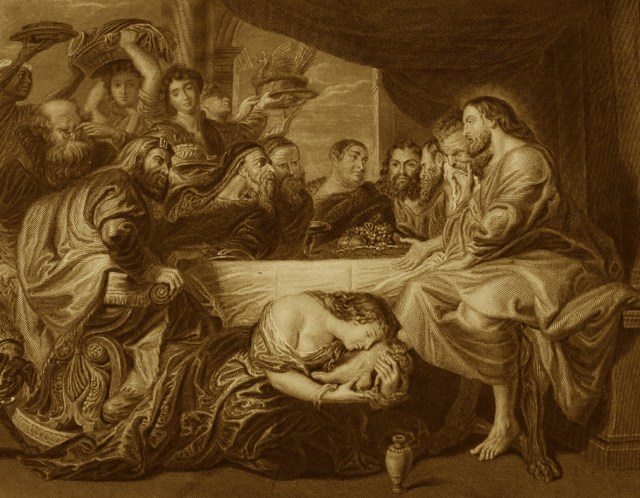
Today, in Mercy, our Gospel places a fundamental question before us.How should the precious oil be used – tenderly poured out or reasonably saved?It is a question that challenges us to balance justice with mercy, reality with hope, law with passion.How are we being asked to open our alabaster jar?
This poem by Malcolm Guite may offer inspiration for our prayer:
Come close with Mary, Martha, Lazarus so close the candles stir with their soft breath and kindle heart and soul to flame within us, lit by these mysteries of life and death. For beauty now begins the final movement in quietness and intimate encounter. The alabaster jar of precious ointment is broken open for the world’s true Lover.
The whole room richly fills to feast the senses with all the yearning such a fragrance brings. The heart is mourning but the spirit dances, here at the very center of all things, here at the meeting place of love and loss, we all foresee, and see beyond the cross.
(Malcolm Guite: The Anointing at Bethany)
Jesus, give us courage to accompany you in your final journey. May your passion, death and resurrection bring us new life.
As we make this Holy Week journey, may we prove our love by our actions.May we live generously, hopefully, and gratefully in the Mercy of God.
Music:Pour My Love on You by Craig and Dean Phillips
In these times that feel so unfamiliar, so surreal, the rites of Holy Week offer us a reassuring pattern for our prayer. As we begin these rituals, we already know where we will joyfully finish. It is a feeling so opposite from our current global concerns which leave us questioning how this nightmare will ever end.
Through the solemnities of Holy Week, we are reminded that there is nothing we experience not already patterned in the Paschal Mystery. There is nothing we suffer or hope for not already etched on the heart of Jesus Christ.
These liturgies are an invitation to enter into that Sacred Heart, to place our experiences beside those of Jesus. No matter where we find ourselves on the journey, Jesus is with us:
In the confusion of Palm Sunday, tossed between loyalty and betrayal
In the suggestive silence of Holy Monday and Tuesday, when plotters whisper and friends weaken
In the discomfort of Spy Wednesday, when we realize suffering is inevitable
In the profound communion of Holy Thursday
In the loneliness of a decisive Garden and the angst of a resisted outcome
In the inexorable solitude of dying and death
In the other-worldly contemplation of a silent Saturday
In the sunrise of a promise, longed for and believed in
Even though we cannot attend services in community, let us not allow this pandemic to isolate us from the blessings of this sacred week. Let’s be intentional about the time and practices we will give to these mysteries.
We are invited into the Life and Passion of Jesus Who, in turn, wants to be with us in our experience of this journey. Each day, let us listen – let us become “obedient” (which means “listening”) – for the very personal whisper of grace in our souls. And even though we may pray alone, let us pray for the whole world suffering and rising with our beloved Savior.
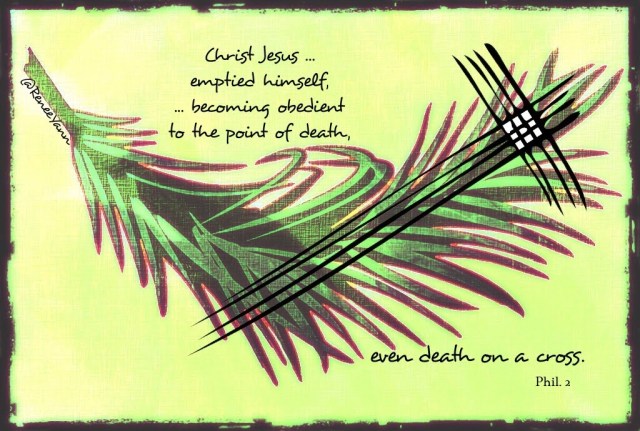
I think today’s reading from Philippians is the most beautiful and pregnant passage in all of scripture. May it guide our prayer during this unique Holy Week when we all so hunger for God’s presence and healing.
Music: Philippians Hymn – John Michael Talbot
(Lyrics below)
And if there be therefore any consolation
And if there be therefore any comfort in his love
And if there be therefore any fellowship in spirit
If any tender mercies and compassion
We will fulfill His joy
And we will be like-minded
We will fulfill His joy
We can dwell in one accord
And nothing will be done
Through striving or vainglory
We will esteem all others better than ourselves
This is the mind of Jesus
This is the mind of Our Lord
And if we follow Him
Then we must be like-minded
In all humility
We will offer up our love
Though in the form of God
He required no reputation
Though in the form of God
He required nothing but to serve
And in the form of God
He required only to be human
And worthy to receive
Required only to give
This is the mind of Jesus
This is the mind of Our Lord
And if we follow Him
Then we must be like-minded
In all humility
We will offer up our love
In all humility
We will offer up our love
Today in Mercy, we encounter the stories of Suzanna and the woman taken in adultery. Both these stories always make me mad. Even though their ultimate lesson is the justice and mercy of God, I can’t help nettling every time I read them.
Here’s why. Still today, in so many instances, women continue to endure the same kind of assault, objectification, suspicion and blame — and still at the hands of judges, clerics, business and political leaders. Just let the newsreels of the past few years run through your mind. You’ll be as angry as I am.
So to save you from a continuing diatribe, I have gone back to a piece I wrote for the Catholic Health Association several years ago. It looks at the themes of this week in Lent. It helps us to break through the stories to their point of redemption, to go through death to life, sin to forgiveness, judgement to mercy, darkness to light.
Reflection for the Fifth Week of Lent
I will keep my covenant with you … to be your God and the God of your descendants after you. ~Genesis 17:7
photo by Chi Pham
The golden June morning had broken bright and warm through the hospital windows. With its breaking, the attending physician and chaplain had received a page. Dorothy had taken an unexpected turn. She was struggling both to live and to die.
As they attended and comforted her, Dorothy managed to whisper ” … wait for Henry.” Henry, her husband of fifty-eight years, had arrived promptly at 7:00 AM daily for all the weeks of Dorothy’s hospitalization. Glancing at her watch, the chaplain saw that it was just 6:50 AM.
When, after ten eternal minutes, Henry appeared at the door, he carried a small bouquet of yellow roses from their beloved garden. Quickly apprehending the changed situation, he laid the roses aside and hurried to hold Dorothy for the last few minutes of her life. In the loving, covenanted presence Dorothy had waited for, she finally embraced a peaceful death.
It had not been easy for Dorothy to die nor, from then on, had it been easy for Henry to live. Still, through many bereavement visits, the chaplain watched their long, honest love arise to heal Henry. Through prayer and the benediction of memories, Henry realized that their love, like the roses still blooming in their garden, was both fragile and perpetual.
In this week’s readings, God again calls us to such a love. As God brought Lazarus, Suzanna and Shadrack out of darkness and death, so God promises to bring us. “I will keep my covenant with you,” God says. “Whoever keeps my word will never die.”
Accompanying Jesus, as he nears Jerusalem, let us trust and cherish these promises in our own darknesses and bereavements. Let us ask God to deliver us from both our sins and our judgements of others.
Today, in Mercy, our first reading from the Ezekiel seems so pertinent to our times:
Thus says the Lord GOD: O my people, I will open your graves and have you rise from them, and bring you back to the land you love…
Indeed, our times do carry a funereal feeing — a sense of loss, confinement, and death. The way one does with sudden death, we ask ourselves what happened! We long to see the light of God’s promise breaking over the stormy horizon.
photo by Yousef Espanioly
Our readings this Fifth Sunday of Lent are about just such transformation. They are about passing through the valley of bereavement to new life.
In this unprecedented time, each one of us and all of us are being called forth from old graves to a new understanding of life… called from a universal blindness to a new light. Our Gospel story of the raising of Lazarus invites us to think about our own tombs, our own darknesses from which the Lord summons us to “Come forth!”
Our rising is not easy, because this deadly blindness is deceptive. It is like someone walking through the Louvre, staring into a mirror. It is the blindness of self-absorption despite a surrounding sea of miracles.
When we exist within such blindness, we are as good as dead. We are Lazarus lost in a tomb. We become buried in all the manifestations of such egotism: greed, denial worry, obsession, anxiety, self-righteousness, regret and their myriad companions.
These are illusions we nurture that the world exists only as we choose to see it; that we are the universal center; that all depends on our preferences; that should we fail, the world ends.
When we operate under these illusions, all life’s energy turns inward where it fizzles in a cyclonic vacuum. The world of “me” is a tomb sealed off from the world of “us”. Ultimately, it is we who bind ourselves in its sepulchral wrappings.
But Jesus calls, “Come out!” He tells us to leave the mirror in the tomb as we walk into the true light. We are called to new life together in Him. We are released now to see the world through God’s eyes.
Having known a deadly darkness, how precious the light of new life was to Lazarus! How profound his appreciation, given a renewed vision!
What would it be like for us to live our lives with this second sight? How might we love people differently, as Lazarus must have newly treasured his sisters? How might the fabricated walls between us disappear within the grace of a second understanding? How might we see creation anew, apprehend time in eternal dimensions, embrace ourselves and others as Divine children?
Caught in our mirrors, we disregard the sacred dust around us, failing to recognize it as the stuff of stars. May we turn toward the brilliant call of Jesus. “Look”, he says. “Look at what I have given you!” May we seek the Lazarus moment in every experience – even the stunning shock of pandemic. May the grace of Jesus’s summons unbind us with resurrected joy!
Music: Lazarus, Come Forth – The Bishops (Lyrics below)
Please see second post today for a poem I like about this story.
Heartbroken, tears falling
Martha found Jesus
She questioned why Lazarus had died.
When she had thus spoken, her doubts were then silenced.
He walked toward the body and cried.
Lazarus, come forth.
Awake like the morning.
Arise with new hope, a new life is born.
Lazarus, come forth.
From death now awaken.
For Jesus has spoken.
Death’s chains have been broken.
Lazarus, come forth.
The tomb now was empty.
Martha stopped crying.
Her brother now stood by her side.
The Pharisee’s wondered about what had happened.
How could one now live who had died?
The reason this story gives hope to so many
Is although we know we must die.
Our bodies won’t stay there
In cold and dark silence.
We’ll hear Jesus cry from on high.
Children come forth
Awake like the morning.
Arise with new hope, a new life is born.
Children come forth.
From death now awaken.
For Jesus has spoken.
Death’s chains have been broken.
Children come forth.
For Jesus has spoken.
Death’s chains have been broken.
My Children come forth.
Children come forth.
Children, come forth.
Today, in Mercy, God sends Moses down to straighten out his “depraved people” because, despite all God’sgoodness to them, they have preferred “the golden calf”.
In the deprivations of this pandemic time, when all of us are doing a lot of soul-searching, we are discovering quite a few golden calves still running around in our times.
One of them jumped out at me last night when I read this headline:
Texas’ lieutenant governor suggests grandparents
are willing to die for US economy
I woke up this morning still appalled by the statement.But upon reflection, I realized that Mr. Patrick may have unwittingly done us a great service if we ruthlessly unpack his cavalier remarks.
How have we gotten to a world where such a statement can be uttered and even approved by some? How can we so blatantly ignore basic moral principles such as the sanctity of every life, and that the ends never justify the means? Well, let’s take a look at Moses’ “depraved” community. They seem to have reached a similar moral deprivation.
I think the key lies with the golden calf.The idol is a symbol of the Israelite community’s economy, what they really deem most important, what they really worship when they think God isn’t looking. When they look upon its golden reflection, they see themselves mirrored back the way they want to be – rich, powerful, and dominant. Lt. Governor Patrick’s statement should make us consider how we have become hypnotized by the same idolatries.
Let’s face it.We live in a culture that has normalized war, capital punishment, abortion, illegal detention, corporate hijacking of natural resources, unchecked pollution, and commercialization of deadly substances like tobacco. Why are we surprised that we’re ready to sacrifice the elderly to preserve the sheen on our “golden calf”?
We have created a world where we welcome information sources that tell us lies just so we can be falsely convinced and dangerously indifferent. It’s really hard to discern a moral path amidst today’s political complexities. So let’s just build that golden calf whose mesmerizing patina permits us to remain morally comatose!
I hope we allow this man’s callous commentary to continue to stab our consciences:
Somebody’s beloved can die
not only so that my beloved can live,
but can also have an undamaged economy.
What “economy”, for God’s sake? Does he mean the one where over 40 million Americans and nearly 800 million worldwide face daily hunger? Or where 80 million Americans have inadequate or no health insurance? Or does he mean the extractive economy which causes two-thirds of the world population to live on less than $10 per day?
I’m pretty sure he means instead the economy of the “ golden calf” where
half of the world’s net wealth belongs to the top 1%
top 10% of adults hold 85%
while the bottom 90% eke out existence onthe remaining 15% of the world’s total wealth
I’m not willing to die to shore up that economy, are you? But I’m sure willing to fight to change it.
So, at least, thanks for inspiring me, Lt. Governor Patrick and God help you!
Music: If There’s a God in Heaven – Elton John – (a song that could reflect how the ancient Israelites struggled with their tortuous journey. (Lyrics below)
Torn from their families
Mothers go hungry
To feed their children
But children go hungry
There’s so many big men
They’re out making millions
When poverty’s profits
Just blame the children
If there’s a God in heaven
What’s he waiting for
If He can’t hear the children
Then he must see the war
But it seems to me
That he leads his lambs
To the slaughter house
And not the promised land
Dying for causes
They don’t understand
We’ve been taking their futures
Right out of their handsThey need the handouts
To hold back the tears
There’s so many crying
But so few that hear
Today, in Mercy, our readings confirm that a life patterned on Christ contradicts worldly definitions.
Deuteronomy gives us stark, either-or, advice:
I have set before you life and death, the blessing and the curse. Choose life, then, that you and your descendants may live, by loving the LORD, your God, heeding his voice, and holding fast to him.
It’s definitive, but we could probably do that, right? Choose life, love God, heed God’s voice, hold fast to God? Sounds OK, doesn’t it?
It’s when Jesus comes along that it sounds difficult.
Jesus tells us, “Here’s how you choose life –
“Whoever wishes to save his life will lose it, but whoever loses his life for my sake will save it.”
Jesus tells us, “Here’s the God you must love, one who
“suffers greatly, is rejected, and is killed.”
Jesus tells us, “Here’s what my voice says to you –
“What profit is there for you to gain the whole world yet lose or forfeit yourself?”
Jesus tells us, “Here’s how you hold fast to me –
‘Take up your cross daily and follow me.”
Some have huge crosses to carry in their lives – perhaps famine, enslavement, untended illness, homelessness, persecution, poverty. Those who carry such crosses are singularly loved by God who dwells with them.
But if we don’t have big, obvious crosses in our lives – if we are among those the world deems fortunate – how do we follow the crucified Jesus to find our way to eternal life?
How do we really CHOOSE LIFE?
We need to get close to the ones God singularly loves. We need to walk beside them and lift some of their heavy crosses. We need to help their voices be heard, their needs be met, their rights be honored.
Not all of us can do this by direct service. But we can do it by our advocacy, our material contributions, and our articulated support for justice.
We need to make these choices for life all the time. But Lent is a great time to examine the vigor and commitment of our choices, a time to take a closer walk with our suffering Christ and ask him to inspire our courage.
Music:Just a Closer Walk with Thee – Patsy Cline and Willie Nelson
Today, in Mercy, Sirach gives us a beautiful eulogy for King David.
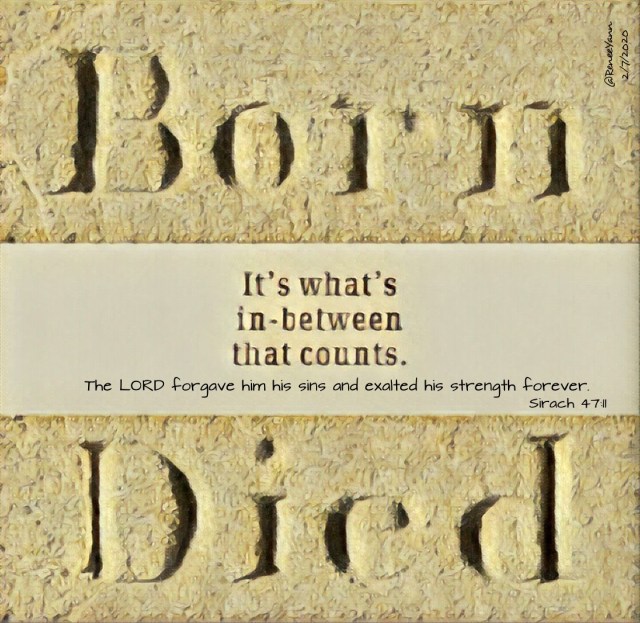
A eulogy sets a particular frame of remembrance around a person’s life. Like Sirach today, that frame tries to capture the positive accomplishments of the person who has died. We set aside any mistakes and negativity. Or we acknowledge them as Sirach has done for David by invoking God’s forgiveness:
The LORD forgave him his sins and exalted his strength forever.
To tell the truth, I’ve attended a few funerals where I wondered what the speaker might come up with in a positive regard. You know, you need more than a sentence or two for a decent eulogy! Despite my wondering, every tribute has provided an enriching lesson on the sacred beauty of a human life.
There are times when I leave such a life celebration thinking, “Gosh, I never realized that about him!” or “Wow, there are so many things we don’t understand about someone’s life!”
If only we could treat every living person with the same honor their eulogies inspire!
In our Gospel, we read the sad and violent story of John the Baptist’s martyrdom. It’s a passage filled with the best and the worst of the human heart. One would wonder what kind of eulogy could have eventually been crafted for the likes of Herod, Herodias, and Salome.
But for John the Baptist, Jesus had given him the perfect epitaph even before John died.
I say to you, among those born of women there is no one greater than John;
In the verse, Jesus also reveals what it takes to earn greatest accolade in God’s eyes:
… yet the one who is least in the kingdom of God is greater than John.
Luke 7:28
When Jesus spoke that verse, John had not yet died. If Jesus said anything about John after his death, the words are not recorded. All we have is this poignant response from Matthew:
Later, John’s disciples came for his body and buried it.
Then they went and told Jesus what had happened.
As soon as Jesus heard the news,
he left in a boat to a remote area to be alone.
But the crowds heard where he was headed
and followed on foot from many towns.
Jesus saw the huge crowd as he stepped from the boat,
and he had compassion on them and healed their sick. Matthew 14: 12-14
As we pray today with the legacies of David and the Baptist, we might consider what we’d want to see engraved on our own tombstones. I’ve told my friends I’d like to see this:
She was kind.
Still working on it!😉
What about you?
Music: Lay Me Down – in this song, two icons of country music, Loretta Lynn and Willie Nelson sing their own kind of eulogy. (Lyrics below)
I raised my head and set myself In the eye of the storm, in the belly of a whale My spirit stood on solid ground I’ll be at peace when they lay me down
When I was a child, I cried Until my needs were satisfied My needs have grown up, pound for pound I’ll be at peace when they lay me down
When they lay me down someday My soul will rise, then fly away This old world will turn around I’ll be at peace when they lay me down
This life isn’t fair, it seems It’s filled with tears and broken dreams There are no tears where I am bound And I’ll be at peace when they lay me down
When they lay me down some day My soul will rise, then fly away This old world will turn around I’ll be at peace when they lay down
When they lay me down some day My soul will rise and fly away This old world will turn around I’ll be at peace when they lay me down
Today, in Mercy, we read one of the saddest lines in Scripture.
You have followed the story in these daily passages. Absalom rebels, designing to usurp his father’s throne. A massive battle rises between them. David, as commander-in-chief, remains behind, but gives instructions to his generals to spare Absalom’s life. Joab ignores the command, killing Absalom in a moment of vulnerability.
David is devastated.
David Mourning Absalom’s Death – Jean Colombe
I think there is no more wrenching human emotion than regret. When I ministered for nearly a decade as hospice chaplain, and later in the emergency room, I saw so much regret.
People who had waited too long to say “I’m sorry”, “I forgive you”, “Let’s start over”, “Thank you for all you did for me”, “I love you”…..
Instead, these people stood at lifeless bedsides saying things like, “I should have”, “I wish…”, “If only…”
Life is complex and sometimes difficult. We get hurt, and we hurt others — sometimes so hurt that we walk away from relationship, or stay but wall ourselves off.
We might think that what is missing in such times is love. But I think it is more likely truth. In times of painful conflict, if we can hear and speak our truth to ourselves and one another, we open the path to healing.
If you want the truth, I’ll tell you the truth.
Listen to the secret sound,
the real sound, which is inside you. ~ Kabir
That healing may demand adjustments, agreements, even a willingness to step apart in mutual respect. But if the changes emerge from shared truth, restoration and wholeness are possible.
David and Absalom never found that path because they were so absorbed in their own self-interests. Theirs was the perfect formula for regret – that fruitless stump that perpetually sticks in the heart.
I remember a trauma surgeon leaving the hospital late one night after an unsuccessful effort to save a young boy who had been shot. The doctor carried the loss so heavily as he walked into the night saying to me, “I’m just going to go home and hug my kids.”
As we pray over David and Absalom today, let us examine our lives for the fractures that are still healable and act on them. Let us “hug” the life we have. Regret is a useless substitute.
When David Heard – Eric Whitaker ( The piece builds. Be patient. Lyrics below)
When David heard that Absalom was slain,
he went up into his chamber over the gate and wept,
and thus he said;
My son, my son,
O Absalom my son,
would God I had died for thee!
When David heard that Absalom was slain,
he went up into his chamber over the gate and wept,
and thus he said;







 Lavish Mercy