Today, in Mercy, we join Mary and the disciples as they deal with Christ’s death. No doubt, the range of emotions among them was as great as it would be among any group or family losing someone they dearly loved.
They had entered, with heart-wrenching drama, into a period of bereavement over the loss of Jesus. Doubt, hope, loss, fear, sadness and remembered joy vied for each of their hearts. They comforted one another and tried to understand each other’s handling of their terrible shared bereavement.
They did just what we all do as families, friends and communities when our beloved dies.
But ultimately, our particular bereavement belongs to us alone, woven from the many experiences we have had with the person who has died. These are personal and indescribable, as is the character of our pain and loss.
Do not be afraid of your bereavement. It is a gift of love.
Holy Saturday, like bereavement, is a time of infrangible silence. No matter how many “whys” we throw heavenward, no answer comes. It is a time to test what Love has meant to us and, even as it seems to leave us, how it will live in us.
As we pray today with the bereaved Mother and disciples, let us fold all our bereavements into their love. We already know the joyful end to the story, so let us pray today with honesty but also with unconquerable hope that we will live and love again.
Today, in God’s Lavish Mercy, we pray with Psalm 81, another call to listen to God’s Word in order to find the fullness of life:
If only my people would hear me, and Israel walk in my ways, I would feed them with the best of wheat, and with honey from the rock I would fill them.
But honestly, isn’t it hard to listen sometimes. Even the psalm suggests that there are such loud, distracting events in our lives that we sometimes can’t hear that Word:
In distress you called, and I rescued you. Unseen, I answered you in thunder; I tested you at the waters of Meribah. Hear, my people, and I will admonish you; O Israel, will you not hear me?
The psalm shows us that God’s deepest Word comes to us in thunder, in storm. It is a truth Jesus embraced on Calvary. It is a truth our lives will sometimes require of us.
This morning my prayer is filled with thoughts of my friend whose young daughter died last week. When even I, who never met Emily, can feel the overwhelming sadness of her untimely death, what unbearable storm must surround her parents! How can they hear the word of faith in the tumult?
Many years ago, I attended an evening event on the other side of my state. During the ceremony, a tornado touched down very nearby. After several frightening hours, I was able to travel back to my hotel, about five miles away.
But the roads were blocked with debris. The streets lights and signs had been blown down. And I was completely unfamiliar with the vicinity. I did eventually make it “home” to the hotel, but it wasn’t the same as I had left it. Part of the roof lay across the street. The window in my room had been fractured and boarded up.
For me, the memory is a parable about suffering. When the storm comes, we may pass through it, but we are not unchanged. Our world is not unchanged.
Jesus was not unchanged by Good Friday and Easter Sunday. By hearing God’s Word in the storm, Jesus was transformed. This is the legacy of faith Christ has given us in the Paschal Mystery. May it strengthen, heal, and transform us this Lent. May it comfort all those who so dearly love Emily.
Poetry: The Man Watching by Rainer Maria Rilke, Translated by Robert Bly
I can tell by the way the trees beat, after so many dull days, on my worried windowpanes that a storm is coming, and I hear the far-off fields say things I can’t bear without a friend, I can’t love without a sister.
The storm, the shifter of shapes, drives on across the woods and across time, and the world looks as if it had no age: the landscape, like a line in the psalm book, is seriousness and weight and eternity.
What we choose to fight is so tiny! What fights with us is so great. If only we would let ourselves be dominated as things do by some immense storm, we would become strong too, and not need names.
When we win it’s with small things, and the triumph itself makes us small. What is extraordinary and eternal does not want to be bent by us. I mean the Angel who appeared to the wrestlers of the Old Testament: when the wrestlers’ sinews grew long like metal strings, he felt them under his fingers like chords of deep music.
Whoever was beaten by this Angel (who often simply declined the fight) went away proud and strengthened and great from that harsh hand, that kneaded him as if to change his shape. Winning does not tempt that man. This is how he grows: by being defeated, decisively, by constantly greater beings.
Today, in God’s Lavish Mercy, we pray with Psalm 116 which Pope John Paul II called “A Prayer of Thanksgiving to the Lord”.
Praying the psalm today, in the context of our other Sunday readings, leads us deeper into the nature of that “thanksgiving” and its relationship to sacrifice.
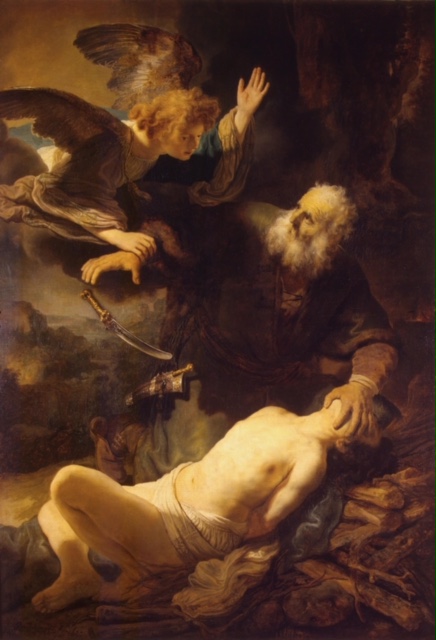
Abraham and Isaac by Rembrandt
In our first reading, we meet Abraham, full of thanks that God reconsidered the command to sacrifice his dear son.
But then our second reading expresses thanks that God was willing to sacrifice his own Son for our sakes.
The Transfiguration by Titian
Finally, our Gospel takes us to the Transfiguration where that Son who will be sacrificed is revealed in his true glory.
What is the thread binding these readings? I think it can be found in this Gospel verse:
This is my beloved Son. Listen to him.
True listening is obedience. The words come from the same root: obedience = listen to,” from ob “to” + audire “listen, hear”.
Abraham listens, no matter how hard, and finally hears God’s real command to love.
Jesus listens to the Will of the Father even through his suffering, and is led to Resurrection.
We, like Peter, James and John, are called to listen to Jesus who will transfigure our perceptions about what life is really calling us to.
In each case, intent “obedience” allows the listener to hear and see beneath circumstances to the deeper Grace beyond appearances. Deep spiritual listening transfigures us!
This is the whole point of the spiritual life. Our lives are so much more than mere circumstances or appearance. Our psalm calls us to believe this even in difficulty:
I believed, even when I said, “I am greatly afflicted.” Precious in the eyes of the LORD is the death of his faithful ones.
Psalm 116:10
When we do this, we are freed to engage our lives at the level of God’s Will which is always for our good, which is always from Love. The long tradition of faith, learned from our forbearers, assures us of this:
O LORD, I am your servant; I am your servant, the child of your faithful ones; you have loosed my bonds. To you will I offer sacrifice of thanksgiving, and I will call upon the name of the LORD.
Psalm 116:16-17
Some of us go through life continually angry, frustrated, or overwhelmed by our challenges. Others, experiencing similar or even greater challenges, reflect a spirit of joy, peace, and gratitude. Why is that? I think today’s readings give us a big clue. Let’s listen to them!
Poetry: Story of Isaac, written and chanted by the bard Leonard Cohen who also wrote the currently popular “Hallelujah “.
Music: Psalm 116: Steve Green
Lyrics
I love the Lord, He heard my voice
He heard my voice. He heard my voice
He heard my cry for mercy
Because He has turned His ear to me
I will call (I will call)
I will call (I will call)
I will call on the Lord for as long as I live

I love the Lord, He heard my voice
He heard my voice. He heard my voice
He heard my cry
I love the Lord, He heard my voice
He heard my voice. He heard my voice
He heard my cry for mercy
He heard my cry for mercy
Today, in God’s Lavish Mercy, we pray with Psalm 138, an ardent thanksgiving for favors received.
Lord, on the day I called for help, you answered me.
Psalm 138:3
Queen Esther by Andrea del Castagno – 15th C.
The psalm today reflects back to our first reading from the Book of Esther. The “favor received” in that story is a monumental one: saving the Jewish people from extinction. This deliverance is commemorated on the Jewish Feast of Purim which, coincidental to our liturgical reading, is celebrated this year on February 25th.
Reflecting on “favors received”, we might be moved to thank God for the blessings in our lives. Some blessings are evident from the get-go. But some come initially wrapped in challenge, worry, even anguish:
Queen Esther, seized with mortal anguish, had recourse to the LORD. She lay prostrate upon the ground, together with her handmaids, from morning until evening, and said: “God of Abraham, God of Isaac, and God of Jacob, blessed are you. Help me, who am alone and have no help but you, for I am taking my life in my hand.
Esther C: 12-16
What is it that changes these darknesses into Light? Psalm 138 offers us this clue:
When I called, you answered me; you built up strength within me. Your right hand saves me. The LORD will complete what he has done for me; your kindness, O LORD, endures forever; forsake not the work of your hands.
Psalm 138: 3,7-8
Certainly a positive outcome to our prayer, like Esther’s, allows us to see a blessing. But what about the times when the outcome disappoints or even devastates us?
The answer has something to do with spiritual “strength”, with a long faith like Esther’s. She puts her hope in the Lord and waits for the answer to unfold even at the risk of her life.
Trusting God like this means that we believe in God’s bigger picture for us and for all that we love.
It means that, by faith, we live partly in the eternal world we cannot yet see.
It means that the quintessential things of our heart and soul exist beyond time, in the unbounded love of God.
It means that we trust God to complete all things in lavish mercy.
The LORD is with me to the end. LORD, your Mercy endures forever. Never forsake the work of your hands!
Psalm 138: 7-8
That kind of faith won’t just pop up when we are in trouble. It has to be ingrained – the very fabric of our lives, knitted there by the prayerful surrender of our daily lives to God’s amazing Grace.
Poetry: Rock of My Salvation BY MORDECAI BEN ISAAC TRANSLATED BY SOLOMON SOLIS-COHEN
Mighty, praised beyond compare,
Rock of my salvation,
Build again my house of prayer,
For Thy habitation!
Offering and libation, shall a ransomed nation
Joyful bring
There, and sing
Psalms of Dedication!

Woe was mine in Egypt-land,
(Tyrant kings enslaved me);
Till Thy mighty, out-stretched Hand
From oppression saved me.
Pharaoh, rash pursuing, vowed my swift undoing—
Soon, his host
That proud boast
’Neath the waves was rueing!

To Thy Holy Hill, the way
Madest Thou clear before me;
With false gods I went astray—
Foes to exile bore me.
Torn from all I cherished, almost had I perished—
Babylon fell,
   Ze-ru-ba-bel
Badest Thou to restore me!

Then the vengeful Haman wrought
Subtly, to betray me;
In his snare himself he caught—
He that plann’d to slay me.
(Hauled from Esther’s palace; hanged on his own gallows!)
Seal and ring
Persia’s king
Gave Thy servant zealous.

When the brave Asmonéans broke
Javan’s chain in sunder,
Through the holy oil, Thy folk
Didst Thou show a wonder—
Ever full remained the vessel unprofanèd;
These eight days,
Lights and praise,
Therefore were ordainèd.

Lord, Thy Holy Arm make bare,
Speed my restoration;
Be my martyr’s blood Thy care—
Judge each guilty nation.
Long is my probation; sore my tribulation—
Bid, from Heaven,
Thy shepherds seven
Haste to my salvation!
Today, in God’s Lavish Mercy, we pray with Psalm 128 which some describe as a blueprint for a happy home.
Happy are they all who fear the Lord, and who follow in the ways of God! You shall eat the fruit of your labor; happiness and prosperity shall be yours. Your wife shall be like a fruitful vine within your house, your children like olive shoots round about your table.
Psalm 128, Canadian Inclusive Psalter
As lovely as it is, this interpretation may be overly simple.
Psalm 128, written in the post-exilic period, is the people’s song of gratitude for the chance to return to their homeland after the Babylonian captivity.
For Israel, the captivity was the result of their faithlessness to their covenant with God. The core sentiment of the psalm is awareness, repentance, and conviction to live life more intentionally – to live in fear of the Lord and thus preserve oneself from future calamity:
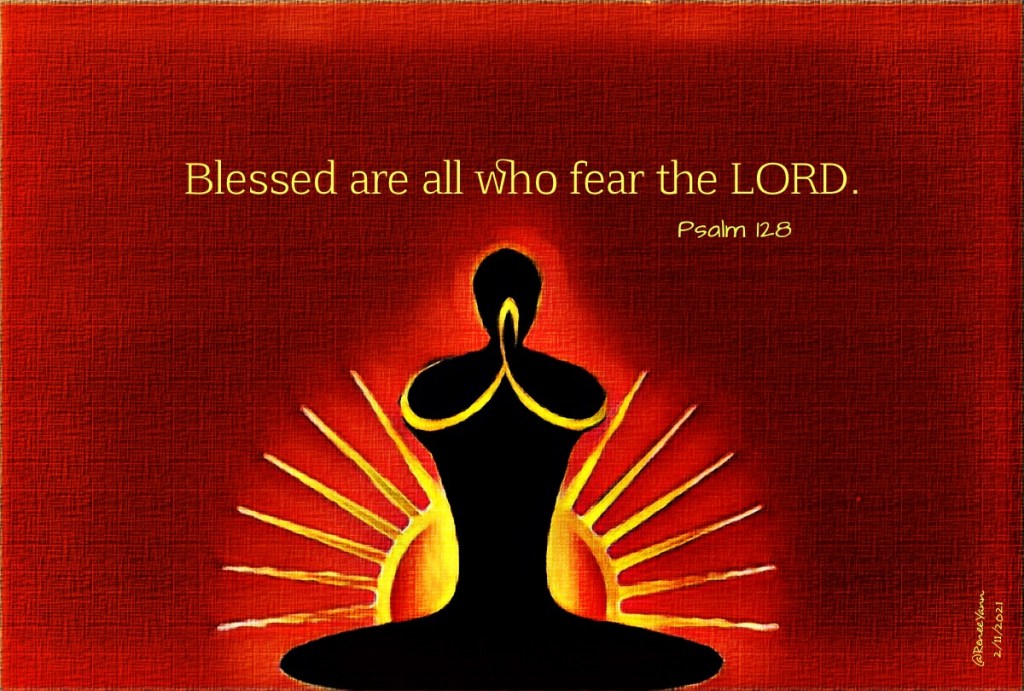
Blessed are you who fear the LORD, who walk in the Lord’s ways!
For us, that word “fear” is a tough one. It seems to contradict our desired relationship with the God who is Love, the God we have met in the person of Jesus Christ. How do we reconcile the contradiction?
Proverbs tells us this:
The fear of the LORD is the beginning of wisdom, and knowledge of the Holy One is understanding.
Proverbs 9:10
So this “fear” is significantly different from the emotion we might feel when, for example, we hear an unfamiliar noise in our darkened house.
Thus the ‘fear of the Lord’ is a relational term signifying the Israelites’ response to God’s grace displayed in salvation (especially the Exodus). As Walter Brueggemann has aptly written, it means: to take God with utmost seriousness as the premise and perspective from which life is to be discerned and lived. That ‘utmost seriousness’ requires attentiveness to some things rather than others, to spend one’s energies in response to this God who has initiated our life.
Mark J. Boda, Professor of Old Testament, McMaster Divinity College
This, in fact, is the rich sentiment underlying Psalm 128, and that will yield the security of an intimate relationship with God
May the LORD bless you from Zion; may you see Jerusalem’s prosperity all the days of your life, and live to see your children’s children. Peace upon Israel!
Psalm 128: 4-5
…as our life unfolds in God’s grace.
The psalmist’s “fear” might be more akin to awe, reverence, glad obedience to our God who loves us and wills our good. It is a virtue rooted in our search for a holy awe and wisdom as our life unfolds in God’s Grace:
Old Testament scholar, Walter Brueggemann, says we live in a technological society that has grossly confused knowledge and wisdom. He says wisdom is the mystery, held by God, about how and why life works…how creation holds together…and how human reason has its limits. Wisdom is God’s secret and even our bold Enlightenment expectations barely lay a finger on that secret. Wisdom involves recognizing limits before the mystery of God. Knowledge has to do with control, says Brueggemann. Wisdom has to do with awe.
William M. Klein, Pastor, Lexington Presbyterian Church
Poem: I Am Bending My Knee Originally from the Carmina Gadelica I, 3. Taken from Esther de Waal, editor, The Celtic Vision (Liguori, MO: Liguori/Triumph, 1988, 2001), p. 7.
I am bending my knee
In the eye of the Father who created me,
In the eye of the Son who purchased me,
In the eye of the Spirit who cleansed me,
In friendship and affection.
Through Thine own Anointed One, O God,
Bestow upon us fullness in our need,
Love towards God,
The affection of God,
The smile of God,
The wisdom of God,
The grace of God,
The fear of God,
And the will of God
To do on the world of the Three,
As angels and saints
Do in heaven;
Each shade and light,
Each day and night,
Each time in kindness,
Give Thou us Thy Spirit.
Music: The Fear of the Lord – First Baptist Dallas (Wow! How about this music ministry!)
Today, in God’s Lavish Mercy, we pray with Psalm 27, a song of intimate relationship with God. The psalmist is suffused with God’s Presence in the way morning light permeates the shadows.
The LORD is my light and my salvation; whom should I fear? The LORD is my life’s refuge; of whom should I be afraid?
Psalm 27:1
Because of this deeply abiding Love, the psalmist fears nothing – not armies, nor any other threat to peace and grace-filled confidence.
Though an army encamp against me, my heart will not fear; Though war be waged upon me, even then will I trust.
Psalm 27:3
We have little, or maybe big, wars at times, don’t we? Armies of pain, or sadness, struggle or confusion standing at the border of our hearts? In such times, Psalm 27 invites to remember and trust:
For God will hide me in the holy abode in the day of trouble; will conceal me in the shelter of God’s tent, will set me high upon a rock.
With the psalmist, we pray with longing – we implore God to show us this comforting, protective love.
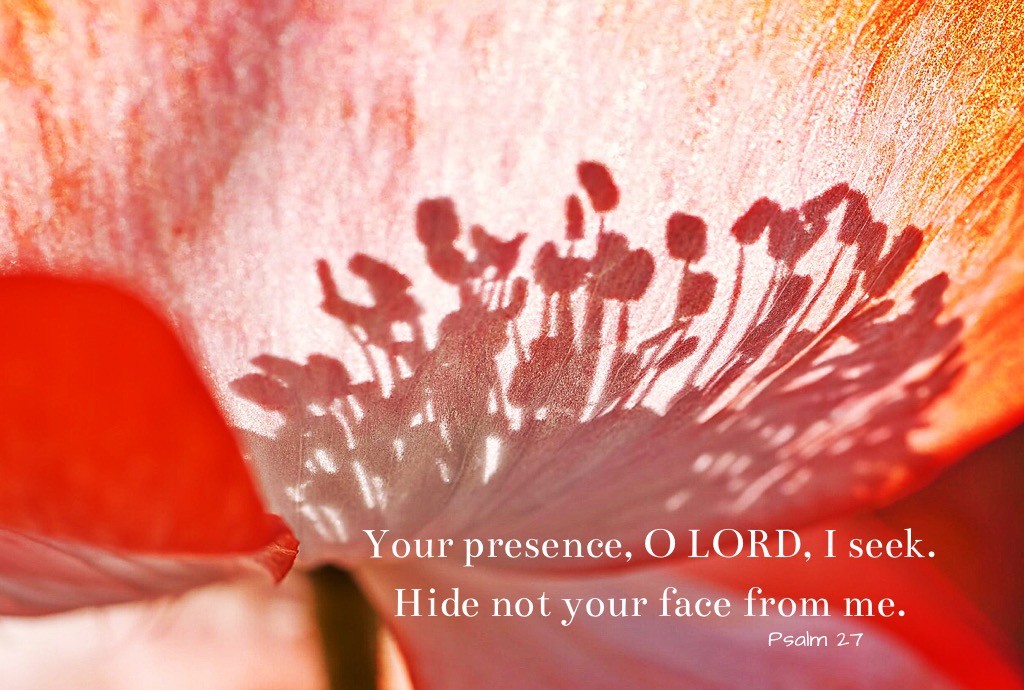
Your presence, O LORD, I seek. Hide not your face from me; do not in anger repel your servant. You are my helper: cast me not off.
Poetry: from The Spiritual Canticle – John of the Cross
Oh, then, soul,
most beautiful among all creatures,
so anxious to know
the dwelling place of your Beloved
so you may go in search of him
and be united with him,
now we are telling you that
you yourself are his dwelling
and his secret inner room and hiding place.
There is reason for you to be elated
and joyful in seeing that all your good and hope
is so close as to be within you,
or better, that you cannot be without him.
Behold, exclaims the Bridegroom,
the kingdom of God is within you.
Music: Unchained Melody – sung by Susan Boyle
Psalm 27 reminds me of this modern classic which, no doubt, was written about a different kind of love. But listening to the song as a prayer, a holy longing can be unchained in our spirits.
Today, in God’s Lavish Mercy, we pray with Psalm 31 which assures us that we can rest in God’s love if we will just hope.
Let your hearts take comfort, all who hope in the Lord.
Psalm 31: 25
Hope can be a complex virtue to understand. The Catholic Catechism describes Hope in this way: Hope is the theological virtue by which we desire the kingdom of heaven and eternal life as our happiness, placing our trust in Christ’s promises and relying not on our own strength, but on the help of the grace of the Holy Spirit. (CCC 1817)
This definition offers an important key. The kind of hope we are praying about in our psalm is a “virtue”, not a feeling. And in particular, hope is one of the three theological virtues which, according to the brilliant Thomas Aquinas means this:
… these virtues are called theological virtues “because they have God for their object, both in so far as by them we are properly directed to Him, and because they are infused into our souls by God alone, as also, finally, because we come to know of them only by Divine revelation in the Sacred Scriptures”.
Now, you know, Thomas wasn’t probably that fun to talk with, given all that theological Latin. But, wow, he nailed this one.
What I think he meant, in other words, is that we are not talking about the feeling of hope, as when we put a soufflé in the oven and hope it doesn’t collapse. Or when we study like crazy and hope the right questions are on the exam. Or even when, more importantly, we make a life choice like marriage or religious life and hope it will bring us a fulfilling, lasting joy.
These kinds of “hopes” might be better defined as optimistic expectations. If they fail to be fulfilled, we might give up on them, perhaps even stop trying to achieve the kind of joy they promised. (That’s a whole other reflection! 🙂 )
Instead, the Hope we are praying about today is not a feeling. It is a gift, given by God and nurtured by our faithful practice of scriptural prayer.
Just like “Life” which is breathed into us by God without any cooperation of our own, the virtue of Hope – along with Faith and Love – is infused into our souls in God’s loving act of creation.
And just like the principle of life, Faith, Hope, and Love reside in us forever.
These theological realities can be hard to grasp. To make it easier, I turn them into images for my prayer. I picture Faith, Hope and Love as three small but inextinguishable candle flames deep in my spirit. God is the One who fires their light and warmth.
The circumstances of my life, chosen or imposed, can affect my ability to see and feel the power of these gifts. But circumstances cannot extinguish them because they belong to God not to me.
Once I said in my anguish, “I am cut off from your sight”; Yet you heard the sound of my pleading when I cried out to you.
Psalm 31: 23
By prayer, and the faithful effort to be open to God’s Presence in my life, these virtues deepen in me. I can rest assured in their divine constancy. Their power and energy fuel my life both in the favorable and unfavorable “winds” of my circumstances.
Love the LORD, all you his faithful ones! The LORD keeps those who are constant, but more than requites those who act proudly.
Psalm 31: 24
I found this tender transliteration of Psalm 31 by Christine Robison helpful for my prayer:
I have come to you, O God, please, take me in.
Hear my prayers, be my rock, my stronghold, my castle.
Help me untangle myself from the web of confusions
and self-deceptions that I’m stuck in.

I put my trust in you—I give you my life.
I have turned
from the temptation to trust the ten thousand things.
I have turned
from the temptation to despair of your love and help.

I have learned
to see you in my sorrows and afflictions
A lot of my life went by before I managed this,
which makes me sad.

Now, I practice trust and open-hearted acceptance
of my life as it is.
Now I practice trust and open-hearted acceptance
of You as You are.
Poetry: Hope – Lisel Mueller
It hovers in dark corners
before the lights are turned on,
it shakes sleep from its eyes
and drops from mushroom gills,
it explodes in the starry heads
of dandelions turned sages,
it sticks to the wings of green angels
that sail from the tops of maples.

It sprouts in each occluded eye
of the many-eyed potato,
it lives in each earthworm segment
surviving cruelty,
it is the motion that runs
from the eyes to the tail of a dog,
it is the mouth that inflates the lungs
of the child that has just been born.

It is the singular gift
we cannot destroy in ourselves,
the argument that refutes death,
the genius that invents the future,
all we know of God.
It is the serum which makes us swear
not to betray one another;
it is in this poem, trying to speak.
Today, in God’s Lavish Mercy, we pray with Psalm 111, a song of reassurance and hope.
God, renowned for grace and mercy, Who gives to those living in awe, will forever be mindful of the covenant once promised.
Psalm 111: 4-5
It is a wonderful thing when we can trust someone to remember a promise made to us. Psalm 111 tells us we can trust God like that.
Maybe some of you share this experience. When I was a little girl, my Dad often did the food shopping. Sometimes, he went to the new “big store” (supermarkets were the new thing in the early ‘50s). When he did, I always asked him to remember to bring me a surprise, and he never forgot.
Usually the surprise would be a little bag of M&Ms or Hershey kisses. But once it was a carrot- remarkably like the carrots he bought for the week’s cooking!
Had Dad forgotten his promise, or was he just in to a healthier form of surprise?😂😉
Sometimes it feels like that with God’s Promise. Its fulfillment doesn’t always come to us in the ways we expect or pray for. Instead of special, surprising sweetness, God’s signs feel like carrots … ordinary carrots that we see every day, that we mix into the soup of our daily unsurprising lives.
Our Alleluia Verse today is a good prayer when our life seems full of “carrots”:
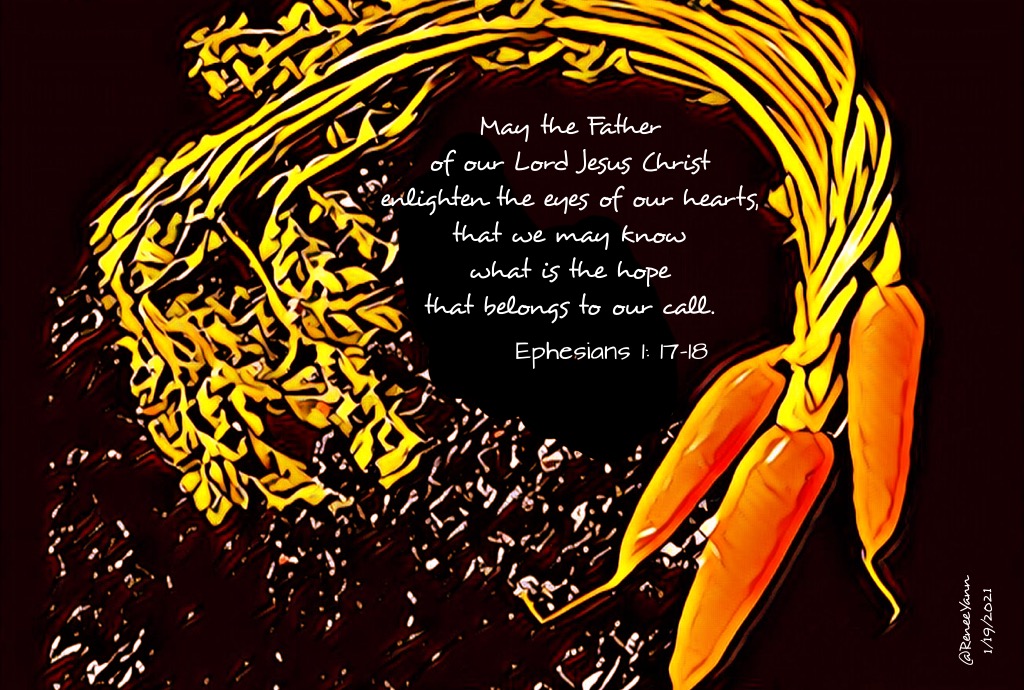
May the Father of our Lord Jesus Christ enlighten the eyes of our hearts, that we may know what is the hope that belongs to our call.
Ephesians 1: 17-18
May our eyes be enlightened to see God’s Promise fulfilled in the amazing blessings of our lives:
I will give thanks to the LORD with all my heart in the company and assembly of the just. Great are the works of the LORD, exquisite in all their delights.
Psalm 111: 1-2
My Dad loved me with all his heart and would have given me anything good that was in his power to give.
We can be assured, as in Psalm 111, that all- powerful God is like that too. It’s just that sometimes those good things look like ordinary carrots and we need enlightened eyes to recognize their exquisiteness.
Poetry: Mindful – Mary Oliver
Everyday
I see or hear
something
that more or less

kills me
with delight,
that leaves me
like a needle

in the haystack
of light.
It was what I was born for —
to look, to listen,

to lose myself
inside this soft world —
to instruct myself
over and over

in joy,
and acclamation.
Nor am I talking
about the exceptional,

the fearful, the dreadful,
the very extravagant —
but of the ordinary,
the common, the very drab,

the daily presentations.
Oh, good scholar,
I say to myself,
how can you help

but grow wise
with such teachings
as these —
the untrimmable light

of the world,
the ocean’s shine,
the prayers that are made
out of grass?
Music: Blessed Assurance
Blessed assurance, Jesus is mine!
Oh, what a foretaste of glory divine!
Heir of salvation, purchase of God,
Born of His Spirit, washed in His blood
Chorus:
This is my story, this is my song,
Praising my Savior all the day long;
This is my story, this is my song,
Praising my Savior all the day long.
Perfect submission, perfect delight,
Visions of rapture now burst on my sight;
Angels, descending, bring from above
Echoes of mercy, whispers of love.
Perfect submission, all is at rest,
I in my Savior am happy and blest,
Watching and waiting, looking above,
Filled with His goodness, lost in His love.
Today, in God’s Lavish Mercy, we pray with Psalm 105 celebrating God’s covenanted faithfulness to us.
Give thanks to the LORD, invoke God’s name; make known among the nations God’s deeds. Sing, sing God’s praise, proclaim all God’s wondrous deeds. (because…) The Lord remembers the covenant for ever.
Psalm 105: 1-2, 8
We certainly can spend some time in prayer today remembering God’s faithfulness to us personally. A grateful review of our life journey can always offer new insights into God’s love and generosity.
But more specifically, our psalm calls us to plumb the two readings which it connects.
Hebrews reminds us that God’s love is so extreme that God took Flesh in Jesus to teach us, in terms we could understand, the degree of God’s love.
In Mark, we see the early expression of that love, as Jesus reveals his healing power to the wretchedly suffering crowds.
In these readings, we learn that God’s promise endures to each generation:
God remembers the covenant forever which was made binding for a thousand generations– Which was entered into with Abraham and by God’s oath to Isaac.
Psalm 105: 8
In Chronos Time, this enduring covenant was enfleshed in Jesus. It continues in Kairos Time through each person’s Baptism into Christ through the Holy Spirit.
In other words, we are the agents of God’s covenant with the world. Our lives must enflesh God’s Mercy for our times.
In his letter to Titus, Paul puts this clearly:
But when the kindness and love of God our Savior appeared, we were saved not because of righteous things we had done, but because of God’s mercy. God saved us through the washing of rebirth and renewal by the Holy Spirit, poured out on us generously through Jesus Christ our Savior, so that, having been justified by God’s grace, we might become heirs having the hope of eternal life.
Titus 3: 4-7
May the message of these readings free us, inspire us, and impel us to a grace-filled response.
Poetry: Grace by Jill Peláez Baumgartner
Is it the transparency
and lift of air?
Is it release
as when the pebble
flings out of the slingshot
or the tethered dog
suddenly is without lead?

Or is it more like standing
on a dark beach
at midnight,
the surf loud
with its own revolution,
the horizon invisible,
the entire world the threat
of rushing water?

No one who swims
at night in the ocean
feels weightless
embracing armfuls of water
against the ballast
of the waves’ fight.

Swimming:
toward the shore lights
or out into the vast bed
of the sea's white fires?
Music: Confitemini Domino – Psalm 105 – Orlando di Lasso (first published in 1562)
Today, in God’s Lavish Mercy, we pray with Psalm 8, a brief, beautiful, and highly personal hymn to an awesome Creator.
Charles Spurgeon, celebrated 19th century Baptist preacher, calls this psalm “the song of the Astronomer”, as gazing at the heavens inspires the psalmist to meditate on God’s creation and the human person’s place in it.
The core of Psalm 8 asks a question: What are we that you are mindful of us, we humans that you care for us?
Psalm 8:5-6
Indeed, what are we, who are we? It is a question which each of us spends a lifetime answering.
If you were asked to introduce yourself to a total stranger, how would you begin?
With your name, expressing your unique identity?
Any group to which you belong?
Or where you’re from?
What you life work is?
Where you fit in society, to whom you are related?
How you have been defined by your accomplishments?
For example, might the self-introduction sound something like this:
Any similarity to persons living or dead is purely unintentional 🙂
Hi, I’m Mary Smith. I’m a dentist, born and raised in Schenectady. I wrote the book, “How Gumdrops Ruin Kid’s Teeth”. You may have heard of my great-grandfather and his brother, the cough drop magnates.
Psalm 8 suggests a whole other way of self-definition:
Hi, I’m Mary, a child of God, part of an infinite universe that spills from God’s creative love.
I am in awe of our Creator who loves and cares for me, who has ennobled me in grace. I try to let all my actions give God praise.
I take seriously my role in cherishing all Creation. As I do this, my own divinely-given nature is revealed and made available to God for the transformation of the world.
I will sing of your majesty above the heavens When I see your heavens, the work of your fingers, the moon and stars that you set in place. What are we that you are mindful of us, that you care for us? Yet you have made us little less than angels crowned us with glory and honor. You have given us rule over the works of your hands, put all things at our feet: O LORD, our Lord, how awesome is your name through all the earth!
Poetry (well really prose): from Hamlet by William Shakespeare
Shakespeare uses Psalm 8 as his reference point for Hamlet’s monologue. Hamlet is saying that although humans may appear to think and act “nobly” they are essentially “dust”. Hamlet is expressing his melancholy to his old friends over the difference between the best that men aspire to be, and how they actually behave; the great divide that depresses him. (Spark Notes)
I offer the passage to say that Hamlet has become disillusioned, lost his awareness of his own awesome identity in God. Don’t be like Hamlet.
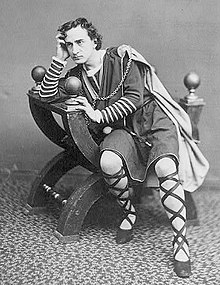
Hamlet, played by Edwin Booth – c.1870 (source: wikipedia)
I have of late—but wherefore I know not—lost all my mirth,
forgone all custom of exercises,
and indeed it goes so heavily with my disposition
that this goodly frame, the earth, seems to me a sterile promontory;
this most excellent canopy, the air—look you,
this brave o'erhanging firmament,
this majestical roof fretted with golden fire—
why, it appears no other thing to me
than a foul and pestilent congregation of vapors.
What a piece of work is a man!
How noble in reason, how infinite in faculty!
In form and moving how express and admirable!
In action how like an angel,
in apprehension how like a god!
The beauty of the world.
The paragon of animals.
And yet, to me, what is this quintessence of dust?
Man delights not me.
No, nor woman neither,
though by your smiling you seem to say so.
Music: Domine, Deus Noster (Psalm 8) by Marc-Antoine Charpentier














 Lavish Mercy