Psalm 33: Fashioned by God

Wednesday of the Twenty-second Week in Ordinary Time

Wednesday, September 2, 2020


Today, in God’s Lavish Mercy, we pray again with Psalm 33, this time with one different verse from a few days ago:

From heaven’s fixed throne God beholds
all who dwell on the earth,
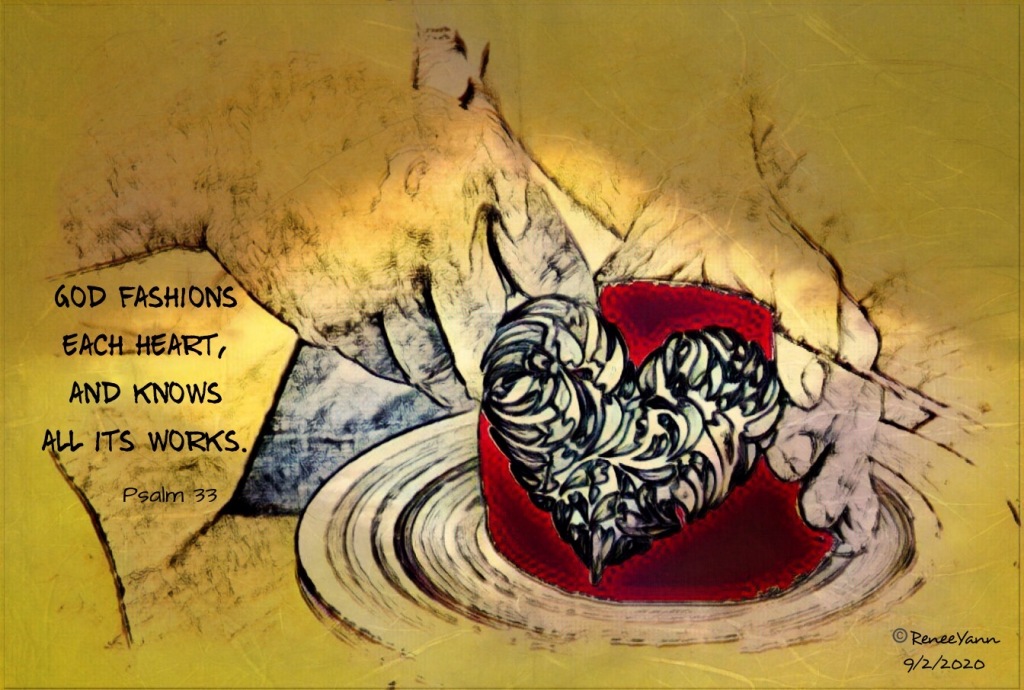
God Who fashions each heart
and knows all its works.

Think of that: God fashions each heart.

The phrase has special meaning for me today because, yesterday, we welcomed a precious new baby girl into our family.

I look at her newborn innocence and realize that she is the freshest, most hopeful breath of God, still so wrapped in the heavenly air from Whom we all receive life.


We all received that Breath once and it lives eternally within us. Every one of us has received a heart fashioned in God’s own image.

Sometimes that reality is hard to believe about ourselves and others, as it seems to have been for the Corinthians in today’s first reading. Sometimes we make a real mess of the gift we have been given!

Nevertheless, the gift is true and remains true despite our worst efforts!😉


Reflecting on today’s Gospel, there may be “various diseases” and dysfunctions that we wish to bring to the healing hands of Jesus today – for ourselves and for our world. We ask God to restore our innocence and hope throughout our lives and world.

In order to remember and live within the sacred truth that God breathed us into being, we might repeat today’s psalm refrain throughout our day:

Blessed are we, chosen to be God’s own.


Poetry: Two poems today to bless our dear new child Claire:

Songs of Innocence - William Blake
Little Lamb who made thee
Dost thou know who made thee
Gave thee life & bid thee feed.
By the stream & o’er the mead;
Gave thee clothing of delight,
Softest clothing wooly bright;
Gave thee such a tender voice,
Making all the vales rejoice!
Little Lamb who made thee?
Dost thou know who made thee?

Little Lamb, I’ll tell thee; 
Little Lamb, I’ll tell thee:
He is called by thy name, 
For He calls Himself a Lamb 
He is meek, and He is mild, 
He became a little child.
I a child, and thou a lamb, 
We are called by His name. 
Little Lamb, God bless thee! 
Little Lamb, God bless thee!


Christina Rossetti - Holy Innocents
Sleep, little baby, sleep;
The holy Angels love thee,
And guard thy bed, and keep
A blessed watch above thee.
No spirit can come near
Nor evil beast to harm thee:
Sleep, sweet, devoid of fear
Where nothing need alarm thee.
The love which doth not sleep,
The eternal Arms around thee:
The shepherd of the sheep
In perfect love hath found thee.
Sleep through the holy night,
Christ-kept from snare and sorrow,
Until thou wake to light
And love and warmth to-morrow.

Music: Innocence – Roberto Cacciapaglia

Psalm 113: Awesome!

Wednesday of the Nineteenth Week in Ordinary Time

August 12, 2020

Today, in God’s Lavish Mercy, we pray with Psalm 113, a magnificent hymn praising God in the heavens. 

The psalm is commonly used at Vespers, the evening prayer of the Church – and no wonder. How often in the evening do we look to the glorious skies, emblazoned with the setting sun, and turn our minds to God!

Who is like the LORD, our God, who is enthroned on high,
and looks upon the heavens and the earth below?


It is in contemplating the sky’s immensity that we begin to appreciate the Divine Infinity.


Last night, I FaceTimed with my niece and her toddler boy, a joy she frequently offers me. During the call, my grandnephew carried his little tablet to the window, opened his “SkyView” app, and began exploring the heavens. Even the youngest “pueri” (Latin for “boys, children, servants”) spontaneously offer our Vespers in answer to God’s Beauty!


As we pray this psalm, at whatever time of day, we can let ourselves rest in silent awe, aware of God’s majesty – that Majesty which deigns to create, love and eternally sustain each one of us beloved “pueri”.


Poetry: Stars by Majorie Pickthall

Photo by Ruvim on Pexels.com
Now in the West the slender moon lies low, 
And now Orion glimmers through the trees, 
Clearing the earth with even pace and slow, 
And now the stately-moving Pleiades, 
In that soft infinite darkness overhead 
Hang jewel-wise upon a silver thread. 
And all the lonelier stars that have their place, 
Calm lamps within the distant southern sky, 
And planet-dust upon the edge of space, 
Look down upon the fretful world, and I 
Look up to outer vastness unafraid 
And see the stars which sang when earth was made. 

Music: Laudate Pueri – Claudio Monteverdi

Laudate, pueri, Dominum; 
laudate nomen Domini.
Sit nomen Domini benedictum 
ex hoc nunc et usque in saeculum.
A solis ortu usque ad occasum 
laudabile nomen Domini.
Excelsus super omnes gentes Dominus, 
et super caelos gloria ejus.
Quis sicut Dominus Deus noster, 
qui in altis habitat, 
et humilia respicit in caelo et in terra?
Suscitans a terra inopem, 
et de stercore erigens pauperem:
ut collocet eum cum principibus, 
cum principibus populi sui.
Qui habitare facit sterilem in domo, 
matrem filiorum laetantem.

Psalm 36: Whew!

Thursday of the Sixteenth Week in Ordinary Time

July 23, 2020

From 2016:
Today, in Mercy, we pray to be childlike. As life seasons us, it also sometimes hardens us with an impermeability that prevents continued spiritual growth. We pray for the gifts of trust, hope and faith to return our hearts to the openness of a child that we may respond joyfully to the Holy Spirit.


Today, in God’s Lavish Mercy, we pray with Psalm 36, a praise hymn of David after a frightening encounter with an enemy.

I could have used this psalm last week. Someone immensely dear to me was hospitalized with suspicion of Covid 19. The fear, for him and for all who love him, was pretty overwhelming.

I did manage a prayer of abandonment before the negative diagnosis was returned about 36 hours later. But I’m rather sure that, like most of my attempts at abandonment, it was somewhat half-hearted. I really wanted my own will and hoped God’s Will was in alignment. Blessedly, it was.

But I would like to deepen in true trust and abandonment to God’s care for me and for all of us.


Psalm 36 gives us a chance to examine David’s prayer of abandonment, which drawing on a long history of God’s wisdom and favor, deeply trusts himself to God.

In our prayer today, we might recall God’s faithful care throughout our lives and release into God’s hands any worries we carry. Let us simply receive that infinite, refreshing fountain of grace pouring over all Creation.

Fountain of Life stained glass window at the Church of St. Maria del Mar in Barcelona,  copyright José Luíz Bernardes Ribeiro, https://creativecommons.org/licenses/by-sa/3.0/

Poetry:  Fountains in the sea by Marin Sorescu, translated by Seamus Heaney

Sorescu was a Romanian poet and playwright and one of the most popular figures to emerge from Romanian literary culture since the 1960s. He died in 1996, the year he was nominated for the Nobel Prize in Literature

Seamus Heaney, who died in 2013, was an Irish poet, playwright and translator. He received the 1995 Nobel Prize in Literature.

Fountains in the sea

Water: no matter how much, there is still not enough.
Cunning life keeps asking for more and then a drop more.
Our ankles are weighted with lead, we delve under the wave.
We bend to our spades, we survive the force of the gusher.

Our bodies fountain with sweat in the deeps of the sea,
Our forehead aches and holds like a sunken prow.
We are out of breath, divining the heart of the geyser,
Constellations are bobbing like corks above on the swell.

Earth is a waterwheel, the buckets go up and go down,
But to keep the whole aqueous architecture standing its ground
We must make a ring with our bodies and dance out a round
On the dreamt eye of water, the dreamt eye of water, the dreamt eye of water.

Water: no matter how much, there is still not enough.
Come rain, come thunder, come deluged dams washed away,
Our thirst is unquenchable. A cloud in the water’s a siren.
We become two shades, deliquescent, drowning in song.

My love, under the tall sky of hope
Our love and our love alone
Keeps dowsing for water.
Sinking the well of each other, digging together.
Each one the other’s phantom limb in the sea.

Music: Your Love, Oh Lord – Third Day

Psalm 102: God’s Time

Thursday of the Fifteenth Week in Ordinary Time

July 16, 2020

From 2018: Feast of Our Lady of Mount Carmel

Today, in God’s Lavish Mercy, we pray with Psalm 102, one of the seven penitential psalms. It is introduced as “the prayer of the afflicted”.

Yet, I find our verses today full of hope. They look with confidence to a better future.

You, O LORD, abide forever,
and your name through all generations.
You will arise and have mercy on Zion,
for it is time to pity her.

That last line, “for it is time to pity her”, is particularly touching as the psalmist nudges God to move forward with healing. Don’t we  pray like that sometimes?

  • Dear God, I’ve had all I can take! Please fix this — now!
  • Lord, I’ve learned my lesson. Please relent and rescue me.
  • Jesus, please let this trial be over and let us survive.
  • Lord, it is time for this to be over!

The bedrock of this prayer is the psalmist’s deep trust that God will act as God has promised:

The nations shall revere your name, O LORD,
and all the kings of the earth your glory,
When the LORD has rebuilt Zion
and appeared in his glory;
When he has regarded the prayer of the destitute,
and not despised their prayer.


You may find your heart filled with a prayer like this today. Surely, our whole human community voices a longing for the pandemic sufferings to be over. Or there may be other afflictions you carry that are testing the limits of your endurance.

Psalm 94 holds out encouragement and hope. Reach for it and let it strengthen you.

But you are forever the same, Lord, 
without beginning or end, 
infinite in your compassion, 
fathomless in your love. 
You rebuild the desolate city; 
you bring the exiles back home. 
You grant the poor your abundance; 
you guide the nations toward peace.
You hear the cry of the destitute 
and the sobbing of the oppressed. 
You soothe the pain of the captive; 
you set the prisoner free. 
Come to me too in your mercy 
and set my soul at peace.
from A Book of Psalms by Stephen Mitchell

Poetry: from Burnt Norton – T.S. Eliot

Time present and time past
Are both perhaps present in time future, 
And time future contained in time past.
If all time is eternally present
All time is unredeemable.
What might have been is an abstraction 
Remaining a perpetual possibility
Only in a world of speculation.
What might have been and what has been 
Point to one end, which is always present. 
Footfalls echo in the memory
Down the passage which we did not take 
Towards the door we never opened
Into the rose-garden. 
My words echo 
Thus, in your mind.

Music: On Time God – Deborah Kline Iantorno

Psalm 145: Through the Generations

Monday of the Fourteenth Week in Ordinary Time

July 6, 2020

Today, in God’s Lavish Mercy, we again pray with Psalm 145 – different verses. The great tenderness in today’s other readings is reflected in the choice of these particular psalm lines.

Our first reading is God’s tender love song to Israel spoken through the prophet Hosea. Our Gospel recounts several acts of tenderness as Jesus ministers to the suffering people he meets.


Psalm 145 reminds us that if we look back over our lives, and even farther back over our ancestors’ lives, we too will discover God’s continual love and mercy to us.

Generation after generation praises your works
and proclaims your might.
They speak of the splendor of your glorious majesty
and tell of your wondrous works.


Many ancestral blessings have been passed on to us – in skills, attitudes, physical strengths – but most importantly, in faith. We probably believe because someone before us taught us how.

There is no greater gift we can give to our children, and to all our beloveds, than to encourage their faith. Let’s take that to heart today as we pray. And let’s thank God for our own story and heritage of faith we have been given.


Poetry: Faith is the Pierless Bridge by Emily Dickinson, who appeared as more a dismissive critic of faith than a proponent. Yet, like many of us who bother to talk about a particular topic, she proved it to be more important to her than she professed.

Faith — is the Pierless Bridge
Supporting what We see
Unto the Scene that We do not —
Too slender for the eye
It bears the Soul as bold
As it were rocked in Steel
With Arms of Steel at either side —
It joins — behind the Veil
To what, could We presume
The Bridge would cease to be
To Our far, vacillating Feet
A first Necessity.

Music: In Every Age – Janèt Sullivan Whitaker

Psalm 60: Punch Drunk with Troubles

Monday of the Twelfth Week in Ordinary Time

June 22, 2020


It has been suggested that I make it easier to find previous reflections on the readings for the day, just in case you would like to pray with the First Reading or Gospel. I’ll try to remember to do that.


Today, in God’s Lavish Mercy, we pray with Psalm 60, and it’s a doozy. It is a hard Psalm to pray with because it contains many layers of meaning. But, in the end, I think it is worth the effort.

The Psalm emerges from a time filled with violence. David struggles to keep control both within and outside his kingdom. His own son and nephew turn against him. His nephew wreaks unspeakable mayhem in Israel’s name. Everything in David’s world is in violent disarray. He actually whines to God about the mess:

  • O God, you have rejected us and broken our defenses …
  • You have rocked the country and split it open …
  • You have made your people feel hardships …
  • You have given us stupefying wine…

Like many of you, I read these verses in the wake of another divisive political rally, in a country riven by fearful hatred, racism, biased brutality, political corruption, and poisonous propaganda. I am so tempted to immediately tie Psalm 60 to these current realities.

But I think that, when we pray the psalms, we must let them first teach us about ourselves. Once that conversion or enlightenment occurs, it may then be possible to apply their wisdom to our world.


King David by Matthias Stom

What is it that makes Psalm 60 a prayer and not a political manifesto? We find the answer in verse 7:

Help us with your right hand, O Lord, and answer us.

David realizes that he is completely out of whack. He has just put all the responsibility for his chaos in God’s lap when it is really David’s own self-serving choices that have caused the problem. 

David’s selfish, short-sighted, and sinful decisions have blinded him like “stupefying wine”. One might say he has drunk his own kool-aid. He needs God’s justice to detoxify him … that divine “right hand” which created a perfectly balanced world.

Each of David’s previously mentioned “whines” is completed with a sincere and contrite plea:

  • rally us!
  • repair the cracks in the country
  • give us aid against the foe

Once we realize, like David:

  • that the “country” is our own heart,
  • that the “foe” is any residue there of injustice, 
  • and that the “rally” must be of our own merciful love,

… only then might we be ready to pray for our fractured country and our broken, weeping world.


Poetry: Manifesto: The Mad Farmer Liberation Front – Wendell Berry’s inspired poem about conversion and recovery of the soul in a soul-killing culture.

Love the quick profit, the annual raise,
vacation with pay. Want more 
of everything ready-made. Be afraid 
to know your neighbors and to die.

And you will have a window in your head. 
Not even your future will be a mystery 
any more. Your mind will be punched in a card 
and shut away in a little drawer.
 
When they want you to buy something 
they will call you. When they want you 
to die for profit they will let you know. 
So, friends, every day do something 
that won't compute. Love the Lord. 
Love the world. Work for nothing. 
Take all that you have and be poor. 
Love someone who does not deserve it.

Denounce the government and embrace 
the flag. Hope to live in that free 
republic for which it stands. 
Give your approval to all you cannot
understand. Praise ignorance, for what man 
has not encountered he has not destroyed.

Ask the questions that have no answers. 
Invest in the millenium. Plant sequoias. 
Say that your main crop is the forest 
that you did not plant, 
that you will not live to harvest.

Say that the leaves are harvested 
when they have rotted into the mold.
Call that profit. Prophesy such returns. 
Put your faith in the two inches of humus 
that will build under the trees 
every thousand years.

Listen to carrion — put your ear 
close, and hear the faint chattering 
of the songs that are to come. 
Expect the end of the world. Laugh. 
Laughter is immeasurable. Be joyful 
though you have considered all the facts. 
So long as women do not go cheap 
for power, please women more than men.

Ask yourself: Will this satisfy 
a woman satisfied to bear a child? 
Will this disturb the sleep 
of a woman near to giving birth? 

Go with your love to the fields. 
Lie down in the shade. Rest your head 
in her lap. Swear allegiance 
to what is nighest your thoughts.

As soon as the generals and the politicos 
can predict the motions of your mind, 
lose it. Leave it as a sign 
to mark the false trail, the way 
you didn't go.

Be like the fox 
who makes more tracks than necessary, 
some in the wrong direction. 
Practice resurrection.

Music: Be Still My Soul – Exultate Singers

Psalm 16: A Night Prayer

Memorial of Saint Anthony of Padua, Priest and Doctor of the Church

Saturday, June 13, 2020

Click here for readings

psalm16 path2

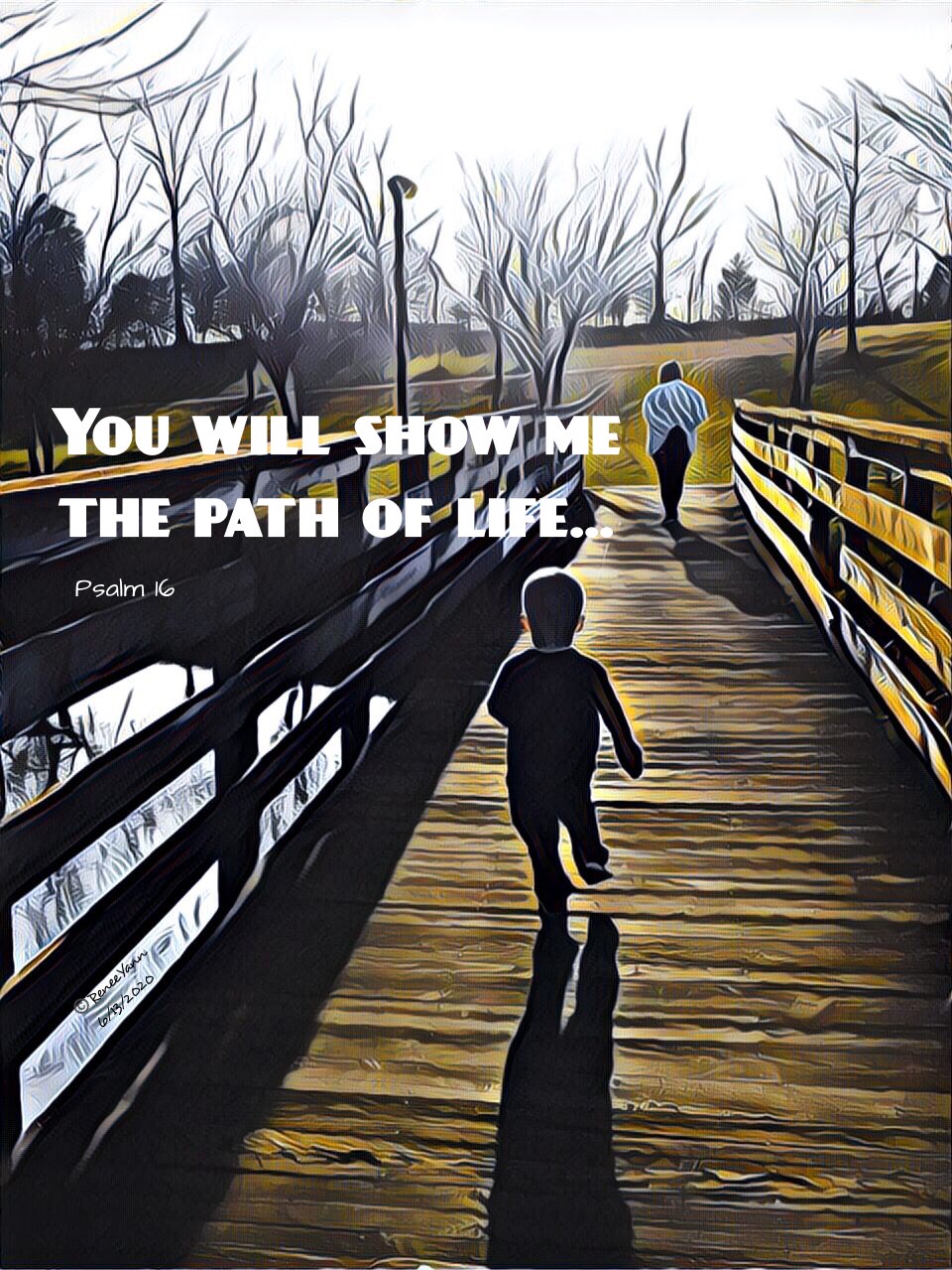
Today, in God’s Lavish Mercy, we pray once again with Psalm 16. Verses 1-10 strike me as a perfect “nighttime” prayer.

In his musical Phantom of the Opera, Andrew Lloyd Weber lyricizes about the “beauty of the night”.  

It’s a soulful song, and in itself could be used for prayer, especially when we pray in times of spiritual darkness or unknowing. In many ways, it reminds me of John of the Cross’s poem, “The Dark Night”. (Verses below for our poetry today).


All of us have times when our prayer seems to echo back to us without a response from God. Our faith may be tested and our trust stretched very thin. God seems so distant that we wonder what happened to cloud the relationship! We linger in a spiritual darkness that is dry and disconcerting.

Dali John of Cross
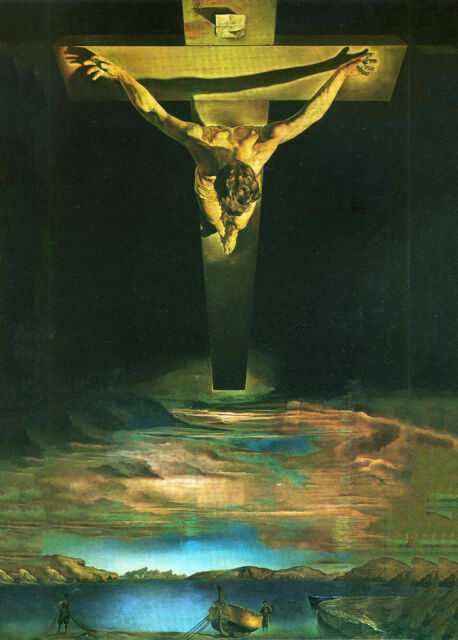
Christ of St. John of the Cross by Salvador Dali (1951) – Kenmore Art Gallery, Glasgow

These times in the spiritual life were experienced and described by writers like John of the Cross and the author of “The Cloud of Unknowing”. They are times when our experiences and prayer invite us to a new and deeper understanding of God. They ask us to let go of our intellectual certainties and abandon ourselves to God without demands.


Recently, while describing how disappointed he was in God, a friend told me that he had “lost” his faith long ago. Well, obviously, he hadn’t because he still held expectations of the “God” who was disappointing him. I told him that I had lost my faith a few times too, and that every time I got it back, it was new and deeper than the one I had lost. My “septuagenarian God” is very different from the one I came to follow when I was eighteen!


Our minds and souls are so small next to God’s Infinity. But slowly, through a life of prayerful fidelity and loving service, God stretches our capacity to know and return a Love which is beyond reason.

But the stretching times can be dark – times when Psalm 16 is a comforting prayer.

I like to pray with this transliteration by Steven Mitchell – A Book of Psalms

Unnamable God,
I feel you with me at every moment.
You are my food, my drink,
my sunlight, and the air I breathe.
You are the ground I have built on
and the beauty that rejoices my heart. 

I give thanks to you at all times
for lifting me from my confusion,
for teaching me in the dark
and showing me the path of life. 

I have come to the center of the universe;
I rest in your perfect love.
In your presence there is fullness of joy
and blessedness forever and ever.

Music: Path of Life – The Dameans

Poetry: The Dark Night – Stanzas Of The Soul

( Some people find John of the Cross surprising, if not strange or shocking, in his imagery. He was a grace-filled mystic and poet whose images of God expanded beyond the boundaries we might be accustomed to. And that very extravagance is John’s beauty — he invites us to a place we might not otherwise think to go.)

1. One dark night,
fired with love’s urgent longings
— ah, the sheer grace! —
I went out unseen,
my house being now all stilled.

2. In darkness, and secure,
by the secret ladder, disguised,
— ah, the sheer grace! —
in darkness and concealment,
my house being now all stilled.

3. On that glad night,
in secret, for no one saw me,
nor did I look at anything,
with no other light or guide
than the one that burned in my heart.

4. This guided me
more surely than the light of noon
to where he was awaiting me
— him I knew so well —
there in a place where no one appeared.

5. O guiding night!
O night more lovely than the dawn!
O night that has united
the Lover with his beloved,
transforming the beloved in her Lover.

6. Upon my flowering breast
which I kept wholly for him alone,
there he lay sleeping,
and I caressing him
there in a breeze from the fanning cedars.

7. When the breeze blew from the turret,
as I parted his hair,
it wounded my neck
with its gentle hand,
suspending all my senses.

8. I abandoned and forgot myself,
laying my face on my Beloved;
all things ceased; I went out from myself,
leaving my cares
forgotten among the lilies.

Psalm 71: From My Youth ’til Now

Saturday of the Ninth Week in Ordinary Time

June 6, 2020

Click here for readings

Today, in God’s Lavish Mercy, we pray with Psalm 71.

Psalm 71_16

This is the psalm of someone who has loved God all their lives. Theirs is a proven love, a long faithfulness.

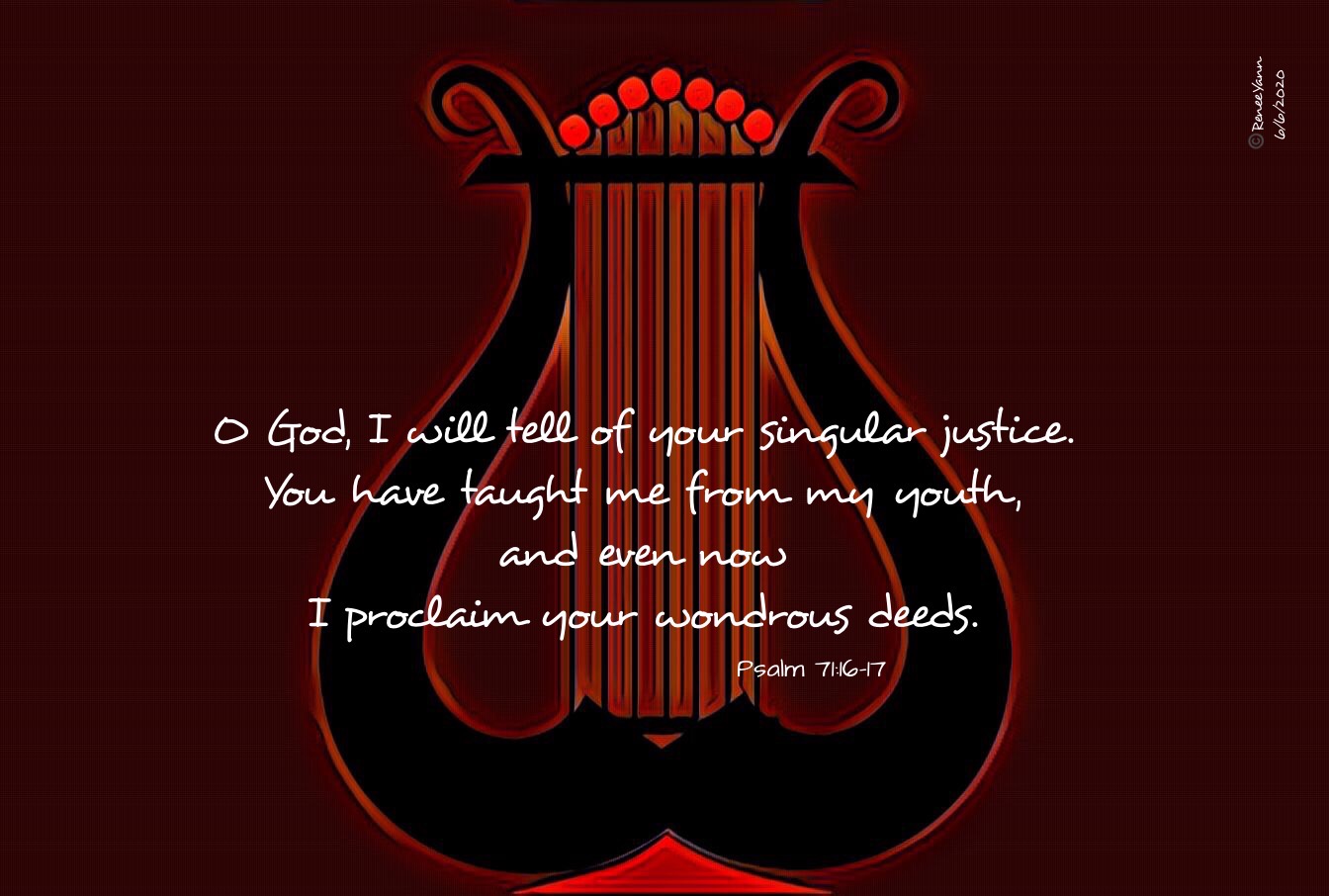
O God, you have taught me from my youth,
and till the present I proclaim your wondrous deeds.


As we look back over our own lives in humility and gratitude, we might speak a similar prayer.

Some of us have been blessed with an early faith that has illuminated every page of our life story. Some of us have come by it a little harder, or a little later, or with frequent clouds around our light.

But we are still here praying, aren’t we – still reaching, like the psalmist, for God’s steadying hand.

My mouth shall be filled with your praise,
with your glory day by day.
Cast me not off in my old age;
as my strength fails, forsake me not.


The psalmist’s enduring relationship with God is rooted in this understanding: that every moment of our lives reveals the face of a just and merciful God. Our part is to believe and trust enough to discover that Face and reveal it to others.

But I will always hope
and praise you ever more and more.
My mouth shall declare your justice,
day by day your salvation.


king harpThe psalmist promises to witness to God’s faithfulness by singing with the lyre. In his letter today, Paul charges Timothy to do the same thing (sans lyre):

I charge you in the presence of God and of Christ Jesus,
who will judge the living and the dead,
and by his appearing and his kingly power:
proclaim the word;
be persistent whether it is convenient or inconvenient …


In our Gospel, Jesus says that the proclamation of our faith must be sincere, generous, and humble, never used to politicize and advance our stature over others, or as a tool for our personal aggrandizement:

scribeBeware of the scribes, who like to go around in long robes

and accept greetings in the marketplaces,
seats of honor in synagogues,
and places of honor at banquets.
They devour the houses of widows and, as a pretext,
recite lengthy prayers.
They will receive a very severe condemnation.


Oh, so many modern applications come to mind regarding this advice! But, for today, let’s just examine our own hearts.

Music: Psalm 71 – Jason Silver


Poetry: For Light
 by John O’Donohue

Light cannot see inside things.
That is what the dark is for:
Minding the interior,
Nurturing the draw of growth
Through places where death
In its own way turns into life.

In the glare of neon times,
Let our eyes not be worn
By surfaces that shine
With hunger made attractive.

That our thoughts may be true light,
Finding their way into words
Which have the weight of shadow
To hold the layers of truth.

That we never place our trust
In minds claimed by empty light,
Where one-sided certainties
Are driven by false desire.

When we look into the heart,
May our eyes have the kindness
And reverence of candlelight.

That the searching of our minds
Be equal to the oblique
Crevices and corners where
The mystery continues to dwell,
Glimmering in fugitive light.

When we are confined inside
The dark house of suffering
That moonlight might find a window.

When we become false and lost
That the severe noon-light
Would cast our shadow clear.

When we love, that dawn-light
Would lighten our feet
Upon the waters.

As we grow old, that twilight
Would illuminate treasure
In the fields of memory.

And when we come to search for God,
Let us first be robed in night,
Put on the mind of morning
To feel the rush of light
Spread slowly inside
The color and stillness
Of a found word.

Eternal Life: I Like It!

Seventh Sunday of Easter

May 24, 2020

Click here for readings

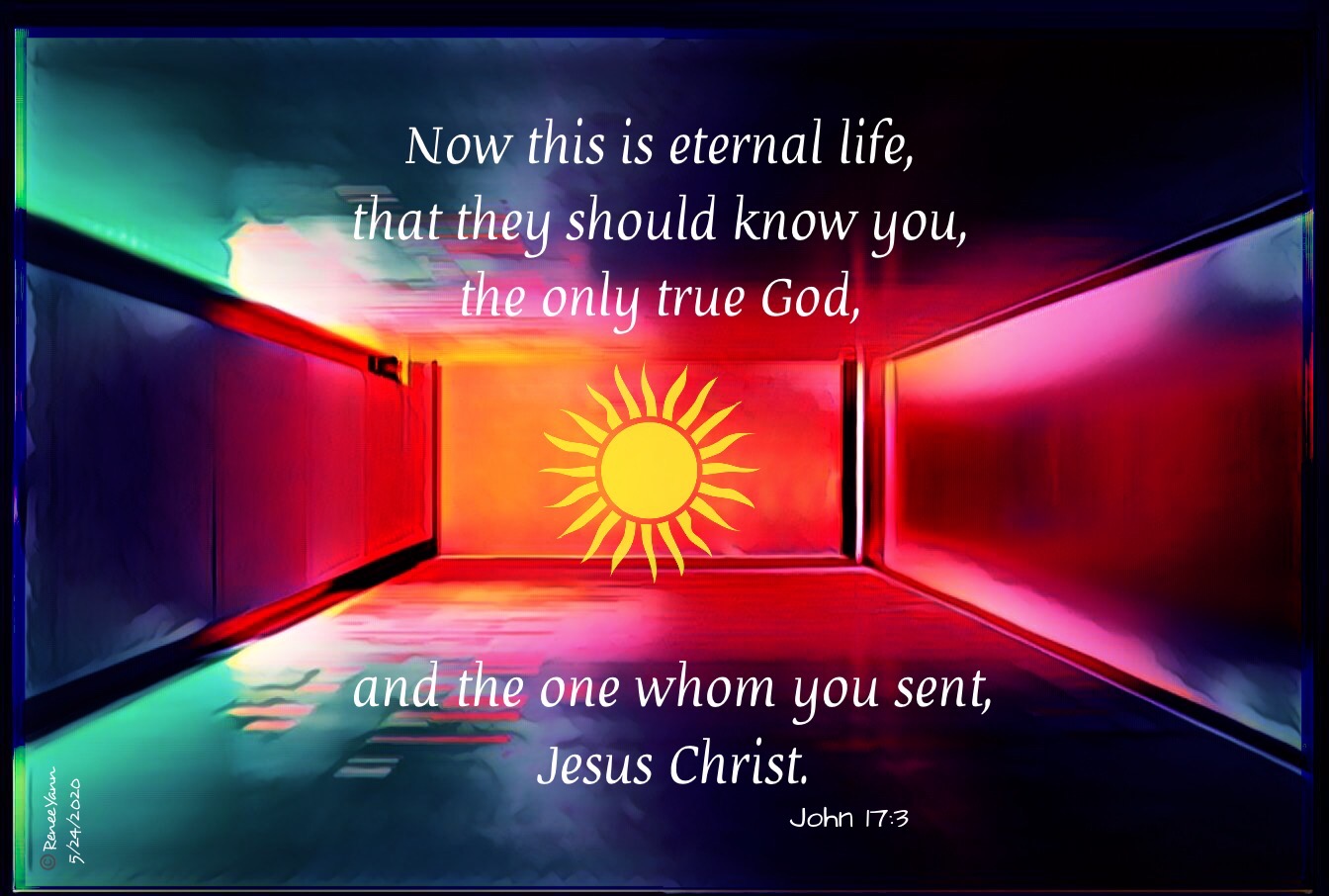
John 17_3 eternalJPG

Today, in Mercy, Jesus defines for us what it means to have eternal life. And the parameters of that definition are so far beyond our limited perceptions — at least mine.


The first time I heard the phrase “eternal life”, I was a three-year-old staring up at the edge of my grandmother’s casket. In those days, family members were “waked” at home for three days. Before Father Connolly came to say a few prayers, I had been lifted up to see Grandmom, icy white in her pretty blue gown, definitely in a sleep I had never seen before.

girl blue
Later, as the priest intoned blessings over her, I was too little to see over that casket’s edge, so I wondered if she might already have left to find eternal life when he mentioned it. I hoped she could take the blue dress with her because she looked so pretty in it.


Thus began my lifelong quest to understand where Grandmom had gone and to insure this elusive “eternal life” for myself someday. My early catechism lessons presented  a “Plant Now – Reap Later” view of eternal life.  Remember this from the Baltimore Catechism?

  1. Why did God make you?
  2. God made me to know Him, to love Him, and to serve Him in this world, and to be happy with Him forever in the next.

( However, I prefer this verion of the query which I heard recently.  When asked why God made her, a little girl responded, “Because He thought I’d like it!”)


Still as a result of our early catechesis, many of us consider “eternal life” a future state achieved after death or perhaps not until the Second Coming.

In today’s reading, and throughout John’s Gospel, Jesus begs to differ.

byrneBrendan Byrne, SJ, New Testament scholar, when describing the Prologue of John’s Gospel, says this:
(The central notion of John’s Gospel is this…) The entire life of Jesus Christ will be a playing out, in the field of time, of the divine communion of love that exists between the Father and the Son. Played out in the human sphere, it will be accessible to human beings, so that they, as “children of God”, may be drawn into Jesus’ filial communion of love with the Father and so come to share the divine eternal life.

In other words, as we deepen in our relationship with Christ, we deepen in divine and eternal life. For those whose life is anchored in faith, we rejoice in eternal life now as well as forever.


brownRaymond E. Brown, premier Johannine scholar, says that we find this “eternal life” in the ordinary stuff of our human life, transformed by the sacramental touch of the Incarnate Christ:

We must stress that the Johannine Jesus is not engaged in cosmetic improvement of the quality of life on earth, offering more abundant water and food, with sharper vision and a longer span of years. From another world come his gifts, even if confusingly they bear the same names that our language gives to what we so eagerly seek on earth: food, light, and life. In reality, however, his gifts go beyond anything we could hope for, satisfying needs we scarcely knew we had and doing so permanently.


May we see every aspect of our lives in this sacred light, convinced in our hearts that God made us “because He thought we’d like it”, and wanting to share eternal life with us right now and forever.

Music:  O Love of God, How Strong and True – written by  Horatius Bonar (1808-1889),
(sung here by Washington National Cathedral Choir who sang it as well at President Reagan’s funeral in 2004.)

O love of God, how strong and true!
Eternal, and yet ever new;
Uncomprehended and unbought,
Beyond all knowledge and all thought.

O love of God, how deep and great!
Far deeper than man’s deepest hate;
Self-fed, self-kindled like the light,
Changeless, eternal, infinite.

O heavenly love, how precious still,
In days of weariness and ill,
In nights of pain and helplessness,
To heal, to comfort, and to bless!

O wide embracing, wondrous love!
We read thee in the sky above,
We read thee in the earth below,
In seas that swell, and streams that flow.

We read thee best in him who came
To bear for us the cross of shame;
Sent by the Father from on high,
Our life to live, our death to die.

We read thy power to bless and save,
Even in the darkness of the grave;
Still more in resurrection light
We read the fulness of thy might.

O love of God, our shield and stay
Through all the perils of our way!
Eternal love, in thee we rest,
For ever safe, for ever blest.


Asking for a Friend…

Saturday of the Sixth Week of Easter

May 23, 2020

Click here for readings

john6_29 Ask

Today, in Mercy, Jesus once again instructs his disciples to pray “in my Name”.

Amen, amen, I say to you,
whatever you ask the Father in my name he will give you.
Until now you have not asked anything in my name;
ask and you will receive, so that your joy may be complete.

What does Jesus really mean by,:

“Ask in My Name”.


There is an idiomatic phrase popular in culture today, “just asking for a friend”. It is used when the questioner feels embarrassed or unsure about the question, or unworthy of posing it oneself, for example: Can you really go to jail for not paying your taxes, just asking for a friend?


What might happen if we prayed like this, taking Jesus seriously in his offer to intervene for us, to stand in the place of our fear, hesitation, confusion, or unworthiness:

  • Dear God, please forgive me for this sinful choice I made. I ask you in the Name of Jesus, my friend.
  • Dear God, will you please comfort my dear one who is suffering. I ask you in the Name of Jesus, my friend.
  • Dear God, will you please intervene to stop the suffering in the world. I ask you in the Name of Jesus, my friend.

How would the addition of this little phrase change my prayer?


magic

The words are not a magic formula for working miracles. They won’t allow us to cure the sick or raise the dead in visible ways. But they will allow us to heal ourselves and others in ways beyond human calculation.

I think the words are a key to unlock our understanding that when we pray in the Name of Jesus, the miracle happens in us, not in our surroundings.


150 cross

We realize that Jesus, in whose Name we pray, changed the world not by magic but by sacrificial love. Becoming his friend and praying in his name demands that we too live our experiences with that kind of unquestioning love.

Such love unveils the glorious mystery of the Cross to us. Even under its shadow, we see through to the triumph of the Resurrection as Jesus did. 

Certainly, suffering was not removed from Jesus’ life nor from that of his followers.

But what was given was abiding faith, hope, love, and the trustworthy promise of eternal life.

Let’s ask for these precious gifts, in the Name of Jesus.

Music: In Jesus’ Name I Pray – Charley Pride
(Lyrics below)

In Jesus’ Name I Pray

Father give me strength, to do what I must do.
Father give me courage, to say what I must say.
Let that spirit move me.
I’m nothing on my own.
Father stand by me, I can not stand alone, in Jesus name I pray.

Father open up my eyes to your wonders all around.
Father let me see the good and beauty of this day.
Fill my heart with love, for my fellow man.
And if I’m tempted Father.

Father take my hand, in Jesus name I pray.
Father help me through the troubled days that lie ahead.
Let your life stand before me, that I may find a way.
So let me stumble Father, or fall beneath my load.

Father guide my footsteps.
Hold me to the road, in Jesus name I pray.
Let not hunger be my guide, nor fear be my master.
Father let not envy, be a part of me in any way.

Father search my soul, take away my fear and doubt.
Any moment that you find this,
Father cast it out, in Jesus name I pray.
Ah ah ah Amen.