In God’s Hands

Tuesday of the Fourth Week of Easter

May 5, 2020

Click here for readings

Today, in Mercy, the image of God’s hands emerges in each of our readings.

preachers

There were some …. proclaiming the Lord Jesus.
The hand of the Lord was with them
and a great number who believed turned to the Lord.
Acts 11:21
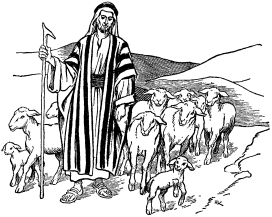

shepherd


I know them, and they follow me.
I give them eternal life, and they shall never perish.
No one can take them out of my hand.
John 10:28


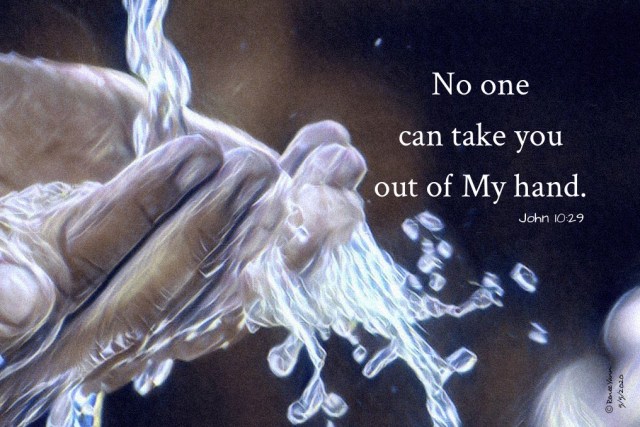
My Father, who has given them to me, is greater than all,
and no one can take them out of the Father’s hand.
John 10:29


Each of these images evokes and inspires our trust that God abides with and sustains us – that we are in God’s hands.

We all know what it’s like to place ourself in someone else’s hands. Sometimes we do it willingly, sometimes not. Sometimes it is an act of trust, sometimes fear.

This morning, as I pray, I remember two parallel but distinctly different incidents of being in someone else’s hands. 


pikesIn the first, I went with friends on a drive to the top of Pike’s Peak in Colorado. It was before the serpentine road was paved in 1999. The driver was the young cowboy nephew of one of the passengers, and he thought it was really fun to scare us out of our wits. He took the many curves and switchbacks at headlong speed. I closed my eyes and started praying.


doctor-clipart-transparent-12The second memory is recent. Just before my knee replacement surgery, as I lay slightly anesthetized in pre-op, my surgeon came to the bedside. He sat down, took my hand and said, “I want you to know that I will do the surgery myself and be with you the whole time. I am putting my initials on your knee so you can be certain I’ll fix the right one.” He smiled, and I again closed my eyes and started praying.


What different prayers they were! One was begging God to intervene and save me. The other was thanking God for putting me in trustworthy hands.
Jn10_29 hands

With God, we are always in trustworthy hands. Indeed, sometimes it may feel like God is flying over the edge of Pike’s Peak with us in the back seat. But here’s the thing: God is in the car with us – and God always lives! If we give ourselves completely to God in trust, we will live too.

Eventually, our practice of trust grows enough to comfort us in all things. We realize God is always sitting beside us, taking our hand, assuring us of that Loving Presence Who always abides.

A great freedom comes with that realization, steeped in years of trust and understanding that God’s Will for us is our eternal good. The preachers in Acts today, and the disciples in John rejoiced and acted in such trust. May we too be strengthened, blessed, and impelled by it.

Music:  Into Your Hands – Ray Rep

Into Your hands we commend our spirit –Ray Repp

Into Your hands we commend our spirits O Lord,
Into Your hands we commend our hearts.
For we must die to ourselves in loving You,
Into Your hands we commend our love.

O God, my God, why have You gone from me,
Far from my prayers, far from my cry?
To You I call and you never answer me,
You send no comfort and I don’t know why!

You’ve been my guide since I was very young,
You showed the way, you brought relief;
But now I’m lonely, nobody’s by my side:
Take heed, my Lord, listen to my prayer.

A Shocking Gift

Friday of the Third Week of Easter

May 1, 2020

Click here for readings

Dali
Institution of the Eucharist: Salvador Dali

Today, in Mercy, our Gospel is serious business. In it, Jesus reveals the lynchpin of our sacramental faith.

Amen, amen, I say to you,
unless you eat the Flesh of the Son of Man and drink his Blood,
you do not have life within you.
Whoever eats my Flesh and drinks my Blood
has eternal life,
and I will raise him on the last day.

It is a stark and shocking statement. The listening Jews “quarreled among themselves, saying, ‘How can this man give us his Flesh to eat?’.”

Down through the ages, struggling believers have grappled with the same question. Or, perhaps less preferable, complacent believers have never even considered it.

I think Jesus wanted us to consider it, absorb it, be changed by it, live within it, because “unless you eat the Flesh of the Son of Man and drink his Blood, you do not have life within you.”


Among the Christian denominations there is a range of interpretations of this teaching. 

Wikipedia has a very good summary. Click to read it.


As Catholics, we believe that Christ is truly and fully present in Eucharist and that, by Communion, becomes fully present in us, the Church.

When the Church celebrates the Eucharist, the memorial of her Lord’s death and resurrection, this central event of salvation becomes really present and “the work of our redemption is carried out”. This sacrifice is so decisive for the salvation of the human race that Jesus Christ offered it and returned to the Father only after he had left us a means of sharing in it as if we had been present there. Each member of the faithful can thus take part in it and inexhaustibly gain its fruits. This is the faith from which generations of Christians down the ages have lived.
(ECCLESIA DE EUCHARISTIA, Encyclical of John Paul II)


For me, it is a truth only appreciated when approached with more than the mind. It must be apprehended with the heart and soul. God so loves us in the person of Jesus Christ that God chooses to be eternally present with us, and in us, through the gift of Eucharist.

Praying with this truth over the years has led me to read authors like Edward Schillebeeckx (Christ the sacrament of the encounter with God), Diarmuid O’Murchu (Quantum Theology), and Pierre Teilhard De Chardin (Hymn of the Universe).

deChardin


But I will tell you that every time I receive the Eucharist, I let this little hymn play in my heart, one I learned for my First Holy Communion. It still unites my heart to my desired faith.

Music: Jesus, Jesus, Come to Me – sung by the Daughters of Mary
( I know the album art is not classic, but I can still believe I’m one of those little kids climbing into Jesus’s lap🤗. I think most of us are a mix of both unsophisticated and erudite theologies, so I hope you can enjoy this musical selection.)

Divine Inheritance

Memorial of Saint Catherine of Siena, virgin and doctor of the Church

April 29, 2020

Click here for readings

Today, in Mercy, our Gospel gives us the sense of Jesus claiming his inheritance  from the Father. He makes it clear that the Father’s Will is the Redemption of all Creation. This is the divine charge given to Jesus. This is his mission.

Jn6_37


Jesus continues to use the symbol of bread to teach the forming community. 

Bread sustains life.
God’s Word is eternal life.

Sharing bread is an act of community.
In the Body of Christ, we are made One with God
and with one another.

Bread can stale and disintegrate.
Within the Body of Christ, we become eternal
and will be raised up unto the Last Day.


These are such BIG thoughts, amazing teachings. I always wonder how simple shepherds, fishermen and housekeepers were supposed to understand! I wonder how we, in our human limitations, could begin to comprehend the infinitely loving design of God revealed in Jesus Christ!


Today, as we celebrate the feast of the great Saint Catherine of Siena, we can learn from her spiritual wisdom. Without formal education, she grew by grace into a Doctor of the Church.

Siena


She was born Catherine Benincasa on March 25, 1347, in Siena, Italy, and was a twin, the 24th child of 25. She only lived to the age of 33, dying of a stroke in Rome in 1380. Catherine of Siena, often referred to as “great Kate,” is well known for her expressive life of prayer shared in three major sources of writings: over 400 letters, 26 prayers, and The Dialogue of Divine Providence, which she referred to as “the book,” written in the format of a conversation between herself and God. She was noted for her style of learning, not acquired from formal education and degrees, but gained from an interior wisdom that came from lived experiences and a mystical life of prayer. ( https://www.hprweb.com/2020/02/the-trinitarian-theology-of-the-eucharist-according-to-st-catherine-of-siena/)


Here are two selections from Catherine’s extensive writings which reveal her ever-deepening relationship with God through the gift of the Bread of Life.


Eternal God, Eternal Trinity, You have made the Blood of Christ so precious through His sharing in your Divine Nature. You are a mystery as deep as the sea; the more I search, the more I find, and the more I find the more I search for You. But I can never be satisfied; what I receive will ever leave me desiring more. When You fill my soul I have an ever-greater hunger, and I grow more famished for Your Light. I desire above all to see You, the true Light, as you really are.


St. Catherine of Siena, Prayer 12, V 124–157

And by the light of most holy faith
I shall contemplate myself in you.
And I shall clothe myself in your eternal will,
And by this light I shall come to know
That you, eternal Trinity,
Are table
And food
And waiter for us.

You, eternal Father,
Are the table
That offers us as food
The Lamb, your only-begotten Son.

He is the most exquisite of foods for us,
Both in his teaching,
Which nourishes us in your will,
And in the sacrament
That we receive in Holy Communion,
Which feeds and strengthens us
While we are pilgrim travelers in this life.

And the Holy Spirit
Is indeed a waiter for us,
For he serves us this teaching
By enlightening our mind’s eye with it
And inspiring us to follow it.
And he serves us charity for our neighbors
And hunger to have as food
Souls
And the salvation of the whole world
For the Father’s honor

So we see that souls enlightened in you,
True light,
Never let a moment pass
Without eating this exquisite food
For your honor.

Music:  Ave Verum Corpus – words attributed to 14th century Pope Innocent VI, melody to Mozart, sung by King’s College Choir

Hail, true body
Ave, ave verum Corpus 

Born of the Virgin Mary;
Natum de Maria Virgine

Truly offered,
Vere passum, immolatum 

In the cross for man
In cruce pro homine

Whose side
Cujus latus perforatum 

Water and blood
Fluxit aqua et sanguine

May we taste
Esto nobis praegustatum 

Time of death
Mortis in examine 

The time of death
In mortis examine

Life is the Miracle

Tuesday of the Third Week of Easter

April 28, 2020

Click here for readings

Today, in Mercy, Acts recounts the sad but inspiring story of Stephen’s martyrdom.

To read an earlier reflection on St. Stephen’s death, click here.


In our Gospel, we continue to pray with John’s Discourse on the Bread of Life.

The setting is Capernaum, on the other side of the lake from where the feeding of the 5000 occurred. Rumors are flying about how Jesus got from one side to the other without a boat. In other words, the air is buzzing with whispers of miracles.


Some bright light in the re-gathering crowd decides to become their representative and inquisitor of Jesus:

inquisitors

“What sign can you do, that we may see and believe in you?
What can you do?
Our ancestors ate manna in the desert … ”
(how about something a long those lines, the questioner seems to imply????)

Where was this guy when the loaves and fishes were pouring out of a single basket? Where was he when Jesus appeared at the lake’s far side, already rested and waiting for the exhausted, arriving crowd?


But Jesus doesn’t take the inquisitor’s bait. He speaks as the Divine Teacher to help them understand that this is about a lot more than signs and miracles. 

Jesus reminds them that any “miracle”, any “manna” should lead us to God, in whose Presence the need and demand for continuing miracles ceases.

Jn6_35 bread

Jesus encourages them to get beyond their limited perceptions of signs, manna, bread, and miracles. He explains that all the Power of God stands before them in him, the Son, the Bread sent “down from heaven, and giving life to the world.”

It’s a lot to take in. But they want to: “Sir, give us this bread always.”


It’s a lot for us to take in too, don’t you think. I know I wouldn’t mind a regular old miracle now and then… a shower of manna or a cure for Covid19!

But instead Jesus asks us to live within the miracle of God’s Presence in all things, in the bread of our ordinary lives which He transforms by love.

Jesus said to them, “I am the bread of life;
whoever comes to me will never hunger,
and whoever believes in me will never thirst.”

Stephen had this kind of radical faith. “Filled with the Holy Spirit”,  he could – even in the throes of human contradiction – “see the heavens opened and the Son of Man standing at the right hand of God.”

May our faith ever deepen that we too see God in the Bread of our ordinary daily lives. May that faith inspire us to act always with love, hope and mercy.

Music:  I Am the Bread, the Bread of Life – Brian Hoare 

Our Deepest Hunger

Monday of the Third Week of Easter

April 27, 2020

Click here for readings

Today, in Mercy, Acts introduces us to Stephen, so filled with the Holy Spirit that “his face was like the face of an angel”.

You may wish to refer to last year’s reading on Stephen’s introduction.

Click here to read about Stephen


For today’s reflection, though, our focus will be John 6 which is the beginning of a week-long journey into the discourse on the Bread of Life (Jn 6:22-71). These passages, going from today until Friday, are like a “faith boot camp” for Jesus’s followers. They contain the core message of who Jesus is and how we are brought into communion with him.

The reading seems so meaningful in these days when we are kept from shared communion and community in the Eucharist, when we long to be gathered again around that table of love.


John’s Gospel does not include an account of the Last Supper and institution of the Eucharist. The Bread of Life Discourse is where Jesus proclaims those teachings in John. It is a more detailed instruction and, as we pray with it over the course of the week, we may trace our own past and current awakening in faith.

painting
Limbourg Brothers, Très Riches Heures du duc de Berry, Jesus Feeding the 5,000 Source Wikimedia Commons

Today’s verses offer very basic training. Jesus has just fed 5000 people in the miracle of the loaves and fishes. The crowds, not having a global view of the miracle like we do, are confused. They know they got plenty to eat, but did everybody? They heard many people ate, but they saw only their nearby neighbors. What really happened out on the green field?

Finding Jesus the next day, they are ready for another meal. They’re more interested in matzoh than miracles. Their basic hunger for physical sustenance consumes them. Jesus begins the task of opening their hearts to their deeper hungers and his desire to meet them:

Jesus said,
“You are looking for me
not because you saw signs
but because you ate the loaves and were filled.
Do not work for food that perishes
but for the food that endures for eternal life.”

Jn6_27 food


Praying with today’s Gospel, we might ask ourselves some basic questions about our own faith.

  • When we go looking for God, as these hungry people did, what is it that we are looking for?
  • Do we talk to God only when we need something the way these folks needed another loaf or fish?
  • Jesus is inviting us to Eucharist, to Communion with him. To what degree have we opened our hearts to that invitation by our reflective prayer and acts of mercy?

Jesus’s basic message to his flock today is this:

Don’t be satisfied by a tasty roll, a fat fish,
(or a fancy car, a good job, a comfortable life.)
God made you for much more than these things.
Come to Me and feed your deepest hunger.

Maybe, as we pray, we can ask the question posed at end of today’s Gospel and listen intently to Jesus’s answer:

So they said to him,
“What can we do to accomplish the works of God?”
Jesus answered and said to them,
“This is the work of God, that you believe in the one he sent.”

Music: Hungry – Kathryn Scott

Live Your Resurrection Power!

Third Sunday of Easter

April 26, 2020

Click here for readings

Today, in Mercy, our Eastertide readings once again pull us into the full power of the Resurrection.

Act2_24

Just listen to Peter who stands and raises his mighty voice over the gathered crowd:

Let this be known to you, and listen to my words.
You who are Israelites, hear these words.
Jesus the Nazarene was a man commended to you by God …
This man … you killed, using lawless men to crucify him.
But God raised him up,
releasing him from the throes of death,

because it was impossible for him to be held by it.

There is no fear in Peter. There is only the courage that comes from certainty in God’s power over death. This is the grace of Resurrection Faith.


Resurrection Faith is a power we intensely need in these times that so test us. 

We may be severely tested like those suffering illness and loss; like those valiantly serving the suffering. Or we, like many, may simply be challenged by our self-isolation and radical disruption of routine.

emmaus nuns
In that, we may be like the disciples walking home to Emmaus. They didn’t die on Calvary. They weren’t even retained as followers of Jesus. They simply drifted away from their Hope. They were going home to a sad but comfortable dinner adequate enough to invite a stranger.

Yet they were heartbroken. The world they had loved and hoped in had been shattered. Everything they believed in appeared to be contradicted by the Cross. Most devastating of all, they were at a loss to imagine a future. 

Aren’t we at least a little bit like them?

Aren’t we dazed that the reality we trusted seems to have disappeared overnight? Aren’t we too trying to figure out what we do now in the vacuum? Aren’t we too so blinded by sadness that we might fail to see God walking right beside us?


In our second reading, Peter gives us the formula to break through such blindness:

    • Invoke God as your Father
    • Remain faithful to your good works
    • Conduct yourselves with reverence during the time of your sojourning,
    • Realize that you are already ransomed from death by the precious blood of Christ

Practicing this kind of Resurrection Faith in troubled times makes us not only unafraid of death but, more importantly, unafraid of life. Because I think that is what really most cripples us – not any fear of dying, but rather our fear of fully living our life in God.

We worry about what we have to lose if we live like that, don’t we?

By jeopardizing everything most precious to us, these pandemic times make clear all that we have to lose. But they also make clear the powers in us impossible to chain: how we love, hope, serve and believe. Neither death nor pandemic has power over these living graces.


Like the Emmaus disciples, our hearts burn within us, too, with an ardent mix of longing, confusion, and stubborn trust. Like them, let us sit down with Jesus at the table of our lives. Let his patient voice speak to our souls and clear our vision. The Resurrection power of God is alive in all things. May we recognize that Power even in these seemingly contradictory times.

cross

Because Christ rose from the dead, it is impossible for any form of death to hold us captive. On this Third Sunday of Easter, our readings invite us to truly believe that. Let’s fully accept the invitation, dear friends. Let’s live like we believe!

Music: Christ Our Hope in Life and Death – The Gettys 

Easter 2020

Easter Sunday of the Resurrection of the Lord

April 12, 2020

Click here for readings

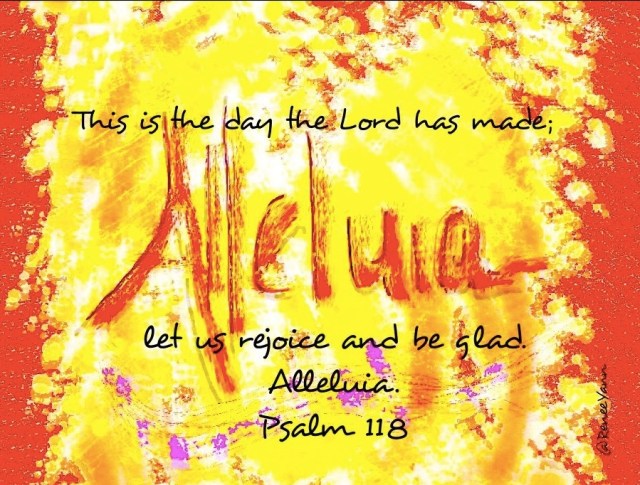
This is the day the Lord has made.
Let us rejoice and be glad. Alleluia!
Psalm 118

Alleluia


They woke up one morning beside each other as they had for fifteen years. The scent of last night’s acrid argument lingered in the corners of the room. After a few moments, he turned to her and said, “We need to learn how to love each other again. Can we try?”  

Over the course of long-term relationships, the parties change. Phil and Judy wanted to remain committed to their marriage, but they found themselves strangled by years of unpruned misunderstandings. All heart commitments meet similar challenges. All dreams fray a little on their way to fulfillment. 

We have followed Jesus through Holy Week on such a road. Passover Sunday filled his spirit with the fresh scent of palms and possibilities. But as the week waned, the Father led Jesus in a daunting direction. He asked his Son to pay the ultimate price for love. 

Our lives too will teach us this: every ride on a palm-strewn road meets a fork toward Gethsemane. There is no true love without sacrifice. But the road does not end at the foot of the cross. Loving sacrifice lifts us to see this morning’s Easter sunrise. The life that had lain hidden in darkness now rises triumphant in our hearts. Today, we are offered the grace to live this mystery on our own journeys. Amazingly, Easter invites us to fall in love again with God and to begin our lives anew.

Easter 2020

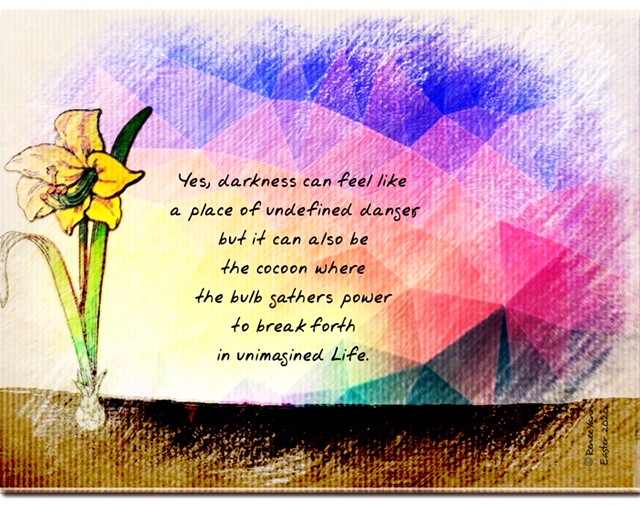
In this time global shadows, may the Easter Truth strengthen us to deepen in faith, hope and love. Yes, darkness can feel like a place of undefined danger, but it can also be the cocoon where the bulb gathers power to break forth in unimagined Life.

Music:  Alleluia! Alleluia! (Lyrics below)

Alleluia, alleluia!
Let the holy anthem rise,
and the choirs of heaven chant it
in the temple of the skies.
Let the mountains skip with gladness
and the joyful valleys ring,
with hosannas in the highest
to our Savior and our King.

Alleluia, alleluia!
Like the sun from out the wave,
he has risen up in triumph
from the darkness of the grave,
he, the splendor of the nations,
he, the lamp of endless day;
he, the very Lord of glory,
who is risen up today.

Alleluia, alleluia!
Blessed Jesus make us rise,
from the life of this corruption
to the life that never dies.
May we share with thee thy glory
when the days of time are past,
and the dead shall be awakened
by the trumpet’s mighty blast.

Good Friday 2020

Good Friday of the Lord’s Passion

April 10, 2020

Click here for readings

Today, in Mercy, we pray within the incomprehensible Love Who is Jesus.

Love given

A most beautiful hymn from the Good Friday liturgy is the Popule Meus.

Popule Meus, also known as the ‘Improperia‘ or the ‘Reproaches,‘ is the hymn sung after the Adoration of the Cross on Good Friday. Christ reproaches the People, contrasting the innumerable favors God has bestowed upon them with the injuries He has received from their hands. Where God led them to the Chosen Land, the Peole led Him to the Cross. Where God gave a royal scepter, the People returned a crown of thorns.

This prayer focuses us on our own relationship with God. We too are Children of the Promise. How have we responded? How do we find ourselves as we kneel before the Cross?

The Trisagion prayer is an ancient chant repeated within the Popule Meus. It is a verse we can repeat as a mantra whenever we meditate on the Cross.

Ágios o Theos.
Ágios íschyros.
Ágios athánatos, eléison imas.

Holy God,
Holy Mighty One,
Holy Immortal One,
have mercy on us.


During the hours from Noon until 3:00 on this Good Friday, and since we are inhibited from Church attendance, some may wish to read parts of the Good Friday liturgy. I found this site with a complete service. However, the book is formatted in such a way that you must skip from side to side to follow in order. It’s not hard, just look for the page numbers in the lower left of each page.

(I was not particularly fond of the hymns offered in this program. So in a second post today, I have listed Handel’s meditations on the Passion and Death of Christ for your prayerful listening)

Click here to go to the Good Friday Service

Worlds Falling Apart

Saturday of the Fifth Week of Lent

April 4, 2020

Click here for today’s readings

Today, in Mercy, worlds are splitting apart, but the Word of God comes to heal them.

In our first reading, we share in the experience of the prophet Ezekiel.

Ezekiel and his wife lived during the Babylonian Captivity on banks of the Chenab River which is in modern day Iraq. He lived during the siege of Jerusalem in 589 BC. In Ezekiel’s day the northern kingdom had been conquered and destroyed 150 years earlier.

In other words, Ezekiel, like his contemporary Jeremiah, had his heart torn apart along with the homeland they cherished as God’s promise to them. 

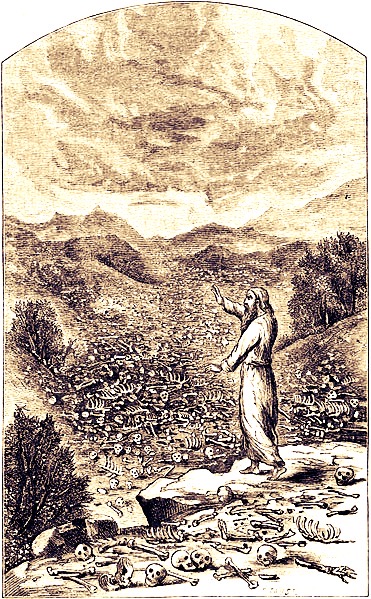
dry bones
The Valley of the Dry Bones – artist unknown

In today’s reading, which comes immediately after his vision of the Dry Bones, Ezekiel prophesies a message of hope and restoration to a fragmented and devastated nation.


In our Gospel, Jesus is the new Ezekiel. He stands in the midst of the bigger “nation” of all God’s Creation which has been fragmented by the failure to love. Like Ezekiel, Jesus offers a message of hope and restoration to sinners.

In this Gospel, Jesus himself is the “Temple” about to destroyed. The prophecy of its destruction is unwittingly delivered by the high priest Caiaphas:

Caiaphas,
who was high priest that year,
said to the Pharisees and Sanhedrin,
“You know nothing,
nor do you consider that it is better for you
that one man should die instead of the people,
so that the whole nation may not perish.”
He did not say this on his own,
but since he was high priest for that year,
he prophesied that Jesus was going to die for the nation,
and not only for the nation,
but also to gather into one the dispersed children of God.

Within Christ’s new law of love, these “children of God” go far beyond the Jewish nation. They are you and me, and every other creature with whom we share this time and universe. The fragmentations which separate and alienate us are dissolved in the Passion, Death and Resurrection of Jesus Christ.


holy week

Holy Week will begin tomorrow when all believers will intensify their desire to join Christ in his final journey to Resurrection, to understand our own lives anew in the power of Paschal Grace.

This is a somber and surreal time for all of us, and we will miss our ability to join one another in our beloved Holy Week Services. But there are some helpful alternatives. I’ve listed some of my favorites below. Click on any of these three links below to explore.

Resources for observing Holy Week at home from Liturgical Press

The Holy Week services at the Vatican will also be available on line. This link explains how to join them in prayer.

EWTN television station also has a full schedule of Holy Week prayer opportunities.

Music:  Make Us One – featuring James Lorne’s. Written by Sally DeFord
(Lyrics below)

Lyrics

How shall we stand amid uncertainty?
Where is our comfort in travail?
How shall we walk amid infirmity,
When feeble limbs are worn and frail?
And as we pass through mortal sorrow,
How shall our hearts abide the day?
Where is the strength the soul may borrow?
Teach us thy way.

Chorus:
Make us one, that our burdens may be light
Make us one as we seek eternal life
Unite our hands to serve thy children well
Unite us in obedience to thy will.
Make us one! teach us, Lord, to be
Of one faith, of one heart
One in thee.
Then shall our souls be filled with charity,
Then shall all hate and anger cease
And though we strive amid adversity,
Yet shall we find thy perfect peace
So shall we stand despite our weakness,
So shall our strength be strength enough
We bring our hearts to thee in meekness;
Lord, wilt thou bind them in thy love?

(Repeat chorus)

Take from me this heart of stone,
And make it flesh even as thine own
Take from me unfeeling pride;
Teach me compassion; cast my fear aside.
Give us one heart, give us one mind
Lord, make us thine
Oh, make us thine!
(Repeat chorus)

God’s Starry Calendar

Thursday of the Fifth Week of Lent

April 2, 2020

Click here for readings

Abraham
Abraham Looks to the Heavens from Bible Pictures by Charles Foster (1897)

Today, in Mercy, Yahweh is very clear with Abram that he is now in a life-changing situation:

My covenant with you is this:
you are to become the father of a host of nations.
No longer shall you be called Abram;
your name shall be Abraham,
for I am making you the father of a host of nations.


pregnantHaving witnessed how young fathers are upended by the news of impending fatherhood, I can’t even imagine what Abraham felt like when he heard this:
I will render you exceedingly fertile;
I will make nations of you;
kings shall stem from you.

But aside from the practical ramifications of God’s promise, what Abraham is invited to is a whole new outlook on the world.  God lays out before him a vision of the ages, infinitely beyond the confines of Abraham’s current understanding.

dangles

It is an existence beyond time and human definition. It is the infinite place of God’s timelessness, where we all exist, but forget when we are born. Our lifetime is a spiritual journey back to remembrance.


In our Gospel, Jesus uses a rather cryptic phrase as he challenges his listeners to look beyond their circumscribed perspectives:

Amen, amen, I say to you,
whoever keeps my word will never see death….
Abraham your father rejoiced to see my day;
he saw it and was glad.

Jn8_56 Abraham

By fully embracing his covenant with God, Abraham saw beyond death.  The vision of heaven was opened to him and he lived his life by its power. He lived then within the Day of the Lord, not within any small confined reality.

Jesus offers us the same invitation. We can choose to see with God’s eyes, or with only our own. We can choose to live within God’s infinity, or in only our own earthbound borders.

In our current global situation, when time has lost its shape and days silently morph into one another, it may be a good time to remember the eternal character of our heart.  It may be time to have a sit-down with God about our covenant, like the conversation God had with Abraham.

Music: In the Day of the Lord  – M.D. Ridge