Christ, the Crucified King

The Solemnity of Our Lord Jesus Christ, King of the Universe

November 24, 2019

Click here for readings

Today, in Mercy, we celebrate the Solemnity of Christ the King. This feast was established in 1925 by Pope Pius XI by his encyclical Quas Primas. The Pope was acutely aware of the secularization of society and culture. He wanted this feast and devotion to bring people a deep awareness that Christ is the center of all Creation.

The images, language and metaphors are ones that spoke to the people in the early 20th century. They may ring differently to us. Concepts of king”, “empire”, “dominion”, “subjection” tend to engender negative connotations for many of us.
(Unless, of course, we’re referring to the “King of Rock and Roll” – Elvis, of course. Or  for some younger among us, the “King of Pop” – Michael Jackson. Then we seem OK with it!)

Our readings today can direct us to a deeper understanding of the characteristics Pius sought to highlight, ones that may speak more clearly to us in our time.

Our first reading from Samuel presents the anointing of David as King of Israel. Anointed by those who were “his own bone and flesh”, David prefigured the Incarnate Christ who, by the power of the Holy Spirit, took our flesh to redeem us.
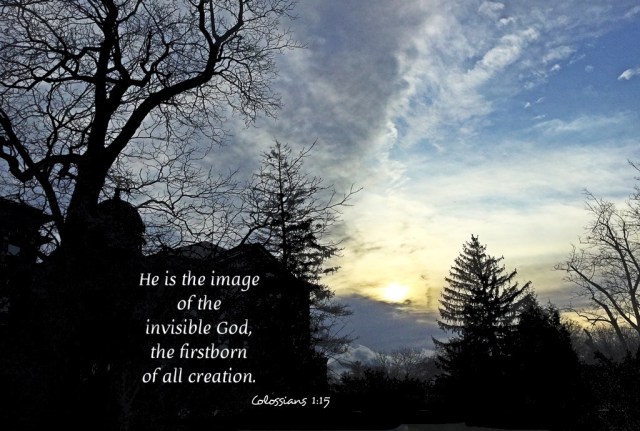

Col1_15 image

The magnificent passage from Colossians offers exultant praise to the Creator for 

…delivering us from the power of darkness
and transferring us to the kingdom of the beloved Son,
in whom we have redemption …


And our Gospel gives us our precious Jesus on the Cross, teaching us the paradoxical truth of what his “Kingdom” really means – not oppressive dominion, but rather a sacrificial love that gives everything for the life of the beloved.

van eyck
Van Eyck’s painting of Christ King and his follower Petrus Christus’s Christ Suffering (15th C.)

Many cannot recognize such “kingship”. They cannot see the holy power within Christ’s sacrifice. They are, as Pius XI recognized for his time, blinded by a secularized culture and a dispirited life.

Let us pray today with the “justly condemned”, but spiritually enlightened, man in our Gospel who asked his Crucified King,

“Lord Jesus,
remember me
when you come into Kingdom!”

Music: Jesus Remember Me

We Were Made for Heaven

Saturday of the Thirty-third Week in Ordinary Time

November 23, 2019

Click here for readings

Lk20_36 eternal life

Today, in Mercy, Maccabees gives us a colorful account of the defeat, dismay and ultimate death of Antiochus IV, persecutor of the Jews. The account, like most of the Books of Maccabees, is primarily historical, not spiritual or theological. But threaded through the books, of course, is the underlying biblical orientation that God-Yahweh is present and active in all life’s circumstances.

Today’s passage has even pagan Antiochus considering how God/Fate has brought him to judgement- to “payback” time:

But I now recall the evils I did in Jerusalem,
when I carried away all the vessels of gold and silver
that were in it, and for no cause
gave orders that the inhabitants of Judah be destroyed.
I know that this is why these evils have overtaken me;
and now I am dying, in bitter grief, in a foreign land.


Our Gospel repeats an incident we prayed with just the Sunday before last, in which some Sadducees question Jesus about marriage laws and the afterlife. Their questioning reminds me of modern songwriter Eric Clapton’s musings in his song:

Tears in Heaven – Eric Clapton

Jesus doesn’t sing to the Sadducees, as far as I know. Rather, he answers them this way:

Those who are deemed worthy to attain to the coming age
and to the resurrection of the dead
neither marry nor are given in marriage.
They can no longer die,
for they are like angels;
and they are the children of God
because they are the ones who will rise.


So for us today, the questions and concerns of both Antiochus and the Sadducees might lead us to consider how we feel about the “afterlife”.

Do you ever wonder what heaven will be like? Will we see our beloveds once again? Will we see our “unbeloveds” too and what will that be like!! Do you calculate whether or not you’ll even make the cut through the Pearly Gates?

When I think about heaven these two promises of Jesus sustain, comfort and animate me. Maybe you’ll consider their power too as you pray today.

I have come that you may have life,
and have it to the full.
John 10:10


Eternal life is this, that they know you,
the only true God,
and Jesus Christ, whom you have sent.
John 17:3

Music: That You May Have Life – André Crouch
(Lyrics below)

(I come that you might have life more abundantly)
(I come that you might have life through eternity)
I didn’t come to condemn the world
nor to shame you for your wrong no no
but I came to mend your broken heart and give your heart a song
(I come to give you life more abundantly – more abundantly)
Your life without Christ
is like a star that will never never shine
It’s like a winding road that goes nowhere
Woah but Jesus said (I come) I come (to give you life) to give you life (more)
(I come) I come (to give you joy) to give you joy
(I come to give you life more abundantly ee ee ee ee more abundantly)
but Jesus said (I come to give you life more) oh I left my home in glory
(I come) I come (to give you joy) just to bring you joy
(I come) I love you I love you (to give you life) and I want to give you life
(more abundantly) more abundantly
Mmmm (ee ee ee ee) more abundantly (more abundantly)
People all over the world (all I want to do is give you life)
listen to the LORD speaking right now
(more abundantly ooh ooh ooh ooh) people all over the world
(all I want to do is give you joy more abundantly ooh ooh ooh ooh)
(all I want to do is give you life . . 

A Transformed Heart

Memorial of Saint Cecilia, Virgin and Martyr

November 22, 2019

Click here for readings

Saint_Cecilia
Poster of fresco after John Dryden’s poem “A Song for Saint Cecilia’s Day

(Following in a second post will be John Dryden’s A Song for St. Cecilia’s Day, 1687)

Today, in Mercy, we celebrate the feast of St. Cecilia who is the patron of musicians. A Christian martyr of the 2nd century, she is one of seven women in addition to the Blessed Virgin mentioned by name in the Canon of the Mass. Her deep spirituality led to a sacred intimacy with God which gave her the faith and courage to endure martyrdom.

Both readings today speak about the Temple. After the victory of Judas Maccabeus, the Jewish people restore their Temple with exuberant celebration, recognizing it as a symbol of God’s Presence with them.

In today’s Gospel. Jesus also “restores” the Temple by driving out the merchants who have diverted the Temple’s purpose as representative of God’s Presence.

Our bodies too are temples of the Holy Spirit.

Paul, in his letter to the Corinthians tells us:

Do you not know
that your bodies are temples of the Holy Spirit,
who is in you, whom you have received from God?
You are not your own; you were bought at a price.

Through our Baptism into the Passion, Death and Resurrection of Christ, the Holy Spirit dwells in us. We are called to be transformed by this Indwelling. As in any relationship, this transformation is accomplished through transparency, communication, listening and acting on behalf of the Beloved.

Geoffrey Brown, a deeply spiritual poet, offers us this imaginative image of waiting for and welcoming, as Cecilia did, the transformative Presence of God in our lives:

I must remember to go down to the heart cave
And sweep it clean, make it warm, with fire on the hearth
And candles in their niches
The pictures on the walls glowing with quiet lights

I must remember to go down to the heart cave
And make the bed with the quilt from home
Strew rushes on the floor
And hang lavender and sage from the corners

I must remember to go down to the heart cave
And be there when you come.

Music:  Marc-Antoine Charpentier – Caecilia Virgo et Martyr


For more on Charpentier’s magnificent works, click here

Charpentier’s Histoires Sacrées, or sacred histories, are in reality, dramatic religious scenes taken from the bible or the lives of the saints and set to music.

Cæcilia, virgo et martyr octo vocibus dates from around 1677. This tells the story of St Cecilia, the patron saint of music and musicians, and an early Christian martyr. Cecilia’s husband and brother are executed for converting to Christianity, with Cecilia following shortly afterwards. Perhaps the highpoint of this piece is the final Guay – Nolite flere fideles where firstly the angels claim that Cecilia has been ‘crowned by them’, before the rest of the chorus sing ‘Come, then, let us sing and exult in Cecilia’s victory.’ Quite wonderful in the way it incorporates Cecilia’s position among musicians. (Stuart Sillitoe)

Jesus Wept

Memorial of the Presentation of the Blessed Virgin Mary

November 21, 2019

Click here for readings

Today, in Mercy, the Book of Maccabees introduces us to Mattathias, revered leader of the Jews in the city of Modein. He violently refuses the Greek Seleucid command to worship their gods, thus initiating the Maccabean Revolt. The wars lasted nearly a decade. Final victory is commemorated in the Feast of Hanukkah:

The Jewish festival of Hanukkah celebrates the re-dedication of the Temple following Judah Maccabee’s (Mattathias’s son)victory over the Seleucids. According to tradition, victorious Maccabees could find only a small jug of oil that had remained pure and uncontaminated by virtue of a seal, and although it contained only enough oil to sustain the Menorah for one day, it miraculously lasted for eight days, by which time further oil could be procured. (Wikipedia)

Our first reading is really describing the beginning of civil and intercultural wars by which dedicated Jews sought to establish both their religion and their nation. Core to their motivation was the desire to freely be in relationship with their one God according to their own custom and law.

In our Gospel, Jesus has come as the full manifestation of that One God. He has invited the Jewish people to a new and complete relationship with God, but they have resisted.

Lk19_41 weptJPG

Now, as he nears his final fate in Jerusalem, Jesus realizes that his dream for the People will not be fully realized. They will experience a destruction like the one once feared by Mattathias. The reality causes Jesus to weep.

Are the passages only  about the Jews, their religion and their history? Yes, and no.

For us, they are about choosing a faithful, evolving relationship with God – a relationship that will demand truth, action and at times suffering as we pursue deeper and deeper understanding of God’s Presence in our lives.

Our world and its culture place many godless choices before us, choices that could make Jesus weep because of the suffering they cause others. These choices are not as easy to identify as they were in the time of Mattathias. They don’t come dressed as a pagan soldier ready to kill our resistance.

They come in the large subtleties of politics, economics, human rights, global relationships. These choices show themselves in the small exercise of our respect, care, and reverence for all Creation. But they do come to us in every moment and they demand our witness.

Jesus wants the new Kingdom to rise in us when we open our hearts to his Word. It is an ongoing and daily Resurrection. Let’s pray for to courage for it!

Music:  When Jesus Wept – William Billings

One of the most well-known of the early American canons, originally appeared in the New England Psalm Singer. It was written in 1770 by William Billings, a self-taught singing-school teacher and composer who served as choir leader at Old South Church in Boston.

(Lyrics below)

When Jesus wept, the falling tear
In Mercy flowed beyond all bound;
When Jesus groaned at rambling fear
Seized all the guilty world around.

Per a valued friend:

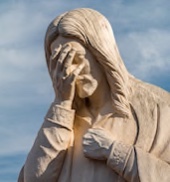
There is a statue in Oklahoma City called “Jesus Wept.”  It is on the grounds of St. Joseph Church in the city – which is right across from where the Oklahoma City Federal Building had been located.  The people of the parish wanted to erect the statue on their grounds because the memorial on the federal property couldn’t be religious.  It is a very moving statue.

Breath and Life Eternal

Wednesday of the Thirty-third Week in Ordinary Time

November 20, 2019

Click here for readings

2Mc7_23

Today, in Mercy, our two readings are dramatically intense. 

Who can read the story of the Maccabean Martyrs without a mix of horror, empathy, and astonishment?

And don’t we all feel a pang of pity for the poor, fearful servant who hid his talent in a handkerchief much to the King’s displeasure?

The two stories, (one based in fact, the other a parable), paint a contrasting picture of courageous faith against fearful subservience. The difference between the actors lies in their capacity, or lack there of, to look beyond themselves toward eternal life.

Mother Maccabee bolsters her sons with her faith in a life beyond their current circumstances:

… the Creator of the universe
who shapes each man’s beginning,
as he brings about the origin of everything,
he, in his mercy,
will give you back both breath and life,
because you now disregard yourselves
for the sake of his law.

The poor soul in Jesus’s parable doesn’t have that faith and vision. His perception of God, represented by the King, is one of only harsh judgement. His fear causes him to bury not only his talent, but also his openness to the possibilities of grace and transformed relationship with God.

Jesus told his parable because indeed the Kingdom was at hand. He and his disciples were near Jerusalem where the Passion, Death and Resurrection events would begin.

He wants his followers to realize the challenging gift they have been given in their call to be his disciples. He wants them to see that it is now on them to magnify his message courageously and generously until he returns to perfect the Kingdom.

He wants us to understand that too.

Music:   Be Not Afraid – written by Bob Dufford, SJ, sung here by Cat Jahnke

Who Will Stand in the End?

Thirty-third Sunday in Ordinary Time

November 17, 2019

Click he for readings

Today, in Mercy, our readings carry the full flavor of the “end times” warnings, those repeated annually as we move closer to Advent ( which is only two weeks away!)

Malachi is very direct:

Lo, the day is coming, blazing like an oven,
 when all the proud and all evildoers will be stubble…

Wow! Really? Our reaction might range from “Good! Go get ‘em, God!” to “Oh, dear God, I hope it’s not me!!!”.

But Paul resets us on the right track. He says something like this:

Listen! You must imitate your teachers in Christ.
Live with integrity, justice and generous mercy.
Navigate the world with these as your compass.
Then you will welcome the end times.


Lk21_19 perseverance

In our world, we see the opposing forces of good and evil clearly pulling against one another. In our decisions and attitudes, we are confronted with the choice between sin and selflessness.

The “elephant in the room” this week for many of us is the impeachment hearings. How do we view this event as people of Gospel faith? How do we respond?

elephant

While some of us believe strongly in separation of Church and State, still we acknowledge that our FAITH is exercised in a political world. We pursue our full conversion in Christ through “polity“:  our just and compassionate interactions with all Creation.

Right in front of us this week, we have seen  amazing displays of courage and morality standing against venal self-interests. How does what we see align with our own living of justice and mercy?

Political scientist Harold Lasswell defined politics as “who gets what, when, and how“. If this isn’t the same challenge tackled in the Gospel, I don’t know what is! Jesus said that the poor and disenfranchised should be the first to “get” – through peace, love and mercy. Making that happen is our Christian call.

However, it is likely impossible to communicate God’s vision for the world in the language of politics.  Walter Brueggemann says this:

The prophet’s task is to imagine the world as though Yahweh, the God of Israel and the creator of heaven and earth, were a real character and a lively agent in the life of the world.  I believe that such a claim, then and now, has to be articulated poetically in order not to be co-opted by political absolutism or theological orthodoxy.
~Walter Brueggemann 

Our readings today give us this poetic vision and challenge. Read them with great longing to hear God’s voice for our times. The world so sorely needs the answer that will grow in our souls.

Music:  Let Justice Roll

Midnight Miracle

Saturday of the Thirty-second Week in Ordinary Time

November 16, 2019

Click here for readings

Today, in Mercy, we are blessed with some of the most gloriously imaginative images in Scripture:

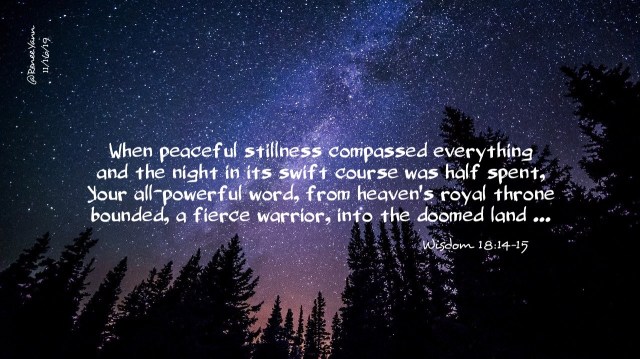
wis18_midnight

Although the passage is a poetic recounting of the Exodus experience, it always makes me think of Christmas. 

  • Midnight on a starry night
  • Peaceful stillness over the earth
  • The all-powerful Word transformed 
  • Appearing among us like a comet in our darkness
  • Hope renewed for an otherwise doomed land

Praying with the passage this morning, I realize that my “Christmas lens” on the reading is right on target.

The Christmas event begins our Exodus story, a story completed in the Passion, Death and Resurrection of Christ.

Just as the God of Moses reached into ancient Israel’s life to free them, transform them and make them God’s People, so God reaches into our lives. God does this not only on Christmas, but in every moment of our experience.

As our media and consumer culture bombards us, all too early, with all the secularized images of Christmas, let today’s verses bring us back to the true startling grace of our own Christ/Exodus stories:

We are not alone in the midnights of our lives.
Listen underneath all the distractions
to the, at first, softly emerging sound of Love
humming under all things.
Watch for the small lights of heaven
longing to break into our human darkness.
Give yourself to their Light.

No matter where we are in our lives right now,
no matter the joy or pain of our present circumstances,
God wants to use these realities to be with us
and to teach us Love.
Let us invite God
into our willingness
to learn that Love,

to become that Love.


Music: Winter Cold Night – John Foley, SJ

Lyrics below (yes, it is an Advent/ Christmas song. But it fits so perfectly. Please forgive me if I am rushing the season too.🤗)

Dark, dark, the winter cold night. Lu-lee-lay.
Hope is hard to come by. Lu-lee-lay.
Hard, hard, the journey tonight. Lu—lee-lay.
Star, guide, hope, hide our poor, winter cold night.

And on earth, peace, good will among men.

Lean, lean, the livin’ tonight. Lu-lee-lay.
Star seems darker sometimes. Lu-lee-lay.
Unto you is born this day a Savior.
Pain, yes, in the bornin’ tonight. Lu lee—lay.
Star, guide, hope, hide our poor, winter cold night.

Vultures Forecasted!

Friday of the Thirty-second Week in Ordinary Time

November 15, 2019

Click here for readings

Today, in Mercy, our scripture message is blunt. If yesterday’s sweet words from Wisdom were like “rich toffee for the spirit”, today’s are more like a double shot of bourbon for the mind.

toffeebourbon

Basically our first reading says “Yes”- creation is magnificent, but not as magnificent as its Creator! You, learned humans, how could you have gotten stuck only half-way to that truth? How did you end up making gods from the very things that were supposed to show you the one true God?

In our Gospel, Jesus speaks even more starkly. He describes the “end times” when “one will be taken and the other left”. That reading  always scared me as a child and, to be honest, still scares me a little. The popular “rapture literature” has monopolized on that fear. Nobody likes the idea of their buddy, sitting right beside them eating ice cream, suddenly disappearing, right?

vultureAnd I guess Jesus actually was trying to strike a little healthy fear into his listeners too. He told them the vultures were already gathering. It’s late in the game. Get your act together.
Early Christians thought a lot about the end times. They expected them to come quickly after the Resurrection. Well, 2000 years later, our obsession may have cooled somewhat. 

Nevertheless, an end will come to this life as we know it. And wouldn’t it be a shame if we had spent our precious worship on false and distracting gods like money, fame, power, luxury and self-aggrandizement?

“Wouldn’t it be a shame”, as one of our dear Sisters once said, “to come to the end of your life and realize you had missed the whole point?”

 Music: One True God – Mark Harris

The Hearings

Memorial of Saint Frances Xavier Cabrini, Virgin

November 13, 2019

Click here for readings

Today, in Mercy, as the first public impeachment hearings begin, our readings seem eerily in synch with current events.

First of all, the hearings begin on the date we celebrate Frances Xavier Cabrini, first naturalized citizen of the United States to be canonized by the Roman Catholic Church. 

As I write about her, the US Supreme Court opens the DACA hearings, testing three cases against the Trump administration’s decision in 2017 to end deportation protections for so-called Dreamers. The Court will decide whether the decision to end the program was based on legally sound reasons.
(The Deferred Action for Childhood Arrivals (DACA) program, which grants deferral from deportation and work permits to nearly 700,000 undocumented immigrants who arrived in the country as children.)

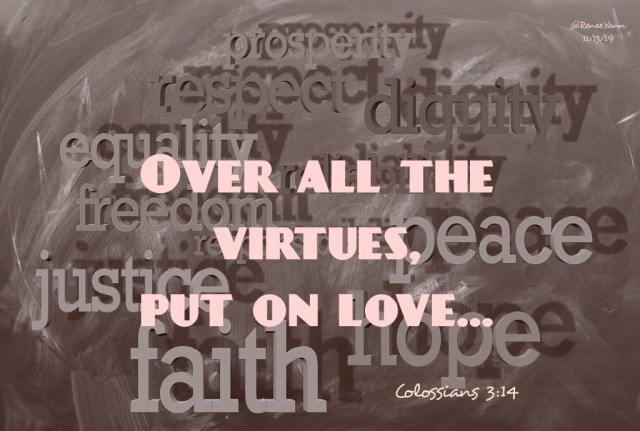
Col3_14 put on love

Our first reading from the Book of Wisdom is crystal clear about the moral responsibilities of leaders to act with justice tempered by mercy, and always to exhibit special concern for the poor and marginalized.

Using these scripture verses, Pope Leo XIII wrote two of his many compelling encyclicals. His writings, and the entire legacy of Catholic Social teaching, guide us as we discern who, how, and why to use our voting power to advance justice for all people.

The following excerpts, though a little long, are well worth our attention to provide a foundation for our prayer during these strained partisan times. Perhaps we might pray them in short doses over the course of these hearings.

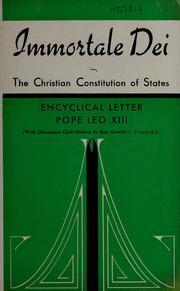
from: Encyclical Letter Immortale Dei, Pope Leo XIII

immortale

They, therefore, who rule should rule
with evenhanded justice, not as masters,
but rather as parents,
for the rule of God over humanity is most just,
and is tempered always with a parent’s kindness.

Government should, moreover, be administered
for the well-being of the citizens,
because they who govern others possess authority
solely for the welfare of the State.
Furthermore, the civil power must not be subservient to
the advantage of any one individual or of some few persons,
inasmuch as it was established for the common good of all. 

But, if those who are in authority rule unjustly,
if they govern overbearingly or arrogantly,
and if their measures prove hurtful to the people,
they must remember that the Almighty
will one day bring them to account,
the more strictly in proportion to the sacredness of their office
and preeminence of their dignity.


Diurturnum

from: Encyclical Letter of Pope Leo XIII, Diuturnum

But in order that justice may be retained in government,
it is of the highest importance that those who rule States
should understand that political power
was not created for the advantage of any private individual;
and that the administration of the State
must be carried on to the profit of those
who have been committed to their care,
not to the profit of those to whom it has been committed. 

On this account
they are warned in the oracles of the sacred Scriptures,
that they will have themselves some day to render an account
to the King of kings and Lord of lords;
if they shall fail in their duty,
that it will not be possible for them in any way
to escape the severity of God:
“The Most High will examine your work
and search out your thoughts:
because being ministers of his kingdom
you have not judged rightly…
Horribly and speedily will he appear to you,
for a most severe judgment shall be for them that bear rule…
For God will not accept any man’s person,
neither will he stand in awe of any man’s greatness;
for he made the little and the great,
and he hath equally care of all.
But a greater punishment is ready for the more mighty”


Music: O Lord, the Clouds Are Gathering – Graham Kendrick

Want to Shine?

Memorial of Saint Josaphat, Bishop and Martyr

November 12, 2019

Click here for readings

Today, in Mercy, as we remember St. Josephat, our readings instruct us on what it means to be God’s faithful servant.

Josephat was. 

A 17th century saint born in Lithuania, Josephat was a humble and self-sacrificing Bishop. But his life was embroiled in the social and religious unrest subsequent to the Union of Brest.

(The Union of Brest, was the 1595-96 decision of the Ruthenian Orthodox Church eparchies (dioceses) in the Polish-Lithuanian Commonwealth to break relations with the Eastern Orthodox Church and to enter into communion with, and place itself under the authority of, the Roman Catholic Pope. – Wikipedia)

To a much greater degree than it would today, such a decision carried immense political import, creating the deadly oppositions to which Josephat ultimately lost his life.

Read Josephat’s story here.


Our first reading today, which is so familiar from the funerals we’ve attended, reminds us that all our lives will eventually return to God (hopefully not so dramatically as Josephat’s did).

Our Gospel too enjoins us to live humble, grateful lives of service, recognizing that everything we have and are belongs to God:

Is the Master grateful to that servant
because he did what was commanded?

So should it be with you.
When you have done all you have been commanded, say,
“We are unprofitable servants;
we have done what we were obliged to do.”

If we do this, we shall be blessed as described in Wisdom:

Those who trust in him shall understand truth,
and the faithful shall abide with him in love:
Because grace and mercy are with his holy ones,
and his care is with his elect.

Wisdom3_7 sparksJPG


These are sobering but necessary thoughts. As I write today (on November 11th), I think of the humble servant Catherine McAuley who died on this date in 1841. She has certainly sent sparks through the stubble. On this Veterans’ Day, I think of all who have died in war. I think of our Sister-veterans, Sister Bernard Mary Buggelein and Sister Dorothy Hillenbrand who served in WWII and now rest in our community cemetery. All of their lives have been called into the great embrace of our Eternal God. May all our lives inspire one another to humble service and praise.


Music: The Souls of the Righteous – Geraint Lewis, sung by Jesus Choir- Cambridge

The souls of the righteous are in the hands of God,
and the pain of death shall not touch them.
To the eyes of the foolish, they seemed to perish,
but they are in peace.

Wisdom 3:1-3