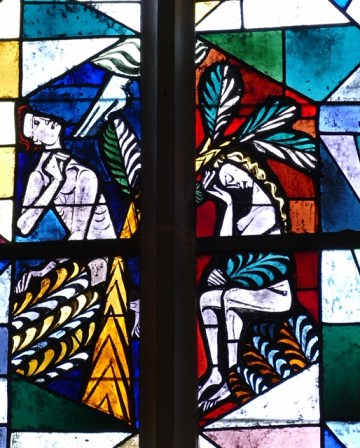
Today, in Mercy, Paul contrasts the sin of “Adam” to the gift of Jesus, demonstrating the specifics of Christ’s redemptive act.
A key phrase for our prayer might be the following. The concupiscence of human nature will always make the sinful choice a possibility. But we can gain courage and strength from this powerful line from Paul:
Where sin increased, grace overflowed all the more….
Jesus teaches a lesson about perseverance in the spiritual life. He says if we stick with it, God will welcome us the way a generous master thanks and embraces a loyal servant. He adds a comforting thought for those of us of “a certain age”.
And should he come in the second or third watch and find them prepared in this way, blessed are those servants.
Yesterday, I attended a 95th birthday party for my Mistress of Novices. Fifty plus years ago, she guided a gaggle of hopeful and naive young nuns toward the depths of the spiritual life. She didn’t do it by words alone. She did it by faithful, humble, steadfast and joyful living in the Presence of God. Now, in the third watch, she is still doing the same thing – and she has done it for all the years in between…indeed, a blessed servant!
Sister Catherine Rawley, RSM Happy 95th Birthday
This is what Jesus is talking about today. Look around you and see the parables alive in your own life, your own history, your own heart.
Music: Song of a Faithful Servant
(A simple, childlike song. Please excuse the spelling. There’s no way for me to fix it although I desperately want to)
Today, in Mercy, Paul counsels us to be steadfast in our faith. Jesus counsels us to avoid greed. How might the two be connected?
Paul lauds Abraham whose faith convinced him that God’s promise to him would be fulfilled. Jesus promises us eternal life in a realm apart from any earthly treasure. If we believe in Jesus’s promise, we realize the futility of possessiveness, greed and consumerism.
That’s a really hard call in our society. Every type of media conspires to convince us that we are not enough as we are. We need a better car, house, clothes, haircut, and on and on to make us “acceptable”. Populism and racism ingrained in our politics convince us that we need to be a certain color, nationality, religion, speak a certain language to be worth anything.
Jesus says NO. You are beautiful as I created you. And you already have everything you need to merit my promise of eternal life. You have only one need in this world — to love yourself and one another so that my promise can be released in you and in all Creation.
Today, in Mercy, our scripture readings are a little heavy. I had to dig to get my inspiration. But there are gems in these dense words!
It was not through the law that the promise was made to Abraham and his descendants that he would inherit the world, but through the righteousness that comes from faith.
This is a spiritually freeing passage. It assures us that God is with us through our faith, not through the perfection with which we keep laws and rules.
Our Gospel reinforces the message:
Everyone who speaks a word against the Son of Man will be forgiven, but the one who blasphemes against the Holy Spirit will not be forgiven
The passage is a little scary when first read, because we all hope we haven’t done anything to offend the Holy Spirit. But what Jesus is telling his listeners is this:
If a person criticizes or rejects my life and teaching, forgiveness is still possible when they come to their senses and repent. It’s like cutting the bad spot out of an otherwise good apple.
But if a person chooses to live a life which blasphemes (mocks, dismisses) the Spirit of life, love, mercy and peace, that person can never be forgiven — because they can never repent. They will be rotten to the core.
So the advice of Paul and Jesus boils down to this, I think. Befriend the Holy Spirit by your life of faithful choices. Listen to Her inspiration. Help others to do the same. And do not worry. when you make a few mistakes. God stands by the promise to be with us always.
Today, in Mercy,Paulmakes clear that Jesus came to redeem ALL people.
For there is no distinction; all have sinned and are deprived of the glory of God. They are justified freely by his grace through the redemption in Christ Jesus…
This is the magnificent message of the Good News, the Gospel, to which Paul dedicated his apostolic life.
We celebrate another champion of the Gospel today in St. Ignatius of Antioch, (not to be confused with the 16th century founder of the Jesuits, Ignatius of Loyola.)
St. Ignatius of Antioch lived just a short time after Paul, dying in 107 BC. Like Paul, Ignatius was martyred in Rome. He too wrote many letters to his Church, although these are not included in the Bible.
Christianity is not a matter
of persuading people of particular ideas,
but of inviting them to share in the greatness of Christ.
So pray that I may never fall into the trap
of impressing people with clever speech,
but instead I may learn to speak with humility,
desiring only to impress people with Christ himself.
Ignatius lived a life of humble, faithful witness. He took to heart the cautions Jesus offers in today’s Gospel to those who teach and preach about faith:
Woe to you, scholars of the law! You have taken away the key of knowledge. You yourselves did not enter and you stopped those trying to enter.
We are all called to preach the Gospel by the witness of our lives. May we have humility,courage and insight like that of Ignatius, so that we make it easier, not harder, for people to come to God.
Today, in Mercy, we have our second passage from Joel. It’s a awe-filled reading which describes Yahweh calling together the nations for final judgement. The gathering is to take place in the valley between the Temple Mount and the Mount of Olives.
From his poetic imagination, Joel describes the apocalyptic scene:
Apply the sickle, for the harvest is ripe; Come and tread, for the wine press is full; The vats overflow, for great is their malice. Crowd upon crowd in the valley of decision; For near is the day of the LORD in the valley of decision.
It is a place where the Lord decides who, by their decisions, belongs to God and who does not. Those who have suffered, even shed blood to remain faithful – these are God’s holy ones. They will receive the reward.
What can we learn from this reading which grew out of Israel’s experience so long ago? How can we relate to a “valley” on the other side of the world?
That awesome valley runs right down the middle of our heart. It is the place within every moment where we decide for God or for self. On one side, its high ridges call us to greed, irresponsible self-interest, manipulative relationship, indifference to others’ suffering.
On the other side, the heights of love, mercy, and justice stretch before us.
We will stand in that valley innumerable times in our lives. Which way we have chosen to climb makes all the difference when the final trumpet sounds.
Music today is a stretch. But I think Joel’s vivid prophesying was a stretch for his people too. The song is “Valley of Decision”, a reggae worship sung. It is sung by Christafari, a Christian convert from Rastafarianism. We all come to God in different ways. I was fascinated and inspired by this singer’s own choice from his “Valley of Decision”. (Words below)
VALLEY OF DECISION Joel 3:14-21
(Chorus):
Run come and fall people take heed to His call,
Valley of Decision. Valley of Decision.
This is no game, people have to die in His name
Valley of Decision. Valley of Decision.
Darkness it looms all around us, I find it hard to see.
I don’t know, I don’t know, I don’t know, I don’t know, I don’t know
whether I should stay or whether I should flee.
People all around me seem, they seem to be so sad.
I see them cry I hear them bawl I see their backs against the wall,
I wish I could wipe away their tears.
(Pre Chorus):
There’s a Holy, a Holy hill, Holy Mount Zion,
Holy, Holy Mount Zion (Heb 12:22).
Just know that He’s the Lord your God
in this Valley of Decision, Valley of Decision.
Chat Chorus):
Even though I run through enough Hills and Valleys
I fear no evil cause God is with me.
Even though I run through enough Hills and Valleys
Thy rod and staff they will comfort me (Psalm 23:4). (2x)
(Chorus)
(Pre Chorus)
(Chat Chorus)
Jah (Yahweh) Great and dreadful day will soon come (Joel 2:11).
Jah will pour out His mighty, mighty, mighty Spirit to all mankind (Acts 2:17).
Through Him all creation, all creation was made (John 1:3).
Those who call upon His name, Call on His name and you will be saved (Rom 10:13).
Today, in Mercy, we read from the Book of Baruch, a little book with a big punch. Baruch authored “scribal literature”, that which completed the message of another writer. Baruch was Jeremiah’s scribe, working to finish the edges of this most complex of the prophets.
Our reading today reflects this complexity. The Israelites have a history of intertwined faith and faithlessness. They also have current overwhelming sufferings. How does the prophet employ these two realities to impel hearts toward God?
Baruch characterizes God as angry and vengeful, punishing the people for their idolatry. It’s a model that works for Baruch’s time and purposes. But it’s not the God I know and love. So how can the passage speak to me?
The core of Baruch’s message is that things can be really bad sometimes in life, but that God is with us even in those times. Our turning to God in trust and patience will allow us to remain faithful and to deepen spiritually even in suffering. That fidelity brings joy and peace.
It’s hard to have that kind of faith. We want to manage our lives, and even manage God, in order to make sense of the chaos of life – to provide sensible, rectifiable reasons for suffering and evil.
We want to control demons like the early disciples did.
In our Gospel, these disciples return from their missionary trips all puffed up with their powers over evil. Jesus cautions them saying that’s not at all what it’s all about. Any miraculous power they have in a given moment is only a sign of a Greatness beyond them.
Instead, their names a written in Heaven by the long, unshakeable fidelity that comes with keeping their eyes on God; by giving themselves to the mysterious, sometimes hidden, presence of God in every reality; by allowing that Presence to transform them and their circumstances.
(Speaking of prophets, a beautiful poem, Advice to a Prophet, came across my email today thanks to Joe Riley at Panhala. The poem is fitting as we close this Season of Creation. I will include it in a second post in case you’d like to read it.)
Music:a little revival music today, New Name Written Down in Glory. Picture the disciples singing this after Jesus instructs them in today’s Gospel.
Today, in Mercy, Ezra and Nehemiah gather all the People for a gargantuan spiritual renewal! It is the People themselves who request this renewal, realizing that they have drifted from the Law and desiring to ritualize their return to it.
It seems fitting that this reading comes just after the Jewish celebration of Rosh Hashana (from sundown on Sunday, September 29 until sundown on Tuesday, October 1, 2019.) This feast marks the beginning of the Jewish High Holy Days.
One of the lessons Christians can take from today’s passage is awareness of the great power and gift of God’s Word. Ezra’s community was changed by listening to that Word with open, repentant hearts.
In our Gospel, Jesus sends his disciples out to preach that Word, now transformed by the power of his Incarnation. He tells them to preach that “the Kingdom of God is at hand!”
Just this week, Pope Francis has taken steps to rekindle our appreciation of the Word. By declaring the Third Sunday in Ordinary Time as the Sunday of the Word of God, our Pope wants to help us grow in love and devotion to Sacred Scripture.
(Personally, I welcome this focus. At the time of the Second Vatican Council, there was a new and deepened awareness of the gift of Sacred Scripture. As a young religious, that awareness was central to my spiritual formation. Since that time, there seems to have been an unfortunate shift away from that emphasis. I see the Pope’s declaration as a welcome corrective to that shift.)
Pope Francis has designated the day “to the celebration, study and dissemination of the word of God “ so as to help the Church “experience anew how the risen Lord opens up for us the treasury of his word and enables us to proclaim its unfathomable riches before the world’.
May we gratefully respond!
(See below the music : If you are interested, I have copied a very good excerpt from Pope Francis Apostolic Letter.)
Music: We Come to Hear Your Word – Chris Jubilee
Below is an excerpt from the Pope’s Apostolic Letter APERUIT ILLIS -INSTITUTING THE SUNDAY OF THE WORD OF GOD. I found it to be helpful in understanding the Pope’s intent with this feast:
With this Letter, I wish to respond to the many requests I have received from the people of God that the entire Church celebrate, in unity of purpose, a Sunday of the Word of God.
It is now common for the Christian community to set aside moments to reflect on the great importance of the word of God for everyday living. The various local Churches have undertaken a wealth of initiatives to make the sacred Scripture more accessible to believers, to increase their gratitude for so great a gift, and to help them to strive daily to embody and bear witness to its teachings.
The Second Vatican Council gave great impulse to the rediscovery of the word of God, thanks to its Dogmatic Constitution Dei Verbum, a document that deserves to be read and appropriated ever anew. The Constitution clearly expounds the nature of sacred Scripture, its transmission from generation to generation (Chapter II), its divine inspiration (Chapter III) embracing the Old and New Testaments (Chapters IV and V), and the importance of Scripture for the life of the Church (Chapter VI).
To advance this teaching, Pope Benedict XVI convoked an Assembly of the Synod of Bishops in 2008 on “The Word of God in the Life and Mission of the Church”, and then issued the Apostolic Exhortation Verbum Domini, whose teaching remains fundamental for our communities.[1] That document emphasizes in particular the performative character of the Word of God, especially in the context of the liturgy, in which its distinctively sacramental character comes to the fore.[2]
It is fitting, then that the life of our people be constantly marked by this decisive relationship with the living word that the Lord never tires of speaking to his Bride, that she may grow in love and faithful witness.
Consequently, I hereby declare that the Third Sunday in Ordinary Time is to be devoted to the celebration, study and dissemination of the word of God. This Sunday of the Word of God will thus be a fitting part of that time of the year when we are encouraged to strengthen our bonds with the Jewish people and to pray for Christian unity. This is more than a temporal coincidence: the celebration of the Sunday of the Word of God has ecumenical value, since the Scriptures point out, for those who listen, the path to authentic and firm unity.
Today, in Mercy,Zechariah channels God, with the most intense of human emotion.
The prophet wants Israel to have some understanding of God’s infinite love and hope for them, so he puts these words in God’s mouth:
I am intensely jealous for Zion, stirred to jealous wrath for her.
Like a spouse longing for a lost beloved, God longs for the restoration of Israel to the Divine embrace.
Wherever our relationship with God is frayed or broken, God is jealous for us too. If we can turn our hearts in repentance, prayer, and hope, we too will hear God’s longing for us.
In our Gospel, Jesus tries to refocus his disciples on that loving call. In a classic example of missing the obvious, they are distracted over who is the most important. Here is the Lord of all sitting beside them, and they are arguing about their personal status!
By pointing to a child in their midst, Jesus reminds his followers of the innocence and transparency we need in order to open ourselves to God.
Let’s pray for that openness today so that we can hear and rejoice in a promise such as Israel heard through Zechariah:
You shall be my people, and I will be your God, with faithfulness and justice.
Today, in Mercy, our readings will challenge us in ways we might rather not hear.
In our first reading, feisty Amos lambastes the Israelites for their sumptuous lifestyle which is indifferent to the plight of those who are poor. He calls them “complacent”, “at ease” in their prosperous, privileged existence, a condition that has numbed them to the harrowing inequities from which others suffer.
In our second reading, Paul gives a final, impassioned charge to his dear protégé Timothy. He tells him not just to avoid, but to flee such complacency and the greedy materialism which feeds it. He outlines the elements of a Christian life, enjoining Timothy to “pursue righteousness, devotion, faith, love, patience, and gentleness”.
Paul gives Timothy the key to true Christian life:
Keep the commandment without stain or reproach …
…. “the commandment” being to love God above all, and love neighbor as self.
Dives and Lazarus by Bonifazio di Pitati The National Gallery – London
Our Gospel is, perhaps painfully, familiar to all of us – the story of Lazarus and Dives. It is a parable which puts the economic divide under the crystalline light of the Gospel, challenging us as to where we fit in it.
Most of us like comfort. We would rather be “haves” than “have nots”. But we struggle within our comfortable lives to discern our responsibility for others. We’re certainly not intentionally hard-hearted, “lying on ivory couches” and “drinking wine from bowls” while modern day Lazarus languishes right beside us.
We do try, in many ways, to respond to the call for charity and service. But don’t we still measure ourselves after hearing this Gospel? Don’t we still worry about any “Lazarus” unnoticed at our door?
Amos, Paul, and Jesus are charging us – just as they charged their immediate listeners – to live a life based in Biblical and Gospel justice. Justice seeks fullness of life for all the community. Jesus teaches us that “the community” is all Creation, and that how we treat the community is how we treat him.
Every day we might remind ourselves that, however hard we try, it is never enough. We must keep on peeling away any indifference or blindness we have to the injustices of our culture and times, our economic and political systems. And we too must flee them, running toward justice, righteousness, and mercy.
We must ask ourselves this hard question:
Does my “wealth” – however large or small, material or immaterial- nourish the community or only consume it?
Music: Five Variants of Dives & Lazarus – Ralph Vaughn Williams’s beautiful interpretation of the folk song “Dives and Lazarus”.
If you might be interested in the original song – a great example of folk art: Sung here by Maddy Prior (Lyrics below)
as it fell out upon one day
rich Diverus he made a feast
and he invited all his friends
and gentry of the best
then Lazarus laid him down and down
even down at Diverus’ door
some meat, some drink, brother Diverus
do bestow upon the poor
thou art none of mine, brother Lazarus
that lies begging at my door
no meat, no drink I’ll give to thee
nor bestow upon the poor
then Lazarus laid him down and down
even down at Diverus’ wall
some meat, some drink, brother Diverus
or with hunger starve I shall
thou art none of mine, brother Lazarus
that lies begging at my wall
no meat, no drink I’ll give to thee
but with hunger starve you shall
then Lazarus laid him down and down
even down at Diverus’ gate
some meat, some drink, brother Diverus
for Jesus Christ His sake
thou art none of mine, brother Lazarus
that lies begging at my gate
no meat, no drink I’ll give to you
for Jesus Christ His sake
then Diverus sent out his serving men
to whip poor Lazarus away
they had no power to whip one whip
and they threw their whips away
then Diverus sent out his hungry dogs
to worry poor Lazarus away
but they had no power to bite one bite
and they licked his sores away
as it fell out upon one day
poor Lazarus sickened and died
there came two angels out of Heaven
his soul thereto to guide
rise up, rise up brother Lazarus
come along with me
there’s a place for you in Heaven
sitting on an angel’s knee
as it fell out all on one day
Diverus sickened and died
there came two serpents out of Hell
his soul thereto to guide
rise up, rise up brother Diverus
come along with me
there is a place for you in Hell
sitting on a serpent’s knee
Diverus lifted up his eyes and he saw poor Lazarus blessed
a drop of water brother Lazarus
for to quench my flaming thirst
if I had as many years to live as there are blades of grass
I would make it in my will secure
that the Devil should have no power
Hell is dark, Hell is deep Hell is full of mice
it’s a pity that any poor sinful soul should be barred from our saviour Christ
Today, in Mercy, we begin a few weeks of readings from the minor prophets – Zechariah being today’s writer.We also continue with Luke’s Gospel which will take us through to the season of Advent.
The combination of readings today brought to my mind a treasured and bittersweet quote from our beloved founder:
Zechariah writes for a community with a foot in both worlds – joys and sorrows. They are freed from captivity but burdened with its harsh memory. They have committed in hope to the rebuilding of the temple, but they are filled with doubts about their ability to deliver. They have a plan for their restoration, but realize that God’s plan is beyond their imagination. They see a protected, walled-in future. God sees a “Jerusalem” without walls, circled only by the fire of God’s love.
Zechariah tells them to let go and fall into God’s Imagination, no matter how scary that might be for them:
People will live in Jerusalem as though in open country, because of the multitude of men and beasts in her midst. But I will be for her an encircling wall of fire, says the LORD, and I will be the glory in her midst.
In our Gospel, Jesus has begun to gently hint that the disciples’ future may not be as they would like to imagine. At this point in the Gospel story, joys are running pretty high- lots of miracles, crowds growing, the awesomeness of the Transfiguration still lighting up their dreams.
But Jesus drops a little reality, a little sorrow into the mix:
Pay attention to what I am telling you. The Son of Man is to be handed over to men.
The disciples don’t fully comprehend the warning. It is too much for them to take. We understand, don’t we? Is there anything harder to swallow than sorrow, loss, the crash of a bright dream?
Remembering Zechariah ‘s words may strengthen us when the mix of sorrow seems too much for us:
But I will be for her an encircling wall of fire, says the LORD, and I will be the glory in her midst. … Sing and rejoice, O daughter Zion! See, I am coming to dwell among you, says the LORD.
Music: Where Joy and Sorrow Meet – Ultimate Tracks




 Lavish Mercy