The Scripture of Our Lives

Monday, August 13, 2018

Readings: http://www.usccb.org/bible/readings/081318.cfm

Ez1 boing

Today, in Mercy,  in our first reading, Ezekiel signals that something really important has happened. He does this by means of a prophetic word formula – repeated and patterned phrases found throughout the Bible. 

One pattern that we’re accustomed to is, “Amen, Amen, I say to you..” Jesus used it to say, “Listen up! Important info to follow!”

Another pattern is the specific setting of time and place to mark an event as pivotal. One such beloved phrase: “It came to pass in those days, that Caesar Augustus issued a decree that a census should be taken of the entire Roman world.

Ezekiel’s formulaic phrase is a marker in his spiritual life: 

On the fifth day of the fourth month of the fifth year,
that is, of King Jehoiachin’s exile,
The word of the LORD came to the priest Ezekiel…

If we look back over our own lives, we will remember moments when God clearly entered our experience. We may not have realized it until long after. We may be surprised to remember a point in time as the opportunity God took to embrace us. But through reflective prayer, we begin to see that God is with us, even in our darkest moments, bringing the revelation of God’s infinite Love and Mercy.

What if we filled in the blanks in Ezekiel’s formula with our own life markers? What if we thanked God for each of them, dark or light – asking for the grace to understand their revelation?

Each of our lives is its own scripture, telling the story of God’s love and presence. Spend time with yours today.

Music: God of All My Days ~ Casting Crowns
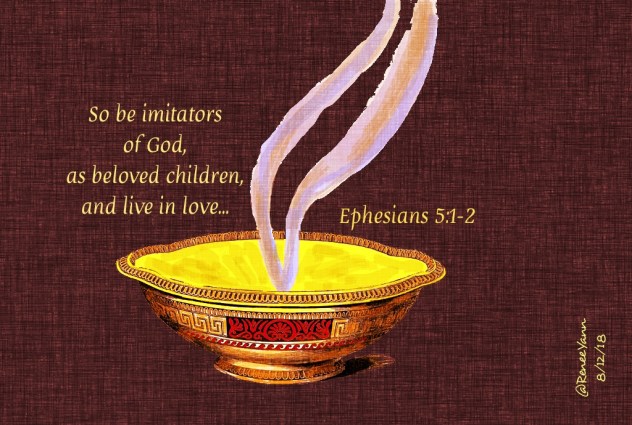
Live in Love

Sunday, August 12, 2018

Readings: http://www.usccb.org/bible/readings/081218.cfm

Eph 5_1 live in love

Today, in Mercy, our readings capture the essence of life in God through Christ.

The first reading from Kings tells how Elijah, after eating the food God had provided him, was able to endure the long journey to God’s mountain.

In today’s Gospel passage, Jesus makes clear that no one makes that journey into the heart of God unless God calls us. But Jesus says that the invitation is given to all who believe. He says that, just as with Elijah, the Father gives us food – Jesus himself – the bread of life.

The second reading from Ephesians says that we have already “been sealed for the day of redemption through the Holy Spirit.” Paul says that, given this amazing gift, we have only one job:

So be imitators of God, as beloved children,
and live in love,
as Christ loved us and handed himself over for us
as a sacrificial offering to God for a fragrant aroma.

We are so accustomed to hearing these astounding passages that we may miss how astounding they really are. But Macrina Wiederkehr says:

When Jesus’ words begin to sound naive to our 21st century minds, let us look through the words, in between the words, underneath for a deeper truth.

Pierre Teilhard de Chardin, the great Jesuit mystical theologian, upon reading these passages,saw the mystery of the Body of Christ. He saw our call to be the heart of Christ in the world. He saw Christ’s promise to become one with us in Eucharist. He saw that, through this Infinite Love played out in our ordinary lives, God continues to redeem Creation.

In each soul,
God loves and partly saves the whole world
which that soul sums up
in an incommunicable and particular way.
~ The Divine Milieu ~

Music: Quintessence – Spencer Brewer

May this lovely instrumental piece help take us to a deeply prayerful place as we contemplate God’s gift in Jesus.

Did You Say, “Die”?

Friday, August 10, 2018

Readings: http://www.usccb.org/bible/readings/081018.cfm

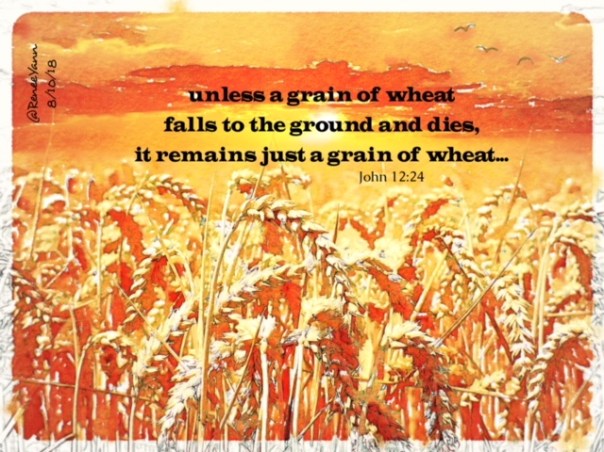
Today, in Mercy, on this feast of St. Lawrence, our readings are all about wheat. Then, again, they’re really not.

John 12_24 grain

The readings, of course, are about eternal life – lessons taught in symbols the listeners could relate to. The agrarian community of Jesus’ time understood clearly what happened to a grain of wheat when buried in the rich soil. They understood, too, how a single grain, fallen on the barn floor and lost underfoot, had no hope of life.

It is a powerful lesson about community, selflessness, and what we need to do to live a full and meaningful life. 

We have to die —  to our isolation, self-absorption, greed, objectification and domination over others, “me-firstness”. 

Basically, we have to resist the Seven Deadly Sins that make life “all about me”: 

  • Self-adulating pride
  • Vengeful anger
  • Depersonalizing lust
  • Ungrateful envy
  • Consumeristic gluttony
  • Mean Greed
  • Irresponsible laziness

To move beyond these sins, we must recognize, respect and care for others – all others – as children of God.

If we can do that, our grain of wheat will land in harmony with the faith community and will contribute to its abundant life – and to our own. That faith community might be as small as my family or as big as the world. But unless I live there in selflessness, I will never come to my full potential a human being.

Musical reflection: A Grain of Wheat ~ Torchbearers

This Ancient Love

Wednesday, August 8, 2018

Readings: http://www.usccb.org/bible/readings/080818.cfm

Today, in Mercy,  our readings focus on the infinite mercy of God — the Lavish Mercy of God.

ancient love Jer 31_3

Jeremiah speaks God’s voice to the ancient Israelites, forgiving them, consoling them, encouraging them. He promises that, delivered from their captivity, they will rejoice and “come streaming into the Lord’s blessings”.

In our Gospel, even an outcast woman receives the mercy of Jesus. She received this for two reasons: her faith was both extraordinary and unrelenting for her daughter.

Both Israel and the Canaanite woman are in desolate situations. They are bereft of nearly everything but hope and faith. We may have felt like that sometimes. Certainly there are people throughout our world who feel like that today.

As we pray today, we can place any desolation we are carrying, and the desolation of suffering people across the world, into the open arms of God. God has and will always love us and, even though unseen, is guiding us to the fullness of life. May our faith be extraordinary and unrelenting.

Music: This Ancient Love ~ Carolyn McDade

I’m Hungry!!

Sunday, August 5, 2018

Readings: http://www.usccb.org/bible/readings/080518.cfm

“Don’t we have anything decent to eat around here?” “There’s nothing to eat in this house !”  

How many times do parents hear these complaints from their growing teenagers! The problem? They’re not looking for the apples, or eggs, or yogurt, or avocados which actually are in the fridge. They’re looking for junk!

Bread of Life

Today’s first reading reflects a similar situation with the Jews in the desert. They are hungry, but not for the spiritual food Yahweh is offering them. They complain continuously. So God relents, feeding them manna and quail. But God is clear. He says, “I have done this so that you may know I am the Lord, your God.”

In the Gospel, Jesus admonishes his listeners, “Do not work for food that perishes but for the food that endures for eternal life.” Jesus doesn’t mean we should stop eating. He knows that we need food and other things in order to live. What He wants us to understand is that these things have only secondary importance to the food for our soul, a sustenance which we often relegate to inferior status, to “when we have time”.

In his advice to the Ephesians, Paul says that to live without spiritual awareness is “to live in the futility of our minds”. It’s a powerful phrase, generating an image of us running around in our heads after all sorts of vain worries and goals — junk.

At our essence, we are hungry for the Bread of Life. Nothing else will fill that emptiness.

Music: Bread of Life ~ Bernadette Farrell 

Bread of life, hope of the world,
Jesus Christ, our brother:
feed us now, give us life,
lead us to one another.

As we proclaim your death,
as we recall your life,
we remember your promise
to return again.

Bread of life, hope of the world,
Jesus Christ, our brother:
feed us now, give us life,
lead us to one another.

The bread we break and share
was scattered once as grain:
just as now it is gathered,
make your people one.

Bread of life, hope of the world,
Jesus Christ, our brother:
feed us now, give us life,
lead us to one another.

We eat this living bread,
we drink this saving cup:
sign of hope in our broken world,
source of lasting love.

Hold us in unity,
in love for all to see;
that the world may believe in you,
God of all who live.

You are the bread of peace,
you are the wine of joy,
broken now for your people,
poured in endless love.

The Prophet is Never Welcome

Friday, August 3, 2018

Readings: http://www.usccb.org/bible/readings/080318.cfm

ordinary miracles

Today, in Mercy,  Jesus returns to his hometown to speak with his neighbors in the synagogue.  We can imagine the scene – maybe a few buddies who grew up with Jesus, kicking a ball around the dusty streets of Nazareth. Maybe there were neighbor ladies who went to the well daily with Mary., or a few older guys who had exchanged the secrets of woodworking with Joseph.

They might have come to the synagogue expecting little but to hear the old scriptures interpreted in the old way. They could live with that.  They had become entrenched in their ordinary lives and, despite its drudgeries, it was comfortable for them.

We can understand these people. In many ways, we might be like them.  We might go to church on Sunday and pray everyday, but we don’t want our faith to get too mixed up in our lives. We certainly don’t want some preacher telling us we have to change our comfortable ways because “the Kingdom of God is at hand”.

But that’s what Jesus did that Sabbath in the hometown synagogue.

You see their reaction. “Who the heck is this guy to tell us what to do? Isn’t he merely one of us?”

Their defenses and prejudices bar them from hearing the liberating word of Jesus.  He asks them to break open their ordinary lives to find the call to grace hidden within. He doesn’t want them to abandon their lives. He wants them to transform their lives by recognizing the presence of God in the everyday miracles of human life, love, mercy and forgiveness. He challenges them to welcome the same miracles in the poor, the stranger, even the enemy. Now wait a minute!!!!

There may have been some who heard and responded to him that day. But their voices were drowned out by those whose souls had atrophied with comfort, selfishness, ignorance and fear.

We don’t have to go too far to find such scenes today.  It may be at a church, a political event, a family conversation, an exchange among friends. These situations may confront us with the stark difference, in ourselves and in others, between truth and opinion, between faith and religion, between justice and law. 

In these common situations of our lives, can we find the miracles God is offering us? Can we listen beyond the words with a faith-filled heart and hear God’s Word? Can we allow our thinking to be transformed by the challenging graces of our ordinary lives? Can we ask ourselves sincerely, “If Jesus were here for this moment, what would he want to happen in my heart and actions?”

Music: Word of God Speak by MercyMe

The Work of God’s Hands

Thursday, August 2, 2018

Readings: http://www.usccb.org/bible/readings/080218.cfm

Today, in Mercy, Jeremiah provides us with the memorable image of the potter and the clay.

If you have ever worked in ceramics or sculpting, you know how the artist becomes one with her work. A shapeless lump of earth takes on an identity within your hands. Ever so delicately, you work to find the potential beauty in the clay. We might begin over and over until we find the perfect dynamic between our hands and the malleable clay.

Jer18_5 potter

Just the right touch, the perfect pressure, and something new – never here before – emerges. The new creation, while existing itself, holds the Potter’s character. It embodies her effort and hope. It is a physical testimony to her dream.

In this scripture passage, God is telling Jeremiah that this is how it is with Israel (and in place of Israel, we can read our own names.) Through the circumstances and opportunities of our lives, God is shaping his dream – the Divine hope for a loving creature who reflects the beauty of God.

As we deepen in our spiritual life, we become more sensitive to God’s touch, more aware of God’s creative presence in our lives. God reworks us, offering us the perfection of grace over the course of our lifetimes. May we have the wisdom to yield to God’s intention in our lives – to make, as Mother Theresa says, “something beautiful for God”.

Music: Abba, Father ~ John Michael Talbot

How Does God Think We Are Doing?

Tuesday, July 31, 2018

Readings: http://www.usccb.org/bible/readings/073118.cfm

Today, in Mercy, the readings from Jeremiah and Matthew squarely place the reality of sin in our sight. Nobody likes to talk about sin, at least if they’re normal. We like to talk about fun, success, winning, freedom, prosperity. But when the distortion of these things get in the way of our relationship with God and neighbor, then we’re talking about sin.

Ps79 Deliver usJPG

How do you feel about our world today? The small area of my world is abundantly blessed and happy, as I hope yours is. The inhabitants of Jeremiah’s world felt the same way — until the devastation touched them! Then they realized that their “comfortable “ world was woefully out of line with God’s hope.

They had been blind to the sin around them, and their –  perhaps –  unwitting part in it. Ultimately, they were visited with destruction. We might read their plight and say, “Oh well, they worshipped false idols.  No wonder God was displeased with them.”

A better read might be:

  • Are there any false gods in my life? Who or what do I really worship above all things?
  • Are there false gods in our world? How do I respond to them- in the political arena, in the workplace, in my social sets?

The world is so much bigger than our  living rooms or offices. And we are called to be faithful witnesses to God in that bigger world. How are we doing? Today, Jeremiah and Jesus offer us an examination of conscience.

Today is also the feast of St. Ignatius Loyola. This is a version of the five-step Daily Examen that St. Ignatius practiced.

  1. Become aware of God’s presence.
  2. Review the day with gratitude. 
  3. Pay attention to your emotions.
  4. Choose one feature of the day and pray from it.
  5. Look toward tomorrow.

For more on Ignatian spirituality see:

Click here to go to Ignatian Spirituality website

Music: Take, Lord, Receive – The Prayer of St. Ignatius by John Foley

Hungry?

Sunday, July 29, 2018

Readings:  http://www.usccb.org/bible/readings/072918.cfm

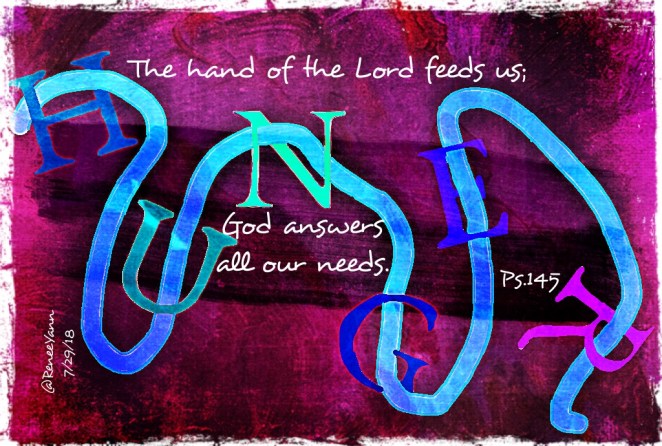
Today, in Mercy, our readings assure us that God cares about our hungry spirits and will satisfy them. 

Ps145 HungerJPG

Both the prophet Elisha and Jesus respond to the needs of the hungry crowds by the power of their faith. In each story, there is only a small amount of food to meet the overwhelming need of the people. But those small amounts, given selflessly and gratefully, renew themselves until all are satisfied.

Our spiritual hungers are deep, and much harder to fill than our physical ones. Sometimes, we don’t even know what we are longing for. Thus we may end up filling our emptiness with distractions and junk.

Today’s readings encourage us to turn our soul’s needs toward God. St. Augustine said this:

You have made us for yourself, O Lord,
and our hearts are restless (hungry)
until they rest in You.

Notice that in Jesus’s miracle of the loaves and fishes, there is one key action before the multiplication occurs.

Then Jesus took the loaves, gave thanks,
and distributed them to those who were reclining,
and also as much of the fish as they wanted. 

Let’s sift through even the small sustenance of our life for the things that we are grateful for. When we lift these up in thanksgiving, glimpsing the loving face of God, other graces will begin unexpectedly to multiply around and within us.

Music: O, My Soul Hungered – Corbin Allred

Would God Divorce Us?

Saturday, July 28, 2018

Readings:  http://www.usccb.org/bible/readings/072818.cfm

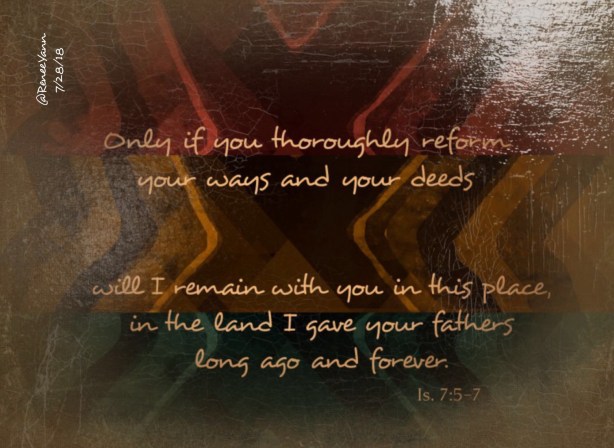
Today, in Mercy, we hear from Jeremiah, a “sock-it-to-‘em” prophet. He lived in a disastrous time for Judah, and had to deliver some difficult challenges to the people. Today’s passage is called the Temple Sermon. It confronts his listeners with the fact that there is a big difference between their professed faith and their daily practice. In other words, they are living a lie.

Jeremiah7_5

The people seem to think that no matter how idolatrous or immoral their choices are, the Temple building will protect them from God’s anger. It’s a mentality that might remind us of the film “The Godfather”, where the mafioso kill and cheat all week but always fulfill their sacramental obligations.

God tells Jeremiah to go stand at the Temple gate and tell the people that their fake piety won’t work. Instead they are to:

  • thoroughly reform their ways and deeds
  • deal justly with their neighbor
  • no longer oppress the resident alien, the orphan, and the widow
  • no longer shed innocent blood in this place (cease human sacrifice)
  • or follow strange gods to their own harm

Otherwise, Jeremiah says, they risk losing God because God will not live in a desecrated Temple.

The message to us that comes wrapped in the ancient words of Jeremiah?

  • Examine your life.
  • Is our faith sincere, proven by our practices?
  • Do we give others not only the benefit of the doubt, but also the benefit of our kindness?
  • Do we support and foster immigrants, orphans, widows … in other words the vulnerable?
  • Do we stand against the suffering of innocents caused by war and unjust policy?
  • Do we resist the “gods” competing for our souls — all the destructive isms and addictions of our time?

Otherwise, Jeremiah says, we risk losing God because God will not live in a heart-temple that is desecrated.

Music: Fill This Temple – Don Moen

https://m.youtube.com/watch?v=r1CIpLFywdc