This Day I Have Begotten You

Friday of the Fourth Week of Easter
May 5, 2023

Today’s Readings:

https://bible.usccb.org/bible/readings/050523.cfm

Today, in God’s Lavish Mercy, our readings again draw our hearts to the power of the Resurrection to transform our lives.

The passage from Acts gives us the first half of Paul’s sermon in Pisidian Antioch, to a gathering of both Jews and Gentiles. Paul, who did not know Christ before the Resurrection, calls on the witness of the original disciples who shared earthly ministry with Jesus:

For even though (the inhabitants of Jerusalem and their leaders) 
found no grounds for a death sentence,
they asked Pilate to have Jesus put to death,
and when they had accomplished all that was written about him,
they took him down from the tree and placed him in a tomb. 
But God raised him from the dead,
and for many days he appeared to those
who had come up with him from Galilee to Jerusalem. 
These are now his witnesses before the people.

Acts 13:28-31

These witnesses attest to the primordial element of our faith:

Jesus Christ conquered death
and, in doing so,
gave all of us
the gift of eternal life in him.

This amazing truth is not something outside or distant from us. This truth is the core of our lives in faith. By believing it, remembering it, calling its dynamism into our dailyness, we are endowed with the power of God to live beyond death even in the midst of it.


In the life of my religious community, spring is always a time of Jubilee – a time to acclaim God’s rejuvenation of nature and life.

Just after Easter, we capture Alleluia grace to celebrate our sisters and their decades of fidelity. These Silver, Golden and Diamond years unfold in a perpetual wave from the time of Catherine McAuley. At Jubilee, we bathe in their awesome and unwordable grace. Last Friday evening, we held this year’s celebration, one bursting with the sentiments of “L’chiam” – To Life!


But just on that same Friday afternoon, one of our venerable sisters had died after living over 70 years in Mercy. I know the contrasting emotions struck many of us in our jubilant chapel. These feelings became even more evident as we read the back cover of our program naming all those Jubilarians who had preceded us to heaven.

Will we all meet in heaven?

O what joy even to think of it.

Catherine McAuley: Letter to Teresa White February 3, 1841


And that, my dear friends, is the key word: HEAVEN – another word for the eternal life given us in the Resurrected Christ. We don’t always realize it but, through Easter grace, we are living in heaven right now. Death, transformed forever in Jesus, is the unmasking which allows our full realization.


This is what Jesus conveyed to his disciples in today’s Gospel. Don’t be afrain of anything – not even death. I am already completely with you.

Jesus said to his disciples:
“Do not let your hearts be troubled. 
You have faith in God; have faith also in me. 
In my Father’s house there are many dwelling places.
If there were not,
would I have told you that I am going to prepare a place for you?
And if I go and prepare a place for you,
I will come back again and take you to myself,
so that where I am you also may be.
Where I am going you know the way.”

John 14:1-4

In Greek, the phrase for “do not be troubled” ( ταρασσεσθω – tar-as’-so) pertains particularly to the dread of death natural to the human condition. This is the fear that Jesus wishes to alleviate for his disciples, especially as he moves into the Paschal event.

He wishes to soothe that fear in us as well. We have the inifinite assurance of eternal life. When we face death, the loss of friends, or the overwhelming weight of the passing years, we can reach through any heaviness to that Resurrecting Light. By the life-giving invitation of Christ, we – and all whom we ever love – are already residents in the mansion of God.

Alleluia – Jubilate


The Jubilarian celebrants, most in the video above, are:

75 years: Sister Mary Jude DiSciascio, Sister Mary Klock, Sister Eileen Trinity

70 years: Sister Maryann Burgoyne, Sister Maria Madonna Johnson, Sister Joanne McIlhenney, Sister Rosemary Powers

60 years: Sister Sara Anne Condart, Sister Maureen Crissy, Sister Georgia Greene, Sister LaVerne Marie King, Sister Patricia Leipold, Sister Dorothea Maholland, Sister Mary Mulholland, Sister Beverly Palumbo, Sister Benvinda Ann Pereira, Sister Elaine Schaeffer, Sister Monica Sheehy, Sister Bonita Marie Smith, Sister Renee Yann

50 Golden Years: Maureen Roe, Terry Saetta, Susan Walsh and Regina Ward.


Poetry: Near Sunset on the Shore – Renee Yann, RSM


Four o’clock, life’s waning autumn afternoon;
daylight spent against the salted sea.
Tide, this moment, turns to imperceptible ebb.
Evening imagines its own midnight, indigo.

Same shore; same horizon. Only
sky, drunk deep, betrays change.
Jigger of sunset, rubied brandy,
introduced to unintoxicated day.

Now come the memories, wave
upon wave, inviting immersion. Now come
the lingering hopes, vortex of longing for
all that has or might have been loved.

Now in near-dusk, understanding,
feeble at first, then determined.
Can so little really have mattered?
Can the one truth simply have been

riveted presence, moment by moment,
to pain and to joy; fascination, ennui?
Has Sacred Fire smoldered so long
In such innocent ashes?

The question, or is it the answer, hovers and stills.
Sweet, purple evening rises like smoke from the embers
Of the inessential and shorn. Once, some distant morning,
hearts were set to this moment in brilliant, unproven vows.

The ocean of years, in hypnotic cadence,
Allowed, then rescinded, distraction.
Now, under its waves, tenacious and constant,
deep diving down in the luminous darkness of God.


Music: Divine Mystery – Heather Houston (lyrices below)


Oh I am opening up for a dance with Divine Mystery
Oh I am trusting the path that’s unfolding before me with ease

Just let go now, trust the flow
Just let go now, then you’ll know

Right on time now, I’ve arrived
Right on time now, I’m aligned

Upside-Down, Inside-Out

Thursday of the Fourth Week of Easter
May 4, 2023

Today’s Readings:

https://bible.usccb.org/bible/readings/050423.cfm

Today, in God’s Lavish Mercy, our two readings take us on a journey. We sail through Israel’s long and spectacular salvation history from Moses through David and forward to Jesus. And in the sailing, we get turned head over heels.


In our first reading, Paul encapsulates twelve hundred years in a few elegant verses. (Nice job, Paul!)

The touchpoints of his homily are these:

  • the sojourn in the land of Egypt. 
  • forty years in the desert.
  • destruction of Canaan,
  • judges up to Samuel the prophet.
  • King Saul, for forty years. 
  • King David whose descendants gave Israel …
  • JESUS
  • then a little mention of John the Baptist

Paul’s succinct preaching allows us to see God’s powerful arm reaching through the long sleeve of Isreal’s history, finally handing the Chosen People the ultimate gift — Jesus Christ the Messiah.


Ah, but then we have our Gospel – which does today what it always does so well. It turns everything upside down and inside-out.

Through the twelve hundred years of Israel’s pre-Christian history, we see an agonizingly slow rise to power and glory culminating in David’s reign. How deeply later Israelites longed for a future Savior who would shine like the royal David had – who would restore the glory of Israel. That was their cherished expectation.


But Jesus turns that long sleeve of salvation history inside out. He preaches an inverse power fueled by service, a glory dressed in humble acts of mercy and forgiveness.

His longing is not for a worldly restoration, but for a whole New Creation born of sacrificial love. His hope is not for a secular kingdom but for a transformational community enlivened in the Triune God.

When Jesus had washed the disciples’ feet, he said to them:
“Amen, amen, I say to you, no slave is greater than his master
nor any messenger greater than the one who sent him.
If you understand this, blessed are you if you do it.

John 12:16-20

As we read and pray the scriptures, we get better at seeing the sacred understory of grace sustaining us. Upside-down, inside-out, our daily life is filled with divine mystery and revelation. We just have to look at the flip side to catch hold of the sail.

I was a teenager during the golden age of the 33 and 45 rpm records. I had a slew of Elvis, Fats Domino, Roy Orbison, The Everley Brothers, Ray Charles, The Supremes and many others. Each record had a hit on one side, and I rarely bothered to look at the other side. One day I flipped one of my “Top 10s” (The Wildcat Blues) to take a look at the other side, only to find what would become one of my favorite songs of all time: Petite Fleur. After the 1950s, it faded from the top ten list, but it has stayed on my list for 60 years.

When I hear that song, it sinks into my spirit creating a feeling that resists words. Like much good music, it reorders something in my spirit so that I see the world a little differently. And I would never have found it if I hadn’t turned things upside down to listen to the understory.


If we allow ourselves to dive deep under the scriptures – to go to the “flip side” – as Jesus invites us to do in today’s Gospel, we will find our own “petite fleurs” of insight and grace.

If you understand this,
blessed are you if you do it.

John 13:17

Prose: from Seeing by Annie Dillard

The secret of seeing is, then, the pearl of great price. 
If I thought he could teach me to find it and keep it forever 
I would stagger barefoot across a hundred deserts 
after any lunatic at all. 

But although the pearl may be found,
it may not be sought. 
The literature of illumination reveals this above all: 
although it comes to those who wait for it, 
it is always, even to the most practiced and adept, 
a gift and a total surprise… 

I cannot cause light; 
the most I can do is try to put myself 
in the path of its beam. 
It is possible, in deep space, to sail on solar wind. 
Light, be it particle or wave, has force: 
you rig a giant sail and go. 

The secret of seeing is to sail on solar wind.
Hone and spread your spirit till you yourself are a sail, 
whetted, translucent, broadside to the merest puff.

Music: Petite Fleur – Chris Barber

Mystery!

Feast of Saints Philip and James, Apostles
May 3, 2023

Today’s Readings:

https://bible.usccb.org/bible/readings/050323.cfm

Today, in God’s Lavish Mercy, our Gospel invites us to pray with the Apostle Philip on this his and James’ feast day.

St. James and St. Philip by Peter Paul Rubens


Philip is mentioned several times in John’s Gospel

  • In John 6:6, Jesus engages Philip regarding the feeding of the 5,000.
  • In John 12:21, Philip appears speaks for the Greek community, informing Andrew that they want to be introduced to Jesus.
  • In today’s Gospel, Philip asks Jesus to be shown the Father. Jesus responds with a simple and perfect instruction on one of the most profound mysteries of our faith – the nature of the Trinity.

“Master, show us the Father, and that will be enough for us.”
Jesus said to him, “Have I been with you for so long a time
and you still do not know me, Philip?
Whoever has seen me has seen the Father.
How can you say, ‘Show us the Father’?
Do you not believe that I am in the Father and the Father is in me?
The words that I speak to you I do not speak on my own.
The Father who dwells in me is doing his works. 

John 14:9-10

Jesus seems surprised at Philip’s question. Maybe he didn’t think it was that hard to understand the Blessed Trinity! But writers ever since have found it pretty complex. Most notably, St. Augustine took over 15 years to write his masterpiece De Trinitate (On the Trinity). An excellent current English translation by Edmund Hill, OP contains fifteen books in over five hundred pages!


But Jesus makes it pretty simple for Philip. Here’s my interpretation:

Philip, You see me, you see the Creator.
We are perfectly One.
Perfect Love does that.
My words are the Creator’s Words.
My works are completing the Creator’s works Who dwells in me.
It’s not a problem, Philip. You don’t need an answer.
It’s a beautiful Mystery. Just believe and be with it.


The noted 20th century Christian existentialist Gabriel Marcel wrote about the difference between a mystery and a problem.

Marcel worried that a technical ethos was reshaping how we see the world and ourselves. He especially worried about a tendency to reduce mysteries to problems. A problem, for Marcel, is something external to us that can be determinatively understood and solved with a generalizable technique. A mystery, on the other hand, is something in which we are inextricably involved. It has roots deep within us, but it also reaches beyond us. While a problem can be definitively solved, a mystery can only be navigated in light of the concrete situation and the people involved.

Gabriel Marcel: Mystery in an Age of Problems – Steven Knepper

True faith requires that we trust the Mystery of God. Like Philip, we may want answers to the great challenges of life and religion. But these things are not like math problems or scientific equations which can reach human resolution.

Life and faith are more like poetry or music – both of which enter into us and change something deep inside of us. It is a change that cannot be put into words but is nevertheless real. It is mystery.


Knowing and loving our Triune God is the same kind of mystery. We are made of God and God dwells within us. Each of our life experiences offers a small revelation of this overarching Mystery which is far too infinite to ever be packaged in a “solution” such as Philip requests in our Gospel.


Sometimes we may hear ourselves trying to turn the mystery of God into a solvable problem. Do you ever think or voice questions like these:

  • Why does God allow good people to suffer?
  • Why didn’t God just create everybody to be good, to erase evil from the world?
  • Why is God letting THIS (whatever it is) happen to me!

At different times in our spiritual lives, we all suffer from the Big WHY. Some people never get over it, turning atheist or agnostic in their approach to life when they can’t reach an answer. Some, by the grace of God, abide in the questions and come to a place of undefinable peace in the Mystery of God.

Let’s pray to St. Philip today to be granted a measure of the grace he obviously received as he went on to carry the Gospel to Greece, Syria, and Phrygia.

And, although we have concentrated on Philip today, here’s a word about St. James who was obviously very special to Jesus. James, along with his brother John and Peter, formed an informal triumvirate among the Twelve Apostles. Jesus allowed them to be the only apostles present at three quintessential events:

  • Mark 5:37: the Raising of Jairus’ daughter
  • Matthew 17:1: the Transfiguration of Jesus
  • Matthew 26:37: the Agony in the Garden of Gethsemane

Poetry: If Only – Rainer Maria Rilke from The Book of Hours

If only there were stillness, full, complete.
If all the random and approximate
were muted, with neighbors’ laughter, for your sake,
and if the clamor that my senses make
did not confound the vigil I would keep —
Then in a thousandfold thought I could think
you out, even to your utmost brink,
and (while a smile endures) possess you, giving
you away, as though I were but giving thanks,
to all the living.

Music: Lux Beata Trinitas – the hymn, ascribed to St. Ambrose in the 4th century, is sung here by Harry Christophers and the Sixteen whose mission is “… a performing arts charity which exists to take beautiful and inspiring choral music, from the Renaissance to today, to as wide and diverse an audience as possible.” (English translation of hymn below)

O TRINITY of blessed Light,
O Unity of sovereign might,
as now the fiery sun departs,
shed Thou Thy beams within our hearts.
To Thee our morning song of praise,
to Thee our evening prayer we raise;
Thee may our glory evermore
in lowly reverence adore.
All laud to God the Father be;
all praise, Eternal Son, to Thee;
all glory, as is ever meet,
to God the Holy Paraclete.

The Last Day of April

April 30, 2023

On this last day of the month, let me start with a caveat:  I love April.  It is the month of my birth and the birth of several people I love.  April often gives us our first glimpse of spring and our first sounds of Alleluia. 

But April is also full of contradictions: teasing sun and drenching rain; “shorts” weather one day, mufflers the next; a large measure of Easters, but a heavy dose of Good Fridays.

In other words, April – like its cousin October – is most perfectly reflective of our rollercoaster lives. And that reflection mirrors, not exactly a sadness, but a certain purple wistfulness inherent in all of life. Catherine McAuley described it this way: 

This mingling is something we balance within ourselves every day of our lives, but maybe especially in April, as the great poet T.S. Eliot notes:

April is the cruellest month, breeding
Lilacs out of the dead land, mixing
Memory and desire, stirring
Dull roots with spring rain.
Winter kept us warm, covering
Earth in forgetful snow, feeding
A little life with dried tubers.

So what do we do with April’s “cruelty” which might be defined as that tinge of melancholy lurking even in the greatest joy? 

Rather than push it down or turn away from it (which I think most of us try to), there is a gift in prayerfully breaking open that languor, like an egg shell holding life’s fragile and surprising transformation. 

For example, we might place before God in prayer these “cruelties” which carry both joys and sorrows:

  • Change which, in any form, requires a shifting from the comforts that have secured us
  • Loss that comes in the shape of missed opportunities, lapsed friendships, harbored unforgiveness, wrong choices and a hundred other “wish I could do over”s
  • Aging which, though a blessing when considering the alternative, brings a slow reckoning with our vulnerabilities
  • Bereavement, that terrible forest of loving memories and winding sadness where we feel lost as we long for healing

The poet Phillis Levin captures the power of such reflection in her beautiful poem. It’s a sad poem, but articulating it gave the poet an emotional release that carried healing :

Under a cherry tree
I found a robin’s egg,
broken, but not shattered.
I had been thinking of you,
and was kneeling in the grass
among fallen blossoms
when I saw it: a blue scrap,
a delicate toy, as light
as confetti
It didn’t seem real,
but nature will do such things
from time to time.
I looked inside:
it was glistening, hollow,
a perfect shell
except for the missing crown,
which made it possible
to look inside.
What had been there
is gone now
and lives in my heart
where, periodically,
it opens up its wings,
tearing me apart.

As we move into the bright light of May then summer, it’s important not to neglect that shadowed strain running through and binding all human experience. When we, like Catherine McAuley, find it rising to the surface of our lives, we too must reflectively pray it into God’s heart so that we can find its healing power and peace.


Music: The Last Day of April – Ann Sweeten

The Narrow Gate

Fourth Sunday of Easter
April 30, 2023

Today’s Readings:

https://bible.usccb.org/bible/readings/043023.cfm

Today, in God’s Lavish Mercy, Jesus tells us the he is “the gate”. If he were here, preaching to us in person today, the symbol wouldn’t work as well as it did in his own time. In the countryside of the Gospels, there were gates all over the place protecting flocks from the multiple threats around them.

But my guess is that you haven’t seen one of these things recently or likely EVER.


So what have we seen that might bring home the essence of the Gospel to us? I’ll tell you what came to my mind.

On occasion, we buy bulk candy for our Sisters at our nursing facility. The candy factory has been around for decades and, as in some neighborhoods of the old city, the area surrounding it has become a residential and commercial desert. With that isolation, the property has become unsafe, an unfortunate target for thieves and vandals.

And so the site has been fortified – metal shields, wired windows, old sealed doors. Just try to get inside without the right directions, information, invitation or credentials! See that little red door about the middle of the photo? It doesn’t open for everyone! You have to know the way to get to the sweets inside!


Jesus is telling us that the same thing is true for those seeking salvation. There is only one way, and it is through Jesus – the Gate.

Jesus refers to this symbol frequently so he must be pretty serious about it!

Enter through the narrow gate.
For wide is the gate
and broad is the road that leads to destruction,
and many enter through it.
But small is the gate and narrow the road
that leads to life, and only a few find it.

Matthew 7:13-14

Strive to enter through the narrow door.
For many, I tell you, will seek to enter
and will not be able.

Luke 13:24

Today’s readings remind us about just how serious Jesus is. The folks in Jerusalem, hearing Peter and scared for their complicity in the Crucifixion, want to get directions for passage through the Gate. Peter tells them:

Repent and be baptized, every one of you,
in the name of Jesus Christ for the forgiveness of your sins;
and you will receive the gift of the Holy Spirit.

Acts 2:38

In his letter today, Peter tells us that repentance translates to imitation of Christ in our lives

If you are patient when you suffer for doing what is good,
this is a grace before God.
For to this you have been called,
because Christ also suffered for you,
leaving you an example that you should follow in his footsteps.
He committed no sin, and no deceit was found in his mouth.

1 Peter 2:20-22

In our Gospel, Jesus says that the Gate is available to everyone, but only through him:

I am the gate.
Whoever enters through me will be saved,
and will come in and go out and find pasture.

John 19:7-8

Bottom line? How do I pass through the Gate to the richness inside?

  • Believe
  • Repent – Turn from anything that blocks me from living the Gospel
  • Imitate Christ in my own life

Poetry: A Gate – Donna Mancini – the recipient of a National Endowment for the Arts Fellowship and a New York Foundation for the Arts Grant. She is a professor of English at Hunter College. The poem portrays the poet ,at a spiritually vulnerable time in her life, seeking the Gate to peace.

I have oared and grieved,
grieved and oared,
treading a religion
of fear. A frayed nerve.
A train wreck tied to the train
of an old idea.
Now, Lord, reeling in violent
times, I drag these tidal
griefs to this gate.
I am tired. Deliver
me, whatever you are.
Help me, you who are never
near, hold what I love
and grieve, reveal this green
evening, myself, rain,
drone, evil, greed,
as temporary. Granted
then gone. Let me rail,
revolt, edge out, glove
to the grate. I am done
waiting like some invalid
begging in the nave.
Help me divine
myself, beside me no Virgil
urging me to shift gear,
change lane, sing my dirge
for the rent, torn world, and love
your silence without veering
into rage.

Music: Shepherd Me – Ann Sweeten

Completely occupied with good deeds …

Memorial of Saint Catherine of Siena, Virgin and Doctor of the Church
April 29, 2023

Today’s Readings

https://bible.usccb.org/bible/readings/042923.cfm

Today, in God’s Lavish Mercy, we prayerfully remember one of the great women of the Church, Catherine of Siena.

Catherine of Siena, TOSD (1347 – 1380) was a member of the Third Order of Saint Dominic. She was a mystic, activist, and author who had a great influence on Italian literature and on the Catholic Church. Canonized in 1461, she is also a Doctor of the Church.

Three genres of work by Catherine survive:
– Her major treatise is The Dialogue of Divine Providence. It is a dialogue between God and a soul who “rises up” to God.
– Catherine’s letters are considered one of the great works of early Tuscan literature.
– Twenty-six prayers of Catherine of Siena also survive, mostly composed in the last eighteen months of her life.

Wikipedia

The beauty of Catherine’s life and spirituality has blessed the world for nearly seven centuries. Still, it has never grown old because it was fully rooted in an eternal God.

Catherine’s sanctity was born of:
transcendent FAITH,
uncompromising TRUTH,
and overarching LOVE
for God
and God’s Creation.


Our first reading today introduces another, much earlier, woman pillar of the Church – Tabitha, sometimes called Dorcas. She was so important to the Christian community in Joppa that they sent for Peter upon her death. They needed his intervention in order to hold the community together in the face of this profound loss.

Now in Joppa there was a disciple named Tabitha
(which translated is Dorcas). 
She was completely occupied with good deeds and almsgiving. 
Now during those days she fell sick and died,
so after washing her, they laid her out in a room upstairs. 

Acts 9: 36-38

St. Cyprian, writing in the 3rd century, implies that Dorcas merited Peter’s miraculous intervention because of her Christian generosity, her being “completely occupied with good deeds and almsgiving“.

Dorcas, Raised from the Dead by Peter – Jacob Jordaens (c. 1655)


Though little is given to describe Tabitha’s position in the community, one might imagine that she was a woman of some means. Many widows achieved a certain status living on the accumulated wealth of their deceased husbands and the dividends of their recovered dowries. This generous women seems to have gathered around her a community of less fortunate neighbors who came to depend on her for their livelihood.

In Tabitha/Dorcas, we find a model of women’s discipleship repeated through the centuries and into our own times.

  • She is aware of the needs around her and of her own capacity to meet those needs.
  • Inspired by the Gospel, she builds a community to embrace both the needs and the strengths she recognizes.
  • She acts FOR others, especially those who are in need, in imitation of Christ.

In the 14th century, Catherine of Siena manifested a similar pattern of discipleship.

Catherine of Siena – from Eleanor Fortescue Brickdale’s
Golden Book of Famous Women (1919)


Catherine saw the whole Church as her community and recognized its need for reconciliation and unity. She confronted fracturing political allegiances and destructive ecclesiastical egos to advocate for the Roman Pope’s sovereignty over the global Church, thus influencing the entire flow of European history.

My sweet Lord, look with mercy upon your people
and especially upon the mystical body of your Church.
Greater glory is given to your name for pardoning a multitude of your creatures
than if I alone were pardoned for my great sins against your majesty.
It would be no consolation for me to enjoy your life
if your holy people stood in death.
For I see that sin darkens the life of your bride the Church
– my sin and the sins of others.

from A Dialogue on Divine Providence

Catherine, whose profound spirituality was laced with miracles and mysticism, nevertheless taught an attainable spiritual discipline in her writings – a practical spirituality demonstrated, as was Tabitha’s, in generous acts of love:

The love which the soul sees that God has for her,
she, in turn, extends to all other creatures. . .
she immediately feels compelled to love her neighbor as herself,
for she sees how supremely she herself is loved by God,
beholding herself in the wellspring of the sea of the Divine Essence.

Letter to Raymond of Capua, dated February 17, 1376

In our Gospel, Jesus has just finished telling the people:

“Amen, amen, I say to you,
unless you eat the flesh of the Son of Man
and drink his blood, you do not have life within you.”

They respond to this “hard saying” with hesitancy and “shock”. Jesus tells them that he knows that this level of faith is impossible to reach on one’s own and so…

“For this reason I have told you that no one can come to me
unless it is granted him by my Father.”

John 6: 64-65

Tabitha and Catherine of Siena, by the power of the Holy Spirit granted through our Creator, attained a beautiful faith expressed in generous works for their communities. As we pray with them today, let us ask God for the grace of such faith for ourselves and for our whole Church.


Poetry: Consumed in Grace (Catherine of Siena) – from Daniel Ladinsky’s “Love Poems from God”

I first saw God when I was a child, six years of age.
The cheeks of the sun were pale before Him,
and the earth acted as a shy
girl, like me.

Divine light entered my heart from His love
that did never fully wane,

though indeed, dear, I can understand
how a person’s faith
can at times flicker,

for what is the mind to do
with something that becomes the mind’s ruin:
a God that consumes us
in His grace.

I have seen what you want;
it is there, a Beloved of infinite
tenderness.


Music: The Mystical Ecstasy of Catherine of Siena – from the opera Santa Caterina da Siena by Marco Enrico Bossi

Taught By God …

Thursday of the Third Week of Easter
April 27, 2023

Today’s Readings:

https://bible.usccb.org/bible/readings/042723.cfm

Today, in God’s Lavish Mercy, we read the fascinating account of the conversion of the Ethiopian eunuch. The story, filled with heavenly manifestations, may seem “other-worldly” to us and, in a way, that’s just what it is.

There is a new world – a New Covenant – sprung from Christ through the power of his Resurrection. The Acts of the Apostles is the proclamation of that New World given to us in a series of stories and miracles generated through the Holy Spirit.

And the story of the Ethiopian eunuch is a powerful one, offering a spectrum of interpretations and applications to our own spiritual life. However, using today’s Gospel as a lynchpin, let’s explore one particular concept.


In the passage from John, Jesus tells the crowds:


“No one can come to me
unless the Father who sent me draw him,
and I will raise him on the last day.
It is written in the prophets:
They shall all be taught by God.
Everyone who listens to my Father
and learns from him comes to me.

John 6:44-45

In other words, in order to truly understand our reality, we must allow the Spirit of God to enter our hearts and minds — because there is more to what is than meets the eye!

We cannot truly interpret our world with only our own intellectual resources. Our knowledge and understanding must be fed by God so that we may see the deep Spirit living under our otherwise thin perception of life.


The Baptism of the Eunich – Rembrandt

In our passage from Acts, the Ethiopian is a person of faith, a worshipper who seeks God. But he has hit a wall. He realizes that he cannot fully understand God’s revelation without a Spirit-inspired teacher. And lucky him – the Spirit decides to plunk Philip down in the middle of the desert to be that very teacher!

The context of the story tells us that God wants us all to be fully incorporated into God’s own life —

  • no matter how far out we are in our spiritual “deserts”
  • no matter what physical elements define or limit us
  • no matter what walls we hit when trying to live a faithful life

In our Gospel, Jesus tells us that he is the new and perfect source of nourishment for our yearning spirits. It is the Spirit of Jesus that Philip has brought to the Ethiopian.

Amen, amen, I say to you,
whoever believes has eternal life. 
I am the bread of life. 
Your ancestors ate the manna in the desert, but they died;
this is the bread that comes down from heaven
so that one may eat it and not die. 
I am the living bread that came down from heaven;
whoever eats this bread will live forever;
and the bread that I will give
is my Flesh for the life of the world.”

John 6:47-51

Now I doubt that we’re going to find Philip waiting by our “chariot” out in the driveway tomorrow morning. So how are we to be “taught by God“. Here are some ways that I think can help:

  • faithful prayer informed by good spiritual reading
  • devoted scripture study and prayer
  • spiritual retreat and reflection
  • spiritual companionship with others sincerely seeking God

Poetry: Soliloquy of the Ethiopian Eunuch – Robert Phillips

The miracle began with a miracle.
I was sitting in my gold-trimmed chariot
(well, not exactly my chariot—like all
my accoutrements, it belongs to her—
Candace, Queen of all the Ethiopians.
But since she put me in charge of her treasure,
I have the opportunity to live high.
Beauty has its privileges, and I don't mean
Candace. I'm here to tell you: That girl
Wasn't around when they passed out looks).
There I was, biding my time in the chariot,
near Jerusalem where I'd gone to worship.
I'd just passed Gaza, a real cultural desert.
I was studying Isaiah the Prophet
when suddenly this white man was translated—
there's absolutely no other word for it—
he literally was translated from wherever
to right next to me. It was the damndest thing!
He just stood there, ahuffing and apuffing.
Then he says with the greatest impertinence.
"Do you understand that book you're reading?"
His meaning was undeniable: the fact
that I'm black must have implied I'm illiterate,
or ignorant at best, despite my purple
silk robe and heavily gilded chariot.
I said, "This Isaiah is a heavy dude.
Perhaps you can shed some light on this passage?"
He was led as a sheep to the slaughter;
and like a lamb dumb before her shearer,
so opened he not his mouth . … "So who's the he?"
I asked. "Is this Isaiah talking
about himself, or is he palavering about
somebody else?" And Whitey (his real name was
Philip; it means Lover of Horses—ha!)
Whitey explained to me the "he" was Jesus,
and began to preach about the humiliation
of Jesus, and how his judgment was taken
away before his life on earth was taken,
and how he said not one word to save himself.
And now, in order to be saved, a body
must be baptized in the holy name of God.
I took it all in. Then he clambered inside
the chariot, and we commenced riding north,
which was where he came from before translated.
Presently we came upon a teensy pond.
"Here's some H20. So what's to keep you from
baptizing me on the spot?" That set him off
preaching some more: "If you believe with all
your heart that Jesus Christ is the Son of God,
blah blah blah, I'll do it." Seems this Jesus cat
charged him and a bunch of other honkies
to preach all nations about this Jesus stuff.
I told him with my dusky skin I qualified as
"all nations." So I stopped the chariot,
and we both sashayed down to the water hole.
And hallelujah, he baptized me! In the name
of the Father, and the Son, and the Holy Ghost.
Like to drowned me. The waters of salvation
ran down my dreadlocks. My gloomy skin took on
a peaceful hue. My black soul became dove white.
Then that lover of horses disappeared—poof!
It was enough to make my head spin, popping
in and out of the desert like that. Later
I heard Philip was preaching in this city
and that, creating real photo opportunities.
When I got back to the palace, I camped it up
about being saved, being washed in the blood
of the Lamb, and how this black soul now was white
as snow. (Though I confess I've never seen snow.
It's just one of those things you take on faith.)
Queen Candace had a hissy fit, stomped her foot
because she hadn't been baptized and her eunuch
had. I told her she'd just have to wait until
Philip or one of that gang of ten others
came her way. But she never did. I don't think
they thought hateful ugly queens much worth saving .
Now don't think being a eunuch is easy.
It was done so I could better serve my God
and my queen. I continued to lust in my heart.
But now I'm saved, I sleep the sleep of the just.

Music: Immortal, Invisible, God Only Wise – Walter C. Smith

A Dynamic Faith

Wednesday of the Third Week of Easter
April 26, 2023

Today’s Readings:

https://bible.usccb.org/bible/readings/042623.cfm

Today, in God’s Lavish Mercy, our readings allow us to experience the dynamic nature of faith, as it was experienced in the early Church.And it wasn’t always pretty!

The Stoning of St. Stephen – Rembrandt

Acts tells us of a rising violence toward the Christians, especially those considered “Hellenistic Jews”. There was prejudice against them among the Pharisees even before these Jews converted to Christianity. They were “outsiders “:

The Hellenistic Jews are those who speak mainly Greek, and formerly lived outside of Judea and Galilee. But they had settled in Jerusalem — retired, as it were, to the homeland. Nevertheless, they still have affinities with lands of the Jewish dispersion from which they came. The Hebraic Jews are those who speak mainly Aramaic, and were born in Jerusalem or Judea.

Michael Morrison, PhD, professor of Biblical Studies at Grace Communion Seminary


Stephen, the first Christian martyr, was a Hellenist, as was Philip mentioned today as the first Christian missionary. He is a different Philip from the Apostle who remained in Jerusalem according to the passage.


As I picture the forces at work in the early Church, I am reminded of the ocean, ever-changing in its flow from peace to storm, yet ever-constant in its tides.

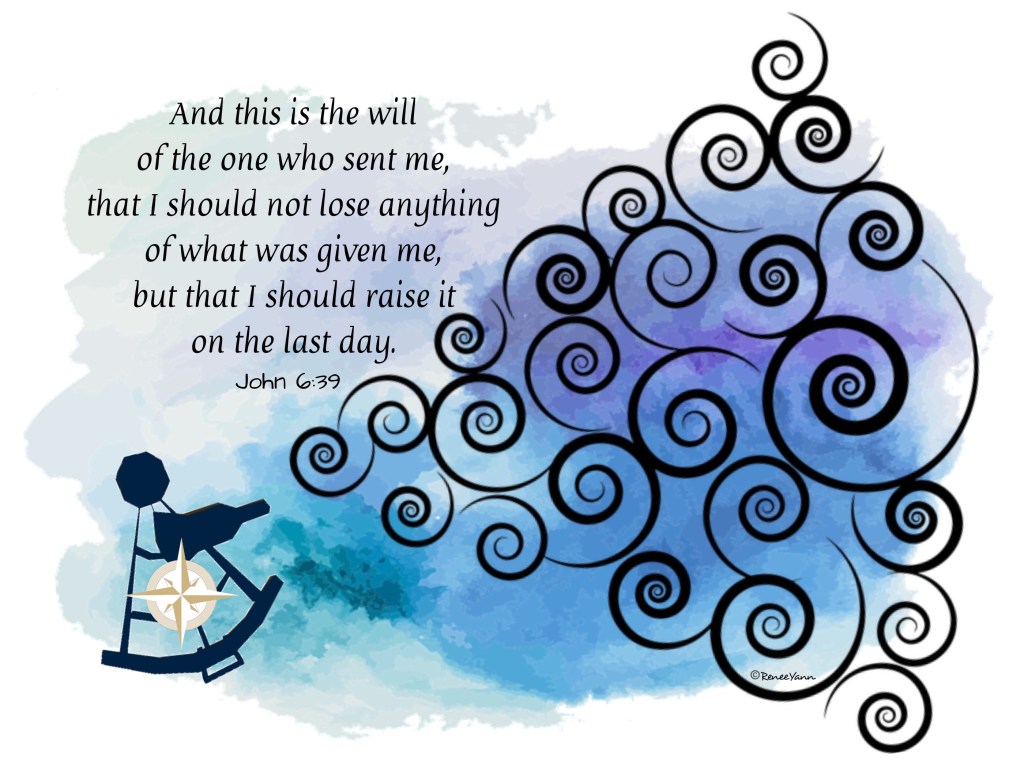
Faith is the anchor holding us steady in the waves, the sextant pointing us toward Christ’s Promise. As our Gospel says:

And this is the will of the one who sent me,
that I should not lose anything of what he gave me,
but that I should raise it on the last day.
For this is the will of my Father,
that everyone who sees the Son and believes in him
may have eternal life,
and I shall raise him on the last day.

John 6: 39-40

Stephen had this vital and tenacious faith, and died for it. Philip had it and shared it. The Apostles had it and held it steady for the rest of us.

How is the vital and dynamic faith living in me? How deeply do I believe and live the Promise? Let’s ask God today to strengthen our faith and to keep our focus on the Promise of eternal life.


Poetry: In Whom We Live and Move and Have Our Being – Denise Levertov 

Birds afloat in air's current,
sacred breath?  No, not breath of God,
it seems, but God
the air enveloping the whole
globe of being.
It's we who breathe, in, out, in, in the sacred,
leaves astir, our wings
rising, ruffled -- but only the saints
take flight.  We cower
in cliff-crevice or edge out gingerly
on branches close to the nest.  The wind
marks the passage of holy ones riding
that ocean of air.  Slowly their wake
reaches us, rocks us.
But storms or still,
numb or poised in attention,
we inhale, exhale, inhale,
encompassed, encompassed.

Music: The Promise – Marc Enfroy

… that you believe…

Monday of the Third Week of Easter
April 24, 2023

Today’s Readings:

https://bible.usccb.org/bible/readings/042423.cfm

Today, in God’s Lavish Mercy, our readings remind us that being a Christian is simple, but not easy.

Stephen, presented to us in our reading from Acts, must have been a beautiful, simple person — almost angelic according to Acts’ description:

Stephen, filled with grace and power,
was working great wonders and signs among the people.

Acts 6:8

All those who sat in the Sanhedrin looked intently at him
and saw that his face was like the face of an angel.

Acts 6:15

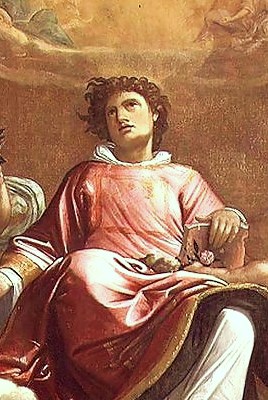
St. Stephen – Giacomo Cavedone – c. 1601


Despite his goodness, Stephen became an object of hate and persecution by many:

Certain members of the so-called Synagogue of Freedmen,
Cyreneans, and Alexandrians,
and people from Cilicia and Asia,
came forward and debated with Stephen,
but they could not withstand the wisdom and the Spirit with which he spoke.
Then they instigated some men to say,
“We have heard him speaking blasphemous words
against Moses and God.”

Acts 6:9-11

This is such a revealing passage! Stephen’s persecutors cannot challenge his preaching themselves, so they create a web of poisonous lies and entangle some other men in its venom. They instigate these men to spread false allegations against Stephen which will eventually lead to his martyrdom.


There is a vital lesson here for us. Truth matters. Lies matter. They are the engines that drive not only our relationships and actions, but our very culture. And a hard look at our modern culture suggests that we are becoming a culture of lies.

I don’t need to give examples here. We know just from glancing at the newspaper, or perhaps – unfortunately – from reflecting on our own experiences.

We know the people who pretend they are what they are not.

We know who pretends that they are not what they actually are.


Jesus is a Truth Teller. In our Gospel, he gently confronts a bunch of people who are “pretending” their faith. Jesus tells them they’re not so much interested in the Truth he preaches as in the food he provided just yesterday. After all, everybody loves a good picnic!

Jesus answered them and said,
“Amen, amen, I say to you, you are looking for me
not because you saw signs
but because you ate the loaves and were filled.
Do not work for food that perishes
but for the food that endures for eternal life,
which the Son of Man will give you. 
For on him the Father, God, has set his seal.” 

John 6: 26-27

These bread seekers in our Gospel hear Jesus’s challenge so they ask him

“What can we do to accomplish the works of God?”
Jesus answered and said to them,

“This is the work of God,
that you believe in the one he sent.”

Just believe. Doing so will lead us to Truth and to a holy simplicity like that which radiated from Stephen. It’s that simple …. and that hard.


Poetry: A Christmas Hymn – by Richard Wilbur

Although the following poem is out of season, and does not mention Stephen, its refrain references his method of martyrdom: “every stone shall cry”. The poem is also a succinct and lyrical summary of the life of Christ and its meaning for us — a good thing to consider during this Eastertide.

A stable lamp is lighted
whose glow shall wake the sky;
the stars shall bend their voices,
and every stone shall cry.
And every stone shall cry,
and straw like gold shall shine;
a barn shall harbour heaven,
a stall become a shrine.
This child through David’s city
shall ride in triumph by;
the palm shall strew its branches,
and every stone shall cry.
And every stone shall cry,
though heavy, dull and dumb,
and lie within the roadway
to pave his kingdom come.
Yet he shall be forsaken,
and yielded up to die;
the sky shall groan and darken,
and every stone shall cry.
And every stone shall cry
for gifts of love abused;
God’s blood upon the spearhead,
God’s blood again refused.
But now, as at the ending,
the low is lifted high;
the stars shall bend their voices,
and every stone shall cry.
And every stone shall cry
in praises of the child
by whose descent among us
the worlds are reconciled.

Music: Every Stone Shall Cry – Steve Bell musically interprets Wilbur’s poem.

Who? Me?

Third Sunday of Easter
April 23, 2023

Today’s Readings:

https://bible.usccb.org/bible/readings/042323.cfm

Today, in God’s Lavish Mercy, our readings invite us to consider any unrecognized blindness in our lives.

In the passage from Acts, Peter confronts the Israelites with an appalling truth to which they had been blind:

Jesus the Nazarene was a man commended to you by God
with mighty deeds, wonders, and signs,
which God worked through him in your midst, as you yourselves know.
This man, delivered up by the set plan and foreknowledge of God,
you killed, using lawless men to crucify him.

Acts 2:22-23

Peter Preaching in Jerusalem – Charles Poërson -c. 1642

Peter left his audience no outs, no excuses. He put the harsh fact before them and asked them to acknowledge it so that they might move forward in faith.


In our second reading, Peter counsels the early converts to recognize that they were rescued from a spiritually fatal blindness:

… conduct yourselves with reverence during the time of your sojourning,
realizing that you were ransomed from your futile conduct ..

1 Peter 1:17-18

Pilgrims on the Road to Emmaus – James Tissot

Luke’s Gospel gives us the warmly accessible Emmaus story. We have walked beside these beloved, crest-fallen disciples for years, haven’t we? But each year might reveal something different and deeper about the “blindness” that prevented them from recognizing Jesus who walked right beside them.

These progressive revelations can challenge us about how readily we recognize God’s Presence in our lives.

  • Were these otherwise faithful disciples just disappointed that their faith had not been rewarded with the results they expected?
  • Were they angry that they had wasted time trusting an apparent “failure”?
  • Were they only shallow believers anyway who had not really invested in Jesus?
  • Were they riddled with false expectations about the Messiah?
  • Were they so confined by old religious habits that they just couldn’t imagine an “Easter Jesus”?
  • Or were they just tired, hungry and caught on a dark road, thinking they could find an answer all by themselves?

Maybe we’ve been in a spot like theirs sometime in our lives. 


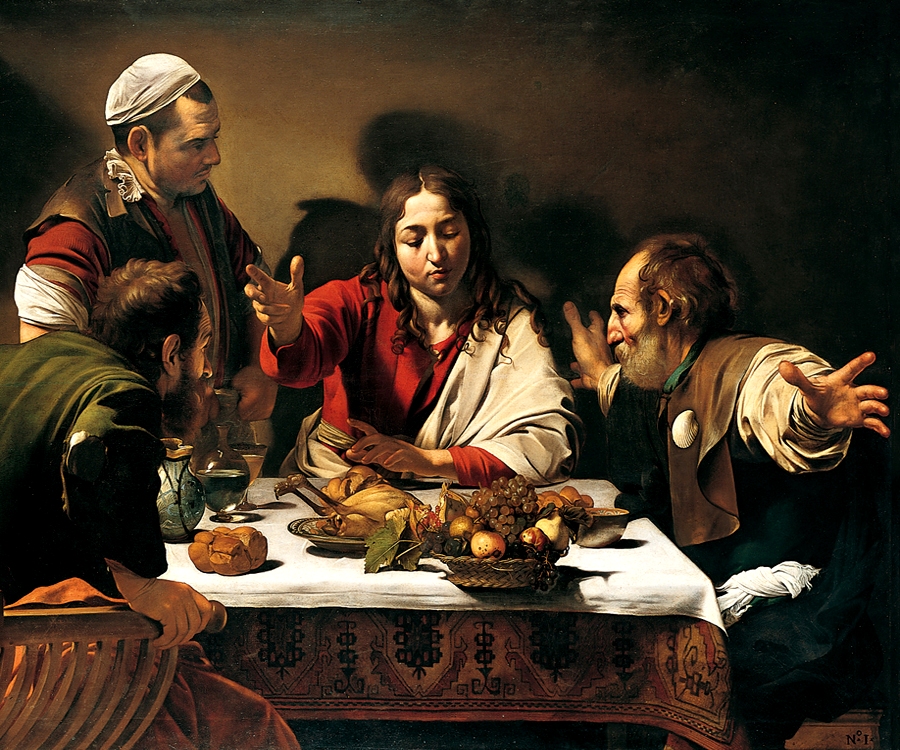
Dinner at Emmaus – Caravaggio


Let’s be with those disciples today and find ourselves in their story. Let’s attend to the “bread” of our dailyness as Jesus breaks it, and let our eyes be opened:

… while he was with them at table,
he took bread, said the blessing,
broke it, and gave it to them.
With that their eyes were opened and they recognized him…

Luke 24:30-31

Poetry: Witness – Denise Levertov

Sometimes the mountain
is hidden from me in veils
of cloud, sometimes
I am hidden from the mountain
in veils of inattention, apathy, fatigue,
when I forget or refuse to go
down to the shore or a few yards
up the road, on a clear day,
to reconfirm
that witnessing presence.


Music: Open My Eyes, Lord – Jesse Manibussan