God of Abundance

Friday of the Second Week of Easter
April 21, 2023

Today’s Readings:

https://bible.usccb.org/bible/readings/042123.cfm

Today, in God’s Lavish Mercy, our readings offer us two very human, accessible stories.

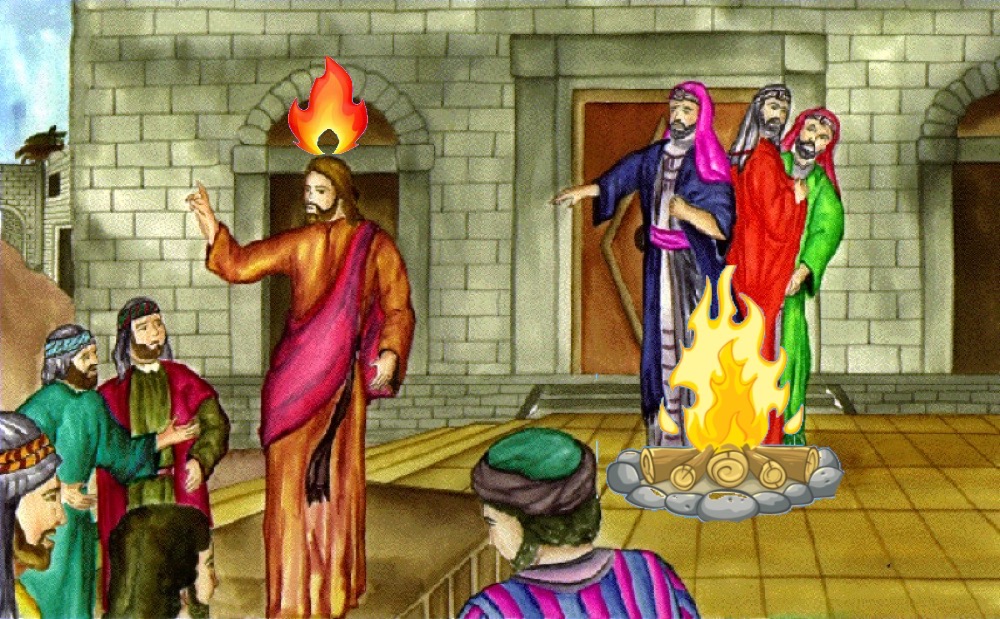
The first, from Acts, is about the Pharisee named Gamaliel. Gamaliel was a big deal. An esteemed authority in the powerful Sanhedrin, he was the son and grandson of highly respected Jewish teachers. He was wise, prudent, honest and practical. Gamaliel was the “real deal” himself, and he recognized it in others.

Gamaliel and Nicodemus Mourn the Death of Stephen – Carlo Saracini -1615 AD

In today’s reading, Gamaliel intervenes in the Sanhedrin’s relentless pursuit of the early disciples. He basically tells his colleagues, “Hey, wait a minute. If these guys are “the real deal”, there is nothing we can do to undermine them. If they are not, they will undermine themselves. So just cool it for a while.”

While there is scant verifiable evidence to the fact, tradition holds that Gamaliel converted to Christianity. He is venerated as a saint in both the Roman Catholic and the Orthodox traditions.


Our Gospel tells us the familiar yet still amazing account of the miracle of the loaves and fishes.

It’s a wonderful story. I mean just put yourself in this noisy, curious, hungry crowd of 5000 people! Picture Jesus going up the mountainside so they could – maybe – hear what he might say.

Imagine that you’re Philip when Jesus turns to him and asks,
“Where will we get enough food for this crowd?”

Do you see the unspoken answers written all over Philip’s face,
“How should I know? Why are you asking ME!!!!”

The passage says that Jesus was testing Philip, but it was more like a tease when I picture it. Can’t you see the mischievous little smile on Jesus’s face? Jesus knew what he was going to do about the crowd’s hunger. He wanted to be sure his disciples paid strict attention to what was about to happen. So he got them involved with his testing questions.


God wants us to pay attention, too, to what happens when we bring our hungers before God’s merciful goodness. Like the few fish and loaves, God takes the smallest parts of us and builds them up with the gift of grace. God finds the willing fragments of faith, hope and love in us and multiplies them with God’s own power.


With this miracle, Jesus shows his followers and all of us, that there is a sacred reality and Truth beyond the thin scarcities we at first perceive. Deep faith allows us to plumb that reality and to live in its expansive promise. Walter Brueggemann puts it this way:

The feeding of the multitudes … is an example of the new world coming into being through God. When the disciples, charged with feeding the hungry crowd, found a child with five loaves and two fishes, Jesus took, blessed ,broke and gave the bread. These are the four decisive verbs of our sacramental existence. Jesus conducted a Eucharist, a gratitude. He demonstrated that the world is filled with abundance and freighted with generosity. If bread is broken and shared, there is enough for all. Jesus is engaged in the sacramental, subversive reordering of public reality.

Walter Brueggemann, The Liturgy of Abundance, The Myth of Scarcity

Gamaliel opened his heart to this Truth,
as did the first disciples.
It’s our turn now.

(Insert your name), where will we get the food
to feed these hungers in our world?


Poetry: Miracles – Walt Whitman

Why, who makes much of a miracle?
As to me I know of nothing else but miracles,
Whether I walk the streets of Manhattan,
Or dart my sight over the roofs of houses toward the sky,
Or wade with naked feet along the beach just in the edge of the water,
Or stand under trees in the woods,
Or talk by day with any one I love, or sleep in the bed at night with any one I love,
Or sit at table at dinner with the rest,
Or look at strangers opposite me riding in the car,
Or watch honey-bees busy around the hive of a summer forenoon,
Or animals feeding in the fields,
Or birds, or the wonderfulness of insects in the air,
Or the wonderfulness of the sundown, or of stars shining so quiet and bright,
Or the exquisite delicate thin curve of the new moon in spring;
These with the rest, one and all, are to me miracles,
The whole referring, yet each distinct and in its place.
To me every hour of the light and dark is a miracle,
Every cubic inch of space is a miracle,
Every square yard of the surface of the earth is spread with the same,
Every foot of the interior swarms with the same.

To me the sea is a continual miracle,
The fishes that swim—the rocks—the motion of the waves—the
ships with men in them,
What stranger miracles are there?


Music: God of Abundance – Kat Mills

A Good Heart, an “Easter-ed Heart”

Thursday of the Second Week of Easter
April 20, 2023

Today’s Readings:

https://bible.usccb.org/bible/readings/042023.cfm

Today, in God’s Lavish Mercy, the post-Resurrection Apostles continue their unstoppable testimony to Jesus Christ. Their persistence “infuriates” the Sanhedrin who fear the blood of Christ being called down upon them!

“We gave you strict orders did we not,
to stop teaching in that name.
Yet you have filled Jerusalem with your teaching
and want to bring this man’s blood upon us.”
But Peter and the Apostles said in reply,
“We must obey God rather than men. 
The God of our ancestors raised Jesus,
though you had him killed by hanging him on a tree.
God exalted him at his right hand as leader and savior
to grant Israel repentance and forgiveness of sins.
We are witnesses of these things,
as is the Holy Spirit whom God has given to those who obey him.”

Acts 5: 28-33

There is an interesting play in the words and concepts of this reading from Acts.

  • While the Sanhedrin are infuriated, or filled with the fire of denial and sin, the Apostles are inflamed with the unquenchable Fire of the Holy Spirit.
  • While the Sanhedrin fear the blood of Christ called down upon them, the disciples hearts are transformed by its power.

The contrast in their responses to God’s Word is stunning.


In our Gospel, John captures this contrast in a nutshell:

The one who comes from above is above all.
The one who is of the earth is earthly
and speaks of earthly things.

John 3:31

In other words, those transformed in the power of the Resurrection see the world with God’s eyes — “from above”. Those unconverted by that Power still see the world in godlessness.


Our Gospel calls us to be like the disciples not like the Sanhedrin.  It calls us to open our hearts:

  • to see the Truth Who is Jesus Christ
  • to believe that the Truth of his Resurrection lives in us
  • to become that Truth through the witness of our lives.

The Gospel calls us to live a whole-hearted faith which allows the Holy Spirit to be expressed in every aspect of our lives. Jesus does not ration the gift of the Spirit, nor should we:

Whoever does accept Christ’s testimony certifies that God is trustworthy.
For the one whom God sent speaks the words of God.
He does not ration his gift of the Spirit.

John 3:33-34

How do we live such a life of Christian witness? Do we have to shout the witness out loud with every action of our lives?  I don’t think so.

Brother David Steindl-Rast describes believers like this:

People who have faith in life are like swimmers who entrust themselves to a rushing river. They neither abandon themselves to its current nor try to resist it. Rather, they adjust their every movement to the watercourse, use it with purpose and skill, and enjoy the adventure.


And the great St. Teresa of Avila blesses believers with this prayer:

May today there be peace within.
May you trust God that you are exactly where you are meant to be.
May you not forget the infinite possibilities that are born of faith.
May you use those gifts that you have received,
and pass on the love that has been given to you.
May you be content knowing you are a child of God.
Let this presence settle into your bones,
and allow your soul the freedom to sing, dance, praise and love.
It is there for each and every one of us.


Poetry: Little Summer Poem Touching The Subject Of Faith by Mary Oliver

Every summer
I listen and look 
under the sun’s brass and even
into the moonlight, but I can’t hear

anything, I can’t see anything — 
not the pale roots digging down, nor the green 
stalks muscling up,
nor the leaves
deepening their damp pleats,

nor the tassels making,
nor the shucks, nor the cobs.
And still,
every day,

the leafy fields
grow taller and thicker — 
green gowns lofting up in the night,
showered with silk. 

And so, every summer,
I fail as a witness, seeing nothing — 
I am deaf too
to the tick of the leaves, 

the tapping of downwardness from the banyan feet — 
all of it
happening
beyond any seeable proof, or hearable hum. 

And, therefore, let the immeasurable come.
Let the unknowable touch the buckle of my spine.
Let the wind turn in the trees,
and the mystery hidden in the dirt

swing through the air.
How could I look at anything in this world
and tremble, and grip my hands over my heart?
What should I fear? 

One morning
in the leafy green ocean
the honeycomb of the corn’s beautiful body
is sure to be there.


Music: A Good Heart – Marc Enfroy

So Loved …

Wednesday of the Second Week of Easter
April 19, 2023

Today’s Readings:

https://bible.usccb.org/bible/readings/041923.cfm

Today, in God’s Lavish Mercy, we continue what we began on Monday, a long immersion in John’s Gospel which will not conclude until Pentecost.

As a guide in praying with the glorious Gospel, I am using a book from the series “A Catholic Commentary on Sacred Scripture”. This particular volume is “The Gospel of John” by Francis Martin and William M. Wright. These authors open their work with this beautiful introduction:

Pope St. Gregory the Great compared Scripture to
a “smooth, deep river
in which a lamb may walk
and an elephant may swim.


These words certainly apply to the Gospel of John.
Within its pages are found divine teachings
articulated with simple images such as water and light,
memorable stories composed with literary and dramatic skill,
and glimpses into the very mystery of God,
proceeding from the most profound mystical illumination.
Like the loaves and fishes multiplied by Jesus,
the Gospel of John provides a superabundance
of spiritual teaching, edification, and challenges to all its readers,
whether beginners or experienced.


Our Gospel today gives us the central point inspiring John’s entire Gospel:

God so loved the world that he gave his only-begotten Son,
so that everyone who believes in him might not perish
but might have eternal life.

John 3:16

As we go deeper into our post-Easter journey, on the way to the confirmation of Pentecost, we need to keep repeating this amazing truth to ourselves …

And it helps to remind ourselves as well that “God so loved ME … that God gave God’s ALL for me.”


As we pray with John’s Gospel over the next several weeks, we will be doing the same work that the Apostles are doing in our first reading from Acts.  We will be telling the story of Love – the story of Jesus who lived, died and rose from the dead to save us.

Each little part of that story can teach us and change us.  By our choice to believe, and to act on that faith, we are transformed from darkness to Light in the power of the Resurrection.

And this is the verdict,
that the light came into the world,
but people preferred darkness to light,
because their works were evil.
For everyone who does wicked things hates the light
and does not come toward the light,
so that his works might not be exposed.
But whoever lives the truth comes to the light,
so that his works may be clearly seen as done in God.

John 3:19-21

For today, we may want to consider any darkness in our world or in ourselves that we wish to carry into God’s amazing Light and Love. There, let us lay the darkness down and pray to live the truth which John encourages us to live.


Poetry: “Truth”, said a traveller by Stephen Crane

“Truth," said a traveller,
“Is a rock, a mighty fortress;
“Often have I been to it,
“Even to its highest tower,
“From whence the world looks black.”

“Truth," said a traveller,
“Is a breath, a wind,
“A shadow, a phantom;
“Long have I pursued it,
“But never have I touched
“The hem of its garment.”

And I believed the second traveller;
For truth was to me
A breath, a wind,
A shadow, a phantom,
And never had I touched
The hem of its garment.

Music: God So Loved the World – Sir John Stainer

God so loved the world,
that He gave His only-begotten Son,
that whoso believeth in Him should not perish,
but have everlasting life.
For God sent not His Son into the world
to condemn the world;
but that the world through Him
might be saved. Amen.

Even When We Do Not See

Second Sunday of Easter
(Sunday of Divine Mercy)
April 16, 2023

Today’s Readings:

https://bible.usccb.org/bible/readings/041623.cfm

Today, in God’s Lavish Mercy, we read about the “Golden Years” of Christianity, those early days when Resurrection glory still lay fresh and warm over the nascent Church:

Awe came upon everyone,
and many wonders and signs were done through the apostles.
All who believed were together and had all things in common;
they would sell their property and possessions
and divide them among all according to each one’s need.
Every day they devoted themselves
to meeting together in the temple area
and to breaking bread in their homes.
They ate their meals with exultation and sincerity of heart,
praising God and enjoying favor with all the people.
And every day the Lord added to their number those who were being saved.

Acts 2: 43-47

Have you had times like that in your life where circumstances merged to make life a little piece of heaven? The right time, the right people, the right work to share? Perhaps the effort was taxing, but the merged joy and enthusiasm carried you through.

Some of my wonderful friends sharing a joyful project together

We cherish such times when we have them. And we remember their stories with tenderness, laughter and gratitude. This kind of remembering is what Luke, Peter, and John offer in our readings. They invite to experience the “indescribable joy” of our “new birth in Christ“ just as they experienced it.


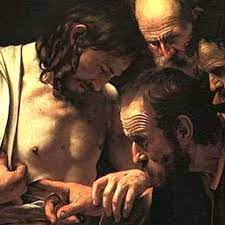
Of course, we weren’t with the disciples in that first post-Easter glow. We might struggle a little, like absent Thomas did, to enthusiastically believe. He demanded to SEE before he would give his heart over:

Thomas, called Didymus, one of the Twelve,
was not with them when Jesus came.
So the other disciples said to him, “We have seen the Lord.”
But he said to them,
“Unless I see the mark of the nails in his hands
and put my finger into the nailmarks
and put my hand into his side, I will not believe.”

John 20:24-25

Jesus was so kind to Thomas, wasn’t he – allowing Thomas not only to see, but to touch his sacred wounds.

Jesus is kind to us too. Through our Baptism, we are invited to see and touch Christ’s wounds in our own time and, like the gloriously joyous disciples, to be healers in God’s name.

In this you rejoice, although now for a little while
you may have to suffer through various trials,
so that the genuineness of your faith …
may prove to be for praise, glory, and honor
at the revelation of Jesus Christ.

Although you have not seen him you love him;
even though you do not see him now yet believe in him,
you rejoice with an indescribable and glorious joy,
as you attain the goal of your faith, the salvation of your souls.

1 Peter 1:6-8

Poetry: from “Sounding of the Seasons” by Malcolm Guite

“We do not know… how can we know the way?”
Courageous master of the awkward question,
You spoke the words the others dared not say
And cut through their evasion and abstraction.

Oh doubting Thomas, father of my faith,
You put your finger on the nub of things
We cannot love some disembodied wraith,
But flesh and blood must be our king of kings.

Your teaching is to touch, embrace, anoint,
Feel after Him and find Him in the flesh.
Because He loved your awkward counter-point
The Word has heard and granted you your wish.

Oh place my hands with yours, help me divine
The wounded God whose wounds are healing mine.

Music: Surely God Is With Us – Rich Mullins 

Breakfast with Jesus

Friday in the Octave of Easter
April 14, 2023

Today’s Readings:

https://bible.usccb.org/bible/readings/041423.cfm

Today, in God’s Lavish Mercy, we once again have readings sprinkled with the names of ancient people who lived in the immediate Resurrection light.

In our first reading from Acts:

After the crippled man had been cured,
while Peter and John were still speaking to the people,
the priests, the captain of the temple guard,
and the Sadducees confronted them,
disturbed that they were teaching the people
and proclaiming in Jesus the resurrection of the dead.

Acts 4:1-2
  • Peter and John, courageously, exuberantly sharing the Word
  • Annas, the retired but still influential high priest to whom Jesus was first brought when arrested
  • Caiaphas, the reigning high priest, who plotted to kill Jesus, condemned him for blasphemy, and sent him for judgment to Pilate
  • John and Alexander, less known priestly trainees, but known well enough to have their names recorded

Christ Before Caiaphas- Matthias Stom


In our Gospel, John names some of the group lolling along the beach one day. It’s interesting how he remembers and identifies them as he tells the story many years later:

  • Simon Peter – remembered with both his original and later Christ-given name
  • Thomas called Didymus – a name meaning “twin”, who was his twin and why is he never mentioned as a disciple?
  • Nathanael from Cana in Galilee – identified here by his home town of Cana. Had it been at his home, perhaps his wedding, that Christ’s first miracle occurred?
  • Zebedee’s sons – John, writer of the Gospel identifies himself and his brother (James) only by their relationship to their very influential father
  • two others of his disciples – what about these two? Why has John, who was there, conveniently forgotten their names? Were they women, whom custom often left unnamed and perhaps overlooked?

Breakfast with Jesus – C.Michael Dudash


These readings offer us rich opportunities to chose one of these people and sit with them as they condition their hearts to the overwhelming truth of the Resurrection.

How does each one respond to their redeemed reality? We have the same choice these ancient persons had. Do we:

  • live and preach the Good News by our choices, as Peter and John did?
  • resist its call to us like the high priests?
  • dive whole-heartedly toward Jesus like half-clad Peter?
  • surrender our doubts and finally believe like Thomas?
  • invite Jesus into our life, home and celebrations like Nathaniel may have?
  • realize how our elders have gifted us with faith and honor them as Zebedee’s sons did?

And what about the “two others of his disciples” left in the unnamed shadows of history? Perhaps we are more like them – quietly doing, praying, loving, hoping to respond with humble hearts to the Easter gift we have been given.


This morning, let’s sit beside Jesus and his barbecued fish to talk about it. Let’s listen to what he hopes for and loves in us.

Jesus said to them, “Come, have breakfast.”
And none of the disciples dared to ask him, “Who are you?”
because they realized it was the Lord.
Jesus came over and took the bread and gave it to them,
and in like manner the fish.
This was now the third time Jesus was revealed to his disciples
after being raised from the dead.

John 21:12-14

Poetry:  Jesus Makes Breakfast: A Poem about John 21:1-14 
– by Carol Penner, Mennonite pastor currently teaching theology at Conrad Grebel University College in Waterloo, Ontario.

I could smell that charcoal fire a long way off
while we were still rowing far from shore.
As we got closer I could smell the fish cooking,
I imagined I could hear it sizzling.
When you’re hungry, your mind works that way.

When the man by the fire called out asking us about our catch,
we held up the empty nets.
And his advice to throw the nets in once more
is something we might have ignored,
except for the smell of cooking fish…
this guy must know something  about catching fish!

The catch took our breath away;
never in my life have we pulled so many in one heave.
I was concentrating on the catch,
but John wasn’t even paying attention,
he was staring at the shore
as if his life depended on it.
Then he clutched my shoulder, crying,
“It is the Lord!”

Suddenly, everything came into focus,
the man, the catch, the voice,
and nothing could stop me,
I had to be with the Master.

There were no words at breakfast,
beyond, “Pass the fish,”
or “I’ll have a bit more bread.”
We sat there, eating our fill,
basking in the sunrise.
We didn’t have to say anything.
Jesus just smiled and served.


Music: Spend some time on that morning beach with Jesus:

Turn toward Light!

Tuesday in the Octave of Easter
April 11, 2023

Today’s Readings:

https://bible.usccb.org/bible/readings/041123.cfm

Today, in God’s Lavish Mercy, we share the heartfelt experience of the early disciples captured in a few poignant comments.

Sometimes words are so full of meaning that they burst in your heart when you read them — when you hear them

Two such phrases rise up from our readings today: 

Cut to the heart

In our first reading, the Easter-liberated Apostles preach the Gospel with gusto! They tell it – exactly like it is- to the crowd gathered in Jerusalem:

On the day of Pentecost, Peter said to the Jewish people,
“Let the whole house of Israel know for certain
that God has made him both Lord and Christ,
this Jesus whom you crucified.”

Acts 2:36

….” this Jesus whom you crucified..”

For those in that crowd, these were shattering words to hear! The feeling is like when you drop a precious vase and it crumbles at your feet! What do you do now? It is too late to redeem the brokenness! They were “cut to the heart” by the realization.

But that is the wonder of the Resurrection. It is never too late! Our life in God is never irrevocably broken!

Peter, motivated by Jesus’ own act of forgiveness from the cross, said to them,

“Repent and be baptized, every one of you,
in the name of Jesus Christ, for the forgiveness of your sins;
and you will receive the gift of the Holy Spirit.
For the promise is made to you and to your children
and to all those far off,
whomever the Lord our God will call.”

Acts 2:38-39

Rabbouni 

Our Gospel extends this theme of restoration and hope. As we pray with its grace-filled drama, we thank John for being the only Evangelist to record this poignant moment between Jesus and Mary.

After Mary had discovered the empty tomb, and summoned the other disciples to see it, she lingers there once they have returned the city. 

She doesn’t know what to do! Feel her confusion, her distress. Easter faith has not yet dawned in her. She thinks the precious body of Jesus has been stolen, perhaps desecrated – again, like a beautiful vessel splintered and lost forever.

Then she turns toward the Light – as we all must do when we are overshadowed in doubt.

She said to the angels, “They have taken my Lord,
and I don’t know where they laid him.”
When she had said this, she turned around and saw Jesus there…

John 20:14

Still, she doesn’t fully recognize him until he lovingly speaks her name. Then she in turn utters the word so full of devotion and love: Rabbouni 

Noli Me Tangere – Antonio Corregio

Think about it! You can imagine how she felt when she said it – just like you would feel if you thought you had lost a Beloved but they returned to you alive and transformed!

Let’s be with Jesus and Mary in this sacred moment, hearing our own name spoken by our Beloved, responding in amazed tenderness from the depths of our heart.


Poetry: Rabboni! by John Banister Tabb (1845 – 1909) an American poet, Roman Catholic priest, and professor of English.

"I bring thee balm, and, lo, Thou art not here!
Twice have I poured mine ointment on Thy brow,
And washed Thy feet with tears. Disdain'st Thou now
The spikenard and the myrrh?"
“Has Death, alas, betrayed Thee with a kiss
That seals Thee from the memory of mine?”
“Mary!” It is the self-same Voice Divine.
"Rabboni!" -- only this.

Music: Rabboni – Ken Young

You were there when the world had turned against me.
When the darkness had possessed my soul,
Your tender mercy made me whole.
When I followed You, my life was filled with meaning
From the morning to the evening.
I’ve seen the face of God.

Chorus:
Rabboni! My Teacher and my God!
You’re alive and my burdens melt away.
Rabboni! Sweet Son of God Most High!
I know death has lost its power
And Your glory’s here to stay. (repeat).

When I close my eyes
I can hear Your voice so clearly saying,
“Father, please forgive them,
For they know not what they do.”
What good reason did they have to do
The things they did to You?

So I come once again bringing all I have to offer,
Just to find a dark and empty tomb,
Your holy frame somehow exhumed.
Then I hear someone say,
“Why are tears so freely falling?
Can’t You hear the voice that’s calling?
A voice that knows Your name.”

Alleluia! Alleluia!

Easter Sunday
April 9, 2023

Today’s Readings:

https://bible.usccb.org/bible/readings/040923.cfm

Today, in God’s Lavish Mercy, our hearts sing the triumphant Alleluia!

The Promise is kept!

Faith is affirmed!

Breath, held in the darkness, is confidently released into the Light!

Jesus Christ is risen from the dead!


This is the central canon of our faith. If we truly believe it and live from that conviction, everything – yes, everything– becomes grace.

If then you were raised with Christ, seek what is above, 
where Christ is seated at the right hand of God.
Think of what is above, not of what is on earth.
For you have died, and your life is hidden with Christ in God.
When Christ your life appears,
then you too will appear with him in glory.

Colossians 3:1-4

In our prayer today, we might want to be with Mary on that early morning, as she walks through the lingering shadows. Is there something she has yet to release into the compassionate heart of God – some doubt or fear she clings to? Some fruitless crutch in her life that blocks her full yielding to God’s Presence?

She sees the stone rolled away? What does it mean to her? What does it mean to us?

As we will find a little later in John’s Gospel, Mary’s recognition of the Resurrected Christ was a slow and tender dawning. Perhaps our is too. Today, and throughout the coming Easter Season, is a time to engage that Holy Sunrise!


Poetry: two poems for Easter

Rabboni – by Herbert Gustav Schmaltz

The Magdalen, A Garden and This – Kathleen O’Toole

She who is known by myth and association 
as sinful, penitent, voluptuous perhaps... 
but faithful to the last and then beyond.

A disciple for sure, confused often with Mary, 
sister of Lazarus, or the woman caught 
in adultery, or she who angered the men

by anointing Jesus with expensive oils.
She was the one from whom he cast out seven 
demons-she's named in that account.

Strip all else away and we know only 
that she was grateful, that she found her way 
to the cross, and that she returned

to the tomb, to the garden nearby, and there, 
weeping at her loss, was recognized, 
became known in the tender invocation

of her name. Mary: breathed by one 
whom she mistook for the gardener, he 
who in an instant brought her back to herself-

gave her in two syllables a life beloved, 
gave me the only sure thing I'll believe 
of heaven, that if it be, it will consist

in this: the one unmistakable 
rendering of your name.

Excerpt from Paradisio – Dante

Like sudden lightning scattering the spirits
of sight so that the eye is then too weak
to act on other things it would perceive,
such was the living light encircling me,
leaving me so enveloped by its veil
of radiance that I could see no thing.
The Love that calms this heaven always welcomes
into Itself with such a salutation,
to make the candle ready for its flame.

Music:  Love Crucified Arose – Michael Card

Long ago, He blessed the earth
Born older than the years
And in the stall the cross He saw
Through the first of many tears

A life of homeless wandering
Cast out in sorrow’s way
The Shepherd seeking for the lost
His life, the price He paid

Love crucified arose
The risen One in splendor
Jehovah’s sole defender
Has won the victory

Love crucified arose
And the grave became a place of hope
For the heart that sin and sorrow broke
Is beating once again

Throughout Your life You’ve felt the weight
Of what You’d come to give
To drink for us that crimson cup
So we might really live

At last the time to love and die
The dark appointed day
That one forsaken moment when
Your Father turned His face away

Love crucified arose
The One who lived and died for me
Was Satan’s nail-pierced casualty
Now He’s breathing once again

Love crucified arose
And the grave became a place of hope
For the heart that sin and sorrow broke
Is beating once again

Love crucified arose
The risen One in splendor
Jehovah’s sole defender
Has won the victory

My Body … for You

Holy Thursday
April 6, 2023

Today’s Readings:

https://bible.usccb.org/bible/readings/040623-Supper.cfm

Today, in God’s Lavish Mercy, the greatest act of love unfolds around a simple table, in the last rich hues of a Jerusalem sunset. No doubt the Twelve whom we are used to seeing in the paintings, and the many other who had sustained Christ’s journey by their service, sensed that this was an extraordinary Seder.

As you place yourself in the scene, you may wish to be one of the Apostles, or you may be the one who baked bread that would become His Body. You may be the one who decanted the precious wine to be His Blood.

Wherever you are in that ancient, yet living story – and wherever you are tonight, let the ancient awe fill your heart as you hear these astounding words:

Brothers and sisters:
I received from the Lord what I also handed on to you,
that the Lord Jesus, on the night he was handed over,
took bread, and, after he had given thanks,
broke it and said, “This is my body that is for you.
Do this in remembrance of me.”
In the same way also the cup, after supper, saying,
“This cup is the new covenant in my blood.
Do this, as often as you drink it, in remembrance of me.”
For as often as you eat this bread and drink the cup,
you proclaim the death of the Lord until he comes.

1 Corinthians 11: 23-26

After the supper, to help us comprehend his incomprehensible Gift, Jesus shows us what Eucharist looks like in everyday practice. It looks like the selfless service of a tender foot washing, the humble bending of our hearts to tend another’s need.

So, during supper,
fully aware that the Father had put everything into his power
and that he had come from God and was returning to God,
he rose from supper and took off his outer garments.
He took a towel and tied it around his waist.
Then he poured water into a basin
and began to wash the disciples’ feet
and dry them with the towel around his waist.

….

So when he had washed their feet
and put his garments back on and reclined at table again,
he said to them, “Do you realize what I have done for you?
You call me ‘teacher’ and ‘master,’  and rightly so, for indeed I am.
If I, therefore, the master and teacher, have washed your feet,
you ought to wash one another’s feet.
I have given you a model to follow,
so that as I have done for you, you should also do.”


Dearest Jesus, teach us the deep, deep lessons of these readings. Let them live in us in sacramental vigor poured over the world in Mercy.

As you walk now from the Upper Room toward the Agony of Gethsemane, let us walk beside you in trusting love.


Poetry: Loves – Scott Cairns is the author of eight books of poetry, including The Theology of Doubt (1985), The Translation of Babel (1990), Philokalia (2002), Idiot Psalms (2014), and Slow Pilgrim: The Collected Poems (2015). Spirituality plays an integral role in Cairns’ writing; in an interview, he said, “I’ve come to think of beauty as how God woos us to himself. One doesn’t so much create it or illuminate it as partake of it. Thereafter, one participates, collaborates, in its endless development.”

One of the more dramatic poems is “Loves.” In the voice of Mary Magdalen it offers a strong critique of the separation of flesh and spirit: “All loves are bodily, require / that the lips part, and press their trace / of secrecy upon the one / beloved . . .


Loves

Of Love’s discrete occasions, we
observe sufficient catalogue,
a likely-sounding lexicon

pronounced so as to implicate
a wealth of difference, where reclines
instead a common element,

itself quite like those elements
partaken at the table served
by Jesus on the night he was

betrayed—like those in that the bread
was breakable, the wine was red
and wet, and met the tongue with bright,

intoxicating sweetness, quite
like ... wine. None of what I write arrives
to compromise that sacrament,

the mystery of spirit graved
in what is commonplace and plain—
the broken, brittle crust, the cup.

Quite otherwise, I choose instead
to bear again the news that each,
each was still itself, substantial

in the simplest sense. By now, you
will have learned of Magdalen, a name
recalled for having won a touch

of favor from the one we call
the son of man, and what you’ve heard
is true enough. I met him first

as, mute, he scribbled in the dust
to shame some village hypocrites
toward leaving me unbloodied,

if ill-disposed to taking up
again a prior circumstance.
I met him in the house of one

who was a Pharisee and not
prepared to suffer quietly
my handling of the master’s feet.

Much later, in the garden when,
having died and risen, he spoke
as to a maid and asked me why

I wept. When, at any meeting
with the Christ, was I not weeping?
For what? I only speculate

—brief inability to speak,
a weak and giddy troubling near
the throat, a wash of gratitude.

And early on, I think, some slight
abiding sense of shame, a sop
I have inferred more recently

to do without. Lush poverty!
I think that this is what I’m called
to say, this mild exhortation

that one should still abide all love’s
embarrassments, and so resist
the new temptation—dangerous,

inexpedient mask—of shame.
And, well, perhaps one other thing:
I have received some little bit

about the glib divisions which
so lately have occurred to you
as right, as necessary, fit

That the body is something less
than honorable, say, in its
... appetites? That the spirit is

something pure, and—if all goes well—
potentially unencumbered
by the body’s bawdy tastes.

This disposition, then, has led
to a banal and pious lack
of charity, and, worse, has led

more than a few to attempt some
soul-preserving severance—harsh
mortifications, manglings, all

manner of ritual excision
lately undertaken to prevent
the body’s claim upon the heart,

or mind, or (blasphemy!) spirit—
whatever name you fix upon
the supposéd bodiless.

I fear that you presume—dissecting
the person unto something less
complex. I think that you forget

you are not Greek. I think that you
forget the very issue which
induced the Christ to take on flesh.

All loves are bodily, require
that the lips part, and press their trace
of secrecy upon the one

beloved—the one, or many, endless
array whose aspects turn to face
the one who calls, the one whose choice

it was one day to lift my own
bruised body from the dust, where, it seems
to me, I must have met my death,

thereafter, this subsequent life
and late disinclination toward
simple reductions in the name

of Jesus, whose image I work
daily to retain. I have kissed
his feet. I have looked long

into the trouble of his face,
and met, in that intersection,
the sacred place—where body

and spirit both abide, both yield,
in mutual obsession. Yes,
if you’ll recall your Hebrew word.

just long enough to glimpse in its
dense figure power to produce
you’ll see as well the damage Greek

has wrought upon your tongue, stolen
from your sense of what is holy,
wholly good, fully animal—
the body which he now prepares.

Music: Tenebrae Music for Holy Thursday –  Giovanni Pierluigi da Palestrina (1525-94)

This musical meditation is based on the Lamentations in the Book of Jeremiah. The word “tenebrae” means “shadows”.

The Other Side of Light

April 1, 2023

Dear Friends,

It feels appropriate that, before we resume gathering together in Lavish Mercy tomorrow, I comment a bit on my time away from the blog.

First, I sincerely thank you all for your prayers and encouragement. In a shadowy time, you gave me the generous lights of comfort and joy. I am deeply grateful.

Now, as I continue to heal from a time of unexpected vulnerability, I have the advantage of being able to reflect in peace on what has happened to me. 

Part of that peace and healing has been a move to our Motherhouse, a loving community where I have the support and care I need right now. I am blessed beyond words by this gift.


This photo was taken in the early 1900s for the Merion Historical Society


My new room is on the very western end of the building (See blue arrow above.) However, I look out my ample windows not to a sunset horizon – but instead to the imposing wall of our magnificent chapel. Some were concerned that the “wall view” might not be optimal. They didn’t realize that the wall housed an unexpected gift – a bird’s eye view of the glorious rose window that, for over a century, has blessed our chapel with dawn Light.

And I am now on the other side of that Light as it flows over my beloved community – a place that feels ever closer to God with each sunrise.


Sometimes, especially in the evening, I will catch a lovely glow within chapel on one of the several stained glass windows. I consider these my own special sunsets given only to me for my unique reflection. These windows are icons for me as I pray and learn from my own little “passover experience” this winter. 

Evening Window from the Outside!

During times of suffering, loss, or unchosen change in our lives, it is hard to turn to the Light. As we begin our Holy Week walk, consider that Jesus faced this struggle in the shadows of Gethsemane. There, he taught us what it takes not only to turn toward Light, but to become It.

Then going out he went, as was his custom, to the Mount of Olives, and the disciples followed him. 

When he arrived at the place he said to them, “Pray that you may not undergo the test.”

After withdrawing about a stone’s throw from them and kneeling, he prayed, saying, “Father, if you are willing, take this cup away from me; still, not my will but yours be done.”

And to strengthen him an angel from heaven appeared to him.

Matthew 22: 40-43

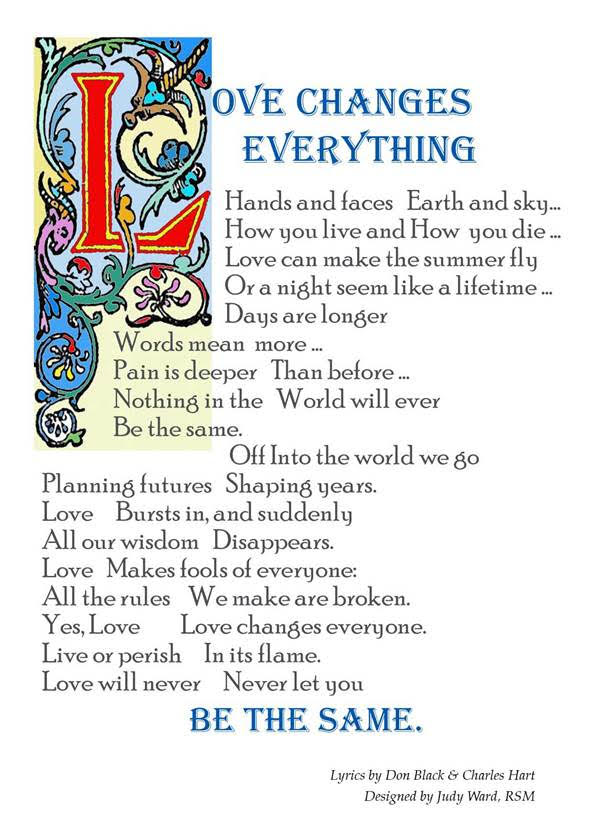
As it was with Jesus, a “Gethsemane moment” in any of our lives is an invitation to abandon ourselves in trust to God’s inscrutable Love — a falling helplessly, but hopefully, into a Love that changes everything.

For Jesus, his embrace of God’s Will in that tenebrous garden opened his heart to the glory of the Resurrection and led him to the other side of Light. How might such self-giving open and lead us?


Love Changes Everything – Andrew Lloyd Webber, Don Black, and Charles Hart

Law Yields to Love

Wednesday of the Second Week in Ordinary Time
January 18, 2023

Today’s Readings:

https://bible.usccb.org/bible/readings/011823.cfm

Today, in God’s Lavish Mercy,  the writer of Hebrews continues to shine light on the superior “priesthood” of Jesus Christ – that aspect of Christ’s ministry that breaks heaven open for us and reinstates us as God’s children.

heb2 priest

Hebrews calls Christ a priest “according to the order of Melchizedek” – an order above and beyond the priesthood of Aaron and Levi.

Although there are a few references to Melchizedek in scripture, only one narrative refers to him:

After Abram returned from defeating Kedorlaomer and the kings allied with him,
the king of Sodom came out to meet him in the Valley of Shaveh (that is, the King’s Valley).
Then Melchizedek king of Salem brought out bread and wine.
He was priest of God Most High, and he blessed Abram, saying,
“Blessed be Abram by God Most High,
    Creator of heaven and earth.
And praise be to God Most High,
    who delivered your enemies into your hand.”
Then Abram gave him a tenth of everything.

Genesis 14: 17-20

Melchizedek, whose priesthood preceded even Abraham, is offered in Hebrews as a prototype of Jesus who fulfills and perfects the Old Testament promises.

Does this matter to us modern day Christians who can barely say “Melchizedek “, let alone spell it? And if it does matter, how?

An answer may be revealed in our Gospel today. 

In it, Jesus challenges the old, pharisaical, law-bound way of thinking. As the new and perfect “priest”, Jesus breaks that way of thinking with the transformation of love. Jesus is the perfection of that which Melchizedek was only the forerunner.

Then he said to the Pharisees,
“Is it lawful to do good on the sabbath rather than to do evil,
to save life rather than to destroy it?”
But they remained silent.
Looking around at them with anger
and grieved at their hardness of heart,
Jesus said to the man, “Stretch out your hand.”
He stretched it out and his hand was restored.
The Pharisees went out and immediately took counsel
with the Herodians against him to put him to death.

Mark 3:3-6
  • This man with the withered hand is more important than the law. 
  • This act of healing and wholeness is more important than ritual adherence. 
  • The priesthood of Jesus is the breakthrough revelation of what God really desires – mercy, not sacrifice.

Poetry: Excerpt from John Berryman’s Eleven Addresses to the Lord

John Berryman (1914 – 1972) was an American poet and scholar. He was a major figure in American poetry in the second half of the 20th century and is considered a key figure in the “confessional” school of poetry. Eleven Addresses to the Lord describes, with an interplay of sincerity and irony, the poet’s struggle to believe. Section 10 below reveals love over law as a key factor in Berryman’s evolving faith.

10

Fearful I peer upon the mountain path
where once Your shadow passed, Limner of the clouds
up their phantastic guesses. I am afraid,
I never until now confessed.
I fell back in love with you, Father, for two reasons:
You were good to me, & a delicious author,
rational & passionate. Come on me again,
as twice you came to Azarias & Misael.
President of the brethren, our mild assemblies
inspire, & bother the priest not to be dull;
keep us week-long in order; love my children,
my mother far & ill, far brother, my spouse.
Oil all my turbulence as at Thy dictation
I sweat out my wayward works.
Father Hopkins said the only true literary critic is Christ.
Let me lie down exhausted, content with that.

Music: Love Broke Thru ~ Toby Mac