Be Merciful

Twenty-fourth Sunday in Ordinary Time
September 17, 2023

Today’s Readings:

https://bible.usccb.org/bible/readings/091723.cfm


Today, in God’s Lavish Mercy, we pray with Psalm 103, and its gentle comforting refrain:

The Lord is kind and merciful, 
slow to anger, and rich in compassion.


Our Sunday readings encourage to become like this merciful, forgiving, patient, compassionate God.

I’m not doing so well at that. Anybody else with me? Sometimes I feel like we’re living in a desert devoid of humanness and reverence, and I am an unfortunate part of it!

Somehow, in our current political and cultural environment, too often I feel angry and even outraged. Those kinds of feelings don’t leave much room for compassion and its accompanying virtues!


Recently I witnessed two wonderful friends openly spat on social media because of their opposing political camps. I’ve seen family members shut each other out for the same reasons. We can’t turn on the TV without seeing a barrage of hateful words and actions unleashed against other human beings.

I feel poisoned and sick when I see the culture we have brewed for ourselves!


In our first reading, Sirach seems to have felt pretty sickened by his environment too. He counsels his listeners:

Forgive your neighbor’s injustice;
then when you pray, your own sins will be forgiven.
Could anyone nourish anger against another
and expect healing from the LORD?

Sirach 28:2-3

Paul, in our second reading, tells us why we should change our hateful behavior:

None of us lives for oneself, and no one dies for oneself.
For if we live, we live for the Lord,
and if we die, we die for the Lord;
so then, whether we live or die, we are the Lord’s.

Romans 14:7-8

In our Gospel, Jesus uses a stunning parable to drive home the commandment for forgiveness. I don’t think any of us really wants to end up like the selfish, wicked servant – handed over to the torture of our own hatreds.

Then in anger his master handed him over to the torturers
until he should pay back the whole debt.
So will my heavenly Father do to you,
unless each of you forgives your brother from your heart.

Matthew 18:35

This Sunday’s readings are serious. They’re not kidding. We have to change any sinful incivility or hate that resides in our hearts. We may not be able to change our feelings. But we can stop feeding them with lies, propaganda, and conspiracy theories.

What we can change are our actions and words. And we must.


Poetry: Love my enemies, enemy my love by Rebecca Seiferle

Oh, we fear our enemy’s mind, the shape
in his thought that resembles the cripple
in our own, for it’s not just his fear
we fear, but his love and his paradise .

We fear he will deprive us of our peace
of mind, and, fearing this, are thus deprived,
so we must go to war, to be free of this
terror, this unremitting fear, that he might

he might, he might. Oh it’s hard to say
what he might do or feel or think.
Except all that we cannot bear of
feeling or thinking—so his might

must be met with might of armor
and of intent—informed by all the hunker
down within the bunker of ourselves.
How does he love? and eat? and drink?

He must be all strategy or some sick lie.
How can reason unlock such a door,
for we bar it too with friends and lovers,
in waking hours, on ordinary days?

Finding the other so senseless and unknown,
we go to war to feel free of the fear
of our own minds, and so come
to ruin in our hearts of ordinary days.


Music: Kyrie Eleison – Lord, have Mercy

This is an extended, meditative singing of the prayer. I like to listen to it in the very early morning. Just doing that is a good prayer for me.

“Keeping” the Word

Memorial of Saints Cornelius, Pope, and Cyprian, Bishop, Martyrs
Saturday of the Twenty-third Week in Ordinary Time
September 16, 2023

Today’s Readings:

https://bible.usccb.org/bible/readings/091623.cfm


Today, in God’s Lavish Mercy, in his letter to Timothy, we see that Paul thought he had been the foremost of bad dudes.

This saying is trustworthy and deserves full acceptance:
Christ Jesus came into the world to save sinners.
Of these I am the foremost.

1 Timothy 1:15

Well, maybe – maybe not! It’s hard to imagine that a really bad guy could end up with the sacred portfolio Paul compiled before he met his maker. Jesus says as much in today’s Gospel:

A good tree does not bear rotten fruit,
nor does a rotten tree bear good fruit.
For every tree is known by its own fruit.

Luke 6:43-44

So let’s say Paul wasn’t really a “bad guy” before he got knocked off his Damascus-bound horse. Then what was he? The key word in Paul’s self-description is this: SINNER. Paul was a sinner.

Sinners are otherwise “good guys” who make bad choices for their spiritual lives. When those bad choices multiply and begin to feed on one another, the soul deteriorates like the rotten tree in Jesus’s image.


Jesus uses an additional metaphor to describe the process of continual spiritual conversion:

“Why do you call me, ‘Lord, Lord,’ but not do what I command?
I will show you what someone is like who comes to me,
listens to my words, and acts on them.
That one is like a man building a house,
who dug deeply and laid the foundation on rock;
when the flood came, the river burst against that house
but could not shake it because it had been well built.

Luke 6:46-48

We open our hearts to Mercy by these commitments to God’s Word in our daily spiritual life:

  • listening
  • acting
  • deepening

Integrity in these three spiritual practices requires dedicated prayer and reflection, a faithful “keeping” with the Word of God. As our Alleluia Verse assures us:

Alleluia, alleluia.
Whoever loves me will keep my Word,
and my Father will love them,
and we will come to them.

John 14:23

Poetry: [i carry your heart with me(i carry it in] – e.e.cummings

i carry your heart with me(i carry it in
my heart)i am never without it(anywhere
i go you go,my dear;and whatever is done
by only me is your doing,my darling)
i fear
no fate(for you are my fate,my sweet)i want
no world(for beautiful you are my world,my true)
and it’s you are whatever a moon has always meant
and whatever a sun will always sing is you
here is the deepest secret nobody knows
(here is the root of the root and the bud of the bud
and the sky of the sky of a tree called life;which grows
higher than soul can hope or mind can hide)
and this is the wonder that's keeping the stars apart

i carry your heart(i carry it in my heart)


Music: Remain in Me – Steve Angrisano

Hidden Motives

Memorial of Saint Dominic, Priest
Tuesday of the Eighteenth Week in Ordinary Time
August 8, 2023

Today’s Readings:

https://bible.usccb.org/bible/readings/080823.cfm


Today, in God’s Lavish Mercy, we pray with Psalm 51 which expresses the ardent desire for forgiveness and reconciliation.

The psalm reflects back to our first reading – an episode of sibling rivalry, jealousy, and hidden motives.

Moses, favored of God and leader of the people, makes a questionable choice. He marries outside the tribe, after telling everyone else not to. Hmmm. His siblings, Aaron and Miriam, don’t like that. So they indignantly complain:

Is it through Moses alone that the LORD speaks?
Does God not speak through us also?

Numbers 12:2

God hears their complaint and sees through it. God sees that they are less concerned about the marriage and more concerned about themselves. They’re tired of Moses telling them what to do. They think God could have picked a better leader — one of them!

God sets them straight about how special Moses is, and their responsibility to support, not undermine, him.

Should there be a prophet among you,
in visions will I reveal myself to him,
in dreams will I speak to him;
not so with my servant Moses!
Throughout my house he bears my trust:
face to face I speak to him;
plainly and not in riddles.
The presence of the LORD he beholds.

Numbers 12:6-7

The whole story is really about motives. Everything we do must be done out of love – out of reverence for God, and out of respect and hope for ourselves and others. This is what it means to have a clean heart. And it is the plea of Psalm 51.

A clean heart create for me, O God,
and a steadfast spirit renew within me.
Cast me not off from your presence,
and your Holy Spirit take not from me.

Psalm 51: 12-13

Prose: This is a great piece by Sister Joyce Rupp on a clean heart (published in America magazine)

https://www.ncronline.org/blogs/clean-heart


Music: Psalm 51 – Chant of the Heart

Jubilee!

Saturday of the Seventeenth Week in Ordinary Time
Saturday, August 5, 2023

Today’s Readings:

https://bible.usccb.org/bible/readings/080523.cfm


One in a series of 60 paintings by Jacob Lawrence which captures
the journeys of millions of African-Americans
who left the Jim Crow South
in search of better lives elsewhere.


Today, in God’s Lavish Mercy, Leviticus offers us a reading critical to our moral clarity.

This fiftieth year you shall make sacred
by proclaiming liberty in the land for all its inhabitants.
It shall be a jubilee for you,
when every one of you shall return to his own property,
every one to his own family estate.

Leviticus 25:10

Leviticus 25 is the account of Jubilee which, for the Mosaic community, was the quintessential practice of justice.

When the Israelites came to the Promised Land, they came as an emancipated people to share in the abundance to which God had delivered them. There was initial equity in the sharing. But over time, power, influence and wealth were hoarded – endangerments that threaten all communities.

In the proclamation of Jubilee, God directs the people to return to an original justice in which all persons are freed from indebtedness of any kind in order to live in communal harmony.


Consider the hypothetical example of an Israelite family that lost their land twelve years before the Jubilee Year. On the tenth day of the seventh month, the entire community participates in the Day of Atonement and its ritual purging of sin. On this very same day, the trumpet is blown and the Jubilee year is announced; in this year, both sins and debts are forgiven, and the family that had been forced to live and work in another’s household for more than a decade regain possession of their land.

Imagine the joy of this moment! Imagine the dreams and desires! After having served as hired hands for a generation, now to be restored to a position of social and economic strength!

Michael J. Rhodes – Jubilee Formation: Cultivating Desire and Dependence in Leviticus 25

The concept of this type of justice is alien to our capitalist and consumerist orientations. We may have heard the attitude expressed, or we may hold it ourselves, that some people have and some people don’t. And the ones who “have” earned it and deserve it.

“Jubilee” instructs us that this is a false context for fulfilling God’s Will for the wholeness of Creation. In such a false context, reward ensues from avarice, dominance, possessiveness, and aggression, yielding a continually deeper gap between those who have and those who do not, between those who influence and those who cannot, between those who thrive and those who do not.


“Jubilee” resets the game board and in so doing resets attitudes about who owns what and how they must use it to enact the Reign of God.

I recently heard a story which speaks of forgetting to whom things belong. A very proper lady went to a tea shop. She sat at a table for two, ordered a pot of tea, and prepared to eat some cookies which she had in her purse. Because the tea shop was crowded, a man took the other chair and also ordered tea. As it happened, he was a Jamaican black, though that is not essential to the story. The woman was prepared for a leisurely time, so she began to read her paper. As she did so, she took a cookie from the package. As she read, she noticed that the man across also took a cookie from the package. This upset her greatly, but she ignored it and kept reading. After a while she took another cookie. And so did he. This unnerved her and she glared at the man. While she glared, he reached for the fifth and last cookie, smiled and offered her half of it. She was indignant. She paid her money and left in a great hurry, enraged at such a presumptuous man. She hurried to her bus stop just ouside. She opened her purse to get a coin for her bus ticket. And then she saw, much to her distress, that in her purse was her package of cookies unopened. The lady is not different from all of us. Sometimes we possess things so long that do not really belong to us that we come to think they are ours. Sometimes, by the mercy of God, we have occasion to see to whom these things in fact belong.

Walter Brueggemann, “Voices of the Night—Against Justice,” in To Act Justly, Love Tenderly, Walk Humbly: An Agenda for Ministers

The applications are abundant, obvious, and profound for our own lives in the various communites in which we live. But they are not easy applications to confront or practice. They pose the ultimate question to us: where do we place our security? The answer determines how fully we understand “Jubilee”.


You have two meaningful prose passages to consider today so let’s just add a little music for your prayer time.

Gabriel’s Oboe – Ennio Morricone played by Henrik Chaim Goldschmidt

Coming to Forgiveness

Memorial of Saint Kateri Tekakwitha, Virgin
Friday of the Fourteenth Week in Ordinary Time
July 14, 2023

Today’s Readings:

https://bible.usccb.org/bible/readings/071423.cfm


Today, in God’s Lavish Mercy, our Gospel describes the suffering to be encountered by disciples as they live and preach the Gospel.

Jesus said to his Apostles:
“Behold, I am sending you like sheep in the midst of wolves;
so be shrewd as serpents and simple as doves.
But beware of men,
for they will hand you over to courts
and scourge you in their synagogues,
and you will be led before governors and kings for my sake
as a witness before them and the pagans.

Matthew 10:16-18

The suffering is predicted to come from many quarters, but perhaps the most heart-breaking is persecutioin within families:

Brother will hand over brother to death,
and the father his child;
children will rise up against parents and have them put to death.
You will be hated by all because of my name,
but whoever endures to the end will be saved.

Matthew 10:21-22

Our reading from Genesis, on the other hand, describes the loving resolution of a long-standing family rupture as Jacob (now called “Israel”) reunites with his long-lost son:

Israel had sent Judah ahead to Joseph,
so that he might meet him in Goshen.
On his arrival in the region of Goshen,
Joseph hitched the horses to his chariot
and rode to meet his father Israel in Goshen.
As soon as Joseph saw him, he flung himself on his neck
and wept a long time in his arms.
And Israel said to Joseph, “At last I can die,
now that I have seen for myself that Joseph is still alive.”

Genesis 46:28-30

Many of us have borne the pain of similar fractures in our various “families”: family of origin, community, church or friends. Sometimes the cause of these breaks may be contradictions in faith and moral practice. At other times, loving bonds break because of willfulness, arrogance, ignorance, small-heartedness or the many other forms of human limitation.

The outrageous jealousy of Joseph’s brothers cleft their otherwise contented family. But into that chasm, God poured time’s grace and Joseph’s healing. From these gifts, Joseph was able to step into reconciliation, inviting his repentant brothers to join him.


In our own lives, such a step can be inordinately huge. The longer we hesitate to take it, the more it widens, sometimes to the point of apparent no return. But the grace of forgiveness is always available to us even if actual reconciliation is impossible because of the recalcitrance, inaccessibility, or perhaps even death of the other party.

When they hand you over,
do not worry about how you are to speak
or what you are to say.
You will be given at that moment what you are to say.
For it will not be you who speak
but the Spirit of your Father speaking through you.

Matthew 10:19-20

Psalm Poem: Psalm 37 – interpreted by Christine Robinson

The evil prosper, but don’t you wallow in anger.
Do what you can and let it go.
Remember the long arc of the universe
and how it bends towards justice.
Set your feet on that path; it is True.
Be still.
Wait for God’s word to speak to your heart.
Enjoy your life as it is, find your work, love those around you.
Hold your head up and teach your children.
Notice those who are honest.
Join the upright
Make peace where you can
Trust in God.

Music: excerpts from Joseph and the Amazing Technicolor Dreamcoat – Andrew Llyod Webber

These two videos capture the story of Jacob’s arrival in Egypt and Joseph’s self-reconciliation. The first ends rather abruptly, but thesecond picks up the action. All lyrics are below.

[NARRATOR]
Joseph knew by this his brothers now were honest men
The time had come at last to reunite them all again

[JOSEPH]
Can’t you recognize my face? Is it hard to see
That Joseph, who you thought was dead, your brother
It’s me?

[ENESMBLE]
Joseph, Joseph, is it really true?
Joseph, Joseph, is it really you?

[NARRATOR & ENESMBLE]
Joseph! Joseph!

——————-

So Jacob came to Egypt
No longer feeling old
And Joseph came to meet him
In his chariot of gold
Of gold
Of gold
Of gold!

————-

[JOSEPH]
I closed my eyes, drew back the curtain
To see for certain what I thought I knew
Far, far away, someone was weeping
But the world was sleeping
Any dream will do

[JOSEPH & CHILDREN]
I wore my coat with golden lining
Bright colors shining, wonderful and new
And in the east, the dawn was breaking
And the world was waking
Any dream will do
A crash of drums

[NARRATOR]
A flash of light

[JOSEPH]
My golden coat flew out of sight

[JOSEPH & NARRATOR]
The colors faded into darkness
I was left alone

[JOSEPH, NARRATOR & CHILDREN]
May I return to the beginning?
The light is dimming, and the dream is too
The world and I, we are still waiting
Still hesitating
Any dream will do

Blessed Retrospect!

Thursday of the Fourteenth Week in Ordinary Time
July 13, 2023

Today’s Readings:

https://bible.usccb.org/bible/readings/071323.cfm


Joseph Forgives His Brothers – Joseph Von Cornelius

Today, in God’s Lavish Mercy, Joseph forgives his brothers and Jesus commissions his disciples.

The story of Joseph’s forgiveness makes a tender and indelible mark on the prayerful reader. How we wish we could be as magnanimous as Joseph in our forbearance!


Joseph’s experience is one of a long-held hurt that he sets aside to pursue another life. But even though he achieves tremendous success in his new environment, hurts like this are never forgotten. Joseph’s sobs at verse four indicate the painful memory’s depth.

Joseph could no longer control himself
in the presence of all his attendants,
so he cried out, “Have everyone withdraw from me!”
Thus no one else was about when he made himself known to his brothers.
But his sobs were so loud that the Egyptians heard him,
and so the news reached Pharaoh’s palace.
“I am Joseph,” he said to his brothers.
“Is my father still in good health?”
But his brothers could give him no answer,
so dumbfounded were they at him.

Genesis 45:1-3

“To forgive is to set a prisoner free
and discover that the prisoner was you.”

Lewis B. Smedes

So many lessons can be drawn from this passage, but clearly the power of forgiveness is most evident. Joseph has been able to live a fruitful life in Egypt because he has already forgiven his brothers’ treachery, long before they unexpectedly arrive at his palace doorstep. He has chosen not to live under the burden of their treacherous choice.

In the wider perspective of God’s timing, we see that the treachery actually yielded a blessing not only for Joseph, but for all of Israel. We ask for the grace to see how our own need to give and receive forgiveness holds a larger blessing for our lives.


Poetry: Let It Go – e.e.cummings

Let it go – the
smashed word broken
open vow or
the oath cracked length
wise – let it go it
was sworn to
go
 
let them go – the
truthful liars and
the false fair friends
and the boths and
neithers – you must let them go they
were born
to go
 
let all go – the
big small middling
tall bigger really
the biggest and all
things – let all go
dear
 
so comes love

Music: Remember Not the Things of the Past – Bob Hurd

Remember not the things of the past;
now I do something new,
do you not see it?
Now I do something new, says the Lord.
 
In our distress God has grasped us by the hand,
opened a path in the sea, and we shall pass over,
we shall pass over, free at last.
 
In our parched land of hypocrisy and hate,
God makes a river spring forth,
a river of mercy, truth and compassion;
come and drink.
 
And who among us is sinless in God’s sight?
Then who will cast the first stone,
when he who was sinless
carried our failings to the cross?
 
Pressing ahead, letting go what lies behind,
may we be found in the Lord, and sharing his dying,
share in his rising from the dead.

Radical Prayer

Thursday of the Eleventh Week in Ordinary Time
June 22. 2023

Today’s Readings:

https://bible.usccb.org/bible/readings/062223.cfm

Today, in God’s Lavish Mercy, Jesus teaches us how to pray.

Jesus said to his disciples:
“In praying, do not babble like the pagans,
who think that they will be heard because of their many words.
Do not be like them.
Your Father knows what you need before you ask him.

“This is how you are to pray:
‘Our Father…

Matthew 6:7-9

Don’t babble …”. Gosh, haven’t you wanted to say that to a few people when they ramble around the point without ever making it! And here we have Jesus saying it to us, kindly and instructively, but nonetheless directly.


This morning, I was thinking about the quality of my own prayer, realizing that every now and again I do babble a lot of nonsense to God before coming to a point of grateful adoration and listening.

And then I remembered a brief clip of conversation from yesterday.

One of the blessings of living in our large Motherhouse is that I am surrounded by wise and holy women steeped in decades of deepening prayer. One of these beloved elders chatted with me last night about her recent retreat. She said, “It was such a peaceful time to pray. And I really wanted to pray… me and God, God and me.” The joyful sincerity and clarity of her statement blessed me with an equal desire to pray that simply.


In today’s Gospel, Jesus opens the door for us to this kind of radical prayer.

It is a prayer which:
grants us the privilege of calling heaven down to earthOur Father who art in heaven
basks in God’s awesome Presencehallowed be thy name
invokes that Presence to unfold Love’s designthy Kingdom come,
thy will be done,
on earth as it is in heaven.
It is a prayer of:
consistent trustGive us this day our daily bread
willing repentanceand forgive us our trespasses
unmeasured forgiveness as we forgive those who trespass against us
and a quenchless hunger for graceand lead us not into temptation,
but deliver us from evil.

Jesus is teaching us how to pray. His prayer is simple, authentic, and direct. He begins by naming his relationship with God, Abba, Father – an act of humble, intimate mutuality. How do we speak to God in our prayer? How do we name God in the deep silence of our hearts? Father, Mother, Beloved, Sweet Light, Tender Mercy? And by what name does God call me in the quiet rhythm of prayer? Perhaps with words, or with unwordable love.


Poetry: Praying – Mary Oliver

It doesn't have to be
the blue iris, it could be
weeds in a vacant lot, or a few
small stones; just
pay attention, then patch

a few words together and don't try
to make them elaborate, this isn't
a contest but the doorway

into thanks, and a silence in which
another voice may speak.

Music: Prayer – Ernest Bloch

“Nigun” means a traditional synagogue melody, with tones that Jesus might have heard as he prayed.

The Heart to Give My All

Memorial of Saint Aloysius Gonzaga, Religious
Wednesday, June 21, 2023

Today’s Readings:

https://bible.usccb.org/bible/readings/062123.cfm


Today, in God’s Lavish Mercy, Paul and Jesus give us some tips on sound Christian living.

Paul instructs us to live out of our abundance rather than our scarcity.

Brothers and sisters, consider this:
whoever sows sparingly will also reap sparingly,
and whoever sows bountifully will also reap bountifully.
Each must do as already determined, without sadness or compulsion,
for God loves a cheerful giver.
Moreover, God is able to make every grace abundant for you,
so that in all things, always having all you need,
you may have an abundance for every good work.

2 Corinthians 9:6-8

It seems like responding to Paul’s challenge shouldn’t be hard for those of us who actually have an abundance of this world’s goods and benefits. But I think sometimes it is.

It’s pretty easy to assess our generosity when we look at money or physical goods. It’s clear when I give someone in need $5.00 or a warm shirt. What’s not so clear is how generous I am , both locally and globally, with non-material goods like my prayer, respect, time, service, patience, understanding, forgiveness, tolerance, appreciation, encouragement or the many hidden awarenesses that might make someone else’s life more gracefully abundant.


Jesus tells us that if we offer these invisible generosities, we will be divinely enriched:

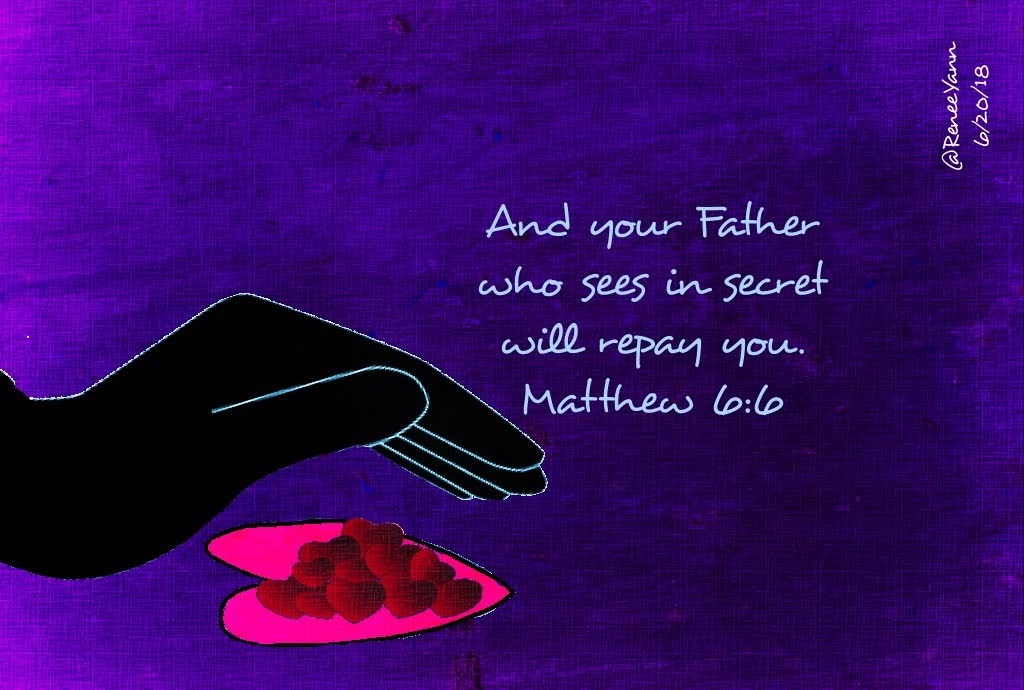
… your Father who sees what is hidden will repay you.


Jesus also expects us to make that offering. Notice that, when describing good works, Jesus doesn’t say “IF” you do these things. He says “WHEN” you do them:

When you give alms, do not blow a trumpet before you…
when you give alms,
do not let your left hand know what your right is doing,
so that your almsgiving may be secret.
And your Father who sees in secret will repay you.


When you pray, do not be like the hypocrites,
who love to stand and pray on street corners …
when you pray, go to your inner room, close the door,
and pray to your Father in secret.
And your Father who sees in secret will repay you.


When you fast, do not look gloomy like the hypocrites …
when you fast, anoint your head and wash your face,
so that you may not appear to others to be fasting,
except to your Father who is hidden.
And your Father who sees what is hidden will repay you.”


Many of us are embarrassingly blessed in this life. Living gratefully is the first step to easing that embarrassment and turning it into spiritual self-knowledge. That deep gratitude will strengthen us for quiet, joyous generosity and the recognition that all our true abundance belongs to God.


Prose: from Gitanjali 50 – Rabindranath Tagore

I had gone a-begging from door to door in the village path, when thy golden chariot appeared in the distance like a gorgeous dream and I wondered who was this King of all kings!

My hopes rose high and methought my evil days were at an end, and I stood waiting for alms to be given unasked and for wealth scattered on all sides in the dust.

The chariot stopped where I stood. Thy glance fell on me and thou camest down with a smile. I felt that the luck of my life had come at last. Then of a sudden thou didst hold out thy right hand and say “What hast thou to give to me?”

Ah, what a kingly jest was it to open thy palm to a beggar to beg! I was confused and stood undecided, and then from my wallet I slowly took out the least grain of corn and gave it to thee.

But how great my surprise when at the day’s end I emptied my bag on the floor to find a least little grain of gold among the poor heap. I bitterly wept and wished that I had had the heart to give thee to my all.

Music: Soul Food – Dean Evenson

The Indescribable Gift

Thursday of the Tenth Week in Ordinary
June 15, 2023

Today’s Reading:

https://bible.usccb.org/bible/readings/061523.cfm


Today, in God’s Lavish Mercy, our readings offer us insight into spiritual clarity.

For sure I, like all of you reading this blog, want to know God more deeply.
Moses did.
The people of the Hebrew Scriptures did.
But Paul tells us in our first reading that they didn’t have the advantage – the “indescribable gift” – that we have: Jesus, the Incarnate Word of God.

To this day, whenever Moses is read,
a veil lies over the hearts of the children of Israel,
but whenever a person turns to the Lord the veil is removed.
Now the Lord is the Spirit and where the Spirit of the Lord is,
there is freedom.

2 Corinthians 3:15-17

Paul says that despite this gift, some of us, blinded by “the god of this age” may remain in darkness:

And even though our Gospel is veiled,
it is veiled for those who are perishing,
in whose case the god of this age
has blinded the minds of the unbelievers,

2 Corinthians 4:3-4

Paul compares this blocked vision to a veil covering our eyes and distancing us from the fullness of God.

It’s a great image! Don’t we unconsciously cover our eyes when we don’t want to see what’s really going on? Don’t we cast our own glance downward to obscure our eyes when we are unsure of ourselves or, maybe, telling a white lie?


This morning, when I read about Paul’s “veil”, I remembered a funny but instructive incident from my childhood. I was about seven years old and had been sent to my room for some egregious infraction of household law. Convinced of my innocence and righteousness, I pouted there until Mom called me downstairs for dinner.

Still angry, I didn’t want to go, so I decided not to “face” my family at the dinner table. Probably, deep in my heart, I knew I had been wrong but didn’t yet have the freedom to “face” myself. So, employing a pair of Mom’s old sunglasses and Grandpop’s handkerchief, I appeared at the dinner table like this – “veiled”. (Believe me, it was no fun trying to eat my mashed potatoes that way!)


I am a long, long way from that bratty little girl now. But there are still places in my life where I want to reach for the hanky and the glasses because I’m not ready for God’s overwhelming grace offered to me in every life circumstance. So often, I am still convinced that I see the darkness that I see, rather than the Mystery within it inviting me to Light..

For God who said, “Let light shine out of darkness”,
has shone in our hearts to bring to light
the knowledge of the glory of God
on the face of Jesus Christ.

1 Corinthians 4:6

Back when I was seven years old, it was Uncle Joe who teased me, with a gentle love, out of my peevishness. Maybe God is trying to do that for you, for me, today. What do you think?

(Uncle Joe and me, about 35 years after the described incident.)


Poetry: from Rumi

Your thoughts are a veil 
on the face of the Moon.

That Moon is your heart,
and those thoughts cover your heart.

So let them go,
just let them fall into the water.

Music: Heaven’s Window – Peter Kater – you will hear a gentle call to Agnus Dei, Jesus Lamb of God as the music lifts the veil to heaven. Just relax and let the music lift you too.

Upside-Down, Inside-Out

Thursday of the Fourth Week of Easter
May 4, 2023

Today’s Readings:

https://bible.usccb.org/bible/readings/050423.cfm

Today, in God’s Lavish Mercy, our two readings take us on a journey. We sail through Israel’s long and spectacular salvation history from Moses through David and forward to Jesus. And in the sailing, we get turned head over heels.


In our first reading, Paul encapsulates twelve hundred years in a few elegant verses. (Nice job, Paul!)

The touchpoints of his homily are these:

  • the sojourn in the land of Egypt. 
  • forty years in the desert.
  • destruction of Canaan,
  • judges up to Samuel the prophet.
  • King Saul, for forty years. 
  • King David whose descendants gave Israel …
  • JESUS
  • then a little mention of John the Baptist

Paul’s succinct preaching allows us to see God’s powerful arm reaching through the long sleeve of Isreal’s history, finally handing the Chosen People the ultimate gift — Jesus Christ the Messiah.


Ah, but then we have our Gospel – which does today what it always does so well. It turns everything upside down and inside-out.

Through the twelve hundred years of Israel’s pre-Christian history, we see an agonizingly slow rise to power and glory culminating in David’s reign. How deeply later Israelites longed for a future Savior who would shine like the royal David had – who would restore the glory of Israel. That was their cherished expectation.


But Jesus turns that long sleeve of salvation history inside out. He preaches an inverse power fueled by service, a glory dressed in humble acts of mercy and forgiveness.

His longing is not for a worldly restoration, but for a whole New Creation born of sacrificial love. His hope is not for a secular kingdom but for a transformational community enlivened in the Triune God.

When Jesus had washed the disciples’ feet, he said to them:
“Amen, amen, I say to you, no slave is greater than his master
nor any messenger greater than the one who sent him.
If you understand this, blessed are you if you do it.

John 12:16-20

As we read and pray the scriptures, we get better at seeing the sacred understory of grace sustaining us. Upside-down, inside-out, our daily life is filled with divine mystery and revelation. We just have to look at the flip side to catch hold of the sail.

I was a teenager during the golden age of the 33 and 45 rpm records. I had a slew of Elvis, Fats Domino, Roy Orbison, The Everley Brothers, Ray Charles, The Supremes and many others. Each record had a hit on one side, and I rarely bothered to look at the other side. One day I flipped one of my “Top 10s” (The Wildcat Blues) to take a look at the other side, only to find what would become one of my favorite songs of all time: Petite Fleur. After the 1950s, it faded from the top ten list, but it has stayed on my list for 60 years.

When I hear that song, it sinks into my spirit creating a feeling that resists words. Like much good music, it reorders something in my spirit so that I see the world a little differently. And I would never have found it if I hadn’t turned things upside down to listen to the understory.


If we allow ourselves to dive deep under the scriptures – to go to the “flip side” – as Jesus invites us to do in today’s Gospel, we will find our own “petite fleurs” of insight and grace.

If you understand this,
blessed are you if you do it.

John 13:17

Prose: from Seeing by Annie Dillard

The secret of seeing is, then, the pearl of great price. 
If I thought he could teach me to find it and keep it forever 
I would stagger barefoot across a hundred deserts 
after any lunatic at all. 

But although the pearl may be found,
it may not be sought. 
The literature of illumination reveals this above all: 
although it comes to those who wait for it, 
it is always, even to the most practiced and adept, 
a gift and a total surprise… 

I cannot cause light; 
the most I can do is try to put myself 
in the path of its beam. 
It is possible, in deep space, to sail on solar wind. 
Light, be it particle or wave, has force: 
you rig a giant sail and go. 

The secret of seeing is to sail on solar wind.
Hone and spread your spirit till you yourself are a sail, 
whetted, translucent, broadside to the merest puff.

Music: Petite Fleur – Chris Barber