Deuteronomy 32: Moses’ Psalm

Monday of the Seventeenth Week in Ordinary Time

July 26, 2020

Today, in God’s Lavish Mercy, we pray with Deuteronomy 32, commonly referred to as the Song of Moses. Most biblical scholars agree that the selection was composed long after Moses died and inserted in Deuteronomy perhaps at the time of the prophet Samuel.

As literature, the poem shows Moses prophesying the troubles that will come upon the people because of their faithlessness. As history, these troubles have already occurred and are referenced as a lesson for the future.


The verses highlighted today are unhappy ones. With exaggerated anthropomorphism, God is characterized as really mad and passive-aggressive with Israel. It’s not a nice picture of how God relates to us. It’s not real either.

Still, the writer was a human being searching for some rational way to understand the trauma Israel was experiencing at the hands of their enemies. The logic, or illogic, goes something like this:

  • things are a mess
  • it must be our fault
  • we did bad things
  • so God’s mad and did bad things back
  • we better straighten up
  • then God might relent

We are all tempted to reason like this when we experience misfortune, pain, and trauma. We think evil should make sense. It doesn’t. The interplay of good and evil is a mystery we will never understand in this life.


What we can understand is faithfulness – God’s to us, and ours to God.

God, you are my Rock—how faultless are your deeds,
how right all your ways!
You are faithful God, without deceit,
You are Justice, Righteousness, and Mercy

This is the true message of the Song of Moses: Our merciful God is always faithful. When we experience suffering in life, – even the kind we bring on ourselves and one another – let our sorrow draw us ever closer to God’s Mercy which abides with us in all our troubles. Within the sacred mystery of grace, that Mercy seeks to transform us into Mercy ourselves.


Poetry:  Possible Answers to Prayer by Scott Cairns
The poem gives a wake up call about self-absorption in our prayers, and – with its own touch of anthropomorphism – images how God might perceive narrow prayers. The poem encourages us to accompany others in their greater sufferings.

Your petitions—though they continue to bear
just the one signature—have been duly recorded.
Your anxieties—despite their constant,

relatively narrow scope and inadvertent
entertainment value—nonetheless serve
to bring your person vividly to mind.

Your repentance—all but obscured beneath
a burgeoning, yellow fog of frankly more
conspicuous resentment—is sufficient.

Your intermittent concern for the sick,
the suffering, the needy poor is sometimes
recognizable to me, if not to them.

Your angers, your zeal, your lipsmackingly
righteous indignation toward the many
whose habits and sympathies offend you— 
      
these must burn away before you’ll apprehend
how near I am, with what fervor I adore
precisely these, the several who rouse your passions.

Music: Audite Caeli – Michel Richard Delalande

This motet captures the opening words of the Song of Moses, Deuteronomy 32.

Audite, caeli, quae loquor: audiat terra verba oris mei.
Concrescat ut pluvia doctrina mea, fluat ut ros eloquium meum,
quasi imber super herbam, et quasi stillae super gramina.
Quia nomen Domini invocabo: date magnificentiam Deo nostro.
Dei perfecta sunt opera, et omnes viae ejus judicia.

Hear, O ye heavens, the things I speak,
let the earth give ear to the words of my mouth.Let my doctrine gather as the rain, let my speech distil as the dew,
as a shower upon the herb, and as drops upon the grass.
Because I will invoke the name of the Lord: give ye magnificence to our God.
The works of God are perfect, and all his ways are judgments.


Psalm 51: Secret Heart

Friday of the Fourteenth Week in Ordinary Time

July 10, 2020

Today, in God’s Lavish Mercy, we pray with Psalm 51, a deeply moving plea for a pure heart and a right spirit. Psalm 51 is a penitential psalm known by its Latin name, Miserere (Have Mercy). You, dear readers, may remember a reflection on this beautiful psalm from just about a month ago.


As I prayed with Psalm 51 today, I asked myself how my spirit has been doing in the intervening month. May I challenge you all with the same question?

Corona time is not easy on the Spirit. Confinement, uncertainty, suffering and loss have impacted all of us in some way. Restrictions away from friends, family, and community deplete us. Social unrest and political lunacy unsettle us.

On the other hand, some of us have been able to embrace this time as a long retreat from “the way things were”. It has been a time of washing our hearts down to their bare muscle. We have sat in the quiet with questions like “What is it that I most love,  most trust, most need, most believe in, most hope for?”.


It is such an appropriate time to pray Psalm 51, to be with God in our “secret heart” – that place where no one else ever hears our rawest thoughts and purest prayers:

  • to acknowledge any sin or guilt we carry
  • to name our desire for healing and clarity
  • to listen to the whispering of Wisdom within us
  • to find our strength by finding our rootedness in God
  • to reclaim joy even in the midst of difficulty
  • to make our heart at home in praise
  • to be righted by Mercy

Let’s pray with and for one another as we cherish this Psalm.


Poetry: The Place Where We Are Right – Yehuda Amichai

From the place where we are right
Flowers will never grow
In the spring.
The place where we are right
Is hard and trampled
Like a yard.
But doubts and loves
Dig up the world
Like a mole, a plow.
And a whisper will be heard in the place
Where the ruined
House once stood.

Music: Wisdom in the Secret Heart – Shane and Shane

Psalm 60: Punch Drunk with Troubles

Monday of the Twelfth Week in Ordinary Time

June 22, 2020


It has been suggested that I make it easier to find previous reflections on the readings for the day, just in case you would like to pray with the First Reading or Gospel. I’ll try to remember to do that.


Today, in God’s Lavish Mercy, we pray with Psalm 60, and it’s a doozy. It is a hard Psalm to pray with because it contains many layers of meaning. But, in the end, I think it is worth the effort.

The Psalm emerges from a time filled with violence. David struggles to keep control both within and outside his kingdom. His own son and nephew turn against him. His nephew wreaks unspeakable mayhem in Israel’s name. Everything in David’s world is in violent disarray. He actually whines to God about the mess:

  • O God, you have rejected us and broken our defenses …
  • You have rocked the country and split it open …
  • You have made your people feel hardships …
  • You have given us stupefying wine…

Like many of you, I read these verses in the wake of another divisive political rally, in a country riven by fearful hatred, racism, biased brutality, political corruption, and poisonous propaganda. I am so tempted to immediately tie Psalm 60 to these current realities.

But I think that, when we pray the psalms, we must let them first teach us about ourselves. Once that conversion or enlightenment occurs, it may then be possible to apply their wisdom to our world.


King David by Matthias Stom

What is it that makes Psalm 60 a prayer and not a political manifesto? We find the answer in verse 7:

Help us with your right hand, O Lord, and answer us.

David realizes that he is completely out of whack. He has just put all the responsibility for his chaos in God’s lap when it is really David’s own self-serving choices that have caused the problem. 

David’s selfish, short-sighted, and sinful decisions have blinded him like “stupefying wine”. One might say he has drunk his own kool-aid. He needs God’s justice to detoxify him … that divine “right hand” which created a perfectly balanced world.

Each of David’s previously mentioned “whines” is completed with a sincere and contrite plea:

  • rally us!
  • repair the cracks in the country
  • give us aid against the foe

Once we realize, like David:

  • that the “country” is our own heart,
  • that the “foe” is any residue there of injustice, 
  • and that the “rally” must be of our own merciful love,

… only then might we be ready to pray for our fractured country and our broken, weeping world.


Poetry: Manifesto: The Mad Farmer Liberation Front – Wendell Berry’s inspired poem about conversion and recovery of the soul in a soul-killing culture.

Love the quick profit, the annual raise,
vacation with pay. Want more 
of everything ready-made. Be afraid 
to know your neighbors and to die.

And you will have a window in your head. 
Not even your future will be a mystery 
any more. Your mind will be punched in a card 
and shut away in a little drawer.
 
When they want you to buy something 
they will call you. When they want you 
to die for profit they will let you know. 
So, friends, every day do something 
that won't compute. Love the Lord. 
Love the world. Work for nothing. 
Take all that you have and be poor. 
Love someone who does not deserve it.

Denounce the government and embrace 
the flag. Hope to live in that free 
republic for which it stands. 
Give your approval to all you cannot
understand. Praise ignorance, for what man 
has not encountered he has not destroyed.

Ask the questions that have no answers. 
Invest in the millenium. Plant sequoias. 
Say that your main crop is the forest 
that you did not plant, 
that you will not live to harvest.

Say that the leaves are harvested 
when they have rotted into the mold.
Call that profit. Prophesy such returns. 
Put your faith in the two inches of humus 
that will build under the trees 
every thousand years.

Listen to carrion — put your ear 
close, and hear the faint chattering 
of the songs that are to come. 
Expect the end of the world. Laugh. 
Laughter is immeasurable. Be joyful 
though you have considered all the facts. 
So long as women do not go cheap 
for power, please women more than men.

Ask yourself: Will this satisfy 
a woman satisfied to bear a child? 
Will this disturb the sleep 
of a woman near to giving birth? 

Go with your love to the fields. 
Lie down in the shade. Rest your head 
in her lap. Swear allegiance 
to what is nighest your thoughts.

As soon as the generals and the politicos 
can predict the motions of your mind, 
lose it. Leave it as a sign 
to mark the false trail, the way 
you didn't go.

Be like the fox 
who makes more tracks than necessary, 
some in the wrong direction. 
Practice resurrection.

Music: Be Still My Soul – Exultate Singers

Psalm 69: Snapping Out on God

Twelfth Sunday in Ordinary Time

June 21, 2020

Today, in God’s Lavish Mercy, we pray with Psalm 69 which Brueggemann describes as

“a script for unburdening negation in God’s presence. It is a script for rehabilitation to the community of praise and thanks.”

Walter Bruggemann: From Whom No Secrets Are Hid

This Sunday’s reading are not happy ones. Jeremiah is plagued by his persecutors. Romans describes the reign of sin and death before Christ’s act of redemption. And, in our Gospel, Jesus tells his followers not to be afraid of those who kill the body but cannot kill the soul!

Guess what! Despite the Gospel’s advice, I am afraid of that kind of stuff — persecution, sin, evil, murder…. and all the other terrible consequences in the larger reading of all of Psalm 69.

And guess what else. The psalmist is not only afraid. He is angry… and I mean infuriated, outraged and massively ticked off.

No one wants to listen to him about his grievances either so who gets an earful? Yes, you got it — God. 


In verses 22-28, the writer spews a line of curses for his enemies. And they’re masterpieces — very satisfying ideations if you ever find yourself in similar straits.

But that’s the whole beauty of this psalm. All the negativity remains in the prayer’s imagination. It is not acted out. Once vehemently expressed to God, the catharsis slowly evolves to healing. This happens because the complaining psalmist all of a sudden realizes to Whom he is complaining — the Merciful One, the Patient One, the Forgiving One who has given all these generosities repeatedly to him.

I pray to you, O LORD,
for the time of your favor, O God!
In your great kindness answer me
with your constant help.
Answer me, O LORD, for bounteous is your kindness;
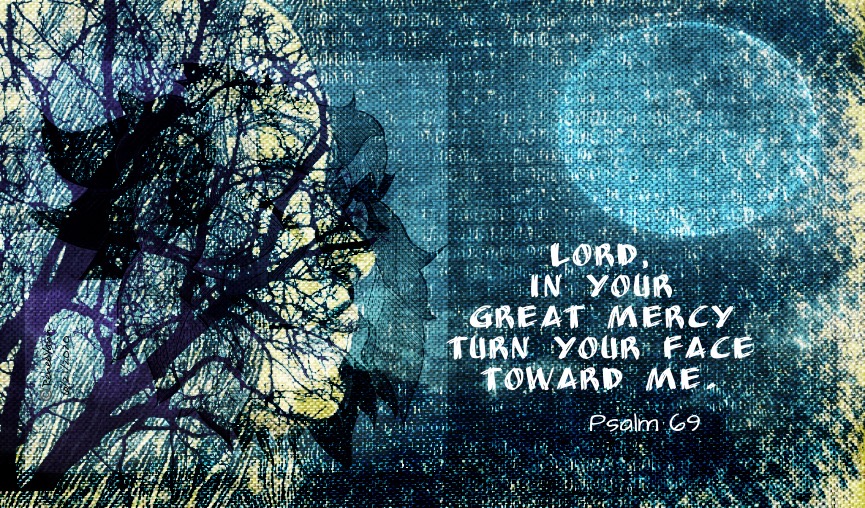
in your great mercy turn toward me.


Seeing God’s Face turn toward him in prayer, the psalmist regains balance. The final verse of the psalm rests on the hope and confidence God has promised in the covenantal relationship.

For God will rescue Zion,
and rebuild the cities of Judah.
They will dwell there and possess it
the descendants of God’s servants will inherit it;
those who love God’s name will dwell in it.


Anger visits all of us, sometimes in response to persecution, misunderstanding or disrespect. We feel it for personal grievances and for meanness in the world toward the helpless.  Praying with Psalm 69 may help us, too, find our balance, as did the psalmist, so that the anger leads to wholeness rather than destruction.


Poetry: Time’s Lesson – Emily Dickinson

Mine enemy is growing old, —
I have at last revenge.
The palate of the hate departs;
If any would avenge, —

Let him be quick, the viand flits,
It is a faded meat.
Anger as soon as fed is dead;
'T is starving makes it fat.

Music: Liberty and Justice for All – Brandon Williams

Psalm 51: A Contrite Spirit

Tuesday of the Eleventh Week in Ordinary Time

June 16, 2020

Today, in God’s Lavish Mercy, we pray with Psalm 51, the Miserere. Perhaps the most recognized of the penitential psalms, it is said to have been written by David after his adulterous affair with Bathsheba. ( although it more likely was written separately and applied to David’s situation later.)

This psalm is so rich in deep spiritual psychology that it would be a shame to dismiss it simply as a “confessional”. The psalm truly teaches us how our soul’s vigor and wholeness may be restored in an environment of sin where we are often both consciously and unconsciously complicit.


Let me give an example of how I see this. Last night in my city, a group of protesters gathered around a statue of Christopher Columbus, supposedly, “to protect it” from dismantling by “them”. Many in the group carried clubs and bats; a few carried military-style weapons. All of the “defenders” were white, angry, and mostly men.

I ask myself what were they really there to do. What did they really feel they had to defend? Did their violent public intimidation scream out, “We love Christopher Columbus!”? Or did it shout, “We refuse to acknowledge that our heritage is laced with racism and sinful domination!”?


For me, this is the kind of sinful circumstance which Psalm 51 can help us redeem. We may not act out our culpable ignorance, violence, defensiveness, or racism like last night’s threatening mob. But we must examine what we retain of these sins in our choices, attitudes, speech, and complicit silence.

How does Psalm 51 guide us to that kind of redemption?

First, there is a broken-hearted recognition of failure in holding up our end of relationship with God. Because, as David acknowledges, it is God whom we ultimately offend in our crassness toward one another. It’s not about only one sinful act, like the list we made before our grade school confessions. It’s about a fissure in love, honesty, and loyalty to the One who gives us all life.


Second, there is confession – saying out loud the failure that has replaced love. My favorite Biblical scholar, Walter Brueggemann, describes it as Truth-telling:

Psalm 51 makes available the truth of our life before God. On the one hand, it resists arrogant autonomy that imagines (with David) that we can live without accountability or dependence on the will and purpose of God. On the other hand, it contradicts the practice of denial that is so seductive in a society that has no time, patience, or energy for the nurture of an interior life. It turns out that truth-telling before God is an indispensable condition for joyous existence. Such emancipation makes for exuberant singing and glad generosity. (Walter Brueggemann: From Whom No Secrets are Hid)

Third, and most important because it is woven through and sustains the other two, is the immovable confidence in God’s mercy and God’s desire to give it.

For you do not desire sacrifice or I would give it;
a burnt offering you would not accept.

My sacrifice, O God, is a contrite spirit;
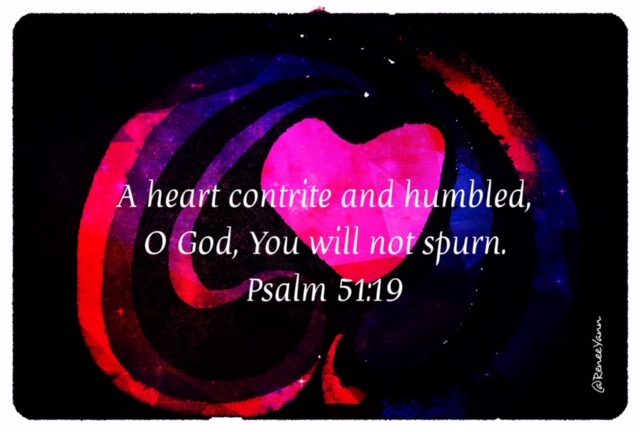
a contrite, humbled heart, O God, you will not scorn.

Psalm 51 is a big one. If you have time, read the whole thing reflectively. It’s good medicine once we have the courage to swallow it.


Poetry: To Live in the Mercy of God – Denise Levertov

To lie back under the tallest
oldest trees. How far the stems
rise, rise
               before ribs of shelter
                                           open!

To live in the mercy of God. The complete
sentence too adequate, has no give.
Awe, not comfort. Stone, elbows of
stony wood beneath lenient
moss bed.

And awe suddenly
passing beyond itself. Becomes
a form of comfort.
                      Becomes the steady
air you glide on, arms
stretched like the wings of flying foxes.
To hear the multiple silence
of trees, the rainy
forest depths of their listening.

To float, upheld,
                as salt water
                would hold you,
                                        once you dared.

 To live in the mercy of God.

To feel vibrate the enraptured
waterfall flinging itself
unabating down and down
                              to clenched fists of rock.

Swiftness of plunge,
hour after year after century,
                                                   O or Ah
uninterrupted, voice
many-stranded.
                              To breathe
spray. The smoke of it.
                              Arcs
of steelwhite foam, glissades
of fugitive jade barely perceptible. Such passion—
rage or joy?

                              Thus, not mild, not temperate,
God’s love for the world. Vast
flood of mercy
                      flung on resistance.

Music: Miserere Mei Deus – Gregorio Allegri 

Psalm 119: Your Awesome Word

Memorial of Saint Boniface, Bishop and Martyr

June 5, 2020

Click here for readings

Psalm 119_word

Today, in God’s Lavish Mercy, we pray with Psalm 119 which is considered a hymn psalm, meant for offering praise for God’s handiwork.

bird

This psalm, the longest in the Bible, is an extended string of delight in God’s beauty, power, and tenderness. It reminds me of a mockingbird’s lovely, tireless song, lilting up into the morning or evening sky.

Though long, the psalm is a very simple yet profound prayer. Seeing its length, we might tend to set it aside for a shorter psalm. Instead, don’t tackle the whole thing. Pick one verse that speaks to you. Sit down beside it. Let it crawl into to your lap like a small child. Cradle it and let your soul hum with it.


I remember, as a young novice, learning to pray this beautiful psalm in Latin. Its innocent clarity echoed my desire simply to deepen in God’s ways. Psalm 119 has been one of my favorites for nearly sixty years now, carrying God’s Word to me in myriad ways.

119


Today in our prayer, we might want to contemplate what single word God is speaking most clearly to us in this moment. The words vary over the course and circumstances of our lives. Let us listen and respond to what we hear today in quiet prayer.

wordcloud

Music: Word of God, Speak – MercyMe

Psalm 123: Song of the Caged Bird

Memorial of Saint Charles Lwanga and Companions, Martyrs

Charles Lwango
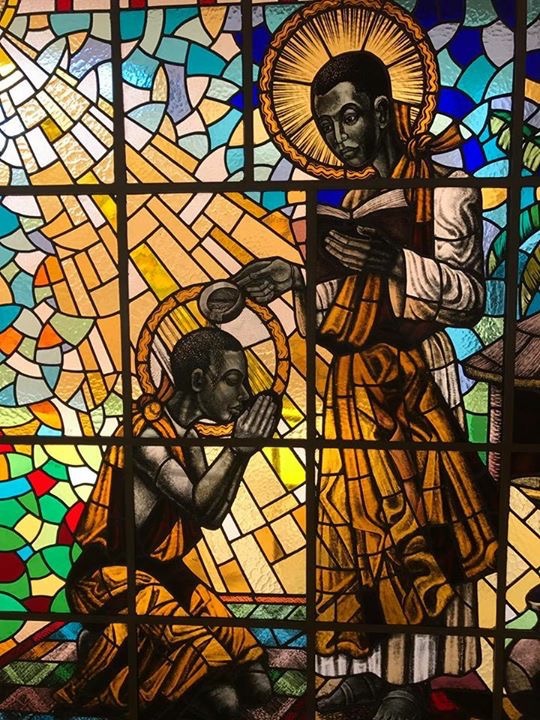
St. Kizito being baptised by St. Charles Lwanga at Munyonyo – stained glass at Munyonyo Martyrs Shrine

Charles Lwanga (1860 – 1886) was a Ugandan convert to the Catholic Church, who was martyred for his faith and is revered as a saint by both the Catholic Church and the Anglican Communion.


June 3, 2020

Click here for today’s readings

Today, in God’s Lavish Mercy, we pray with Psalm 123. How fitting that this particular prayer should bless us at this time!

Psalm 123 is one of the fifteen Psalms of Ascent (120-134). It is thought that these prayer songs were sung by pilgrims ascending to Jerusalem, expressing the joys, sorrows, needs and sufferings of the community.

Among them Psalm 123 is a lament, particularly for the scorn and contempt the Israelites felt as they tried to live lives of faith in a hostile world. Verses 3 and 4, (not included in today’s passage) plead:

Show us favor, LORD, show us favor,
for we have our fill of contempt.
Our souls are more than sated
with mockery from the insolent,
with contempt from the arrogant.

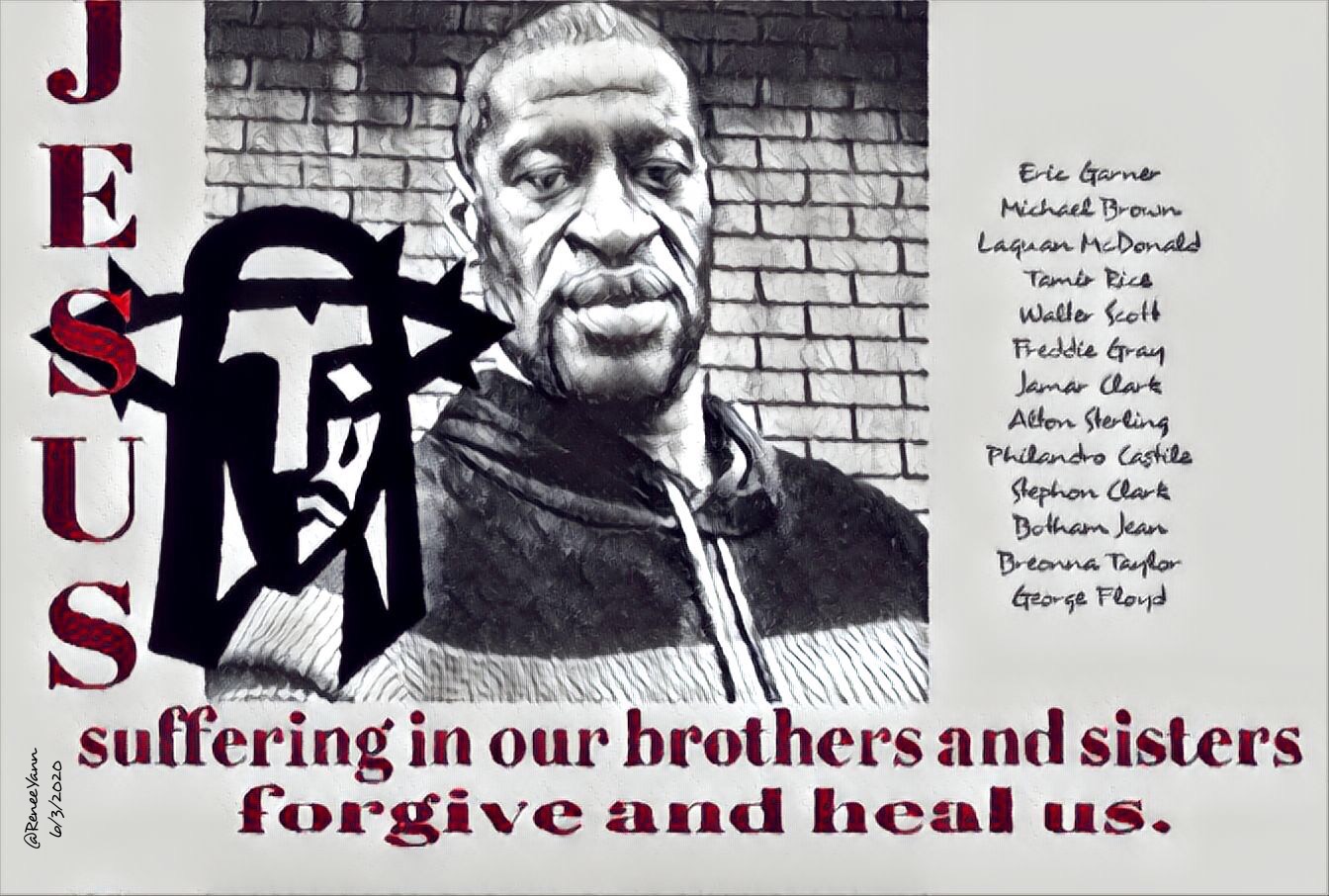
Praying with Psalm 123, we might think of today’s “pilgrims”, traveling the streets in protest of racial injustice. The integrity of their cause has been polluted by the rioters and looters infiltrating them, drawing contempt even from some who might otherwise have supported them.

Geo_Floyd

Still, people of faith must not be distracted from the truth, nor should we hide from the reality of our own complicity in normalizing unjust systems.  We must hear the lament of all those who long for justice. We must acknowledge that our current structures have grievously failed people of color, the poor and the refugee. We must make the choices that justice and mercy demand of us.


Today’s Responsorial verses may help us. In our hearts and souls, let us stand beside one another as we pray, each of us created to serve God by serving one another:

To you I raise my eyes,
to you enthroned in heaven.
Yes, like the eyes of servants
on the hand of their masters,

Like the eyes of a maid
on the hand of her mistress,
So our eyes are on the LORD our God,
till we are shown favor.


A poem to enrich your reflection:

cage

Caged Bird
A free bird leaps
on the back of the wind
and floats downstream
till the current ends
and dips his wing
in the orange sun rays
and dares to claim the sky.

But a bird that stalks
down his narrow cage
can seldom see through
his bars of rage
his wings are clipped and
his feet are tied
so he opens his throat to sing.

The caged bird sings
with a fearful trill
of things unknown
but longed for still
and his tune is heard
on the distant hill
for the caged bird
sings of freedom.

The free bird thinks of another breeze
and the trade winds soft through the sighing trees
and the fat worms waiting on a dawn bright lawn
and he names the sky his own

But a caged bird stands on the grave of dreams
his shadow shouts on a nightmare scream
his wings are clipped and his feet are tied
so he opens his throat to sing.

The caged bird sings
with a fearful trill
of things unknown
but longed for still
and his tune is heard
on the distant hill
for the caged bird
sings of freedom.
~ Maya Angelou


Music: Giovanni Pierluigi da Palestrina: Ad te levavi oculos meos (Psalm 123)

Ad te levavi oculos meos, qui habitas in caelis.
Ecce sicut oculi servorum in manibus dominorum suorum;
sicut oculi ancillae in  manibus dominae suae:
ita oculi nostri ad Dominum Deum nostrum,
donec misereatur nostri.

Miserere nostri, Domine, miserere nostri,
quia multum repleti sumus despectione;
quia multum repleta est anima nostra
opprobrium abundantibus, et despectio superbis.

Being Led to Light

Monday of the Fifth Week of Lent
March 30, 2020


Click here for readings

Today in Mercy, we encounter the stories of Suzanna and the woman taken in adultery. Both these stories always make me mad. Even though their ultimate lesson is the justice and mercy of God, I can’t help nettling every time I read them.

Here’s why. Still today, in so many instances, women continue to endure the same kind of assault, objectification, suspicion and blame — and still at the hands of judges, clerics, business and political leaders. Just let the newsreels of the past few years run through your mind. You’ll be as angry as I am.

So to save you from a continuing diatribe, I have gone back to a piece I wrote for the Catholic Health Association several years ago.  It looks at the themes of this week in Lent. It helps us to break through the stories to their point of redemption, to go through death to life, sin to forgiveness, judgement to mercy, darkness to light.


Reflection for the Fifth Week of Lent

 I will keep my covenant with you …
to be your God
and the God of your descendants after you.
~Genesis 17:7

roses
photo by Chi Pham

The golden June morning had broken bright and warm through the hospital windows. With its breaking, the attending physician and chaplain had received a page. Dorothy had taken an unexpected turn. She was struggling both to live and to die.

As they attended and comforted her, Dorothy managed to whisper ” … wait for Henry.” Henry, her husband of fifty-eight years, had arrived promptly at 7:00 AM daily for all the weeks of Dorothy’s hospitalization. Glancing at her watch, the chaplain saw that it was just 6:50 AM.

When, after ten eternal minutes, Henry appeared at the door, he carried a small bouquet of yellow roses from their beloved garden. Quickly apprehending the changed situation, he laid the roses aside and hurried to hold Dorothy for the last few minutes of her life. In the loving, covenanted presence Dorothy had waited for, she finally embraced a peaceful death.

It had not been easy for Dorothy to die nor, from then on, had it been easy for Henry to live. Still, through many bereavement visits, the chaplain watched their long, honest love arise to heal Henry. Through prayer and the benediction of memories, Henry realized that their love, like the roses still blooming in their garden, was both fragile and perpetual.

In this week’s readings, God again calls us to such a love. As God brought Lazarus, Suzanna and Shadrack out of darkness and death, so God promises to bring us. “I will keep my covenant with you,” God says. “Whoever keeps my word will never die.”

Accompanying Jesus, as he nears Jerusalem, let us trust and cherish these promises in our own darknesses and bereavements. Let us ask God to deliver us from both our sins and our judgements of others.

Music: No Shame – by Tenth Avenue North

Come Back!

Saturday of the Second Week of Lent

March 14, 2020

Click here for readings

Today, in Mercy, our readings are soaked in Mercy itself … seasoned by repentance, forgiveness, hope, and trust.

Both in Micah’s lilting, poetic words and in Jesus’s  parable, we are embraced by the infinite tenderness of God.

You may find the following comparison odd at first, but stay with me a minute. Reading this morning’s scriptures, I thought of Lidia Bastianich, the famous chef. To me, her show is the perfect combination of instruction, humor, and familial camaraderie. Still, even though Lydia offers tons of invaluable culinary tips, it is her repeated farewell phrase that I most treasure: “Tutti a tavola a mangiare!”. “Let everyone come to the table and eat!”

Lydia


Micah, who prophesied just prior to the Siege of Jerusalem in 587 BC, condemned the sinfulness rampant in Israel and Judah. At the same time, he consoled the “remnant” people and, àla Lydia, invited them to the table of forgiveness and reconciliation. Here’s the way Micah asks God to “set the table” for God’s repentant People:

Shepherd your people with your staff,
the flock of your inheritance,
That dwells apart in a woodland,
in the midst of Carmel.
Let them feed in Bashan and Gilead,
as in the days of old …


prodigal dinner
The Parable of the Prodigal Son by Frans II Francken

Jesus describes a similar banquet offered to the repentant son:

The father ran to his son, embraced him and kissed him.
His son said to him,
‘Father, I have sinned against heaven and against you;
I no longer deserve to be called your son.’
But his father ordered his servants,
‘Quickly, bring the finest robe and put it on him;
put a ring on his finger and sandals on his feet.
Take the fattened calf and slaughter it.
Then let us celebrate with a feast
because this son of mine was dead, and has come to life again;
he was lost, and has been found.’

As I pray today, I ask if there is any lost or hungry part of my spirit that longs to return to the table of Peace and Mercy. I pray also for those places and souls throughout our world who hunger to hear:

Tutti a tavola a mangiare!”

Music: Father, I Have Sinned -written by Fr. Eugene O’Reilly

A Plea for Mercy

Monday of the Second Week in Lent

March 9, 2020

Click here for readings

bruggemann

Today, in Mercy, our reading from Daniel gives us one of the Great Prayers of the Old Testament (according to Walter Brueggemann’s like-named book.)

The Book of Daniel and chapter nine in particular, have been the subjects of extensive biblical exegesis. Chapter nine in considered one of the Messianic Prophecies, Old Testament markers pointing to Christ. So there is much we could study about today’s first reading.


But how might we pray with it?

Naming the sins of all the People, Daniel’s great prayer is a plea for mercy:

Lord, great and awesome God,
you who keep your merciful covenant
toward those who love you
and observe your commandments! …
… yours, O Lord, our God,
are compassion and forgiveness!

Three themes, so strikingly germane to Lent, arise from Daniel’s prayer:

Repentance
Forgiveness
Transformation


Our Responsorial Psalm picks up this plea to Mercy for Mercy:

Remember not against us the iniquities of the past;
may your compassion quickly come to us,
for we are brought very low.
R.    Lord, do not deal with us according to our sins.
Help us, O God our savior,

because of the glory of your name;
Deliver us and pardon our sins
for your name’s sake.


The questions for each of us as we pray today —

Is there someplace in my life
longing for such mercy and healing?

Where can my spirit grow
from repentance, forgiveness, and transformation?

be Mercy

In our Gospel Jesus tells us how to open our hearts to this merciful healing.

Be merciful, just as your Father is merciful.
Stop judging and you will not be judged.
Stop condemning and you will not be condemned.
Forgive and you will be forgiven.
Give and gifts will be given to you;
a good measure, packed together, shaken down, and overflowing,
will be poured into your lap.
For the measure with which you measure
will in return be measured out to you.”

There it is in black and white. Whether or not the advice changes my heart is up to me!

Music: Kyrie Eleison (Lord, have mercy) Beethoven- Missa Solemnis