Keys to Wisdom

Twenty-first Sunday in Ordinary Time
August 27, 2023

Today’s Readings:

https://bible.usccb.org/bible/readings/082723.cfm


Today, in God’s Lavish Mercy, our readings revolve around the symbol of keys and the authority attached to them.

Chapter 22 of Isaiah tells the story of Eliakim whose name means “one whom God establishes”. Eliakim takes over as King Hezekiah’s prime minister. Shebna, his predecessor, has kind of wimped out as a fitting leader. Expecting an invasion by the Assyrian armies, Shebna has abandoned hope and instead built himself a nice tomb just in case. So, according to Isaiah, God is unhappy with Shebna and gives the authority and keys to Eliakim:

Thus says the LORD to Shebna, master of the palace:
“I will thrust you from your office
and pull you down from your station.
On that day I will summon my servant
Eliakim, son of Hilkiah;
I will clothe him with your robe,
and gird him with your sash,
and give over to him your authority.
He shall be a father to the inhabitants of Jerusalem,
and to the house of Judah.
I will place the key of the House of David on Eliakim’s shoulder;
when he opens, no one shall shut,
when he shuts, no one shall open.

Isaiah 22:19-22

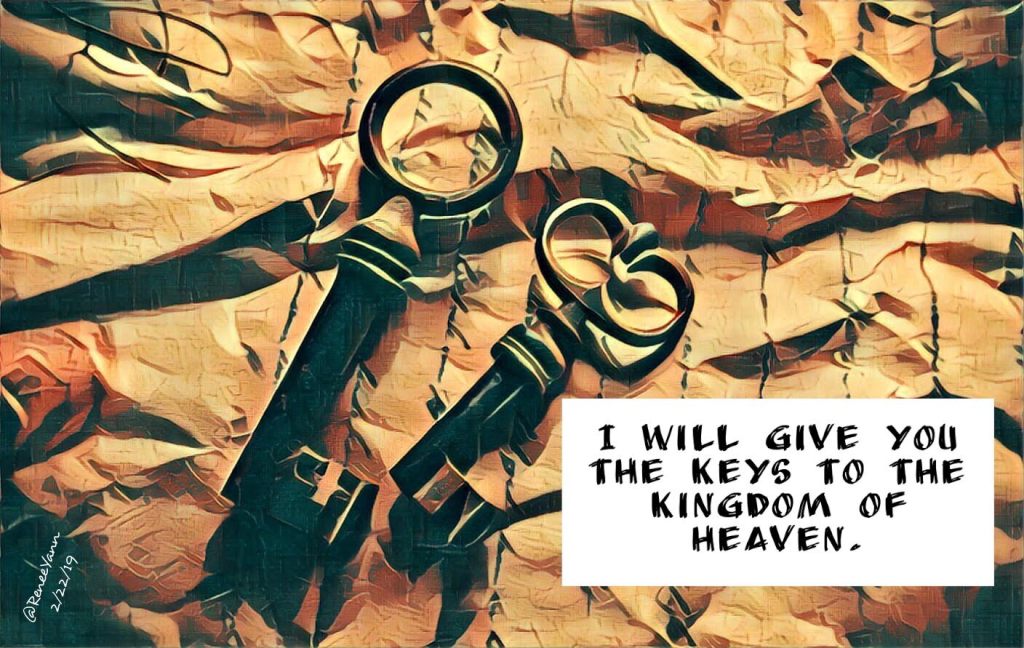
The bestowal of “keys” is the key concept here (not to make a pun.) Keys, both in the passage from Isaiah and from Matthew, symbolize the commissioning of Eliakim and Peter as immediate subordinates to the “king”. They are to act in the king’s place as necessary and appropriate. They have “the keys to the kingdom”.


Our second reading leads us to understand that the symbolic keys given to Peter unlock mysteries far exceeding those described in Isaiah. The entire exchequer of the Faith is placed in Peter’s hands, a treasury for which Christ makes Peter and his successors forever responsible.

Oh, the depth of the riches and wisdom and knowledge of God! 
How inscrutable are his judgments and how unsearchable his ways!
For who has known the mind of the Lord
or who has been his counselor?
Or who has given the Lord anything
that he may be repaid?

For from him and through him and for him are all things. 
To him be glory forever. Amen.

Romans 11:33-36

While the Catholic Church interprets these passages as evidence for the primacy of Peter and the Popes, these scriptures also call all Christ’s disciples to plumb the depths of God’s infinite wisdom as it speaks within their own lives. In the community of learning and living we call “Church”, each of us has a role in illuminating the Gospel for our world.

Our daily prayer with the scriptures and our pursuit of reliable sources of sacred learning will deepen our ability to live the Gospel in our time. Peter did his job in his time. Now it’s our turn and Pope Francis’s turn. Let’s pray for him in a special way today.


Prayer for Pope Francis:

The ancient prayer for the Pope, sung regularly in the Vatican in Latin and found in prayer books and hymnals everywhere, is paraphrased from Psalm 41:3: 

May the Lord preserve him, give him a long life, 
make him blessed upon the earth,
and not hand him over to the power of his enemies.
O God, Shepherd and Ruler of all the faithful, 
look down in your mercy upon your servant, Francis,
whom you have appointed to preside over your Church,
and grant, we beseech you, that both by word and example,
he may edify all those under his charge so that,
with the flock entrusted to him,
he may arrive at length unto life everlasting.

Music: Who Has Known – John Foley, SJ

Oh, the depth of the riches of God
And the breadth of the wisdom and knowledge of God
For who has known the mind of God
To Him be glory forever

A virgin will carry a child and give birth
And His name shall be called Emmanuel
For who has known the mind of God
To Him be glory forever

The people in darkness have seen a great light
For a child has been born, His dominion is wide
For who has known the mind of God
To Him be glory forever

Hope and Resilience

Friday of the Twentieth Week in Ordinary Time
August 25, 2023

Today’s Readings:

https://bible.usccb.org/bible/readings/082523.cfm


Today, in God’s Lavish Mercy, we read the tender and beloved story of Ruth and Naomi. We have come to love the beautiful exchange between these two women, filled with devotion and selfless love:

But Ruth said to Naomi, “Do not ask me to abandon or forsake you!
For wherever you go, I will go, wherever you lodge I will lodge,
your people shall be my people, and your God my God.
Where you die I will die,
and there be buried.
May the LORD do thus to me, and more,
if even death separates me from you!”

Ruth 1: 16-17

Who doesn’t long to be devoutly loved the way Ruth loved Naomi?
Who, especially in elder years or lonely times, isn’t filled with gratitude for the faithful companionship of dear ones?
Who isn’t moved at a wedding ceremony when young couples make brave promises like Ruth’s, having no idea what their vow will require down the years?


Reading the story of Ruth from these perspectives can carry us to deep reflection, but it can also leave us with an insubstantial or idealized perception of the infinite Love mirrored in this Scripture.

The Book of Ruth is so much more than an admirable devotion.

In the Book of Ruth, significant theological formation occurs, presenting a beautifully written story placed distinctively between the chaos of the Book of Judges and the epic struggle between the prophet Samuel and the intractable King Saul in the first book of Samuel. Nestled in between this chaotic downward spiral and the recalcitrance of Saul, Ruth exhibits resilience amidst vulnerability, an outsider grafted into the Davidic lineage and its climactic conclusion in Christ. A theology of hope for those found outside the normative structures of patriarchal, religious, and cultural normative spheres.

Bradford Parker: Ruth: A Theology of Resilience Amidst Vulnerability

Various authors suggest a host of underlying theological themes in Ruth:

  • the community is responsible for those who are hungry;
  • the experience of despair cannot be ignored;
  • people young and old are to be cared for; and
  • the marginalized are to push to the center, and those at the center are to move toward the marginalized. (Katherine Doob Sakenfeld: Ruth, Interpretation)

Another writer sees “Ruth is herself the “mirror of God” by reflecting Yahweh through her actions of devotion throughout the narrative.” (John C. Holbert: Preaching the Old Testament)

Andre LaCocque argues that “Ruth belongs to the extraordinary. She is characterized by hesed (Mercy).” (Ruth: Continental Commentary)


The Book of Ruth, on surface appearance, is a simple yet compelling story. But reading under its words, we will find astounding depth:

  • a faithful elder who now feels abandoned by God (Naomi),
  • a vulnerable young woman who chooses to act for mercy and justice (Ruth)
  • a man who, by aligning himself unselfishly to the Law, allows the continuation of the familial line which will lead through Obed to David and ultimately to Jesus.(Boaz)

Naomi teaches us how to respond from the depths of loss, sadness, diminishment, or fear. Ruth shows us how courage, fidelity, and mercy act in the everyday world.
Boaz models faithfulness, responsibility, and justice given without question when needed.


It is not a stretch to say that Ruth is a Christ figure, foreshadowing the Merciful Jesus who accompanies us in our vulnerabilities and who, by loving us, teaches us how to love:

“Teacher, which commandment in the law is the greatest?”
He said to him,
“You shall love the Lord, your God, with all your heart,
with all your soul, and with all your mind.
This is the greatest and the first commandment.
The second is like it:
You shall love your neighbor as yourself.
The whole law and the prophets depend on these two commandments.”

Matthew 22:36-40

Poetry: Rather than choose a single poem for you, here is the link to a series of thoughtful, poetic reflections on the characters in the Book of Ruth.

Poems from the Velveteen Rabbit blog

Music: Ruth’s Song – Misha and Marty Goetz

Blessings without Reservation

Feast of Saint Bartholomew, Apostle
August 24, 2023

Today’s Readings:

https://bible.usccb.org/bible/readings/082423.cfm


Today, in God’s Lavish Mercy, we pray with Psalm 145, a luxuriant song of praise to a God who overwhelms us with generosity.

I will extol you, my God and king;
I will bless your name forever and ever.

Every day I will bless you;
I will praise your name forever and ever.

Great is the LORD and worthy of much praise,
whose grandeur is beyond understanding.

Psalm 145: 1-3

Citing verses 13-20 which are structured around the word “all”, Walter Brueggemann says:

The image is an overflow of limitless blessing 
given without reservation 
to all who are in need 
and turn to the Creator.

… Which brings us to Nathaniel and how this prayer might have sung in his heart.


I got to be friends with Nathaniel sixty years ago when, at my reception into our community, Mother Bernard decided to give me his name. And after an initial shock, I came to love it.

Nathaniel and I have spent countless hours under his fig tree sharing both our lives. I’ve asked him many times what he was thinking about when Philip came to invite him to meet Jesus. Nathaniel always has a different answer… one amazingly similar to whatever happens to be preoccupying me at the time.😇

a favorite old book that started some of my conversations with Nathaniel

One element remains constant in every circumstance: in his quiet moments, Nathaniel sought God’s Light. As our Gospel shows, that Luminous Word came to him and he responded.


I think that in our “fig tree moments”, we have finally sifted through all that we are capable of in order to find Grace in our lives. Now we wait, in the shade and quiet of prayer, for the True Answer to invite us into Its Mystery.

When that answering Word comes, it shatters our doubts and pretenses like eggshells. And through the shattered shells, the Word releases new life in us. We move deeper into the unbreakable Wholeness and Infinity. Like Nathaniel, even in our ordinary lives, we begin to “see greater things” than we had ever imagined.


Nathanael said to him, “How do you know me?” 
Jesus answered and said to him,
“Before Philip called you, I saw you under the fig tree.”
Nathanael answered him,
“Rabbi, you are the Son of God; you are the King of Israel.”
Jesus answered and said to him,
“Do you believe
because I told you that I saw you under the fig tree?
You will see greater things than this.”
And he said to him, “Amen, amen, I say to you,
you will see heaven opened and the angels of God
ascending and descending on the Son of Man.”

John 1:48-51

After that momentous afternoon when he was drawn from his figgy shade into the Light, Nathaniel’s life became a hymn of praise and thanksgiving.

Let all your works give you thanks, O LORD,
    and let your faithful ones bless you.
Let them discourse of the glory of your Kingdom
    and speak of your might.

Psalm 145:10-11

Poem-Prayer from Christine Robinson

Psalm 145 – Opening Heart

I exalt you, Holy One, and open my heart to you
by remembering your great love.
Your expansiveness made this beautiful world
in a universe too marvelous to understand.
Your desire created life, and you nurtured
that life with your spirit.
You cherish us all—and your prayer
in us is for our own flourishing.
You are gracious to us
slow to anger and full of kindness
You touch us with your love—speak to us
with your still, small voice, hold us when we fall.
You lift up those who are oppressed
by systems and circumstances.
You open your hand
and satisfy us.
You ask us to call on you—
and even when you seem far away, our
longings call us back to you.
Hear my cry, O God, for some days, it is all I have.

Music: I Will Praise Your Name – Bob Fitts

Lord I will praise your name
I will praise your name
I will praise your name and extol You

I will praise Your name (I will praise Your name)
I will praise Your name
As I behold You

I will magnify, I will glorify
I will lift on high Your name, Lord Jesus
I will magnify, I will glorify
I will lift on high Your name, Lord Jesus

For Your love is never ending
And Your mercy ever true
I will bless Your name Lord Jesus
For my heart belongs to You

I will praise Your name
I will praise Your name and extol you

I will magnify, I will glorify
I will lift on high Your name, Lord Jesus
For Your love is never ending
And Your mercy ever true

I will bless Your name Lord Jesus
For my heart belongs to You
I will praise Your name
I will praise Your name and extol you
I will magnify, I will glorify
I will lift on high Your name, Lord Jesus

Idolatry

Memorial of Saint Pius X, Pope
Monday of the Twentieth Week in Ordinary Time
August 21, 2023

Today’s Readings:

https://bible.usccb.org/bible/readings/082123.cfm


Today, in God’s Lavish Mercy, our two readings connect to remind us of an essential truth: stay faithful to God’s Word in order to live in peace, justice, and joy.


The passage from Judges recounts the topsy-turvy history of Israel around 800 years before Christ. It was a time when various Judges served as leaders before the eventual establishment of the kingdom under Samuel.

The Twelve Judges of Israel (in technicolor!)

These were tough times for Israel. One after another, hostile forces rose against them. During each threat, someone would emerge as a deliverer and, with their heroic success, endure for a while as the Judge.


The writer equates Israel’s ups and downs with God’s pleasure or displeasure with the people. When the people broke faith, God punished them with political turmoil. When the people were repentant, God provided a deliverer.

Of course, this is an overly simplified interpretation of events. By infusing God with the human qualities of anger and appeasement, the writer explains complex history as a simple quid pro quo: You’re bad, you get zapped. You’re good, you get rewarded.


We know that our God does not vacillate between angry punishment and satisfied recompense. God is always loving, forgiving, and nurturing. So what can this passage teach us about our own faith life and the spiritual culture of our times?

I found a key reflection point in the passage’s initial phrase: The children of Israel offended the LORD by serving the Baals.

The “Baals” are false gods erected by those who manipulate “faith” to advance their self-absorbed agendas. In the time of the Judges, these Baals might have been represented by carved idols, or natural phenomena such as the moon or stars. In the end, this idolatry – like all idolatries – rewarded some hidden promoter with money, power, or influence.


But what are the “Baals” of our culture? What is our modern idolatry?

Britannica Dictionary offers this definition of idolatry: “A person becomes guilty of a more subtle idolatry, however, when, although overt acts of adoration are avoided, he attaches to a creature the confidence, loyalty and devotion that properly belong only to the Creator.”

As we pray with this passage, we might look to our own society with its infectious materialism, nationalism, consumerism, racism, sexism. These and other imposed societal shackles serve to bind some in order to exalt others to idol status. As it is with any communicable disease, some of these systems – acknowledged or not – may be lurking within us.


Worship of these “isms” falsly legitimizes:

  • the usurpation of the poor in a credit-bound economic system
    (e.g. how many times have you been offered “revolving credit” which makes money on ever-increasing interest rates)
  • the armed control of the defenseless
    (e.g. the insurmountable influence of the gun lobby to produce weapons of mass destruction despite the repeated massacres of our children)
  • the supersession of the haves over the have-nots
    (e.g. college placement of moneyed descendants over academically superior disadvantaged applicants)
  • the veiled acquiescence to white-advantage
    (e.g. entrenched indifference to colorless board rooms, executive suites, and other decision-making forums)
  • the subtle second-classism toward and objectification of women
    (e.g. the range of systemic oppressions suffered by women, from Taliban terrors and sex trafficking to indefensible Church exclusions)

Our Gospel clearly states the antidote to such idolatry:

Jesus answered the young man:

There is only One who is good.
If you wish to enter into life,

keep the commandments:
(Love God above all things,
and your neighbor as yourself.)

Jesus tells him further that if he wishes to be perfect, he will:

  • dispossess himself of anything that distracts him from God
  • follow Jesus and the Gospel with all his heart

I never read that Gospel without realizing that, just like that young man, I have a lot of work to do on my own often idolatrous soul.


Poetry: Sell All You Have – Malcolm Guite

To whom, exactly, are you speaking Lord?
I take it you’re not saying this to me,
But just to this rich man, or to some saint
Like Francis, or to some community,
The Benedictines maybe, their restraint
Sustains so much. But I can’t bear this word!
I bought the deal, the whole consumer thing,
Signed up and filled my life with all this stuff,
And now you come, when I’ve got everything,
And tell me everything is not enough!
But that one thing I lack, I cannot get.
Sell everything I have? That’s far too hard
I can’t just sell it all… at least not yet,
To whom exactly, are you speaking Lord?

Music: Simple Living (A Rich Young Man) – Keith & Kristyn Getty, Stuart Townend

All Are Welcome

Twentieth Sunday in Ordinary Time
August 20, 2023

Today’s Readings:

https://bible.usccb.org/bible/readings/082023.cfm


Christ and the Canaanite Woman – Annibale Carracci

Today, in God’s Lavish Mercy, we read the story of the Canaanite woman whom Jesus first meets with sarcastic banter. The banter however serves to expose some of the alienating prejudices of Jesus’s time which he then dissolves in a sweeping act of mercy and inclusion.

But the woman came and did Jesus homage, saying, “Lord, help me.”
He said in reply,
“It is not right to take the food of the children
and throw it to the dogs.”
She said, “Please, Lord, for even the dogs eat the scraps
that fall from the table of their masters.”
Then Jesus said to her in reply,
“O woman, great is your faith!
Let it be done for you as you wish.”

Matthew 15:25-28

The outcast Canaanite woman prevails on Jesus to broaden his kingdom. His response is to open his heart to another way of bringing mercy to all those longing for it. Jesus’s words and actions signify a new culture of divine justice offered to all people. They alert his reticent disciples to practice the same kind of generous, inclusive mercy in their ministries.


Our Gospel challenges us to confront our own prejudices and any limitations we place on who is welcome in the Kingdom of God. It clearly establishes a single element as the determiner of who belongs to God’s new Reign of Love. That element is FAITH.

Then Jesus said to her in reply,
O woman, great is your faith
Let it be done for you as you wish.” 


Prose for Reflection: Pope Francis continually encourages the Church toward this faith-defined inclusivity.

Being the church, being the people of God, … means being God’s leaven in this our humanity. It means proclaiming and bearing God’s salvation in this our world, which is often lost and needful of having encouraging answers, answers that give hope, that give new energy along the journey.

May the church be the place of God’s mercy and love where everyone can feel themselves welcomed, loved, forgiven and encouraged to live according to the good life of the Gospel. And in order to make others feel welcomed, loved, forgiven and encouraged, the church must have open doors so that all might enter. And we must go out of those doors and proclaim the Gospel.”


Music: All Are Welcome – Marty Haugen

Let us build a house
Where love can dwell
And all can safely live
A place where
Saints and children tell
How hearts learn to forgive
Built of hopes and dreams and visions
Rock of faith and vault of grace
Here the love of Christ shall end divisions
All are welcome, all are welcome
All are welcome in this place

Let us build a house where prophets speak
And words are strong and true
Where all God's children dare to seek
To dream God's reign anew
Here the cross shall stand as witness
And a symbol of God's grace
Here as one we claim the faith of Jesus
All are welcome, all are welcome
All are welcome in this place

Let us build a house where love is found
In water, wine and wheat
A banquet hall on holy ground
Where peace and justice meet
Here the love of God, through Jesus
Is revealed in time and space
As we share in Christ the feast that frees us
All are welcome, all are welcome
All are welcome in this place

The Darks and Lights of Scripture

Saturday of the Nineteenth Week in Ordinary Time
August 19, 2023

Today’s Readings:

https://bible.usccb.org/bible/readings/081923.cfm


Today, in God’s Lavish Mercy, we have the last of our readings from the Book of Joshua, writings that tell the story of Israel from the conquest of Canaan to the Babylonian exile. Joshua is a difficult book to read for at least two reasons: it is dull and boring, and it is full of brutality and violence.

Modern scholars tend to agree that the bloody battles described in Joshua never happened and that the Book should be viewed more as legend or myth. So why is it even included in the Bible to which we look for inspiration in building a peaceful and just world? It is hard work to find nuggets of this kind of inspiration in the Book of Joshua! (But there are a few, I must admit. Here is one of my favorites:)


Actually, the Book of Joshua is not alone in the challenges it tosses at its readers.. There are many passages in the Hebrew Scriptures that might cause us to flinch at their tone or violence. They are particularly upsetting when they implicate God as a condoner of such violence.

God’s tone in today’s passage might strike us in this way:

Joshua in turn said to the people,
“You may not be able to serve the LORD, for he is a holy God;
he is a jealous God who will not forgive
your transgressions or your sins.
If, after the good he has done for you,
you forsake the LORD and serve strange gods,
he will do evil to you and destroy you.

Joshua 24:19-20

When I read that passage I say to myself, “Wait a minute, Joshua!!! That’s not the God I know and love. So what can this passage teach me?”

Feminist theologian Carolyn Sharp writes that Joshua has “important potential to draw contemporary communities of faith into reflection on their own subjectivity, the power dynamics that energize and fracture their common life, and their need for robust and ongoing reformation. Joshua remains a disturbing book, and the first step toward ethical appropriation of its truth is to acknowledge that.”


We may choose to skip over disturbing and confusing passages like some found in Joshua. But the Church includes some of them in the liturgical readings because every scripture passage has something to teach us – just like every person has something to teach us.

From some people, we learn what we want to be like in life. And from others we learn exactly the opposite. So it is with scripture. Reading with a critical eye and a converted heart, we can benefit both from the positive and the negative energy in various Bible passages. And, as Christians, we must read all Scripture in the ultimate light of Jesus Christ and his Gospel.


Of course, as we pray with Scripture, we more readily appropriate those passages that touch our spirits with light and joy. We have such a passage in today’s Gospel:

Children were brought to Jesus
that he might lay his hands on them and pray.
The disciples rebuked them, but Jesus said,
“Let the children come to me, and do not prevent them;
for the Kingdom of heaven belongs to such as these.”
After he placed his hands on them, he went away.

Matthew 19:13-15

Poetry: God’s Grandeur – Gerard Manley Hopkins

The world is charged with the grandeur of God.
It will flame out, like shining from shook foil;
It gathers to a greatness, like the ooze of oil
Crushed. Why do men then now not reck his rod?
Generations have trod, have trod, have trod;
And all is seared with trade; bleared, smeared with toil;
And wears man’s smudge and shares man’s smell: the soil
Is bare now, nor can foot feel, being shod.
And for all this, nature is never spent;
There lives the dearest freshness deep down things;
And though the last lights off the black West went
Oh, morning, at the brown brink eastward, springs—
Because the Holy Ghost over the bent
World broods with warm breast and with ah! bright wings.

Music: Speak, O Lord – Stuart Townend

Transfigured before Them

Feast of the Transfiguration of the Lord
August 6, 2023

Today’s Readings:

https://bible.usccb.org/bible/readings/080623.cfm

Today, in God’s Lavish Mercy, on this glorious Feast of the Transfiguration, we pray with Psalm 97 which prophesies the messianic era when God will reign supreme over the earth. Its verses announce God’s sovereignty, the establishment of justice, and universal joy.

Transfiguration by Giovanni Bellini

Our Gospel describes the moment when Jesus gave his three disciples a glimpse of that future glory in order to sustain them through the sufferings to come.

Jesus took Peter, James, and his brother, John,
and led them up a high mountain by themselves.
And he was transfigured before them;
his face shone like the sun
and his clothes became white as light…

Matthew 17:1-2

As we pray Psalm 97 today, we might think of our experiences of God’s beauty, tenderness, and joy. Remembering and storing these small, accumulated revelations helps us to hold faith in times of darkness or trouble.

In Martin Luther King’s final speech the night before he was assassinated, he spoke of his own transfiguring moments and the courageous faith they inspired in him:

Well, I don’t know what will happen now. We’ve got some difficult days ahead. But it doesn’t matter with me now. Because I’ve been to the mountaintop. And I don’t mind. Like anybody, I would like to live a long life. Longevity has its place. But I’m not concerned about that now. I just want to do God’s will. And He’s allowed me to go up to the mountain. And I’ve looked over. And I’ve seen the promised land. I may not get there with you. But I want you to know tonight, that we, as a people, will get to the promised land. And I’m happy, tonight. I’m not worried about anything. I’m not fearing any man. Mine eyes have seen the glory of the coming of the Lord.


Also in our prayer today, we are mindful of the anniversary of the atomic bombings of Hiroshima and Nagasaki, events which represent the complete inversion of God’s will for the Peaceful Kingdom.

Majesty, turned inside out by our sin, becomes terror.

Oppenheimer is a popular film showing in theaters right now. Robert Oppenheimer, one of the designers of the atomic bomb, reflecting on the bomb’s first test, said that as he watched the huge blast wave ripple out over the New Mexico desert, a line from the Hindu scripture Bhagavad Gita came to mind: “Now I am become Death the Destroyer of Worlds.


Psalm 97 reminds us that all Creation belongs to God:

The LORD is king; let the earth rejoice;
let the many islands be glad.
Clouds and darkness are round about him,
justice and judgment are the foundation of his throne.

Psalm 97:1-2

If, by faith, we learn to see and reverence God’s glory in all things, we can be delivered from the terrors of war, racism, and every other deathly weapon which threatens us. As Psalm 97 so encouragingly closes:

You who love the LORD, hate evil,
God protects the souls of the faithful,
rescues them from the hand of the wicked.
Light dawns for the just,
and gladness for the honest of heart.
Rejoice in the LORD, you just,
and give thanks at the remembrance of his holiness.

Psalm 97:10-12

Poetry: Origami by Joyce Sutphen 

In Hiroshima’s Peace Park there is a statue of Sadako Sasaki lifting a crane in her arms. Sadako was two years old when the atomic bomb was dropped; she was diagnosed with leukemia ten years later. The Japanese believe that folding a thousand origami cranes brings good fortune. Sadako spent the last months of her young life folding hundreds of paper cranes. She folded 644 before she died.


Origami

It starts 
with a blank sheet,
an undanced floor,

air where no sound
erases the silence.
As soon as

you play the first note,
write down a word,
step onto the empty stage,

you've moved closer
to the creature inside.
Remember—

a square
can end up as frog, cardinal,
mantis, or fish.

You can make
what you want,
do what you wish.

Music: Our God Reigns – James Kilbane

How lovely on the mountains

Are the feet of him

Who brings good news,good news

Announcing peace, proclaiming

News of happiness.

Our God reigns; our God reigns!

Chorus:

Our God reigns!

Our God reigns!

Our God reigns!

Our God reigns!

He had no stately form;

He had no majesty,

That we should be

drawn to Him.

He was despised,

and we took no account of Him,

Yet now He reigns

With the Most High.

Out of the tomb He came

With grace and majesty;

He is alive, He is alive.

God loves us so see here His hands,

His feet, His side.

Yes, we know

He is alive.

Outside the Lines

Memorial of Saint John Vianney, Priest
Friday of the Seventeenth Week in Ordinary Time
August 4, 2023

Today’s Readings:

https://bible.usccb.org/bible/readings/080423.cfm


Today, in God’s Lavish Mercy, we dip our toes into the Book of Leviticus which is basically a set of instructions on how to live a good life.

Leviticus 23 establishes five holy times of prayer, reflection, and action for the people to grow in friendship with God.

  • the Sabbath (vv. 1–3)
  • the Feast of the Unleavened Bread, or Passover (vv. 4–14)
  • the Feast of Weeks, or Pentecost (vv. 15–23);
  • on the Day of Atonement (vv. 26-32)
  • the Feast of the Tabernacles (vv.33-44)

As Christians, we may be more familiar with Sabbath and Passover because their patterns are embodied in our Sunday and Easter celebrations. In the other less familiar feasts, we might recognize harvest sharing (Weeks), repentance (Atonement), reflection and recommitment (Tabernacles).


The Book of Leviticus is a formation manual for Israel’s spiritual life. Realizing that fact this morning, I thought about my Novitiate and early formation experiences in religious life. Readers who are religious sisters or brothers might share my experience, and those who are lay can probably think of their own comparisons. What were our earliest steps in our journey into God?

I wasn’t completely clueless when I came to the convent at 18 years of age. I did have a vigorous spiritual life and a deep desire to grow in relationship with God. What I needed was spiritual discipline and a quiet reverence in my whole being. And, in those early years, I received abundant amounts of both from multiple sources. It was my “Leviticus Time”.


But our “Leviticus Time” is only a launchpad. If we refuse to leave it, we will never fly. What we must move on to is a personal relationship with God, grounded in loving faith and Gospel commitment. While enhanced by exterior resources, the power of that relationship springs from an interior intimacy with God, as realized so clearly by our saint for today, John Vianney.


Today’s Gospel shows us a group of people unable to take that next step – beyond rules and practices into committed relationship. (“beyond” not “without” rules and practices – more on that in tomorrow’s reflection)

Jesus came to his native place and taught the people in their synagogue.
They were astonished and said,
“Where did this man get such wisdom and mighty deeds?
Is he not the carpenter’s son?
Is not his mother named Mary
and his brothers James, Joseph, Simon, and Judas?
Are not his sisters all with us?
Where did this man get all this?”
And they took offense at him.
But Jesus said to them,
“A prophet is not without honor except in his native place
and in his own house.”
And he did not work many mighty deeds there
because of their lack of faith.

Matthew 13:54-58

This is such a sad Gospel! Here God was right in the midst of these people! They could see him and hear him. He personally invited them to believe. But they refused to see God in Jesus. All they could see was their stagnated prejudgments and inert definitions.

These were probably good people. They more than likely kept all the Leviticus regulations. They colored within the lines, so to speak. Then Jesus came and asked them to step outside the lines. He asked them to believe that the poor are blessed and the persecuted happy. He asked them to cast their nets again into a sea that had denied them all night. He asked them to walk to him across the water. He asked them to sell everything they had and follow. He asked them to fall into the ground and die, as he would.

Only a courageous few set their safe scroll of Leviticus aside to give Jesus a wholehearted “Yes”.

What might we have done — what are we doing — when Jesus invites us outside the lines?


Poetry: Of Being – Denise Levertov

I know this happiness
is provisional:

the looming presences --
great suffering, great fear --

withdraw only
into peripheral vision:
but ineluctable this shimmering
of wind in the blue leaves:
this flood of stillness
widening the lake of sky:
this need to dance,
this need to kneel:
this mystery:

Music: Only You

Something a little different this morning – a picture to contemplate while you listen to a beautiful song. Just click the little white arrowhead in the grey bar below. Let the song take you where it will in your own spiritual landscape.

image by David Mark from Pixabay

Little Things Mean a Lot

Memorial of Saint Ignatius of Loyola, Priest
Monday of the Seventeenth Week in Ordinary Time
July 31, 2023

Today’s Readings:

https://bible.usccb.org/bible/readings/073123.cfm


The Adoration of the Golden Calf – Nicholas Poussin

Today, in God’s Lavish Mercy, Aaron, brother of Moses, gets an “F” as a substitute teacher. While Moses is on the mountain negotiating with God for Israel’s future, Aaron caves to the people’s demands and assists them in creating an idol – the infamous “golden calf”.

As Walter Brueggemann says, “All it takes is a little gold to make a god”:

All you need in order to make a god is a measure of the substance that is most valuable in the community, in this case gold…and a mold that can shape the gold. The mold readily available to Aaron is a calf, well, better a “bull” – a symbol and embodiment of virility and fertility, the strength, power, and capacity to generate new life! All you need to make a god is a little gold and a pattern of vitality and fertility that bespeaks self-sufficiency,

Walter Brueggemann – from a Sunday sermon delivered in 2020

Moses was on the mountain for forty days. In his absence, and with God’s silence, the people became frightened. They felt powerless. In that powerlessness, they had a choice: to believe that God would be true to God’s word, or to construct an alternate god of their own design, one that made them feel powerful again. They made the wrong choice.


Praying with this passage today, we might ask ourselves what we do when circumstances render us powerless. What do we do when God seems silent and the supports we have trusted disappear or fail? What do we do when there seems to be no answer to our prayers?

And what is the substance, as Bruegemann notes, most valued in my various communities – the substance most likely to be turned to an idol: reputation, status, resources, influence, political power, physical strength or appearance?

Do we make the mistake of thinking things like this: My power rests in my money, or my looks, or my family name, or my business success, or my intelligence, or my intimidating reputation?

When it comes to the fundamental needs of our lives, none of these things can empower us. Every one of them can fail or disappear. Our only true power lies in God’s unfailing love for us and will for our good. That power is always with us but can be accessed only through faith.


Our Gospel tells us that all one needs is a little faith to ground oneself in the power of God’s love and fidelity..

Jesus proposed a parable to the crowds.
“The Kingdom of heaven is like a mustard seed
that a person took and sowed in a field.
It is the smallest of all the seeds,
yet when full-grown it is the largest of plants.
It becomes a large bush,
and the birds of the sky come and dwell in its branches.”

Matthew 13:31-32

I saw a great graphic on Facebook the other day. It pictured an open hand reaching out with a small speck on the index finger. The caption read:

I have a mustard seed,
and I’m not afraid to use it.


In the absence of a malleable, obeisant god, Israel mistakes their wealth for their god. They mold it into a figure that appears to restore their control over their lives. But they end up with only a clump of unresponsive metal.

God is not a divine butler waiting at the doorway for our next command. The ever-presnt Holy One is sometimes thickly veiled within the circumstances of our lives. It takes faith to stay in relationship with our often silent, but nonetheless abiding God.

Our Gospel tells us that if we have even the smallest seed of that faith, it will root in us and sustain us. And even the smallest measure of “holy yeast” will ferment to the point that others will find in us the inspiration to believe.


Poetry: The Golden Calf by John Newton, (1725 – 1807) who was an English evangelical Anglican cleric and slavery abolitionist. He had previously been a captain of slave ships and an investor in the slave trade. He served as a sailor in the Royal Navy (after forced recruitment) and was himself enslaved for a time in West Africa. He is noted for being author of the hymns Amazing Grace and Glorious Things of Thee Are Spoken.

When Israel heard the fiery law,
From Sinai's top proclaimed;
Their hearts seemed full of holy awe,
Their stubborn spirits tamed.
Yet, as forgetting all they knew,
Ere forty days were past;
With blazing Sinai still in view,
A molten calf they cast.
Yea, Aaron, God's anointed priest,
Who on the mount had been
He durst prepare the idol-beast,
And lead them on to sin.
Lord, what is man! and what are we,
To recompense thee thus!
In their offence our own we see,
Their story points at us.
From Sinai we have heard thee speak,
And from mount Calv'ry too;
And yet to idols oft we seek,
While thou art in our view.
Some golden calf, or golden dream,
Some fancied creature-good,
Presumes to share the heart with him,
Who bought the whole with blood.
Lord, save us from our golden calves,
Our sin with grief we own;
We would no more be thine by halves,
But live to thee alone.

Music: Amazing Grace


Sowers of Goodness

Memorial of Saints Joachim and Anne,
Parents of the Blessed Virgin Mary
Wednesday of the Sixteenth Week in Ordinary Time
July 26, 2023

Today’s Readings:

https://bible.usccb.org/bible/readings/072623.cfm


Mary with Joachim and Anne – Pietro Ayers


Today, in God’s Lavish Mercy, we pray with Anne and Joachim, parents of Mary, Mother of Jesus. Praying with them is challenging because we know little or nothing about this holy couple. Their names appear nowhere in the Bible. There are no canonical readings about them. So how can we imagine what they might have been like in order to imitate their spirituality?

What we have come to venerate as the miraculous story of Anne and Joachim comes to us primarily from the 2nd century apocryphal Gospel of St. James which is part of the New Testament Apocrypha.

The term “Apocrypha” refers to scores of manuscripts written about Christ and early Christianity which, for any number of reasons, have not been included in the scriptural canon – the Bible as we know it.


If you are interested in learning more about these books, their influence, and why they are not part of the cureent canon, this Wikipedia article is a great place to start. I found it fascinating:

https://en.wikipedia.org/wiki/New_Testament_apocrypha


For our prayer today, we might think of Anne and Joachim in the light of our passage from Matthew. We are quite familiar with the image of the “sower” as someone working in a field for the purpose of a successful crop.

But let’s expand that image to be one who “sows” good deeds – righteousness – within the fields of family, neighbohood and world. This was Anne and Joachim’s work which generated the wholesome being who was Mary. This then was the work of Mary who was the mothering cradle for the Incarnation. Their lives, fertile with goodness, were the life-giving fields for the first-fruits of Christ.


The kind of seed we sow, and how we sow it, matters, as our Gospel tells us:

A sower went out to sow.
And as he sowed, some seed fell on the path,
and birds came and ate it up.
Some fell on rocky ground, where it had little soil.
It sprang up at once because the soil was not deep,
and when the sun rose it was scorched,
and it withered for lack of roots.
Some seed fell among thorns, and the thorns grew up and choked it.
But some seed fell on rich soil, and produced fruit,
a hundred or sixty or thirtyfold.
Whoever has ears ought to hear.

Matthew 13:3-9

Most of us went out many years ago to “sow” in our life’s field. Certainly the seed, good or bad, has fallen on a number of both hospitable and inhopitable places. Reflecting today, and committing for the future, we might look to this first Holy Family. Their stories buried deeply in history, still by their fruits we know them. Such fruit yields from grace planted in faithful hearts. Let’s ask them to help us be their imitators.


Prose Prayer: My mother had great devotion to St. Anne and, when our family had a need, often made an offering through the Shrine of St. Anne de Beaupre in Canada. Mom and I would recite this prayer together, especially on Tuesday which an old tradition dedicates to St. Anne. When Mom passed away on a Tuesday, I felt it was a special gift and that surely St. Anne came to accompany her to heaven.


Music: Lamb of God from the Mass of St. Ann composed by Ed Bolduc who is Director of Music at St. Ann’s Parish in Marietta, Georgia. I was familiar with the Gloria but not other parts of the composition. I thought this Lamb of God was appropriate for today’s feast because it sounds like a lullaby good St. Anne might sing to her Grandchild.