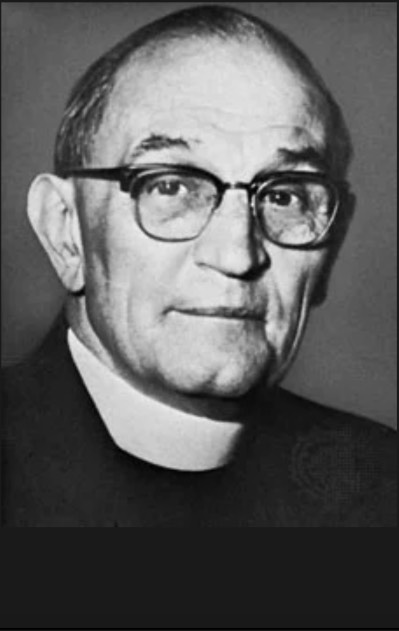
On March 6, 1984, a man named Martin Niemoeller died. He had been a German U-boat commander in WWI. After that war, he became a Lutheran pastor and initially supported Hitler. But as the years moved toward WWII, Niemoeller became more and more critical of Hitler. Arrested several times, he finally spent seven years in various concentration camps beginning in 1938. He was liberated from Dachau in 1945.
Martin Niemoeller wrote the following words:
“They came for the Communists, but I was not a Communist so I did not speak out. They came for the Socialists and trade unionists, but I was neither, so I did not speak out. They came for the Jews but I was not a Jew, so I did not speak out. Then they came for me, and there was no one to speak for me.”
As the world deals with interminable war, terrorism, racism, and cloaked fascism, we should remember that true justice and peace always include BOTH understanding and standing up.
Music: Show Me How to Stand for Justice – Martin Leckebusch
Jesus told his disciples a parable. “Consider the fig tree and all the other trees. When their buds burst open, you see for yourselves and know that summer is now near; in the same way, when you see these things happening, know that the Kingdom of God is near. Luke 21:29-31
Jesus tells his followers to be attuned to the emergence of God’s Kingdom.
The reality is that the Kingdom of God already enfolds us, but it is difficult for us to see it with our human eyes. When we see a ripe peach or tomato, we know it is ready to come to the table. But are we able to see the Spirit of God ripening in the world around us? Are we ready to pluck grace from our everyday circumstances so that God’s Reign is released into the world?
Today, in God’s Lavish Mercy: We prayerfully consider all that blossoms in our daily life. Where is the invitation to holiness within our circumstances? May God lift us to pick the fruit offered.
Poetry: Go to the Limits of Your Longing – Rainer Maria Rilké
God speaks to each of us as he makes us, then walks with us silently out of the night.
These are the words we dimly hear:
You, sent out beyond your recall, go to the limits of your longing. Embody me.
Flare up like a flame and make big shadows I can move in.
Let everything happen to you: beauty and terror. Just keep going. No feeling is final. Don’t let yourself lose me.
Nearby is the country they call life. You will know it by its seriousness.
And now, bless the God of all, who has done wondrous things on earth; Who fosters people’s growth from their mother’s womb, and fashions them according to his will! May he grant you joy of heart and may peace abide among you; May God’s goodness toward us endure to deliver us in our days. Sirach 50:22-24
Remain faithful until death, and I will give you the crown of life.
Revelation 2:10
.In Luke 21, Jesus exhorts his disciples to remain faithful. Then he describes how fraught with difficulties that faithfulness will be: denouncement, imprisonment, false judgment, disavowal by family and friends, hatred, and even death. What is so terrifying about the Gospel that it evokes these responses in its enemies? What is so powerful about the Gospel that it will sustain its believers even through such trials?
Today, in God’s Lavish Mercy: I ask myself, “Have I ever really suffered anything for the sake of the Gospel”? What would that suffering look like? Would it not be setting aside my selfishness for the sake of the neighbor – even the unloved neighbor? If we dare to do that, we will surely suffer.
Prose: from Walter Bruggemann in “God’s Neighborly Economy”
“Who is my neighbor?”(Luke 10:29)
The Bible is unflinching and unambiguous in its identification of the neighbor: widow, orphan, immigrant, the poor, lepers, the blind, deaf, lame … all those without viable resources or reliable advocacy.
Jesus Christ is the faithful witness, the firstborn of the dead and ruler of the kings of the earth. To him who loves us and has freed us from our sins by his blood, who has made us into a kingdom, priests for his God and Father, to him be glory and power forever and ever. Amen. Behold, he is coming amid the clouds, and every eye will see him, even those who pierced him. All the peoples of the earth will lament him. Yes. Amen.
“I am the Alpha and the Omega, ” says the Lord God, “the one who is and who was and who is to come, the almighty.” Revelation 1:5-8
Pope Pius XI instituted the Feast of Christ the King in his 1925 encyclical Quas primas. The encyclical was written in response to growing secularism and secular ultra-nationalism. The encyclical, wedged between two World Wars, attempted to focus people’s minds and hearts on Christ whose power unites and directs us to peace rather than domination.
Today, in God’s Lavish Mercy: We pray to be agents of peace and justice in our world, sustained by our devotion to Christ who modeled his kingship by loving service, especially to the poor and marginalized.
While people were listening to Jesus speak, he proceeded to tell a parable because he was near Jerusalem and they thought that the Kingdom of God would appear there immediately. So he said, “A nobleman went off to a distant country to obtain the kingship for himself and then to return. He called ten of his servants and gave them ten gold coins and told them, ‘Engage in trade with these until I return.’ Luke 19:11-13
This is a tough parable to get real devotional about. It’s the story of a nasty guy who wants to be king. When his campaign is repulsed, he takes it out on his servant whom he deems unproductive.
But think about where Jesus told the story. He is at the threshold of Jerusalem where, through his Passion and Death, he will reign over the universe. But Jesus will do this by the inverse of what we would expect. He will be rejected by this world to open us to the deeper essence of its heart.
Today, in God’s Lavish Mercy: Jesus wants his followers to be productive in spreading the Gospel. He wants us to blossom in faith and service to God’s Name. We pray for the courage to exercise those gifts in faith, hope, and charity.
Prose: Prayer of Walter Brueggemann
You are the giver of all good things.
All good things are sent from heaven above,
rain and sun, day and night,
justice and righteousness,
bread to the eater and seed to the sower,
peace to the old, energy to the young,
joy to the babes.

We are takers, who take from you, day by day,
daily bread, taking all we need as you supply,
taking in gratitude and wonder and joy.

And then taking more,
taking more than we need,
taking more than you give us,
taking from our sisters and brothers,
taking from the poor and the weak,
taking because we are frightened, and so greedy,
taking because we are anxious, and so fearful,
taking because we are driven, and so uncaring.

Give us peace beyond our fear, and so end our greed.
Turn our taking into giving, since we are in your giving image:
Make us giving like you,
giving in joy, not taking,
giving as he gave himself up for us all,
giving, never taking.
Amen.
Music: God Turn Me Into a Flower
What would it take to truly “blossom” for God, to be the Love that Jesus hopes for us, to take the coin of grace and enrich it by our service of the Gospel?
As you listen to this rather mysterious song, you might consider those questions.
Now a man there named Zacchaeus, who was a chief tax collector and also a wealthy man, was seeking to see who Jesus was; but he could not see him because of the crowd, for he was short in stature. So he ran ahead and climbed a sycamore tree in order to see Jesus, who was about to pass that way. When he reached the place, Jesus looked up and said, “Zacchaeus, come down quickly, for today I must stay at your house.” And he came down quickly and received him with joy. Luke 19:2-6
Every scripture passage has a lesson for us. And even though I’m tall, not short, there is a lesson here for me. For you too!
We want to grow in our ability to find God in every circumstance of our lives. But, at times, we may be short on the faith, hope, or charity to do so. We may be short on living the works of mercy. Not to sound hip-hop, but we may be short on “Gratitude for the Beatitude”!
Today, in God’s Lavish Mercy: We ask Jesus to discover us in whatever metaphorical tree we might be hiding, to come under our roof, and to live at the center of our lives.
Poetry: The Stature of Zacchaeus – Amos Russel Wells (1862-1933)
Zacchaeus struggled with the crowd;
A little man was he.
"Vermin!" he muttered half aloud,
"I'll make them honor me.
Ah, when the taxes next are due,
I'll tower as is meet;
This beggarly, ill-mannered crew
Shall cower at my feet."
Zacchaeus climbed the sycomore
(He was a little man),
And as he looked the rabble o'er
He chuckled at the plan.
"I get the thing I want," he said,
"And that is to be tall.
They think me short but by a head
I rise above them all."
"Zacchaeus, come! I dine with you,"
The famous Rabbi cried.
Zacchaeus tumbled into view
A giant in his pride.
He strutted mightily before
That silly, gaping throng;
You'd think him six feet high or more,
To see him stride along.
Zacchaeus listened to the Lord,
And as he listened, feared;
How was his life a thing abhorred
When that pure Life appeared!
Down to a dwarf he shrank away
In sorrow and in shame.
He owned his sins that very day,
And bore the heavy blame.
But as he rose before the crowd,
(A little man, alack!)
Confessed his guilt and cried aloud
And gave his plunder back,
I think he stood a giant then
As angels truly scan,
And no one ever thought again
He was a little man.
Music: Zacchaeus – Miriam Therese Winter, Medical Mission Sisters
Jesus stopped and ordered that the blind man be brought to him; and when he came near, Jesus asked him, “What do you want me to do for you?” He replied, “Lord, please let me see.” Jesus told him, “Have sight; your faith has saved you.” He immediately received his sight and followed him, giving glory to God. Luke 18:40-42
This Gospel story is filled with images and interactions that might speak to our souls.
Today, in God’s Lavish Mercy: We consider this: What if Jesus asked you that question right now? “What do you want me to do for you?”
What would your request be? Would you be tempted to respond as if Jesus were a genie who deals in wishes not hopes?
Or would your answer grow from your deep faith as it does with this blind man? Upon his healing, heaven’s window was opened to him. The Gospel tellsus that “he followed” Jesus. His newfound vision was put fully at the service of God.
Poetry: Blind Trust – Irene Zimmerman
Bartimeus sat outside
the town of Jericho.
The more they told him where to go,
the louder he cried.

He had no pride --
when Jesus asked he simply stared:
"Lord, I want to see!" and waited
to be eyed.
But when the kindness and generous love of God our savior appeared, not because of any righteous deeds we had done but because of his mercy, he saved us through the bath of rebirth and renewal by the Holy Spirit, whom he richly poured out on us through Jesus Christ our savior, so that we might be justified by his grace and become heirs in hope of eternal life. Titus 3:4-7
The saint we honor today is an exemplar of the spiritual life Paul describes in his letter to Titus – centered in God’s mercy, inspired by the Holy Spirit, and unified with Jesus Christ and his Gospel.
Today, in God’s Lavish Mercy, we take time to be with Frances Xavier Cabrini, and with any of our special saints who model for us the pathway to eternal life.
Research: The story of St. Frances Xavier Cabrini’s life is inspiring and astounding. To read a summary, click here:
Music: Va, Pensiero (from the film Cabrini) is an aria from the opera Nabucco written by Giuseppe Verdi in 1842. The aria is popularly known as “The Chorus of the Hebrew Slaves”.
The opera recollects the period of Babylonian captivity after the destruction of Solomon’s Temple in Jerusalem in 586 BC.
The libretto is by Temistocle Solera, inspired by Psalm 137. The opera with its powerful chorus established Verdi as a major composer in 19th-century Italy. The full incipit is “Va, pensiero, sull’ali dorate”, meaning “Go, thought, on wings of gold”. (Wikipedia)
Goes, thought, on golden wings Va, pensiero, sull’ali dorate
It goes, it places you on the slopes, on the hills Va, ti posa sui clivi, sui colli
Where they smell warm and soft Ove olezzano tepide e molli
The sweet auras of the native soil L’aure dolci del suolo natal He greets the banks of the Jordan Del Giordano le rive saluta
The towers of Sione collapsed Di Sione le torri atterrate
Oh, my beautiful and lost homeland Oh, mia patria sì bella e perduta
Oh, memory so dear and fatal Oh, membranza sì cara e fatal Golden harp of the fateful prophets Arpa d’or dei fatidici vati
Why does it change from the willow tree you hang? Perché muta dal salice pendi?
Rekindle the memories in your chest Le memorie nel petto raccendi
It tells us about times gone by Ci favella del tempo che fu O similar of Sòlima to the fates O simile di Sòlima ai fati
You draw a sound of raw lament Traggi un suono di crudo lamento
O may the Lord inspire you with a concert O t’ispiri il Signore un concento
May it infuse virtue into suffering Che ne infonda al patire virtù May it infuse virtue into suffering Che ne infonda al patire virtù
May it infuse virtue into suffering Che ne infonda al patire virtù
Jesus said to his disciples, “Things that cause sin will inevitably occur, but woe to the one through whom they occur. It would be better for him if a millstone were put around his neck and he be thrown into the sea than for him to cause one of these little ones to sin. Luke 17:1-2
Jesus is serious about the importance of good example and moral living. I mean, look at the heft of that millstone! It ain’t no necklace! If you’re thrown into the sea with that around your neck, there’s no coming back.
Today, in God’s Lavish Mercy: We pray for the spiritual sensitivity to be aware of our motivations, our influence on others, and any selfish or concupiscent choices we make.
Poetry: House of Light – Mary Oliver
Still, what I want in my life is to be willing to be dazzled— to cast aside the weight of facts
and maybe even to float a little above this difficult world. I want to believe I am looking
into the white fire of a great mystery. I want to believe that the imperfections are nothing— that the light is everything—that it is more than the sum of each flawed blossom rising and falling. And I do.







 Lavish Mercy