Today, in God’s Lavish Mercy, we begin our readings with God’s stern but magnificent commission to the prophet Jeremiah:
… stand up and tell them all that I command you.
What Jeremiah had to tell the Israelites was not comforting news. He prophesied that if they didn’t repent from their idolatry, Jerusalem would fall into the hands of foreign oppressors. Nobody wanted to hear it. They led Jeremiah a life, to the point that he is often referred to as “The Weeping Prophet”. Over the course of forty years and the reign of five Judean kings, Jeremiah’s message continues until, in the end, it comes to fulfillment in the Babylonian Captivity.
Jeremiah Lamenting the Fall of Jerusalem Rembrandt
How did Jeremiah sustain such confrontational preaching in the face of intractable resistance?
Perhaps the answer lies in our second reading. He did it out of love.
Arthur Cundall, a British scripture scholar writes:
“God wanted a person with a very gentle and tender heart for this unrewarding ministry of condemnation. Jeremiah’s subsequent career shows that he had this quality in full measure.”
Jeremiah is a living example of the loving, humble, truth-seeking, hope-impelled soul described in 1 Corinthians, our second reading.
Strive eagerly for the greatest spiritual gifts. But I shall show you a still more excellent way. If I speak in human and angelic tongues, but do not have love, I am a resounding gong or a clashing cymbal. And if I have the gift of prophecy, and comprehend all mysteries and all knowledge; if I have all faith so as to move mountains, but do not have love, I am nothing.
1 Corinthians 13: 1-2
In Luke’s Gospel today, we see Jesus rejected in the same manner as Jeremiah. Jesus’s message calls his listeners to deep conversion of heart in order to be redeemed. Like the ancient Israelites, they don’t want to hear it. They cannot break through their comfortable existence to acknowledge its emptiness.
Jesus is Rejected at Nazareth Maerten de Vos – 16th Century
And he said, “Amen, I say to you, no prophet is accepted in his own native place….
… When the people in the synagogue heard this, they were all filled with fury. They rose up, drove him out of the town, and led him to the brow of the hill on which their town had been built, to hurl him down headlong. But Jesus passed through the midst of them and went away.
Luke 4:24; 28-30
The message for us today? Is there an emptiness somewhere in our hearts that we have not yet given over to God? Are we filling it with “false gods”, rather than the loving virtues described in Corinthians? Is there even a small resistance to the Word that keeps us in a “dead space”.
We know where our “dead spaces” are, and we deeply intend them to come alive again. Today, let’s choose to walk the bridge from intention to practice.
Poetry: Jeremiah – Saint John Henry Newman
"WOE'S me!" the peaceful prophet cried,
"Spare me this troubled life;
To stem man's wrath, to school his pride,
To head the sacred strife!

"O place me in some silent vale,
Where groves and flowers abound;
Nor eyes that grudge, nor tongues that rail,
Vex the truth-haunted ground!"

If his meek spirit err'd, opprest
That God denied repose,
What sin is ours, to whom Heaven's rest
Is pledged, to heal earth's woes?
Music: One of my all time favorite songs (Wow! And how about the snow geese at the end of this video!)
Today, in God’s Lavish Mercy, we clearly are being taught. The first lesson comes from a gripping iconic story in Samuel – the treacherous murder of Uriah; the second from the Markan Parables – the miraculous mustard seed.
In our first reading, the noble, kingly David takes a mighty fall. He has tripped over his own power and descended into a chasm of indifference, lust, manipulation, deceit, and murder. Walter Brueggemann captures the immensity of the story here:
II Samuel 11:1–27 We are now at the pivotal turning point in the narrative plot of the books of Samuel. We are also invited into the presence of delicate, subtle art. We are at the threshold of deep, aching psychology, and at the same time we are about to witness a most ruthless political performance. In this narrative we are in the presence of greatness. For David and for Israel, we are at a moment of no return. Innocence is never to be retrieved. From now on the life of David is marked, and all Israel must live with that mark.
David handing over a letter to Uriah, 1619 – Pieter Lastman
Unfortunately, David’s moral depravity is reshaped and retold in thousands of other biographies throughout history as “strongmen” (and women) grasp power. Too bad David, and those like him, could not have benefitted from some later-age wisdom such as these two quotables:
Power tends to corrupt, and absolute power corrupts absolutely. ~ John Dalberg-Acton, letter to Bishop Mandela Creighton, (April 1887)
One uncontrolled character flaw can ruin your greatest accomplishment. ~ Wayde Goodall, Why Great Men Fall: 15 Winning Strategies to Rise Above It All (2005)
While David’s sinfulness had corrupted the concept of “kingdom”, in Mark, Jesus teaches us a divinely refreshed understanding of the term.
When asked what the kingdom of heaven is like, Jesus describes generous, inclusive reality sprung from humble, hopeful investment:
To what shall we compare the Kingdom of God, or what parable can we use for it? It is like a mustard seed that, when it is sown in the ground, is the smallest of all the seeds on the earth. But once it is sown, it springs up and becomes the largest of plants and puts forth large branches, so that the birds of the sky can dwell in its shade.
Mark 4: 30-32
Perhaps our prayer today is best reflected in the Alleluia Verse – a plea to retain, in our choices, the deep innocence of faith:
Blessed are you, Creator, Lord of heaven and earth; you have revealed to little ones the mysteries of the Kingdom.
Matthew 11:25
Praying with that this morning, I offer you the innocent drawing of my 6 year-old grand-nephew Robert, an interpretation of what it means to fall down.
Something Falling Down, as titled by the Artist
Poetry: When the Great Trees Fall – Maya Angelou
When great trees fall,
rocks on distant hills shudder,
lions hunker down
in tall grasses,
and even elephants
lumber after safety.
When great trees fall
in forests,
small things recoil into silence,
their senses
eroded beyond fear.
When great souls die,
the air around us becomes
light, rare, sterile.
We breathe, briefly.
Our eyes, briefly,
see with
a hurtful clarity.
Our memory, suddenly sharpened,
examines,
gnaws on kind words
unsaid,
promised walks
never taken.
Great souls die and
our reality, bound to
them, takes leave of us.
Our souls,
dependent upon their
nurture,
now shrink, wizened.
Our minds, formed
and informed by their
radiance,
fall away.
We are not so much maddened
as reduced to the unutterable ignorance
of dark, cold
caves.
And when great souls die,
after a period peace blooms,
slowly and always
irregularly. Spaces fill
with a kind of
soothing electric vibration.
Our senses, restored, never
to be the same, whisper to us.
They existed. They existed.
We can be. Be and be
better. For they existed.
Music: All the King’s Horses – Aretha Franklin Although the song is not biblical, the lyrics carry similar emotions to the ones we find in the reading from Samuel.
Today, in God’s Lavish Mercy, our readings place us at watershed moments in the lives of David and Jesus.
All the tribes of Israel came to David in Hebron and said: “Here we are, your bone and your flesh. In days past, when Saul was our king, it was you who led the children of Israel out and brought them back. And the LORD said to you, ‘You shall shepherd my people Israel and shall be commander of Israel.’” When all the elders of Israel came to David in Hebron, King David made an agreement with them there before the LORD, and they anointed him king of Israel.
2 Samuel 5:1-4
In 2 Samuel 5, David fully assumes the kingship through the approbation of the community. The scene marks the culmination of his rise to power and “the beginning of the rest of his life”.
Through our readings in Samuel until now, we have ascended with David to the pinnacle of his life. We are about to begin weeks of moving down “the other side of the mountain”.
Scholars generally see the David narrative in two primary units, the Rise of David (I Sam. 16:1—II Sam. 5:10) and the Succession Narrative (II Sam. 9:1—20:26; I Kings 1:1—2:46). Chapters 5:11—8:18, fall between two larger units. Whereas the first presents David in his ascendancy, the second presents David in his demise and expresses pathos and ambiguity. Our chapters thus come after the raw vitality of the rise of David and before the terrible pathos of the succession narrative. They show the painful process whereby this beloved chieftain is transformed into a hardened monarch, who now has more power than popular affection.
Walter Brueggemann, First and Second Samuel
In our Gospel, Jesus also comes to a sort of “continental divide”. But rather than community approbation, Jesus encounters the condemnation of the scribes who have come from Jerusalem to assess him.
The scribes who had come from Jerusalem said of Jesus, “He is possessed by Beelzebul,” and “By the prince of demons he drives out demons.”
Mark 3:22
From this moment in his life, Jesus too launches into his “kingship”, one that looks very different from David’s. The ensuing chapters of Samuel will reveal how David struggles and succumbs to the temptations of power and domination. The Gospels, on the other hand, describe Jesus’s “kingdom” as one of humility, mercy, and love for those who are poor and suffering.
Only through faith can we understand the inverse power of God present in the Life, Death and Resurrection of Jesus, and in our own lives. Jesus, the “new David”, is anointed in the Spirit to reveal and incorporate us into the kingdom of God.
Prose: from Immanuel Jakobovits who was the Chief Rabbi of the United Hebrew Congregations of the Commonwealth from 1967 to 1991.
To those without faith
there are no answers.
To those with faith,
there are no questions.
Music: King David, music by Herbert Howells, sung by Sarah Connolly from a poem by Walter de la Mare
King David – Walter de la Mare
King David was a sorrowful man:
    No cause for his sorrow had he;
    And he called for the music of a hundred harps,
    To ease his melancholy.

    They played till they all fell silent:
    Played-and play sweet did they;
    But the sorrow that haunted the heart of King David
    They could not charm away.

    He rose; and in his garden
    Walked by the moon alone,
    A nightingale hidden in a cypress-tree
    Jargoned on and on.

    King David lifted his sad eyes
    Into the dark-boughed tree-
    ''Tell me, thou little bird that singest,
    Who taught my grief to thee?'

    But the bird in no wise heeded
    And the king in the cool of the moon
    Hearkened to the nightingale's sorrowfulness,
    Till all his own was gone.
Today, in God’s Lavish Mercy, our readings focus on Sacred Scripture as the revealed Word of God.
Ezra, from our first passage, lived almost 500 years before Christ during the Babylonian captivity, a time when much of the population of Judea was deported to what is modern day Iraq. When the Persian King Cyrus the Great conquered Babylon, the Jews were permitted to return to Judea.
Ezra Reads the Law to the People – Gustave Dore
During the sixty-year enslavement, many Jews lost touch with their culture, language and religion. Our reading describes Ezra’s efforts to restore the Jewish character of the community by reintroducing them to the Torah. He has to read to them, translating the Hebrew for those who no longer speak the language.
In a gesture foretelling the liberating ministry of Jesus, Ezra unrolls the scroll – symbolic of bringing to light that which has been hidden or buried.
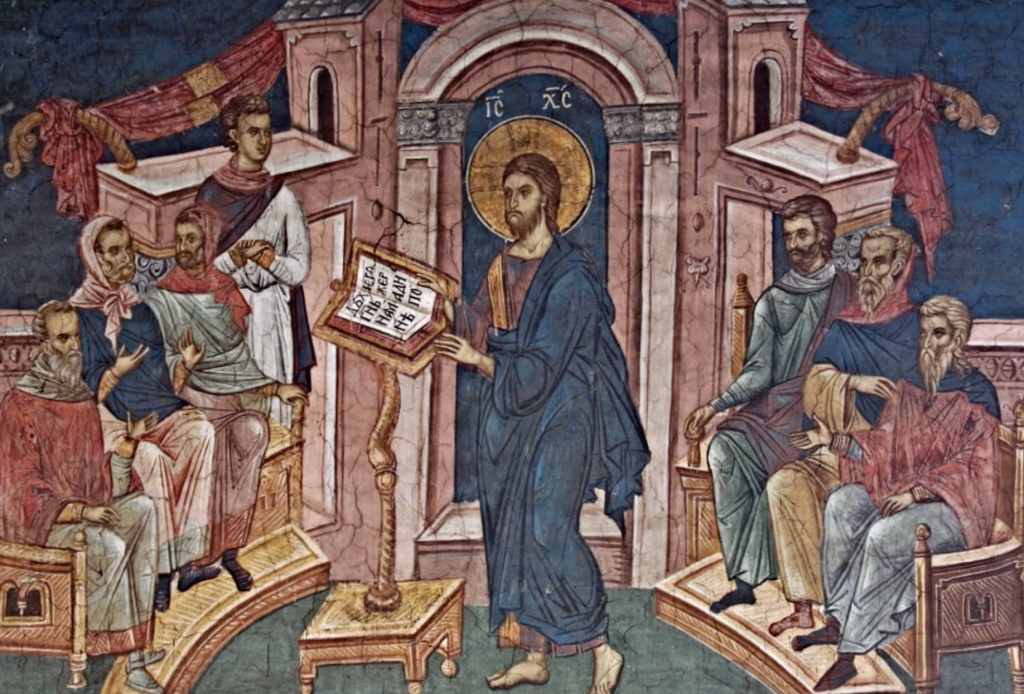
Jesus in the Synagogue at Nazareth – Anonymous
In our Gospel, Jesus too unrolls the scroll. In doing so, Jesus reveals the heart of faith which had been buried within the Law. Jesus preaches in a new “language” – the language of God’s all-inclusive mercy, forgiveness, and love.
For us who believe, the holy scriptures are a Living Word which, through thoughtful prayer, will continually reveal God’s heart to us. It is worth our time and attention to become friends with these sacred messages.
Many of you, dear readers, will be familiar with the ancient prayer practice of “lectio divina”. In her book “Too Deep for Words”, Sister Thelma Hall describes the practice:
… a wholistic way of prayer which disposes, opens, and “in-forms” us for the gift of contemplation God waits to give, by leading us to a place with him at our deepest center … It begins this movement by introducing us to the power of the Word of God in scripture to speak to the most intimate depths of our hearts …
Sister Thelma Hall’s book, a classic, is available on Amazon for those who might enjoy exploring Lectio Divina. I highly recommend it. My copy, nearly 30 years old, is beginning to show its age, but then again, so am I!
Poetry: The Word Of God – George MacDonald
Where the bud has never blown
Who for scent is debtor?
Where the spirit rests unknown
Fatal is the letter.
In thee, Jesus, Godhead-stored,
All things we inherit,
For thou art the very Word
And the very Spirit!
Today, in God’s Lavish Mercy, our readings center on the themes of grief, honor, and mercy.
In the passage from 2 Samuel, Saul has been killed in battle. The news is brought to David by a scheming Amalekite who (later verses reveal) hopes to profit from his enterprise. He has stripped Saul’s dead body of its kingly insignia, obsequiously depositing it at David’s feet. The messenger expects David’s vengeful rejoicing and a hefty reward.
Instead David, with reverence and honor appropriate to a future king, launches a deep public mourning for Saul and Jonathan. It is a bereavement necessary to both cleanse and heal the community’s heart from all the strife leading up to it.
David seized his garments and rent them, and all the men who were with him did likewise. They mourned and wept and fasted until evening for Saul and his son Jonathan, and for the soldiers of the LORD of the clans of Israel, because they had fallen by the sword.
2 Samuel 1:11-12
David’s lament is profound; it is”splancha”, sprung from his innards, like the anguish Jesus felt for the suffering persons he encountered, as described in our Gospel.
A callous or indifferent heart cannot comprehend such pathos. Seeing it in Jesus, even his relatives thought him insane!
Jesus came with his disciples into the house. Again the crowd gathered, making it impossible for them even to eat. When his relatives heard of this they set out to seize him, for they said, “He is out of his mind.”
Mark 3:20-21
Our God is a God of boundless love and impractical mercy. David models a bit of that godliness. Jesus is its complete Incarnation.
Poem: David and Jonathan by Abraham Crowley, an English poet born in the City of London in 1618. He was one of the leading English poets of the 17th century.
Still to one end they both so justly drew,
As courteous Doves together yok'd would do.
No weight of Birth did on one side prevaile,
Two Twins less even lie in Natures Scale,
They mingled Fates, and both in each did share,
They both were Servants, they both Princes were.
If any Joy to one of them was sent;
It was most his, to whom it least was meant,
And fortunes malice betwixt both was crost,
For striking one, it wounded th'other most.
Never did Marriage such true Union find,
Or mens desires with so glad violence bind;
For there is still some tincture left of Sin,
And still the Sex will needs be stealing in.
Those joys are full of dross, and thicker farre
These, without matter, clear and liquid are.
Such sacred Love does he'avens bright Spirits fill,
Where Love is but to Understand and Will,
With swift and unseen Motions; such as We
Somewhat express in heightned Charitie.
O ye blest One! whose Love on earth became
So pure that still in Heav'en 'tis but the same
There now ye sit, and with mixt souls embrace,
Gazing upon great Loves mysterious Face,
And pity this base world where Friendship's made
A bait for sin, or else at best a Trade.
Music: Lascia Ch’io Pianga (Let Me Weep)- Georg Frideric Handel – a single piece of beautiful music today in two version, an aria and an instrumental interpretation.
Julia Lezhneva – soprano
Stjepan Hauser – cellist
Lascia ch’io pianga la cruda sorte, e che sospiri la libertà. Il duolo infranga queste ritorte de’ miei martiri sol per pietà.
Let me weep cruel fate, and sigh for liberty.
May sorrow break these chains Of my sufferings, for pity’s sake.
Today, in God’s Lavish Mercy, our readings are full of drama and meaning enveloped in two of the greatest speeches of the Hebrew Scriptures – one from David, the other from Saul. The use of speeches to unfold the narrative is characteristic of the high points of Scripture. And these are two winners.
In the passage from Samuel, David spares Saul’s life even though Saul is in murderous pursuit of him. The result is the final dissolution of Saul’s kingship. It is a scene that could be right out of MGM! (Here is a video for kids featuring the moment. But I thought it was pretty cool. Maybe you will too.)
Is David noble or naïve? Is he magnanimous or stupid? Is he sincere or clever? Various scripture scholars interpret these passages in a host of ways. But as I pray this morning, I ask myself what it is that God might be saying to me through this passage.
Two things rise up:
Above all else, David is motivated by a deep respect for God’s Will and Presence in his life. He doesn’t force God’s Will by seizing the kingship. David waits and listens for God’s intention.
David said to his men, “The LORD forbid that I should do such a thing to my master, the LORD’s anointed, as to lay a hand on him, for he is the LORD’s anointed.”
2. David engages Saul directly and respectfully, perhaps in the hope of reaching a resolution of their issues. This honesty appears to motivate Saul to see himself and his situation clearly. It is a consummate act of reconciliation.
When David finished saying these things to Saul, Saul answered, “Is that your voice, my son David?” And Saul wept aloud.
Reverence and honesty rooted in sincere love and respect for one another! What a world we would live in if each of us practiced these things unfailingly!
In our Gospel, Jesus calls his disciples to live in the world in just such a way – to bring healing and wholeness in the Name of Christ, for the sake of Love.
Our Alleluia Verse today captures the essence of Christ’s call to them —- and to us:
God was reconciling the world to himself in Christ, and entrusting to us the message of that reconciliation.
Poetry:Saul And David by Anthony Hecht, 1923 – 2004, was an American poet. His work combined a deep interest in form with a passionate desire to confront the horrors of 20th century history, with the Second World War, in which he fought, and the Holocaust being recurrent themes in his work.
It was a villainous spirit, snub-nosed, foul Of breath, thick-taloned and malevolent, That squatted within him wheresoever he went …….And possessed the soul of Saul.
There was no peace on pillow or on throne. In dreams the toothless, dwarfed, and squinny-eyed Started a joyful rumor that he had died …….Unfriended and alone.
The doctors were confounded. In his distress, he Put aside arrogant ways and condescended To seek among the flocks where they were tended …….By the youngest son of Jesse,
A shepherd boy, but goodly to look upon, Unnoticed but God-favored, sturdy of limb As Michelangelo later imagined him, …….Comely even in his frown.
Shall a mere shepherd provide the cure of kings? Heaven itself delights in ironies such As this, in which a boy’s fingers would touch …….Pythagorean strings
And by a modal artistry assemble The very Sons of Morning, the ranked and choired Heavens in sweet laudation of the Lord, …….And make Saul cease to tremble.
Music: To Fill the World with Love sung by Richard Harris (Lyrics below, but you will no doubt recall them from the fabulous film “Goodbye Mr. Chips”.)
In the morning of my life I shall look to the sunrise. At a moment in my life when the world is new. And the blessing I shall ask is that God will grant me, To be brave and strong and true, And to fill the world with love my whole life through.
(Chorus) And to fill the world with love And to fill the world with love And to fill the world with love my whole life through
In the noontime of my life I shall look to the sunshine, At a moment in my life when the sky is blue. And the blessing I shall ask shall remain unchanging. To be brave and strong and true, And to fill the world with love my whole life through
(Chorus)
In the evening of my life I shall look to the sunset, At a moment in my life when the night is due. And the question I shall ask only God can answer. Was I brave and strong and true? Did I fill the world with love my whole life through?
Today, in God’s Lavish Mercy, we read about Jesus’s first public miracle at Cana. It is a story that has always fascinated me, mostly because of what is left unsaid – what is written between the lines.
The Gospel begins by telling of a wedding and “the mother of Jesus was there”. The suggestion is that Mary had been staying at the wedding site and that she had a special role in the preparations. Perhaps she was the aunt or good friend of the bride or groom. Whatever the case, Mary seems to have had some unique responsibility for the ceremony’s success.
This responsibility motivates her to solicit Jesus’s help when she notices the wine is running out. Did she expect a miracle in return for her remark? We don’t know. Perhaps she just wanted Jesus and his young friends to run down to the local wine store for replenishments.
It was Jesus who decided to turn the request into an occasion for a miracle. Why? It seems like a frivolous miracle when there were sick to be cured and dead to be raised!
The final lines of this section might help answer that question:
Jesus did this as the beginning of his signs at Cana in Galilee and so revealed his glory, and his disciples began to believe in him.
John 2:11
Jesus decided to first reveal his glory at a wedding feast, a party, an ordinary celebration of life and love. The dramatic, life-saving miracles would come – demons grabbing pigs and diving headlong into the sea.
But this first one, the one his closest family and friends would especially remember, was all about joy, dancing, music, friendship – the divine strength of our shared and graced humanity.
Probably most of us don’t expect to encounter a really eye-popping miracle in our lives. But maybe in our challenges we, like Mary, could walk up behind Jesus and whisper, “This situation needs your touch”.
Oh, how Jesus might surprise us – by letting us pour out an everyday miracle right before our eyes! Let’s be aware today of the miracles we might take for granted – life, laughter, love, friendship, hope, courage, delight in nature ….
Poetry: The Gourd – Paul Laurence Dunbar The poet suggests in these lines that it is in simplicity, and poverty of spirit, that life’s true miracles are revealed to us.
In the heavy earth the miner Toiled and laboured day by day, Wrenching from the miser mountain Brilliant treasure where it lay. And the artist worn and weary Wrought with labour manifold That the king might drink his nectar From a goblet made of gold.
On the prince’s groaning table Mid the silver gleaming bright Mirroring the happy faces Giving back the flaming light, Shine the cups of priceless crystal Chased with many a lovely line, Glowing now with warmer colour, Crimsoned by the ruby wine.
In a valley sweet with sunlight, Fertile with the dew and rain, Without miner’s daily labour, Without artist’s nightly pain, There there grows the cup I drink from, Summer’s sweetness in it stored, And my lips pronounce a blessing As they touch an old brown gourd.
Why, the miracle at Cana In the land of Galilee, Tho’ it puzzles all the scholars, Is no longer strange to me. For the poorest and the humblest Could a priceless wine afford, If they’d only dip up water With a sunlight-seasoned gourd.
So a health to my old comrade, And a song of praise to sing When he rests inviting kisses In his place beside the spring. Give the king his golden goblets, Give the prince his crystal hoard; But for me the sparkling water From a brown and brimming gourd!
Today, in God’s Lavish Mercy, our readings burst with lessons for our faith. We might center our prayer on these three dynamic elements:
Power Praise Perseverance
Power
In our first reading, Israel is in the midst of a profound power shift. Until this time, Israel has thrived in “covenantal localism” which released possibility and initiative within the broad community. But now, perhaps stressed by the Philistine threat, the elders lobby for the establishment of a kingship – a centralization of power, wealth, land control, and local self-determination. ( based on Walter Brueggemann: First and Second Samuel: Interpretation: A Bible Commentary for Teaching and Preaching)
The Elders Ask Samuel for a King
Samuel isn’t happy with the elders’ suggestion and, apparently, neither is God. Samuel tells the elders so in a passionate speech against regalism. He pronounces that when the king has usurped all their rights, God will not deliver them as they once were delivered from a similar bondage in Egypt:
When this takes place, you will complain against the king whom you have chosen, but on that day the LORD will not answer you.
1 Samuel 8:18
The lesson for us is that the use and organization of power must always be for the sake of communal justice and well-being. Fostering these universal goods is the perpetual struggle of nations and institutions. As part of any community, we are called advocate for a just distribution of power for all people.
Praise Our Responsorial Psalm counsels that in all such human interactions, our focus must be on God and God’s Will for universal wholeness and peace – a peace evidenced in justice, joy, and praise.
Blessed the people who know the joyful shout; in the light of your countenance, O LORD, they walk. At your name they rejoice all the day, and through your justice they are exalted.
Psalm 89:16-17
Perseverance
Mark’s story of the cure of a paralyzed man demonstrates the power of faithful perseverance. This man’s community – his friends – persist until he fully benefits from God’s desire for his wholeness.
Unable to get near Jesus because of the crowd, they opened up the roof above him. After they had broken through, they let down the mat on which the paralytic was lying. When Jesus saw their faith, he said to him, “Child, your sins are forgiven.”
Mark 2:4-5
Such is our responsibility to pursue our own wholeness and the wholeness of our global community.
Poetry: Ozymandias – Percy Bysshe Shelley
(The poem explores the fate of history and the ravages of time: even the greatest men and the empires they forge are impermanent, their legacies fated to decay into oblivion. (Wikipedia)
I met a traveller from an antique land
Who said: ‘Two vast and trunkless legs of stone
Stand in the desert. Near them, on the sand,
Half sunk, a shattered visage lies, whose frown,
And wrinkled lip, and sneer of cold command,
Tell that its sculptor well those passions read
Which yet survive, stamped on these lifeless things,
The hand that mocked them and the heart that fed:
And on the pedestal these words appear:
“My name is Ozymandias, king of kings:
Look on my works, ye Mighty, and despair!
”Nothing beside remains. Round the decay
Of that colossal wreck, boundless and bare
The lone and level sands stretch far away.’
Music: Aria – composed by Friedrich Gulda, played by Tomoko Inoue
Today, in God’s Lavish Mercy, our readings present a human cycle with which we all are familiar- the experience of falling and being lifted up again.
Failure then Mercy then Redemption
In our first reading, we hear about Hophni and Phinehas, sons of old Eli. They were not nice guys. They represent everything that happens when politics and power corrupt religion.
Now the sons of Eli were wicked; they had respect neither for the LORD nor for the priests’ duties toward the people.
1 Samuel 2: 13-14
After a first defeat by the Philistines, the elders of Israel sent for the Ark of the Covenant to fortify them in battle. Hophni and Phineas, being the Ark’s tenders, accompanied it from Shiloh. But the presence of the Ark, representing God, didn’t bring victory. Israel lost a second battle.
The Philistines fought and Israel was defeated; every man fled to his own tent. It was a disastrous defeat, in which Israel lost thirty thousand foot soldiers. The ark of God was captured, and Eli’s two sons, Hophni and Phinehas, were among the dead.
1 Samuel 4:11
Wow! You know it’s bad enough when we fail a first time! But after asking God to step in, we still fail??? Uh Oh!
Extraordinary Failure
Our Responsorial Psalm is the prayer of those recognizing themselves as utterly defeated, confused, and begging for redemption – the “Uh Oh People”!
Why do you hide your face, forgetting our woe and our oppression? For our souls are bowed down to the dust, our bodies are pressed to the earth. Redeem us, Lord, because of your mercy.
Psalm 44:24-25
Extraordinary Redemption
Mark’s Gospel tells the story of one devastated and utterly dependent on God to be restored, — a story of the immediacy of God’s Mercy when we open our hearts to it:
A leper came to him and kneeling down begged him and said, “If you wish, you can make me clean.” Moved with pity, he stretched out his hand, touched the leper, and said to him, “I do will it. Be made clean.”
Mark 1:40
Extraordinary Mercy
Listen, I’ve been an “uh oh person” many times in my life. Probably you have too. As we pray with these passages, our own failures and defeats may speak to us. Whether we are in their midst or simply wrapped in their recollection, let’s open our spirits to these extraordinary gifts:
honest recognition of our failures
a request for healing redemption
gratitude for God’s Lavish Mercy
Poetry: The Leper – by Nathaniel Parker Willis
It’s a rather long poem, and may delight only the literary nerds like me. But it paints a wonderful story if you can take time to read it sometime.
“ROOM for the leper! room!” And, as he came, The cry passed on—“Room for the leper! Room!” Sunrise was slanting on the city gates Rosy and beautiful, and from the hills The early risen poor were coming in, 5 Duly and cheerfully to their toil, and up Rose the sharp hammer’s clink and the far hum Of moving wheels and multitudes astir, And all that in a city murmur swells— Unheard but by the watcher’s weary ear, 10 Aching with night’s dull silence, or the sick Hailing the welcome light and sounds that chase The death-like images of the dark away. “Room for the leper!” And aside they stood— Matron, and child, and pitiless manhood—all 15 Who met him on his way—and let him pass. And onward through the open gate he came, A leper, with the ashes on his brow, Sackcloth about his loins, and on his lip A covering, stepping painfully and slow, 20 And with a difficult utterance, like one Whose heart is with an iron nerve put down, Crying, “Unclean! unclean!”
’Twas now the first
Of the Judean autumn, and the leaves, Whose shadows lay so still upon his path, 25 Had put their beauty forth beneath the eye Of Judah’s palmiest noble. He was young, And eminently beautiful, and life Mantled in eloquent fulness on his lip, And sparkled in his glance; and in his mien 30 There was a gracious pride that every eye Followed with benisons—and this was he! With the soft airs of summer there had come A torpor on his frame, which not the speed Of his best barb, nor music, nor the blast 35 Of the bold huntsman’s horn, nor aught that stirs The spirit to its bent, might drive away. The blood beat not as wont within his veins; Dimness crept o’er his eye: a drowsy sloth Fettered his limbs like palsy, and his mien, 40 With all its loftiness, seem’d struck with eld. Even his voice was changed; a languid moan Taking the place of the clear silver key; And brain and sense grew faint, as if the light And very air were steeped in sluggishness. 45 He strove with it awhile, as manhood will, Ever too proud for weakness, till the rein Slacken’d within his grasp, and in its poise The arrowy jeered like an aspen shook. Day after day, he lay, as if in sleep. 50 His skin grew dry and bloodless, and white scales, Circled with livid purple, cover’d him. And then his nails grew black, and fell away From the dull flesh about them, and the hues Deepen’d beneath the hard unmoisten’d scales, 55 And from their edges grew the rank white hair, —And Helon was a leper!
Day was breaking,
When at the altar of the temple stood The holy priest of God. The incense lamp Burn’d with a struggling light, and a low chant 60 Swell’d through the hollow arches of the roof Like an articulate wail, and there, alone, Wasted to ghastly thinness, Helon knelt. The echoes of the melancholy strain Died in the distant aisles, and he rose up, 65 Struggling with weakness, and bow’d down his head Unto the sprinkled ashes, and put off His costly raiment for the leper’s garb: And with the sackcloth round him, and his lip Hid in a loathsome covering, stood still, 70 Waiting to hear his doom:—
Depart! depart, O child Of Israel, from the temple of thy God! For He has smote thee with His chastening rod; And to the desert-wild, 75 From all thou lov’st away, thy feet must flee, That from thy plague His people may be free.
Depart! and come not near The busy mart, the crowded city, more; Nor set thy foot a human threshold o’er; 80 And stay thou not to hear Voices that call thee in the way; and fly From all who in the wilderness pass by.
Wet not thy burning lip In streams that to a human dwelling glide; 85 Nor rest thee where the covert fountains hide; Nor kneel thee down to dip The water where the pilgrim bends to drink, By desert well or river’s grassy brink;
And pass thou not between 90 The weary traveller and the cooling breeze; And lie not down to sleep beneath the trees Where human tracks are seen; Nor milk the goat that browseth on the plain, Nor pluck the standing corn, or yellow grain. 95
And now, depart! and when Thy heart is heavy, and thine eyes are dim, Lift up thy prayer beseechingly to Him Who, from the tribes of men, Selected thee to feel His chastening rod, 100 Depart! O Leper, and forget not God!
And he went forth—alone! not one of all The many whom he loved, nor she whose name Was woven in the fibres of the heart Breaking within him now, to come and speak 105 Comfort unto him. Yea—he went his way, Sick, and heart-broken, and alone—to die! For God had cursed the leper!
It was noon,
And Helon knelt beside a stagnant pool In the lone wilderness, and bathed his brow, 110 Hot with the burning leprosy, and touched The loathsome water to his fever’d lips, Praying that he might be so blest—to die! Footsteps approach’d, and with no strength to flee, He drew the covering closer on his lip, 115 Crying, “Unclean! unclean!” and in the folds Of the coarse sackcloth shrouding up his face, He fell upon the earth till they should pass. Nearer the Stranger came, and bending o’er The leper’s prostrate form, pronounced his name— 120 “Helon!” The voice was like the master-tone Of a rich instrument—most strangely sweet; And the dull pulses of disease awoke, And for a moment beat beneath the hot And leprous scales with a restoring thrill. 125 “Helon! arise!” and he forgot his curse, And rose and stood before Him.
Love and awe
Mingled in the regard of Helon’s eye As he beheld the Stranger. He was not In costly raiment clad, nor on His brow 130 The symbol of a princely lineage wore; No followers at His back, nor in His hand Buckler, or sword, or spear,—yet in His mien Command sat throned serene, and if He smiled, A kingly condescension graced His lips, 135 The lion would have crouch’d to in his lair. His garb was simple, and His sandals worn; His stature modell’d with a perfect grace; His countenance, the impress of a God, Touch’d with the open innocence of a child; 140 His eye was blue and calm, as is the sky In the serenest noon; His hair unshorn Fell to His shoulders; and his curling beard The fulness of perfected manhood bore. He looked on Helon earnestly awhile, 145 As if His heart were moved, and stooping down, He took a little water in His hand, And laved the sufferer’s brow, and said, “Be clean,” And lo! the scales fell from him, and his blood Coursed with delicious coolness through his veins, 150 And his dry palms grew moist, and his lips The dewy softness of an infant’s stole, His leprosy was cleansed, and he fell down Prostrate at Jesus’ feet and worshipped Him.
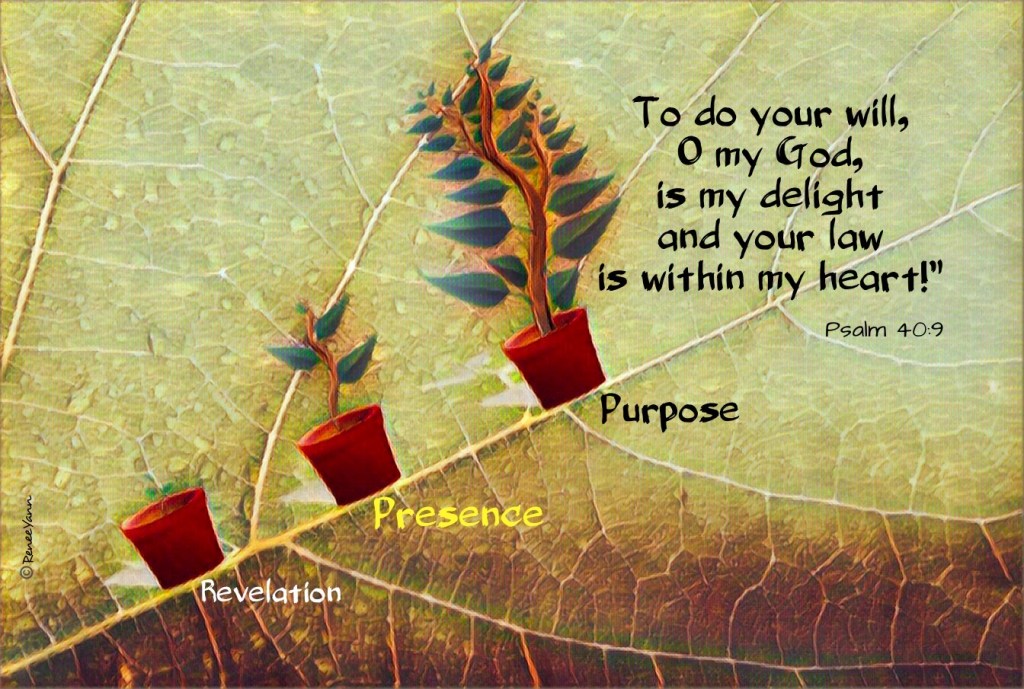
Today, in God’s Lavish Mercy, our readings lead us through an evolution of grace from:
Revelation to Presence to Purpose
How simply charming yet powerful is the wonderful story of Samuel’s call! We can picture the tousled-hair boy sleeping near the Ark of the Covenant, youthfully unaware of his awesome surroundings.
God’s voice insists into Samuel’s unawareness, finally capturing his attention after four tries.
Oil painting on canvas, The Calling of Samuel by Sir Joshua Reynolds PRA (Plympton 1723 – London 1792), circa 1770-6. A half-length portrait of a young boy, turned to the left, gazing upwards, his right hand outstretched, wearing a loose brown cloak. Stormy sky.
Extraordinary Revelation
From that moment, Samuel lives fully in the Presence of the Lord:
Samuel grew up, and the LORD was with him, not permitting any word of his to be without effect. Thus all Israel from Dan to Beersheba came to know that Samuel was an accredited prophet of the LORD.
1 Samuel 3: 19-20
The Prophet Samuel – Claude Vignon
Extraordinary Presence
Mark’s Gospel narrates another call for us – the emerging call of Jesus and his mentoring of his disciples to share his sacred ministry:
Rising very early before dawn, he left and went off to a deserted place, where he prayed. Simon and those who were with him pursued him and on finding him said, “Everyone is looking for you.” He told them, “Let us go on to the nearby villages that I may preach there also. For this purpose have I come.” So he went into their synagogues, preaching and driving out demons throughout the whole of Galilee.
Mark 1: 35-39
Extraordinary Purpose
As we pray this reflection today, we may be just waking up as Samuel was. We may be slowly emerging from the desert of our sleep. Or we may be at a point in our spiritual lives where the Light is dawning on us for some other reason.
Wherever we are, let’s be aware that each “dawning” brings
a newRevelation of grace
a deeper invitation to God’s Presence
a fresh call to engage God’s Purpose for our lives
Poetry: The Collar by George Herbert (1593 – 1633) a poet, orator, and priest of the Church of England. Herbert is considered one of the great metaphysical poets. In this poem, he writes about the evolution of his desire to fully answer God’s call, symbolized in the priestly collar that he wore. The final lines remind me of Samuel’s call.
I struck the board, and cried, “No more;
I will abroad!
What? shall I ever sigh and pine?
My lines and life are free, free as the road,
Loose as the wind, as large as store.
Shall I be still in suit?
Have I no harvest but a thorn
To let me blood, and not restore
What I have lost with cordial fruit?
Sure there was wine
Before my sighs did dry it; there was corn
Before my tears did drown it.
Is the year only lost to me?
Have I no bays to crown it,
No flowers, no garlands gay? All blasted?
All wasted?
Not so, my heart; but there is fruit,
And thou hast hands.
Recover all thy sigh-blown age
On double pleasures: leave thy cold dispute
Of what is fit and not. Forsake thy cage,
Thy rope of sands,
Which petty thoughts have made, and made to thee
Good cable, to enforce and draw,
And be thy law,
While thou didst wink and wouldst not see.
Away! take heed;
I will abroad.
Call in thy death’s-head there; tie up thy fears;
He that forbears
To suit and serve his need
Deserves his load.”
But as I raved and grew more fierce and wild
At every word,
Methought I heard one calling, Child!
And I replied My Lord.
Music: God’s Calling – George Melendez
I wonder if George Herbert could have appreciated this rap song😀











 Lavish Mercy