The “Un-pearl-y” Gates?

Thirty-third Sunday in Ordinary Time
November 14, 2021

Today, in God’s Lavish Mercy, our readings offer another taste of “pre-Advent agita”. You know what I mean. Those metaphoric gates described in our readings don’t seem all the “pearly” to me! In fact, the image that comes to mind is the massive wrought iron gates of Moffat Public School when I stood before them on my first day going to kindergarten!

Well, get ready for it! In the next few weeks of readings:

  • the sun will be darkened,
  • and the moon will not give its light,
  • and the stars will be falling from the sky,
  • and the powers in the heavens will be shaken

The phrase, “In those days” becomes prelude to some scary stuff! What’s going on here?


Well, the Church Year – symbolic of the total Christian life – is coming to an end. With its closing, we are constantly reminded that this might be our last chance to get our act together before we are judged.

I always disliked these apocalyptic readings. As a child, I was frightened by them. As an adult, they don’t easily convey the kind of God Who has loved me into my maturity. But they do reveal the God of fidelity who stays with us through it all to the end.

One line from today’s reading that captures the heart? 

When you see these things happening,
know that He is near, at the gates.

There are still a lot of closed gates in my heart – places I have not yet given over fully to God. You? Same?

This reading challenges us to go to the gate, unlock it, and let our whole heart meet God who is waiting there for us, despite any fears we may harbor – even of the end-time.


Poetry: from Paradiso – Dante Allegheri

“O grace abounding and allowing me to dare
to fix my gaze on the Eternal Light,
so deep my vision was consumed in it!
I saw how it contains within its depths
all things bound in a single book by love
of which creation is the scattered leaves:
how substance, accident, and their relation
were fused in such a way that what I now
describe is but a glimmer of that Light.”


Music: Heaven’s Gate – instrumental music to pray with as we unlock our gates. 🙂

Grateful

November 10, 2021
Memorial of Saint Leo the Great, Pope and Doctor of the Church

Today, in God’s Lavish Mercy, we pray with Psalm 82 considered, by at least one Biblical scholar, to be:

“the single most important text in the entire Christian Bible.”

John Domenic Crossan, an Irish-American New Testament scholar,
historian of early Christianity, and former Catholic priest

Council of the Gods by Raphael, (Public domain, via Wikimedia Commons)

Psalm 82 best summarizes for me the character of (the early Biblical) God.
It imagines a scene in which God sits among the gods and goddesses in divine council.
Those pagan gods and goddesses are dethroned not just because they are pagan,
nor because they are other, nor because they are competition.
They are dethroned for injustice, for divine malpractice, for transcendental malfeasance.
They are rejected because they do not demand and effect justice among the peoples of the earth.
And that justice is spelled out as protecting the poor from the rich,
protecting the systemically weak from the systemically powerful.

excerpts from Crossan: The Birth of Christianity

Rise up, O God, bring judgment to the earth.
Defend the lowly and the fatherless;
    render justice to the afflicted and the destitute.
Rescue the lowly and the poor;
    from the hand of the wicked deliver them.
Psalm 82: 3-4


In today’s Gospel, we encounter this just and supreme God in the person of Jesus when we witness the cure of the ten lepers.  

You know, it would be startling enough to run into one leper on your daily walk, right?  But TEN! That must have been an astounding situation. And to see those sad, disfigured people restored to wholeness must have been nearly overwhelming for the entourage accompanying Jesus.

Can you imagine that the recipients of such a miracle wouldn’t have clung in gratitude to Jesus for the rest of their days??? But, wow, only one even bothered to say “Thank you”.

What might have kept the other nine away,
locked in their blind ingratitude?

Perhaps it’s not such a mystery if we allow ourselves to examine our own often ungrateful hearts. We don’t necessarily mean to be boorish in the face of God’s kindness and the generosity of others, but we sometimes suffer from …

  1. Distraction: our lives are filled with frenetic activity which causes our blessings to flit by us into dizzying forgetfulness
  2. Entitlement: we think we deserve or have earned those blessings
  3. Self-absorption: we are so wrapped up in ourselves that we don’t even notice that our whole life is a gift
  4. Laziness: we might say thanks if we get around to it. But we never get around to it.
  5. Unresolved anger: we’re mad that we even needed help
  6. Non-intentionality: we fail to live with intention and reflection, thus missing the opportunities for gratitude 
  7. Pride: we are too proud to acknowledge that we need anything
  8. Fear: we are afraid something will be required of us in return for the gift
  9. Spiritual blindness: we just don’t see the nurturing power of God and others in our life

It’s likely that our nine ungrateful lepers had these human frailties. But don’t be thinking about them, or your acquaintances who share their failings.  

Let’s think about ourselves and how we want to be more grateful. Let’s think about our omnipotent God who is always Justice and Mercy.

The story is a powerful wake-up call to do better than the poor lepers did by living this prayer:

May I live humbly and gratefully today.


Poetry: The Ten Lepers – by Rosanna Eleanor (Mullins) Leprohon who was both a poet and novelist. Born in Montreal in 1829, Rosanna Mullins was educated at the convent of the Congregation of Notre Dame.

’Neath the olives of Samaria, in far-famed Galilee,
Where dark green vines are mirrored in a placid silver sea,
’Mid scenes of tranquil beauty, glowing sun-sets, rosy dawn,
The Master and disciples to the city journeyed on.

And, as they neared a valley where a sheltered hamlet lay,
A strange, portentous wailing made them pause upon their way—
Voices fraught with anguish, telling of aching heart and brow,
Which kept moaning: “Jesus, Master, have mercy on us now!”

Softly raised the gentle Saviour His eyes like midnight star,
And His mournful gaze soon rested on ten lepers, who, afar,
Stood motionless and suppliant, in sackcloth rudely clothed,
Poor Pariahs! by their nearest, their dearest, shunned and loathed.

Not unto Him prayed vainly those sore afflicted ten,
No! He yearned too fondly over the erring sons of men,
Even sharing in their sorrows, though He joined not in their feasts,—
So He kindly told the Lepers: “Show yourselves unto the priests.”

When, miracle of mercy! as they turned them to obey,
And towards the Holy Temple quickly took their hopeful way,
Lo! the hideous scales fell off them, health’s fountains were unsealed,
Their skin grew soft as infant’s—their leprosy was healed.

O man! so oft an ingrate, to thy thankless nature true,
Thyself see in those Lepers, who did as thou dost do;
Nine went their way rejoicing, healed in body—glad in soul—
Nor once thought of returning thanks to Him who made them whole.

One only, a Samaritan, a stranger to God’s word,
Felt his joyous, panting bosom, with gratitude deep stirred,
And without delay he hastened, in the dust, at Jesus’ feet,
To cast himself in worship, in thanksgiving, warm and meet.

Slowly questioned him the Saviour, with majesty divine:—
“Ten were cleansed from their leprosy—where are the other nine?
Is there none but this one stranger—unlearned in Gods ways,
His name and mighty power, to give word of thanks or praise?”

The sunbeams’ quivering glories softly touched that God-like head,
The olives blooming round Him sweet shade and fragrance shed,
While o’er His sacred features a tender sadness stole:
“Rise, go thy way,” He murmured, “thy faith hath made thee whole!”


Music:  Hymn of Grateful Praise – Folliott S. Pierpoint

God Knows My Truth

November 8, 2021
Monday of the Thirty-second Week in Ordinary Time

Today, in God’s Lavish Mercy, we pray with the comforting yet challenging Psalm 139, a prayer of awareness, intimacy, and trust.

O LORD, you have probed me and you know me;
    you know when I sit and when I stand;
    you understand my thoughts from afar.
My journeys and my rest you scrutinize,
    with all my ways you are familiar.

Psalm 139:1-3

The thought that God knows us so intimately might be both assuring and/or scary — depending on how we know and understand ourselves. The psalmist describes an overwhelming wonder at the thought of God’s closeness:

Even before a word is on my tongue,
    behold, O LORD, you know the whole of it.
Behind me and before, you hem me in
    and rest your hand upon me.
Such knowledge is too wonderful for me;
    too lofty for me to attain.

Psalm 139:4-6

As we pray Psalm 139, the awe settles into a deep awareness that God’s penetrating Presence in our spirits is ever beneficent and merciful. We pray to yield to its Love and seek its Wisdom.

Where can I go from your spirit?
    From your presence where can I flee?
If I go up to the heavens, you are there;
    if I sink to the nether world, you are present there.
If I take the wings of the dawn,
    if I settle at the farthest limits of the sea,
Even there your hand shall guide me,
    and your right hand hold me fast.

Psalm 139:7-10

On this 32nd Monday, we begin a week of readings from the Book of Wisdom. Written in the century surrounding the birth of Christ, Wisdom is the work of a poet, theologian, philosopher, and moralist. 

Today’s passage alerts us, as does our Gospel, that holding God’s Presence within us, we must live lives that bear it witness:

For wisdom is a kindly spirit,
yet she acquits not blasphemers of their guilty lips;
Because God is the witness of the inmost self
and the sure observer of the heart
and the listener to the tongue.
For the Spirit of the Lord fills the world,
is all-embracing, and knows what the person truly bespeaks by their lives.

Wisdom 1:6-7

A millstone at someone’s feet …

For as our Gospel tells us today:

Jesus said to his disciples,
“Things that cause sin will inevitably occur,
but woe to the one through whom they occur.  
It would be better to have a millstone hung around the neck
and be thrown into the sea
than to cause one of these little ones to sin.”

Luke 17:1-2

Poetry: Wisdom – Tagore

The small wisdom 
is like water in a glass:
clear, transparent, pure.

The great wisdom 
is like the water in the sea:
dark, mysterious, impenetrable.

Music: The Perfect Wisdom of Our God – The Gettys

Be Generous Stewards

November 6, 2021
Saturday of the Thirty-first Week in Ordinary Time 

Today, in God’s Lavish Mercy, we pray with Psalm 145, the only psalm to be designated as “praise” in its superscription: A psalm of praise. Of David.

This is an intriguing psalm to be chosen for today’s readings which, at first glance, have little to do with “praise”.


Our reading from Romans is the closing chapter of Paul’s letter in which is listed a catalogue of early Christians movers and shakers. The names are of influential and generous people who joined Paul and used their resources to foster the Gospel. They were the stewards of our nascent faith and are accorded a timeless memorial in the epistle’s final chapter.(Notably, many of them are women who obviously played significant roles in the blossoming of the early Church.)


In our Gospel, Jesus explains the parable about the dishonest steward. The steward has been accused of squandering his master’s goods and is about to be fired. In order to rectify accounts, the steward rewrites customer receipts, balancing with his own commissions. That way, his master doesn’t prosecute him and his customers like him enough to consider him for the job he now needs.

The parable is about how to use our wealth of blessings in order to respond to God’s goodness to us. By our generosity for others, we also serve God.


So how does Psalm 145 fit in? When the core attitude of our life is one of thanksgiving and praise:

  1. we have the insight to recognize our true wealth, the blessings God has given us

Every day will I bless you,
and I will praise your name forever and ever.
Great is the LORD and highly to be praised;
Whose greatness is unsearchable.

2. we look to our ancestors in faith as inspiration for generosity (people like those of 

Romans 16)

Generation after generation praises your works
and proclaims your might.
They speak of the splendor of your glorious majesty
and tell of your wondrous works.

3. we draw grace from their example and from the eternal beauty of Creation

Let all your works give you thanks, O LORD,
and let your faithful ones bless you.
Let them discourse of the glory of your Reign
and speak of your power.


Poetry: Hymns for the Amusement of Children – Hymn 21. Generosity by Christopher Smart, 1722 – 1771) a talented and controversial English religious poet. 

Christopher Smart’s poetry is notable for its visionary power, Christian ardor, and lyrical virtuosity from The Poetry Foundation: https://www.poetryfoundation.org/poets/christopher-smart

That vast communicative Mind, 
That form'd the world and human kind, 
And saw that all was right; 
Or was Thyself, or came from Thee, 
Stupendous Generosity, 
Above all lustre bright.
 
" Not for themselves the bees prepare 
" Their honey, and the fleecy care, 
" Not for themselves are shorn: 
" Not for themselves the warblers build, 
" Not for themselves the lands are till'd, 
" By them that tread the corn." 

The Lord shed on the Holy Rood 
His infinitely gen'rous blood, 
Not for himself, but all; 
Yea e'en for them that pierc'd his side, 
In patient agony he died, 
To remedy the Fall. 

O highly rais'd above the ranks 
Of Angels — he cou'd e'en give thanks 
Self-rais'd, and self-renew'd — 
Then who can praise, and love, and fear 
Enough? — since he himself, 'tis clear, 
Is also Gratitude.

Music: Generous Giver – Vintage Worship

Paid in Full

November 5, 2021
Friday of the Thirty-first Week in Ordinary Time

Today, in God’s Lavish Mercy, we pray with Psalm 98, a beautiful hymn celebrating God’s munificence.

Our readings are about spiritual wealth, stewardship and Godly generosity.

Paul starts us off by proclaiming that the wealth/riches of salvation belong to ALL humanity. He presents himself as a unique “steward “ of those riches to the Gentiles.

Thus I aspire to proclaim the Gospel
not where Christ has already been named,
so that I do not build on another’s foundation,
but as it is written:

    Those who have never been told of him shall see,
    and those who have never heard of him shall understand.

Romans 15:21

Our Gospel gives us a second interpretation of “stewardship” in the parable the wily steward. This fella’ gets called on the carpet for squandering his employer’s resources. Pink slip time! 

So the steward calls in some of the debtors and reduces their debt by the amount of his own commission. By doing this, he hopes to make some friends to support him in his impending unemployment.


Talbots

Many years ago, there was a Talbot’s outlet in the Franklin Mills Mall in Northeast Philly (I know. Heaven, right?) You could get an amazing deal on the clearance items. But you got an even better deal if you went to a certain cashier for your checkout.

He was a tall, flamboyant and loudly funny guy. If a price tag was missing on an item, you got it virtually for free. He would make outlandish comments like, “Oh, honey, this isn’t your color so let’s discount it 50%.” If you bought two of the same item, he might announce,”Two for one today”, charging for only one. He was a living example of the Biblical steward! Over time, he developed a devoted buying community – those who had learned the secret of why people waited in his long line!


In today’s parable, Jesus isn’t advocating that we cheat our employers. The parable isn’t really about that at all. It is about the way he wants his disciples to be profligate in preaching the mercy of God.

Remember that this parable comes in between two blockbusters about Mercy – the Prodigal Son and Lazarus and the Rich Man. In a way, you might say Jesus is on a tear about the unbounded generosity of God in forgiveness and hope for us. Jesus makes clear that the wealth of Divine Love is delivered to us by our unbounded Christian love for one another.


So today, maybe we can think about the Talbot’s guy. We have been abundantly blessed by God’s love for us. Let’s pay it forward over and over today… and every day. Let’s generously share the infinite discount of Mercy.


Poetry: Mercy – by Charles Mackay, (1814 – 1889), a Scottish poet, journalist, author, anthologist, novelist, and songwriter.

A little stream had lost its way
Amid the grass and fern;
A passing stranger scooped a well,
Where weary men might turn;
He walled it in and hung with care
A ladle at the brink;
He thought not of the deed he did,
But judged that all might drink.
He passed again, and lo! the well,
By summer never dried,
Had cooled ten thousand parching tongues,
And saved a life beside.

A nameless man, amid a crowd
That thronged the daily mart,
Let fall a word of hope and love,
Unstudied, from the heart;
A whisper on the tumult thrown,
A transitory breath–
It raised a brother from the dust,
It saved a soul from death.
O germ! O fount! O word of love!
O thought at random cast!
Ye were but little at the first, But mighty at the last.


Music: Jesus Paid It All – Elvira M. Hall (1865) This rendition of the hymn by Kristian Stanfill (born 1983) is so interesting. Offered here with modern instrumentation, the words date back to the era of the US Civil War. Past and present meld in the ever eternal love God has for us. An original version is below in case you’d like to compare the music. i think both are beautiful.

The Heart of Love

October 31, 2021
Thirty-first Sunday in Ordinary Time

Today, in God’s Lavish Mercy, we pray with beautiful Psalm 18:

I love you, O LORD, my strength,
    O LORD, my rock, my fortress, my deliverer.
R. I love you, Lord, my strength.
My God, my rock of refuge,
    my shield, the horn of my salvation, my stronghold!

Psalm 18: 2-3

In our readings, both Deuteronomy and Mark proclaim the call to love God wholeheartedly.

In Mark, it is one of the scribes who initiates this proclamation by asking Jesus which is the first – most important – of the commandments. Unlike many of Jesus’ encounters with the scribes and Pharisees, this one does not seem hostile. The man, as one might expect of an expert in the Law, wants to know if Jesus continues the priorities of the Torah. 

One of the scribes came to Jesus and asked him,
“Which is the first of all the commandments?” 

Mark 12:28

He is pleased with Jesus’ answer. And Jesus is pleased with him. We can almost see Christ’s smile at the scribe’s sincere and lived response. 

Jesus replied, “The first is this:
Hear, O Israel!
The Lord our God is Lord alone!
You shall love the Lord your God with all your heart,
with all your soul, 
with all your mind,
and with all your strength.
The second is this:
You shall love your neighbor as yourself.
There is no other commandment greater than these.” 
The scribe said to him, “Well said, teacher.

Mark 12: 29-31

This man sees through the Pharisaical confusions which have been heaped upon this most important law. He understands that love of God and neighbor mean infinitely more than burnt offerings and public sacrifices.


How do we reach this wholehearted love in our complex lives? We’re not busy with burnt offerings, but we are distracted by so many forces that lay claim to our attention and devotion. 

We love many worthy and unworthy things in our lives. We often confuse real love with one of its masquerading forms – “loves” that are self-serving rather than other-serving.

Today’s Alleluia verse is an answer to our, “How?”.

Whoever loves me
will keep my word, says the Lord;
and my father will love him
and we will come to him.

John 14:23

Real love is proved by action. It’s that simple.
What do my actions say about where my heart is?
Let me just flip back through my last 24 hours
to see if God would have smiled at my choices, words, and actions.
And let me change what I need to change for tomorrow.


Poetry: from Rumi

Last night I learned how to be a lover of God,
To live in this world and call nothing my own.

I looked inward
And the beauty of my own emptiness
filled me till dawn.
It enveloped me like a mine of rubies.
Its hue clothed me in red silk.

Within the cavern of my soul
I heard the voice of a lover crying,
“Drink now! Drink now!”—

I took a sip and saw the vast ocean— 
Wave upon wave caressed my soul. 
The lovers of God dance around 
And the circle of their steps
becomes a ring of fire round my neck.

Heaven calls me with its rain and thunder—
a hundred thousand cries
yet I cannot hear…..

All I hear is the call of my Beloved.


Music: V’Ahavta- Marty Goetz

V’Ahavta is part of the Shema Yisrael (שְׁמַע יִשְׂרָאֵל)- a prayer that serves as a centerpiece of the morning and evening Jewish prayer services.

Our Tender God

October 25, 2021
Monday of the Thirtieth Week in Ordinary Time

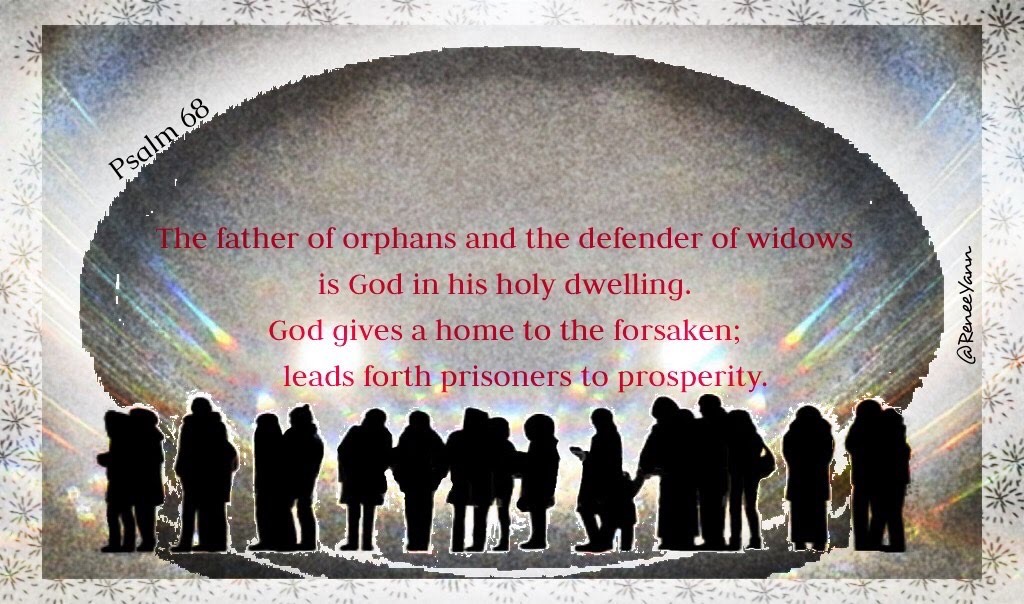
Today, in God’s Lavish Mercy, we pray with Psalm 68 which pictures a triumphant God, rising like the sun over the darkness of evil.

Arise, O God, and let your enemies be scattered;
let those who hate you flee.
Let them vanish like smoke when the wind drives it away; 
as the wax melts at the fire,
so let the wicked perish at your presence.

Psalm 68: 1-3

This psalm comforts us with a tender picture of God:

Protector of orphans, defender of widows,
the One who dwells in holiness,
who gives the solitary a home
and brings forth prisoners into freedom;
but the rebels shall live in dry places.

Psalm 68: 5-6

It is the same tenderness Paul presents in our first reading:

For those who are led by the Spirit of God are children of God.
For you did not receive a spirit of slavery to fall back into fear,
but you received a spirit of adoption,
through which we cry, “Abba, Father!”
The Spirit bears witness with our spirit
that we are children of God,
and if children, then heirs,
heirs of God and joint heirs with Christ…

if only we suffer with him
so that we may also be glorified with him.

And there we have the key line:
we are to live a life aligned with
the Passion, Death, and Resurrection of Christ.

And what will that kind of life look like? It will look like our merciful Jesus of today’s Gospel – who stepped out to see, comfort, and heal the suffering around him.

Jesus recognized the crippled woman as “an heir of God, and joint heir with him” to the fullness of life in God. We are called recognize ourselves and all of our sisters and brothers in the same way.


Poetry: WOMAN UN-BENT (LUKE 13:10–17) – by Irene Zimmerman, OSF

That Sabbath day as always
she went to the synagogue
and took the place assigned her
right behind the grill where,
the elders had concurred,
she would block no one’s view,
she could lean her heavy head,
and (though this was not said)
she’d give a good example to
the ones who stood behind her. 

That day, intent as always
on the Word (for eighteen years
she’d listened thus), she heard
Authority when Jesus spoke. 

Though long stripped
of forwardness,
she came forward, nonetheless,
when Jesus summoned her.
“Woman, you are free
of your infirmity,” he said. 

The leader of the synagogue
worked himself into a sweat
as he tried to bend the Sabbath
and the woman back in place. 

But she stood up straight and let
God’s glory touch her face.

Video: Jesus Heals the Bent-over Woman

If you’d still like a little music, this one seems to fit: Spirit Touch by Joseph Akins

Zap?

October 23, 2021
Saturday of the Twenty-ninth Week in Ordinary Time

Today, in God’s Lavish Mercy, we pray with Psalm 24 in which the psalmist expresses the heart’s deep longing for God:

Who can ascend the mountain of the LORD?
    or who may stand in that holy place?
The one whose hands are sinless, whose heart is clean,
    who desires not what is vain.
Who shall receive a blessing from the LORD,
    a reward from God the savior.
Such is the race that seeks for God,
    that seeks the face of the God of Jacob.

Psalm 24: 5-6

But achieving those sinless hands and clean heart is not always an easy task. It takes a life focused on faith and rooted in love.

Jesus talks about that focus in today’s Gospel.

Jesus gives us a parable which, at first, appears to say, “Get your act together fast, or God might zap you.” From Jesus’s words, we can assume that some public disasters have recently occurred. Those in the gathered crowd are unnerved by these events.

Jesus uses that nervousness to talk about repentance. He tells the people that tragedy can make us wake up to the fact that life is fragile and fleeting. That awareness should make us want to use our time on earth well, to give glory to God.

The repentance Jesus encourages is not just a contrition, or turning from sin. It is an opening of the soul’s eyes to see our lives and circumstances as God sees them.

Is God going to zap us if we don’t have that kind of repentance? No, I think not.

God is always Mercy …
always, always Mercy.

With the parable of the fruitless fig tree, Jesus assures us that God is with us, giving us every grace and opportunity to bear spiritual fruit. God is patient and nurturing. But, in every human life, there is a limit to the time we have to respond.


Poetry: The Facts of Life – Pádraig Ó Tuama

That you were born
and you will die.

That you will sometimes love enough
and sometimes not.

That you will lie
if only to yourself.

That you will get tired.

That you will learn most from the situations
you did not choose.

That there will be some things that move you
more than you can say.

That you will live
that you must be loved.

That you will avoid questions most urgently in need of
your attention.

That you began as the fusion of a sperm and an egg
of two people who once were strangers
and may well still be.

That life isn’t fair.
That life is sometimes good
and sometimes better than good.

That life is often not so good.

That life is real
and if you can survive it, well,
survive it well
with love
and art
and meaning given
where meaning’s scarce.

That you will learn to live with regret.
That you will learn to live with respect.

That the structures that constrict you
may not be permanently constricting.

That you will probably be okay.

That you must accept change
before you die
but you will die anyway.

So you might as well live
and you might as well love.
You might as well love.


Music: Calm the Soul – Poor Clares Galway

A Free and Obedient Heart

October 20, 2021
Wednesday of the Twenty-ninth Week in Ordinary Time

Today, in God’s Lavish Mercy,  we pray with Psalm 124, a dramatic psalm stretched between early desperation and ultimate freedom.

In the psalmist’s prayer, Israel is called to realize that it has narrowly escaped from a mortal danger, never specified, but only alluded to in phrases such as:

  • would have swallowed us alive
  • fury was inflamed against us
  • waters have overwhelmed us
  • torrent swept over us
  • swept over by the raging waters
  • not leave us a prey to their teeth

This is some serious trouble! And because of this blessed escape, the community is called to a life of freely given service and praise.


In our readings, Paul and Jesus both instruct and challenge their listeners and us to a similar response for all the graces we have received – especially being rescued from sin in the life-saving waters of Baptism.

Paul wants us to understand that, through our Baptism, we are living in a whole new power for goodness and grace. The world may look the same as it did before we belonged to Christ, but it isn’t. 

To use a phrase from the poet Gerard Manley Hopkins:

The world is charged with the grandeur of God.
It will flame out, like shining from shook foil;

If we see with the new eyes of grace, we will be able to respond to Jesus’s challenge:

Stay awake!
For you do not know
when the Son of Man will come.

Stay awake. See the world and life as they truly are  – places where God awaits us in every moment. This is the amazing power we have received through our Baptism!

So let’s open our hearts to listen lovingly to the sound of the Holy Spirit in our lives. That freed and obedient heart is precious to God, and is the catalyst to a transformed life!


Poetry: Song for Autumn – Mary Oliver

In the deep fall
don’t you imagine the leaves think how
comfortable it will be to touch
the earth instead of the
nothingness of air and the endless
freshets of wind? And don’t you think
the trees themselves, especially those with mossy,
warm caves, begin to think
of the birds that will come — six, a dozen — to sleep
inside their bodies? And don’t you hear
the goldenrod whispering goodbye,
the everlasting being crowned with the first
tuffets of snow? The pond
vanishes, and the white field over which
the fox runs so quickly brings out
its blue shadows. And the wind pumps its
bellows. And at evening especially,
the piled firewood shifts a little,
longing to be on its way.

Music:  Speak, O Lord – Kristyn Getty

Seeking and Waiting

October 19, 2021
Memorial of Saints John de Brébeuf and Isaac Jogues, Priests, and Companions, Martyrs

Today, in God’s Lavish Mercy,  we pray with Psalm 40 in which the psalmist prays for all who seek God and faithfully wait on God’s salvation:

May all who seek you
    exult and be glad in you,
And may those who love your salvation
    say ever, “The LORD be glorified.”

Psalm 40:17

Luke’s Gospel describes the expectant fidelity God gives us and desires from us. In other words, God waits for us too!

The master of the house was away on a long journey. Likely he would have tried to return home in daylight, because the ancient roads were dark and menacing at night. Perhaps the evening meal was already prepared in anticipation of his arrival. But he does not appear over the distant rise where all the household’s eyes are trained.


You know how they waited. You’ve waited for loved ones coming home in bad weather. You’ve waited for beloved holiday guests when flights are delayed or traffic is snarled.

You watch for headlights cresting down the far road. You listen for the sound of a car door closing. Minutes seem like hours. The perfectly prepared meal cools, and your energy slackens as you pick at the olives and breadsticks.


Sometimes our prayer life feels like that. We do all the things necessary to welcome God’s grace, but instead we feel distant from the Divine Presence. We long for God’s warm blessing over the feast of our life, but God tarries somewhere at the other edge of our hope.  We feel like these Gospel servants who wait, exhausted, even into the early morning hours.

But we don’t give up. Our hope remains steadfast because God has promised. And it is in that fidelity that our eyes are opened to realize that God had been present all along — just not looking as we had expected.

It turns out that God is the One who had been waiting… waiting for us to see.


Poetry: Waiting by Leza Lowitz

You keep waiting for something to happen,
the thing that lifts you out of yourself,

catapults you into doing all the things you've put off
the great things you're meant to do in your life,

but somehow never quite get to.
You keep waiting for the planets to shift

the new moon to bring news,
the universe to align, something to give.

Meanwhile, the pile of papers, the laundry, the dishes, the job –
it all stacks up while you keep hoping

for some miracle to blast down upon you,
scattering the piles to the winds.

Sometimes you lie in bed, terrified of your life.
Sometimes you laugh at the privilege of waking.

But all the while, life goes on in its messy way.
And then you turn forty. Or fifty. Or sixty...

and some part of you realizes you are not alone
and you find signs of this in the animal kingdom

when a snake sheds its skin its eyes glaze over,
it slinks under a rock, not wanting to be touched,

and when caterpillar turns to butterfly
if the pupa is brushed, it will die –

and when the bird taps its beak hungrily against the egg
it's because the thing is too small, too small,

and it needs to break out.
And midlife walks you into that wisdom

that this is what transformation looks like –
the mess of it, the tapping at the walls of your life,

the yearning and writhing and pushing,
until one day, one day

you emerge from the wreck
embracing both the immense dawn

and the dusk of the body,
glistening, beautiful

just as you are.

Music: A country tune today, maybe overly simple. But I find some country music has a profound nugget of truth buried in the twang. I hope you can enjoy it.

He Was There All the Time ~ Gary S. Paxton