Say But the Word

Memorial of Saints Cornelius, Pope, and Cyprian, Bishop, Martyrs

Monday, September 16, 2019

Click here for readings

Today, in Mercy, both our readings today offer us pivotal lessons about what nourishes true leadership: faith, humility, generosity, and inclusivity.

Many of us have been blessed, especially in our young lives, with the gift of wise and loving mentors. Certainly our parents, families and teachers are among the first and most critical.

A little later, our circle of mentors widens. We look for great coaches, wise employers, guiding trainers, caring councilors, trusted friends.

Paul’s letters to Timothy and Titus are biblical examples of such mentorship. In them, the author is guiding young ministers in the art and science of loving, Christ-like leadership.

Key to such leadership in today’s reading is a steadfast commitment to prayer which covers, blesses and includes all people.

In our Gospel, the centurion demonstrates that he is a leader who values these virtues.

The Jews urging Jesus to visit the centurion say that he deserves Christ’s attention because “he loves our nation and he built the synagogue for us.

 My guess is that Jesus wasn’t impelled by this argument, but solely by his splancha – his merciful gut response to the man’s plea.

When the centurion enters the story, his humility is immediately evident: 

Lord, do not trouble yourself,
for I am not worthy to have you enter under my roof.
Therefore, I did not consider myself worthy to come to you;
but say the word and let my servant be healed.

The miracle healing, of course, is granted but that is not the most important part of the story.

!Tim2_5 bridgeJPG

This civil leader’s acknowledgement of Christ’s sovereignty is an act of faith which serves as a model for all of us – to the extent that millennia later we echo his prayer as we prepare to receive Christ in communion.

His is a faith that places Christ at the center of all Creation, commanding the flow of grace and mercy to all creatures. That faith allows the centurion to care even for a suffering servant. It allowed him to support the worship even of a dominated people.

Timothy and Titus have shown that kind of faith. They are the next generation who will carry Christ’s legacy passed to them by Paul. He wants them to understand that humility, largeness of heart, kindness and steadfastness open the way for God’s life-giving will for all people.

Whether, in our current life state, we are leader, or protégé, or both, how do these readings help us to make a clearer way for God in the world? That’s what real leadership is all about. And, as Paul says, we learn it in prayer.

Video: a representation of Luke’s version of this Gospel story:

Faith of Centurion

A Prodigal Love

Twenty-fourth Sunday in Ordinary Time

September 15, 2019

Click here for readings

Today, in Mercy, Numbers tells a story of Moses’ intervention to save the people from God’s wrath. It is a story of God’s relenting … a theme which repeats itself endlessly in the Hebrew Scriptures.

This is the way we sometimes characterize the astonishment of Grace – God’s overwhelming passion to love and forgive us over and over. We just can’t imagine such mercy, such infinite generative love!

And so we imagine instead that Moses made God do it!😉 Yeah, I don’t think so.

We imagine that God cannot tolerate our sinful pursuits because we cannot tolerate them in ourselves or in others. But God is mercy, forgiveness, reconciliation, wholeness, love. God can’t help loving us!

Of course, we shouldn’t be stupid and take advantage of the divine largesse… not because it would hurt God, but because it so damages us and limits our capacity for wholeness. But nevertheless, whether we’re stupid or not, God will always welcome us home.

A few days ago, we prayed with the word splancha – that “gut love” that so describes God’s passion for us. We find the word again today in the heart-wrenching parable of the Prodigal Son.

prodigal son

You know the story. Near the end, as the devastated son returns seeking mercy…

While he was still a long way off,
his father caught sight of him,
and was filled with compassion — with splancha – esplanchnisthē
Luke 15:20

Our God is a Love that is filled, overflowing – with no room for retribution or condemnation.

Indeed, our God, like the Prodigal Father, is soft-hearted, an easy mark, a pushover for our sincere repentance, trust, and hope. Our God would bleed for us!

This short but powerful scene from George Balanchine’s ballet, Prodigal Son, may inspire our prayer today. The father is steadfast, a monolith of strength and love. The son is broken, naked in his desperation. Let their magnetic reunion take you to God’s heart. Let God wrap you too in the mantle of Love for any hurt or emptiness that is within you.

George Balanchine “Prodigal Son” – Final Scene (Son- Barishnikov)


Claude Debussy also wrote a beautiful piece on this parable. If you have a contemplative space sometime this week, you may want to listen to Debussy’s moving opera (with my all-time fav Ms. Jessye Norman.)

Click here for full opera

If you have only a little time, do try this – short, and oh so beautiful!

Music: Debussy The Prodigal Son – Prelude

A Plank in the Eye

Memorial of Saint John Chrysostom, Bishop and Doctor of the Church

Friday, September 13, 2010

Click here for readings

Today, in Mercy, Paul, seeing himself as he really is, gives thanks and praise for his unmerited salvation.

Paul says this:

I was once a blasphemer and a persecutor and an arrogant man,
but I have been mercifully treated
because I acted out of ignorance in my unbelief.
Indeed, the grace of our Lord has been abundant,
along with the faith and love that are in Christ Jesus.

God has also granted me the gift of unmerited salvation. You too, my friends. But everybody’s story is a little different. So I thought a bit today about what I might fill in for those bolded words above. (And you can be sure I’m not going to tell you!😂) You might want to do the same in your prayer today.

In our Gospel, Jesus confronts those who think they are, not beneath, but above redemption and salvation. It’s beautiful: he nails the nitpickers who see the flaws in everyone but themselves.

How can you say to your brother,
‘Brother, let me remove that splinter in your eye,’
when you do not even notice the wooden beam in your own eye?
You hypocrite!  Remove the wooden beam from your eye first;
then you will see clearly
to remove the splinter in your brother’s eye.

IMG_0799Luke6_41 beam

It’s always been one of my favorite passages. But do you know why? It’s because the beam in my own eye probably has prevented me from seeing that the passage is about me!🥺

Music: Only Takes a Moment – Cory Asbury

Remembering Our Way Home…

Wednesday of the Twenty-third Week in Ordinary Time

September 11, 2019

Click here for readings

Today, in Mercy, the world will remember the abomination of the 9/11 attacks when nearly 3000 innocent lives were sacrificed to hatred, vengeance, and cowardice.

Some will remember in anger; some in forgiveness. Some will remember in grief; some in triumph. Some will remember with a will to seek peace; some with a drive to wreak endless retribution. Some with unquenchable sorrow; some with a false and self-destructive pride.

Some, too jaded by the years of savagery since then, will remember the day with despair.

Some, too young to remember at all, will simply try to grow up in the fragmented world it has left them.

Tragically, some throughout the world are so devastated by their own sufferings that there is no energy to remember. Some have endured war and oppression for so long that there is no peace to remember.

We in the human family were not created to live like this. 

Col3_4 christ appears

Paul tells us that we …

… were raised with Christ, so seek what is above,
where Christ is seated at the right hand of God.
Think of what is above, not of what is on earth.
For you have died, and your life is hidden with Christ in God.
When Christ your life appears,
then you too will appear with him in glory.

Jesus tells us that when that glory comes, it will be these who appear with him..

Blessed are you who are poor,
for the Kingdom of God is yours.
Blessed are you who are now hungry,
for you will be satisfied.
Blessed are you who are now weeping,
for you will laugh.
Blessed are you when people hate you,
and when they exclude and insult you,
and denounce your name as evil
on account of the Son of Man.
“Rejoice and leap for joy on that day!
Behold, your reward will be great in heaven.

On this anniversary of the 9/11 attacks, and on every day of our lives, we have a choice of how we will see the world, of how we will love or hate, embrace or exclude our sisters and brothers. Every day, we have choices to make about how we will allow, ignore, or stand against hate, division, oppression and indifference to human suffering.

We may think our power is small to change the world. But it is the only power we have or need. With those graced and intentional choices we…

… have taken off the old self with its practices
and have put on the new self,
which is being renewed, for knowledge,
in the image of its Creator.

Today, as we remember, let us also be excruciatingly aware of those who continue to suffer … at the world’s hard borders, in the Bahamas, Syria, Yemen, Rakhine, and in every place where abusive domination and greedy indifference crushes innocent life.

Music: When We Go Home, We Go Together- Pure Heart Ensemble 

All That Is Withered

Memorial of Saint Peter Claver, Priest

September 9, 2019

Click here for readings

Today, in Mercy, Paul and Jesus share a similar situation.

Paul is imprisoned in Rome. Visited by Epaphras, a citizen of Colossae, Paul seizes the chance to write to these Christians whom he has never seen in person. Paul tells the Colossians that his singular intention is to preach the truth of the Gospel so that they, and all the world, may be transformed in Christ.

to bring to completion for you the word of God,
the mystery hidden from ages and from generations past.

That “mystery” is the nature of God as Love, only fleetingly accessible before its full revelation in the Person of Jesus Christ.

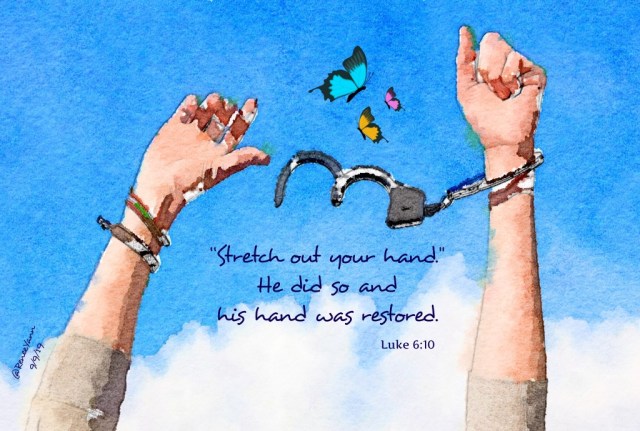
Luke6_10 withered hand

Jesus too, in today’s Gospel, is in a sort of prison. The prison consists of the entrenched resistance of people like the Pharisees. They are so entangled in the deceitful and self- serving interpretation of Law that they are blind to the revelation before them. They wait to pounce on Jesus if, contrary to the laws of the Sabbath, he heals a man’s withered hand.

Jesus tries logic in today’s account:

Then Jesus said to them,
“I ask you, is it lawful to do good on the sabbath
rather than to do evil,
to save life rather than to destroy it?”

Unable to resist the logic, the Pharisees retreat to anger. They begin to plot the removal of this Truth they cannot counter. The saddest part of these resistances is that they estrange the resisters from their own good, from their own freedom, from their own salvation.

In our world, we see so many places closed off to the Mystery of Love.  We see people imprisoning themselves in their own resistance and hate while they plot to build barriers against others. We see it in our geo-political world, in our Church, in our workplaces, in ourselves.

It takes courage to recognize and turn from such self-destructive fixations. We must be alert and brave to cooperate with our own transformation in grace.

This is why Paul writes of …

the great struggle I am having for you
and for those in Laodicea
and all who have not seen me face to face,
that their hearts may be encouraged
as they are brought together in love,
to have all the richness of assured understanding,
for the knowledge of the mystery of God, Christ,
in whom are hidden all the treasures of wisdom and knowledge.

This is why God continues to offer grace in the gift of Jesus Christ, healing all that is “withered” in us when we lift it up in faith.

Music: God Will Make a Way – Dan Moen

God is a Sliding Board!

Saturday of the Twenty-second Week in Ordinary Time

September 7, 2019

Click here for readings

Today, in Mercy,  Paul references some pretty mean-spirited Colossians:

You once were alienated and hostile in mind
because of evil deeds.

Whoa! Where did these meanies come from amid all the blessed populace?
They must have been nice to be around!

All of us have been in the presence of such off-kilter people. They seem all twisted in their own negativity and judgmentalism. There is no joy in them, no warmth, no kindness. Unhappily, we may even have such a person at times.

Paul is clear on the cure for such ill-temper:

  • Reconciliation through a persevering faith
  • Stability in hope, grounded the Gospel

If you have ever used a GPS device while driving, you have probably had the same experience as I have. At least five annoying times per journey, the gal is my dashboard shouts:

Recalculating route!

Paul says that with our reconciliation through the Passion, Death and Resurrection of Jesus, there is no need to recalculate. As our Responsorial Psalm tells us:

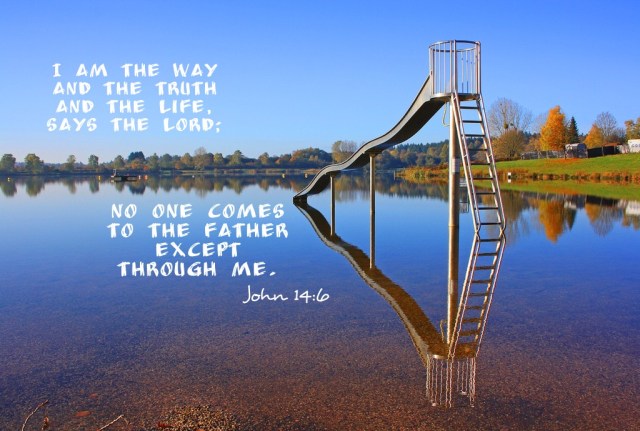
I am the way and the truth and the life, says the Lord;
no one comes to the Father except through me.

Once again in our Gospel, the Pharisees try to distract from the clarity of Jesus’ message. They worry about the tiniest grains rather than the Radiant Truth in their midst. They keep trying to recalculate a route through their circuitous laws rather than opening their hearts to the Way.

It’s easy to get infected with such running around in circles. The bigness of God can be scary. We sometimes make up useless curves to avoid God’s awesomeness.

Jn14_6slide

Indeed, God is a sliding board with no handrails! But, Paul assures us that we are riding it in Christ’s arms.

Music: I Am the Way, the Truth and the Life – Bob Hurd

Big Prayers

Thursday of the Twenty-second Week in Ordinary Time

September 5, 2019

Click here for readings

Today, in Mercy, Jesus and Paul teach us how to pray for one another.

I like to call it “gifting prayer” because it is, indeed, a generous offering we give to others.


Little Prayers

little prayers

I sometimes pray for simple things – that a family member wins the lottery, or it doesn’t rain on a friend’s wedding.

And I pray for consequential things – improved health for a neighbor, safety for travelers, deliverance from disaster.

These prayers are rooted in the wish for material improvement. But there is a deeper kind of prayer that we can offer.


The Big Prayer

Gifting Prayer is a wide halo of love and hope we generate
by our desire for someone else’s eternal good – for their holiness.

This kind of prayer is much bigger than the small prayers we say for others. 

Paul describes what such prayer should ask for – that our beloved:

  • be filled with the knowledge of God’s will
  • gain all spiritual wisdom and understanding
  • walk in a manner worthy of the Lord
  • be fully pleasing, in every good work 
  • bear fruit and grow in the knowledge of God,
  • be strengthened with all endurance and patience,
  • and give thanks, with joy, to the Father for the gift of faith

Now THAT’S a prayer!


Gospel Clues

Jesus, in today’s Gospel, gives us a clue about how to pray such a prayer. He says that it’s kind of like catching fish. The Gospel fishermen have labored all night with no results. Sometimes our prayer feels like that, doesn’t it?

Lk5_4 nets

Jesus says no matter. Keep on fishing – keep on praying. Shift perspective a little bit “to the other side of the boat” – to God’s way of seeing good for those we pray for.

Ask for God to do what God deems best. This attitude in prayer opens us to divine possibilities. It hopefully brings unimagined resolutions to those we pray for.

Put out into deep water and lower your nets for a catch…
…When they had done this, they caught so great a number of fish
that their nets were bursting.

Let God burst the tight net by which we might define our prayer. Let’s be amazed by all that God desires to give us beyond our small wishes.

Music: Trust His Heart – Babbie Mason

Don’t Take It for Granted

Wednesday of the Twenty-second Week in Ordinary Time

September 4, 2019

Click here for readings

Today, in Mercy,  we begin a little over a week of readings from Colossians. Paul loves this community in a way similar to the Thessalonians. The Colossians’ faith has been tested and has proven true.

But Paul wants to protect their faith because it is being newly tested by a round of heresies and social challenges.

The words of these scriptures want to protect and direct us too.

We, like the people in today’s Gospel, are familiar with Jesus. But familiarity can breed things not so obvious as contempt. It can breed indifference, ingratitude, unexamined expectations, taking our blessings for granted. (Examination of Conscience Alert!!)

col1_6

Both Colossians and Luke today encourage us to recognize the unparalleled gift of our faith – to protect, nurture, rejoice in and share it.

Just as in the whole world
the Gospel is bearing fruit and growing,

so also among you,
from the day you heard it
and came to know
the grace of God in truth.

Music: Bless Our God – John Foley (Lyrics below) Just a beautiful song — I love it!

You’re Invited – (and so is everyone else)

Twenty-second Sunday in Ordinary Time

September 1, 2019

Click here for readings

Today, in Mercy, our readings share the common theme of humility, instructing us that the virtue is essential to our salvation.

Lk14_11 humbled

Humility, of course, gets a bad rap in our dominating, “me” culture. We tend to think of humiliation, servitude, inelegance rather than the actual root of the word: humus -“of the earth”.

I was fascinated last week by a small fracas arising from the unconsidered remarks of one of our Phillies baseball players. The team has been running hot and cold – with a little bit too much cold for some fans. The famous Philly “boos” have been flying. Frustrated with these, outfielder Sean Rodriguez referred to the disgruntled fans as “entitled”. 

angry

Uh oh! They didn’t like that. We prefer to think of ourselves as “deserving “, right?

Humility is that virtue which helps us realize that we are not “entitled” or “deserving” of anything over and above other human beings. It roots us in the respect for each other that refuses to rank the worth of other human beings. 

The social leverage that comes from wealth, power, and influence can beguile us. We become lost in a maze of stereotypes, rankings and prejudices which are the foundation of social injustice.


We hear among ourselves justifying phrases for our entitlement like:

  • well, I earned what I have
  • at least I paid for it
  • “they” need to work if they want to have …(food, healthcare, housing…)
  • it’s their own fault for … (dropping out of school, taking drugs, ….)
  • that’s just the way it is in “those” countries. The people are …(lazy, stupid, violent …)
  • “they” don’t need what I need. “They” are used to being … (poor, disabled, sick …)

And probably the most dangerous of all the phrases:

  • it’s not my problem
  • I’m not the one exiling, bombing, blocking, trafficking, enslaving “them”

Today’s readings enjoin us: it is my problem. My attitude, choices, vote, conversation, and lifestyle matter at the banquet of life we are all meant to share.

My intention to humbly join and rejoice with all Creation, to take a seat beside and never above my sister and brother – this is my “entitlement” to the one banquet that matters.

When you hold a banquet,
invite the poor, the crippled, the lame, the blind;
blessed indeed will you be because of their inability to repay you.
For you will be repaid at the resurrection of the righteous.

Music:  A Place at the Table – Lori True and Shirley Elena Murray

Faithful Monica

Memorial of Saint Monica

Tuesday, August 27, 2019

Click here for readings

Today, in Mercy, we celebrate St. Monica, mother of St. Augustine of Hippo.

Monica
Santa Monica e Sant’Agostino by Giuseppe Riva (This work is in the public domain n its country of origin and other countries and areas where the copyright is the author’s life plus 100 years or less.)

Monica had a difficult life, burdened by an autocratic pagan husband. She was forbidden to have her children baptized. Augustine worried her deeply because he developed into a wayward and lazy young man. Eventually he was wooed by the Manichaean heresy which denied Christ as God. This was too much for Monica. She asked him to leave her house.

But Monica continued for seventeen years to pray for and encourage Augustine to return to a faithful, moral life. Finally through the influence of St. Ambrose, Augustine was converted.

How many mothers and fathers, friends and spouses have prayed like this for someone they love? How many of us have had a “lost sheep” right in the center of our family but beyond its touch?

Monica’s great love and faithful devotion to her son are reminiscent of Paul’s love for his Thessalonian flock:

… we were gentle among you,
as a nursing mother cares for her children.
With such affection for you, we were determined to share with you
not only the Gospel of God, but our very selves as well,
so dearly beloved had you become to us.

This is the way God loves us and draws us to himself. It is the way that we, who carry God’s love in the world, must be with one another.

Our Gospel gives us another example of how disgusted Jesus is with those who pretend the “exteriors” of faith but on the inside are “blind hypocrites… full of plunder and self-indulgence”.

Instead, we need a faith like Monica’s, humble and generous but at the same time tenacious and persevering in seeking good.

Music: Give Me the Faith Which Can Remove – written by Charles Wesley, younger brother of John Wesley, founder of Methodism