Today, in Mercy, we celebrate St. Monica, mother of St. Augustine of Hippo.
Santa Monica e Sant’Agostino by Giuseppe Riva (This work is in the public domain n its country of origin and other countries and areas where the copyright is the author’s life plus 100 years or less.)
Monica had a difficult life, burdened by an autocratic pagan husband. She was forbidden to have her children baptized. Augustine worried her deeply because he developed into a wayward and lazy young man. Eventually he was wooed by the Manichaean heresy which denied Christ as God. This was too much for Monica. She asked him to leave her house.
But Monica continued for seventeen years to pray for and encourage Augustine to return to a faithful, moral life. Finally through the influence of St. Ambrose, Augustine was converted.
How many mothers and fathers, friends and spouses have prayed like this for someone they love? How many of us have had a “lost sheep” right in the center of our family but beyond its touch?
Monica’s great love and faithful devotion to her son are reminiscent of Paul’s love for his Thessalonian flock:
… we were gentle among you, as a nursing mother cares for her children. With such affection for you, we were determined to share with you not only the Gospel of God, but our very selves as well, so dearly beloved had you become to us.
This is the way God loves us and draws us to himself. It is the way that we, who carry God’s love in the world, must be with one another.
Our Gospel gives us another example of how disgusted Jesus is with those who pretend the “exteriors” of faith but on the inside are “blind hypocrites… full of plunder and self-indulgence”.
Instead, we need a faith like Monica’s, humble and generous but at the same time tenacious and persevering in seeking good.
Music: Give Me the Faith Which Can Remove – written by Charles Wesley, younger brother of John Wesley, founder of Methodism
Today, in Mercy, we begin eight days of Thessalonians, coupled with the final section of Matthew’s Gospel before the Passion, Death and Resurrection narrative.
First Thessalonians is a love note, a thank you note. In it, Paul speaks to the community with great affection and gratitude because they have caught fire with the Gospel he shared with them.
Paul’s words carry the loving, grateful voice of God to us who also try, with all our hearts, to give ourselves to the Gospel.
In today’s Gospel, Matthew gives us the sad counterpoint to Paul’s joy. Jesus thunders woe over the Pharisees who, unlike the Thessalonians, smother the ardent message he offers them.
They bind. They control. They peddle a religion rooted in parsimonious law rather than generous freedom. They promote a system that sustains their privilege.
Jesus tells us that Pharisaical religion sucks the soul from people, binding them in a self-serving, spiritless law – where power and material prosperity supersede truth, loving community, and sincere worship.
In Paul’s words, God blesses and thanks us for our true faith which – by generosity, hope, love, sacrifice and hopeful endurance – builds the Community of God.
Throughout history, some people have used the scripture to justify the kind of pharisaical selfishness bewailed in today’s Gospel. They isolate and demonize other human beings by the deceitful turning of the holy Word. They are clever and convincing. They appeal to our rationality rather than our souls.
Today’s readings remind us to take great care in discerning the Spirit. We will never find Her where there is no love, mercy, kindness, freedom, forgiveness, and joy.
Music: one of my favorite hymns. Though from Ephesians, it carries the same message as our reading from Thessalonians today. I pray this prayer for all of you, dear friends.
Ephesians 1 – by Suzanne Toolan, RSM
Blessed be the God and Father of our Lord Jesus Christ.
In him we were chosen to live through love in his light.
That is why I never cease to give thanks to God for you.
And pray that the God of our Lord Jesus Christ
will grant you the Spirit of wisdom
and knowledge of himself
that you may glory, glory in his goodness.
Today, in Mercy, I thank God that we have gotten to the Book of Ruth. The wars and subterfuges of the Judges we’re sorely testing me!😂 But the beautiful story of Ruth and Naomi, familiar and beloved, offers us a more spontaneous inspiration for prayer.
Naomi’s husband and only two sons have died. Her only remaining family are her two daughters-in-law, Ruth and Orpha. Naomi, resigning herself to a lonely death, urges these two young women to return to their kinsmen and begin new lives. Orpha acquiesces.
Ruth Swearing Allegiance to Naomi by Jans Victor (1619-1676)
But Ruth abides. Together, she and her mother-in-law return to Bethlehem, Naomi’s homeland. There, by her humble and steadfast work to support Naomi, Ruth attracts the love and admiration of Boaz, whom she eventually marries.
On the surface, and appropriately, we may read the story to be about Naomi and Ruth, their response to devastating bereavement, and their ultimate, fruitful devotion to each other.
However, on a deeper level, we may see Naomi as a symbol of suffering and need, and Ruth as an icon of God. In that manner of reading:
God suffers our diminishments with us
God refuses to abandon us
God accompanies us to a new understanding of ourselves
God works to feed our poverty of mind, heart and spirit
God brings our brokenness to wholeness by loving fidelity to us
What a different kind of message from Judges the Book of Ruth brings us – a tender and merciful God more like the God of the Gospel. Although the author of the Book of Ruth is unknown, some think – because of the tone and characters – that it was written by a woman. I like that thought.
May our prayer today take us to the place where God abides with us in any suffering or spiritual longing we hold. May God’s faithful companionship heal and transform us. May God’s song of fidelity thrill, delight and sustain us. May we return it with generosity and joy.
Music: Covenant Song – Rory Cooney and Gary Daigle (Lyrics below)
Wherever you go, I will follow, Wherever you live is my home.
Though days be of blessing or sorrow, though house be of canvas or stone,
Though Eden be lost to the past, though mountains before us be vast,
Wherever you go, I am with you. I never will leave you alone.
Whatever you dream, I am with you, when stars call your name in the night Though shadows and mist cloud the future,
together we bear there a light. Like Abram and Sarah we stand, with only a promise in hand. But lead where you dream: I will follow. To dream with you is my delight.
And though you should fall, you will find me, when no other friend can you claim,
when foes beat you down or betray you, and others desert you in shame.
When home and dreams aren’t enough, and you run away from my love,
I’ll raise you from where you have fallen. Faithful to you is my name.
Wherever you die, I will be there to sing you to sleep with a psalm,
to soothe you with tales our journey, your fears and your doubts I will calm.
We’ll live when journeys are done forever in mem’ry as one.
And we will be buried together, and awaken to greet a new dawn.
Wherever you go, I will follow. Behold! The horizon shines clear.
The possible gleams like a city: together we’ve nothing to fear.
So speak with words bold and true the message my heart speaks to you.
You won’t be alone, I have promised. Wherever you go, I am here.
Today, in Mercy, our readings are about possessions – in every sense of that word.
In today’s reading from Judges, the first of a few this week, we see Israel in the years between entering the Promised Land to the rise of Saul as king. During these four hundred years, a series of judges tries to keep Israel on track with God. It is a frustrating assignment!
As today’s passage describes, the Israelites get caught in an endlessly repeating cycle:
worship false gods
get zapped by true God
feel really bad, say sorry
be forgiven
repeat cycle
Hmm! I’ve seen this pattern somewhere before. Oh, yeah! It’s just like the one describing all my good intentions that never quite materialized!
Many of us can identify with the rich young man in the Gospel. We want to take our relationship with God up a notch. We would like to be better, holier people. But we may also, like the young man, like the ancient Israelites, be caught in a cycle of behaviors and choices which inhibit us.
Jesus tells this young man to get rid of his possessions, freeing him to really follow Jesus.
What possesses us, holding us back from that radical following?
It is not always material goods. They are easy to identify and dispatch. It is our tightly held and hidden illusions, resentments, prejudices, assumptions, entitlements, fears, jealousies, disappointments, angers. These are the heavy chains that cling to us as we try to move deeper into God.
May we be inspired by Matthew’s young man to recognize and break through the cycles that bind us by hearing God’s invitation to wholeness – an invitation always deep within our life circumstances.
Today, in Mercy, we have a few slightly complex readings. But, as with all Sunday lectionary choices, they are strung together by a single theme.
Upon first reading, we might think that theme is FAITH since the word is mentioned at least eight times. And, indeed, “faith” is the foundation of these readings – the faith of Abraham, Isaac, Jacob, the Desert Jews, the disciples, and the new Christian community.
It is the testimony of this ancient and enduring faith that encourages us to be ready, as Jesus says in today’s Gospel:
Do not be afraid any longer, little flock, for your Father is pleased to give you the kingdom.
This phrase of Jesus reveals another, deeper, theme: courageous hope.
How awesome that God, in covenant with God’s People, could keep alive – for 400 years- the hope of salvation! How miraculous that these ordinary farmers, milkmaids, herdsman, and shepherds could sustain their hope through numerous generations!
Today’s readings are sending us this message:
Be courageous! You are the Bearer of Hope
to this generation!
It may seem in our world, and in our individual lives, that God tarries beyond tolerance in answering our hope – for peace, civility, equality, security, goodness.But we must remember that with God there is no time. God is already responding within the long fidelity of our hope. (Our clocks and Apple watches just are obscuring our view. 😉)
That faithful hope creates the space for charity. And charity is the human face of Divine Love already Abiding.
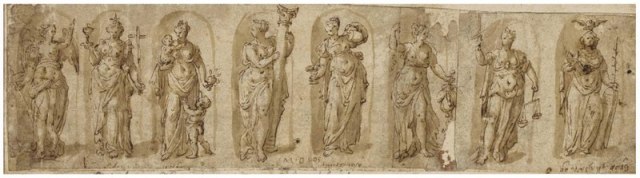
Faith, Hope, and Charity – the theological virtues (Remember that from your Baltimore Catechism?).
The Theological and Cardinal Virtues with Wisdom: Hope, Faith, Charity, Fortitude, Temperance, Liberality, Justice and Sapientia by Maarten de Vos (1532-1603)
These virtues are the foundation of the spiritual life. Contemporary theology ties these irrevocably to the virtue of justice – the seeking of right relationship in all Creation.
Anselm Min, Professor of Religion at Claremont Graduate University, has edited a powerful book on this subject. (Unfortunately, now out print and thus hugely expensive). One reviewer of the book, Lameck Banda, Professor at Justo Mwale University in Lusaka, Zambia, offers this insight into Min’s collection:
“The running thread throughout this book is that, whichever way the contemporary culture may seek to view and treat faith, hope, and love, the ultimate goal of these virtues is to radically and comprehensively address issues which tend to undermine the agenda of justice.”
That summary in itself gave me a lot to think and pray about. I hope it inspires you as well. God bless your Sunday!
Music: Hymn of Hope from The Secret Garden by Rolf Lovland
Today, in Mercy, our readings are connected by two often oppositional themes: BARGAINING and TRUST.
The Genesis passage is a familiar story, mainly because “Mrs. Lot” later gets turned into a pillar of salt. But the beginning of the story, today’s reading, is all about Moses bargaining with God to spare the inhabitants of sinful Sodom and Gomorrah.
The Divine conversation is painted in very human terms, a ping-pong match of “what if”s and “OK”s between Moses and God. Moses finally bargains God down to the hope of finding just ten good men in these depraved cities. And Moses trusts God to be merciful, a trust delivered in the salvation of Lot and his family.
In the second reading from Colossians, Paul reminds us of our own deliverance through baptism and sharing in the Resurrection of Christ. This is the infinite gift in which we put our hope and trust as believers.
Our Gospel reading from Luke opens with the Our Father, the ultimate prayer of trust. Jesus goes on to tell us that we can always trust God’s care for us.
Ask and you will receive; seek and you will find; knock and the door will be opened to you. For everyone who asks, receives; and the one who seeks, finds; and to the one who knocks, the door will be opened.
Jesus isn’t talking about magic, where we just say the word and automatically get what we imagined, or where we bargain with God as if we had something to offer.
Jesus is talking about that fundamental trust which believes in God’s faithfulness to us in all circumstances. He will not “hand us a serpent when we ask for an egg”. But it may be a very different “egg” (outcome) from the one we expected. Trust allows us to crack it open to find the unimagined grace inside.
Today, in Mercy, our Exodus reading coincides perfectly with today’s Memorial Feast for Anne and Joachim, grandparents of Jesus.
In the passage, we have one of many Old Testament formulations of the Ten Commandments. We learned these codes as children, and perhaps have always interpreted them as laws which, when broken, marked us as sinners.
While this is one approach, a more mature and life-giving one is offered by the Biblical scholar Terence E. Fretheim:
The focus (of these directives) is on
protecting the health of the community, to which end the individual plays such an important role. Exodus: Interpretation: A Biblical Commentary for Teaching and Preaching
The command to honor one’s father and mother clearly demonstrates this approach. It is a command not only for children to be docile and obedient. Rather it denotes a life-long responsibility to care for parents and other nurturers of our lives. The command also suggests the responsibility of these nurturers to live honorably so that their children may respond to their example with equal honor.
Today is a day to pray for our own families and for all families, for the young and the elderly, and for those walking the tenuous bridge in between.It is a day to assess how well we carry our responsibilities to honor, obey, bless and foster life for one another.
It is a day to be deeply grateful for the love of family which we are blessed to experience; a day to pray for healing for those not equally blessed. Let us pray for families distressed by the necessity to migrate, and further burdened by nations’ failures to keep the commandment of neighborly love.
Like Mary, may we embrace the elders in our lives who love and need us, be these parents, mentors, community members, or neighbors. Scripture promises us that, in doing so, we shall have “mercy bestowed on us down to the thousandth generation.”
( I am republishing last year’s post for this feast. I think it is worth another read. But to make up for my little bit of laziness, I will send another post today with a few profound quotes from Henri Nouwen’s book Can You Drink the Cup? – Ave Maria Press; 10th Anniversary edition (October 1, 2012))
Today, in Mercy, we learn a lesson in humble leadership, thanks to “Mrs. Zebedee”. Our Gospel recounts the story of the mother of James and John interceding for her sons with Jesus. Like many overprotective mothers, she intervenes in their adult lives. She wants to make sure they get the best deal for their investment with Jesus.
Veronese-Le-Christ-Rencontrant La Femme Et Les Fils de Zebedee By Paolo Veronese
Unfortunately, “Mrs. Zebedee” has missed the whole point of Christian discipleship. Her boys have decided to follow a man who says things like this:
The last shall be first and the first, last.
Unless you lay down your life, you cannot follow me.
Whoever takes the lowly position of a child is the greatest in the Kingdom of Heaven.
The seats at Christ’s right and left, which she requests for her sons, will bring them rewards only through humility and sacrificial service.
Jesus is gentle with “Mrs. Zebedee”. He understands how hard it is for any of us to comprehend the hidden glory of a deeply Christian life. We are surrounded by a world that screams the opposite to us:
Me first!
Stand your ground!
Good guys finish last!
So Jesus turns to James and John. One can imagine the bemused look on his face. He knows the hearts of these two men. He knows they have already given themselves to him. So he asks them for a confession of faith, “Can you drink the cup that I will drink?”
Their humble, faith-filled answer no doubt stuns their mother. She is left in wonder at the holy men her sons have become. Perhaps it is the beginning of her own deep conversion to Christ.
As we pray with this passage on the feast of St. James the Apostle, where do find ourselves in this scene? How immediate, sincere, and complete is our response to Jesus’ question: “Can you drink the cup….?”
Music: Can You Drink the Cup? (Be patient. The song has a slightly delayed start. You may have to click the white arrowhead in the orange circle- upper left. Lyrics below.😀)
Can You Drink The Cup?
Lyrics by Pamela Martin, Music by Craig Courtney
Copyright 2001, Beckenhorst Press, Inc.
Can you dring the cup,
embrace it in your hands?
Can you look inside
and face what it demands?
In the wine you see
reflections of your soul.
No one else can drink
this cup that you must hold.
Can you drink the cup?
Then you must lift it high
though this cup of joy
holds pain and sacrifice.
When you lift your cup,
raise it unafraid.
Lift it up, this cup
of life, and celebrate.
Can you drink the cup
until there is no more?
When the wine is gone,
Christ Himself will pour.
Though you drink it all
the cup is never dry,
God keeps filling it
with everlasting life.
Today, in Mercy, our readings are an interplay of trust and fear, just like most of our lives are.
The TV character Adrian Monk is the exaggerated personification of our human fears. You name it, he’s afraid of it. Most of us aren’t that bad off, thank God. But we all have fears at times, and maybe life-long ones.
We might entertain conquerable anxieties like fear of water, or public speaking, or heights. These limits to our courage can be stretched by lessons and practice.
But the deeper fears, like those central to today’s readings, are radically existential and perhaps never fully conquerable. These might include fear of meaninglessness, loneliness, diminishment, and death.
Joseph’s brothers handle their doubts by straight-talking with him. They trust his assurances. Joseph addresses his concerns about burial by pressing a promise from these same brothers.
In our Gospel, Jesus tells us how to deal with our deepest worries and fears. He assures us that no one or nothing can break the insoluble bond of love God has for us. He promises that we will endure eternally within this love. He reminds us that, ultimately, this is the only thing that matters.
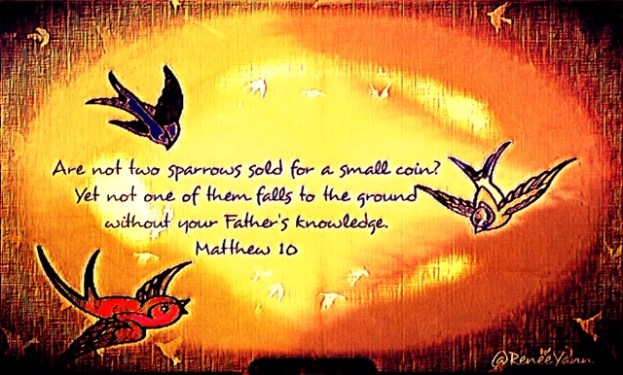
The image of the free and unfettered sparrow shows us how God wants us to live and enjoy our creaturehood. The image of a loving God, brushing our hair and counting every one of them, may inspire us to deeper trust as we pray today.
You may be familiar with the trusting phrase attributed to Julian of Norwich:
“All shall be well,
and all manner of thing shall be well.”
Actually, it was Jesus who spoke the word to her in a vision:
“But Jesus, who in this vision informed me of all that is needed by me, answered with these words and said: ‘It is true that sin is cause of all this pain, but all shall be well, and all shall be well, and all manner of thing shall be well.’
“These words were said most tenderly, showing no manner of blame to me nor to any who shall be saved.”
Indeed, we will meet the results of sin and darkness in the world and in ourselves. Julian grew to understand that, in God’s love, we are saved from that darkness:
And from the time that [the vision] was shown, I desired often to know what our Lord’s meaning was. And fifteen years and more afterward I was answered in my spiritual understanding, thus: ‘Would you know your Lord’s meaning in this thing? Know it well, love was his meaning. Who showed it to you? Love. What did he show you? Love. Why did he show it? For love. Keep yourself therein and you shall know and understand more in the same. But you shall never know nor understand any other thing, forever.’
Thus I was taught that love was our Lord’s meaning. And I saw quite clearly in this and in all, that before God made us, he loved us, which love was never slaked nor ever shall be. And in this love he has done all his work, and in this love he has made all things profitable to us. And in this love our life is everlasting. In our creation we had a beginning. But the love wherein he made us was in him with no beginning. And all this shall be seen in God without end …
Music: All Shall Be Well – Kathleen Deignan (Lyrics below)
All shall be well and all manner of thing shall be well.
Receive the gift of healing
from the well of tears;
be washed anew
by grief and sorrowing.
Receive the gift of healing
from our mother Earth,
her deep and dark
and secret verdancy.
Receive the gift of healing
from the shaman’s touch:
the wounded healer’s power
to revive.
Receive the gift of healing
in the arms of love,
embraced in passion
and compassioning.
Today, in Mercy, we come to the heart of the Jacob story. Through prayer, it may reveal the heart of our story too.
Think of this. Is there anything better than a true friend who, even in your worst isolation, says:
I’ve got your back.
I’m right here at your side.
I’m with you through it all.
This is who God promises to be for Jacob in today’s wonderful first reading.
Trickster Jacob, banished and fleeing from His enraged brother, falls asleep on the vast plain, with only a rock for his pillow. He is on a journey between two lives – the old one of extreme conflict, and a new one, as yet unrevealed. When he falls asleep on this desolate night, he thinks he journeys alone.
Ever feel like that? In life, we make many small and big journeys from the old to the new, the comfortable to the challenging, the past to the future, the known to the unknown. Sometimes we make choices to leave a “life” behind. Sometimes, life makes the choice in spite of us. In many of these chosen or unchosen transitions, we may feel very alone, even abandoned.
The good news of today’s reading is that God thinks otherwise.
Know that I am with you; I will protect you wherever you go, and bring you back to (wholeness). I will never leave you until I have done what I promised you.
In today’s Gospel, Jesus realizes this same ancient promise in the lives of two people on painful journeys.
He heals the hemorrhaging woman through just her trusting fingertip along his garment’s hem. Such is the awesome power of faith and promise!
He raises new life in a dying child by the reach of her father’s faith into the heart of God’s mercy.
God is with each one of us too – unequivocally. God’s Mercy is everywhere and always.
Jacob responds to God’s promise with faith and hope. So do the Gospel’s centurion and suffering woman. Each of them, in their particular journey, shows us how to welcome God’s promise, “I am with you.” All we need do is to be with God too.








 Lavish Mercy