Today, in Mercy, our readings pour out the lavish mercy of God. Our prayer invites us bask in that warmth and understanding.
The prophet Micah asks,
“Who is there like You … the God who delights in clemency?”
Our Psalm reminds us that “the Lord is kind and merciful”:
For as the heavens are high above the earth, so surpassing is his kindness toward those who fear him. As far as the east is from the west, so far has he put our transgressions from us.
(Two musical selections today.)
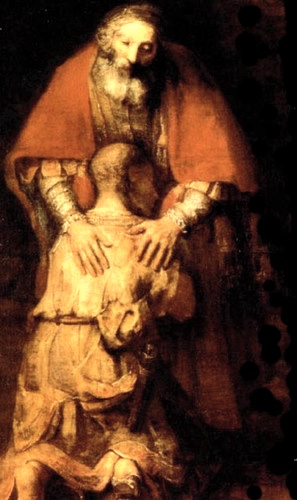
Then Jesus tells us the tender parable of the Prodigal Son, which is really more about the Merciful Father. He receives his contrite child in the same way that God receives us in our repentance.
Sometimes we become so content with ourselves that we fail to realize our need for contrition. Sometimes our failures are buried so deep and so long in us that we become blind to them. Repentance is the grace to break through that blindness.
We were created to be an image of the merciful God we meet in today’s scripture. Where we are short of that in our actions, words, choices and attitudes – that’s where we have need of repentance.
Rembrandt’s magnificent painting captures a sacred feeling that might help our prayer. Sometimes we are the gracious Father – loving, forgiving, hoping and working for life in others. Sometimes we are the son, returning from our own destructive selfishness to seek a new beginning. Sometimes we are a little bit of each.
Today, in Mercy, our Gospel gives us the disturbing parable of the rich man, sometimes called Dives, and Lazarus, a very poor man.
The story is disturbing because
Lazarus suffers so desperately
Dives is impervious to that suffering
God won’t give Dives a break after his death
We fear being in either of these guys’ situations
Probably, like most people, we’d rather be rich than poor. But would we rather be generous with that wealth or selfish? Do we ever find ourselves thinking thoughts like this, deciding we’re not responsible for the gap between rich and poor:
“I worked hard for what I have. Let everybody else do the same!”
That wealth gap cannot be mended simply by giving a dollar to a corner beggar nor by donating our wornout clothes to Goodwill. This kind of re-balancing requires a conversion of heart which touches our economic, political and moral understanding.
I was struck this morning by this headline from The Economist, a British weekly magazine.
How can today’s Gospel inspire and encourage us in a global culture that infcreasingly marginalizes persons who are poor, resourceless, and politically oppressed?
May the story of Lazarus and Dives influence us to use the powers we have to make just and generous decisions.
We can vote for just, generous and moral leaders.
We can advocate for universally just policies.
We can donate to compassionate causes.
We can confront hateful speech and stereotyping.
We can speak and act for justice, peace, inclusivity and mercy.
We just have to be courageous before, like Dives, it is too late for us.
Today, in Mercy, our Gospel tells the story of Mrs. Zebedee, who sought a prejudiced advantage for her two disciple sons.
Jesus said to her, “What do you wish?” She answered him, “Command that these two sons of mine sit, one at your right and the other at your left, in your kingdom.”
Sounds a little like something ripped from today’s headlines, doesn’t it.
There is a natural inclination to advantage those we love. But when we do so to the unjust disadvantage of others, that’s a problem.
We know from experience that people use various points of leverage to gain advantage in life. We see people use money, power, political connections, and other influences to get a job, choose a school, land an important invitation, get a traffic ticket written off, etc., etc. Maybe, on occasion, we are one of those people.
Today’s Gospel teaches us a lesson. In gaining such advantage, we may, as Jesus says, “not know what we are asking for”. Can we actually DO the job, succeed in the school, … become a better person by what we have maniputively gained?
The Gospel also brings before us the “other people” who lost the right to what we unjustly claimed. How do they begin to see us? What do we lose in respect and mutuality within our community? How do we begin to see ourselves in relationship to justice, honesty, sincerity and truth?
Jesus hopes that we will love every person to the extent that we want her/his just advantage as much as we want our own? That is the “cup” He drinks through his Passion and Death.
Let us ponder Jesus’s question to us: Can you drink the cup that I will drink?
Today, in Mercy, Jesus tells us to take it up a notch. It’s not good enough, he says, not to kill people.
You have heard that it was said to your ancestors, You shall not kill; and whoever kills will be liable to judgment. But I say to you …
When we first read this, we might think we’re pretty safe. After all, how many of us actually kill people?!?!
But let’s check that, Jesus says:
Don’t remain angry with your sister/brother
Don’t call them“empty head” (raqa)
Don’t call them fools
Jesus seems to be telling us that there are many ways to kill!
We can kill the possibility of relationship by our unresolved angers, grudges, sustained hatred of people.
We can kill hope in someone by labeling them stupid or foolish.
We can easily kill someone’s reputation by a false or injudicious word.
We can kill joy by our indifference.
We can kill love with ingratitude.
We can kill innocence with any of the seven deadly sins
It takes vigorous spiritual attention to live at the level Jesus is asking of us. Let’s give our souls that particular attention, especially during our Lenten journey.
The mnemonic has been helpful to me as an adult too. It reminds me to communicate with God only many levels, not just to ask for something. I know how I feel about someone who never talks to me unless they need something. I don’t want to be that way with God.
In our first reading, Esther prays a prayer of supplication for the deliverance of her people from death. Her prayer is not a simple, passing, “Please”. The passage tells us:
She lay prostrate upon the ground,
together with her handmaids, from morning until evening, (praying)
In our Gospel, Jesus describes the prayer of supplication :
Ask and it will be given to you; seek and you will find; knock and the door will be opened to you.
My prayers of supplication haven’t always seemed to get the results Esther got or that Jesus describes. Ever feel that way … that your prayer really hasn’t been answered?
Faith assures us that all our needs are met … even before we present them to God. God is acting in our lives whether or not we speak with God about it.
Our prayer, as it becomes deeper and truer, allows us to enter God’s action with faith, hope, love and courage. This is the perfect prayer of supplication – it allows us to float, content, in the water of God’s will always flowing around our lives.
David Foster Wallace created a parable you may have heard:
Two young fish are swimming along, and they happen to meet an older fish swimming the other way, who nods at them and says, “Morning, boys. How’s the water?” And the two young fish swim on for a bit, and then eventually one of them looks over at the other and says, “What is water?”
Foster explains, “The point of the fish story is merely that the most obvious, important realities are often the ones that are hardest to see and talk about.”
Our reality is that we exist in the “water” of God’s life and presence. May our “asking” of God lead us to understand that our life in God is already the answer.
Music: Prayer Is the Soul’s Sincere Desire – James Montgomery (1771–1854)
Montgomery wrote the lyrics at the request of Edward Bickersteth, who wanted them for his book Treatise on Prayer. Montgomery called this “the most attractive hymn I ever wrote.”
( I have included all the Lyrics below. Quite beautiful, I think.)
Prayer is the soul’s sincere desire,
Unuttered or expressed;
The motion of a hidden fire
That trembles in the breast.
Prayer is the burden of a sigh,
The falling of a tear
The upward glancing of an eye,
When none but God is near.
Prayer is the simplest form of speech
That infant lips can try;
Prayer, the sublimest strains
That reach the Majesty on high.
Prayer is the Christian’s vital breath,
The Christian’s native air,
His watchword at the gates of death;
He enters Heav’n with prayer.
Prayer is the contrite sinner’s voice,
Returning from his ways,
While angels in their songs rejoice
And cry, “Behold, he prays!”
The saints in prayer appear as one
In word, in deed, and mind,
While with the Father and the Son
Sweet fellowship they find.
Nor prayer is made on earth alone;
The Holy Spirit pleads,
And Jesus, on th’eternal throne,
For sinners intercedes.
O Thou by whom we come to God,
The life, the truth, the way,
The path of prayer Thyself hast trod:
Lord, teach us how to pray.
Today, in Mercy, the voice of the Lord, in both Leviticus and Matthew, makes one thing abundantly clear: God lives in the “least ones”, and this is where we must love and serve God.
In our first reading, God tells the people to be holy – not by offering God sacrifice and praise, but like this:
Don’t steal.
Don’t lie.
Don’t make an empty vow.
Don’t cheat.
Don’t hurt those already hurting.
Don’t make false judgments.
Don’t be prejudiced.
Don’t do nasty gossip.
Don’t ignore your neighbor’s need.
Don’t hate, take revenge on, or begrudge others.
In other words,
You shall love your neighbor as yourself.
I am the LORD.
We are so accustomed to this passage that we may miss how startling it is! God asks nothing of us for himself! God asks only that we love God through our neighbor.
In Matthew’s Gospel, Jesus reiterates this command in the form of positive actions, adding how we will be judged by it. Jesus says:
Feed the hungry.
Hydrate the thirsty.
Welcome the stranger.
Clothe the naked.
Care for the sick.
Visit the imprisoned.
We are called to these works of mercy on many levels. Certainly the call is first to the physically suffering – the homeless, the refugee, the uncared for, the abused.
But we also know from our own experience that there are all kinds of hungers and thirsts in the human heart. There is a loneliness that persists even in a crowd. There is naked fear, depression and isolation even among those otherwise warmly dressed. There are sicknesses that come from selfishness and others that come from abandonment. There are prisons without bars.
We do not have to look far to find the “least ones” whom God wishes us to love and serve.
We do not have to look far to find God. We just have to look deep.
Music: The Circle of Mercy – Jeannette Goglia, RSM
Today, in Mercy, our readings invite us to spiritual honesty with its accompanying transparency.
In a fabulous metaphor, Sirach tells us that under stress, the measure of our honesty will be evident:
When the sieve is shaken,
the husks appear.
Don’t we try to hide our weaknesses, fears, worries, and doubts? Sometimes we even hide them from ourselves! And God! But under stress, these “husks” rise to the surface and affect our behavior and interactions. Sometimes we create a life-long attitude that attempts to conceal these negativities but causes people – even ourselves – to wonder why we’re so mean, aloof, distracted or angry all the time.
Luke likens this concealment to a “plank”in our inner eye, a blindness which will not let us see ourselves as we are before God – beautiful, beloved and whole. We myopically see instead all our own and other’s annoying fragmentations.
Corinthians tells us that this kind of negative thinking is death-dealing; that it is a product of living only by law and not by spirit. Paul says:
The sting of death is sin, and the power of sin is the law. But thanks be to God who gives us the victory through our Lord Jesus Christ
These readings help us to deepen our understanding that only when we open our lives to God will we fully be open to ourselves. Then, as our Psalm explains:
The just one shall flourish like the palm tree, like a cedar of Lebanon shall they grow. They that are planted in the house of the LORD shall flourish in the courts of our God.
They shall bear fruit even in old age; vigorous and sturdy shall they be, Declaring how just is the LORD, my rock, in whom there is no wrong.
Music: O God, You search Me and You Know Me By Bernadette Farrell
Today, in Mercy, let this picture carry home the message of today’s Gospel for our time. Let us consider our moral and civic responsibilities to this child and the thousands like him throughout the world. Let us pray in the spirit of Jesus to understand what Mercy requires of us.
Enough said.
If you would like to help our Sister Anne Connolly working directly at our southern border with refugee families:
Gifts may be sent to:
Sisters of Mercy
(Please mark “Border Aid”)
c/o Sisters of Mercy-Border Aid
Development Office
515 Montgomery Avenue Merion, PA.19066
Today, in Mercy, our readings weave together the themes of
Wisdom, Law and Integrity.
Balanced in our soul, these offer the perfection of spiritual life.
Sirach instructs us that the journey to this perfection is challenging but worthwhile.
Wisdom walks with us as a stranger and at first she puts us to the test; Fear and dread she brings upon us and tries us with her discipline until she try us by her laws and trust our souls.
How beautiful this passage is! Picture Wisdom-Sophia walking with you, through your life to your present days. As young people, many of us were challenged in learning spiritual discipline – the Law of Love. Many of us are challenged still at times. But wisdom walks with us, gently testing our resolve for goodness- forgiving, instructing, redeeming, encouraging us.
Eventually, there is between us and Wisdom, as with cherished old friends, a comfort and understanding which allows us to know each other’s thoughts and completely trust each other’s good will. An integrity of goodness grows within us.
Our Psalm 119 summarizes this blessed relationship:
O Lord, great peace have they
who love your law.
In the short pericope from Mark’s Gospel, Jesus drives home to his disciples that the grace of the Holy Spirit – the power for goodness – is not confined by our restrictive definitions, expectations,, or role assignments. All hearts at one with the Law of Wisdom and Love give glory to God.
In my prayer today, I remembered with grateful love the many guides who have taught me Wisdom in my life. I rested in quiet gratitude with Wisdom, my old friend.
My prayer led me to include this quote from one of my all-time favorite books:
(P.S. What five books would you take with you if stranded on an island for the rest of your life? I’d include this one.)
Every truth is a reflection; behind the reflection and giving it value, is the Light. Every being is a witness; every fact is a divine secret; beyond them is the object of the revelation, the Wisdom witnessed to. Everything true stands out against the Infinite as against its background; is related to it; belongs to it. A particular truth may indeed occupy the stage, but there are boundless immensities beyond. One might say a particular truth is only a symbol, a symbol that is real, a sacrament of the Absolute. ~ Antonio Sertillanges, The Intellectual Life
Music: The Perfect Wisdom Of Our God – Keith & Kristyn Getty, Stuart Townend








 Lavish Mercy