Today in Mercy, we experience both Paul and Jesus praying for their followers. They each use similar words.
Paul: And now I commend you to God and to that gracious word of his that can build you up and give you the inheritance among all who are consecrated.
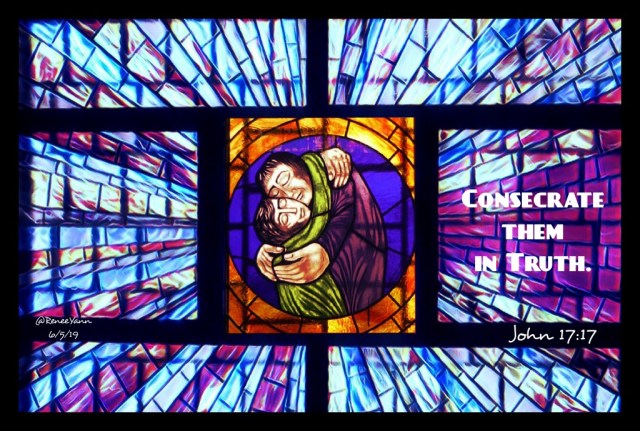
Jesus: Consecrate them in the truth. Your word is truth. As you sent me into the world, so I sent them into the world. And I consecrate myself for them, so that they also may be consecrated in truth.
Do you pray for others? To protect those you love? To change those who are bound in Spirit? To alleviate those who suffer? To awaken those that are caught in the vortex of selfishness or self-destruction? To increase the blessings of the generous?
Perhaps the greatest prayer we can offer for another is one like that of Paul and Jesus – a plea for the other to stand Blessed in the Truth of who they are in God — CONSECRATED by their Creaturehood, their Baptism, their faith, and their infinite power for Life in the Holy Spirit.
Today, we might pray like this for our Beloveds, and for those we might like to love better; for those who are unloved, and those unaware of how much they are loved.
It’s an appropriate theme at this time of weddings, graduations, retirements, house-hunting, and other temporary or final leave-takings.
Farewells are tough, aren’t they? They are an uneven mix of sadness and joy, one party often more heavily burdened than the other.
I think of the day I left home to enter the convent. I was bursting with joy, enthusiasm, curiosity and wonder. But I was woefully unaware of my parent’s profound sense of loss. It was a stunningly uneven farewell that I only came to understand in my growing maturity.
In our readings today, Paul and Jesus are poignantly aware of their farewells.
Paul says:
But now I know that none of you to whom I preached the kingdom during my travels will ever see my face again.
And Jesus says:
And now I will no longer be in the world, but (my followers) are in the world, while I am coming to the Father.
Both Paul and Jesus use their farewells to pray for their disciples, to confirm their strength, and to proclaim that their followers are ready to carry on the mission. You can almost envision these two great mentors releasing their disciples into the fullness of their own call.
Over our lifetimes, we will love and mentor many people: children, friends, students, protégés. There will come times when we must release them into new dimensions of their lives.
Sometimes we are the ones breaking forth to a new horizon, strengthened by the generous direction of those we leave behind.
In each situation, may we treasure the love that is generous enough to give new life. May we bless one another with a magnanimity like that of Jesus when He made his farewell:
I pray for you and … I will ask the Father and he will give you his Spirit to be with you always.
As I look back on that day long ago, standing with my parents at the front door of the Motherhouse, it was that kind of farewell that they unselfishly gave to me.
Today, in Mercy, our Gospel describes the Ascension of Jesus into heaven – a glorious and bittersweet moment for his disciples.
Our second reading from Ephesians is so perfectly chosen for that moment. Even though the passage is written by Paul much later, one can imagine Jesus blessing his surrounding friends with a similar prayer just as he returns to the Father.
This beautiful passage and the song accompanying it need no further words from me. Let us be with Jesus on this holy day and receive all the blessings and love he wishes to give us.
May the God of our Lord Jesus Christ, the Father of glory, give you a Spirit of wisdom and revelation resulting in knowledge of him. May the eyes of your hearts be enlightened, that you may know what is the hope that belongs to his call, what are the riches of glory in his inheritance among the holy ones, and what is the surpassing greatness of his power for us who believe…
Music: Ephesians Hymn I – Suzanne Toolan, RSM
Blessed be the God and Father of our Lord, Jesus Christ
Through him, we were chosen to live through love in his light
That is why I never cease to give thanks to God for you
And pray that the God of Our Lord, Jesus Christ
May grant you the Spirit of Wisdom and knowledge if Himself
That you may Glory, Glory in his goodness.
The discrepancy is in us – in our limited capacity to access reality on its many levels.
Like an iceberg, every story, every feeling, has an “understory” that we either miss, fear, or only incompletely comprehend.
Today, Jesus promises his faithful disciples the wondrous hope of the Holy Spirit Who, by Her profound gifts, will lead us to the depths of life in God. Descending ever more deeply into that Truth, we will see beyond the surface of our life into its sacred character. Our vision of the world, like a holy X-ray, will change radically. We will begin to see with the eyes of God.
This deepening is like a dance where the Spirit leads and we follow. By opening our eyes to each moment’s deeper truth, the Holy Spirit will invite us to live our lives in wisdom, understanding, counsel, fortitude, knowledge, piety, and awe of God.
We can sense the dance in ourselves when we see the Holy Spirit’s fruits blossom in us: charity, joy, peace, patience, kindness, goodness, generosity, gentleness, faithfulness, modesty, self-control, purity of heart.
We have all been there at moments in our lives, dear friends — on the edge of God’s immense love for us and for all Creation — a starry evening on a deserted beach; a quiet, warm room during a winter storm; a friend’s generous embrace in our sorrow; a small awareness of all the Love God has for us. Think of your own moments when the Holy Spirit longed to love you beyond yourself. Ask for a re-run!
Those readers in the northern hemisphere are close to our summer season, with the fields yielding the abundant fruit of winter’s waiting. All of us, no matter our location, await the imminent outpouring of Pentecost. It is a good time to look at our own heart’s fields, to open them the the Holy Spirit’s astounding call and companionship.
Music: Who Has Known – John Foley, SJ
This is really an Advent/Christmas hymn, but I think it works well with today’s reflection. I hope you agree. (Lyrics below)
O the depth of the riches of God;
and the breadth of the wisdom and knowledge of God!
For who has known the mind of God?
To Him be glory forever.
A virgin will carry a child and give birth,
and His name shall be called Emanuel.
For who has known the mind of God?
To Him be glory forever.
The people in darkness have seen a great light;
for a child has been born, His dominion is wide.
For who has known the mind of God?
To Him be glory forever.
Today, in Mercy, Jesus offers his good-byes as time approaches for him to return to the Father.
His friends are sad. Wouldn’t you be? What a guy to have known, and palled around with, and loved – in person! But now it’s time for Jesus to return to his role in the Blessed Trinity. And it is time for the Holy Spirit’s continuing role in the world to begin.
Jesus describes the Spirit’s role as one that will set things right by:
showing the world its mistake in rejecting Jesus
making clear that Jesus’s teaching was right and just
condemning any evil that denies Christ’s teaching
The Holy Spirit will do all this in a different way from Jesus. Jesus was beside his disciples showing them the way to live – and he still is. But the Holy Spirit in within the People of God, working through our communal love, mercy, and justice to transform all Creation.
So Jesus is telling us not to be sad. He is still with us in Scripture and Sacrament. But now our experience of being with God is enriched by the indwelling Spirit who breathes Life to the world through our faith.
What an astounding good-bye Gift! Do we appreciate it, respond to it — even realize we have received it? We are capable of so much more than a small understanding of God. Let us ask to be opened to that Power.
Today, in Mercy,Acts describes Peter in the full energy of his discipleship. The infant Church was at peace, being built up by the power of the Holy Spirit.
Peter, completely filled with this sacred power, raises a woman from the dead. He does this in the Name of Jesus to Whom he has given his entire being.
Our Gospel describes the moment of Peter’s total commitment. Some have turned away from Jesus because of his teaching on the Eucharist. Jesus asks the Twelve if they to wish to go too.
Simon Peter answered him, “Master, to whom shall we go? You have the words of eternal life. We have come to believe and are convinced that you are the Holy One of God.
At pivotal points in our faith life, Jesus asks us the same question. May we always have the strength and insight to turn toward Christ. May we pour our hearts into the welcoming love of Jesus, just as Peter did.
Music: To Whom Shall We Go – Robin and Staci Calamaio – Father and daughter team
Today, in Mercy, Acts tells us more about Stephen, who was introduced in Saturday’s reading as “a man filled with faith and the Holy Spirit”.
Stephen is among the first group of Christians designated as deacons “to serve at table” – in other words, to do the administrative tasks that kept the community whole.
However, Stephen’s gifts went well beyond these services. Acts describes him like this:
Stephen, filled with grace and power, was working great wonders and signs among the people.
This man was radiant with Holy Spirit! He had so opened his soul to God’s grace and power that he was transformed even to the point that, when indicted:
All those who sat in the Sanhedrin looked intently at him and saw that his face was like the face of an angel.
That same grace and power that fired Stephen’s spirit are available to us. In this holy Eastertide, as we await the Holy Spirit on Pentecost, let us give sincere time and intention to praying for these gifts – for ourselves, for our faith communities, our communities of love, for our leaders, for our world.
This poem by Gerard Manley Hopkins might help us picture how the Holy Spirit waits to be welcomed into our hearts and lives:
God’s Grandeur
The world is charged with the grandeur of God. It will flame out, like shining from shook foil; It gathers to a greatness, like the ooze of oil Crushed. Why do men then now not reck his rod? Generations have trod, have trod, have trod; And all is seared with trade; bleared, smeared with toil; And wears man’s smudge and shares man’s smell: the soil Is bare now, nor can foot feel, being shod.
And for all this, nature is never spent; There lives the dearest freshness deep down things; And though the last lights off the black West went Oh, morning, at the brown brink eastward, springs— Because the Holy Ghost over the bent World broods with warm breast and with ah! bright wings.
(Gerard Manley Hopkins (1844–89). Poems. 1918.)
Music: J.S.Bach – Gedenk an uns mit deiner Liebe (Think of us with your Love)
– from Cantata BWV 29 – Wir danken dir, Gott, wir danken dir (Tranlations below)
Gedenk an uns mit deiner Liebe,
Schleuß uns in dein Erbarmen ein!
Segne die, so uns regieren,
Die uns leiten, schützen, führen,
Segne, die gehorsam sein!
Think of us with your love, enclose us in your pity! Bless those who govern us, those who guide, protect and lead us, bless those who are obedient!
Today, in Mercy, our readings weave together the themes of
Wisdom, Law and Integrity.
Balanced in our soul, these offer the perfection of spiritual life.
Sirach instructs us that the journey to this perfection is challenging but worthwhile.
Wisdom walks with us as a stranger and at first she puts us to the test; Fear and dread she brings upon us and tries us with her discipline until she try us by her laws and trust our souls.
How beautiful this passage is! Picture Wisdom-Sophia walking with you, through your life to your present days. As young people, many of us were challenged in learning spiritual discipline – the Law of Love. Many of us are challenged still at times. But wisdom walks with us, gently testing our resolve for goodness- forgiving, instructing, redeeming, encouraging us.
Eventually, there is between us and Wisdom, as with cherished old friends, a comfort and understanding which allows us to know each other’s thoughts and completely trust each other’s good will. An integrity of goodness grows within us.
Our Psalm 119 summarizes this blessed relationship:
O Lord, great peace have they
who love your law.
In the short pericope from Mark’s Gospel, Jesus drives home to his disciples that the grace of the Holy Spirit – the power for goodness – is not confined by our restrictive definitions, expectations,, or role assignments. All hearts at one with the Law of Wisdom and Love give glory to God.
In my prayer today, I remembered with grateful love the many guides who have taught me Wisdom in my life. I rested in quiet gratitude with Wisdom, my old friend.
My prayer led me to include this quote from one of my all-time favorite books:
(P.S. What five books would you take with you if stranded on an island for the rest of your life? I’d include this one.)
Every truth is a reflection; behind the reflection and giving it value, is the Light. Every being is a witness; every fact is a divine secret; beyond them is the object of the revelation, the Wisdom witnessed to. Everything true stands out against the Infinite as against its background; is related to it; belongs to it. A particular truth may indeed occupy the stage, but there are boundless immensities beyond. One might say a particular truth is only a symbol, a symbol that is real, a sacrament of the Absolute. ~ Antonio Sertillanges, The Intellectual Life
Music: The Perfect Wisdom Of Our God – Keith & Kristyn Getty, Stuart Townend
Today, in Mercy,we begin a series of readings from the Book of Sirach. Today’s is particularly beautiful as it describes Wisdom – Sophia, a feminine principle of God’s nature.
The passage itself is poetically inspiring, and certainly doesn’t need my words to explain it. Each of us will draw our own inspiration from this reading. For me, this scripture stretches my perception of God’s nature, neither male nor female, but embodying and generating the beauty of both.
This thought provoking quote from theologian Elizabeth Johnson, CSJ, may enrich your reflection as it did mine.
God Language and Women
“What is the right way to speak about God in light of women’s reality? Ideas of God are cultural creatures related to the time and place in which they are conceived. We have traced one pattern of Christian feminist language arising from diverse experiences: the Spirit’s universal quickening and liberating presence, the living memory of Wisdom’s particular path in the history of Jesus, and inconceivable Holy Wisdom herself who brings forth and orients the universe. We have explored the ways in which these discourses coalesce into the symbol of the Trinity, a living communion of mutual and equal personal relations. Divine capacity for relation has led to speaking about Sophia-God’s participation in the suffering of the world that empowers the praxis of freedom, a discourse that takes place in the energizing matrix of the one God’s sheer liveliness named with the symbol SHE WHO IS. All of the above chapters are clues, starting points, commencements. This generation needs to keep faith with this question, creating, testing, reflecting, discarding, keeping. No language about God will ever be fully adequate to the burning mystery which it signifies. But a more inclusive way of speaking can come about that bears the ancient wisdom with a new justice.”
from her book She Who Is
Music: Sanctus – from the Mass of St. Cecilia – Gounod (sung by Jessie Norman)
Today, in Mercy, wecelebrate the Memorial of Saint Thomas Aquinas, Priest and Doctor of the Church.
The influence of Aquinas on Catholic theology and resultant culture cannot be overstated.He is considered by many to be the foremost articulator of the Catholic tradition of reason and of divine revelation. For centuries, his thought became the underlying curriculum for priestly and religious training, universally influencing Catholic education, preaching, and theology.
Thomistic thought has been a great blessing to the Church. On the other hand, there are concerns about those who enshrine 13th century concepts without ongoing theological examination and development.
St. Anselm, outstanding theologians of the 11th century said, “Theology is faith seeking understanding.” It is trying to know all we can about God, but it always falls short of knowing God.
Many modern theologians develop emerging thought using Aquinas as their foundation, while deconstructing the unhelpful medieval constrictions of his work. Elizabeth Johnson, CSJ is one of my favorites. She has been noted as offering “new ways to think and speak about God within the framework of traditional Catholic beliefs and motifs.”
As well as his immense body of theology, Thomas Aquinas was the composer of many treasured hymns. You might enjoy this one today.
Music: Adorote Devote ~ Thomas Aquinas
See below for both Latin and English lyrics
1. Adoro te devote, latens Deitas, Quae sub his figuris vere latitas; Tibi se cor meum totum subiicit, Quia te contemplans, totum deficit.
2. Visus, tactus, gustus in te fallitur,
Sed auditu solo tuto creditur; Credo quidquid dixit Dei Filius, Nil hoc verbo veritatis verius.
3. In Cruce latebat sola Deitas. At hic latet simul et humanitas: Ambo tamen credens, atque confitens, Peto quod petivit latro paenitens.
4. Plagas, sicut Thomas, non intueor, Deum tamen meum te confiteor: Fac me tibi semper magis credere, In te spem habere, te diligere.
5. O memoriale mortis Domini, Panis vivus vitam praestans homini: Praesta meae menti de te vivere, Et te illi semper dulce sapere.
6. Pie pellicane Iesu Domine, Me immundum munda tuo Sanguine: Cuius una stilla salvum facere Totum mundum quit ab omni scelere.
7. Iesu, quem velatum nunc aspicio, Oro, fiat illud, quod tam sitio, Ut te revelata cernens facie, Visu sim beatus tuae gloriae. Amen.
1.Godhead here in hiding, whom I do adore,
Masked by these bare shadows, shape and nothing more,
See, Lord, at thy service low lies here a heart
Lost, all lost in wonder at the God thou art.
2. Seeing, touching, tasting are in thee deceived:
How says trusty hearing? that shall be believed;
What God’s Son has told me, take for truth I do;
Truth himself speaks truly or there’s nothing true.
3. On the cross thy godhead made no sign to men,
Here thy very manhood steals from human ken:
Both are my confession, both are my belief,
And I pray the prayer of the dying thief.
4. I am not like Thomas, wounds I cannot see,
But can plainly call thee Lord and God as he;
Let me to a deeper faith daily nearer move,
Daily make me harder hope and dearer love.
5. O thou our reminder of Christ crucified,
Living Bread, the life of us for whom he died,
Lend this life to me then: feed and feast my mind,
There be thou the sweetness man was meant to find.
6. Bring the tender tale true of the Pelican;
Bathe me, Jesu Lord, in what thy bosom ran—
Blood whereof a single drop has power to win
All the world forgiveness of its world of sin.
7. Jesu, whom I look at shrouded here below,
I beseech thee send me what I thirst for so,
Some day to gaze on thee face to face in light
And be blest for ever with thy glory’s sight.
Amen.