Today, in God’s Lavish Mercy, we pray with inspired Isaiah who must have had such a beautiful mind – a mind to imagine God making a tired world new!
In our first reading, Isaiah shows us what our radiant and nourishing God can do for those who live in darkness, destitution and fear. (Once we get past the unfortunate metaphor of being called a worm!)
I will open up rivers on the bare heights, and fountains in the broad valleys; I will turn the desert into a marshland, and the dry ground into springs of water. I will plant in the desert the cedar, acacia, myrtle, and olive; I will set in the wasteland the cypress, together with the plane tree and the pine, That all may see and know, observe and understand, That the hand of the LORD has done this, the Holy One of Israel has created it.
Isaiah 41:18-20
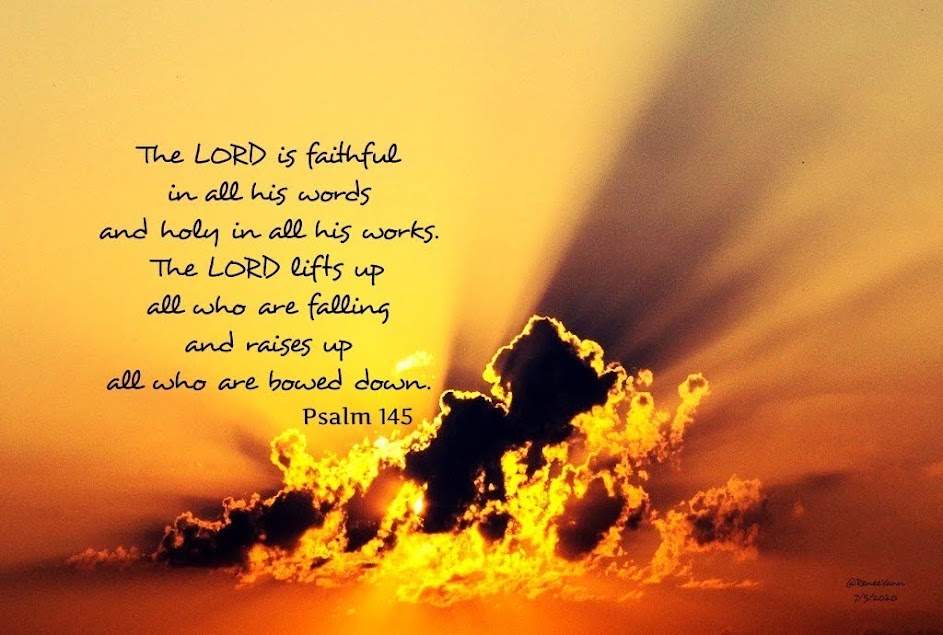
Psalm 145 reminds that God is with us – on our side – in both Advent and our Life Journey.
As the year moves closer to its time of deepest darkness, may we know God’s bright Presence in our hearts. May we sense God lighting, once again, the dark places in our lives and in our world.
We all have parched and painful situations, unanswered hopes, lingering fears. Let us bring them out of the shadows today and open them to the refreshing grace of God who made the stars to give us hope.
Today, in God’s Lavish Mercy, our Advent readings increase in joyously expectant tone. They offer us wonderful images for our hope!
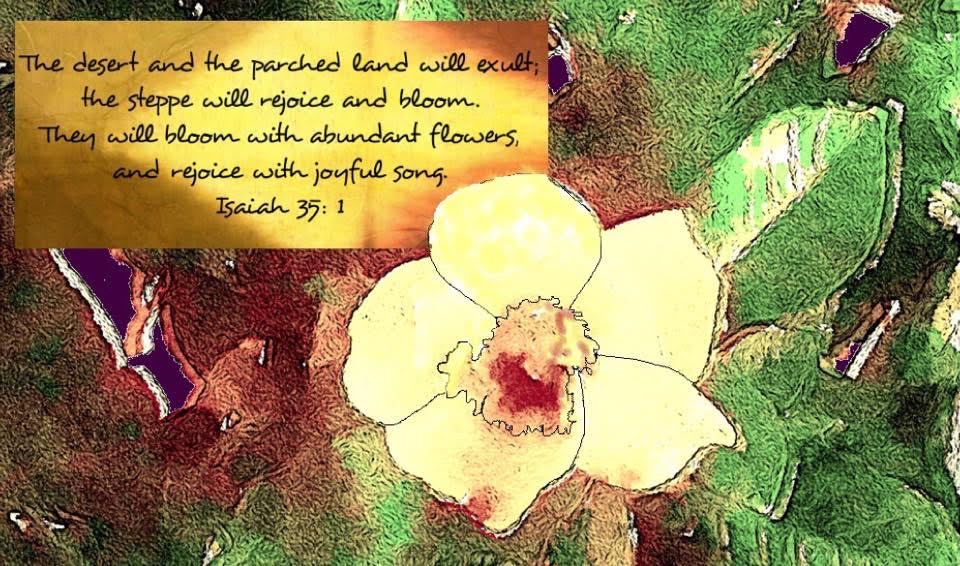
1. Our First Reading – A Blossoming Desert
Isaiah’s exultant description of the Peaceful Kingdom
2. Our Psalm – An Expectant Heart
the Psamist’s confidence in God’s intervention
3. Our Gospel – A Merciful, Rule-Breaking Savior!
Jesus’s miracle, and probable delight, for the paralyzed man lowered through the roof! (Here is Mark’s version of the same incident as in Luke today.)
We have seen incredible things.. Luke 5:26
These passages are filled with an exuberant expectation, much like children feel as they discover an amazing gift. I remember with delight how my toddler nieces, nephew, and grands responded to their first snow! It’s a wonder that makes us want to be young again and eager for what may seem otherwise incredible.
May we open our hearts with innocent hope toward God’s promise that we are loved beyond our wildest dreams – by a God Who will redeem us!
If you can, take the time today to read these passages slowly, listening for the particular word that will fall upon your heart like a blossom of hope in the desert – (or icy white magic from the sky!)
Poetry: Snow by Gillian Clarke
The dreamed Christmas, flakes shaken out of silences so far and starry we can’t sleep for listening for papery rustles out there in the night and wake to find our ceiling glimmering, the day a psaltery of light.
So we’re out over the snow fields before it’s all seen off with a salt-lick of Atlantic air, then home at dusk, snow-blind from following chains of fox and crow and hare, to a fire, a roasting bird, a ringing phone, and voices wondering where we are.
A day foretold by images of glassy pond, peasant and snowy roof over the holy child iconed in gold. Or women shawled against the goosedown air pleading with soldiers at a shifting frontier in the snows of television,
while in the secret dark a fresh snow falls filling our tracks with stars.
Music: Winter Snow Song – Audrey Assad
[Verse 1] Could’ve come like a mighty storm With all the strength of a hurricane You could’ve come like a forest fire With the power of Heaven in Your flame
[Chorus] (But) You came like a winter snow Quiet and soft and slow Falling from the sky in the night To the earth below
[Verse 2] Oh You could’ve swept in like a tidal wave Or an ocean to ravish our hearts You could have come through like a roaring flood To wipe away the things that we’ve scarred
[Chorus] (But) You came like a winter snow Quiet and soft and slow Falling from the sky in the night To the earth below
[Bridge] Ooh no, Your voice wasn’t in a bush burning No, Your voice wasn’t in a rushing wind It was still, it was small, it was hidden
[Chorus] (But) You came like a winter snow Quiet and soft and slow Falling from the sky in the night To the earth below
[Outro] Falling, oh yeah, to the earth below You came falling from the sky in the night To the earth below
Today, in God’s Lavish Mercy, we stand with Isaiah on the rim of hope. We wait, trusting that “in a very little while”, the Lord will make Creation whole.
It’s a precipitous place, this cliff called “Hope”. It requires that we risk ourselves solely on the promises of a God we cannot see. It invites us to leap into a mist we cannot control.
Or can we?
In today’s Gospel, Jesus invites the blind men to the cliff’s edge by asking them:
Do you believe that I can do this?
Well, that’s everything, isn’t it? If our answer is “No”, “Maybe”, or “Kinda’”, we might as well just lie down on this side of the Promise.
But if our answer is brave, like the Gospel blind ones, we too may have our vision cleared to see that there is no leap required. We already stand beside God.
When his children see the work of my hands in his midst, They shall keep my name holy; they shall reverence the Holy One of Jacob, and be in awe of the God of Israel. Isaiah 29:23
Poetry:Hope – Lisel Mueller
It hovers in dark corners before the lights are turned on, it shakes sleep from its eyes and drops from mushroom gills, it explodes in the starry heads of dandelions turned sages, it sticks to the wings of green angels that sail from the tops of maples.
It sprouts in each occluded eye of the many-eyed potato, it lives in each earthworm segment surviving cruelty, it is the motion that runs from the eyes to the tail of a dog, it is the mouth that inflates the lungs of the child that has just been born.
It is the singular gift we cannot destroy in ourselves, the argument that refutes death, the genius that invents the future, all we know of God.
It is the serum which makes us swear not to betray one another; it is in this poem, trying to speak.
Today, in God’s Lavish Mercy, Isaiah promises the people that they will sing a song in the land of Judah. It will be a song that celebrates confidence in God, justice, enduring faith, peace and trust.
Do you ever sing to God when your heart is filled like that? I don’t mean Church-singing or words somebody else wrote.
I mean that sweet, indecipherable whisper a mother breathes over her child, or the mix of a hundred half-remembered melodies we hum when we are lost in the fullness of our lives.
And I don’t just mean the happy songs.
I mean the songs of loss and longing, awe and wonderment at life’s astounding turns. I mean even the sounds of silence when the refrain within us cannot be spoken.
When your heart is really stuck, unable to find the words to express the depth of your joy, longing or sorrow, try singing to God like that. So many times, I have done this while out on a solitary walk, or sitting by the water’s edge, or even driving on an open road. Sometimes, God even sings back!
Isaiah’s people were able to sing their song because they held on to faith and acted in justice. In our Gospel, Jesus tells us that this must be the way of our prayer too. He says that simply saying, “Lord, Lord” won’t cut it!
Real prayer is not just words. It is a life given to hearing God’s Word and acting on it. Real prayer is about always singing our lives in rhythm with the infinite, merciful melody of God.
Poetry: Every Riven Thing ~ Christian Wiman
God goes, belonging to every riven thing he’s made sing his being simply by being the thing it is: stone and tree and sky, man who sees and sings and wonders why
God goes. Belonging, to every riven thing he’s made, means a storm of peace. Think of the atoms inside the stone. Think of the man who sits alone trying to will himself into a stillness where
God goes belonging. To every riven thing he’s made there is given one shade shaped exactly to the thing itself: under the tree a darker tree; under the man the only man to see
God goes belonging to every riven thing. He’s made the things that bring him near, made the mind that makes him go. A part of what man knows, apart from what man knows,
God goes belonging to every riven thing he’s made.
Today, in God’s Lavish Mercy, we come – FINALLY – to the last day in Ordinary Time. And, believe me, the readings are as daunting as their predecessors suggested they would be.
They are so daunting that I will leave you to them if you wish, but I choose to close the Liturgical Year with another story I wrote years ago.
May the story inspire you as we stand on beautiful Advent’s doorstep. Within it, may you find love, hope, tenderness, mercy and gratitude to carry with you into the new Church Year.
The Earring
Young Emma, skewered by indecision, had stared into her mother’s jewelry box. She had always loved those bejeweled earrings, a gift to her mother from her grandmother—an heirloom now, a treasure beyond price. She wanted so to wear them on this special date, but they were “hands off” and she knew it. Still, her mother at work and unaware of her desire, Emma had succumbed to temptation.
The dance had been wonderful, a whirlwind of such delight that Emma had not noticed when her left earring had brushed against her partner’s shoulder, tumbling hopelessly under the dancers’ trampling feet. Only at evening’s end, approaching her front door exhausted and dreamy, had she reached up to unclip the precious gems.
Her mother sat waiting for her in the soft lamplight, having already noticed the earrings missing from her dresser. Awaiting retribution, Emma knelt beside her mother and confessed the further sacrilege of loss. But her mother simply cupped Emma’s tearful face in her hands, whispering, “You are my jewel. Of course I forgive you.” Though accustomed to her mother’s kindness, this act of compassion astonished Emma, filling her with an indescribable, transformative gratitude.
Like Emma, we may be astonished at the graciousness that has been given to us. We may respond by pouring out our thanks to God in a silent act of prayer.
May we also have the courage to become like our merciful God, anticipating the other’s need for our forgiveness and compassion. May we seek the strength not to harbor injury, but too release it to make room for further grace in our hearts.
Advent 2021
I am so excited about Advent – my favorite time of the Church Year! The readings are magnificent — especially lyrical, prophetic Isaiah!
Advent offers us the wonderful call “to relish expectation” – to believe in, to hope for, and to love what we cannot yet see. It is a time of blind but unshakeable trust which teaches us to live within our deep, invisible spirit.
Looking forward to being with all of you tomorrow as we begin the journey through this season of profound hope.
Poetry: I Hear the Oriole’s Always-Grieving Voice – Anna Akhmatova
I chose this poem because it captures a spirit of hope – yet unrealized, but nevertheless convinced.
I hear the oriole’s always-grieving voice, And the rich summer’s welcome loss I hear In the sickle’s serpentine hiss Cutting the corn’s ear tightly pressed to ear. And the short skirts of the slim reapers Fly in the wind like holiday pennants, The clash of joyful cymbals, and creeping From under dusty lashes, the long glance.
I don’t expect love’s tender flatteries, In premonition of some dark event, But come, come and see this paradise Where together we were blessed and innocent.
Music: Gracias a la Vida – Mercedes Sosa and Joan Baez ( English lyrics below.) Thanks to my friend Beth who shared this lovely song on Facebook today.
Thanks to life, which has given me so much. It gave me two beams of light, that when opened, Can perfectly distinguish black from white And in the sky above, her starry backdrop, And from within the multitude The one that I love.
Thanks to life, which has given me so much. It gave me an ear that, in all of its width Records— night and day—crickets and canaries, Hammers and turbines and bricks and storms, And the tender voice of my beloved.
Thanks to life, which has given me so much. It gave me sound and the alphabet. With them the words that I think and declare: “Mother,” “Friend,” “Brother” and the light shining. The route of the soul from which comes love.
Thanks to life, which has given me so much. It gave me the ability to walk with my tired feet. With them I have traversed cities and puddles Valleys and deserts, mountains and plains. And your house, your street and your patio.
Thanks to life, which has given me so much. It gave me a heart, that causes my frame to shudder, When I see the fruit of the human mind, When I see good so far from bad, When I see within the clarity of your eyes…
Thanks to life, which has given me so much. It gave me laughter and it gave me longing. With them I distinguish happiness and pain— The two materials from which my songs are formed, And your song, as well, which is the same song. And everyone’s song, which is my very song. Thanks to life
Wednesday, November 4, 2021 Memorial of St. Charles Borromeo
Today, in God’s Lavish Mercy, we pray with Psalm 27:
Our scripture passages are all about confidence in our salvation.
Do you have that confidence? Do you ever wonder if you’re going to get to heaven? Maybe even worry about it a little?
If so, today’s readings are for you.
Paul tells the faithful:
For if we live, we live for the Lord, and if we die, we die for the Lord; so then, whether we live or die, we are the Lord’s.
And Jesus, using the symbol of a lost sheep, counsels the critical Pharisees:
I tell you, in just the same way there will be more joy in heaven over one sinner who repents than over ninety-nine righteous people who have no need of repentance.
Key to both readings is the call to a repentant, Christian life.
Our beautiful Responsorial Psalm captures the joy of the repentant sinner, the very ones for whom Christ died. It’s a beautiful psalm. We might want to just slowly relish it in our prayer today.
R. I believe that I shall see the good things of the Lord in the land of the living.
The LORD is my light and my salvation; whom should I fear? The LORD is my life’s refuge; of whom should I be afraid?
R. I believe that I shall see the good things of the Lord in the land of the living.
One thing I ask of the LORD; this I seek: To dwell in the house of the LORD all the days of my life, That I may gaze on the loveliness of the LORD and contemplate his temple.
R. I believe that I shall see the good things of the Lord in the land of the living.
I believe that I shall see the bounty of the LORD in the land of the living. Wait for the LORD with courage; be stouthearted, and wait for the LORD.
R. I believe that I shall see the good things of the Lord in the land of the living.
We might want to turn toward the searching Shepherd of today’s Gospel while praying this Psalm of repentance and faith.
Poetry: The Shepherd Boy Sings in the Valley of Humiliation– John Bunyan (1628–1688), a Christian writer and preacher, most famous for The Pilgrim’s Progress.
He that is down needs fear no fall, He that is low, no pride; He that is humble ever shall Have God to be his guide.
I am content with what I have, Little be it or much: And, Lord, contentment still I crave, Because Thou savest such.
Fullness to such a burden is That go on pilgrimage: Here little, and hereafter bliss, Is best from age to age.
Today, in God’s Lavish Mercy, we pray once again with Psalm 126, a song of hope fulfilled:
When the LORD brought back the captives of Zion, we were like men dreaming. Then our mouth was filled with laughter, and our tongue with rejoicing.
Then they said among the nations, “The LORD has done great things for them.” The LORD has done great things for us; we are glad indeed.
Psalm 126: 1-3
In our readings, we are called to be people of hope – to live in gratitude for hopes fulfilled, and to live in confidence of future blessing.
Paul blesses us with some of his most powerful words:
I consider that the sufferings of this present time are as nothing compared with the glory to be revealed for us.
Romans 8:18
How often, over the ensuing centuries, have these words uplifted and embravened a struggling heart! Paul reminds us of what he so passionately believed – that we are not here for this world alone; that we, with all Creation, are being transformed for eternal life in God.
Jesus too reminds us that our life in faith is so much bigger than we perceive. We see a tiny mustard seed, but God sees the whole tree of eternal life blossoming in us. We see a fingertip of yeast, but God sees the whole Bread of Life rising in us.
Paul tells us to be People of Hope who do not yet expect to see the object of their hope but who, nonetheless, believe and love with all their hearts.
May we pray this today for ourselves, and for anyone burdened by suffering or hopelessness at this time in their lives.
Poetry: Hope – Czeslaw Milosz
Hope is with you when you believe The earth is not a dream but living flesh, that sight, touch, and hearing do not lie, That all thing you have ever seen here Are like a garden looked at from a gate. You cannot enter. But you're sure it's there. Could we but look more clearly and wisely We might discover somewhere in the garden A strange new flower and an unnamed star. Some people say that we should not trust our eyes, That there is nothing, just a seeming, There are the ones who have no hope. They think the moment we turn away, The world, behind our backs, ceases to exist, As if snatched up by the hand of thieves.
Today, in God’s Lavish Mercy, we pray with Psalm 130, a “Psalm of Ascents” in which the whole community joined in a prayer of intense supplication as they gathered at the Temple.
Although prayed as a community, the psalm is written in an individual voice, helping us to connect our times of personal desperation to the prayer.
Out of the depths I cry to you, O LORD LORD, hear my voice! Let your ears be attentive to my voice in supplication.
Psalm 130: 1-2
Jonah, in the chapter before today’s first reading, gives us a graphic image of what “the depths” feel like. Not only is Jonah swallowed by the sea, but also by a whale which carries him – imprisoned – to the very bottom of the ocean!
Jonah prayed to the LORD, his God, from the belly of the fish: Out of my distress I called to the LORD, Who answered me; From the womb of Sheol I cried for help, and you heard my voice.
Jonah 2:2-3
“Sheol” is a Hebrew term which could be translated as “place of the dead spirits”. It is different from the grave, which harbors the body. In other words, “Sheol” is a place where our spirits can die before we physically die.
We can experience this kind of spiritual death in so many ways. Some come upon us not by our own choice. Certainly in the illness of depression we feel this darkness. Profound bereavement and debilitating sickness can overwhelm us as well. Praying Psalm 130 may help at such times. But they also call for reaching out to friends, counselors, and professional support to help in our healing.
But the psalm more specifically addresses those times when we get caught in a deadly spiral due to our own sinful and selfish choices – by allowing prejudice, hate, willful ignorance or any of the seven deadly sins to overtake us.
Lord, hear my cry! May your ears be attentive to my cry for mercy. If you, LORD, keep account of sins, Lord, who can stand? But with you is forgiveness and so you are revered.
Psalm 130: 2-4
Psalm 130 tells us that God is present to us in both situations- whether our suffering is brought on by our own choices or not. God will walk us through to the Light when we open ourselves to Grace:
Let us wait patiently to discern God’s way, For with God is kindness and plenteous redemption; God will restore us from every darkness; God’s way is mercy.
Psalm 130: 7-8
Let’s pray for that kind of faith in our hearts, and the hearts of those we love, especially for anyone suffering “the depths” right now.
Poetry: De Profundis – Christina Rossetti
Oh why is heaven built so far, Oh why is earth set so remote? I cannot reach the nearest star That hangs afloat. I would not care to reach the moon, One round monotonous of change; Yet even she repeats her tune Beyond my range. I never watch the scatter'd fire Of stars, or sun's far-trailing train, But all my heart is one desire, And all in vain: For I am bound with fleshly bands, Joy, beauty, lie beyond my scope; I strain my heart, I stretch my hands, And catch at hope.
Music: Out of the Deep – John Rutter
Psalm 130, ‘Out of the deep have I called unto thee O Lord’ begins darkly with an unaccompanied cello solo in C minor, later giving way to a more positive C major at the words ‘for with the Lord there is mercy, and with him is plenteous redemption’.
Out of the deep have I called unto thee, O Lord; Lord, hear my voice. O let thine ears consider well the voice of my complaint. If thou, Lord, wilt be extreme to mark what is done amiss, O Lord, who may abide it? For there is mercy with thee: therefore shalt thou be feared. I look for the Lord; my soul doth wait for him; and in his word is my trust. My soul fleeth unto the Lord before the morning watch; I say, before the morning watch. O Israel, trust in the Lord; for with the Lord there is mercy, and with him is plenteous redemption. And he shall redeem Israel from all his sins.
Today, in God’s Lavish Mercy, we pray with Psalm 43 whose heart reveals the nature of hope and its power to inspire praise.
Wait for God, whom I shall again praise, my savior and my God.
Psalm 43 is really the completion of Psalm 42, and they form a masterful combination.
According to biblical scholar Carroll Stuhmueller:
The three stanzas of Psalm 42-43 lead listeners and readers through depression, struggle, and hope. The refrain sung at the end of each stanza contains three parts that summarize the attitude of each:
Why are you cast down, O my soul
Depression
and why are you disquieted within me?
Struggle
Hope in God Whom I shall again praise,
Hope
my Lord and my God.
Praise
Stuhmueller: Spirituality of the Psalms
The psalm follows logically after today’s first reading in which the prophet Haggai challenges the people to pick themselves up by the bootstraps and get working on the restoration of the Temple. The prophet proclaims encouragement in God’s name:
For I am with you, says the LORD of hosts. This is the pact that I made with you when you came out of Egypt, And my spirit continues in your midst; do not fear!
Haggai 2:5
Praying with these readings, we may reflect on our own current or past challenges in the light of faith and hope. God is with us now as God always has been, and will be.
We are empowered by that promise to live courageous, generous lives. This is what hope looks like when it is alive in us.
Poetry: Hope – Czeslaw Milosz
Hope is with you when you believe The earth is not a dream but living flesh, that sight, touch, and hearing do not lie, That all thing you have ever seen here Are like a garden looked at from a gate. You cannot enter. But you're sure it's there. Could we but look more clearly and wisely We might discover somewhere in the garden A strange new flower and an unnamed star. Some people say that we should not trust our eyes, That there is nothing, just a seeming, There are the ones who have no hope. They think the moment we turn away, The world, behind our backs, ceases to exist, As if snatched up by the hand of thieves.
Today, in God’s Lavish Mercy, we pray with Psalm 98 which we reflected on just this past Saturday on the feast of St. Augustine. Here’s a refresher if you’d care to glance back.
Because they proclaim God’s faithfulness, today’s psalm verses ready us to receive the Gospel’s expansive injunction:
As we pass through the waters of life, we each meet our own “deeps”. Sometimes we do not recognize them as the sacred places where we are to meet God’s call.
Sometimes we see only their choppy surface, their tangled riptides, their frightening shadows.
Sometimes we miss the bounty held in the mystery of these moments. We fold our nets and try to sail away.
As he did for the weary disciples, Jesus
lovingly contradicts our fear,
releases our hope,
fills the flimsy net of our faith to bursting …
… if we will just trust his Word, and cast out with him over the waters of our lives.