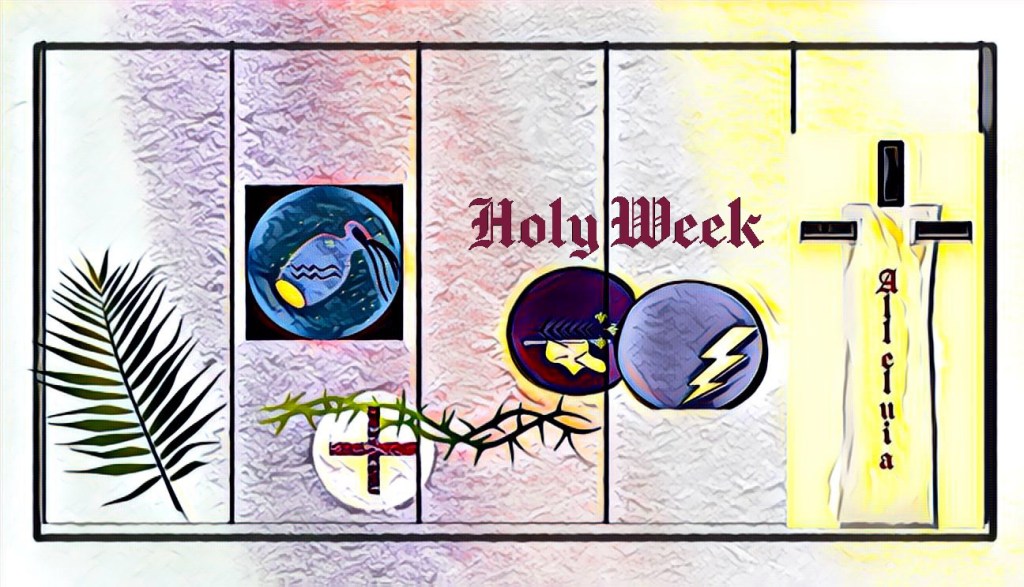
As we begin Holy Week…

Holy Week and Eastertide

Holy Week and Eastertide are times of sacred journey for Christians. We walk with Christ into the true and deepest dimensions of our lives.

All life is about journey and passage. At some time in each of our lives, we are passing:

  • from emptiness to abundance
  • from loneliness to love
  • from exhaustion to renewal
  • from anxiety to peace
  • from burden to freedom
  • from confusion to understanding
  • from bitterness to forgiveness
  • from pain to healing
  • from mourning to remembrance

The great Feasts of Holy Week and Easter, and the reflective weeks that follow, assure us that God accompanies us in all our journeys from darkness to light. The sacredness of these days invites us to quietly name whatever darkness surrounds us and our global family, and to reach through it to the hand of God. Like a parent leading a child in from the storm, the God of Easter longs to bring our hearts home to fullness and joy.

During these coming weeks, I will continue offering reflections centered on a single word, since many of you have expressed to me an appreciation for this approach. In the archives listed on the right of the blog, you can access more extensive reflections for each day of the liturgical cycle, accumulated over the past six years.

As we begin these sacred days, let’s pray for one another. And let us pray particularly for those whose current lives are closely patterned on the sufferings of Christ that, with Him, they may be strengthened with Easter hope and courage.

Caiaphas

Saturday of the Fifth Week of Lent
March 23, 2024

Today’s Readings:

https://bible.usccb.org/bible/readings/032324.cfm


So the chief priests and the Pharisees
convened the Sanhedrin and said,
“What are we going to do?
This man is performing many signs.
If we leave him alone, all will believe in him,
and the Romans will come
and take away both our land and our nation.”
But one of them, Caiaphas,
who was high priest that year, said to them,
“You know nothing,
nor do you consider that it is better for you
that one man should die instead of the people,
so that the whole nation may not perish.”

John 11: 47-50

From the moment described in this Gospel, down through the ages, the name “Caiaphas” shouts infamy. At a moment when he could have made all the difference in history, Caiaphas folded to political expediency, planting the seed for Jesus’s crucifixion.

Moral courage is a gift of the Holy Spirit. It strengthens us to tell the truth when doing so may cost us life, limb, or desired status in the world.

Today, in God’s Lavish Mercy:

With the gift of free will, God has given us tremendous power, just as God gave Caiaphas. Our words, or our silences, can make or break the flow of grace in the world. By the practice of prayerfully considering our allegiances and testimonies, we can fortify our spirits with a sacred honesty – the kind which Caiaphas lacked on that momentous day.

  • Why am I making this choice?
  • Why am I voicing this opinion?
  • Why am I standing on this side of justice or mercy?
  • Who benefits, or who suffers, because of my stance?

And, ultimately, will my testimony make the way for God’s grace?


Poetry: All Is Truth – Walt Whitman

O me, man of slack faith so long!
Standing aloof—denying portions so long;
Only aware to-day of compact, all-diffused truth;
Discovering to-day there is no lie, or form of lie, and can be none,
but grows as inevitably upon itself as the truth does upon
itself,
Or as any law of the earth, or any natural production of the earth
does.

(This is curious, and may not be realized immediately—But it must be
realized;
I feel in myself that I represent falsehoods equally with the rest,
And that the universe does.)

Where has fail'd a perfect return, indifferent of lies or the truth?
Is it upon the ground, or in water or fire? or in the spirit of man?
or in the meat and blood?

Meditating among liars, and retreating sternly into myself, I see
 that there are really no liars or lies after all,
And that nothing fails its perfect return—And that what are called
lies are perfect returns,
And that each thing exactly represents itself,
and what has preceded it,
And that the truth includes all, and is compact, just as much as
space is compact,
And that there is no flaw or vacuum in the amount of the truth—but
 that all is truth without exception;
And henceforth I will go celebrate anything I see or am,
And sing and laugh, and deny nothing.

Music: If We’re Honest – Francesca Battistelli

Whisperings

Friday of the Fifth Week of Lent
March 22, 2024

Today’s Readings:

https://bible.usccb.org/bible/readings/032224.cfm


I hear the whisperings of many:
“Terror on every side!
Denounce! let us denounce him!”
All those who were my friends
are on the watch for any misstep of mine.

Jeremiah 20:10

Oh, the deadly power of a fragile whisper! Its insidious influence seeps into souls, germinates, and grows into fictional suggestions, untested prejudices, and effective shunning by the “in” set.

Whispers are the emanations of fear – we may fear what is different, what we cannot control, what challenges us, what actually exposes pretense in us.

Jeremiah and Jesus encountered the ugly entanglement of such whispers. But they were not trapped because they believed.

Today, in God’s Lavish Mercy:
We pray their prayer for ourselves and for all who suffer the persecution of “whisperings”.

The LORD is with me, like a mighty champion:
my persecutors will stumble, they will not triumph.
O LORD of hosts, you who test the just,
who probe mind and heart,
Let me witness the recompense you take on them,
for to You I have entrusted my cause.


Poetry: A Word – Emily Dickinson

A word is dead
When it is said,
Some say.
I say it just
Begins to live
That day.

Music: from Handel’s Messiah: He trusted in God that He would deliver him

Yours

Thursday of the Fifth Week of Lent
March 21, 2024

Today’s Readings:

https://bible.usccb.org/bible/readings/032124.cfm


I will maintain my covenant with you
and your descendants after you
throughout the ages as an everlasting pact,
to be your God and the God of your descendants after you.

Genesis 17:7

Genesis describes the sacred covenant God shares with us. In our Gospel, Jesus asserts the eternal nature of that covenant, made real in our lives by keeping his Word.

God’s promise of eternal love was made to us as well as to Abraham.
In every moment, God says to us, “I am yours.”
In every moment. we are called to respond, “Yes, Lord, and I am Yours as well.”


Poetry: from The Book of Hours – Rainer Maria Rilkë

Although, as from a prison walled with hate,
each from his own self labors to be free,
the world yet holds a wonder, and how great!
ALL LIFE IS LIVED: now this comes home to me.
But who, then, lives it? Things that patiently
stand there, like some unfingered melody
that sleeps within a harp as day is going?
Is it the winds, across the waters blowing,
is it the branches, beckoning each to each,
is it the flowers, weaving fragrances,
the aging alleys that reach out endlessly?
Is it the warm beasts, moving to and fro,
is it the birds, strange as they sail from view?
This life — who really lives it? God, do you?

Music: My God, I Am Yours – Suscipe of Catherine McAuley

My God, I am yours for time and eternity.
Teach me to cast myself entirely
into the arms of your loving Providence
with a lively, unlimited confidence in your compassionate, tender pity.
Grant, O most merciful Redeemer,
That whatever you ordain or permit may be acceptable to me.
Take from my heart all painful anxiety;
let nothing sadden me but sin,
nothing delight me but the hope of coming to the possession of You
my God and my all, in your everlasting kingdom.

Plot

Saturday of the Fourth Week of Lent
March 16, 2024

Today’s Readings:

https://bible.usccb.org/bible/readings/031624.cfm


Yet I, like a trusting lamb led to slaughter,
had not realized that they were hatching plots against me:
“Let us destroy the tree in its vigor;
let us cut him off from the land of the living,
so that his name will be spoken no more.”

Jeremiah 11:19

“Plot” can be an ugly word – a sinister trap woven in the darkness of fear and ignorance. Such plotters are befuddled by innocence, freedom, honesty, and goodness. Without these virtues themselves, they have no tools to meet challenges with sincerity and trust..

In our readings, we see darkened souls interweaving their fears to trap both Jeremiah and Jesus. It’s a picture of “conspiracy theories” in Biblical times!

In our current culture, we see people design elaborate arguments to justify war, rioting, oppression, weaponry, economic excess, and all the many “isms” that trap others in their vulnerability.

Lent is not just a remembrance of things past. It is a living participation in the Paschal Mystery as Christ experiences it in our times. We must ask ourselves if we ever stand with, or even silently near, the “plotters”.


Poem: The Second Crucifixion – Richard Le Gallienne (1866 – 1947)

LOUD mockers in the roaring street   
  Say Christ is crucified again:   
Twice pierced His gospel-bearing feet,   
  Twice broken His great heart in vain.   
  
I hear, and to myself I smile,          
For Christ talks with me all the while.   
  
No angel now to roll the stone   
  From off His unawaking sleep,   
In vain shall Mary watch alone,   
  In vain the soldiers vigil keep.   
  
Yet while they deem my Lord is dead   
My eyes are on His shining head.   
  
Ah! never more shall Mary hear   
  That voice exceeding sweet and low   
Within the garden calling clear:   
  Her Lord is gone, and she must go.   
  
Yet all the while my Lord I meet   
In every London lane and street.   
  
Poor Lazarus shall wait in vain,   
  And Bartimæus still go blind;   
The healing hem shall ne'er again   
  Be touch'd by suffering humankind.   
  
Yet all the while I see them rest,   
The poor and outcast, on His breast.   
  
No more unto the stubborn heart   
  With gentle knocking shall He plead,   
No more the mystic pity start,   
  For Christ twice dead is dead indeed.   
  
So in the street I hear men say,   
Yet Christ is with me all the day.

Music: Agnus Dei – Michael Hoppé

Recompense

Friday of the Fourth Week of Lent
March 15, 2024

Today’s readings:

https://bible.usccb.org/bible/readings/031524.cfm


The wicked said among themselves…
“Let us condemn him to a shameful death;
for according to his own words, God will take care of him.”
These were their thoughts, but they erred;
for their wickedness blinded them,
and they knew not the hidden counsels of God;
neither did they count on a recompense of holiness
nor discern the innocent souls’ reward.

Wisdom 2: 20-22

In our readings, the Holy One meets the opposition of those who plot against him. They rationalize their persecutions, proclaiming them as acts of justice. They expect their victim to crumble under the pressure of their judgments. What they do not expect is a return of goodness, gentleness, and forgiveness – a recompense of holiness. They do not expect the great contradiction of the Cross, and they are incapable of comprehending it.

Today, in God’s Lavish Mercy:

As Lent deepens, and we come closer to the shadows of Calvary, we are summoned into the sufferings of Jesus to test our own understanding of this Great Contradiction.

What does Christ teach us about payback, unforgiveness, revenge, violence, and war – the popular “recompenses” of our culture to any resistance or injury we encounter?

What might a “recompense of holiness” look like in my life when I meet gracelessness in another person or situation?

How might it transform our belligerent culture if we modeled our behaviors on the holiness of Jesus?


Poetry: Peace-making Is Hard …. – Daniel Berrigan, SJ

hard almost as war. 
the difference being 
one we can stake life upon 
and limb and thought and love.
I stake this poem out 
dead man to a dead stick 
to tempt an Easter chance— 
if faith may be 
truth, our evil chance 
penultimate at last, 
not last. We are not lost. 
When these lines gathered 
of no resource at all 
serenity and strength, 
it dawned on me 
a man stood on his nails, 
an ash like dew, a sweat 
smelling of death and life. 
Our evil Friday fled, 
the blind face gently turned 
another way. Toward Life. 
A man walks in his shroud. 

Music: He Trusted in God – from Handel’s Messiah

Water

Tuesday of the Fourth Week of Lent
March 12, 2024

https://bible.usccb.org/bible/readings/031224.cfm


There is a stream whose runlets gladden the city of God,
the holy dwelling of the Most High.
God is in its midst; it shall not be disturbed;
God will help it at the break of dawn.

Psalm 46:5-6

Our Psalm today connects two readings centered around life-giving water.

Ezekiel’s watery vision offers a symbolic interpretation of the life-force flowing from God’s heart (symbolized by the Temple) to all Creation.

In our Gospel, a man waits for decades beside the waters of an inaccessible pool until Jesus cures him – until Jesus himself becomes the “Water of Life”.


Today, in God’s Lavish Mercy:

Imagine yourself being blessed by life-giving water – maybe a cool swim on a blistering day, or a warm bath on a frosty one.

Imagine walking in a gentle summer rain, no umbrella, no puddle prohibitions.

If you love the ocean, imagine diving under soft waves at flood tide, belly-riding them back, again and again, to a warm, quiet beach.

Now imagine that all that water is God’s Love for you, because it is. And let your heart pray with a joy similar to today’s psalmist!


Poetry: The Waterfall – Henry Vaughan (1621-1695)

With what deep murmurs through time’s silent stealth
Doth thy transparent, cool, and wat’ry wealth
Here flowing fall,
And chide, and call,
As if his liquid, loose retinue stay’d
Ling’ring, and were of this steep place afraid;
The common pass
Where, clear as glass,
All must descend
Not to an end,
But quicken’d by this deep and rocky grave,
Rise to a longer course more bright and brave.

Dear stream! dear bank, where often I
Have sate and pleas’d my pensive eye,
Why, since each drop of thy quick store
Runs thither whence it flow’d before,
Should poor souls fear a shade or night,
Who came, sure, from a sea of light?
Or since those drops are all sent back
So sure to thee, that none doth lack,
Why should frail flesh doubt any more
That what God takes, he’ll not restore?

O useful element and clear!
My sacred wash and cleanser here,
My first consigner unto those
Fountains of life where the Lamb goes!
What sublime truths and wholesome themes
Lodge in thy mystical deep streams!
Such as dull man can never find
Unless that Spirit lead his mind
Which first upon thy face did move,
And hatch’d all with his quick’ning love.
As this loud brook’s incessant fall
In streaming rings restagnates all,
Which reach by course the bank, and then
Are no more seen, just so pass men.
O my invisible estate,
My glorious liberty, still late!
Thou art the channel my soul seeks,
Not this with cataracts and creeks.

Music: How Deep Is the Ocean
As you listen to the smooth jazz of Diana Krall, let yourself be in love with God who raises you from beside whatever pool where you’ve been lingering.

Loved

Fourth Sunday of Lent 
March 10, 2024

Today’s Readings:

https://bible.usccb.org/bible/readings/031024-YearB.cfm


For God so loved the world that he gave his only Son,
so that everyone who believes in him might not perish
but might have eternal life.
For God did not send his Son into the world to condemn the world,
but that the world might be saved through him.

John 3:16-17

For some of us, it’s hard to believe in a God we do not see. This passage from John suggests that God understands how hard it is. So that believers might not “perish” in their natural doubts, God made Divinity visible in Jesus Christ. The reason? Infinite Love for and desire to be one with us.

Today, in God’s Lavish Mercy:

Let’s rest in the confidence and gratitude this passage ignites in our hearts. God loves us — loves you — enough to become like you so that you might become like God.


Poetry: Infinite Love – Julian of Norwich, who was an English anchoress of the Middle Ages. Her writings, now known as Revelations of Divine Love, are the earliest surviving English language works by a woman. They are also the only surviving English language works by an anchoress. ( An anchoress is someone who, for religious reasons, withdraws from secular society to be able to lead an intensely prayer-orientated, ascetic, or Eucharist-focused life.)

Infinite Love

Because of the great,
infinite love which God has for all humankind,
he makes no distinction in love
between the blessed soul of Christ
and the lowliest of the souls that are to be saved . . . .
We should highly rejoice that God dwells in our soul
and still more highly should we rejoice
that our soul dwells in God.
Our soul is made to be God’s dwelling place,
and the dwelling place of our soul
is God who was never made.

Music: God So Loved the World – Mormon Tabernacle Choir

Piety

Saturday of the Third Week of Lent
March 9, 2024

Today’s Readings:

https://bible.usccb.org/bible/readings/030924.cfm


Your piety is like a morning cloud,
like the dew that early passes away.

Hosea 6:4

_______

… the tax collector stood off at a distance
and would not even raise his eyes to heaven
but beat his breast and prayed,
‘O God, be merciful to me a sinner.’
I tell you, the latter went home justified, not the former;
for everyone who exalts himself will be humbled,
and the one who humbles himself will be exalted.”

Luke 18: 13-14

I think the word “Piety” has taken on a rather saccharine connotation because we mistake it for an overly sentimental, and sometimes insincere, devotion. However, the word piety comes from the Latin word pietas, the noun form of the adjective pius (which means “devout” or “dutiful”).

Today, in God’s Lavish Mercy:

Picture Michelangelo’s Pieta. Let yourself feel the emotion captured in the heart of that sculpture. That is pietas/piety – a deep, penetrating presence and love that cannot fully be put into words. A humble, sincere prayer like that of the tax collector is the fruit of such piety.

Most of us are not great sinners. We just make some mean – and perhaps continual – choices that can block the flow of grace into our hearts. God stands beside us as we make such choices, ready to hear us when we turn and ask for the Mercy that will free and deepen us.


Prose: from Point Counterpoint by Aldous Huxley

Aldous Huxley (1894 – 1963) was an English writer and philosopher. His bibliography spans nearly 50 books, including novels and non-fiction works, essays, narratives, and poems.
By the end of his life, Huxley was widely acknowledged as one of the foremost intellectuals of his time. He was nominated for the Nobel Prize in Literature nine times.

From the quote below, Huxley obviously had strong opinions about religion but especially about false piety. Although Jesus would never have put it this way, the sentiments echo those in today’s readings.


“In the abstract you know that music exists and is beautiful. But don’t therefore pretend, when you hear Mozart, to go into raptures which you don’t feel. If you do, you become one of those idiotic music-snobs … unable to distinguish Bach from Wagner, but mooing with ecstasy as soon as the fiddles strike up. 

It’s exactly the same with God. The world’s full of ridiculous God-snobs. People who aren’t really alive, who’ve never done any vital act, who aren’t in any living relation with anything; people who haven’t the slightest personal or practical knowledge of what God is. But they moo away in churches, they coo over their prayers, they pervert and destroy their whole dismal existences by acting in accordance with the will of an arbitrarily imagined abstraction which they choose to call God.

Just a pack of God-snobs. They’re as grotesque and contemptible as the music-snobs … but nobody has the sense to say so. The God-snobs are admired for being so good and pious and Christian. When they’re merely dead and ought to be having their bottoms kicked and their noses tweaked to make them sit up and come to life.” 

Division

Thursday of the Third Week of Lent
March 7, 2024

Today’s Readings:

https://bible.usccb.org/bible/readings/030724.cfm


Jesus was driving out a demon that was mute,
and when the demon had gone out,
the mute man spoke and the crowds were amazed.
Some of them said, “By the power of Beelzebul, the prince of demons,
he drives out demons.”
Others, to test him, asked him for a sign from heaven.
But he knew their thoughts and said to them,
“Every kingdom divided against itself will be laid waste
and house will fall against house.

Luke 11: 14-17

Today’s readings point us to the virtue of spiritual integrity. Several times in the Gospel, Jesus proclaims that we can’t give our allegiance to two contradictory worlds. (Remember, “One can’t serve God and mammon.”?)

Today, in God’s Lavish Mercy:
As our Verse before the Gospel advises, God wants our whole heart. We can’t be “with” God sometimes. We’re either with God or we’re not – always. Our challenge in life is to make sure we recognize those elements pretending to be gods, so that we don’t give our hearts foolishly.


Poetry: My Kingdom – Louisa May Alcott whom you will recognize as the author of Little Women. Alcott was the daughter of strong transcendentalists. Her father’s opinions on education, severe views on child-rearing, and moments of mental instability shaped young Louisa’s mind with a desire to achieve perfection, a goal of the transcendentalists. (cf: wikipedia) Those sensibilities are reflected in the pious 19th-century style of this poem. Still the poem captures the struggles and awarenesses many have in understanding the Kingdom of Heaven within us.

A little kingdom I possess
Where thoughts and feelings dwell,
And very hard I find the task
Of governing it well;
For passion tempts and troubles me,
A wayward will misleads,
And selfishness its shadow casts
On all my words and deeds.
How can I learn to rule myself,
To be the child I should,
Honest and brave, nor ever tire
Of trying to be good?
How can I keep a sunny soul
To shine along life's way?
How can I tune my little heart
To sweetly sing all day?
Dear Father, help me with the love
That casteth out my fear;
Teach me to lean on thee, and feel
That thou art very near,
That no temptation is unseen
No childish grief too small,
Since thou, with patience infinite,
Doth soothe and comfort all.
I do not ask for any crown
But that which all may win
Nor seek to conquer any world
Except the one within.
Be thou my guide until I find,
Led by a tender hand,
Thy happy kingdom in myself
And dare to take command.

Music: Monastery of La Rabida – Vangelis