Recompense

Friday of the Fourth Week of Lent
March 15, 2024

Today’s readings:

https://bible.usccb.org/bible/readings/031524.cfm


The wicked said among themselves…
“Let us condemn him to a shameful death;
for according to his own words, God will take care of him.”
These were their thoughts, but they erred;
for their wickedness blinded them,
and they knew not the hidden counsels of God;
neither did they count on a recompense of holiness
nor discern the innocent souls’ reward.

Wisdom 2: 20-22

In our readings, the Holy One meets the opposition of those who plot against him. They rationalize their persecutions, proclaiming them as acts of justice. They expect their victim to crumble under the pressure of their judgments. What they do not expect is a return of goodness, gentleness, and forgiveness – a recompense of holiness. They do not expect the great contradiction of the Cross, and they are incapable of comprehending it.

Today, in God’s Lavish Mercy:

As Lent deepens, and we come closer to the shadows of Calvary, we are summoned into the sufferings of Jesus to test our own understanding of this Great Contradiction.

What does Christ teach us about payback, unforgiveness, revenge, violence, and war – the popular “recompenses” of our culture to any resistance or injury we encounter?

What might a “recompense of holiness” look like in my life when I meet gracelessness in another person or situation?

How might it transform our belligerent culture if we modeled our behaviors on the holiness of Jesus?


Poetry: Peace-making Is Hard …. – Daniel Berrigan, SJ

hard almost as war. 
the difference being 
one we can stake life upon 
and limb and thought and love.
I stake this poem out 
dead man to a dead stick 
to tempt an Easter chance— 
if faith may be 
truth, our evil chance 
penultimate at last, 
not last. We are not lost. 
When these lines gathered 
of no resource at all 
serenity and strength, 
it dawned on me 
a man stood on his nails, 
an ash like dew, a sweat 
smelling of death and life. 
Our evil Friday fled, 
the blind face gently turned 
another way. Toward Life. 
A man walks in his shroud. 

Music: He Trusted in God – from Handel’s Messiah

Water

Tuesday of the Fourth Week of Lent
March 12, 2024

https://bible.usccb.org/bible/readings/031224.cfm


There is a stream whose runlets gladden the city of God,
the holy dwelling of the Most High.
God is in its midst; it shall not be disturbed;
God will help it at the break of dawn.

Psalm 46:5-6

Our Psalm today connects two readings centered around life-giving water.

Ezekiel’s watery vision offers a symbolic interpretation of the life-force flowing from God’s heart (symbolized by the Temple) to all Creation.

In our Gospel, a man waits for decades beside the waters of an inaccessible pool until Jesus cures him – until Jesus himself becomes the “Water of Life”.


Today, in God’s Lavish Mercy:

Imagine yourself being blessed by life-giving water – maybe a cool swim on a blistering day, or a warm bath on a frosty one.

Imagine walking in a gentle summer rain, no umbrella, no puddle prohibitions.

If you love the ocean, imagine diving under soft waves at flood tide, belly-riding them back, again and again, to a warm, quiet beach.

Now imagine that all that water is God’s Love for you, because it is. And let your heart pray with a joy similar to today’s psalmist!


Poetry: The Waterfall – Henry Vaughan (1621-1695)

With what deep murmurs through time’s silent stealth
Doth thy transparent, cool, and wat’ry wealth
Here flowing fall,
And chide, and call,
As if his liquid, loose retinue stay’d
Ling’ring, and were of this steep place afraid;
The common pass
Where, clear as glass,
All must descend
Not to an end,
But quicken’d by this deep and rocky grave,
Rise to a longer course more bright and brave.

Dear stream! dear bank, where often I
Have sate and pleas’d my pensive eye,
Why, since each drop of thy quick store
Runs thither whence it flow’d before,
Should poor souls fear a shade or night,
Who came, sure, from a sea of light?
Or since those drops are all sent back
So sure to thee, that none doth lack,
Why should frail flesh doubt any more
That what God takes, he’ll not restore?

O useful element and clear!
My sacred wash and cleanser here,
My first consigner unto those
Fountains of life where the Lamb goes!
What sublime truths and wholesome themes
Lodge in thy mystical deep streams!
Such as dull man can never find
Unless that Spirit lead his mind
Which first upon thy face did move,
And hatch’d all with his quick’ning love.
As this loud brook’s incessant fall
In streaming rings restagnates all,
Which reach by course the bank, and then
Are no more seen, just so pass men.
O my invisible estate,
My glorious liberty, still late!
Thou art the channel my soul seeks,
Not this with cataracts and creeks.

Music: How Deep Is the Ocean
As you listen to the smooth jazz of Diana Krall, let yourself be in love with God who raises you from beside whatever pool where you’ve been lingering.

Loved

Fourth Sunday of Lent 
March 10, 2024

Today’s Readings:

https://bible.usccb.org/bible/readings/031024-YearB.cfm


For God so loved the world that he gave his only Son,
so that everyone who believes in him might not perish
but might have eternal life.
For God did not send his Son into the world to condemn the world,
but that the world might be saved through him.

John 3:16-17

For some of us, it’s hard to believe in a God we do not see. This passage from John suggests that God understands how hard it is. So that believers might not “perish” in their natural doubts, God made Divinity visible in Jesus Christ. The reason? Infinite Love for and desire to be one with us.

Today, in God’s Lavish Mercy:

Let’s rest in the confidence and gratitude this passage ignites in our hearts. God loves us — loves you — enough to become like you so that you might become like God.


Poetry: Infinite Love – Julian of Norwich, who was an English anchoress of the Middle Ages. Her writings, now known as Revelations of Divine Love, are the earliest surviving English language works by a woman. They are also the only surviving English language works by an anchoress. ( An anchoress is someone who, for religious reasons, withdraws from secular society to be able to lead an intensely prayer-orientated, ascetic, or Eucharist-focused life.)

Infinite Love

Because of the great,
infinite love which God has for all humankind,
he makes no distinction in love
between the blessed soul of Christ
and the lowliest of the souls that are to be saved . . . .
We should highly rejoice that God dwells in our soul
and still more highly should we rejoice
that our soul dwells in God.
Our soul is made to be God’s dwelling place,
and the dwelling place of our soul
is God who was never made.

Music: God So Loved the World – Mormon Tabernacle Choir

Piety

Saturday of the Third Week of Lent
March 9, 2024

Today’s Readings:

https://bible.usccb.org/bible/readings/030924.cfm


Your piety is like a morning cloud,
like the dew that early passes away.

Hosea 6:4

_______

… the tax collector stood off at a distance
and would not even raise his eyes to heaven
but beat his breast and prayed,
‘O God, be merciful to me a sinner.’
I tell you, the latter went home justified, not the former;
for everyone who exalts himself will be humbled,
and the one who humbles himself will be exalted.”

Luke 18: 13-14

I think the word “Piety” has taken on a rather saccharine connotation because we mistake it for an overly sentimental, and sometimes insincere, devotion. However, the word piety comes from the Latin word pietas, the noun form of the adjective pius (which means “devout” or “dutiful”).

Today, in God’s Lavish Mercy:

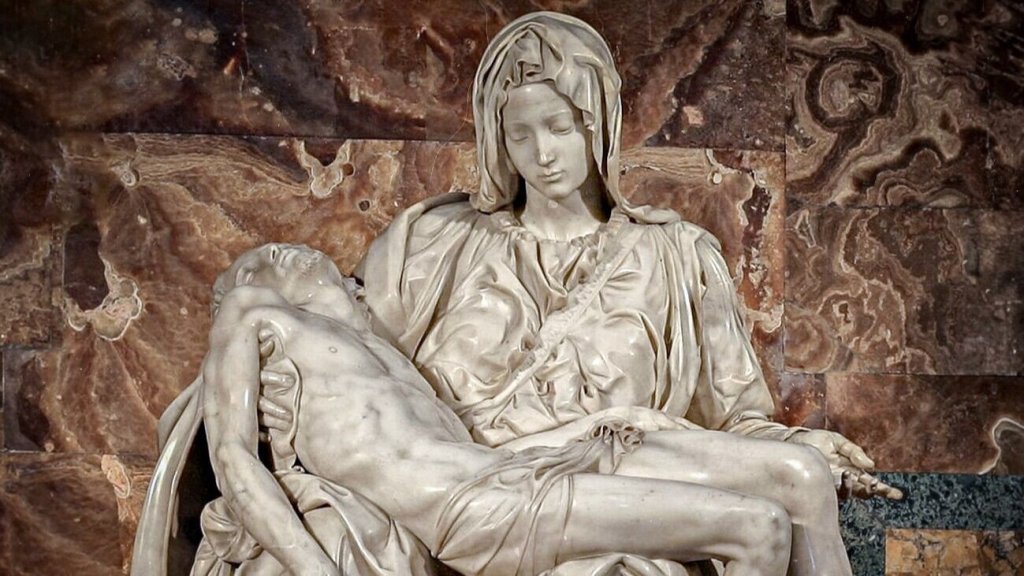
Picture Michelangelo’s Pieta. Let yourself feel the emotion captured in the heart of that sculpture. That is pietas/piety – a deep, penetrating presence and love that cannot fully be put into words. A humble, sincere prayer like that of the tax collector is the fruit of such piety.

Most of us are not great sinners. We just make some mean – and perhaps continual – choices that can block the flow of grace into our hearts. God stands beside us as we make such choices, ready to hear us when we turn and ask for the Mercy that will free and deepen us.


Prose: from Point Counterpoint by Aldous Huxley

Aldous Huxley (1894 – 1963) was an English writer and philosopher. His bibliography spans nearly 50 books, including novels and non-fiction works, essays, narratives, and poems.
By the end of his life, Huxley was widely acknowledged as one of the foremost intellectuals of his time. He was nominated for the Nobel Prize in Literature nine times.

From the quote below, Huxley obviously had strong opinions about religion but especially about false piety. Although Jesus would never have put it this way, the sentiments echo those in today’s readings.


“In the abstract you know that music exists and is beautiful. But don’t therefore pretend, when you hear Mozart, to go into raptures which you don’t feel. If you do, you become one of those idiotic music-snobs … unable to distinguish Bach from Wagner, but mooing with ecstasy as soon as the fiddles strike up. 

It’s exactly the same with God. The world’s full of ridiculous God-snobs. People who aren’t really alive, who’ve never done any vital act, who aren’t in any living relation with anything; people who haven’t the slightest personal or practical knowledge of what God is. But they moo away in churches, they coo over their prayers, they pervert and destroy their whole dismal existences by acting in accordance with the will of an arbitrarily imagined abstraction which they choose to call God.

Just a pack of God-snobs. They’re as grotesque and contemptible as the music-snobs … but nobody has the sense to say so. The God-snobs are admired for being so good and pious and Christian. When they’re merely dead and ought to be having their bottoms kicked and their noses tweaked to make them sit up and come to life.” 

Division

Thursday of the Third Week of Lent
March 7, 2024

Today’s Readings:

https://bible.usccb.org/bible/readings/030724.cfm


Jesus was driving out a demon that was mute,
and when the demon had gone out,
the mute man spoke and the crowds were amazed.
Some of them said, “By the power of Beelzebul, the prince of demons,
he drives out demons.”
Others, to test him, asked him for a sign from heaven.
But he knew their thoughts and said to them,
“Every kingdom divided against itself will be laid waste
and house will fall against house.

Luke 11: 14-17

Today’s readings point us to the virtue of spiritual integrity. Several times in the Gospel, Jesus proclaims that we can’t give our allegiance to two contradictory worlds. (Remember, “One can’t serve God and mammon.”?)

Today, in God’s Lavish Mercy:
As our Verse before the Gospel advises, God wants our whole heart. We can’t be “with” God sometimes. We’re either with God or we’re not – always. Our challenge in life is to make sure we recognize those elements pretending to be gods, so that we don’t give our hearts foolishly.


Poetry: My Kingdom – Louisa May Alcott whom you will recognize as the author of Little Women. Alcott was the daughter of strong transcendentalists. Her father’s opinions on education, severe views on child-rearing, and moments of mental instability shaped young Louisa’s mind with a desire to achieve perfection, a goal of the transcendentalists. (cf: wikipedia) Those sensibilities are reflected in the pious 19th-century style of this poem. Still the poem captures the struggles and awarenesses many have in understanding the Kingdom of Heaven within us.

A little kingdom I possess
Where thoughts and feelings dwell,
And very hard I find the task
Of governing it well;
For passion tempts and troubles me,
A wayward will misleads,
And selfishness its shadow casts
On all my words and deeds.
How can I learn to rule myself,
To be the child I should,
Honest and brave, nor ever tire
Of trying to be good?
How can I keep a sunny soul
To shine along life's way?
How can I tune my little heart
To sweetly sing all day?
Dear Father, help me with the love
That casteth out my fear;
Teach me to lean on thee, and feel
That thou art very near,
That no temptation is unseen
No childish grief too small,
Since thou, with patience infinite,
Doth soothe and comfort all.
I do not ask for any crown
But that which all may win
Nor seek to conquer any world
Except the one within.
Be thou my guide until I find,
Led by a tender hand,
Thy happy kingdom in myself
And dare to take command.

Music: Monastery of La Rabida – Vangelis

Forgive

Tuesday of the Third Week of Lent
March 5, 2024

Today’s Readings:

https://bible.usccb.org/bible/readings/030524.cfm


Peter approached Jesus and asked him,
“Lord, if my brother sins against me,
how often must I forgive him?
As many as seven times?”
Jesus answered,
“I say to you, not seven times but seventy-seven times.

Matthew 18: 21-22

Today’s parable reminds us that often our desire to be forgiven does not match our desire to forgive others. Of course, we understand our personal circumstances and see clearly how they deserve leniency. Can’t you hear yourself saying:

  • “I didn’t mean it!”
  • “I just forgot.”
  • “Give me another chance!”
  • “I won’t let it happen again.”

Many times people do hurtful things because of their own fears. Mercy calls us to receive and forgive those fears and limitations with the same generous grace as God receives us. And our merciful openness must extend endlessly .. “77 times”. That kind of sincere forgiveness takes a lot of grace. Let’s pray for it today.


Poetry: Forgiveness – George MacDonald

God gives his child upon his slate a sum –
To find eternity in hours and years;
With both sides covered, back the child doth come,
His dim eyes swollen with shed and unshed tears;
God smiles, wipes clean the upper side and nether,
And says, ‘Now, dear, we’ll do the sum together!’

Music: Where Forgiveness Is – Sidewalk Prophets

Accepted

Monday of the Third Week of Lent
March 4, 2024

Today’s Readings:

https://bible.usccb.org/bible/readings/030424.cfm


Jesus said to the people in the synagogue at Nazareth:
“Amen, I say to you,
no prophet is accepted in his own native place.
Indeed, I tell you, there were many widows in Israel
in the days of Elijah
when the sky was closed for three and a half years
and a severe famine spread over the entire land.
It was to none of these that Elijah was sent,
but only to a widow in Zarephath in the land of Sidon.

Luke 4: 24-26

In our Gospel today, Jesus is not accepted among his neighbors. That lack of acceptance impels Jesus to move his mission out to the wider community.

“Acceptance” can be seen as a passive word suggesting that we just put up with something we cannot change.

On the other hand, it can be a positive condition in our spirituality by which we prepare ourselves to hospitably receive that which we had not expected. Such positive acceptance suggests a non-judgmental, wise, and discerning heart. The folks in today’s Gospel lacked such hearts.

Today, in God’s Lavish Mercy:

How open are we to grace when it comes to us in new and unexpected ways – new attitudes, new relationships, new awarenesses and responsibilities?

Do we let ourselves be surprised by God? Or are we pretty sure we have God down pat?

Do we seek new and deeper understandings of God’s Word in our lives by widening our circle of experience and understanding? Or is our “faith” a closed and limited system such as the one displayed by the synagogue listeners toward Jesus?


Poetry: Y’Did Nefesh

Yedid Nefesh (‘beloved of the soul’) is the title of a 16th-century Jewish liturgical poem. It is usually sung on Shabbat, the Jewish day of rest and celebration that begins on Friday before sunset and ends on the following evening after nightfall.


Beloved of the soul, Compassionate Father, 
draw Your servant to Your will.
Then Your servant will hurry like a hart
to bow before Your majesty.
To me Your friendship will be sweeter
than the dripping of the honeycomb.
Majestic, beautiful, radiance of the universe, 
my soul is heart-sick for your love.
Please O God, heal her now
by showing her the pleasantness of Your radiance.
Then she will be strengthened and healed
and eternal gladness will be hers.
All worthy One — may Your mercy be aroused 
and please take pity on Your beloved,
because it is so very long that I have yearned intensely
to see the splendor of Your strength,
only these my heart desired,
so please take pity and do not conceal Yourself.
Please be revealed and spread upon me, my Beloved, 
the shelter of Your peace
that we may rejoice and be glad with You.
Hasten, Beloved, for the time has come,
and show us grace as in days of old.

Music: Y’Did Nefesh

Foolishness

Third Sunday of Lent
March 3, 2024

Today’s Readings:

https://bible.usccb.org/bible/readings/030324-YearB.cfm


… We proclaim Christ crucified, …
… Christ the power of God and the wisdom of God.
For the foolishness of God is wiser than human wisdom,
and the weakness of God is stronger than human strength.

1 Corinthians 1: 22-25

This is a great mystery of our faith: that the all-powerful One chose to redeem us by assuming our human weakness, suffering torment, and dying an ignominious death.

When my three-year-old grand-niece visited our convent, she enjoyed walking through the huge motherhouse pointing out every statue of Our Lady of Mercy.

With each discovery she would pronounce the title: “Jeezie and his Mommy”. At the end of a very long corridor, we came to a life-size wooden carving of Jesus Crucified. Little Claire studied it, looked up at me and asked, “Who is that?”.

I simply said, “I don’t know” because her sweet little heart could not bear to learn, or to possibly understand, what happened to her “Jeezie”.

Today, in God’s Lavish Mercy:

Lent is the time to deepen our understanding of what happened to Jesus because of the “foolishness of God”. That Omnipotent Love suffered, died, and rose for us so that we would understand and embrace the meaning of Love in our own lives.

Let’s pray today for a fuller awareness that our lives are a continuing participation in the Great Love. Let us use these Lenten days to find the pattern of the Cross in our world, and to look within it for the Light of the Resurrection.


Poetry: The Foolishness of God – Luci Shaw

Perform impossibilities
or perish. Thrust out now
the unseasonal ripe figs
among your leaves. Expect
the mountain to be moved.
Hate parents, friends, and all
materiality. Love every enemy.
Forgive more times than seventy-
seven. Camel-like, squeeze by
into the kingdom through
the needle’s eye. All fear quell.
Hack off your hand, or else,
unbloodied, go to hell.
Thus the divine unreason.
Despairing now, you cry
with earthy logic – How?
And I, your God, reply:
Leap from your weedy shallows.
Dive into the moving water.
Eyeless, learn to see
truly. Find in my folly your
true sanity. Then Spirit-driven,
run on my narrow way, sure
as a child. Probe, hold
my unhealed hand, and
bloody, enter heaven.

Music: The Cross is Foolishness – John Michael Talbot (lyrics below)

CHORUS:
The Cross is foolishness to those who perish
But for us it has become the wisdom of God
The Cross is foolishness to those who perish
But for us it is salvation and power from God

Some look for miracles, some look for wisdom
But we preach only Jesus crucified
It seems absurdity, it seems so foolish
But to us it is the wisdom of God

(CHORUS)

(CHORUS)

Eye has never seen, ear has never heard
Nor has it dawned on the limits of the mind
What God has surely prepared
For those who love Him
He reveals this wisdom through the Spirit of God

Prodigal

Saturday of the Second Week of Lent
March 2, 2024

Today’s Readings:

https://bible.usccb.org/bible/readings/030224.cfm


Who is there like you, the God who removes guilt
and pardons sin for the remnant of his inheritance;
Who does not persist in anger forever,
but delights rather in clemency,
And will again have compassion on us,
treading underfoot our guilt?

Micah 7:18-19

We are all familiar with the powerful story of the Prodigal Son.

The word “prodigal”, like many words, can have both light and dark connotations. Its definition, according to Oxford Languages, is twofold:

  • spending resources recklessly
  • giving on a lavish scale

On the darker side, many of us interpret the parable from the viewpoint of the son, considering him “prodigal” because he is excessive in the abuse of his inheritance.
Others see the “Father” as an expression of God’s Lavish Mercy and Prodigal Love toward us even when we make life-changing mistakes.

Today, in God’s Lavish Mercy:

We might choose to pursue both understandings of the word “prodigal” in our prayer today:

  • to ask God’s forgiveness and healing for any sinful prodigality in our lives
  • to imitate God’s Prodigal Generosity in our interactions and relationships

Poetry: The Prodigal – Nancy Cardozo

Prodigal of prayer am I,
Prodigal of tear,
But I have used God sparingly —
I think He does not hear.
Stars to wish on flicker flash
And I know stars will wear;
But I doubt and if I weep,
Stars will never care.
I have let my prayer sift down
Through a starry sieve;
Will God gather up the dust
If I believe?

Music: He Ran To Me’ (The Prodigal Son) – Phillips, Craig and Dean

Cloak

Friday of the Second Week of Lent
March 1, 2024

Today’s Readings:

https://bible.usccb.org/bible/readings/030124.cfm


Israel loved Joseph best of all his sons,
for he was the child of his old age;
and he had made him a beautiful long cloak.
When his brothers saw that their father loved him best of all his sons,
they hated him so much that they would not even greet him.

Genesis 37: 3-4

Joseph, beloved of his father Jacob, wore a multi-colored expression of his father’s love. Because others were jealous of this love, Joseph, the innocent one, was persecuted. Nevertheless, he endured and eventually forgave his brothers, giving them the means for a new life.

Joseph is a prototype of Jesus, the Beloved Son who displayed his Father’s love by his life of mercy. Jesus, Supreme Innocence, was persecuted too, endured death, forgave his persecutors, and gave us new life.

Today, in God’s Lavish Mercy:

In my prayer, I ask myself what patterns of Joseph and Jesus do I see in my world? Where do I see Innocence suffering? Where do I see mercy offered rather than persecution? Where do I see the need for acknowledgement and forgiveness?

Where do I see these things in my wider world and in myself? My awareness and response is the way I walk with Christ this Lent.


Poetry: Joseph’s Coat – George Herbert (1593-1633), English poet, orator, priest, and venerated Saint of the Church of England.

Herbert’s poem suggests that through the “joyes” and “griefs” of life, one finds sanctification only through God’s love and mercy. His imagery references Joseph’s downfall at the hands of his brothers and restoration through God’s design

Wounded I sing, tormented I indite,
Thrown down I fall into a bed, and rest:
Sorrow hath chang’d its note: such is his will,
Who changeth all things, as him pleaseth best.
For well he knows, if but one grief and smart
Among my many had his full career,
Sure it would carrie with it ev’n my heart,
And both would runne untill they found a biere
To fetch the bodie; both being due to grief.
But he hath spoil’d the race; and giv’n to anguish
One of Joyes coats, ticing it with relief
To linger in me, and together languish.
I live to shew his power, who once did bring
My joyes to weep, and now my griefs to sing.

Music: Coat of Many Colors – Brandon Lake