Cup

Wednesday of the Second Week of Lent
February 28, 2024

Today’s Readings:

https://bible.usccb.org/bible/readings/022824.cfm


Then the mother of the sons of Zebedee approached Jesus with her sons
and asked …
“Command that these two sons of mine sit,
one at your right and the other at your left, in your kingdom.”
Jesus said in reply,
“You do not know what you are asking.
Can you drink the chalice that I am going to drink?”
They said to him, “We can.”
He replied,
“My chalice you will indeed drink,
but to sit at my right and at my left,
this is not mine to give
but is for those for whom it has been prepared by my Father.”

Mark 10:20-23

In our Gospel, Jesus makes it clear that the path to heavenly glory is bound by a spiritual discipline that, in this contrary world, will cause us suffering. The cup is that chasm in life where we must choose peace over violence, generosity over selfishness, mercy over judgment, truth over deception, love over indifference. There will be resistance, both within us and around us, when we make such choices.

Today, in God’s Lavish Mercy:

Let’s be honest with ourselves as we answer Jesus’s question:
“Can you drink the cup that I will drink?”
Let’s pray for the grace to drink that cup as it comes to us in the particularities of our own lives.
Let’s ask for the spiritual confidence and understanding that the cup – our cup – leads to eternal life.


Poetry: Can You Drink the Cup? – by Scott Surrency, O.F.M. Cap. (2015)

I found this poem on the website https://thejesuitpost.org/2015/10/can-you-drink-the-cup/

Can you drink the cup?
Drink, not survey or analyze,
ponder or scrutinize –
from a distance.
But drink – imbibe, ingest,
take into you so that it becomes a piece of your inmost self.
And not with cautious sips
that barely moisten your lips,
but with audacious drafts
that spill down your chin and onto your chest.
(Forget decorum – reserve would give offense.)
Can you drink the cup?
The cup of rejection and opposition,
betrayal and regret.
Like vinegar and gall,
pungent and tart,
making you wince and recoil.
But not only that – for the cup is deceptively deep –
there are hopes and joys in there, too,
like thrilling champagne with bubbles
that tickle your nose on New Year’s Eve,
and fleeting moments of almost – almost – sheer ecstasy
that last as long as an eye-blink, or a champagne bubble,
but mysteriously satisfy and sustain.
Can you drink the cup?
Yes, you — with your insecurities,
visible and invisible.
You with the doubts that nibble around the edges
and the ones that devour in one great big gulp.
You with your impetuous starts and youth-like bursts of love and devotion.
You with your giving up too soon – or too late – and being tyrannically hard on yourself.
You with your Yes, but’s and I’m sorry’s – again.
Yes, you – but with my grace.
Can you drink the cup?
Can I drink the cup?
Yes.

Music: We Will Drink the Cup

We will drink the cup.
We will win the fight.
We will stand against the darkness of the night.
We will run the race
And see God’s face,
And build the Kingdom of love.

Do not fear for I am with you.
Be still and know that I am God.

You will run and not grow weary,
For I your God will be your strength.
Refrain

We are the Church, we are the Body.
We are God’s great work of art.

And build the Kingdom of love.

Mountain

Second Sunday of Lent
February 25, 2024

Today’s Readings:

https://bible.usccb.org/bible/readings/022524.cfm


“Take your son Isaac, your only one, whom you love, 
and go to the land of Moriah.
There you shall offer him up as a holocaust 
on a mountain that I will point out to you.”


Jesus took Peter, James, and John 
and led them up a high mountain apart by themselves.
And he was transfigured before them, 
and his clothes became dazzling white, 
such as no fuller on earth could bleach them.


Often it is at the height of our joy, or the height of our sorrow that we feel closest to God. Intense experiences can bring us unequaled grace and opportunity for spiritual growth.

Today, in God’s Lavish Mercy:

In our prayer, we may gratefully remember the “mountains” of our lives, those times when joy, hope, pain, or anxiety built almost insurmountably in our hearts. How did God meet us in those moments? How did we meet God? How have our “mountains” transformed our lives?


Poetry: Unveiling the Heart’s Mirror – Rumi

All through eternity
Beauty unveils His exquisite form
in the solitude of nothingness;
He holds a mirror to His Face
and beholds His own beauty.
he is the knower and the known,
the seer and the seen;
No eye but His own
has ever looked upon this Universe.
His every quality finds an expression:
Eternity becomes the verdant field of Time and Space;
Love, the life-giving garden of this world.
Every branch and leaf and fruit
Reveals an aspect of His perfection.
The cypress gives hint of His majesty,
The rose gives tidings of His beauty.
Whenever Beauty looks,
Love is also there;
Whenever beauty shows a rosy cheek
Love lights Her fire from that flame.
When beauty dwells in the dark folds of night
Love comes and finds a heart
entangled in tresses.
Beauty and Love are as body and soul.
Beauty is the mine, Love is the diamond.
They have together
since the beginning of time-
Side by side, step by step.
I swear, since seeing Your face,
the whole world is fraud and fantasy
The garden is bewildered as to what is leaf
or blossom. The distracted birds
can’t distinguish the birdseed from the snare.
A house of love with no limits,
a presence more beautiful than venus or the moon,
a beauty whose image fills the mirror of the heart.

Music: God on the Mountain – Lynda Randle

Son

Wednesday of the First Week in Lent
February 21, 2024

Today’s Readings:

https://bible.usccb.org/bible/readings/022124.cfm


Just as Jonah became a sign to the Ninevites,
so will the Son of Man be to this generation.
At the judgment
the queen of the south will rise with the men of this generation
and she will condemn them,
because she came from the ends of the earth
to hear the wisdom of Solomon,
and there is something greater than Solomon here.

Luke 11: 30-31

Just like the Ninevites in Jonah’s time, we are called to turn our hearts fully to God. Throughout the Hebrew Scriptures, many prophets were sent with this message. But we have been given One greater than any of these prophets. Jesus is the ultimate Sign of God’s desire for our faith, love, and hope. We are called to live according to his Word.

Today, in God’s Lavish Mercy,

We might ask ourselves how free we are of the need to demand signs from God. When we live in deep relationship with another person, we trust their good will and loving intention toward us. We don’t have to ask them every five minutes if they still love us. We don’t have to pick apart their actions to test their intentions. We trust that they want only the best for us. How much more we can trust God who sent God’s own Beloved Son to redeem us!


Music: Two hymns today.

Son of God – by Starfield

God’s Own Son, Most Holy – by Ryan Flanagan

Verse 1: (From Christian Worship: a Lutheran hymnal‎ #17)
God’s own son, most holy
Came a servant lowly
Came to live among us
Came to suffer for us
Bore the cross to save us
Hope and freedom gave us

Verse 2: (From The 1982 Hymnal: Episcopal, #53)
Still he comes within us
Still his voice would win us
From the sins that hurt us
Would the truth convert us
Not in torment hold us
But in love enfold us

Chorus: (Derived from 4th verse Common Service Book Lutheran #10 and Lutheran Service Book )
Come, O come, Lord Jesus
From our sins release us
Let us here confess you God’s own Son

Verse 3
Thus, if we have known him
Not ashamed to own him
Nor have loved him coldly
But will trust him boldly
He will then receive us
Heal us and forgive us

Chorus
Come, O come, Lord Jesus
From our sins release us
Let us here confess you God’s own Son, most holy
Keep our hearts believing
That we, grace receiving
Ever may confess you God’s own Son, most holy

Verse 4 (From: The Chorale Book for England‎ #26, changed to new English first person plural)
But through many a trial
Deepest self denial
Long and brave endurance
Must we win assurance
That his own he makes us
And no more forsakes us

Pray

Tuesday of the First Week of Lent
February 20, 2024

Today’s Readings:

https://bible.usccb.org/bible/readings/022024.cfm


Jesus said to his disciples:
“In praying, do not babble like the pagans,
who think that they will be heard because of their many words.
Do not be like them.
Your Father knows what you need before you ask him.

Matthew 6: 7-8

I enjoy when Jesus is bluntly funny with his followers, as in today’s “Don’t babble!“. But my enjoyment wanes when I realize that he’s talking to me too. What about the quality of my prayer? Where do I fall on the “babble scale”?

Today, in God’s Lavish Mercy:

We might consider the quality of our prayer, just as we might consider the quality of our conversation with anyone we dearly love. Do we talk with them enough? Do we listen to them well? Do we talk about things that matter? Do we say “the important things” to one another? Do we know and love each other well enough that we can communicate without even speaking?

That deep silent dialogue with God is referred to as contemplative prayer. The site below is a great place to enrich our practice of this type of prayer.

https://mcgrathblog.nd.edu/how-to-practice-centering-prayer-to-pray-and-be-with-god


Poetry: Prayer by Jorie Graham

One of the most celebrated poets of the American post-war generation, Jorie Graham is the author of numerous collections of poetry, including The Dream of the Unified Field: Selected Poems 1974-1992 (1995) winner of the Pulitzer Prize for Poetry. She has taught for many years at Harvard University as the Boylston Professor of Rhetoric and Oratory, the first woman to be given this position, which was previously held by Seamus Heaney and many other writers dating back to the first Boylston Professor, John Quincy Adams.


Over a dock railing, I watch the minnows, thousands, swirl   
themselves, each a minuscule muscle, but also, without the   
way to create current, making of their unison (turning, re-
                                                                      infolding,
entering and exiting their own unison in unison) making of themselves a   
visual current, one that cannot freight or sway by   
minutest fractions the water’s downdrafts and upswirls, the   
dockside cycles of finally-arriving boat-wakes, there where   
they hit deeper resistance, water that seems to burst into   
itself (it has those layers), a real current though mostly   
invisible sending into the visible (minnows) arrowing
                                    motion that forces change

this is freedom. This is the force of faith. Nobody gets   
what they want. Never again are you the same. The longing
is to be pure. What you get is to be changed. More and more by
each glistening minute, through which infinity threads itself,   
also oblivion, of course, the aftershocks of something   
at sea. Here, hands full of sand, letting it sift through   
in the wind, I look in and say take this, this is   
what I have saved, take this, hurry. And if I listen   
now? Listen, I was not saying anything. It was only   
something I did. I could not choose words. I am free to go.   
I cannot of course come back. Not to this. Never.   
It is a ghost posed on my lips. Here: never.

Music: The Prayer – written by David Foster, Carole Bayer Sager, Alberto Testa and Tony Renis

Test!!!

First Sunday of Lent
February 18, 2024

Today’s Readings:

https://bible.usccb.org/bible/readings/021824.cfm


The Spirit drove Jesus out into the desert,
and he remained in the desert for forty days,
tempted by Satan.
He was among wild beasts,
and the angels ministered to him.

Mark 1:12-13

Isn’t it shocking that even our Godly Jesus experienced temptation?

There is a devotional tradition that considers temptation an act of God to test us. You have probably heard the tired old adage, “God will never test us beyond our endurance.”

I think that this is a limited and skewed image of God! God is not our Tester, our Tormentor, or our Tease. God is our Creator and Lover.

It is LIFE that tests us, and God abides with us in every aspect of that testing, just as the Father did with Jesus in the desert.

Today, in God’s Lavish Mercy:

Let us go with Jesus to the desert in our prayer today, asking his enlightenment over any dark corners of our faith, hope, and love. Life can tempt us to choose less than God desires for us. Let us ask for the strength to always choose God Who is Love.


Poetry: THE TESTING (A TRIPTYCH) – Irene Zimmerman, OSF
This is part 2 of a three-part poem by Irene Zimmerman. I highly recommend her beautiful spiritual poetry which illuminates the sacred scriptures.

Higher and yet higher he was led
till all the kingdoms of the world lay spread
before his eyes, more splendid still
than he had ever dreamed.
“Worship me and these are yours,”
the Tempter said.
Mountains boomed and echoed
a thundering “No!” The Son of Man would choose instead to go
where he was sent, to have no place
to lay his head, to be content
to spread himself cross-beamed
above a common hill.

Music: Jesus Tempted in the Desert – text by Herman G. Stuempfle (1923 – 2007); tune by Thomas J. Williams (1890)

Be Opened!

Friday of the Fifth Week in Ordinary Time
February 9, 2024

Today’s Readings:

https://bible.usccb.org/bible/readings/020924.cfm


Today, in God’s Lavish Mercy, both our readings describe situations in which the fullness of the spiritual life is inhibited by choice or circumstance. In the readings from 1 Kings, we meet human beings crippled by moral incapacities. In Mark’s Gospel, we see a man handicapped by physical limitations.

What can we learn about God’s faithfulness from these passages? What can we learn about healing and spiritual renewal?


The Division of the Kingdom under Rehoboam
by William Brassey Hole

In Solomon’s case, his unfaithful choices have brought him to spiritual collapse. 1 Kings tells us that Solomon committed all the sins forbidden in the Book of Deuteronomy. For example, he had over 700 wives and concubines from many alien nations. He built altars to their gods and allowed their idolatry to seep into Israel’s culture. As a result, God pronounced that the united monarchy, composed of the twelve tribes, would be ripped apart – symbolized in the cloak in today’s readings.

Today’s and tomorrow’s passages foretell the revolt within Israel that created the Northern and Southern Kingdoms. Rehoboam, Solomon’s son, is corrupt. The people revolt against his cruelty. Jeroboam, one of Solomon’s political ministers, assumes kingship over ten of the tribes, creating the Northern Kingdom (the Kingdom of Israel).

However, despite Solomon’s and Rehoboam’s infidelity, God remains faithful to the promise to David, allowing two of the tribes to continue under the leadership of David’s house through Rehoboam – the Southern Kingdom (the Kingdom of Judah)


So, are you bored with these snippets of biblical history? Don’t be. They are included in scripture to offer us lessons:

  • God’s voice comes to us in the unfolding of our lives
  • God expects our fidelity
  • Our infidelity leads to disruption
  • Still, God remains faithful and loving toward us
  • It is never too late to open our heart to God’s grace

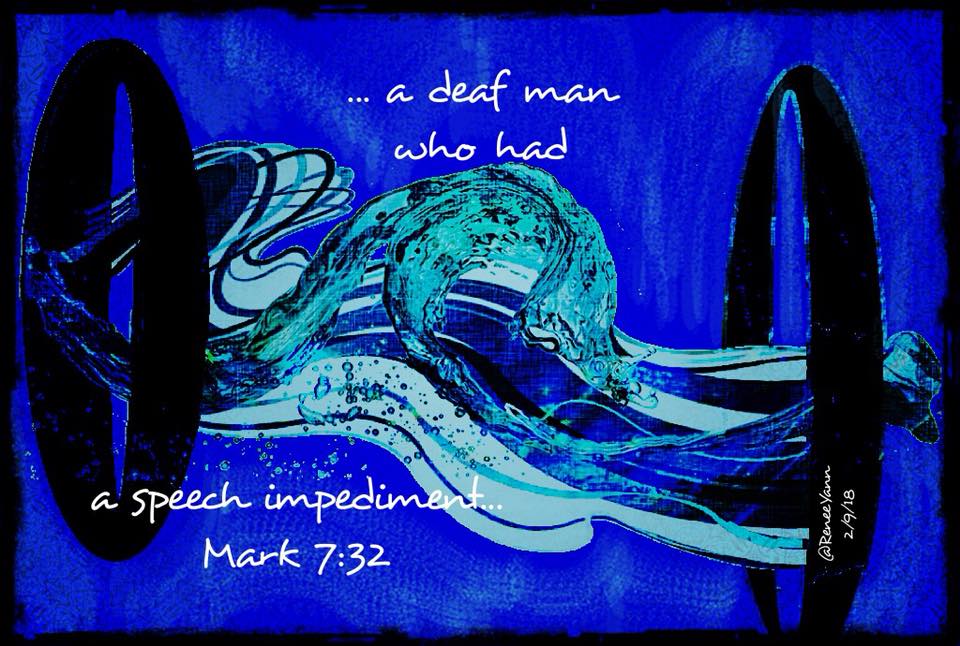
Our Gospel can teach us similar lessons. For undisclosed reasons, our central character is hog-tied by the incapacity to speak and hear. Jesus’s healing of this man shows us that we too can be healed from any incapacity to hear God’s truth in our hearts and to speak it in our lives. All that we need do is what this man has done – to place ourselves in God’s Presence with faith and hope.

Notice that Jesus heals this man in a very human way – with fingers, spit, and guttural groans.

Jesus put his finger into the man’s ears
and, spitting, touched his tongue;
then he looked up to heaven and groaned, and said to him,
“Ephphatha!” (that is, “Be opened!”)
And immediately the man’s ears were opened,
his speech impediment was removed,
and he spoke plainly.

Mark 7:33-35

For the most part, healing comes to us in very human ways as well. God works through our circumstances and relationships to offer us renewing grace. As we live out each day, our life challenges us with a silent command: “Ephphatha!” Be opened to God speaking to you in this moment, in this person, in this situation, in this silence!

Sometimes, we just cannot hear the challenge or speak the truth. We are mute and deaf to the grace of the moment. Today is a good time to pray for openness – Ephphatha!


Poetry: At the Kishinev School for Deaf and Mute Children – Katia Kapovich (1960), a bilingual Russian poet. Born in Chişinău, the capital of Moldova, she later lived in Moscow and St Petersburg. Unable to publish her work in the former USSR because she participated in a samizdat dissident group, she emigrated, moving in 1990 to Jerusalem, where she published her first collection, and then in 1992 to the USA. In 2001, US Poet Laureate Billy Collins selected her for a Witter Bynner Fellowship from the Library of Congress, and she has also been Poet-in-Residence at Amherst College.

My first autumn after college I worked
at the Kishinev School for the Deaf and Mute,
whose voices were not speech,
yet sounded like a language.
A foreign language, muffled and unknown
to the teachers. Its strange vowels,
born in their windpipes,
burned away in their throats.
I wrote the alphabet on the blackboard,
watched them move their lips as they
tried to articulate the sounds of Russian,
but no one could help them.
Yet there was a children’s god in the classroom
who guided them across quicksand
to where the Tower of Babel stood crumbling
and filled their mouths with the ABCs.

Music: I Need Thee Every Hour – in American Sign Language

Turning Always Toward God

Thursday of the Fifth Week in Ordinary Time
February 8, 2024

Today’s Readings:

https://bible.usccb.org/bible/readings/020824.cfm


Today, in God’s Lavish Mercy, our readings leave me wondering about what makes God tick.

We really know nothing about God for sure, except what we have learned and believed in Jesus. The writers of the Hebrew scriptures stretched their imaginations to understand and portray God to the people. Sometimes their metaphors work for us, sometimes not. Today’s, I think, is tricky.


In this first reading, God exacts justice for Solomon’s unfaithfulness, but He does it sort of like a prosecutor in a plea bargain.

I will deprive you of the kingdom … but not during your lifetime
It is your son whom I will deprive … but I won’t take away the whole kingdom.

What’s going on with God in this reading? Well, it’s more like “What’s going on with the writer who tries, retrospectively, to interpret God’s role in Israel’s history?


The passage is much more than a report on exchanges between God and Solomon.

It is a testament to Israel’s unwavering faith that God is intimately involved in their lives. In every circumstance, the believing community returns to the fact that experience leads to God and not away from Him.

So “Solomon … had TURNED his heart to strange gods” 
BUT God had not turned from Solomon. 
Nor would God EVER turn because 
God has CHOSEN Israel.


In our Gospel, the Syrophoenician woman tries to get the favor of Jesus to turn toward her. And actually, Jesus sounds pretty mean and stingy about it.

The woman was a Greek, a Syrophoenician by birth,
and she begged him to drive the demon out of her daughter.
He said to her, “Let the children be fed first.
For it is not right to take the food of the children
and throw it to the dogs.”
She replied and said to him,
“Lord, even the dogs under the table eat the children’s scraps.”
Then he said to her, “For saying this, you may go.
The demon has gone out of your daughter.”

Mark 7:26-30

The writer Mark is portraying, retrospectively, a significant time in Christ’s ministry. Jesus has really gone into hiding in a remote place. Apparently, he wants space to figure some things out. The story indicates that one of those things might be whether or not his ministry should embrace the Gentiles.

The persistence of this woman’s faith is a turning point for Jesus Who evolved, as we all do, in his understanding of his sacred role and meaning in the world.


These passages encourage us to constantly turn toward God Who lives our life with us. Such “turning” helps us to grow spiritually. As we become bigger in heart and soul, so does our concept of God and what God’s hope is for us.


Poetry: All this “turning” brought to mind some favorites lines from T.S. Eliot:

At the still point of the turning world. Neither flesh nor fleshless;
Neither from nor towards; at the still point, there the dance is,
But neither arrest nor movement. And do not call it fixity,
Where past and future are gathered. Neither movement from nor towards,
Neither ascent nor decline. Except for the point, the still point,
There would be no dance, and there is only the dance.

Music: Perfect Wisdom of Our God – The Gettys

Selflessness

Saturday of the Fourth Week in Ordinary Time
February 3, 2024

Today’s Readings:

https://bible.usccb.org/bible/readings/020324.cfm


Today, in God’s Lavish Mercy, our readings offer us insights into the ministry of leadership. They are insights worth pondering for at least these two reasons:

  • We are all called to be leaders in some way in our lives, be it as parent, teacher, supervisor, team captain, committee lead, board chair … you name it.
  • We need to be able to recognize good leaders in order to follow wisely, otherwise we are following self-interested fools determined to re-create us in their likeness.

In both our readings, leadership is characterized by this key element: selflessness.

Solomon, when given the chance to ask for anything he wants, asks for a gift that will benefit the community.


Give your servant, therefore, an understanding heart
to judge your people and to distinguish right from wrong.

1 Kings 4:9

Jesus and the disciples, exhausted from the press of the crowd, still respond in mercy to their relentless needs

Jesus said to the disciples,
“Come away by yourselves to a deserted place and rest a while.”
People were coming and going in great numbers,
and they had no opportunity even to eat.
So they went off in the boat by themselves to a deserted place.
People saw them leaving and many came to know about it.
They hastened there on foot from all the towns
and arrived at the place before them.

When Jesus disembarked and saw the vast crowd,
his heart was moved with pity for them,
for they were like sheep without a shepherd;
and he began to teach them many things.

Mark 6: 30-34

As we daily focus our lives on becoming more like Christ, the practice of selflessness can be tricky – how to live selflessly without losing one’s self; how to foster common and individual good without depleting one’s own spiritual strength. To my mind, these things are important:

Honesty: I think the grounding virtue of a good leader is honesty – with others and with self. Once a leader starts to pretend, deceive, equivocate, feign ignorance, or outright lie, (even to themselves), they are no longer fit to lead.

Spiritual Discipline: When we look at Jesus’s life, we see that he practiced a cycle of ministry and prayer. Several times in the Gospel, Jesus withdraws to commune with the Father. Although Christ was in union with the Father at all times, he exercised his ministry around a personal discipline of solitude and prayer.

Discernment: Solomon understands the importance of this gift. What Solomon actually prays for is the sensitivity to practice the “cardinal virtues” that we learned long ago in catechism class. Remember? Prudence, Justice, Fortitude, and Temperance.


Prose: Remember the Baltimore Catechism? Well, maybe some of you are too young to remember, Here’s how wikipedia defines it:

A Catechism of Christian Doctrine, Prepared and Enjoined by Order of the Third Council of Baltimore, or simply the Baltimore Catechism, was the national Catholic catechism for children in the United States, based on St. Robert Bellarmine’s 1614 Small Catechism. The first such catechism written for Catholics in North America, it was the standard Catholic school text in the country from 1885 to the late 1960s. From its publication, however, there were calls to revise it, and many other catechisms were used during this period. It was officially replaced by the United States Catholic Catechism for Adults in 2004, based on the revised universal Catechism of the Catholic Church.


Throughout my adult life, I have retained an appreciation for what I learned from the now-defunct edition of the Baltimore Catechism. While it conveyed the impression that a recipe for holiness could be compacted into a small manual, its inimitable Thomistic logic left valuable lessons with me to which I often return. Here are a few that informed my prayer today as I reflected on “selflessness”:

Besides the theological virtues of faith, hope, and charity there are other virtues, called moral virtues.

These virtues are called moral virtues because they dispose us to lead moral, or good lives, by aiding us to treat persons and things in the right way, that is, according to the will of God.

The chief moral virtues are: prudence, justice, fortitude, and temperance; these are called cardinal virtues.

These virtues are called cardinal virtues because they are like hinges on which hang all the other moral virtues and our whole moral life. The word “cardinal” is derived from the Latin word “cardo” meaning hinge.

  • Prudence disposes us in all circumstances to form right judgments about what we must do or not do.
  • Justice disposes us to give everyone what belongs to them.
  • Fortitude disposes us to do what is good despite any difficulty.
  • Temperance disposes us to control our desires and to use rightly the things which please ourselves.

Music: Song of Solomon – Martin Smith

Rejected at Nazareth

Memorial of Saint John Bosco, Priest
Wednesday of the Fourth Week in Ordinary Time
January 31, 2024

Today’s Readings:

https://bible.usccb.org/bible/readings/013124.cfm


Today, in God’s Lavish Mercy, David gets himself in trouble once again.

King David said to Joab and the leaders of the army who were with him,
“Tour all the tribes in Israel from Dan to Beer-sheba
and register the people, that I may know their number.”
Joab then reported to the king the number of people registered:
in Israel, eight hundred thousand men fit for military service; 
in Judah, five hundred thousand.

Afterward, however, David regretted having numbered the people,
and said to the LORD:
“I have sinned grievously in what I have done.
But now, LORD, forgive the guilt of your servant,
for I have been very foolish.”

2 Samuel 24: 2;10

In the later years of his kingship, David is pretty impressed with himself. The kingdom has grown exponentially. There is peace and prosperity. David wants a census taken so that he can assess his capacity for new expansion.

So why does God get so mad about this census? The Book of Exodus sets out that a person has the right to number only his own belongings. The People belong to God, not to David. David’s pride and self-satisfaction has taken him over.

Ps32_deep waters

However, as usual, David repents. This is probably the best lesson we can learn from him. Then, in a greatly allegorized treatment, God gives David a choice of three punishments.


Passages like this can confuse us if we interpret them literally. Does God really interact and punish like this? 

It helps to remember the purpose of these writings — not to relay a factual history, but rather to tell a story that helps us grow in relationship with God.

What I believe happened here is that a pestilence did fall upon the country. At the same time, David realized that his heart had grown selfish and graceless. He took the natural event as a sign to turn back to God. And then the writers told the story in a way that the ancient peoples could relate to – with a metaphorical image of a God that forgives but gets even.


In our Gospel, Jesus preaches a clearer and true vision of God – a vision of Complete Mercy, especially toward the vulnerable, weak, and sinful. That pretty much includes all of us.

Jesus releases the power of this Divine Mercy by his words and miracles. But his own family and neighbors reject him. They are more comfortable with a God who behaves like they do – meting out more judgement and punishment (preferably toward others!😉) than mercy and inclusive benediction.


In this Gospel, we begin to see Jesus as One who asks not only for repentance but for conversion – for a new way of being with God and neighbor, the way of Love.

How might we have responded had we been in that neighborhood synagogue? How are we responding today?


Film Excerpt from The Chosen: Jesus is rejected at Nazareth


Music: Today’s Responsorial Psalm 32 – Marty Goetz ( Lyrics below)

Psalm 32 – Marty Goetz

These are periled times we live in, trouble everywhere
Weary hearts will often give in to this world’s despair
But high and over all, our Father knows our every care
And in His Book, if you will look, you’ll find His promise there

(Chorus)
He who trusts in the Lord
Mercy shall surround him
He who trusts in the Lord
Mercy shall surround him
Be glad in the Lord and rejoice
You upright in heart, lift up your voice
For great is His mercy toward all who trust in the Lord

Soon will be the time when we will see the Holy One
Oh how sweet to know that He’ll complete what He’s begun
And blessed is the man who stands forgiven in God’s son
And blessed are they who in that day will hear Him say, “Well done”

(Chorus)

Gracious is He and slow to anger
His loving kindness has no end
With love to embrace both friend and stranger
Reaching out to one and all, who upon His name will call

(Chorus)

Mercy is His reward
For all who trust, for the pure and just
Who put their trust in the Lord
For all who trust for the pure and just who put their trust in the Lord

Mercy in the Darkness

Monday of the Fourth Week in Ordinary Time
January 29, 2024

Today’s Readings:

https://bible.usccb.org/bible/readings/012924.cfm


Today, in God’s Lavish Mercy, our readings are peppered with angst, curses, demons, and rampaging pigs. Not the perfect way to start your day, right? So after quietly reading all the passages, I asked myself if they had anything to offer me this morning, or should I just play Spider Solitaire on my iPad?

As I considered that question, last night’s evening news flashed before my mind – gun violence, assaults, war, hit-and-run accidents! Suddenly I realized that my world is not that different from the mayhem around David or Jesus. My world just wears different clothes and can create chaos faster because of technological power.


The cause of David’s dire situation is clearly defined by Shimei, the curser:

Shimei Curses David – by Julius Schnorr von Carolsfeld

As David was approaching Bahurim,
a man named Shimei, the son of Gera
of the same clan as Saul’s family,
was coming out of the place, cursing as he came.
He threw stones at David and at all the king’s officers,
even though all the soldiers, including the royal guard,
were on David’s right and on his left.
Shimei was saying as he cursed:
“Away, away, you murderous and wicked man!
The LORD has requited you for all the bloodshed in the family of Saul,
in whose stead you became king,
and the LORD has given over the kingdom to your son Absalom.
And now you suffer ruin because you are a murderer.”

2 Samuel 16:5-7

In other words, David is completely out of alignment with the “self” God created him to be. God’s beautiful hope in David has been nearly swallowed up by most of the seven deadly sins. And good for Shimei, who slings every one of them back in David’s face! What a wake-up call!


In our Gospel, the Evil One has taken up residence in the skewed and troubled soul of a tomb-dweller:

… a man from the tombs who had an unclean spirit met Jesus.
The man had been dwelling among the tombs,
and no one could restrain him any longer, even with a chain.
In fact, he had frequently been bound with shackles and chains,
but the chains had been pulled apart by him and the shackles smashed,
and no one was strong enough to subdue him.

Mark 5:3-4

Swine Driven into the Sea by James Tissot

For reasons the Gospel does not reveal, demons rage inside this pathetic man. Jesus confronts them with an intensity even beyond Shimei’s, casting them into the subsequently nose-diving swine:

Catching sight of Jesus from a distance,
he ran up and prostrated himself before him,
crying out in a loud voice,
“What have you to do with me, Jesus, Son of the Most High God?
I adjure you by God, do not torment me!”
(Jesus had been saying to him, “Unclean spirit, come out of the man!”)
Jesus asked him, “What is your name?”
He replied, “Legion is my name. There are many of us.”
And he pleaded earnestly with Jesus
not to drive them away from that territory.

Now a large herd of swine was feeding there on the hillside.
And they pleaded with him,
“Send us into the swine. Let us enter them.”
And he let them, and the unclean spirits came out and entered the swine.
The herd of about two thousand rushed down a steep bank into the sea,
where they were drowned.

Mark 5:6-13

Wow! I mean, really, these two readings are Cecil B. DeMille stuff! Certainly there is a lesson for each of us somewhere in all this drama.

  • Might David’s plight remind us to keep our lives in alignment with God’s hope and will for us?
  • Might Shimei’s rage and brutal honesty help us to consider any retained hurts and vengeances we harbor?
  • Might the poor, chained tomb-dweller help us to place our own small demons squarely in the merciful light of God’s healing power before they get too powerful for us to face?
  • Might the devastated pigs caution us that innocent people can get hurt when our sinful inclinations derail us?

Even though many aspects of today’s readings are harsh, they hold a central message of God’s enduring mercy toward us even in times of desperation and apparent hopelessness. May we hold on to this truth if we ever come to a place of darkness in our lives. And may we offer that Light to those we encounter who are bearing such suffering.


Poetry: Excerpt from “Love Song to the Demon-Possessed Pigs of Gadara” – William Fargason

William Fargason is the author of Love Song to the Demon-Possessed Pigs of Gadara (University of Iowa Press, 2020), winner of the 2019 Iowa Poetry Prize and the 2020 Florida Book Award in Poetry (Gold Medal). In this collection, Fargason inspects the pain of memory alongside the pain of the physical body. Fargason takes language to its limits to demonstrate how grief is given a voice. His speaker confronts illness, grapples with grief, and heals after loss in its most crushing forms. (from Iowa University Press).


The silence just before and just after,
and the black eyes as you leapt— “
no protest, no acceptance either.

You ran almost in unison,
a dance without music,
a curtain call,
and the crowd standing knowing this is what happens
once we find beauty:

                                      we must watch it leave.


Music: Healing Time on Earth – John Denver