Today, in God’s Lavish Mercy, we pray the most painful story of our faith.
So they took Jesus, and, carrying the cross himself, he went out to what is called the Place of the Skull, in Hebrew, Golgotha. There they crucified him, and with him two others, one on either side, with Jesus in the middle. Pilate also had an inscription written and put on the cross. It read, “Jesus the Nazorean, the King of the Jews.”
John 19:16-18
As we watch Infinite Goodness broken on the altar of evil, our own sufferings and those of all the world pour out before us. Because it was for our suffering that Christ died, not only for that of his own time.
Yet it was our infirmities that he bore, our sufferings that he endured, while we thought of him as stricken, as one smitten by God and afflicted. But he was pierced for our offenses, crushed for our sins; upon him was the chastisement that makes us whole, by his stripes we were healed.
Isaiah 53:4-5
Haven’t you asked yourself the question at least once, “Why did it have to be like this? Couldn’t our Redemption have been accomplished without this agony?
It is a question we carry with us throughout our lives as the profound contradiction of suffering challenges and often confounds us. Our faith is tested in pain’s relentless onslaught. Our souls struggle to understand what suffering is trying to tell us about God!
Jesus himself knew that struggle as we see so clearly in the Gethsemane story.
Good Friday is a day to sit quietly with that question, and to finally release it into the Mystery of God. We can never reach an answer or solution. We were not meant to.
We can only trust. That trust will allow suffering to transform us. And though we cannot find a solution, we can, like Jesus in the Garden, reach a place of sacred abandonment to God. From there, our true salvation can begin.
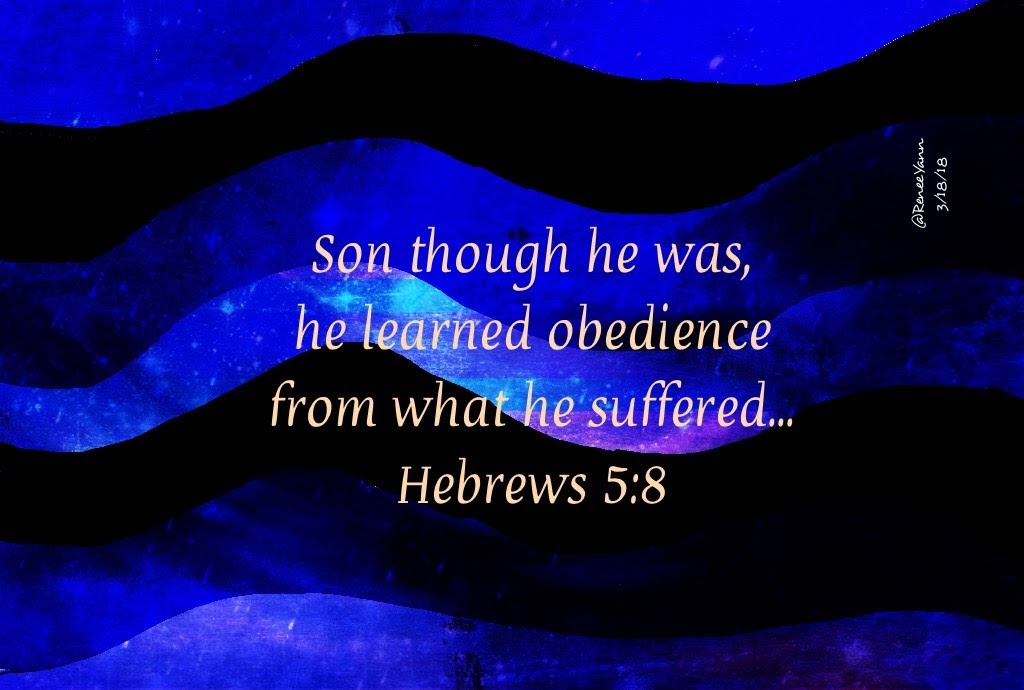
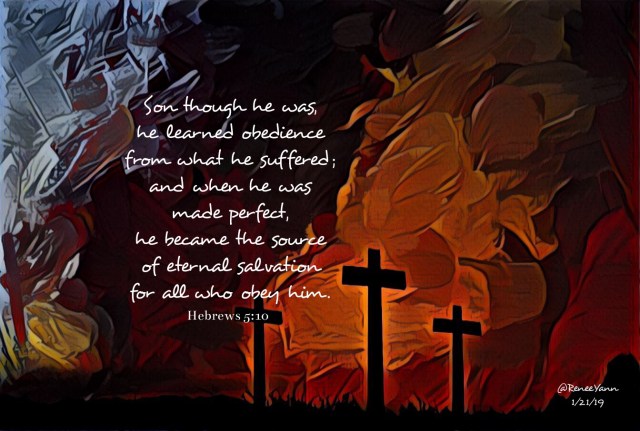
In the days when Christ was in the flesh, he offered prayers and supplications with loud cries and tears to the one who was able to save him from death, and he was heard because of his reverence. Son though he was, he learned obedience from what he suffered; and when he was made perfect, he became the source of eternal salvation for all who obey him.
Hebrews 5:7-9
Poetry: What If I Fall? by Erin Hanson
There is freedom waiting for you,
On the breezes of the sky,
And you ask, "What if I fall?"
Oh, but my darling,
What if you fly?
Music: Take, Lord, Receive: the prayer of St. Ignatius of Loyola – John Foley, SJ
Take, Lord, receive. all my liberty. My memory, understanding, my entire will! Give me only your LOVE, and your Grace, that’s enough for me! Your love and your grace, are enough for me! Take Lord, receive, All I have and posses. You have given unto me, Now I return it. Give me only your love, and your grace, that’s enough for me! Your love and your grace, are enough for me! Take Lord receive, all is yours now. Dispose of it, wholey according to your will. Give me only your love, and your grace, that’s enough for me! Your love and your grace, are enough for me!
Today, in God’s Lavish Mercy, the greatest act of love unfolds around a simple table, in the last rich hues of a Jerusalem sunset. No doubt the Twelve whom we are used to seeing in the paintings, and the many other who had sustained Christ’s journey by their service, sensed that this was an extraordinary Seder.
As you place yourself in the scene, you may wish to be one of the Apostles, or you may be the one who baked bread that would become His Body. You may be the one who decanted the precious wine to be His Blood.
Wherever you are in that ancient, yet living story – and wherever you are tonight, let the ancient awe fill your heart as you hear these astounding words:
Brothers and sisters: I received from the Lord what I also handed on to you, that the Lord Jesus, on the night he was handed over, took bread, and, after he had given thanks, broke it and said, “This is my body that is for you. Do this in remembrance of me.” In the same way also the cup, after supper, saying, “This cup is the new covenant in my blood. Do this, as often as you drink it, in remembrance of me.” For as often as you eat this bread and drink the cup, you proclaim the death of the Lord until he comes.
1 Corinthians 11: 23-26
After the supper, to help us comprehend his incomprehensible Gift, Jesus shows us what Eucharist looks like in everyday practice. It looks like the selfless service of a tender foot washing, the humble bending of our hearts to tend another’s need.
So, during supper, fully aware that the Father had put everything into his power and that he had come from God and was returning to God, he rose from supper and took off his outer garments. He took a towel and tied it around his waist. Then he poured water into a basin and began to wash the disciples’ feet and dry them with the towel around his waist.
….
So when he had washed their feet and put his garments back on and reclined at table again, he said to them, “Do you realize what I have done for you? You call me ‘teacher’ and ‘master,’ and rightly so, for indeed I am. If I, therefore, the master and teacher, have washed your feet, you ought to wash one another’s feet. I have given you a model to follow, so that as I have done for you, you should also do.”
Dearest Jesus, teach us the deep, deep lessons of these readings. Let them live in us in sacramental vigor poured over the world in Mercy.
As you walk now from the Upper Room toward the Agony of Gethsemane, let us walk beside you in trusting love.
Poetry: Loves – Scott Cairns is the author of eight books of poetry, including The Theology of Doubt (1985), The Translation of Babel (1990), Philokalia (2002), Idiot Psalms (2014), and Slow Pilgrim: The Collected Poems (2015). Spirituality plays an integral role in Cairns’ writing; in an interview, he said, “I’ve come to think of beauty as how God woos us to himself. One doesn’t so much create it or illuminate it as partake of it. Thereafter, one participates, collaborates, in its endless development.”
One of the more dramatic poems is “Loves.” In the voice of Mary Magdalen it offers a strong critique of the separation of flesh and spirit: “All loves are bodily, require / that the lips part, and press their trace / of secrecy upon the one / beloved . . .
Loves
Of Love’s discrete occasions, we
observe sufficient catalogue,
a likely-sounding lexicon

pronounced so as to implicate
a wealth of difference, where reclines
instead a common element,

itself quite like those elements
partaken at the table served
by Jesus on the night he was

betrayed—like those in that the bread
was breakable, the wine was red
and wet, and met the tongue with bright,

intoxicating sweetness, quite
like ... wine. None of what I write arrives
to compromise that sacrament,

the mystery of spirit graved
in what is commonplace and plain—
the broken, brittle crust, the cup.

Quite otherwise, I choose instead
to bear again the news that each,
each was still itself, substantial

in the simplest sense. By now, you
will have learned of Magdalen, a name
recalled for having won a touch

of favor from the one we call
the son of man, and what you’ve heard
is true enough. I met him first

as, mute, he scribbled in the dust
to shame some village hypocrites
toward leaving me unbloodied,

if ill-disposed to taking up
again a prior circumstance.
I met him in the house of one

who was a Pharisee and not
prepared to suffer quietly
my handling of the master’s feet.

Much later, in the garden when,
having died and risen, he spoke
as to a maid and asked me why

I wept. When, at any meeting
with the Christ, was I not weeping?
For what? I only speculate

—brief inability to speak,
a weak and giddy troubling near
the throat, a wash of gratitude.

And early on, I think, some slight
abiding sense of shame, a sop
I have inferred more recently

to do without. Lush poverty!
I think that this is what I’m called
to say, this mild exhortation

that one should still abide all love’s
embarrassments, and so resist
the new temptation—dangerous,

inexpedient mask—of shame.
And, well, perhaps one other thing:
I have received some little bit

about the glib divisions which
so lately have occurred to you
as right, as necessary, fit

That the body is something less
than honorable, say, in its
... appetites? That the spirit is

something pure, and—if all goes well—
potentially unencumbered
by the body’s bawdy tastes.

This disposition, then, has led
to a banal and pious lack
of charity, and, worse, has led

more than a few to attempt some
soul-preserving severance—harsh
mortifications, manglings, all

manner of ritual excision
lately undertaken to prevent
the body’s claim upon the heart,

or mind, or (blasphemy!) spirit—
whatever name you fix upon
the supposéd bodiless.

I fear that you presume—dissecting
the person unto something less
complex. I think that you forget

you are not Greek. I think that you
forget the very issue which
induced the Christ to take on flesh.

All loves are bodily, require
that the lips part, and press their trace
of secrecy upon the one

beloved—the one, or many, endless
array whose aspects turn to face
the one who calls, the one whose choice

it was one day to lift my own
bruised body from the dust, where, it seems
to me, I must have met my death,

thereafter, this subsequent life
and late disinclination toward
simple reductions in the name

of Jesus, whose image I work
daily to retain. I have kissed
his feet. I have looked long

into the trouble of his face,
and met, in that intersection,
the sacred place—where body

and spirit both abide, both yield,
in mutual obsession. Yes,
if you’ll recall your Hebrew word.

just long enough to glimpse in its
dense figure power to produce
you’ll see as well the damage Greek

has wrought upon your tongue, stolen
from your sense of what is holy,
wholly good, fully animal—
the body which he now prepares.
Music: Tenebrae Music for Holy Thursday – Giovanni Pierluigi da Palestrina (1525-94)
This musical meditation is based on the Lamentations in the Book of Jeremiah. The word “tenebrae” means “shadows”.
Today, in God’s Lavish Mercy, we stand beside Jesus in a tangled world of insults, violence, plots, and dirty money. How sickening and painful such an atmosphere must have been to him who is Love and Divine Innocence. The psalmist describes the pain like this:
Insult has broken my heart, and I am weak, I looked for sympathy, but there was none; for consolers, not one could I find. Rather they put gall in my food, and in my thirst they gave me vinegar to drink.
Psalm 69: 21-22
Despite such trauma, we see Christ’s trust and holy determination to embrace the Father’s Will however it is revealed to him.
The Lord GOD is my help, therefore I am not disgraced; I have set my face like flint, knowing that I shall not be put to shame.
Isaiah 50:7
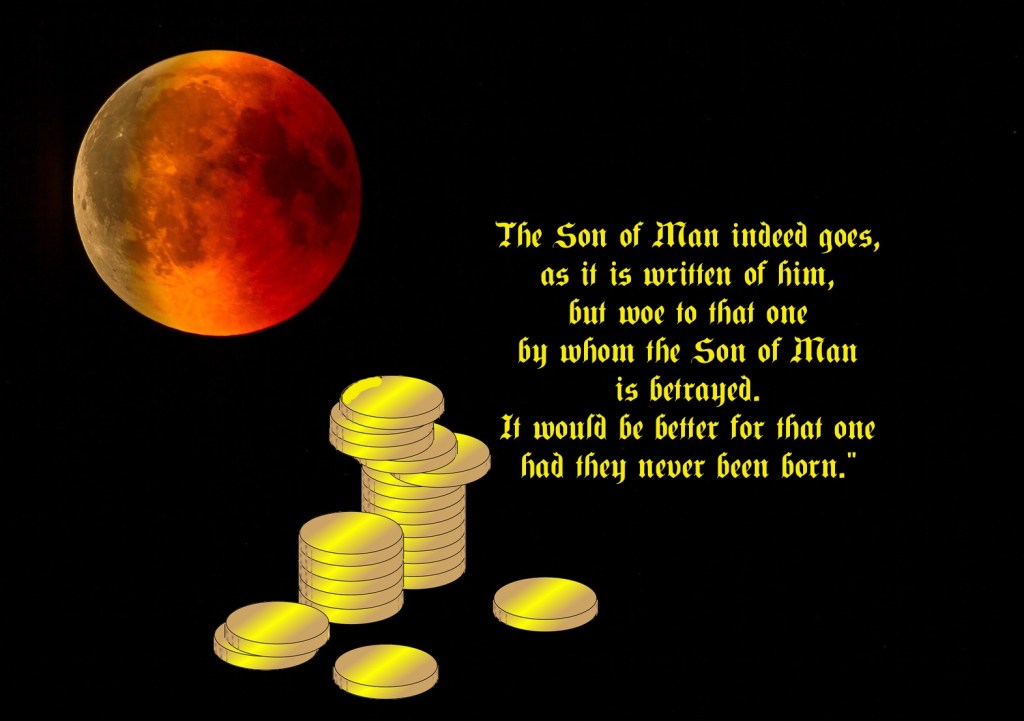
As we look to Jesus’s fidelity to find courage in our own challenges, we must also be starkly aware of what opposing infidelity looks like. We see it in the face of Judas – the Pretender who reclines at the Lord’s table, still eats the sacred food, dissembles his innocence while the blood-coins jingle in his pocket.
Once again, as the Passion story unfolds before us, we can find ourselves somewhere – perhaps many places – in its lines. Wherever that is, let us pray there with Jesus to be open in trust and fidelity to its transformative grace.
Poetry: Slow through the Dark – Paul Lawrence Dunbar
Slow moves the pageant of a climbing race; Their footsteps drag far, far below the height, And, unprevailing by their utmost might, Seem faltering downward from each hard won place. No strange, swift-sprung exception we; we trace A devious way thro’ dim, uncertain light,— Our hope, through the long vistaed years, a sight Of that our Captain’s soul sees face to face.
Who, faithless, faltering that the road is steep, Now raiseth up his drear insistent cry? Who stoppeth here to spend a while in sleep Or curseth that the storm obscures the sky? Heed not the darkness round you, dull and deep; The clouds grow thickest when the summit’s nigh.
Today, in God’s Lavish Mercy, the clouds thicken around Jesus.
Reclining at table with his disciples, Jesus was deeply troubled and testified, “Amen, amen, I say to you, one of you will betray me.” The disciples looked at one another, at a loss as to whom he meant.
John 13:21
How painful for Jesus, and for these who have shared the glorious years of his ministry, to now sit with suspicion among yesterday’s friends. How lonely for each one as the dark force of doubt pushes them away from one another!
Only love can break through this kind of doubt, courageously exposing the truth in order that it might be reconciled and offered forgiveness:
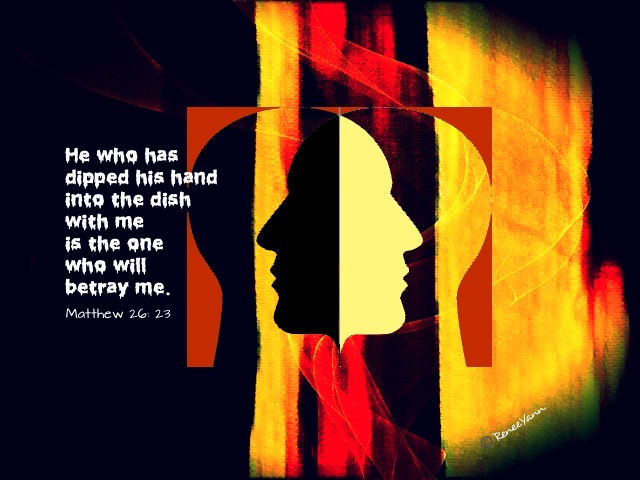
One of his disciples, the one whom Jesus loved, was reclining at Jesus’ side. So Simon Peter nodded to him to find out whom he meant. He leaned back against Jesus’ chest and said to him, “Master, who is it?”
Jesus answered, “It is the one to whom I hand the morsel after I have dipped it.” So he dipped the morsel and took it and handed it to Judas, son of Simon the Iscariot.
John 13: 21-26
As the rest of the Passion story unfolds, both Judas and Peter will need the kind of forgiveness these readings describe. Both prove false to Jesus’s trust. But one has the humble contrition to seek forgiveness. The other cannot forget himself enough to do so.
This “doubtful Tuesday” can teach us much about expectations, courage, truth, love, trust, humility, and forgiveness. Let us sit beside Jesus at the Gospel table and ask him, like the Disciples, how we measure up to his hope for us.
Poetry: Christ Washed the Feet of Judas – George Marion McClellan
Christ washed the feet of Judas! The dark and evil passions of his soul, His secret plot, and sordidness complete, His hate, his purposing, Christ knew the whole. And still in love he stooped and washed his feet.
Christ washed the feet of Judas! Yet all his lurking sin was bare to him, His bargain with the priest, and more than this, In Olivet, beneath the moonlight dim, Aforehand knew and felt his treacherous kiss.
Christ washed the feet of Judas! And so ineffable his love ’twas meet, That pity fill his great forgiving heart, And tenderly to wash the traitor’s feet, Who in his Lord had basely sold his part.
Christ washed the feet of Judas! And thus a girded servant, self-abased, Taught that no wrong this side the gate of heaven Was ever too great to wholly be effaced, And though unasked, in spirit be forgiven.
And so if we have ever felt the wrong Of Trampled rights, of caste, it matters not, What e’er the soul has felt or suffered long, Oh, heart! this one thing should not be forgot: Christ washed the feet of Judas
Music: The Kiss – Joe Niemand
Meet me in the garden My love Meet me there at midnight
At the place only we know My love A kiss awaits tonight
In the darkness between the flowers My love In the shadows of the moon
Your lips will tear the pretense like the curtain tomorrow afternoon
And so the glow of approaching torches Makes the darkness dance like black flames Ever faster to the music of every heart that refuses to be saved
I prayed this could be different That my death could save you too But your choices are your own Now my friend, do what you came to do
Today, in God’s Lavish Mercy we find Jesus standing at the edge of Light and Darkness.
Isaiah, speaking in the Father’s voice, summons and commissions Jesus to the act of Redemption:
Thus says God, the LORD, who created the heavens and stretched them out, who spreads out the earth with its crops, Who gives breath to its people and spirit to those who walk on it:
I, the LORD, have called you for the victory of justice, I have grasped you by the hand; I formed you, and set you as a covenant of the people, a light for the nations,
To open the eyes of the blind, to bring out prisoners from confinement, and from the dungeon, those who live in darkness.
Isaiah 42: 1-8
The divine mandate is triumphant in tone and looks to the other side of Good Friday for its power and hope. But Jesus is no fool. He realizes that Sunday’s paper-thin adulation will shrivel in the coming week’s turmoil. He knows that before the Alleluias sound there will be a sorrowful adagio.
So as enemies seethe in Jerusalem’s shadows, Jesus seeks the light and warmth of his beloved friends. Among them, Mary in particular reaches into his silence, touching threads of hope tangled with disappointment, of courage knotted with fear.
In Bethany, they gave a dinner for him, and Martha served, while Lazarus was one of those reclining at table with him. Mary took a liter of costly perfumed oil made from genuine aromatic nard and anointed the feet of Jesus and dried them with her hair; the house was filled with the fragrance of the oil.
John 12: 1-3
Into this warm comfort, Judas injects his icy venom. This is no surprise to John who clearly describes Judas not as a spontaneous betrayer, but as a long-smoldering “thief” who had never fully embraced his discipleship:
Then Judas the Iscariot, one of his disciples, and the one who would betray him, said, “Why was this oil not sold for three hundred days’ wages and given to the poor?” He said this not because he cared about the poor but because he was a thief and held the money bag and used to steal the contributions.
John 12: 4-6
Today’s readings are filled with the emotions and personalities that Jesus experienced. We will find ourselves somewhere among these as we walk by his side toward Calvary.
Poetry: I Should Not Dare to Leave My Friend – Emily Dickinson
I should not dare to leave my friend,
Because—because if he should die
While I was gone—and I—too late—
Should reach the Heart that wanted me—
If I should disappoint the eyes
That hunted—hunted so—to see—
And could not bear to shut until
They ‘noticed’ me—they noticed me—
If I should stab the patient faith
So sure I’d come—so sure I’d come—
It listening—listening—went to sleep—
Telling my tardy name—
My Heart would wish it broke before—
Since breaking then—since breaking then—
Were useless as next morning’s sun—
Where midnight frosts—had lain!
Music: Gautier Capuçon & friends play Adagio in G minor (Albinoni, arr. Werner Thomas-Mifune)
Today, in God’s Lavish Mercy, we begin once again – and we know the journey so well.
When Jesus and the disciples drew near Jerusalem and came to Bethphage on the Mount of Olives, Jesus sent two disciples, saying to them, “Go into the village opposite you, and immediately you will find an ass tethered, and a colt with her. Untie them and bring them here to me.
Matthew 21:1-2
We have traveled this story many times with Jesus. We have seen the Sunday-green palms shrivel and darken by Friday. We have heard the careless cheers turn to frightened whispers. We have seen the thick crowd thin with fear and faithlessness.
The very large crowd spread their cloaks on the road, while others cut branches from the trees and strewed them on the road. The crowds preceding him and those following kept crying out and saying: “Hosanna to the Son of David; blessed is he who comes in the name of the Lord; hosanna in the highest.” And when he entered Jerusalem the whole city was shaken and asked, “Who is this?” And the crowds replied, “This is Jesus the prophet, from Nazareth in Galilee.”
Matthew 21: 8-11
With each succeeding Holy Week, if we give ourselves to grace, Love maps itself more deeply in our souls. Our own lives, laid beside his in prayer, align us more closely to our own unique Redemption, as we can pray in this most beautiful of scripture passages:
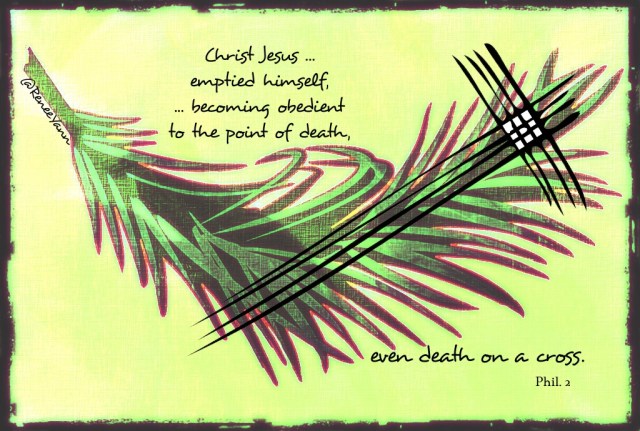
Christ Jesus, though he was in the form of God, did not regard equality with God something to be grasped. Rather, he emptied himself, taking the form of a slave, coming in human likeness; and found human in appearance, he humbled himself, becoming obedient to the point of death, even death on a cross.
Philippians 2:6-8
The rich treasures of our Holy Week readings and rituals carry us deeper into the eternal current of Love Who is Jesus Christ. We are changed, if we let ourselves, because we witness and believe the Divine Contradiction of the Cross and Resurrection – and we let it happen within our own souls.
Indeed, we are privy to the profound intimacy between Jesus and his Father … between Love Incarnate and Love Enlivening. It is an intimacy we pray to be part of because it changes everything to Love.
Because of this, God greatly exalted him and bestowed on him the name which is above every name, that at the name of Jesus every knee should bend, of those in heaven and on earth and under the earth, and every tongue confess that Jesus Christ is Lord, to the glory of God the Father.
Philippians 2: 9-11
In our readings today, and each day this week, try to find the small phrase where your life meets Christ’s journey. Listen with Jesus to the Father’s stunning revelation that Life is accomplished through death to all that is not born of God.
But Jesus cried out again in a loud voice, and gave up his spirit. And behold, the veil of the sanctuary was torn in two from top to bottom. The earth quaked, rocks were split, tombs were opened, and the bodies of many saints who had fallen asleep were raised. And coming forth from their tombs after his resurrection, they entered the holy city and appeared to many. The centurion and the men with him who were keeping watch over Jesus feared greatly when they saw the earthquake and all that was happening, and they said, “Truly, this was the Son of God!”
Matthew 27:50-54
Poetry: Primary Wonder – Denise Levertov
Days pass when I forget the mystery.
Problems insoluble and problems offering
their own ignored solutions
jostle for my attention, they crowd its antechamber
along with a host of diversions, my courtiers, wearing
their colored clothes; cap and bells.
                                                        And then
once more the quiet mystery
is present to me, the throng's clamor
recedes: the mystery
that there is anything, anything at all,
let alone cosmos, joy, memory, everything,
rather than void: and that, O Lord,
Creator, Hallowed One, You still,
hour by hour sustain it.
It feels appropriate that, before we resume gathering together in Lavish Mercy tomorrow, I comment a bit on my time away from the blog.
First, I sincerely thank you all for your prayers and encouragement. In a shadowy time, you gave me the generous lights of comfort and joy. I am deeply grateful.
Now, as I continue to heal from a time of unexpected vulnerability, I have the advantage of being able to reflect in peace on what has happened to me.
Part of that peace and healing has been a move to our Motherhouse, a loving community where I have the support and care I need right now. I am blessed beyond words by this gift.
This photo was taken in the early 1900s for the Merion Historical Society
My new room is on the very western end of the building (See blue arrow above.) However, I look out my ample windows not to a sunset horizon – but instead to the imposing wall of our magnificent chapel. Some were concerned that the “wall view” might not be optimal. They didn’t realize that the wall housed an unexpected gift – a bird’s eye view of the glorious rose window that, for over a century, has blessed our chapel with dawn Light.
And I am now on the other side of that Light as it flows over my beloved community – a place that feels ever closer to God with each sunrise.
Sometimes, especially in the evening, I will catch a lovely glow within chapel on one of the several stained glass windows. I consider these my own special sunsets given only to me for my unique reflection. These windows are icons for me as I pray and learn from my own little “passover experience” this winter.
Evening Window from the Outside!
During times of suffering, loss, or unchosen change in our lives, it is hard to turn to the Light. As we begin our Holy Week walk, consider that Jesus faced this struggle in the shadows of Gethsemane. There, he taught us what it takes not only to turn toward Light, but to become It.
Then going out he went, as was his custom, to the Mount of Olives, and the disciples followed him.
When he arrived at the place he said to them, “Pray that you may not undergo the test.”
After withdrawing about a stone’s throw from them and kneeling, he prayed, saying, “Father, if you are willing, take this cup away from me; still, not my will but yours be done.”
And to strengthen him an angel from heaven appeared to him.
Matthew 22: 40-43
As it was with Jesus, a “Gethsemane moment” in any of our lives is an invitation to abandon ourselves in trust to God’s inscrutable Love — a falling helplessly, but hopefully, into a Love that changes everything.
For Jesus, his embrace of God’s Will in that tenebrous garden opened his heart to the glory of the Resurrection and led him to the other side of Light. How might such self-giving open and lead us?
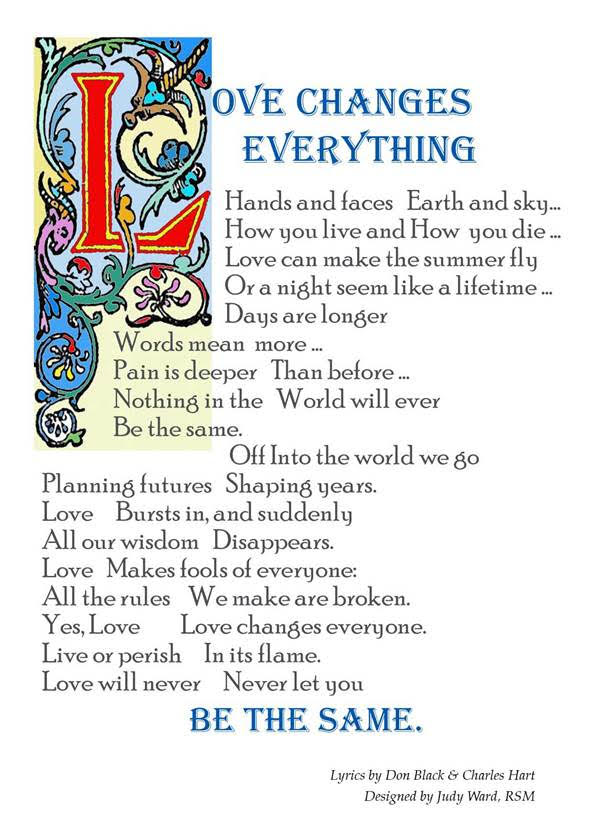
Love Changes Everything – Andrew Lloyd Webber, Don Black, and Charles Hart
Today, in God’s Lavish Mercy, our reading from Hebrews describes Jesus as the perfect high priest. Through the Father’s call, Jesus took on our imperfect nature and transformed it by his Life, Death and Resurrection. In the Eucharist, Jesus left us a living memorial of this transformation so that we might participate in its saving mystery.
Paul’s “perfected priest” is patient because his own weakness humbles him. He does not take honor upon himself, but receives it humbly from God.
Jesus, the model of this priesthood,
… in the days when he was in the Flesh, … offered prayers and supplications with loud cries and tears to the one who was able to save him from death, and he was heard because of his reverence.
The perfection of Christ’s priesthood was accomplished through suffering and obedience. This is how Jesus teaches us to live in reverence and humble service.
As I read and pray with this scriptural understanding of priesthood, I pray for our Church. The catastrophic scandals involving our priests and leaders have deeply shaken the faith of many Catholics over the past several years.
Many are frustrated by the continued refusal of some in our Church to open themselves to new models of priestly service which are grounded in mutuality, inclusivity and simplicity.
The accretions of institutionalization, hierarchical camouflage, and sexist rationale have mitigated the Church’s credibility to touch the lives of ordinary people, especially our emerging adults.
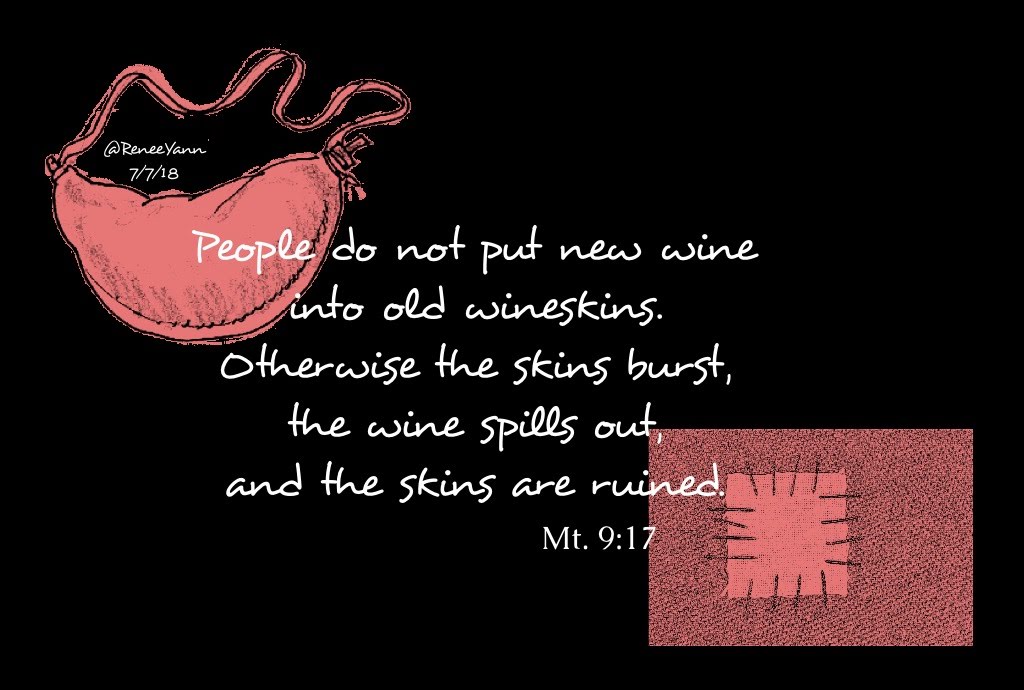
In our Gospel, Jesus talks about an old cloak that needs a patch to make it whole again. He talks about new wine that must be captured and preserved in new wine skins. For me, he is talking about our Church which must be continually renewed and grounded in the truth of the Gospel.
Let us pray that the Church may continue to be transformed by humble obedience to God’s call – just as the high priest of our first reading was perfected.
Let us pray today for our good Pope Francs, bishops, theologians and spiritual leaders – and for the whole People of God – that we may hear and respond.
Prayer: In place of a poem today, this beautiful prayer written in 2019 by Rita Thiron, from the Federation of Diocesan Liturgical Commissions
Prayer for the Church

Heavenly Father,
In every age, you have been our refuge.
Yet again and still, we stand before you
asking for your protection on your holy Church.

For the victims of abuse and their families,
pour out your healing and your peace.
For the Bishops of this country,
inspire their decisions,
and guide them with your Spirit.

For the thousands of good and faithful priests,
who have followed your call
to serve you and your people in holiness,
sustain them by your grace.

For the faithful who are angry, confused,
and searching for answers,
embrace them with your love,
restore their trust,
console them with your clear Gospel message,
and renew them with your sacraments.

We place our Church in your hands,
for without you we can do nothing.

May Jesus, our High Priest and true compass,
continue to lead her in every thought and action
 – to be an instrument of justice,
a source of consolation,
a sacrament of unity,
and a manifestation of your faithful covenant.

Grant this through that same Jesus Christ, our Lord,
who lives and reigns with you
in the unity of the Holy Spirit,
one God, for ever and ever.
Amen.
Today, in God’s Lavish Mercy, we see Jesus fully enrobed in the power of his mission and ready to embark on its accomplishment.
When I prayed with today’s readings, I pictured Jesus standing proudly before the Father saying, “I’m fully ready now to answer the call and become all that I am meant to be for the world.”
The image reminded me of a day long ago when I finally received the last little piece of the outfit I would wear as Mercy postulant. It was late August 1963, just a month before entrance, and very hot. Nevertheless, in a bit of girlish giddiness, I decided to don the entire regalia for the first time and see what my future would look like. After struggling into a few of the unfamiliar pieces, I ran down the stairs to my mother waiting in our living room.
I’ll never forget her face. It was an immense mix of pride, loss, hope, love and astonishment. Neither one of us said, nor had to say, a word. Everything that had been only a dream in my heart went forward – for real – from that moment. Mom knew I meant to do this thing. And, maybe for the first time, I knew it too.
I can picture God the Father looking on Jesus in somewhat the same way as Jesus now stands at the edge of a future he cannot yet imagine.
In our first reading, we see Jesus clothed in the fulfillment of Isaiah’s ancient prophecy:
The LORD said to me: You are my servant, Israel, through whom I show my glory. Now the LORD has spoken who formed me as his servant from the womb, that Jacob may be brought back to him and Israel gathered to him; and I am made glorious in the sight of the LORD, and my God is now my strength!
Isaiah 49:3,5
In our Responsorial Psalm, we can hear Jesus exuding Messianic commitment:
Here I am, Lord; I come to do your will. “In the written scroll it is prescribed for me, to do your will, O my God, is my delight, and your law is within my heart!” I announced your justice in the vast assembly; I did not restrain my lips, as you, O LORD, know. Here am I, Lord; I come to do your will.
In John’s Gospel, John the Baptist stands as a witness to Christ’s messianic authority to execute the Redemptive Act promised in Isaiah:
It is too little, the LORD says, for you to be my servant, to raise up the tribes of Jacob, and restore the survivors of Israel; I will make you a light to the nations, that my salvation may reach to the ends of the earth.
Isaiah 9:6
John testified further, saying, “I saw the Spirit come down like a dove from heaven and remain upon him. I did not know him, but the one who sent me to baptize with water told me, ‘On whomever you see the Spirit come down and remain, he is the one who will baptize with the Holy Spirit.’ Now I have seen and testified that he is the Son of God.”
John 1:32-34
With today’s readings, Jesus begins the great journey to redeem us. We begin with him, praying that throughout this liturgical year, we may be ever more deepened in the grace of that Redemption.
Poetry: The Lamb – William Blake
Little Lamb who made thee
Dost thou know who made thee
Gave thee life & bid thee feed.
By the stream & o'er the mead;
Gave thee clothing of delight,
Softest clothing wooly bright;
Gave thee such a tender voice,
Making all the vales rejoice!
Little Lamb who made thee
Dost thou know who made thee

Little Lamb, I'll tell thee,
Little Lamb, I'll tell thee!

He is called by thy name,
For he calls himself a Lamb:
He is meek & he is mild,
He became a little child:
I a child & thou a lamb,
We are called by his name.
Little Lamb God bless thee.
Little Lamb God bless thee.
Music: Here I Am, Lord – written by Dan Schutte, sung here by John Michael Talbot (lyrics below)
I, the Lord of sea and sky I have heard my people cry All who dwell in dark and sin My hand will save
Here I am, Lord. Is it I, Lord? I have heard you calling in the night I will go, Lord, if you lead me I will hold your people in my heart
I, who made the stars of night I will make their darkness bright Who will bear my light to them? Whom shall I send?
I, the Lord of snow and rain I have borne my people’s pain I have wept for love of them They turn away
I will break their hearts of stone Give them hearts for love alone I will speak my words to them Whom shall I send?
Today, in God’s Lavish Mercy, our first reading describes the penetrating, all-seeing, all-discerning Word of God.
Reading this, some of us may find it startling to think how well God knows us! The truth is God knows us fully, much better than we know ourselves. And God loves us fully, again even better than we love ourselves.
The word of God is living and effective, sharper than any two-edged sword, penetrating even between soul and spirit, joints and marrow, and able to discern reflections and thoughts of the heart. No creature is concealed from him, but everything is naked and exposed to the eyes of him to whom we must render an account.
Hebrews 4:12-14
God already knows and understands the secrets we are slow to share, the hurts we have buried, the angers we try to shackle. God knows the fears we will not face, the regrets we cannot abandon, the sadness we cannot forget, the hopes we hesitate to speak.
God knows and loves it all.
Being present to the Word of God can help us learn to love and accept ourselves as God does.
This Word can come to us in reading and listening. It can come in images, nature and silence. God’s Word is not bound by print or sound. It speaks to us in every circumstance of our lives.
Today, we pray to have a deep love of God’s Word given to us in Scripture, spiritual reading, music, poetry, the beauty of Creation, and the wonder of life. The Holy Word sees and loves us completely. In that complete Love, may we come to know ourselves and to be fully ourselves in God’s Presence.
Poetry: The Word of God – George MacDonald In this rather cryptic poem, I believe MacDonald’s point is this: where the Word of God has not inspired the heart, there is no real life and vigor – either in action (bud) or written word(letter).
Where the bud has never blown
Who for scent is debtor?
Where the spirit rests unknown
Fatal is the letter.
In thee, Jesus, Godhead-stored,
All things we inherit,
For thou art the very Word
And the very Spirit!












 Lavish Mercy