Our Splendid God

Wednesday of the Thirty-third Week in Ordinary Time
November 16, 2022

Today’s Readings:

https://bible.usccb.org/bible/readings/111622.cfm

Today, in God’s Lavish Mercy, we move deeper into the final weeks of Ordinary Time. Our readings continue to offer us images about what it will be like at the end of time.  

In our passage from Revelation, we are given an ornate and exuberant description of how the author envisions God’s “headquarters”, so to speak. With all its gems and thrones and crowns and flaming torches, the passage can be a little overwhelming. But what is the core message? I think it is this:

God is the Splendid Creator. Despite time’s destruction, Creation will be ultimately perfected by our Perfect God. Believing this, we are called to awe-filled worship and gratitude, as spoken in these two verses from the passage:

“Holy, holy, holy is the Lord God almighty,
who was, and who is, and who is to come.”

Revelation 4:8

“Worthy are you, Lord our God,
to receive glory and honor and power,
for you created all things;
because of your will they came to be and were created.”

Revelation 4:11

Today’s Gospel about the talents reminds us that we each have been given particular gifts with which to build up God’s Creation. Like the watchful Master, God expects – and needs – us to use these gifts, and to increase their value by sharing them with our sisters and brothers.

Sometimes we think we have no real gifts to give. But the witness of a simple, faithful, generous life is beyond price.

We may want to spend some prayer time reflecting on the many gifts we have been given – by God and by those who love us, and how we might offer these in worship to our Splendid Generous God.


Poetry: Advice to a ProphetRichard Wilbur (1921 – 2017) was an American poet and literary translator. One of the foremost poets of his generation, Wilbur’s work, composed primarily in traditional forms, was marked by its wit, charm, and gentlemanly elegance. He was appointed the second Poet Laureate Consultant in Poetry to the Library of Congress in 1987 and received the Pulitzer Prize for Poetry twice, in 1957 and 1989.

In Wilbur’s poem, we get a different vision of what the end of times might be like, and how we might respond to the prophet who describes such times.

When you come, as you soon must, to the streets of our city,
Mad-eyed from stating the obvious,
Not proclaiming our fall but begging us
In God's name to have self-pity,

Spare us all word of the weapons, their force and range,
The long numbers that rocket the mind;
Our slow, unreckoning hearts will be left behind,
Unable to fear what is too strange.

Nor shall you scare us with talk of the death of the race.
How should we dream of this place without us?—
The sun mere fire, the leaves untroubled about us,
A stone look on the stone's face?

Speak of the world's own change. Though we cannot conceive
Of an undreamt thing, we know to our cost
How the dreamt cloud crumbles, the vines are blackened by frost,
How the view alters.  We could believe,

If you told us so, that the white-tailed deer will slip
Into perfect shade, grown perfectly shy,
The lark avoid the reaches of our eye,
The jack-pine lose its knuckled grip

On the cold ledge, and every torrent burn
As Xanthus once, its gliding trout
Stunned in a twinkling.  What should we be without
The dolphin's arc, the dove's return, 

These things in which we have seen ourselves and spoken?
Ask us, prophet, how we shall call
Our natures forth when that live tongue is all
Dispelled, that glass obscured or broken

In which we have said the rose of our love and the clean
Horse of our courage, in which beheld
The singing locust of the soul unshelled,
And all we mean or wish to mean.

Ask us, ask us whether with the worldless rose
Our hearts shall fail us; come demanding
Whether there shall be lofty or long standing
When the bronze annals of the oak-tree close.

Music: We Have Gifts to Share – Susan Kay Wyatts – This is a childlike song, but the point is profound. For those with young children and Grands, you might like to share this song with them.

The Divine Adventure

Monday of the Thirty-third Week in Ordinary Time
November 14, 2022

Today’s Readings:

https://bible.usccb.org/bible/readings/111422.cfm

Today, in God’s Lavish Mercy, we earnestly begin the Book of Revelation. These twelve days of passages will close out the liturgical year before Advent.

Rev 2_4 first love

The Book of Revelation, also commonly known as the Apocalypse, is one of the most controversial in the Bible. Scholars disagree as to its author, its meaning, its literary genre and even its place in the biblical canon.

Wherever we might fall in this spectrum of interpretations, the book still can inspire us to prayer and reflection.

In today’s passage, the author addresses the first of seven churches to whom he will write – the church at Ephesus. He praises them and says that God is pleased with their work, their endurance and their fidelity. That must have made them feel pretty good, right?

But then, the heart-breaking line:

Yet I hold this against you:
you have lost the love you had at first.

We might easily find ourselves in this passage. We’re trying hard to be faithful Christians. But, depending on where we are in our lives, have we lost that first fervor?

The continual grind of work, ministry, family and community responsibility can dim that first fire. Maybe the fresh flower has been choked in the daily weeds. Just the accumulation of years may obscure it. Just the unnoticed indifference within and around us can smother the love that once propelled us to choose God as our Everything.


Perhaps with the blind person in our Gospel, we might beg God to let us see where our faith has become dim or even blinded:

The people walking in front rebuked the blind man,
telling him to be silent,
but he kept calling out all the more,
“Son of David, have pity on me!”
Then Jesus stopped and ordered that he be brought to him;
and when he came near, Jesus asked him,
“What do you want me to do for you?”
He replied, “Lord, please let me see.”
Jesus told him, “Have sight; your faith has saved you.”

Luke 18:39-42

Today, let’s try to remember that first love which turned our hearts to God and to God’s work in the world. Let’s ask our generous God, Who longs for our love, to renew our passion and energy for the Divine Adventure.


Poetry: Consumed in Grace – Catherine of Siena

This poem is from a wonderful book which I highly recommend to you:

I first saw God when I was a child, six years of age.
The cheeks of the sun were pale before Him,
and the earth acted as a shy
girl, like me. 

Divine light entered my heart from His love
that did never fully wane, 

though indeed, dear, I can understand how a person’s
faith can at times flicker, 

for what is the mind to do
with something that becomes the mind’s ruin:
a God that consumes us
in His grace.

I have seen what you want;
it is there,
a Beloved of infinite
tenderness.

Music: Power of Your Love – Hillsongs

 Renee Yann, RSM  Disciples

Invisible Presence

Memorial of St. Leo the Great
November 10, 2022

https://bible.usccb.org/bible/readings/111022.cfm

Today, in God’s Lavish Mercy, Jesus tells us a secret about the Kingdom of God:

“The coming of the Kingdom of God
cannot be observed,
and no one will announce,
‘Look, here it is,’ or, ‘There it is.’
For behold, the Kingdom of God
is among you.”

And it remains a bit of a secret, even after He tells it, because it is often very hard to discern the “Kingdom among us”. There is nothing more invisible than something hiding in plain sight.

Lk17_21JPG

Through prayer, we discover that it is about our eyes – not about visibility. It is about the power of grace within us to see beyond appearances. We need a soul that can “peel the onion” of experience to find the face of God resident within all things.

  • With that kind of eyes, you don’t just have a business meeting today.
    You have an opportunity to build God’s Kingdom through respect, encouragement and mutuality.
  • You don’t just pass a person begging on the corner.
    You walk near Christ himself accompanying a broken spirit.
  • You don’t just encounter the hurts and challenges of your life.
    You are invited by God into a living faith that finds God’s will in all things.
  • You don’t live in the world with just other creatures.
    You meet and honor the Divine Presence in every living thing.

Indeed, the Kingdom of God is right here among us.

May we see it!
May we treasure it!
May we reveal it!


Photo by Johannes Plenio on Pexels.com

Poetry: In No Strange Land – Francis Thompson

O world invisible, we view thee,
O world intangible, we touch thee,
O world unknowable, we know thee,
Inapprehensible, we clutch thee!

Does the fish soar to find the ocean,
The eagle plunge to find the air—
That we ask of the stars in motion
If they have rumour of thee there?

Not where the wheeling systems darken,
And our benumbed conceiving soars!—
The drift of pinions, would we hearken,
Beats at our own clay-shuttered doors.

The angels keep their ancient places;—
Turn but a stone and start a wing!
’Tis ye, ’tis your estrangèd faces,
That miss the many-splendoured thing.

But (when so sad thou canst not sadder)
Cry;—and upon thy so sore loss
Shall shine the traffic of Jacob’s ladder
Pitched betwixt Heaven and Charing Cross.

Yea, in the night, my Soul, my daughter,
Cry,—clinging to Heaven by the hems;
And lo, Christ walking on the water,
Not of Genesareth, but Thames!


Music:  Let Your Kingdom Come – Tommy Walker

The Light

Tuesday of the Thirty-second Week in Ordinary Time
November 8, 2022

Today’s Readings:

https://bible.usccb.org/bible/readings/110822.cfm

Today, in God’s Lavish Mercy, our readings carry a few strident tones. 

The description of the perfect Christian household in Paul’s world feels a little uncomfortable for us in today’s culture:

Similarly, older women should be reverent in their behavior,
not slanderers, not addicted to drink,
teaching what is good, so that they may train younger women
to love their husbands and children,
to be self-controlled, chaste, good homemakers,
under the control of their husbands,
so that the word of God may not be discredited.

We understand what Paul was driving at – harmonious, loving and faith-filled families that would nurture the growing Church. But times, attitudes, and understandings change, and the words don’t work so well today.


Our Gospel presents a bit of the same discomfort. It’s hard for us to relate to servanthood, slavery, and unequal accessibility to “the table”.

Jesus said to the Apostles:
“Who among you would say to your servant
who has just come in from plowing or tending sheep in the field,
‘Come here immediately and take your place at table’?
Would he not rather say to him,
‘Prepare something for me to eat.
Put on your apron and wait on me while I eat and drink.
You may eat and drink when I am finished’?


Sometimes the “dissonance” of words or cultural concepts in ancient scriptures might cause us too miss the point. Here’s what I found once I cracked through these passages in my prayer.

  • From Titus:

A deep self-respect and
a reverent mutuality in our relationships
allow God’s Presence to be felt in the world.
They are the signs that draw others to grace.

  • From Luke:

We don’t “deserve” anything from God.
All that God gives us is given
in lavish mercy and infinite generosity.
Everything we are and have is GIFT.
Therefore we are bound in gratitude
to live in love and worship,
and to work for the wholeness of all Creation.


Poetry and Music:

Enjoy the poetry of the mystic Rumi, words very much in the tone of John of Cross.

A God-aligned Heart

Thirty-second Sunday in Ordinary Time
November 6, 2022

Today’s Readings

https://bible.usccb.org/bible/readings/110622.cfm

Today, in God’s Lavish Mercy, one theme threaded through our readings is that of “The Law”.

“Law” is a frustratingly elastic word and concept which runs the gamut from tyranny to benevolent guidance depending on who administers it.

2thess3_5 scale

In both our first reading and our Gospel, we find people trying to curtail the freedom of others by invoking the Law. In 2 Maccabees, King Antiochus attempts to incorporate the Jewish people by fracturing their religious practice, that which identifies and unites them as Jews. On the surface, the story seems to be about eating pork, and one might wonder if that resistance is worth dying for.

But the real conflict is between tyrannical domination and spiritual freedom, between “Empire” and “Kingdom” – a struggle we have seen endlessly repeated through history and current events.

When “law” is interpreted to advantage some and suppress others, it is no longer law. The essence of law is always the wise administration of mercy balanced with justice. The understanding of such law grows from covenanted relationship with the Creator who wills the good and wholeness of all Creatures.


In today’s Gospel, some Sadducees (perhaps sincere, but more likely trying to trap Jesus) ask him to solve a hypothetical problem regarding marriage in the afterlife.

Jesus doesn’t bite. He explains to the questioners that eternal life transcends all their human perceptions of time, relationship and law. The earthly laws by which we either bind or free one another in this world evaporate in Heaven. Only Mercy and Justice order eternal life in the Kingdom of God. ultimately, “law” is alignment of heart with God’s.


Paul tells us that we are called to be examples of that eternal kingdom now. He knows how hard it is, and so he blesses us:

May our Lord Jesus Christ himself and God our Father,
who has loved us and given us everlasting encouragement
and good hope through his grace,
encourage your hearts and strengthen them in every good deed
and word.


May God’s law of love align our hearts
so that we
– like the Maccabees, like Jesus –
will have the courage and strength to live it
in a sometimes hostile world.


Poetry: The Higher Pantheism – Alfred, Lord Tennyson

The sun, the moon, the stars, the seas, the hills and the plains,- 
Are not these, O Soul, the Vision of Him who reigns?
 
Is not the Vision He, tho’ He be not that which He seems? 
Dreams are true while they last, and do we not live in dreams? 

Earth, these solid stars, this weight of body and limb, 
Are they not sign and symbol of thy division from Him? 

Dark is the world to thee; thyself art the reason why, 
For is He not all but thou, that hast power to feel “I am I”? 

Glory about thee, without thee; and thou fulfillest thy doom, 
Making Him broken gleams and a stifled splendour and gloom. 

Speak to Him, thou, for He hears, and Spirit with Spirit can meet- 
Closer is He than breathing, and nearer than hands and feet. 

God is law, say the wise; O soul, and let us rejoice, 
For if He thunder by law the thunder is yet His voice. 

Law is God, say some; no God at all, says the fool, 
For all we have power to see is a straight staff bent in a pool; 

And the ear of man cannot hear, and the eye of man cannot see; 
But if we could see and hear, this Vision-were it not He? 


Music: The Law of the Lord is Perfect

Carry Us Home, Lord!

Thursday of the Thirty-first Week in Ordinary Time
November 3, 2022

Today’s Readings:

https://bible.usccb.org/bible/readings/110322.cfm

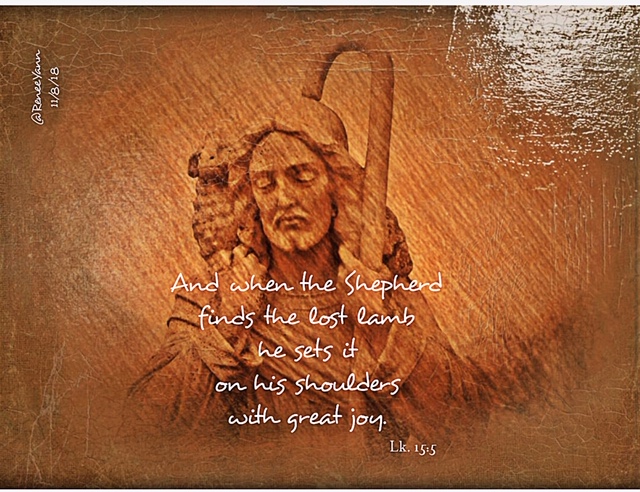
Lk15_5 lost lamb

Today, in God’s Lavish Mercy, we meet the Shepherd bringing the lost lamb home.  Haven’t we all, at sometime in our lives, been carried on those sacred shoulders?

Whether by our own prayers, or the prayers of those who love us, have we not been rescued from sorrow, foolishness, isolation or fear?

This beautiful Gospel assures us of the one thing we most deeply need – we are cherished, irrevocably, by God.

Today, if we need to ride those shoulders, let us trust ourselves to them in prayer. 

If, by grace, we are already home, let us pray for those feeling most lost or abandoned – those most beset by a hostile world. May our merciful action help lift them to peace and the sweet scent of God so close beside them.


Poetry: The Good Shepherd – Brian Yapko

I enjoyed this poem which imagines Jesus still as a youngster experiencing a night as a shepherd. Mary and Joseph think it might not be the right vocation for him after his traumatic overnight!

My count of sheep was off as twilight fell
And father’s friend, Ben Ezra’s lamb was gone!
I had to find her! Searching past the well
I climbed the rocks exhausted but pressed on.
Delay could mean her life! She’d failed to heed
My shepherd’s call and so risked being killed!
Some wild beast might capture her and feed.
I could not let her unstained blood be spilled!

Great danger filled that dark and craggy hill.
My fear was deep! And then my torch went dim!
Oh, why did I avoid my father’s will
To one day be a carpenter like him?
Because my father’s friend was gravely ill.
I loved his sheep, so father made a plan
For me to herd them just one year until
I’m old enough to be declared a man.

I found the frightened lamb inside a cave
Cornered by a wolf of knife-sharp claw.
The fiercest wolf I’ve seen! How could I save
This little sheep? I thrust my staff to draw
Away the beast. He snarled, bit my wrist
And mauled my side. In agony, I heard
The wolf’s attack, too wounded to resist.
But then, thank God, a miracle occurred!

I closed my eyes and with a trembling voice
Said “Help me, father!” And the fierce wolf froze!
He yelped, then fled as if he had no choice!
I clutched the lamb and wept till the sun rose.
Still shaking I then rose up on my feet.
I kissed the lamb and said don’t be afraid
For now you’re safe. She cried a grateful bleat.
She knew I’d saved her and the price I paid.

My parents say I may no longer herd
And must devote my life to nails and wood;
But angels fill my dreams and leave me stirred
To try to be a shepherd—one who’s good—
Who shields his sheep from wickedness and strife.
I love them all, the good ones and the lost;
I’ll fear no evil that might take my life,
For I think their salvation’s worth the cost.


Music: I Will Carry You – Sean Clive

I will carry you when you are weak.
I will carry you when you can’t speak.
I will carry you when you can’t pray.
I will carry you each night and day.

I will carry you when times are hard.
I will carry you both near & far.
I’ll be there with you whenever you fall.
I will carry you through it all.

My arms are wider than the sky,
softer than a little child,
stronger than the raging,
calming like a gentle breeze.
Trust in me to hold on tight because 

I will carry you when you can’t stand.
I’ll be there for you to hold your hand.
And I will show you that you’re never alone.
I will carry you and bring you back home.

Not pain, not fear, not death, no nothing at all
can separate you from my love.
My arms and hands will hold you close.
Just reach out and take them in your own.
Trust in me to hold on tight.
I will carry you.

Released from Hate

Monday of the Thirty-first Week in Ordinary Time
October 31, 2022

Today’s Readings:

https://bible.usccb.org/bible/readings/103122.cfm

Today, in God’s Lavish Mercy, what a beautiful prayer Paul spreads over his listeners. It is a prayer that calls all believers to live in love, peace, and reverence for one another:

Brothers and sisters:
If there is any encouragement in Christ,
any solace in love,
any participation in the Spirit,
any compassion and mercy,
complete my joy by being of the same mind, with the same love,
united in heart, thinking one thing.

Philippians 2:1-2

Reading this passage, I was immediately struck by the awareness of how much opposite messaging we receive in today’s world.

In the arenas of entertainment, politics, civic life, and – sad to say – even religion, we often hear a message contradictory to Paul’s. We hear civic and supposedly “religious” leaders tell their followers to attack, shun, fight, and even “hang” the other. Night after night on our TVs, we watch fictional characters act out the hate and crime that has become normalized in our culture. Our video games, music and movies are drowning in blood, hate and anger.

Sometimes, I am just astounded that we entertain ourselves with murder, war, rape and other outrages against human beings!

With the vicious attack on Paul Pelosi this week, as in so many other horrendous incidents of unbridled hate, we see a perpetrator sickened and abetted by the violent rhetoric our society has allowed. And perhaps even worse than the crime itself, we see political leaders not only minimizing the atrocity, but mocking the victim!


If St. Paul were here, what would he say?

  • where is the encouragement in Christ?
  • where is the solace in love?
  • where is the participation in the Spirit?
  • where is the compassion and mercy?

As a matter of fact, if St. Paul were here, I think he would wail in sadness!


In Luke’s Gospel, Jesus tells us what a society should look like when it respects God and God’s Creation. It should be impelled by the deepest respect and tenderness toward the self and the other:

When you hold a lunch or a dinner,
do not invite your friends or your brothers or sisters
or your relatives or your wealthy neighbors,
in case they may invite you back and you have repayment.
Rather, when you hold a banquet,
invite the poor, the crippled, the lame, the blind; 
blessed indeed will you be because of their inability to repay you.
For you will be repaid at the resurrection of the righteous.

Luke 14:12-14

Bottom line is this: a lot of people just don’t buy Paul’s or Jesus’s message. A lot of people would rather live for themselves to the expense of others.

But we’re not just “a lot of people”. We are Christ’s, and we must examine our speech, attitudes, choices and behaviors for anything that contradicts his message of love, mercy, inclusion, and mutual reverence.

The contradictions are subtle. Discovering and uprooting them takes honest and humble prayer. It requires a good look at how we entertain ourselves, how we confront those we disagree with, who we criticize and how we do it.


Several years ago, I was shocked when someone close to me announced, “I hate Obama!” I asked her why and she said, “I just do. I don’t need a reason!”

Where does all the hate in our culture come from? And, oh, how much more does it tell us about the haters than the ones hated! And of course, the essential question, “What can we do about it?”

Jesus made it simple. He told us to look around the “table” of our attitudes, behaviors and choices.

Who is welcome? Who is shunned? Who is embraced as a human being? Who is objectified and dispensed with as unimportant.

As in all solutions, we can begin with ourselves. Ridding ourselves of these contradictions requires that we listen to ourselves to see if, how, and why we ever use the word “hate”. Only then might we cleanse our hearts of its subtle poisons.


Prose: Two thoughts today

The enemy is fear.
We think it is hate,
but it is really fear.

Mahatma Gandhi

Who would I be,
and what power would be expressed in my life,
if I were not dominated by fear?

Paula D’Arcy

Music: At My Table – JJ Heller – a kinda fun video to watch!

Called by Name

Thirty-first Sunday in Ordinary Time
October 30, 2022

Today’s Readings:

https://bible.usccb.org/bible/readings/103022.cfm

Today, in God’s Lavish Mercy, we have three wonderful readings to enrich our prayer.

In our passage from Wisdom, we can picture the pray-er sitting down with God to express admiration, thanks and love.

Before the LORD the whole universe is as a grain from a balance
 or a drop of morning dew come down upon the earth.
 But you have mercy on all, because you can do all things;
 and you overlook people’s sins that they may repent.
 For you love all things that are
 and loathe nothing that you have made;
 for what you hated, you would not have fashioned.

In his letter to the Thessalonians, Paul prays a beautiful blessing over the community – a blessing which, by grace, transcends through time to us:

We always pray for you,
that our God may make you worthy of his calling
and powerfully bring to fulfillment every good purpose
and every effort of faith,
that the name of our Lord Jesus may be glorified in you,
and you in him,
in accord with the grace of our God and Lord Jesus Christ. 

In Luke’s Gospel, Jesus meets a height-challenged scribe who is intensely interested in seeing the rumored Messiah:

Zaccheus ran ahead and climbed a sycamore tree in order to see Jesus,
who was about to pass that way.
When he reached the place, Jesus looked up and said,
“Zacchaeus, come down quickly,
for today I must stay at your house.” 

Notice that Jesus doesn’t just wave or look at Zacchaeus with a wry smile at his perch. Jesus incorporates Zacchaeus into the embrace of salvation.As Wisdom says, Jesus “loves all things that are..” And as Paul says, “powerfully brings to fulfillment every good purpose
and every effort of faith…”


I think there are times in every life when we need to stretch to find God. We may need to climb faith’s tree and dangle over the confusions of life in the hope of grasping grace. Friends, all of us, no matter how tall we might be, have been Zaccheaus! Am I right? When we are, let”s listen for the One Who calls our name!


Poetry: Zacchaeus – George Macdonald (10 December 1824 – 18 September 1905) was a Scottish author, poet and Christian minister. He was a pioneering figure in the field of modern fantasy literature and the mentor of fellow writer Lewis Carroll. 

To whom the heavy burden clings,
It yet may serve him like a staff;
One day the cross will break in wings,
The sinner laugh a holy laugh.

The dwarfed Zacchaeus climbed a tree,
His humble stature set him high;
The Lord the little man did see
Who sought the great man passing by.

Up to the tree he came, and stopped:
“To-day,” he said, “with thee I bide.”
spirit-shaken fruit he dropped,
Ripe for the Master, at his side.

Sure never host with gladder look
A welcome guest home with him bore!
Then rose the Satan of rebuke
And loudly spake beside the door:

“This is no place for holy feet;
Sinners should house and eat alone!
This man sits in the stranger‘s seat
And grinds the faces of his own!”

Outspoke the man, in Truth‘s own might:
“Lord, half my goods I give the poor;
If one I’ve taken more than right
With four I make atonement sure!”

Salvation here is entered in;
This man indeed is Abraham’s son!”
Said he who came the lost to win-
And saved the lost whom he had won.


Music: He Called Me by My Name – Fr. Christopher Cuelho, OFM

Praying with Jesus

Wednesday of the Twenty-seventh Week in Ordinary Time
October 5, 2022

Today’s Readings:

https://bible.usccb.org/bible/readings/100522.cfm

Today, in God’s Lavish Mercy, Paul and Peter have a big fight – two of the Greats take it to the mat over an issue of inclusivity in the early Church.

To put the episode in a nutshell, Peter had succumbed to political pressure from Jewish Christians to isolate non-Jewish Christians from full participation in the Church. The pressure was rooted in nationalism, religious prejudice and unexamined fear. Peter, in an attempt to manage these forces, made a huge misstep.

Paul, seeing that Peter’s actions would set a dangerous and divisive precedent in the emerging Church, confronted him before the whole community. For a moment in time, these two pillars of Christianity stood on separate shores.

Lk11_2 Pray

Ultimately, through prayer, respect and discernment, Peter and Paul continued together to shepherd the embryonic Church toward a new reality – one built on, but beyond, the Judaism in which they both had been raised.

The Church, as a living reality, will always be challenged by issues of growth, identity, inclusion and other concerns. But as soon as we define ourselves as anything other than simply Christians, we run the risk of moving to our own “separate shores”. 

We are not conservative or liberal Christians. We are not American, or European or Asian Christians. We are not gay or straight, Black or White, male or female, rich or poor Christians.

We are all sisters and brothers in the Gospel of Christ, standing on the same shore with Him, praying to our one Father. May this shared prayer help us to become who we are called to be.


Poetry: Our Father – Malcolm Guite

I heard him call you his beloved son
And saw his Spirit lighten like a dove,
I thought his words must be for you alone,
Knowing myself unworthy of his love.
You pray in close communion with your Father,
So close you say the two of you are one,
I feel myself to be receding further,
Fallen away and outcast and alone.
And so I come and ask you how to pray,
Seeking a distant supplicant’s petition,
Only to find you give your words away,
As though I stood with you in your position,
As though your Father were my Father too,
As though I found his ‘welcome home’ in you.

Music: Lord, Teach Us to Pray ~ Joe Wise

Lessons in Love and Light

Monday of the Twenty-fifth Week in Ordinary Time
September 19, 2022

Today’s Readings

https://bible.usccb.org/bible/readings/091922.cfm

Today, in God’s Lavish Mercy, our readings encourage us to live lives of Charity and Light.

Today’s first reading opens two weeks of inspiration from the Wisdom Literature of the Hebrew Scriptures. These books include Job, Proverbs, Ecclesiastes, Song of Solomon, and parts of Psalms.

Wisdom literature differs from other books in the Old Testament in that the authors were sages rather than prophets or priests. Priests and prophets typically dealt with religious and moral concerns whereas sages generally focused on the practical aspects of how to live and the intellectual challenges that arise when contemplating the human experience. 

from: compellingtruth.org

Our passage from Proverbs offers a good dose of that sage advice with these basics of mutual charity:

  • Refuse no one the good on which they have a claim
  • Plot no evil against your neighbor,
  • Quarrel not with someone without cause,
  • Envy not lawless persons
  • Choose not their ways …

If we all followed that list, the world would be in pretty good shape. And, in Luke’s Gospel, Jesus says that once we get that shaped-up, we can take it up a notch — into the Light:

No one who lights a lamp conceals it with a vessel
or sets it under a bed;
rather, you place it on a lampstand
so that those who enter may see the light.

Matthew’s version adds this line:

Let your light shine before others,
that they may see your good deeds 
and glorify God in heaven.

So how do I let Charity kindle God’s Light in me? The list from Proverbs can get me started, but what might my own “Charity Challenges” look like?

Poetry: Charity — The Greatest of All Three – Robert Morris

The soul serene, impenetrably just, 
Is first in CHARITY; we love to muse 
On such a model; knit in strictest bonds 
Of amity with spirits like disposed; 
Aiming at truth for her own sake, this one 
Passes beyond the golden line of Faith, 
Passes beyond the precious line of Hope, 
And sets foot unmoved on CHARITY . 
“A soul so softly radiant and so white, 
The track it leaves seems less of fire than light.”


Music: Lampstand – Ben Bigelow

(Spoiler alert: Those who are still able may want to dance by the end of this video!🤩 I just did a very good finger-snapping routine)