Today, in God’s Lavish Mercy, we celebrate the Solemnity of the Most Holy Body and Blood of Christ.
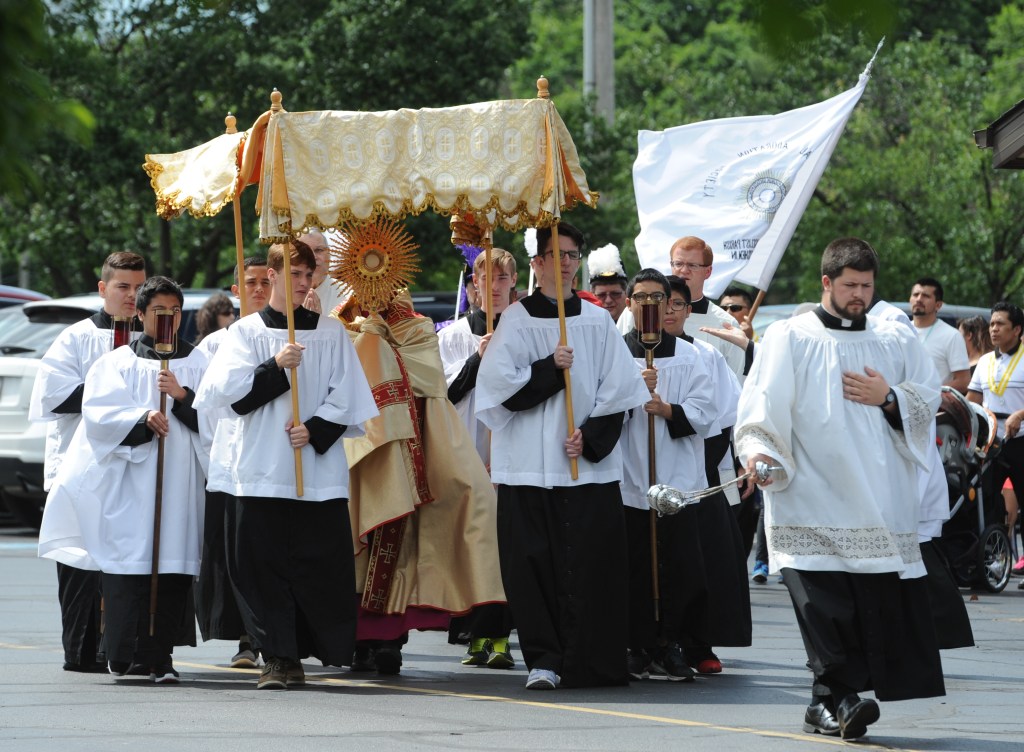
We just called it “Corpus Christi” when I was young. Many of us, of a “certain age”, will remember the extravagant processions through our childhood neighborhoods, the garmented priest carrying the elevated monstrance.
Bishop Kevin Rhoades leads the procession as it leaves St. Thomas church in Elkhart Indiana Sunday June 18, 2017. Today’s Catholic Photo/Joe Raymond)
Little children and adults accompanied the journeying Christ who blessed our neighbors, families, businesses and playgrounds.
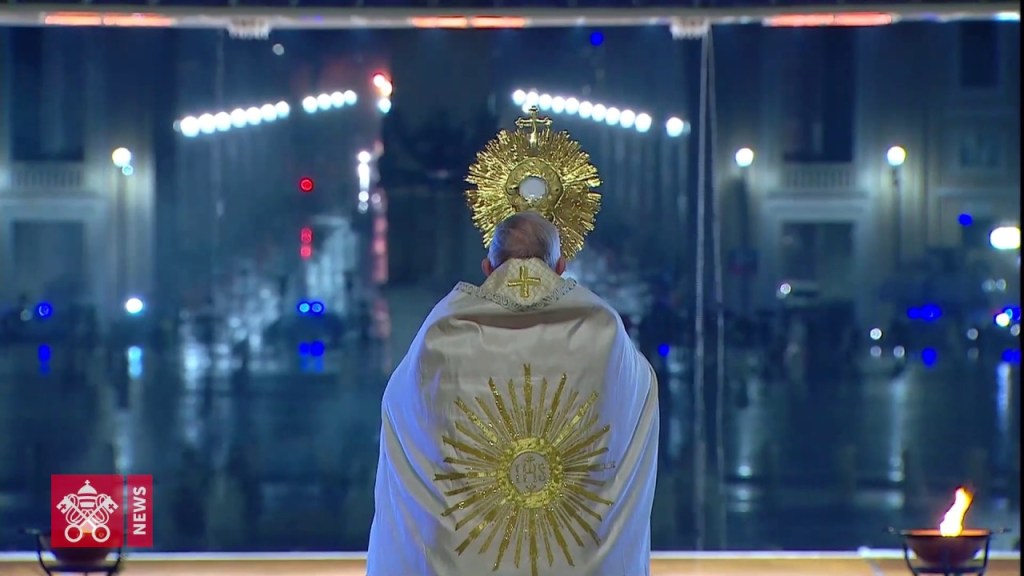
Although, for some, such devotional practices have changed since that time, I was still deeply moved when, during the depth of the current pandemic, Pope Francis stood alone to raise the monstrance in blessing over a starkly empty St. Peter’s Square.
Certainly, all our neighborhoods today could use such a blessing. And, it is we – the People of God and living Body of Christ – who must carry Christ’s Presence to our neighborhoods, workplaces, schools and commonplaces.
Our Responsorial Psalm today offers us this question:
How shall I make a return to the LORD for all the good God has done for me?
Psalm 116:12
Maybe this is one way to hear that question on this Feast:
How will I carry Christ into my world today?
Poetry: Love’s Choice by Malcolm Guite
This bread is light, dissolving, almost air,
A little visitation on my tongue,
A wafer-thin sensation, hardly there.

This taste of wine is brief in flavour, flung
A moment to the palate’s roof and fled,
Even its aftertaste a memory.

Yet this is how He comes.
Through wine and bread
Love chooses to be emptied into me.

He does not come in unimagined light
Too bright to be denied, too absolute
For consciousness, too strong for sight,

Leaving the seer blind, the poet mute;
Chooses instead to seep into each sense,
To dye himself into experience.
Today, in God’s Lavish Mercy, we pray with Psalm 128 which is a recounting of how blessed we are when we live in God’s Presence.
Our Gospel reveals the clear and essential key to attaining that Presence – love of God and neighbor.
The scribe in today’s Gospel is well on his way to living in God’s embrace.
We might choose to go with him to Jesus today to ask what is most important for us as we continually try to open our lives to God’s grace.
How can we increase our understanding, strength, and charity in our everyday choices? …. How can we love more like God loves?
Poetry: Love as if … by Vinita Hampton Wright
Love as if loving is the first thing on your to-do list.
Love as if you have no other plan but to love.
Love as if you are confident that love makes good things happen.
Love as if this is your first opportunity to love.
Love as if this is your last opportunity to love.
Love as if loving can heal all wounds.
Love as if loving is your first purpose on earth.
Love as if loving is your favorite choice.
Love as if you have that kind of power.
Love as if it will keep the earth spinning in vast, beautiful space.
Music: You Shall Love the Lord with All Your Heart
Today, in God’s Lavish Mercy, we pray with Psalm 79, one of the “Sad Songs of Zion”. While many of the Psalms are celebratory in nature, offering praise and thanksgiving, about a third of the Psalter is lament.
These mournful songs remind us that life is indeed full of both joys and sorrows. Faith calls us to live through these modulations within the presence of God.
The psalmist of 79 cries out from imprisonment and deathly fear, but is not without hope for a better future:
Let the prisoners’ sighing come before you; with your great power free those doomed to death. Then we, your people and the sheep of your pasture, will give thanks to you forever; through all generations we will declare your praise.
Psalm 79: 11-13
This is the kind of resilient prayer we can learn from the Psalms. At times, we find ourselves “imprisoned” – locked away from what we most want in our lives – love, peace, security, health, freedom. To deny such suffering only buries us deeper in it.
As we see in our Gospel today, Jesus calls us to face our truth and to seek God’s Presence within it. Doing so will allow us, as it did the disciples, to move beyond self-centered expectation to God-centered courageous hope.
Then James and John, the sons of Zebedee, came to Jesus and said to him, ‘Teacher, we want you to do for us whatever we ask of you.” He replied, ‘What do you wish me to do for you?” They answered him, “Grant that in your glory we may sit one at your right and the other at your left.” Jesus said to them, “You do not know what you are asking. Can you drink the chalice that I drink or be baptized with the baptism with which I am baptized?” They said to him, ‘We can.” Jesus said to them, “The chalice that I drink, you will drink, and with the baptism with which I am baptized, you will be baptized; but to sit at my right or at my left is not mine to give but is for those for whom it has been prepared.”
As we look at our world, and perhaps our own lives, we see much suffering. How can God come to us from the midst of such pain? Psalm 79 tells us to keep inviting God and to be vigilant and attentive for God’s appearance. Just as in our Gospel, it will not look as we had expected it to look.
Remember us Show us Help us Deliver us Free us Then we will give thanks and praise your Name
The Basic Prayer of Psalm 79
Poetry: A Blessing by Elizabeth Eiland Figueroa
May the God of Surprises delight you,
inviting you to accept gifts not yet imagined.
May the God of Transformation call you,
opening you to continual renewal.
May the God of Justice confront you,
daring you to see the world through God’s eyes.
May the God of Abundance affirm you,
nudging you towards deeper trust.
May the God of Embrace hold you,
encircling you in the hearth of God’s home.
May the God of Hopefulness bless you,
encouraging you with the fruits of faith.
May the God of Welcoming invite you,
drawing you nearer to the fullness of God’s expression in you.
May God Who is Present be with you,
awakening you to God in all things, all people, and all moments.
May God be with you.
Amen.
Music: The Joys and Sorrows of Life – Johannes Bornlöff
Today, in God’s Lavish Mercy, we pray with Psalm 104 – a fitting prayer for this glorious Feast of Pentecost.
Lord, send out your Spirit, and renew the face of the earth.
It is a bold prayer, an extravagant request. It asks for everything – a Fire of Love so complete that the whole earth is remade in its Divine Power.
It is a prayer based in mutual invitation as, in the Sequence, we invite the Holy Spirit to renew us:
Come, Holy Spirit, come! And from your celestial home Shed a ray of light divine!
Pentecost Sequence
And, as in any true relationship, the Spirit invites us too – to open our hearts to the infinite grace of this feast. The Book of Revelation describes this reciprocity in this profound passage:
“ I, Jesus, have sent my angel to give you this testimony for the churches. I am the Root and the Offspring of David, and the bright Morning Star.”
The Spirit and the bride say, “Come!” And let the one who hears say, “Come!” Let the one who is thirsty come; and let the one who wishes take the free gift of the water of life.
Revelation 22: 16-17
Today, on the Birthday of the Church, we pray not only for our own soul’s kindling, but for the whole People of God. May the Grace of Pentecost ignite a new fire of charity over all the earth. May that fire clear the way for the Spirit’s gifts to flower, for Her fruits to blossom, for Her power to surprise us as it bursts forth in our hearts!
Poetry: The Golden Sequence
Veni Sancte Spiritus, sometimes called the Golden Sequence, is a sequence prescribed in the Roman Liturgy for the Masses of Pentecost and its octave. It is usually attributed to either the thirteenth-century Pope Innocent III or to the Archbishop of Canterbury, Cardinal Stephen Langton, although it has been attributed to others as well.
“Veni Sancte Spiritus” is one of only four medieval Sequences which were preserved in the Roman Missal published in 1570 following the Council of Trent (1545–63).
The other three occasions when we hear these beautiful ancient hymns are Easter Sunday (“Victimae Paschali Laudes”), Corpus Christi (“Lauda Sion Salvatorem”) and Our Lady of Sorrows (“Stabat Mater Dolorosa”). On Easter Sunday and Pentecost, the sequence must be sung, whereas on Corpus Christi and Our Lady of Sorrows, the sequence is optional.
Wikipedia
Come, Holy Spirit, come!
And from your celestial home
    Shed a ray of light divine!

Come, Father of the poor!
Come, source of all our store!
    Come, within our bosoms shine.

You, of comforters the best;
You, the soul’s most welcome guest;
    Sweet refreshment here below;

In our labor, rest most sweet;
Grateful coolness in the heat;
    Solace in the midst of woe.

O most blessed Light divine,
Shine within these hearts of yours,
    And our inmost being fill!

Where you are not, we have naught,
Nothing good in deed or thought,
    Nothing free from taint of ill.

Heal our wounds, our strength renew;
On our dryness pour your dew;
    Wash the stains of guilt away:

Bend the stubborn heart and will;
Melt the frozen, warm the chill;
    Guide the steps that go astray.

On the faithful, who adore
And confess you, evermore
    In your sevenfold gift descend;

Give them virtue’s sure reward;
Give them your salvation, Lord;
    Give them joys that never end. Amen.
    Alleluia.
Today, in God’s Lavish Mercy, we pray with Psalm 68 which captures a solemn yet glorious theme running through today’s readings: in God’s time, things end and new things emerge.
A bountiful rain you showered down, O God, upon your inheritance; you restored the land when it languished; Your flock settled in it; in your goodness, O God, you provided it for the needy.
Psalm 68: 10-11
This eternal dynamism of life-death-life is wrapped in multi-colored spools around the emotions of our lives. We can hear Paul negotiating his ebbing joys and sorrows in our first reading.
In Acts, Paul is facing his physical diminishment and impending death. Like others throughout all of time, he is retelling his life story, motivations, and achievements so that their significance may be stamped on the hearts of those he will leave behind. In all things, Paul gives the glory to God:
Yet I consider life of no importance to me, if only I may finish my course and the ministry that I received from the Lord Jesus, to bear witness to the Gospel of God’s grace.
Acts 20:24
In our Gospel, Jesus is giving a similar summary and farewell. He prays aloud to the Father so that his disciples may be instructed by hearing his final prayer:
I revealed your name to those whom you gave me out of the world. They belonged to you, and you gave them to me, and they have kept your word. Now they know that everything you gave me is from you, because the words you gave to me I have given to them, and they accepted them and truly understood that I came from you, and they have believed that you sent me. I pray for them.
John 17: 6-9
Both Paul and Jesus have brought the “abundant rain” of Psalm 68 to their ministries. But now it is time for others to carry on the work:
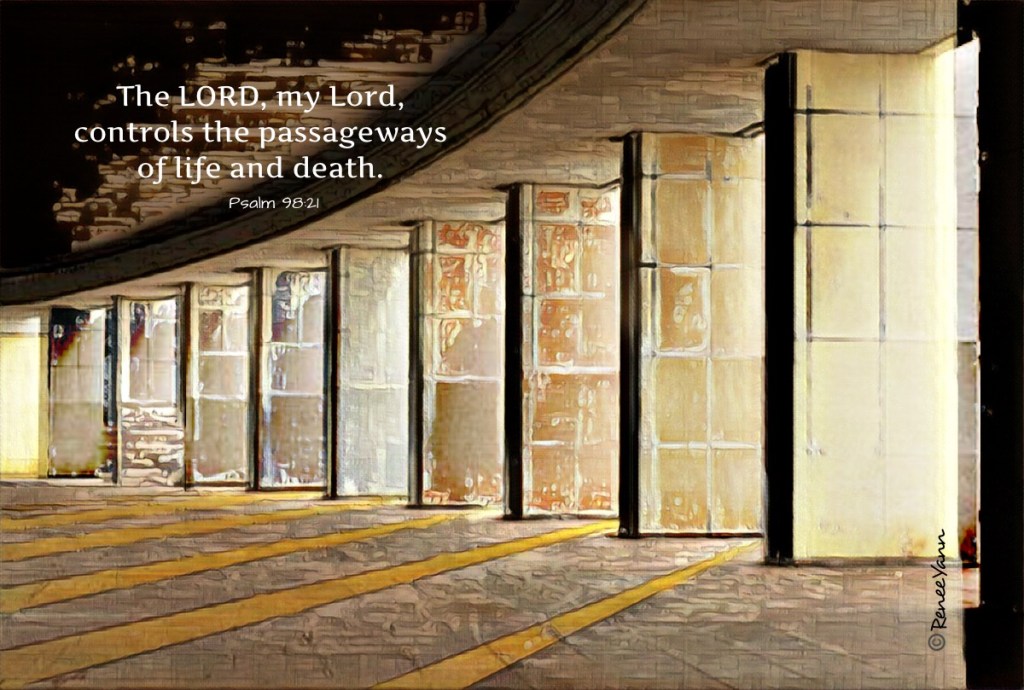
God is a saving God for us; the LORD, my Lord, controls the passageways of life and death.
Psalm 68:21
As the tides of God’s eternity rise and ebb through our lives, we too at times must hand over and/or receive that eternal heritage of grace. May we exercise these rituals with the greatest of reverence and awareness.
Blessed be the Lord day by day, God, our salvation, who carries us. Our God is a God who saves; deliverance from death to life belongs to God.
Psalm 68: 20-21
Like Jesus and Paul, may we open our stories in faith and love to the community that surrounds us. Especially as we mature both in years and experience, may we share our truth with grace and the gift of encouragement to others. And may those younger ministers take up new responsibilities with reverence, joy, and trust.
Poetry: When Someone Goes Away – Nikola Madzirov
In the embrace on the corner you will recognize
someone’s going away somewhere. It’s always so.
I live between two truths
like a neon light trembling in
an empty hall. My heart collects
more and more people, since they’re not here anymore.
It’s always so. One fourth of our waking hours
is spent in blinking. We forget
things even before we lose them –
the calligraphy notebook, for instance.
Nothing’s ever new. The bus
seat is always warm.
Last words are carried over
like oblique buckets to an ordinary summer fire.
The same will happen all over again tomorrow—
the face, before it vanishes from the photo,
will lose the wrinkles. When someone goes away
everything that’s been done comes back.
Music: Music by Giovanni Marradi – several hours of beautiful music. You may wish to listen for awhile.
Today, in God’s Lavish Mercy, we pray with Psalm 47, one of seven enthronement psalms which celebrate a “coronation” of God.
All you peoples, clap your hands, shout to God with cries of gladness, For the LORD, the Most High, the awesome, is the great king over all the earth.
Psalm 47: 1
Used for the feast of the Ascension, the point of the psalm is much more than an exercise of pageantry. It is an act of faith and reverence to God, the Loving Omnipotence who chose to redeem us by assuming our humanity.
It is a confirmation that we believers do see the Supreme Being in the human Jesus we have come to love. This is what Paul prays for the Ephesians in our second reading:
May the eyes of your hearts be enlightened, that you may know what is the hope that belongs to his call, what are the riches of glory in his inheritance among the holy ones, and what is the surpassing greatness of his power for us who believe, in accord with the exercise of his great might, which he worked in Christ, raising him from the dead and seating him at his right hand in the heavens, far above every principality, authority, power, and dominion, and every name that is named not only in this age but also in the one to come.
Ephesians 1:18-21
The Great Commission, found in today’s Gospel, is the true gift of the Ascension.
Go into the whole world and proclaim the gospel to every creature.
Mark 16:15
Jesus tells us that his time on earth is complete. The lesson of Love has been taught. We now are given the power to continue the message for all time.
Jesus promises that our faith will:
–overcome evil -create new possibilities to preach the Gospel -show courage against antagonism -resist suppression -heal and strengthen others to believe
These signs will accompany those who believe:
-in my name they will drive out demons, -they will speak new languages. -They will pick up serpents with their hands, -drink any deadly thing, it will not harm them. –lay hands on the sick, and they will recover.
If we believe and open our hearts to this message, indeed, it is a day for trumpet blasts! Here are a few from one of my favorite triumphal pieces! If the Apostles had only had trumpets, they might have played something like this for the Lord as He ascended 🙂
Poetry: Ascension Sonnet – Malcolm Guite
We saw his light break through the cloud of glory
Whilst we were rooted still in time and place
As earth became a part of Heaven’s story
And heaven opened to his human face.

We saw him go and yet we were not parted
He took us with him to the heart of things
The heart that broke for all the broken-hearted
Is whole and Heaven-centred now, and sings,

Sings in the strength that rises out of weakness,
Sings through the clouds that veil him from our sight,
Whilst we our selves become his clouds of witness
And sing the waning darkness into light,

His light in us, and ours in him concealed,
Which all creation waits to see revealed.
“Joy is God in the marrow of our bones.” (Eugenia Price) Joy is a deep well. If, in times of sorrow, we go down under the sorrow, we will discover that joy is still alive.
Today, in God’s Lavish Mercy, we pray with Psalm 100, considered by some to be the most revered and important of all the psalms. Walter Brueggemann says this:
This psalm is one of the best known and best loved in the entire repertoire of the Psalter. It breathes a faith of simple trust, glad surrender, and faithful responsiveness. It is not sung by newcomers who are only now embracing the faith but by those who are seasoned and at home in this faith and piety.
Psalm 100 is a prayer of pure, complete and confident joy in God. What a great way to live our lives!
Sing joyfully to the LORD, all you lands; serve the LORD with gladness; come before him with joyful song.
Psalm 100: 1-2
This is the kind of joy experienced by the early Church in Acts:
Day after day the churches grew stronger in faith and increased in number.
Acts 16:5
It is the joy which makes us impervious to hate, as Jesus describes in the Gospel:
Jesus said to his disciples: “If the world hates you, realize that it hated me first. If you belonged to the world, the world would love its own; but because you do not belong to the world, and I have chosen you out of the world, the world hates you.
John 15: 18-19
Here is a line I love:
Don’t let the devil steal your JOY!
I first saw it from Pat Livingston, a wonderful speaker and writer on spirituality. But its roots are in John 16:22 as Jesus bids farewell to the disciples:
Now is your time of grief, but I will see you again and you will rejoice, and no one will take away your joy.
Let us look at Jesus in our prayer today, and let him look deeply into us. May that prayer give us immense joy!
Poetry: Happiness Is Harder
To read a book of poetry
from back to front,
there is the cure for certain kinds of sadness.
A person has only to choose.
What doesn’t matter; just that—
This coffee. That dress.
“Here is the time I would like to arrive.”
“Today, I will wash the windows.”
Happiness is harder.
Consider the masters’ description
of awakened existence, how seemingly simple:
Hungry, I eat; sleepy, I sleep. Is this choosing completely,
or not at all?
Music: Jubilate Deo – Mozart
Jubilate Deo omnis terra; servite Domino in lætitia. Introite in conspectu ejus in exsultatione. Scitote quoniam Dominus ipse est Deus; ipse fecit nos, et non ipsi nos. Populus ejus, et oves pascuæ ejus, introite portas ejus in confessione; atria ejus in hymnis, confitemini illi. Laudate nomen ejus, quoniam suavis est Dominus; in æternum misericordia ejus; et usque in generationem et generationem veritas ejus.
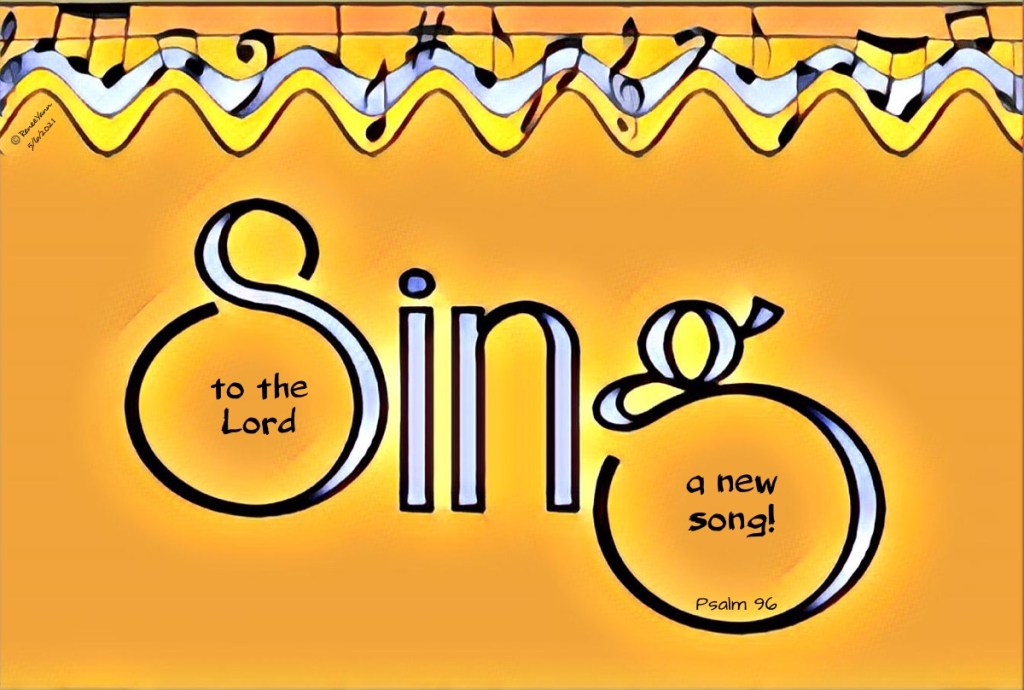
Today, in God’s Lavish Mercy, we pray with Psalm 96, a song which dances with jubilation. It filled my prayer with images and music. No worded reflection … no Vatican documents. Just let the exuberant scriptures uplift you today.
That’s what I share with you today, beloveds❤️
Sing to the Lord! Toss away any old dirge trying to weigh your spirit down!
And sing anew because Jesus has given us this infinite gift.
Poetry: I Call You Beloved – Rabindranath Tagore
When You command me to sing, it seems that my heart would break with pride, and I look to your face, and tears come to my eyes. All that is harsh and dissonant in my life melts into one sweet harmony— and my adoration spreads wings like a glad bird on its flight across the sea. I know You take pleasure in my singing. I know that only as a singer I come before your presence. I touch, by the edge of the far-spreading wing of my song, Your feet, which I could never aspire to reach. Drunk with the joy of singing, I forget myself and call you Beloved, who are my Lord.
Music: Two songs, one classical, one a little devilment, but I couldn’t help singing it.🤗
Today, in God’s Lavish Mercy, we pray with Psalm 145 which reveals a wonderful secret – how to be a Friend of God:
Pope Francis describes friendship with God in a recent Angelus address:
God is not a distant and anonymous being: God is our refuge, the wellspring of our peace and tranquility. God is the rock of our salvation, to which we can cling with the certainty of not falling; one who clings to God never falls! God is our defence against the evil which is ever lurking. God is a great friend, ally, parent to us, but we do not always realize it. We do not realize that we have a friend, an ally, a parent who loves us, and we prefer to rely on immediate goods that we can touch, on contingent goods, forgetting and at times rejecting the supreme good, which is the love of God. Feeling that God is our Parent, in this epoch of orphanhood, is so important! In this orphaned world…
The early Christians persevered in unfolding this secret as told in Acts today:
After they had proclaimed the good news to that city and made a considerable number of disciples, they returned to Lystra and to Iconium and to Antioch. They strengthened the spirits of the disciples and exhorted them to persevere in the faith, saying, “It is necessary for us to undergo many hardships to enter the Kingdom of God.”
Acts 14: 21-22
In our Gospel, Jesus speaks to his disciples before his Ascension. He gives them the secret of hope, peace and encouragement. In that gift, they will stay true friends to him as he is to them:
And now I have told you this before it happens, so that when it happens you may believe. I will no longer speak much with you, for the ruler of the world is coming. He has no power over me, but the world must know that I love the Father and that I do just as the Father has commanded me.
John 14: 29-31
May we live joyfully as Friends of God, confident of and making known God’s merciful Name by our faith, love, mercy, generosity, and hope.
May my mouth speak the praise of the LORD, and may all flesh bless God’s holy name forever and ever.
Psalm 145: 21
Poetry: I Am – Rainer Maria Rilke
I am, you anxious one. Do you not hear me rush to claim you with each eager sense? Now my feelings have found wings, and, circling, whitely fly about your countenance.
Here my spirit in its dress of stillness stands before you, — oh, do you not see? In your glance does not my Maytime prayer grow to ripeness as upon a tree?
Dreamer, it is I who am your dream. But would you awake, I am your will, and master of all splendor, and I grow to a sphere, like stars poised high and still, with time’s singular city stretched below.
Music: Friend of God written by Israel Houghton and sung by the Brooklyn Tabernacle Choir
I am a friend of God
I am a friend of God
I am a friend of God
He calls me friend

Who am I that You are mindful of me?
That You hear me when I call
Is it true that You are thinking of me?
How You love me
It's amazing

Who am I, Lord
Who am I that You are mindful of me?
That You hear me when I call (is it true O Lord?)

Is it true that You are thinking of me?
How You love me (it's amazing Jesus)
It's amazing (I am a friend of God)
I am a friend of God ....(repeated)

What a priviledge it is, yeah
Who am I that You are mindful of me?
That You hear me when I call (is it true, is it true?)
Is it true that You are thinking of me?

(Oh Lord sometimes I don't understand)
How You love me (how You love me Lord?)
It's amazing (oh it's so amazing)
It's amazing (Lord it's so amazing)
It's amazing
I am a friend of God
(These phrases are repeated with lots of praise in between. I hope you feel it too!❤️😇)
Today, in God’s Lavish Mercy, we pray with Psalm 22 which captures the message of all our readings this Sunday: how we receive, cherish, grow and share our faith.
When I read these passages this morning, an image came to my mind.
Sister Bernard Mary was a special, and rather unique Sister of Mercy. Born in 1917, and a true representative of “The Greatest Generation”, she served as a Navy nurse in WWII. Afterward she joined the Sisters of Mercy and lived a long life of expert care in our hospitals and other institutions. Among her many clinical talents, she was the supreme phlebotomist. She could stick even a difficult vein with you never ever noticing the pinch.
When Bernard died at the age of 91, a lone sailor stood in our community cemetery to bugle “Taps” over her flag-draped coffin. The melody captured all the singular simplicity of her dedicated and faithful ministry, sending it to heavens that welcomed her.
Bernard was one of those iconic sisters whose life was fully focused on her faith and ministry. She worked every day, all day and, as far as I could tell, had few other interests than a love of her family.
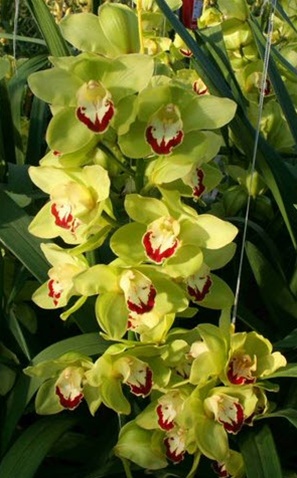
But she had an orchid plant. And it was a doozy. Given the plant as a small gift, she had nurtured that flower like the practiced healer that she was. She understood it, spoke to it, listened to it, responded to it, providing it deeper roots as it grew to an impressive size. Like any plant, it went through cycles. Bernard patiently accompanied and nourished it through every one.
As a result, the orchid was huge and astoundingly beautiful – to the point that each year, it would be entered in the Philadelphia Flower Show. At least on one occasion, it won first prize!
(The Philadelphia Flower Show is an annual event produced by The Pennsylvania Horticultural Society. Said to be the “largest indoor flower show in the world”, it attracts more than a quarter million people annually.)
The image? That magnificent plant was a symbol – the visible expression of Bernard’s quiet but powerful faith.
Let’s consider our own faith. It’s a gift. It deserves our complete and loving attention. It must remain deeply rooted within us. And it should be displayed for the benefit of others through our loving and merciful ministry to those in need.
Psalm 22 says so:
I will offer praise in the great assembly; my vows I will fulfill before those who reverence the Lord.
The needy will eat their fill; those who seek the LORD will offer praise. May your hearts enjoy life forever!
Psalm 22: 26-27
The Acts of the Apostles says so:
The church throughout all Judea, Galilee, and Samaria was at peace. It was being built up and walked in the fear of the Lord, and with the consolation of the Holy Spirit it grew in numbers.
Acts 9:31
John’s letter says so:
And God’s commandment is this: we should believe in the name of the Son, Jesus Christ, and love one another just as commanded us. Those who keep these commandments remain in himGod, and God in them, and the way we know that God remains in us is from the Spirit he gave us.
And our Gospel today says so:
Remain in me, as I remain in you. Just as a branch cannot bear fruit on its own unless it remains on the vine, so neither can you unless you remain in me. I am the vine, you are the branches. Whoever remains in me and I in him will bear much fruit, because without me you can do nothing.
John 15: 4-5
Dear Bernard, simple, faithful sister – you taught me so many things without your ever realizing it… thank you!
Poetry: Re-planting – Renee Yann,RSM
That afternoon,
winter framed sunlight
in the cold windows.

I watched you spread small greens
across a wooden table,
fingering their thready roots
like harp strings.

A song fell from that,
like quiet, nurturing rain.
Unable to sing,
I let the song seep quietly into me,
bathing my uprooted soul
in the warm silence between us.

There, in that comfort,
the small cutting at my core
sought earth,
sought healing.

Finally, I spoke
and laid the whole parched root
upon the table of your mercy. And
you, ever-tender gardener, lifted it
and blew the dust away, and
spitting gently in your hand,
massaged the feeble life it hid
before you stood it carefully in soil.

You said, “Life is like this sometimes.
Be gentle with it.  It will bloom again.”











 Lavish Mercy