Fourth Sunday of Easter

April 25, 2021


Today, in God’s Lavish Mercy, we pray with Psalm 118.

 “This psalm is centered on God, in a movement that expresses gratitude, admiration, joy and praise. In the King James Version, the Lord is mentioned in almost every verse.” (Wikipedia)

Give thanks to the LORD who is good,
    whose mercy endures forever.
It is better to take refuge in the LORD
    than to trust in humans.
It is better to take refuge in the LORD
    than to trust in princes.

Psalm 118: 1, 8-9

Following our first reading today, the psalm focuses me on God’s Name – often “Lord”, as in the psalm – but also so many other Names of God from the riches of scripture and tradition.

… in the Name of Jesus, this man stands before you healed.
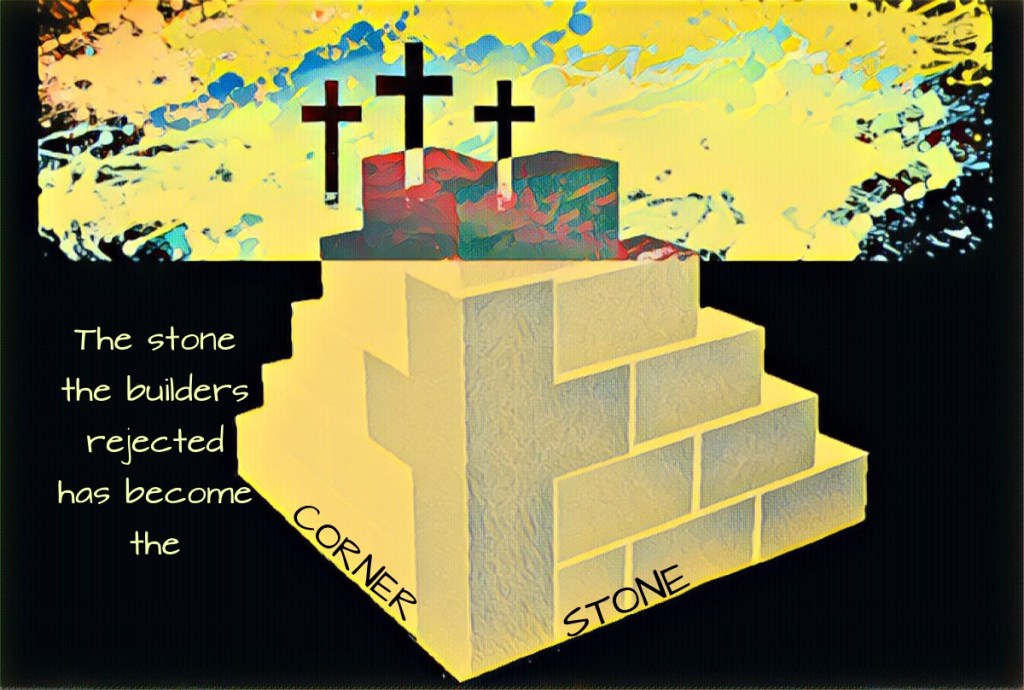
He is the stone rejected by you, the builders,
    which has become the cornerstone.
There is no salvation through anyone else,
nor is there any other name under heaven
given to the human race by which we are to be saved.

Acts 4: 10-12

The fact that we have so many names for God reminds me of how accommodating God is to my need as I pray. 

One day I need “My Rock”.

Another day I delight in “My Dayspring”.

As I wake up each morning and allow the day to embrace me, I often greet God with a special name, depending on the mood and circumstances of my heart:

  • Good morning, Beautiful Light. Take any darkness from our world this day.
  • I greet You, Sweet Lord. Thank you for the delicious gift of life.
  • Cloudy God, you have been hiding from me. Bring me into your Sunshine today.
  • God, my Strong Shoulder, stand by me today.
  • Chilly God, seeming to ignore my prayer, unfreeze my spirit to hear your answer.

Jesus invites us to pray with images that speak to our hearts. In our Gospel, He names himself a Shepherd, an image so accessible to his agrarian listeners, and which said it all without the need for theology!

Jesus said:
“I am the good shepherd.
A good shepherd lays down his life for the sheep.”

John 10:11

As we pray today, within what image is God coming to us? May we let the Holy One speak a sanctifying and special Name over us in our prayer. May it free us just as it freed the man healed in today’s passage from Acts.


Poetry: Six Recognitions of the Lord – Mary Oliver

1.

I know a lot of fancy words.

I tear them from my heart and my tongue.

Then I pray…..

3
I lounge on the grass, that’s all. So
simple. Then I lie back until I am
inside the cloud that is just above me
but very high, and shaped like a fish.
Or, perhaps not. Then I enter the place
of not-thinking, not-remembering, not-
wanting. When the blue jay cries out his
riddle, in his carping voice, I return.
But I go back, the threshold is always
near. Over and back, over and back. Then
I rise. Maybe I rub my face as though I
have been asleep. But I have not been
asleep. I have been, as I say, inside
the cloud, or, perhaps, the lily floating
on the water. Then I go back to town
to my own house, my own life, which has
now become brighter and simpler, some-where I have never been before….

4.

Of course I have always known you

Are present in the clouds, and the

Black oak I especially adore, and the

Wings of birds. But you are present

Too in the body, listening to the body,

Teaching it to live, instead of all

That touching, with disembodied joy.

We do not do this easily….


6.

Every summer the lilies rise
and open their white hands until they almost
cover the black waters of the pond. And I give
thanks but it does not seem like adequate thanks,
it doesn’t seem
festive enough or constant enough, nor does the
name of the Lord or the words of thanksgiving come
into it often enough Everywhere I go I am
treated like royalty, which I am not. I thirst and
am given water. My eyes thirst and I am given
the white lilies on the black water. My heart
sings but the apparatus of singing doesn’t convey
half what it feels and means. In spring there’s hope,
in fall the exquisite, necessary diminishing, in
winter I am as sleepy as any beast in its
leafy cave, but in summer there is
everywhere the luminous sprawl of gifts,
the hospitality of the Lord and my
inadequate answers as I row my beautiful, temporary body
through this water-lily world.


Music: Two Songs for today

Kyrie – Michael Hoppé

Kyrie Eleison
Lord, have Mercy


For those who might want to take it up a notch:
Kyrie – Mr. Mister

Saturday of the Second Week of Easter

April 17, 2021

( A friend posted this on Facebook yesterday. I think it’s such a good thought to begin our prayer.)

Today, in God’s Lavish Mercy, we pray with Psalm 33 in which the psalmist calls on us to sing and dance and SHOUT because God is faithful in keeping promises.

Rejoice in the Lord, you righteous;
it is good for the just to shout praises.
Praise the Lord with the harp;
play to God upon the ten-stringed lyre.
Sing for God a new song;
sound a fanfare with all your skill upon the trumpet.
For the word of the Lord is right,
and all the works of God are sure.
God loves righteousness and justice;
the mercy of the Lord fills the whole earth.

Psalm 33:1-5

In the course of our lives, there are many moments when we want to shout praise to God Who has come through for us in a big way – some gift, resolution, deliverance, insight – that opens our eyes to new life and possibility.

The disciples, tossing about in an uncertain sea, might have felt a little shout coming on when they saw someone walking on the turbulent waters. Can’t you almost hear the astounded “Yippee”s as Jesus assured them it was he?

Translated from the Aramaic 😉

The sea was stirred up
because a strong wind was blowing.
When they had rowed about three or four miles,
they saw Jesus walking on the sea
and coming near the boat,
and they began to be afraid.

John 6:18-20

But Jesus said to them,
“It is I. Do not be afraid.”

John 6: 18-20

As we pray today, we might remember the many times God has walked, unexpected, out of the midst of our storms. We might not be praying in a place where it’s appropriate to SHOUT. So let us take up the ten-stringed lyre of our hearts and quietly sing our gratitude.

Psalm 33:2

Poetry: Where Everything is Music – Rumi

We have fallen into the place
where everything is music.

The strumming and the flute notes
rise into the atmosphere,
and if the whole world's harp
should burn up,
there will still be hidden lyres
playing, playing
 
This singing art
is sea foam.
The graceful movements
come from a pearl
somewhere
on the ocean floor.

Poems reach up like spindrift
and the edge of driftwood
along the beach
wanting, wanting

They derive from a slow
and powerful root
that we cannot see.

Stop the words now.
Open the window
in the center of your chest,
and let the spirits fly
in and out

Music: The Lyre of Megiddo – Peter Pringle

The ancient city of Megiddo is also known as Armageddon. The lyre is made after an image discovered on a piece of ivory that stems from the time of the biblical King David. King David was known to have played a harp, so it is very likely that it was an instrument much like this one.

Easter Friday: Cornerstone

April 9, 2021

Today, in God’s Lavish Mercy, we pray with Psalm 118:

The stone which the builders rejected
    has become the cornerstone.
By the LORD has this been done;
    it is wonderful in our eyes.

Psalm 118:22

That “Stone”, rejected by the builders, is the Crucified Christ, the sight of whom was an abomination to those who expected a battle-victorious messiah.

But Jesus is among us to stand in contradiction to everything that limits the power of God. In Jesus’s Name

  • the poor are rich
  • the lost are found
  • the foolish are wise
  • the persecuted are blessed
  • the dead are raised to life

As Peter says in Acts, worldly rejection holds no sway over the power of this Name:

There is no salvation through anyone else,
nor is there any other name under heaven
given to the human race by which we are to be saved

Acts 4:12
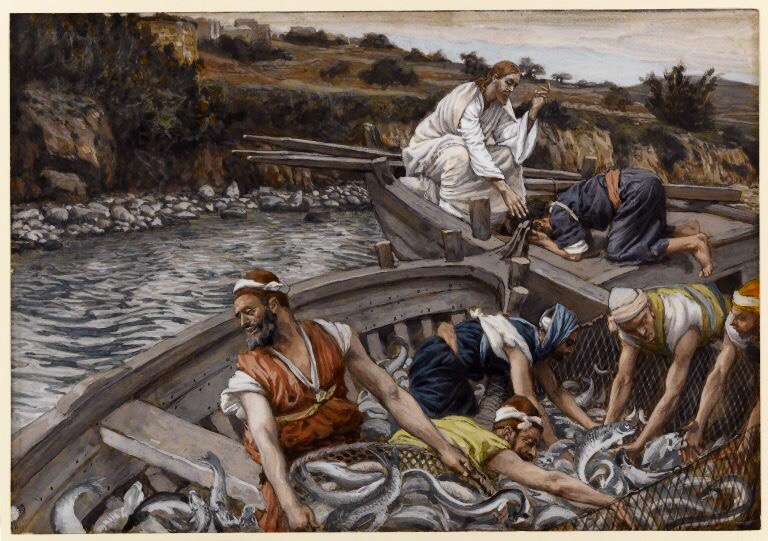
The Miraculous Catch – James Tissot

This is the mysterious lesson of the Cross, a lesson accessed only through faith, a faith the disciples exercise in today’s beautiful Gospel story.

This morning, we might wish to join Jesus for his “Breakfast on the Beach”, feeding our spirits in his resurrected Light. The truth he gives us goes beyond any purely human understanding. Let us listen with our deep hearts; see with grace-filled eyes.


Poetry: True Cornerstone by Robert Morris,  a prominent American poet of the mid-19th century

What is the Mason's cornerstone? 
Does the mysterious temple rest 
On earthly ground — from east to west — 
From north to south — and this alone? 

What is the Mason's cornerstone? 
Is it to toil for fame and pelf, 
To magnify our petty self, 
And love our friends — and this alone? 

No, no; the Mason's cornerstone — 
A deeper, stronger, nobler base, 
Which time and foe cannot displace — 
IS FAITH IN God — and this alone! 

'Tis this which makes the mystic tie 
Loving and true, divinely good, 
A grand, united brotherhood, 
Cemented 'neath the All-seeing Eye. 

'Tis this which gives the sweetest tone 
To Mason's melodies; the gleam 
To loving eyes; the brightest gem 
That sparkles in the Mason's crown. 

'Tis this which makes the Mason's grip 
A chain indissolubly strong; 
It banishes all fraud, and wrong, 
And coldness from our fellowship. 

Oh, cornerstone, divine, divine! 
Oh, FAITH IN God ! it buoys us up, 
And gives to darkest hours a hope, 

And makes the heart a holy shrine. 
Brothers, be this your cornerstone; 
Build every wish and hope on this; 
Of present joy, of future bliss, 
On earth, in Heaven — and this alone!

Music: Loed, When You Came – Kitty Cleveland

Lord, when you came to the seashore 
you weren’t seeking the wise or the wealthy, 
but only asking that I might follow.

O Lord, in my eyes you were gazing, 
Kindly smiling,My name you were saying; 
All I treasured,I have left on the sand there; 
Close to you, I will find other seas.

Señor me has mirado a los ojos,
Sonriendo has dicho mi nombre,
En la rena he dejado mi barca, 
junto a ti buscaré otro mar.

Lord, you knew what my boat carried:
Neither money nor weapons for fighting, 
but nets for fishing my daily labor. 

Lord, have you need of my labor, hands for service,
A heart made for loving, my arms for lifting the poor and broken? 

Lord, send me where you would have me, to a village,
Or heart of the city; I will remember that you are with me.

Easter Tuesday: He Knows My Name

Tuesday in the Octave of Easter

April 6, 2021

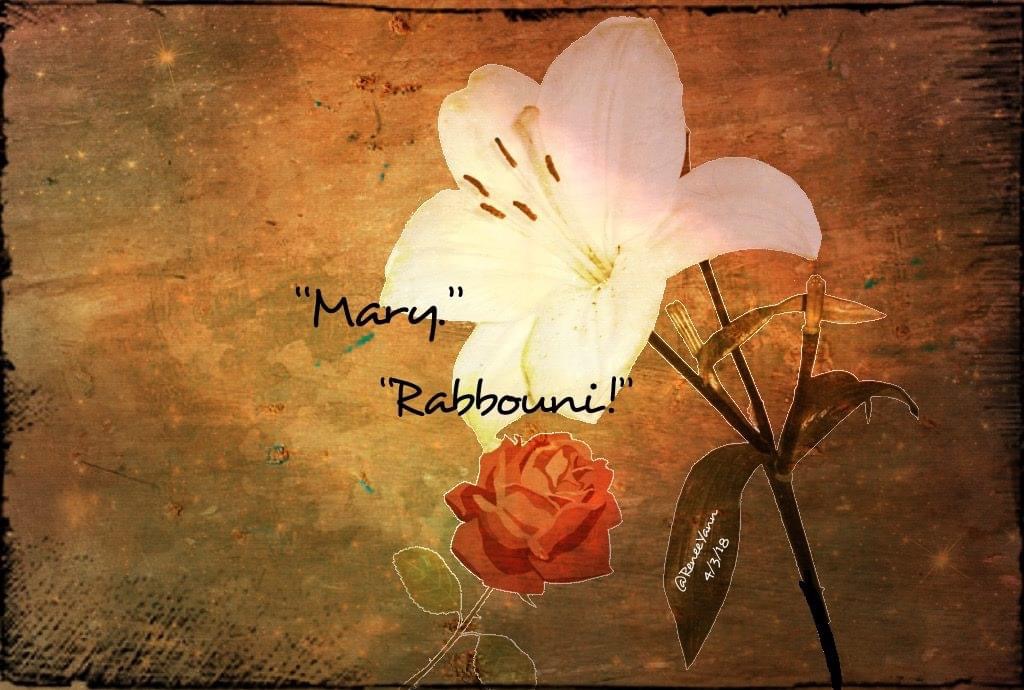
Jesus said to her, “Mary!”
She turned and said to him in Hebrew, “Rabbouni” 

Today, in God’s Lavish Mercy, we pray with Psalm 33 which connects two powerful readings from Acts and John’s Gospel.

Acts describes for us a gathered crowd which, upon Peter’s inspired preaching, become a repentant, converting community. Peter speaks a word that changes them. They are struck through to their core by the enormity of Christ’s sacrifice for them.

Now when they heard (Peter’s preaching),
they were cut to the heart,
and they asked Peter and the other Apostles,
“What are we to do, my brothers?”

Acts 2:37

In our Gospel, a bereaved Mary Magdalene’s heart is cut as well – with sorrow, confusion, and grief. But in that moment when Jesus simply speaks her name, she is awakened, healed, and energized.


What Word is it that our heart longs for today as we pray? What healing, light, and conversion do these readings hold for us as we open our hearts to Easter grace? 

We, too, like Peter’s congregation, have come to hear a Word that transforms us. We, too, like Mary have been waiting in Hope outside the tomb. As we pray today’s scriptures, let’s listen for our name.


Our soul waits for the LORD,
    who is our help and our shield.
May your kindness, O LORD, be upon us
    who have put our hope in you.

Psalm 33:20,22

Poetry: Say My Name – Meleika Gesa-Fatafehi

It is a good day to think about how important one’s name is to them, especially as it expresses our spiritual, familial and cultural rootedness. Meleika Gesa-Fatafehi is a proud Black/Indigenous, Pasifika and West Asian writer. She is from Murray (Mer) Island, from the Zagareb and Dauareb tribes.

My name was my name before
                            I walked among the living
               before I could breathe
               before I had lungs to fill
before my great grandmother passed
               and everyone was left to grieve

My name was birthed from a dream
               A whisper from gods to a king
               A shout into the stars that produced
                             another that shone as bright
They held me without being burnt, humming lullabies in pidgin

My name was passed down from my
               ancestors
They acknowledged my roots grew in two
               places
So, they ripped my name from the ocean
               and mixed it into the bloodlines of my totems

My name has survived the destruction of worlds
and the genocidal rebirthing of so-called ones
It’s escaped the overwhelmed jaw of the death bringer
               Many a time
It has survived the conflicts that resulted in my gods,
               from both lands, knowing me as kin,
but noticing that I am painfully unrecognisable and lost
They are incapable of understanding
               the foreign tongue that was forced on me

My name has escaped cyclones and their daughters
It has been blessed by the dead
As they mixed dirt, salt and liquid red,
               into my flesh
My name is the definition of resilience
It is a warrior that manifested because of warriors

So, excuse me as I roll my eyes or sigh as you
mispronounce my name
               over and over again
Or when you give me another
               that dishonours my mother and father
That doesn’t acknowledge my lineage to my island home
or the scents of rainforest and ocean foam
You will not stand here on stolen land
               and whitewash my name
For it is two words intertwined
               holding as much power as a hurricane
Say it right or don’t say it at all
For I am Meleika
               I will answer when you call


Music: You Know My Name – Brooklyn Tabernacle Choir

(You may come upon an ad in the middle of today’s music — because it is rather long. Just clip the “Skip Ads” after a few seconds and you’ll get back to the choir)

Holy Saturday 2021

April 3, 2021

Alternate Reading from Walter Brueggemann 

Today, in Mercy, we join Mary and the disciples as they deal with Christ’s death. No doubt, the range of emotions among them was as great as it would be among any group or family losing someone they dearly loved.

They had entered, with heart-wrenching drama, into a period of bereavement over the loss of Jesus. Doubt, hope, loss, fear, sadness and remembered joy vied for each of their hearts. They comforted one another and tried to understand each other’s handling of their terrible shared bereavement.

They did just what we all do as families, friends and communities when our beloved dies.

But ultimately, our particular bereavement belongs to us alone, woven from the many experiences we have had with the person who has died. These are personal and indescribable, as is the character of our pain and loss.

Do not be afraid of your bereavement.  It is a gift of love.

Holy Saturday, like bereavement, is a time of infrangible silence. No matter how many “whys” we throw heavenward, no answer comes. It is a time to test what Love has meant to us and, even as it seems to leave us, how it will live in us.

As we pray today with the bereaved Mother and disciples, let us fold all our bereavements into their love.  We already know the joyful end to the story, so let us pray today with honesty but also with unconquerable hope that we will live and love again.

Music: Goodbye, Old Friend – Sean Clive

Good Friday of the Lord’s Passion

April 2, 2021

Today, in God’s Lavish Mercy, we pray with Psalm 31, the prayer of one who will not be shaken from faith in God.

For all my foes I am an object of reproach,
    a laughingstock to my neighbors, and a dread to my friends;
    they who see me abroad flee from me.
I am forgotten like the unremembered dead;
    I am like a dish that is broken.
But my trust is in you, O LORD;
    I say, “You are my God.
In your hands is my destiny; rescue me
    from the clutches of my enemies and my persecutors.”

Psalm 31: 12-13

What is there to say about the Good Friday journey of Jesus? It may be that we can only walk beside him in loving, heart-broken silence.

There are times in our lives when we will be called to walk like this beside others in loving and merciful ministry.

There may be times when others are called to walk with us in such a way.

Let these times inform our prayer today.

Good Friday is the time we gather strength and compassionate understanding from Jesus to help us, in his Name, be Mercy in the world.


Poetry: From “The Dream of the Rood”, one of the Christian poems in the corpus of Old English literature and an example of the genre of dream poetry. Like most Old English poetry, it is written in alliterative verse. Rood is from the Old English word rōd ‘pole’, or more specifically ‘crucifix’. Preserved in the 10th-century Vercelli Book, the poem may be as old as the 8th-century Ruthwell Cross, and is considered as one of the oldest works of Old English literature.

The Rood (cross of Christ) speaks:

“It was long past – I still remember it – 
That I was cut down at the copse’s end,
Moved from my root. Strong enemies there took me,
Told me to hold aloft their criminals,
Made me a spectacle. Men carried me
Upon their shoulders, set me on a hill,
A host of enemies there fastened me.

“And then I saw the Lord of all mankind
Hasten with eager zeal that He might mount
Upon me. I durst not against God’s word
Bend down or break, when I saw tremble all
The surface of the earth. Although I might
Have struck down all the foes, yet stood I fast.

“Then the young hero (who was God almighty)
Got ready, resolute and strong in heart.
He climbed onto the lofty gallows-tree,
Bold in the sight of many watching men,
When He intended to redeem mankind.

I trembled as the warrior embraced me.
But still I dared not bend down to the earth,
Fall to the ground. Upright I had to stand.

“A rood I was raised up; and I held high 
The noble King, the Lord of heaven above.
I dared not stoop. They pierced me with dark nails;
The scars can still be clearly seen on me,
The open wounds of malice. Yet might I
Not harm them. They reviled us both together.
I was made wet all over with the blood
Which poured out from his side, after He had 
Sent forth His spirit. And I underwent
Full many a dire experience on that hill.

I saw the God of hosts stretched grimly out.
Darkness covered the Ruler’s corpse with clouds
His shining beauty; shadows passed across,
Black in the darkness. All creation wept,
Bewailed the King’s death; Christ was on the cross….

“Now you may understand, dear warrior,
That I have suffered deeds of wicked men
And grievous sorrows. Now the time has come
That far and wide on earth men honor me,
And all this great and glorious creation,
And to this beacon offers prayers. On me
The Son of God once suffered; therefore now
I tower mighty underneath the heavens,
And I may heal all those in awe of me.
Once I became the cruelest of tortures,
Most hateful to all nations, till the time
I opened the right way of life for men.”

Music: Pie Jesu – Michael Hoppé

Holy Thursday

Evening Mass of the Lord’s Supper

April 1, 2021

Today, in God’s Lavish Mercy, we pray with Psalm 116 which Walter Bruggemann calls an example of “the performance of thanks”. 

How shall I make a return to the LORD
    for all the good he has done for me?
The cup of salvation I will take up,
    and I will call upon the name of the LORD.

Psalm 116: 12-13

There is a tone of solemn ritual woven through the psalm, just as there is throughout the Holy Thursday liturgies.

The time of waiting and wondering is over. Jesus chooses the Passover meal to formalize his understanding that the time has come to offer his life in an ultimate sacrifice of praise.

Before the feast of Passover, Jesus knew that his hour had come
to pass from this world to the Father.
He loved his own in the world and he loved them to the end.

John 13:1

The Last Supper by the nun Plautilla Nelli (1524–1588) of Florence
Inscribed: Suor Plautilla · Orate Pro Pictora (Pray for the Paintress)

It is likely that, during his Last Supper, Jesus would have prayed, and possibly sung, Psalm 116 as part of the ancient Hallel,  six thanksgiving prayers included in the Passover rites. 

On our behalf, Jesus is about to enflesh in his own life the redemptive promise awaited through the ages. He is about to enact the Great Deliverance — far greater than that achieved in the Passover. By the power of his Paschal sacrifice, we are redeemed from death itself:

Return, my soul, to your rest;
the LORD has been very good to you.
For my soul has been freed from death,
my eyes from tears, my feet from stumbling.
I shall walk before the LORD
in the land of the living

Psalm 116: 7-9

For me, Holy Thursday is the most solemnly beautiful and meaningful day of the Liturgical Year. There is so much to be found in the readings, especially as we peel back single phrases to hear their living power and love. There is so much to be learned at the side of Jesus as we pray with Him.

May we place ourselves beside Jesus at the holy table of his life. Feel him lay the gathering tensions down as he gathers his beloveds in the truth of this moment. It is time for him to give everything over in love. This is the moment of Holy Acquiescence, this is the moment of Eucharist.

With Jesus, let us pray for the loosening of any bonds which prevent us from giving our lives lovingly into God’s Will for us, from allowing Eucharist to be offered through our lives.

Dear to the eyes of the LORD
    is the death of his faithful ones.
I am your servant, the child of your handmaid;
    you have loosed my bonds.
To you will I offer sacrifice of thanksgiving,
    and I will call upon the name of the LORD.
My vows to the LORD I will pay
    in the presence of all his people.

Psalm 116: 15-18

Prose: from Mass on the World, by Pierre Teilhard de Chardin

Since once again Lord 
I have neither bread nor wine nor altar,
I will raise myself beyond these symbols 
up to the pure majesty of the real itself.
 
I, your priest, will make the whole earth my altar, 
and on it I will offer you 
all the labors and the sufferings of the world.
 
I will place on my paten Lord God 
all the harvest to be won from your renewal. 

Into my chalice, I shall pour all the sap 
which is to be pressed out this day 
from the earth’s fruits and from its sufferings.
 
All the things in the world 
to which this day will bring increase; 
all those that will diminish; 
all those, too, that will die: 
all of them, Lord, I try to gather into my arms 
so as to hold them out to you in offering.
 
This is the material of my sacrifice, 
the only material you desire.
The restless multitude, confused or orderly, 
the immensity of which terrifies us, 
this ocean of humanity, 
the slow, monotonous wave-flows which trouble the hearts 
of even those whose faith is most firm.
 
My paten and my chalice are 
the depths of a soul laid widely open 
to all the forces which in a moment will rise up 
from every corner of the earth 
and converge upon the Spirit. 

Grant me the remembrance and the mystic presence 
of all those whom the light is now awakening to the new day.
Receive, O Lord, this all-embracing Host
which your whole creation, moved by your magnetism, 
offers you at this dawn of a new day.
 
Sanctus, Sanctus, Sanctus
Dominus Deus Sabaoth.
Pleni sunt cæli et terra gloria tua.
Hosanna in excelsis.

Music: Sanctus – Jessie Norman

(Get someplace where you can turn the sound up for this and let it blow you away. There are some exquisite soft notes, beginning and end, that you don’t want to miss. Wait for them.)

Psalm 71: A Long Trust

Tuesday of Holy Week

March 30, 2021

Today, in God’s Lavish Mercy, we pray with Psalm 71, a prayer of yielding and confident faith.

Often thought to be the prayer of an aging David, Psalm 71 recalls a long and steady relationship with God. Even as his youthful vigor wanes, the psalmist declares that his true strength rests in God’s faithfulness.

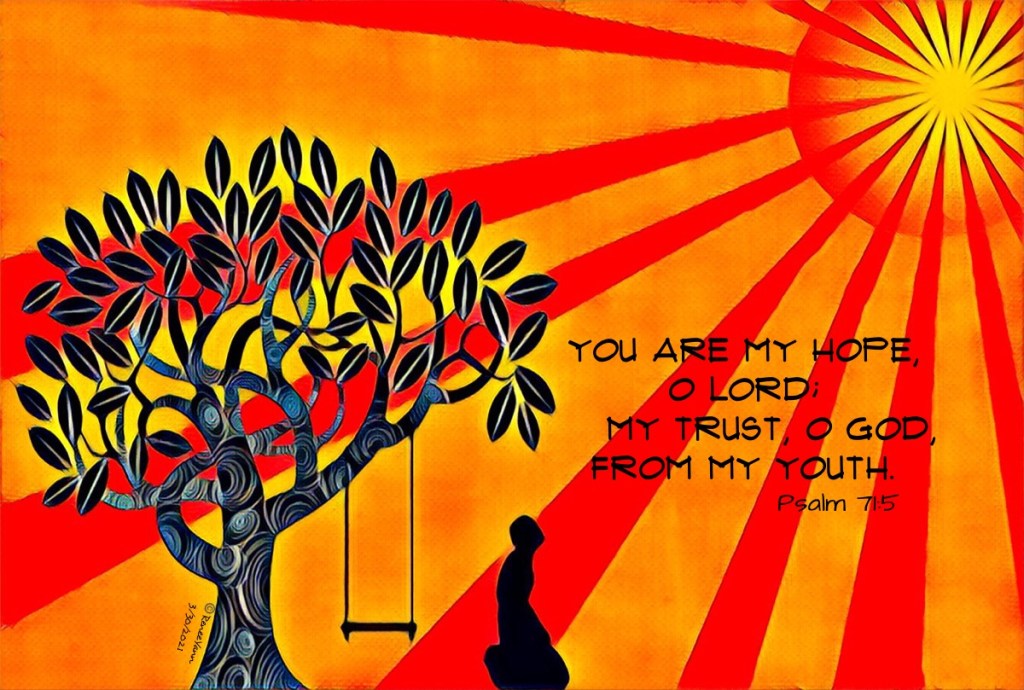
For you are my hope, O LORD;
    my trust, O God, from my youth.
On you I depend from birth;
    from my mother’s womb you are my strength.
My mouth shall declare your justice,
    day by day your salvation.
O God, you have taught me from my youth,
    and till the present I proclaim your wondrous deeds.

Psalm 71: 15-17
King David as an Old Man – Rembrandt

David witnesses to a powerful faith, one that we all might cherish in our human diminishments. It is hard to lose things in our life – youth, health, relationships, reputation, enthusiasm, hope, direction, security. But all of us face at least some of these challenges at some time in our lives.


Judas Iscariot (right), retiring from the Last Supper,
painting by Carl Bloch, late 19th century

In our Gospel today, Jesus acknowledges the loss of trust in a close disciple:

“Amen, amen, I say to you, one of you will betray me.”
The disciples looked at one another, at a loss as to whom he meant.

John 13:21-22

That betrayal is a sign to Jesus that the great dream of his earthly ministry is coming to an ignominious close when even those dearest to him slip into betrayal and denial.


What is it that holds Jesus together, heart and soul riveted on the Father’s Will, as he moves through these heart-wrenching days.

Jesus is the living sacrament of complete obedience and union with God. Every choice of his life has brought him to a readiness for this final and supreme act of trusting love. Like the psalmist today, Jesus’s whole life proclaims:

I will always hope in you
and add to all your praise.
My mouth shall proclaim your just deeds,
day after day your acts of deliverance,
though I cannot number them all.i
I will speak of the mighty works of the Lord;
O GOD, I will tell of your singular justice.
God, you have taught me from my youth;
to this day I proclaim your wondrous deeds.

Psalm 71: 14-17

As we accompany Jesus today, let us pray this psalm with him, asking for an ever-deepening faith, hope, and love.


Poetry: Jesus Weeps – Malcolm Guite

Jesus comes near and he beholds the city
And looks on us with tears in his eyes,
And wells of mercy, streams of love and pity
Flow from the fountain whence all things arise.
He loved us into life and longs to gather
And meet with his beloved face to face
How often has he called, a careful mother,
And wept for our refusals of his grace,
Wept for a world that, weary with its weeping,
Benumbed and stumbling, turns the other way,
Fatigued compassion is already sleeping
Whilst her worst nightmares stalk the light of day.
But we might waken yet, and face those fears,
If we could see ourselves through Jesus’ tears.

Music: Long Ago – Michael Hoppé, Tom Wheater, Michael Tillman

Monday of Holy Week

Monday of Holy Week


March 29, 2021

Today, in God’s Lavish Mercy, we pray with Psalm 27 which is a cry for help from one who is confident of God’s care.

The LORD is my light and my salvation;
    whom should I fear?
The LORD is my life’s refuge;
    of whom should I be afraid?

Psalm 27:1

Despite these verses, the psalmist obviously is afraid, otherwise why pray? As we begin Holy Week, we might imagine Jesus voicing such a prayer. Confident of the Father’s participation in his life, Jesus nevertheless must face daunting realities with courage – but not without fear.

We can learn so much from Jesus in this.

It is a very unusual, and perhaps non-existent, person who has no fears. We all fear something… maybe many things. It is human to fear that which we cannot see, control, or withstand. Even the one touting his great fearlessness is likely afraid of being seen as weak.

What Jesus teaches us is not to let our faith, love and hope be dominated by fear; rather, to engage our lives courageously with these three virtues despite our normal human fears. In so doing, we become the person God hopes for us to be, just as Jesus did.


Who would I be,
and what power would be expressed in my life,
if I were not dominated by fear?

Paula D’Arcy

The triumph is in resisting that domination, not in being fearless. Nelson Mandela has written, “I learned that courage was not the absence of fear, but the triumph over it. The brave man is not he who does not feel afraid, but he who conquers that fear.


I think Jesus was afraid during these final days of his life, but he pushed through to the truth of God’s Will for his life. We can ask Jesus to help us in our fears by praying as he might have with Psalm 27:

You are my light and my salvation
   Whom then shall I fear?

You are the strength of my life
  of what shall I be afraid?

Trials, enemies, changes, difficulties—
  they rise up and they resolve

Therefore–
   I will trust you
   I will wait for you
   I will seek you.

transliteration of Psalm 27 by Christine Robinson

Poetry: from T.S. Eliot, Four Quartet, East Coker

I said to my soul, be still, and let the dark come upon you
Which shall be the darkness of God. As, in a theatre,
The lights are extinguished, for the scene to be changed
With a hollow rumble of wings, with a movement of darkness on darkness,
And we know that the hills and the trees, the distant panorama
And the bold imposing facade are all being rolled away--
Or as, when an underground train, in the tube, stops too long between stations
And the conversation rises and slowly fades into silence
And you see behind every face the mental emptiness deepen
Leaving only the growing terror of nothing to think about;
Or when, under ether, the mind is conscious but conscious of nothing--
I said to my soul, be still, and wait without hope
For hope would be hope for the wrong thing; wait without love,
For love would be love of the wrong thing; there is yet faith
But the faith and the love and the hope are all in the waiting.
Wait without thought, for you are not ready for thought:
So the darkness shall be the light, and the stillness the dancing.

Music: Be Still My Soul – Katharina Amalia Dorothea von Schlegel, born 1697

A Psalm from Jeremiah

Saturday of the Fifth Week of Lent

March 27, 2021


Today, in God’s Lavish Mercy, we pray a responsorial from the Book of Jeremiah:

The Lord will guard us, as a shepherd guards the flock.

The psalm today, with the first reading, brings assurance that God remains with us through suffering and will heal and make us whole again.

That reassurance is needed as we hear the Gospel’s tone darken. After the raising of Lazarus, the whole nation waits to see what will happen to Jesus as Passover nears.


I think, in some ways, impending doom is almost worse than doom itself. Picture the part in a movie where the attacker waits in the dark while the victim tiptoes into lurking danger.

That frightening music they always play! Sometimes the tension heightens to the point that I have to hit the mute or close my eyes!


Entry of Christ into Jerusalem, a 1617 oil painting by Flemish Baroque painter Anthony van Dyck

This is what all surrounding Jerusalem felt like in today’s Gospel. The dark edge of evil hangs in inevitable threat.

But for Jesus, who walked in the hidden light of the Father, the moment brought more than threatening shadows. It was time to fulfill an ancient promise. It was time to offer the greatest act of Love.

Hear the word of the LORD, O nations,
    proclaim it on distant isles, and say:
He who scattered Israel, now gathers them together,
    he guards them as a shepherd his flock.
The LORD shall ransom Jacob,
    he shall redeem him from the hand of his conqueror.

Jeremiah 31: 10-12

As Jesus went off alone to Ephraim to prepare his heart and soul for this ultimate fulfillment, perhaps a prayer from Jeremiah strengthened him, a remembered promise from Ezekiel focused him.

Let us pray with Jesus today as he asks the Father to “shepherd” him. With Jesus, may we find our own strengths and understandings in these ancient prophets.


Poetry: Redemption by George Herbert (1593-1633)who was a Welsh-born poet, orator, and priest of the Church of England. His poetry is associated with the writings of the metaphysical poets, and he is recognised as “one of the foremost British devotional lyricists.”

Having been tenant long to a rich lord, 
    Not thriving, I resolvèd to be bold, 
    And make a suit unto him, to afford 
A new small-rented lease, and cancel th’ old. 

In heaven at his manor I him sought; 
    They told me there that he was lately gone 
    About some land, which he had dearly bought 
Long since on earth, to take possessiòn. 

I straight returned, and knowing his great birth, 
    Sought him accordingly in great resorts; 
    In cities, theaters, gardens, parks, and courts; 

At length I heard a ragged noise and mirth 
    Of thieves and murderers; there I him espied, 
    Who straight, Your suit is granted, said, and died.

Music: Like a Shepherd – St. Louis Jesuits