Come Back!

Saturday of the Second Week of Lent

March 14, 2020

Click here for readings

Today, in Mercy, our readings are soaked in Mercy itself … seasoned by repentance, forgiveness, hope, and trust.

Both in Micah’s lilting, poetic words and in Jesus’s  parable, we are embraced by the infinite tenderness of God.

You may find the following comparison odd at first, but stay with me a minute. Reading this morning’s scriptures, I thought of Lidia Bastianich, the famous chef. To me, her show is the perfect combination of instruction, humor, and familial camaraderie. Still, even though Lydia offers tons of invaluable culinary tips, it is her repeated farewell phrase that I most treasure: “Tutti a tavola a mangiare!”. “Let everyone come to the table and eat!”

Lydia


Micah, who prophesied just prior to the Siege of Jerusalem in 587 BC, condemned the sinfulness rampant in Israel and Judah. At the same time, he consoled the “remnant” people and, àla Lydia, invited them to the table of forgiveness and reconciliation. Here’s the way Micah asks God to “set the table” for God’s repentant People:

Shepherd your people with your staff,
the flock of your inheritance,
That dwells apart in a woodland,
in the midst of Carmel.
Let them feed in Bashan and Gilead,
as in the days of old …
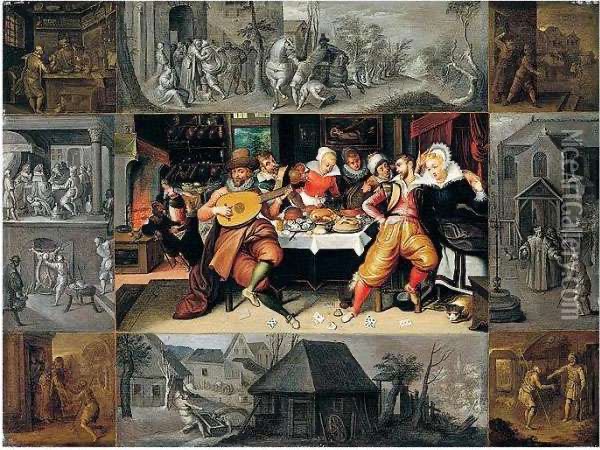

prodigal dinner
The Parable of the Prodigal Son by Frans II Francken

Jesus describes a similar banquet offered to the repentant son:

The father ran to his son, embraced him and kissed him.
His son said to him,
‘Father, I have sinned against heaven and against you;
I no longer deserve to be called your son.’
But his father ordered his servants,
‘Quickly, bring the finest robe and put it on him;
put a ring on his finger and sandals on his feet.
Take the fattened calf and slaughter it.
Then let us celebrate with a feast
because this son of mine was dead, and has come to life again;
he was lost, and has been found.’

As I pray today, I ask if there is any lost or hungry part of my spirit that longs to return to the table of Peace and Mercy. I pray also for those places and souls throughout our world who hunger to hear:

Tutti a tavola a mangiare!”

Music: Father, I Have Sinned -written by Fr. Eugene O’Reilly

Rejected

Friday of the Second Week of Lent

March 13, 2020

Click here for readings

Mt21_42rejected

Today, in Mercy, there is a great sadness in our readings.

The poignant opening line from Genesis immediately strikes us:

Israel loved Joseph best of all his sons,
for he was the child of his old age

Joseph

We picture young Joseph in his beautiful rainbow coat and, under an olive tree’s shade, old Jacob(Israel) proudly, tenderly, watching him play.

As the story ensues to reveal the later betrayal of Joseph’s jealous brothers, we are left astounded. Such treachery, especially among brothers, sickens the heart.


Our Gospel picks up the sad theme because Joseph and his brothers are archetypes of Christ’s story with humankind.

800px-The_Wicked_Husbandman_(The_Parables_of_Our_Lord_and_Saviour_Jesus_Christ)_MET_DP835802
The Wicked Husbandman by John Everett Millais shows the owner’s murdered son

Jesus tells a parable in which he is actually the unnamed main character. He is the Son sent by a loving Father. He is the one rejected, beaten and killed by the treacherous tenants of his Father’s garden.

We know from our familiarity with Scripture that both these stories ultimately come to glorious conclusions. But today’s readings do not take us there. They leave us standing, mouths dropped open, at the dense meanness of the human heart, at the soul’s imperviousness to grace, at the profound sadness Jesus felt at this point in his ministry.

In our prayer today, let’s just be with Jesus, sharing his sadness for the meanness still hardening our world. Let us comfort him with our desire to be open to God’s Grace and Mercy.

Music:  Handel:Messiah – He was despised and rejected – Alfred Deller

Turn and See

Thursday of the Second Week of Lent

March 12, 2020

Click here for readings

Today, in Mercy, our readings offer us studies in dramatic contrasts.

the barren bush in a lava waste
vs.
the tree planted beside the waters

that turns its roots to the stream

Jere17_7barrentree


a rich man who dressed in purple garments and fine linen

vs.
a poor man named Lazarus, covered with sores

Gustave_Dore_Lazarus_and_the_Rich_Man
Lazarus and the Rich Man by Gustave Dore (1891)


What are Jeremiah and Jesus teaching us with these unforgettable images?

Jeremiah summarizes his point in the very first verse:

Cursed is the one who trusts in human beings,
who seeks strength in flesh,
whose heart turns away from the LORD.

In his parable, Jesus has Abraham deliver the point:

You received what was good during your lifetime
while Lazarus likewise received what was bad;
but now he is comforted here, whereas you are tormented.


Praying with these passages, we might determine to make sure we don’t end up like the barren bush or the ultimately tormented rich person. 

But how can we do that?

I think the key lies in Jeremiah’s phrase, “one whose heart turns away from the LORD.” 

In his parable, Jesus shows us what that “turning” looks like. It is any blind indifference in us that allows us to ignore another’s suffering. 

Most of us don’t consciously choose that indifference. We simply fail to turn from our own comfort … plans, needs, agenda … to observe the pain or need around us.

So as we leave our prayer today, perhaps we can do so determined to turn from our self-interests … to see if there is a “Lazarus” right beside us whom we had failed to notice.

Music: Turn My Heart – Lynn DeShazo (Lyrics below)

Turn my heart O Lord
Like rivers of water
Turn my heart O Lord
By Your hand
‘Til my whole life flows
In the river of Your Spirit
And my name
Bring honor to the Lamb

Lord I surrender to
Your work in me
I rest my life within
Your loving hands

(Repeat chorus 3 times)

‘Til my name brings honor
To the Lamb

Here’s That Cup, Again!

Wednesday of the Second Week of Lent

March 11, 2020

Click here for readings

Today, in Mercy, we learn a lesson in humble leadership, thanks once againto “Mrs. Zebedee”.

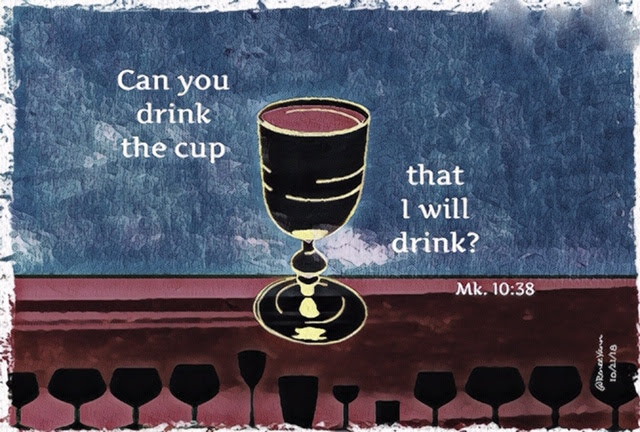
Mk 10_38 cup

Our Gospel recounts the story of the mother of James and John interceding for her sons with Jesus. Like many overprotective mothers, she intervenes even into their adult lives. She wants to make sure they get the best deal for their investment with Jesus.

Listen, I understand and love her! I would be the same way with my kids if I had any. I often say it’s best I had none because “Overprotective Me” would have had to shadow them to school, dances, playgrounds etc. until they were about 35 years old!

But the point of this Gospel story isn’t Mrs. Zebedee’s overprotectiveness.  It has little to do with Mrs. Zebedee at all.

The point is that “Mrs. Zebedee” (like many of us) has missed the whole POINT. The Gospel story is about US and the integrity of our choice to live a life in the pattern of Jesus.

Christ’s disciples have decided to follow a man who says things like this:

  • The last shall be first and the first, last.
  • Unless you lay down your life, you cannot follow me.
  • Whoever takes the lowly position of a child is the greatest in the Kingdom of Heaven.

The seats at Christ’s right and left, which Mrs. Zebedee requests for her sons, will bring them rewards only through humility and sacrificial service.


Here’s the way a 14th century artist imagined the Zebedee family. (Dad looks happy!)

sons of zebedee
Mary Salome and Zebedee with their Sons James the Greater and John the Evangelist (c.1511) by Hans von Kulmbach, Saint Louis Art Museum


Jesus is gentle with “Mrs. Zebedee”. He understands how hard it is for any of us to comprehend the hidden glory of a deeply Christian life. We are surrounded by a world that screams the opposite to us:

  • Me first!
  • Stand your ground!
  • Good guys finish last!

So Jesus turns to James and John (and to us). One can imagine the bemused look on Christ’s face. He knows the hearts of his disciples. He knows they have already given themselves to him. So he asks them for a confession of faith, “Can you drink the cup that I will drink?”

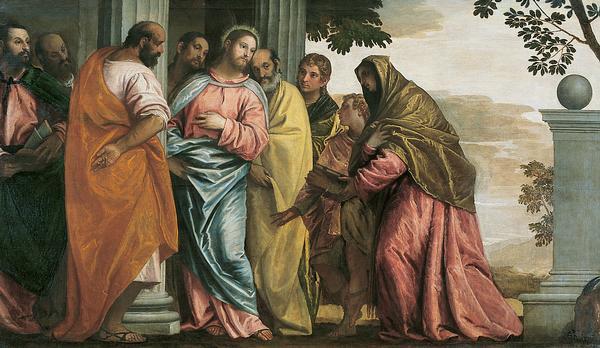
veronese-le-christ-rencontrant-la-femme-et-les-fils-de-zebedee_-_grenoble
The meeting of Christ with Zebedee’s wife and sons by Paolo Veronese

Their humble, faith-filled answer no doubt stuns their mother. She is left in wonder at the holy men her sons have become. Perhaps it is the beginning of her own deep conversion to Christ.

As we pray with this passage, where do we find ourselves in this scene? How immediate, sincere, and complete is our response to Jesus’ question: “Can you drink the cup….?”

Music: To Be a Servant – David Haas

Refrain:
For I have come not to be served but to serve;
To give my life.
If you wish to be the first you must seek
To be a servant, to be a servant.

1. Can you drink the cup that I must drink;
Are you willing?
Can you be baptized like I have been baptized?
Are you able? Are you able?

2. For to sit at my right hand or at my left,
Is not for me to give.
But for those for whom it has been prepared,
It will be given. It will be given.

A Plea for Mercy

Monday of the Second Week in Lent

March 9, 2020

Click here for readings

bruggemann

Today, in Mercy, our reading from Daniel gives us one of the Great Prayers of the Old Testament (according to Walter Brueggemann’s like-named book.)

The Book of Daniel and chapter nine in particular, have been the subjects of extensive biblical exegesis. Chapter nine in considered one of the Messianic Prophecies, Old Testament markers pointing to Christ. So there is much we could study about today’s first reading.


But how might we pray with it?

Naming the sins of all the People, Daniel’s great prayer is a plea for mercy:

Lord, great and awesome God,
you who keep your merciful covenant
toward those who love you
and observe your commandments! …
… yours, O Lord, our God,
are compassion and forgiveness!

Three themes, so strikingly germane to Lent, arise from Daniel’s prayer:

Repentance
Forgiveness
Transformation


Our Responsorial Psalm picks up this plea to Mercy for Mercy:

Remember not against us the iniquities of the past;
may your compassion quickly come to us,
for we are brought very low.
R.    Lord, do not deal with us according to our sins.
Help us, O God our savior,

because of the glory of your name;
Deliver us and pardon our sins
for your name’s sake.


The questions for each of us as we pray today —

Is there someplace in my life
longing for such mercy and healing?

Where can my spirit grow
from repentance, forgiveness, and transformation?

be Mercy

In our Gospel Jesus tells us how to open our hearts to this merciful healing.

Be merciful, just as your Father is merciful.
Stop judging and you will not be judged.
Stop condemning and you will not be condemned.
Forgive and you will be forgiven.
Give and gifts will be given to you;
a good measure, packed together, shaken down, and overflowing,
will be poured into your lap.
For the measure with which you measure
will in return be measured out to you.”

There it is in black and white. Whether or not the advice changes my heart is up to me!

Music: Kyrie Eleison (Lord, have mercy) Beethoven- Missa Solemnis

Be Careful of Love

Saturday of the First Week of Lent

March 7, 2020

Click here for readings

Moses spoke to the people, saying:
“This day the LORD, your God,
commands you to observe these statutes and decrees.
Be careful, then,
to observe them with all your heart and with all your soul.


Today, in Mercy, Moses tells us this:

Be careful, then …

Be careful of what? Does he mean be careful like,”Don’t fall down the steps!”. Or does he mean be careful like, “Hold tenderly to love in your life.”?

In this passage from Deuteronomy, Moses goes on to say one of my favorite biblical phrases:

… today the LORD is making this agreement with you:
you are to be a people peculiarly his own, as he promised you…

Since the 17th century, the word “peculiar” has taken on the meaning of “odd” or “unusual”.  But the original sense comes from the Latin peculiaris meaning “of private property”

Moses is reminding us that we belong to God and God to us in a covenant similar to, but far exceeding, the mutuality of a marriage.

So we should “be careful”, full of care, in appreciation for this infinite love.


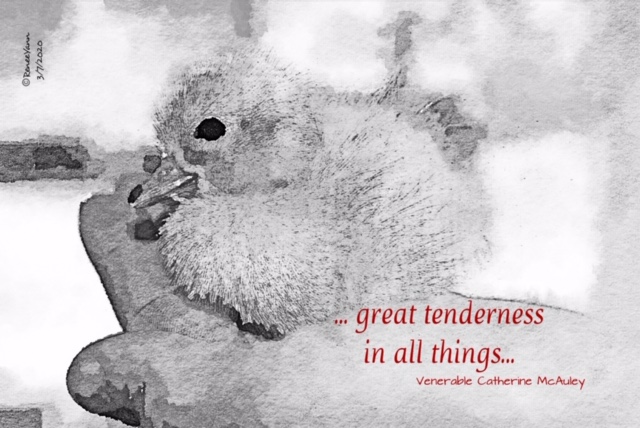
chick

In our Gospel, Jesus tells us how to take this exquisite care of our precious relationship with God:

But I say to you, love your enemies,
and pray for those who persecute you,
that you may be children of your heavenly Father,
for God makes the sun rise on the bad and the good,
and causes rain to fall on the just and the unjust.
… Be compassionate as your Heavenly Father is compassionate.

So, let’s be careful of love today when we find this precious God in our sisters and brothers and in all God’s Creation. Let us be compassionate.

Music:  Compassion Hymn – The Gettys 

The Problem with Prayer

Thursday of the First Week in Lent

March 5, 2020

Click here for readings

Today, in Mercy, our readings could be so reassuring about the power of our prayer, except …..

How often have you prayed
for something that you didn’t get?


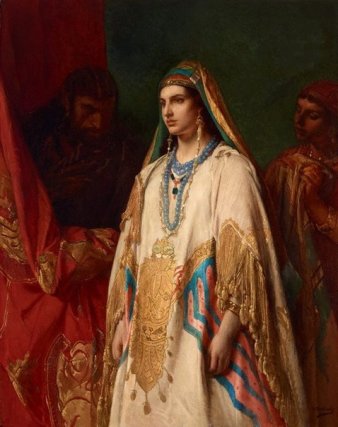
Jean-François_Portaels_-_Esther
Queen Esther – By Jean-François Portaels

In our reading from the Book of Esther, Esther certainly puts everything she has into her prayer for deliverance:

She lay prostrate upon the ground, together with her handmaids,
from morning until evening, and said:
“God of Abraham, God of Isaac, and God of Jacob, blessed are you.
Help me, who am alone and have no help but you,
for I am taking my life in my hand.

The passage, in isolation from the rest of the Book, might lead us to conclude that Esther’s prayer is simply about her asking for, and receiving, what she wants from God. It’s about much more.

Esther, like Christ, is in a position to save her people. She must risk her life to do so. She is praying for the courage to do God’s will, to look past her own comfort and become an agent of grace in her circumstances.

Now that’s some kind of prayer!


Prayer can be like looking in a mirror. All we see reflected back is our own need and desire. We don’t pray honestly and openly enough to let God open a door in the mirror – a door into God’s own will and hope for us.

Mt7_7 doorJPG

That’s the door Jesus is talking about in today’s Gospel.

What we ASK is not just for something we want, but rather to know God’s heart.

What we SEEK is not our own satisfaction, but the grace to embrace God’s mysterious energy in our lives no matter how it comes to us.

What we KNOCK for and desire to be opened to us is deeper love and fuller relationship with our loving God.

Sometimes, the problem with prayer is that we think it’s like asking our rich uncle for a permanent loan. It’s only when we comprehend that prayer is a relationship that the RECEIVE, FIND, and OPENED parts become real for us.

Music: Prayer Is the Key to Heaven – Alan Brewster

( Uncharacteristically, I went old-time revival with this one — but I think the song has something to say. I hope you enjoy it, dear Friends. And for something more classically beautiful, see Handel’s piece below.)


Sinfonia from”Esther”  – George Frideric Handel

A Second Chance

Wednesday of the First Week in Lent

March 4, 2020

Click here for readings

Jonah3_1another chance

Today, in Mercy, one line from our readings hit me like a lightening bolt:

The word of the LORD
came to Jonah
a second time.

Yes, it’s the truth! God will keep coming back again and again to encourage us to hear his true message for our lives.


Our Gospel gives us a hint about how resistant we sometimes are to this deep listening:

This generation is an evil generation;
it seeks a sign, but no sign will be given it,
except the sign of Jonah.


What is the sign of Jonah anyway?

res and life


To put it simply, it is the witness of the Resurrection – that overarching event that changed everything for believers. For just as Jonah was able to return from certain death in the whale’s belly, so Christ conquered death and rose to new life, promising us the same power.

This is the central, life-changing belief for Christians. It should make a difference in how we live.


By our Lenten repentance, we can be like Jonah, grasping the second chance God always gives us to respond to our life circumstances with faith, hope, and love.

I would bet there is something in your life right now that is calling you to such a response. Someplace in your life, you may be caught in a bit of a “whale’s belly 🐳” about some issue, am I right?

God makes us ask ourselves questions most often when He intends to resolve them. He gives us needs that He alone can satisfy, and awakens capacities that He means to fulfill. Any perplexity is liable to be a spiritual gestation, leading to a new birth and a mystical regeneration.” ― Thomas Merton, The Sign of Jonas

Today’s readings remind us that we already have the glorious sign of the Resurrection to inspire us to leap from that dark “belly” into God’s hope for us!

Music:  a fun song “In the Belly of  Whale” – The Newsboys

Sheep or Goat?

Monday of the First Week of Lent

March 2, 2020

Click here for readings

sheep mosaic

Today, in Mercy, we are invited to be like God:

The LORD said to Moses,
“Speak to the whole assembly of the children of Israel
and tell them:
Be holy, for I, the LORD, your God, am holy.

Our first reading goes on to tell us how: be a decent person.

  • Don’t steal, lie, or cheat
  • Pay just wages
  • Respect and help those physically burdened
  • Be impartial and just
  • Defend life
  • Don’t slander, hate, take revenge, or hold a grudge

Basically, the message is about kindness … deep kindness, the type that comes from realizing how infinitely kind God is to us.

Leviticus, after a long list of practical examples, sums it up:

You shall love your neighbor as yourself.
I am the LORD.


Our Gospel tells us what happens when we make the choice to take the Old Testament advice — or not.

little lamb

We are all familiar with the parable of the sheep and the goats. And we all hope our scorecard gets us in the right herd “When the Son of Man comes in his glory, and all the angels with him …”


Basically, in this parable, Jesus puts the advice of Leviticus into practical form for his followers. But he adds one dynamic element that not only invites but impels our wholehearted response:

Amen, I say to you,
what you did not do for one of these least ones,
you did not do for me.

Leviticus invites us to become holy as God is holy. But Jesus reveals the secret that this Holy God lives in the poor, hungry, homeless, imprisoned and sick. By embracing these most beloved of God, we find the pattern of Holiness.

Music: The Least of These – Karl Kohlhase

No Apples!

First Sunday of Lent

March 1, 2020

Click here for readings

Today, in Mercy, we encounter themes of creation, life, temptation, sin, death, and repentance. I’d say that’s a pretty loaded Sunday!

apples

We start out with the simple, but heavily misinterpreted, story of Adam and Eve. This creation myth shared by Judea-Christian and Islamic religions serves as a foundation of these great faith traditions. 

The story is often the first we learn as we are introduced to our family’s faith practice. We imagine Adam and Eve as historically real personalities and the snake as a flesh and blood devil. Some of us never get beyond that elementary understanding of the story.

A and EA few decades ago, I taught New Testament Studies to a class of men aspiring to become deacons. During the session on today’s reading from Romans, a discussion arose about whether an entire human race could descend from just a “first man and woman”. When I pointed out that the creation story uses mythical elements to represent a broader reality, one man reacted adamantly. He could not imagine that there were not a specific “Adam” and “Eve”, but that instead these names represented humankind in their evolving relationship with God. The thought was so shattering to him that he dropped the class. 

That made me sad. But it also caused me to focus on the creation story myself to examine ways in which I might be missing or blocking its deep spiritual significance. Is it really just about temptation, sin, punishment, and death? Or is there a much deeper message for our faith?

One of my go-to theologians has helped me significantly. Walter Brueggemann says this about our consideration of the Creation Story:


Like the people in this narrative, our concern is not finally the danger of sex, the origin of evil, the appearance of death, or the power of the fall. It is, rather, the summons of this calling God for us to be his creatures, to live in his world on his terms.


We struggle throughout our lives to understand God and God’s ways – to live on God’s terms. We will never accomplish it.  We will always meet the “snakes” of questions like:
why

  • Why is there evil in the world?
  • Why does God let innocent people suffer?
  • Why is “this” (Whatever trial) happening to me?
  • Why did he or she have to die so young?
  • Why don’t the bad people die instead?
  • Why? Why? Why?

We want KNOWLEDGE – just what the “serpent” facetiously offered from the forbidden tree!


But this beautiful creation story teaches us that what God desires from us is not knowledge but rather TRUST – trust to live in the unfolding, but never fully-unfolded, mystery of God’s faithfulness to us.

So much in us wants to pluck the magic apple that will make us the “gods” of our existence, controlling life as we would like it to be.

God says instead that we should trust, and delight in sitting under the mysterious, nurturing tree of God’s irreversible, covenantal love – the same love Jesus trusts in today’s challenging Gospel.

Music: Nothing I Hold on To – Will Reagan ( Listen to it like a mantra and let your breathing synch to it. Breathe in Love. Breathe out Trust. No apples necessary.)