A Passion Like Christ’s

Memorial of the Passion of Saint John the Baptist

Thursday, August 29, 2019

Readings: http://www.usccb.org/bible/readings/082919.cfm

Today, in Mercy, we commemorate the Passion of John the Baptist who, besides Mary, was the greatest saint embracing both the Old and the New Testaments.

When I was young, the memorial was simply referred to as “The Beheading of John the Baptist”. The term “passion” captures its meaning so much more clearly:

  • it inclines us to realize the similarities between John’s passion and death and that of Jesus.
  • it shifts the power of the event to John, who chose his fate by the courage of his witness, rather than to see Herod, the “beheader”, as the agent of the story.

John’s whole prophetic life was part of his “passion”. It inevitably led him to this ultimate confrontation with evil.

Walter Bruggemann, in his transformational book “The Prophetic Imagination” writes about prophets. He indicates that prophets emerge in the context of “totalism” – those paralyzing systems which attempt to control and dominate all freedom and possibility.

Totalism kills ideas, hope, freedom, choice, self-determination, and creativity for the sake of controlling reality for its own advantage. Totalism is the ultimate “abusive relationship “.

Brueggemann defines the prophet as one engaged in these three tasks:

  • the prophet is clear on the force and illegitimacy of the totalism.
  • the prophet pronounces the truth about the force of the totalism that contradicts the purpose of God.
  • the prophet articulates the alternative world that God has promised, and that God is actually creating within the chaos around us.

Every age requires prophets because every age is infected with “Herods” trying to thwart God’s reign of love, mercy, truth, freedom, and joy. In our own time, the poison of totalism is quite evident in those systems fueled by racism, militarism, financial duplicity, desecration of the earth, and the sad array of other ideologies that cripple humanity.

Today, as we pray with this great saint, may we be inspired to respond to our own prophetic call – to be prophetic signs of love, mutual reverence, joy, Gospel justice,and lavish mercy for our world.

Music: I think of this song by Simon and Garfunkel as the modern day song of John the Baptist.

https://youtu.be/XgbBLKet14E

Faithful Monica

Memorial of Saint Monica

Tuesday, August 27, 2019

Click here for readings

Today, in Mercy, we celebrate St. Monica, mother of St. Augustine of Hippo.

Monica
Santa Monica e Sant’Agostino by Giuseppe Riva (This work is in the public domain n its country of origin and other countries and areas where the copyright is the author’s life plus 100 years or less.)

Monica had a difficult life, burdened by an autocratic pagan husband. She was forbidden to have her children baptized. Augustine worried her deeply because he developed into a wayward and lazy young man. Eventually he was wooed by the Manichaean heresy which denied Christ as God. This was too much for Monica. She asked him to leave her house.

But Monica continued for seventeen years to pray for and encourage Augustine to return to a faithful, moral life. Finally through the influence of St. Ambrose, Augustine was converted.

How many mothers and fathers, friends and spouses have prayed like this for someone they love? How many of us have had a “lost sheep” right in the center of our family but beyond its touch?

Monica’s great love and faithful devotion to her son are reminiscent of Paul’s love for his Thessalonian flock:

… we were gentle among you,
as a nursing mother cares for her children.
With such affection for you, we were determined to share with you
not only the Gospel of God, but our very selves as well,
so dearly beloved had you become to us.

This is the way God loves us and draws us to himself. It is the way that we, who carry God’s love in the world, must be with one another.

Our Gospel gives us another example of how disgusted Jesus is with those who pretend the “exteriors” of faith but on the inside are “blind hypocrites… full of plunder and self-indulgence”.

Instead, we need a faith like Monica’s, humble and generous but at the same time tenacious and persevering in seeking good.

Music: Give Me the Faith Which Can Remove – written by Charles Wesley, younger brother of John Wesley, founder of Methodism

God’s Thank You Note

Monday of the Twenty-first Week in Ordinary Time

August 26, 2019

Click here for readings

Today, in Mercy, we begin eight days of Thessalonians, coupled with the final section of Matthew’s Gospel before the Passion, Death and Resurrection narrative.

First Thessalonians is a love note, a thank you note. In it, Paul speaks to the community with great affection and gratitude because they have caught fire with the Gospel he shared with them.

Paul’s words carry the loving, grateful voice of God to us who also try, with all our hearts, to give ourselves to the Gospel.

1 Thes 1:5 Thank You

In today’s Gospel, Matthew gives us the sad counterpoint to Paul’s joy. Jesus thunders woe over the Pharisees who, unlike the Thessalonians, smother the ardent message he offers them.

They bind. They control. They peddle a religion rooted in parsimonious law rather than generous freedom. They promote a system that sustains their privilege.

Jesus tells us that Pharisaical religion sucks the soul from people, binding them in a self-serving, spiritless law – where power and material prosperity supersede truth, loving community, and sincere worship.

In Paul’s words, God blesses and thanks us for our true faith which – by generosity, hope, love, sacrifice and hopeful endurance – builds the Community of God.

Throughout history, some people have used the scripture to justify the kind of pharisaical selfishness bewailed in today’s Gospel. They isolate and demonize other human beings by the deceitful turning of the holy Word. They are clever and convincing. They appeal to our rationality rather than our souls.

Today’s readings remind us to take great care in discerning the Spirit. We will never find Her where there is no love, mercy, kindness, freedom, forgiveness, and joy.

Music: one of my favorite hymns. Though from Ephesians, it carries the same message as our reading from Thessalonians today. I pray this prayer for all of you, dear friends.

Ephesians 1 – by Suzanne Toolan, RSM


Blessed be the God and Father of our Lord Jesus Christ.
In him we were chosen to live through love in his light.
That is why I never cease to give thanks to God for you.
And pray that the God of our Lord Jesus Christ
will grant you the Spirit of wisdom
and knowledge of himself
that you may  glory, glory in his goodness.

How Do You Know Me?

Feast of Saint Bartholomew, Apostle

Saturday, August 24, 2019

Click here for readings

Today, in Mercy, we celebrate the Apostle Bartholomew, thought by some to be the same man as our Gospel’s Nathaniel. This Nathaniel has been my prayer companion since 1964 when I received his name at my Religious Reception.

Tissot
Nathaniel Under the Fig Tree by James Tissot (1836-1902)

At first we were surface friends. I imagined what he might have been doing under the fig tree. I was a little shocked at his easy banter with Jesus. I thought about his skepticism, trying to discern how it could eventually yield his sanctity. I wondered if he ever achieved that vision of “angels of God ascending and descending ...”

But as the years passed, and I prayed beside him more often, we came to understand each other better. Nathaniel began to teach me about Jesus and, with that, Jesus began to teach me through Nathaniel.

It was all about being honest with God and opening my perspective to God’s vision.

You see, we are all under various “fig trees” at points in our lives, those small but confining perimeters of shadow which veil God. Sometimes the shadow consists of an event or experience that makes us says, “How can God possibly be in this?” Sometimes the shadow comes from all the obstacles we have placed in Light’s way. Sometimes it is simply the waning energy required by faith’s long journey.

Whatever its source, the shadow captures us in its incarcerating grasp, isolating us from the outrageous hope and possibility of God awaiting us in every circumstance.

Then a voice – our particular “Philip” – suggests we just step away from the umbra.  A person, a book, a memory, a prayerful insight – A GRACE – invites us to “Come and see” more deeply, to let go of all that we thought secured us, to yield to hope, trust, and an incredible new vision.

Jn1_51 NathanielJPG

It is an irreversible moment of unconditional love. It is the moment we make our own proclamation, not unlike Nathaniel’s:

Rabbi, you are the Son of God;
you are the King of Israel.

Nathaniel’s guileless, faith-filled surrender to Jesus opens the way for his transformation. Jesus tells him, “You will see greater things…”. In other words,

God is so much bigger than you think at this moment.
Open your heart and soul to that Infinity!
Your life in Christ is all about going deeper,

(as the Angel invites us in our first reading from Revelation).

We don’t hear much about Nathaniel after that day. Like many of the other Apostles, he lived out his ministry beyond written records. But we can trust that this man “without duplicity” deepened in his honest dialogue with the God he met and embraced on that amazing Judean afternoon.

Music: Touch of Heaven- Hillsong Worship

Wide Mercy

Memorial of Saint Pius X, Pope

August 21, 2019

Click here for readings

Today, in Mercy,  in our reading from Judges, we meet two guys who are polar opposites of each other: Jotham and Abimelech.

Jotham was the youngest of the 70 sons of Gideon (yes, 70 – not a typo. Makes one think of The King and I.) Abimelech is his half-brother, son of Gideon’s Shechemite concubine.

To put the story in a nutshell, Jotham is the goodie and Abimelech is the baddie. Abimelech, lusting to be king, engages his Shechemite family to kill the 70 sons of Gideon. Only Jotham survives. So in our reading, Jotham  prophesies by parable, warning the people that they have made a serious mistake in allowing Abimelech to grasp the kingship.

Praying with this reading, we may realize that some things never change. Human beings still jockey for political power and economic domination. Nations still slaughter and suppress other nations in that pursuit. Some leaders still commandeer control by deception and pretense. The voting populace still allows itself to be hoodwinked by tyrants in disguise.

Jotham doesn’t accept the old adage that religion and politics don’t mix (or however they may have phrased it in his day). He says true leadership must grow from the good faith of both leaders and followers. He says, in parable form, that leaders must be willing to set their own pursuits aside for the good of the people. Otherwise, an avaricious fire burns up the heart of the people.

The landowner in Matthew’s Gospel is a leader in the pattern of God. He administers his charge in such a way that all find benefit. His methods are contradictory and irrational to anyone who fails to see the universal creaturehood of the human family. He reigns from mercy not merit, because he knows that all have full merit in God.

wide mercy

Certainly, my prayer leads me to consider how these principles affect my own leadership responsibilities whether within family, community, workplace, or world.

I am also led to consider how I must respond, just as Jotham did, to any leader or administration that stands in contradiction to these principles.

Faith and morality not only mix with politics, they are its core. Bereft of these, politics becomes nothing but a power game in which the poorest and weakest are the chips.

But, in this Gospel parable, Jesus says his “game” is just the opposite. At his table, the first shall be last and the last first.

These readings have much to offer us as we daily try to right our hearts with the God of infinite mercy.

Music: There’s a Wideness in God’s Mercy – written by Frederick Faber in 1862
Rendered here by Nate Macy

https://youtu.be/l5LN1ZvwWfs

Do or Do Not

Monday of the Twentieth Week in Ordinary Time

August 19, 2019

Click here for readings

Today, in Mercy, our readings are about possessions – in every sense of that word.

In today’s reading from Judges, the first of a few this week, we see Israel in the years between entering the Promised Land to the rise of Saul as king. During these four hundred years, a series of judges tries to keep Israel on track with God. It is a frustrating assignment!

As today’s passage describes, the Israelites get caught in an endlessly repeating cycle:

  • worship false gods
  • get zapped by true God
  • feel really bad, say sorry
  • be forgiven
  • repeat cycle

Hmm! I’ve seen this pattern somewhere before. Oh, yeah! It’s just like the one describing all my good intentions that never quite materialized!

do or do not

Many of us can identify with the rich young man in the Gospel. We want to take our relationship with God up a notch. We would like to be better, holier people. But we may also, like the young man, like the ancient Israelites, be caught in a cycle of behaviors and choices which inhibit us.

Mt19_22many possessions

Jesus tells this young man to get rid of his possessions, freeing him to really follow Jesus.

What possesses us, holding us back from that radical following? 

It is not always material goods. They are easy to identify and dispatch. It is our tightly held and hidden illusions, resentments, prejudices, assumptions, entitlements, fears, jealousies, disappointments, angers. These are the heavy chains that cling to us as we try to move deeper into God.

May we be inspired by Matthew’s young man to recognize and break through the cycles that bind us by hearing God’s invitation to wholeness – an invitation always deep within our life circumstances.

Music: Out of the Deep – Julie Bernstein

In Every Age

Tuesday of the Nineteenth Week in Ordinary Time

August 13, 2019

Click here for readings

Dt32_7Jage to agePG

Today, in Mercy, our readings are peopled with individuals of all ages.

Deuteronomy gives us Moses at 120 years, when time forces him to admit:

“I am now one hundred and twenty years old
and am no longer able to move about freely;
besides, the LORD has told me that I shall not cross this Jordan.

We also have Joshua, vigorous and on the doorstep of his career:

Then Moses summoned Joshua and in the presence of all Israel
said to him, “Be brave and steadfast,
for you must bring this people into the land
which the LORD swore to their fathers he would give them.

The Gospel brings us Jesus near the untimely end of his young life, and the disciples growing into their apostolic maturity.

And then we have the picture of the humble little child who is “the greatest in the Kingdom of Heaven”.

Every one of them, young or old, is seeking God in the circumstances of their lives.

What about you, dear friends, how is the mystery of God unfolding in your life today?  As summer gently and slowly leans toward autumn, let the passing days teach us that each season brings its own graces.

Music: in Every Age – Janet Sullivan Whitaker

Bearer of Hope

Nineteenth Sunday in Ordinary Time

August 11, 2019

Click here for readings

Hebrews11_1 Fith_hope

Today, in Mercy, we have a few slightly complex readings. But, as with all Sunday lectionary choices, they are strung together by a single theme. 

Upon first reading, we might think that theme is FAITH since the word is mentioned at least eight times. And, indeed, “faith” is the foundation of these readings – the faith of Abraham, Isaac, Jacob, the Desert Jews, the disciples, and the new Christian community. 

It is the testimony of this ancient and enduring faith that encourages us to be ready, as Jesus says in today’s Gospel:

Do not be afraid any longer, little flock,
for your Father is pleased to give you the kingdom.

This phrase of Jesus reveals another, deeper, theme: courageous hope.

How awesome that God, in covenant with God’s People, could keep alive – for 400 years- the hope of salvation! How miraculous that these ordinary farmers, milkmaids, herdsman, and shepherds could sustain their hope through numerous generations!

Today’s readings are sending us this message:


Be courageous!
You are the Bearer of Hope
to this generation!


It may seem in our world, and in our individual lives, that God tarries beyond tolerance in answering our hope – for peace, civility, equality, security, goodness.  But we must remember that with God there is no time. God is already responding within the long fidelity of our hope. (Our clocks and Apple watches just are obscuring our view. 😉)

That faithful hope creates the space for charity. And charity is the human face of Divine Love already Abiding.

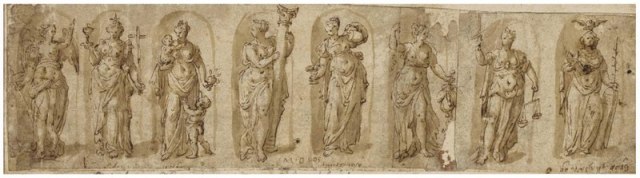
Faith, Hope, and Charity – the theological virtues (Remember that from your Baltimore Catechism?). 

Virtues
The Theological and Cardinal Virtues with Wisdom: Hope, Faith, Charity, Fortitude, Temperance, Liberality, Justice and Sapientia by Maarten de Vos (1532-1603)

These virtues are the foundation of the spiritual life. Contemporary theology ties these irrevocably to the virtue of justice – the seeking of right relationship in all Creation.

Anselm Min, Professor of Religion at Claremont Graduate University, has edited a powerful book on this subject. (Unfortunately, now out print and thus hugely expensive). One reviewer of the book, Lameck Banda, Professor at Justo Mwale University in Lusaka, Zambia, offers this insight into Min’s collection:

“The running thread throughout this book is that, whichever way the contemporary culture may seek to view and treat faith, hope, and love, the ultimate goal of these virtues is to radically and comprehensively address issues which tend to undermine the agenda of justice.”

That summary in itself gave me a lot to think and pray about. I hope it inspires you as well. God bless your Sunday!

Rohr

Music: Hymn of Hope from The Secret Garden by Rolf Lovland

Unless…

Feast of Saint Lawrence, Deacon and Martyr

August 10, 2019

Click here for readings

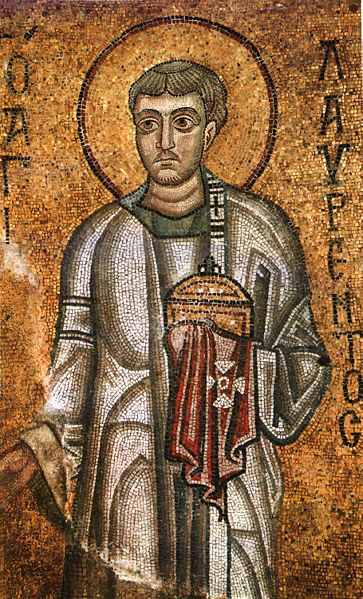
St. Lawrence
Saint Lawrence. Mosaic from the Saint Sophia Cathedral in Kiev.

Today, in Mercy, we celebrate the feast of St. Lawrence who is noted for his love for those who were poor. Legend has it that Lawrence was demanded, before his martyrdom, to turn over the Church’s riches to the emperor Valerian. Instead, he distributed all the resources among the poor. Lawrence then gathered all these people, presenting them before Valerian with these words:

Behold in these poor persons
the treasures which I promised to show you –
these are the true treasures of the Church.

Lawrence was likely inspired by readings like today’s. In Corinthians, Paul encourages us to be cheerful givers. He says this delights God, the Giver of Divine Abundance, whom we are imitating.

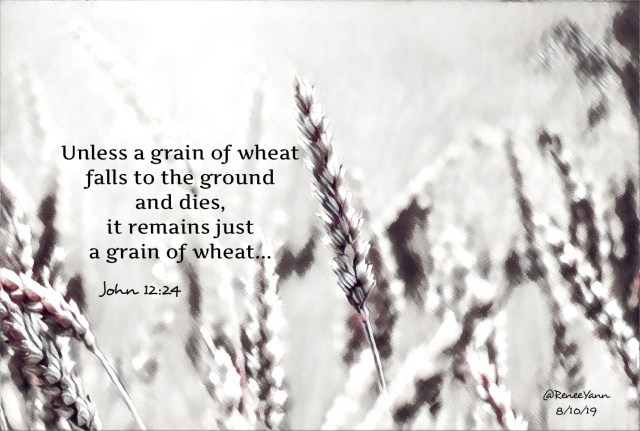
John12_24 grain wheat

In our reading from John, Jesus says that only in dying to ourselves do we live – the ultimate generosity. He says that only by doing this can we truly follow him.

While these readings are clear and simple, they are so profound that we can hardly take in their message. What they ask of us is daunting! The encouragement Jesus gives us to respond to his challenge is this:

The Father will honor whoever serves me.

St. Lawrence believed and lived this promise. What about us?

Music: Before the Bread – Elizabeth Alexander

We all want our lives to be full and complete – to be “bread”. But there are many steps before the grain of wheat becomes bread, as captured in this elegant acapella canon.

Transfigured!

Feast of the Transfiguration of the Lord

August 6, 2019

Click here for readings

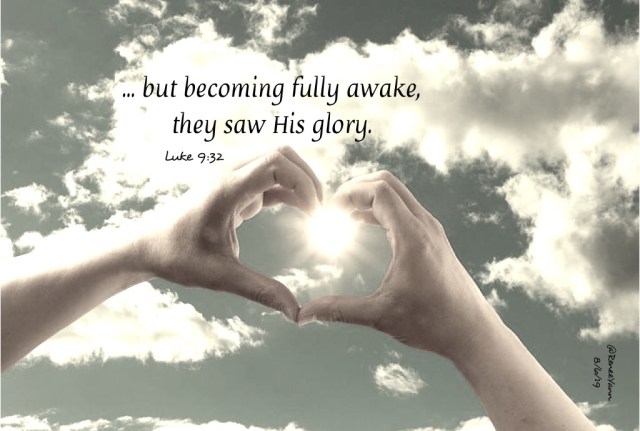
Today, in Mercy, we celebrate the Feast of the Transfiguration, that moment when the Godly glory of Jesus shone in all its splendor before a few very blessed disciples.

Lk9_32 transfiguration

On that blessed day, Peter, James and John went with Jesus to a “very high mountain”. Many scholars identify the site as Mt. Tabor, where the Franciscan Church of theTransfiguration is today. 


Aside:

church


It was interesting to me that, just the other day as I thought about this reflection, I noticed a news alert that a huge fire had broken out on this mountain.

fire


The Franciscans were evacuated and, fortunately, there were no human injuries.


Some theologians suggest that these three disciples were afforded this magnificent gift so that their faith would be sufficiently strengthened to endure the coming sufferings.

“Transfiguration” is a word without a true synonym. It is a unique experience for a being to be completely infused with the glory of God. When this happened to Jesus, something equally unique happened to Peter, James and John as well. They too became new beings, never the same after that glorious and -yes- shocking moment.

Once they descended that mountain, everything changed. In a sense, they too had been “transfigured”. They had seen Jesus clearly in the beauty of his Godliness, and they would now see everything else in that Light.

Sometimes in our lives, God gives us “mini-transfigurations”. Something we had seen only in ordinary terms suddenly becomes an insight into the sacred. It may be a person, a situation, a natural phenomenon. We see through the external trappings and find the glorious Face of God.

Jesus invites us to experience this kind of soul-change by loving God in the poor, sick, uneducated, displaced, suffering, stigmatized people of this world. He asks us to be with them, in word and deed, and to allow God’s light in them to change our hearts and souls.

Music: Transfiguration/We Behold the Splendor of God – Carey Landry (Lyrics below)

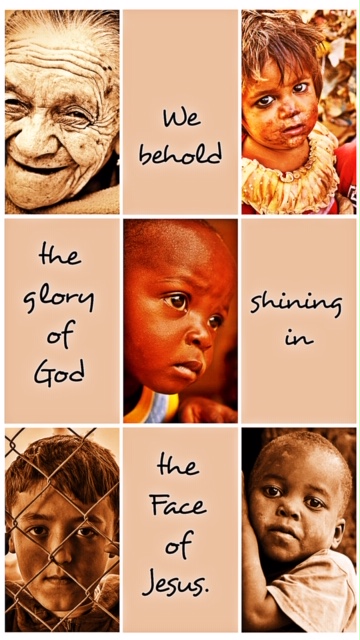
“Transfiguration”faces
[Chorus]
We behold the splendor of God shining on the face of Jesus.
We behold the splendor of God shining on the face of the Son.

[Verse1]
And oh, how his beauty transforms us, the wonder of presence abiding.
Transparent hearts give reflection of Tabor’s light within, of Tabor’s light within.

[Verse 2]
Jesus, Lord of Glory, Jesus, Beloved Son, oh, how good to be with you;
how good to share your light; how good to share your light