Today, in Mercy, our readings are peopled with individuals of all ages.
Deuteronomy gives us Moses at 120 years, when time forces him to admit:
“I am now one hundred and twenty years old and am no longer able to move about freely; besides, the LORD has told me that I shall not cross this Jordan.
We also have Joshua, vigorous and on the doorstep of his career:
Then Moses summoned Joshua and in the presence of all Israel said to him, “Be brave and steadfast, for you must bring this people into the land which the LORD swore to their fathers he would give them.
The Gospel brings us Jesus near the untimely end of his young life, and the disciples growing into their apostolic maturity.
And then we have the picture of the humble little child who is “the greatest in the Kingdom of Heaven”.
Every one of them, young or old, is seeking God in the circumstances of their lives.
What about you, dear friends, how is the mystery of God unfolding in your life today?As summer gently and slowly leans toward autumn, let the passing days teach us that each season brings its own graces.
Today, in Mercy, we have a few slightly complex readings. But, as with all Sunday lectionary choices, they are strung together by a single theme.
Upon first reading, we might think that theme is FAITH since the word is mentioned at least eight times. And, indeed, “faith” is the foundation of these readings – the faith of Abraham, Isaac, Jacob, the Desert Jews, the disciples, and the new Christian community.
It is the testimony of this ancient and enduring faith that encourages us to be ready, as Jesus says in today’s Gospel:
Do not be afraid any longer, little flock, for your Father is pleased to give you the kingdom.
This phrase of Jesus reveals another, deeper, theme: courageous hope.
How awesome that God, in covenant with God’s People, could keep alive – for 400 years- the hope of salvation! How miraculous that these ordinary farmers, milkmaids, herdsman, and shepherds could sustain their hope through numerous generations!
Today’s readings are sending us this message:
Be courageous! You are the Bearer of Hope
to this generation!
It may seem in our world, and in our individual lives, that God tarries beyond tolerance in answering our hope – for peace, civility, equality, security, goodness.But we must remember that with God there is no time. God is already responding within the long fidelity of our hope. (Our clocks and Apple watches just are obscuring our view. 😉)
That faithful hope creates the space for charity. And charity is the human face of Divine Love already Abiding.
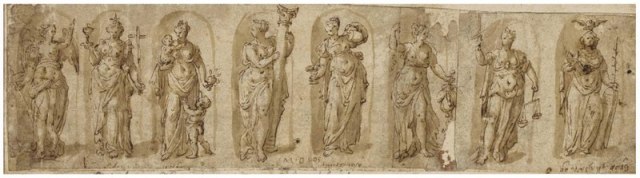
Faith, Hope, and Charity – the theological virtues (Remember that from your Baltimore Catechism?).
The Theological and Cardinal Virtues with Wisdom: Hope, Faith, Charity, Fortitude, Temperance, Liberality, Justice and Sapientia by Maarten de Vos (1532-1603)
These virtues are the foundation of the spiritual life. Contemporary theology ties these irrevocably to the virtue of justice – the seeking of right relationship in all Creation.
Anselm Min, Professor of Religion at Claremont Graduate University, has edited a powerful book on this subject. (Unfortunately, now out print and thus hugely expensive). One reviewer of the book, Lameck Banda, Professor at Justo Mwale University in Lusaka, Zambia, offers this insight into Min’s collection:
“The running thread throughout this book is that, whichever way the contemporary culture may seek to view and treat faith, hope, and love, the ultimate goal of these virtues is to radically and comprehensively address issues which tend to undermine the agenda of justice.”
That summary in itself gave me a lot to think and pray about. I hope it inspires you as well. God bless your Sunday!
Music: Hymn of Hope from The Secret Garden by Rolf Lovland
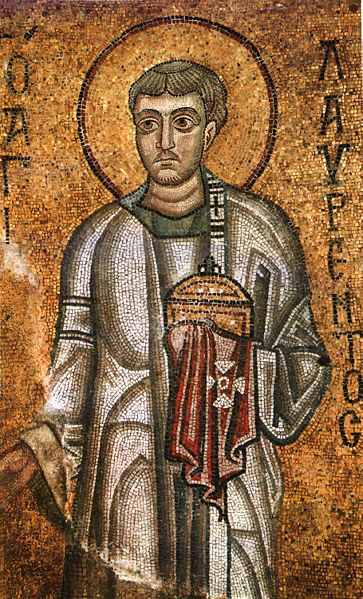
Saint Lawrence. Mosaic from the Saint Sophia Cathedral in Kiev.
Today, in Mercy, we celebrate the feast of St. Lawrence who is noted for his love for those who were poor. Legend has it that Lawrence was demanded, before his martyrdom, to turn over the Church’s riches to the emperor Valerian. Instead, he distributed all the resources among the poor. Lawrence then gathered all these people, presenting them before Valerian with these words:
Behold in these poor persons the treasures which I promised to show you – these are the true treasures of the Church.
Lawrence was likely inspired by readings like today’s. In Corinthians, Paul encourages us to be cheerful givers. He says this delights God, the Giver of Divine Abundance, whom we are imitating.
In our reading from John, Jesus says that only in dying to ourselves do we live – the ultimate generosity. He says that only by doing this can we truly follow him.
While these readings are clear and simple, they are so profound that we can hardly take in their message. What they ask of us is daunting! The encouragement Jesus gives us to respond to his challenge is this:
The Father will honor whoever serves me.
St. Lawrence believed and lived this promise. What about us?
Music: Before the Bread – Elizabeth Alexander
We all want our lives to be full and complete – to be “bread”. But there are many steps before the grain of wheat becomes bread, as captured in this elegantacapella canon.
Today, in Mercy, we celebrate the Feast of the Transfiguration, that moment when the Godly glory of Jesus shone in all its splendor before a few very blessed disciples.
On that blessed day, Peter, James and John went with Jesus to a “very high mountain”. Many scholars identify the site as Mt. Tabor, where the Franciscan Church of theTransfiguration is today.
Aside:
It was interesting to me that, just the other day as I thought about this reflection, I noticed a news alert that a huge fire had broken out on this mountain.
The Franciscans were evacuated and, fortunately, there were no human injuries.
Some theologians suggest that these three disciples were afforded this magnificent gift so that their faith would be sufficiently strengthened to endure the coming sufferings.
“Transfiguration” is a word without a true synonym. It is a unique experience for a being to be completely infused with the glory of God. When this happened to Jesus, something equally unique happened to Peter, James and John as well. They too became new beings, never the same after that glorious and -yes- shocking moment.
Once they descended that mountain, everything changed. In a sense, they too had been “transfigured”. They had seen Jesus clearly in the beauty of his Godliness, and they would now see everything else in that Light.
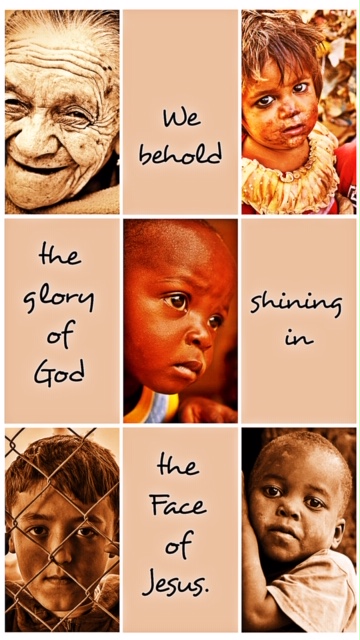
Sometimes in our lives, God gives us “mini-transfigurations”. Something we had seen only in ordinary terms suddenly becomes an insight into the sacred. It may be a person, a situation, a natural phenomenon. We see through the external trappings and find the glorious Face of God.
Jesus invites us to experience this kind of soul-change by loving God in the poor, sick, uneducated, displaced, suffering, stigmatized people of this world. He asks us to be with them, in word and deed, and to allow God’s light in them to change our hearts and souls.
Music: Transfiguration/We Behold the Splendor of God – Carey Landry (Lyrics below)
“Transfiguration” [Chorus]
We behold the splendor of God shining on the face of Jesus. We behold the splendor of God shining on the face of the Son.
[Verse1]
And oh, how his beauty transforms us, the wonder of presence abiding. Transparent hearts give reflection of Tabor’s light within, of Tabor’s light within.
[Verse 2]
Jesus, Lord of Glory, Jesus, Beloved Son, oh, how good to be with you; how good to share your light; how good to share your light
Today, in Mercy, our readings focus on “vanity” – its threats and remedies.
Often, we think of vanity as a physical emotion – that Narcissistic self-absorption that keeps us in front of a mirror for inordinate amounts of time. Our culture promotes this kind of vanity by working endlessly to convince us that without certain products we are “not enough” on our own.
Historically, this kind of rhetoric was directed primarily toward women, spawning a nearly $500 billion global cosmetic market! But men are catching up! The men’s market is forecasted to reach nearly $30 billion by 2023.
Several years ago, while flying home from a business trip, I was seated across from two young women. As we approached home, the one nearest me, began to prepare for landing. She initiated an elaborate cosmetic ritual that involved no fewer than ten brushes plus an array of tubes and compacts. At first, it struck me really funny. Then I realized how very sad it was.
This maturing child was no more than eighteen. She was naturally beautiful with the vigor of youth. But she had obviously spent a lot of money and time not believing in her natural beauty.
Society considers vanity as a kind of pride and pomposity. I think just the opposite. I think vanity is really fear, self-dissatisfaction, anxiety and pain because something has convinced us that we are inadequate.
Vanity damages souls as well as bodies. It makes us behave in greedy, self-absorbed and careless ways toward our neighbors. It makes us pretend we are more than we think we are. It saps us of the strength to be generous, trusting and hopeful.
Paul, in his letter to the Colossians, tells us to get over this kind of vanity:
Put to death, then, the parts of you that are earthly: immorality, impurity, passion, evil desire, and the greed that is idolatry. Stop lying to one another, since you have taken off the old self with its practices and have put on the new self, which is being renewed, for knowledge, in the image of its creator.
What if that sweet girl on Flight 419 had been able to look in her mirror and see the image of her Creator? What if we could all do that? How might we spend our time and money differently if we were convinced of how beautiful we are to God?
Music: How Could Anyone Ever Tell You – Shaina Nell
I have added two versions of this beautiful song. Let God sing it to you in your prayer today.
Today, in Mercy, we consider God’s unconditional love.
God and Moses and the People have been through it. The trail of complaints, the golden calf, the shattered tablets – these are relational dramas to the extreme! Exodus is definitely soap opera material! Does it feel a little bit like your life, or your family’s, or the families you read about in the news?
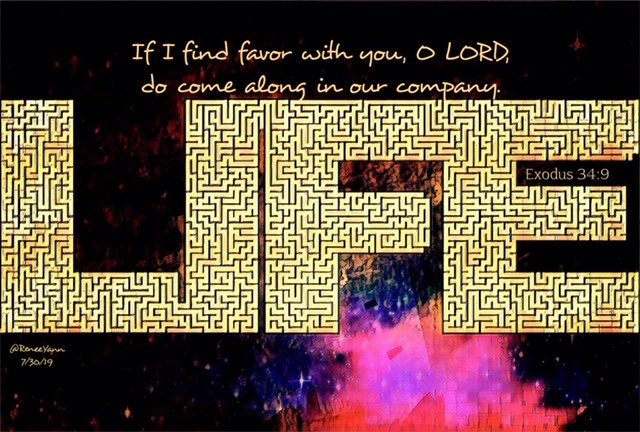
Life is indeed a drama! And our relationship with God is highlighted and shadowed with its twists and turns. For that reason, today’s passage offers us so much comfort and confidence. Even after all that has happened, God reveals himself to Moses like this:
The LORD, the LORD, a merciful and gracious God, slow to anger and rich in kindness and fidelity, continuing his kindness for a thousand generations.
Moses is so moved by this new knowledge of God’s unconditional love, that he welcomes God as part of their community:
If I find favor with you, O LORD, do come along in our company. This is indeed a stiff-necked people; yet pardon our wickedness and sins, and receive us as your own.
We are invited by this reading to open ourselves to that same unconditional love, to thank God for journeying with us through life’s convolutions. Stiff-necked at times, repentant at others, we are always God’s beloved.
As we negotiate the intricacies of our life today, we might trustingly say like Moses:
Today, in Mercy, our readings offer us a central question for our faith and spirituality: What do we really worship?
As we continue the Exodus story, Moses has been on the mountain receiving the Law from God. Meanwhile, back at the ranch, delegated leader Aaron is blowing his assignment. The Israelites tire of waiting for Moses. They want another god to lead them onward. Aaron comes up with idea of fashioning such a idol from all their molten jewelry.
When Moses descends the mountain with the newly-minted tablets in hand, he burns in anger at the scene, smashing the holy stones at his feet. More than a flared temper, this act symbolizes a fractured relationship with God.
The story suggests this for our prayer: we are in ever-deepening relationship with God through our own covenants – our creation, our baptism, our further professions of faith and commitment, our sacramental encounters. These are all living relationships, inviting us to new and deeper life in God.
Still, there may be times in our lives when our hearts lose focus on these covenants
when we try to move somewhere without God’s companionship
when we substitute old baubles for moral or spiritual truth
when we return to weakening comforts rather than grow into a challenging grace
when we just get really mixed up about what is most important in our lives
The calf-worshippers had a big fail in this regard. Exodus tells the story of a merciful God trying to deal with their disloyalty and refashion them as God’s chosen people.
Our Gospel shows us Martha, also a little off target in terms of her spiritual priorities. While she is no where near idol worship, she still allows needless distractions to keep her from fully enjoying relationship with God.
Gentle, merciful Jesus turns her eyes toward him and she understands. Maybe that beautiful grace is what we want to pray for today.
Today, in Mercy, our readings are connected by two often oppositional themes: BARGAINING and TRUST.
The Genesis passage is a familiar story, mainly because “Mrs. Lot” later gets turned into a pillar of salt. But the beginning of the story, today’s reading, is all about Moses bargaining with God to spare the inhabitants of sinful Sodom and Gomorrah.
The Divine conversation is painted in very human terms, a ping-pong match of “what if”s and “OK”s between Moses and God. Moses finally bargains God down to the hope of finding just ten good men in these depraved cities. And Moses trusts God to be merciful, a trust delivered in the salvation of Lot and his family.
In the second reading from Colossians, Paul reminds us of our own deliverance through baptism and sharing in the Resurrection of Christ. This is the infinite gift in which we put our hope and trust as believers.
Our Gospel reading from Luke opens with the Our Father, the ultimate prayer of trust. Jesus goes on to tell us that we can always trust God’s care for us.
Ask and you will receive; seek and you will find; knock and the door will be opened to you. For everyone who asks, receives; and the one who seeks, finds; and to the one who knocks, the door will be opened.
Jesus isn’t talking about magic, where we just say the word and automatically get what we imagined, or where we bargain with God as if we had something to offer.
Jesus is talking about that fundamental trust which believes in God’s faithfulness to us in all circumstances. He will not “hand us a serpent when we ask for an egg”. But it may be a very different “egg” (outcome) from the one we expected. Trust allows us to crack it open to find the unimagined grace inside.
( I am republishing last year’s post for this feast. I think it is worth another read. But to make up for my little bit of laziness, I will send another post today with a few profound quotes from Henri Nouwen’s book Can You Drink the Cup? – Ave Maria Press; 10th Anniversary edition (October 1, 2012))
Today, in Mercy, we learn a lesson in humble leadership, thanks to “Mrs. Zebedee”. Our Gospel recounts the story of the mother of James and John interceding for her sons with Jesus. Like many overprotective mothers, she intervenes in their adult lives. She wants to make sure they get the best deal for their investment with Jesus.
Veronese-Le-Christ-Rencontrant La Femme Et Les Fils de Zebedee By Paolo Veronese
Unfortunately, “Mrs. Zebedee” has missed the whole point of Christian discipleship. Her boys have decided to follow a man who says things like this:
The last shall be first and the first, last.
Unless you lay down your life, you cannot follow me.
Whoever takes the lowly position of a child is the greatest in the Kingdom of Heaven.
The seats at Christ’s right and left, which she requests for her sons, will bring them rewards only through humility and sacrificial service.
Jesus is gentle with “Mrs. Zebedee”. He understands how hard it is for any of us to comprehend the hidden glory of a deeply Christian life. We are surrounded by a world that screams the opposite to us:
Me first!
Stand your ground!
Good guys finish last!
So Jesus turns to James and John. One can imagine the bemused look on his face. He knows the hearts of these two men. He knows they have already given themselves to him. So he asks them for a confession of faith, “Can you drink the cup that I will drink?”
Their humble, faith-filled answer no doubt stuns their mother. She is left in wonder at the holy men her sons have become. Perhaps it is the beginning of her own deep conversion to Christ.
As we pray with this passage on the feast of St. James the Apostle, where do find ourselves in this scene? How immediate, sincere, and complete is our response to Jesus’ question: “Can you drink the cup….?”
Music: Can You Drink the Cup? (Be patient. The song has a slightly delayed start. You may have to click the white arrowhead in the orange circle- upper left. Lyrics below.😀)
Can You Drink The Cup?
Lyrics by Pamela Martin, Music by Craig Courtney
Copyright 2001, Beckenhorst Press, Inc.
Can you dring the cup,
embrace it in your hands?
Can you look inside
and face what it demands?
In the wine you see
reflections of your soul.
No one else can drink
this cup that you must hold.
Can you drink the cup?
Then you must lift it high
though this cup of joy
holds pain and sacrifice.
When you lift your cup,
raise it unafraid.
Lift it up, this cup
of life, and celebrate.
Can you drink the cup
until there is no more?
When the wine is gone,
Christ Himself will pour.
Though you drink it all
the cup is never dry,
God keeps filling it
with everlasting life.
Today, in Mercy, we begin a series of texts about the Passover. These readings are so richly symbolic, not only for our personal prayer, but also for our sacramental understanding. Today’s passage addresses the acquisition and sacrifice of the Passover lamb.
Scenes from Exodus. Full-page miniature, upper register: the tenth plague: the death of the first-born including Pharaoh’s son, lower register: the Israelites leaving Egypt. From the Haggadah for Passover (14thC.)
Maybe for you, as for me, this is one of first Bible stories you recall from childhood. I remember how the drama built as my teacher read this story – all these wide-eyed kindergarteners hanging on her every word.
God was done with Pharaoh who had already ignored nine – yes NINE – plagues! Now the Egyptians’ first-born would be taken from them in a heavenly massacre! It was terrible to imagine. But even worse to consider was how the innocent Israelites would be spared from the dreaded visitation!
Even as a little pre-schooler, I already knew that we sometimes get in situations that only God can get us out of. What I have begun to learn in my maturity is that – rather than get us out of such circumstances – God chooses to pass through these life experiences WITH us.
An image we might consider in our prayer today:these lintels were marked in BLOOD. The visiting angel could have as easily read a charcoal mark on the door, or a colored slab of paint. But the deliverance was secured by blood.
When devastating loss, sorrow or confusion comes to our door, how does our faith deliver us to the Promise of joy and peace?
It cannot be by some hastily obtained symbol or sign, or borrowed prayer. Our faith must already be rooted deep down in our veins, our arteries, our heart, our blood. That rooting shall not be moved, no matter the circumstance. That rooting ties us to the God of Life. That rooting allows us to discover God even in our chaos.
As we pray today, under the lintel post of our faith, let us be mindful that these magnificent passages prefigure the Holy Lamb of God, Jesus, who saves us from every kind of death. May we ask for the grace to deepen our Eucharistic and Paschal faith so that we may fully trust God in our own Passovers.