Don’t Take It for Granted

Wednesday of the Twenty-second Week in Ordinary Time

September 4, 2019

Click here for readings

Today, in Mercy,  we begin a little over a week of readings from Colossians. Paul loves this community in a way similar to the Thessalonians. The Colossians’ faith has been tested and has proven true.

But Paul wants to protect their faith because it is being newly tested by a round of heresies and social challenges.

The words of these scriptures want to protect and direct us too.

We, like the people in today’s Gospel, are familiar with Jesus. But familiarity can breed things not so obvious as contempt. It can breed indifference, ingratitude, unexamined expectations, taking our blessings for granted. (Examination of Conscience Alert!!)

col1_6

Both Colossians and Luke today encourage us to recognize the unparalleled gift of our faith – to protect, nurture, rejoice in and share it.

Just as in the whole world
the Gospel is bearing fruit and growing,

so also among you,
from the day you heard it
and came to know
the grace of God in truth.

Music: Bless Our God – John Foley (Lyrics below) Just a beautiful song — I love it!

Our Laboring Mother

Memorial of Saint Gregory the Great, Pope and Doctor of the Church

Tuesday, September  3, 2019

Click here for readings

Today, in Mercy, Paul again affirms the faith and prudence of the Thessalonians:

Concerning times and seasons, brothers and sisters,
you have no need for anything to be written to you.
For you yourselves know very well
that the day of the Lord will come like a thief at night.

He paints a dire picture of those “times and seasons”, likening them to the onset of labor pains. But like a mother’s labor, these pains ultimately yield life:

For God did not destine us for wrath,
but to gain salvation through our Lord Jesus Christ.

So Christ, our Laboring Mother, delivers us – even through seasons of suffering and evil – to a new day. And we – we are the midwives to one another’s salvation:

Therefore, encourage one another
and build one another up,
as indeed you do.

This honest encouragement is so essential for us in our faith communities because, without it, the mystery of suffering and evil overwhelm us. 

Ps27_13

It is both awesome and fearsome to truly encounter Mystery. In its presence, we are rudderless: we cannot explain, control, or humanly rationalize it. Mystery can only be comprehended by greater Mystery. Suffering can only be plumbed by the greater Mystery of Love.

And we know Love’s Name: Jesus by Roc O’Connor (Lyrics below)

Refrain:

Jesus, Jesus
Let all creation bend the knee to the Lord.

1. In Him we live, we move and have our being;
In Him the Christ, In Him the King!
Jesus the Lord.

2. Though Son, He did not cling to Godliness,
But emptied Himself, became a slave!
Jesus the Lord.

3. He lived obediently His Father’s will
Accepting His death, death on a cross!
Jesus the Lord.

You’re Invited – (and so is everyone else)

Twenty-second Sunday in Ordinary Time

September 1, 2019

Click here for readings

Today, in Mercy, our readings share the common theme of humility, instructing us that the virtue is essential to our salvation.

Lk14_11 humbled

Humility, of course, gets a bad rap in our dominating, “me” culture. We tend to think of humiliation, servitude, inelegance rather than the actual root of the word: humus -“of the earth”.

I was fascinated last week by a small fracas arising from the unconsidered remarks of one of our Phillies baseball players. The team has been running hot and cold – with a little bit too much cold for some fans. The famous Philly “boos” have been flying. Frustrated with these, outfielder Sean Rodriguez referred to the disgruntled fans as “entitled”. 

angry

Uh oh! They didn’t like that. We prefer to think of ourselves as “deserving “, right?

Humility is that virtue which helps us realize that we are not “entitled” or “deserving” of anything over and above other human beings. It roots us in the respect for each other that refuses to rank the worth of other human beings. 

The social leverage that comes from wealth, power, and influence can beguile us. We become lost in a maze of stereotypes, rankings and prejudices which are the foundation of social injustice.


We hear among ourselves justifying phrases for our entitlement like:

  • well, I earned what I have
  • at least I paid for it
  • “they” need to work if they want to have …(food, healthcare, housing…)
  • it’s their own fault for … (dropping out of school, taking drugs, ….)
  • that’s just the way it is in “those” countries. The people are …(lazy, stupid, violent …)
  • “they” don’t need what I need. “They” are used to being … (poor, disabled, sick …)

And probably the most dangerous of all the phrases:

  • it’s not my problem
  • I’m not the one exiling, bombing, blocking, trafficking, enslaving “them”

Today’s readings enjoin us: it is my problem. My attitude, choices, vote, conversation, and lifestyle matter at the banquet of life we are all meant to share.

My intention to humbly join and rejoice with all Creation, to take a seat beside and never above my sister and brother – this is my “entitlement” to the one banquet that matters.

When you hold a banquet,
invite the poor, the crippled, the lame, the blind;
blessed indeed will you be because of their inability to repay you.
For you will be repaid at the resurrection of the righteous.

Music:  A Place at the Table – Lori True and Shirley Elena Murray

God Invests in Us

Saturday of the Twenty-first Week in Ordinary Time

August 31, 2019

Click here for readings

Today, in Mercy, Paul again shows his great admiration for the commitment of the Thessalonians:

You have no need for anyone to write you about fraternal charity…
( in other words, you already live it.)

Don’t we all wish that line could be written, without reservation, to us?

In our Gospel, Jesus tells us the familiar parable of the talents which shows what God would look for in order to say as much to us.

Mt25_25

On the surface this story looks like one about material goods or personal capabilities – about how we use our individual gifts to further God’s reign. Certainly that is one valuable interpretation.

But think about the talents in the story. They did not belong to the servants. They belonged to the master.

This parable is about God’s talents, God’s nature, and how we either frustrate or facilitate their effectiveness in God’s Creation.

We are the means by which God is present in the world.

God invests God’s own heart  in us – Unconditional Love, Lavish Mercy, Infinite Hope, the Perfection of Compassion, Sacred Accompaniment, Abiding Fidelity.

If we tender these divine “talents” to others with care and generosity, we become good and faithful reflections of God’s own presence.

What about the poor soul who buried the talents under his own fear and small-mindedness? Sad, right? But that self-protective, parsimonious little burier hides in all of us.

We know the blockades we put up against God’s Grace. Let us look sincerely at them today, asking to be worthy of the trust invested in us to multiply God’s grace in the world.

Music: Psalm 131 – written by Marty Goetz

A Passion Like Christ’s

Memorial of the Passion of Saint John the Baptist

Thursday, August 29, 2019

Readings: http://www.usccb.org/bible/readings/082919.cfm

Today, in Mercy, we commemorate the Passion of John the Baptist who, besides Mary, was the greatest saint embracing both the Old and the New Testaments.

When I was young, the memorial was simply referred to as “The Beheading of John the Baptist”. The term “passion” captures its meaning so much more clearly:

  • it inclines us to realize the similarities between John’s passion and death and that of Jesus.
  • it shifts the power of the event to John, who chose his fate by the courage of his witness, rather than to see Herod, the “beheader”, as the agent of the story.

John’s whole prophetic life was part of his “passion”. It inevitably led him to this ultimate confrontation with evil.

Walter Bruggemann, in his transformational book “The Prophetic Imagination” writes about prophets. He indicates that prophets emerge in the context of “totalism” – those paralyzing systems which attempt to control and dominate all freedom and possibility.

Totalism kills ideas, hope, freedom, choice, self-determination, and creativity for the sake of controlling reality for its own advantage. Totalism is the ultimate “abusive relationship “.

Brueggemann defines the prophet as one engaged in these three tasks:

  • the prophet is clear on the force and illegitimacy of the totalism.
  • the prophet pronounces the truth about the force of the totalism that contradicts the purpose of God.
  • the prophet articulates the alternative world that God has promised, and that God is actually creating within the chaos around us.

Every age requires prophets because every age is infected with “Herods” trying to thwart God’s reign of love, mercy, truth, freedom, and joy. In our own time, the poison of totalism is quite evident in those systems fueled by racism, militarism, financial duplicity, desecration of the earth, and the sad array of other ideologies that cripple humanity.

Today, as we pray with this great saint, may we be inspired to respond to our own prophetic call – to be prophetic signs of love, mutual reverence, joy, Gospel justice,and lavish mercy for our world.

Music: I think of this song by Simon and Garfunkel as the modern day song of John the Baptist.

https://youtu.be/XgbBLKet14E

Faithful Monica

Memorial of Saint Monica

Tuesday, August 27, 2019

Click here for readings

Today, in Mercy, we celebrate St. Monica, mother of St. Augustine of Hippo.

Monica
Santa Monica e Sant’Agostino by Giuseppe Riva (This work is in the public domain n its country of origin and other countries and areas where the copyright is the author’s life plus 100 years or less.)

Monica had a difficult life, burdened by an autocratic pagan husband. She was forbidden to have her children baptized. Augustine worried her deeply because he developed into a wayward and lazy young man. Eventually he was wooed by the Manichaean heresy which denied Christ as God. This was too much for Monica. She asked him to leave her house.

But Monica continued for seventeen years to pray for and encourage Augustine to return to a faithful, moral life. Finally through the influence of St. Ambrose, Augustine was converted.

How many mothers and fathers, friends and spouses have prayed like this for someone they love? How many of us have had a “lost sheep” right in the center of our family but beyond its touch?

Monica’s great love and faithful devotion to her son are reminiscent of Paul’s love for his Thessalonian flock:

… we were gentle among you,
as a nursing mother cares for her children.
With such affection for you, we were determined to share with you
not only the Gospel of God, but our very selves as well,
so dearly beloved had you become to us.

This is the way God loves us and draws us to himself. It is the way that we, who carry God’s love in the world, must be with one another.

Our Gospel gives us another example of how disgusted Jesus is with those who pretend the “exteriors” of faith but on the inside are “blind hypocrites… full of plunder and self-indulgence”.

Instead, we need a faith like Monica’s, humble and generous but at the same time tenacious and persevering in seeking good.

Music: Give Me the Faith Which Can Remove – written by Charles Wesley, younger brother of John Wesley, founder of Methodism

God’s Thank You Note

Monday of the Twenty-first Week in Ordinary Time

August 26, 2019

Click here for readings

Today, in Mercy, we begin eight days of Thessalonians, coupled with the final section of Matthew’s Gospel before the Passion, Death and Resurrection narrative.

First Thessalonians is a love note, a thank you note. In it, Paul speaks to the community with great affection and gratitude because they have caught fire with the Gospel he shared with them.

Paul’s words carry the loving, grateful voice of God to us who also try, with all our hearts, to give ourselves to the Gospel.

1 Thes 1:5 Thank You

In today’s Gospel, Matthew gives us the sad counterpoint to Paul’s joy. Jesus thunders woe over the Pharisees who, unlike the Thessalonians, smother the ardent message he offers them.

They bind. They control. They peddle a religion rooted in parsimonious law rather than generous freedom. They promote a system that sustains their privilege.

Jesus tells us that Pharisaical religion sucks the soul from people, binding them in a self-serving, spiritless law – where power and material prosperity supersede truth, loving community, and sincere worship.

In Paul’s words, God blesses and thanks us for our true faith which – by generosity, hope, love, sacrifice and hopeful endurance – builds the Community of God.

Throughout history, some people have used the scripture to justify the kind of pharisaical selfishness bewailed in today’s Gospel. They isolate and demonize other human beings by the deceitful turning of the holy Word. They are clever and convincing. They appeal to our rationality rather than our souls.

Today’s readings remind us to take great care in discerning the Spirit. We will never find Her where there is no love, mercy, kindness, freedom, forgiveness, and joy.

Music: one of my favorite hymns. Though from Ephesians, it carries the same message as our reading from Thessalonians today. I pray this prayer for all of you, dear friends.

Ephesians 1 – by Suzanne Toolan, RSM


Blessed be the God and Father of our Lord Jesus Christ.
In him we were chosen to live through love in his light.
That is why I never cease to give thanks to God for you.
And pray that the God of our Lord Jesus Christ
will grant you the Spirit of wisdom
and knowledge of himself
that you may  glory, glory in his goodness.

How Do You Know Me?

Feast of Saint Bartholomew, Apostle

Saturday, August 24, 2019

Click here for readings

Today, in Mercy, we celebrate the Apostle Bartholomew, thought by some to be the same man as our Gospel’s Nathaniel. This Nathaniel has been my prayer companion since 1964 when I received his name at my Religious Reception.

Tissot
Nathaniel Under the Fig Tree by James Tissot (1836-1902)

At first we were surface friends. I imagined what he might have been doing under the fig tree. I was a little shocked at his easy banter with Jesus. I thought about his skepticism, trying to discern how it could eventually yield his sanctity. I wondered if he ever achieved that vision of “angels of God ascending and descending ...”

But as the years passed, and I prayed beside him more often, we came to understand each other better. Nathaniel began to teach me about Jesus and, with that, Jesus began to teach me through Nathaniel.

It was all about being honest with God and opening my perspective to God’s vision.

You see, we are all under various “fig trees” at points in our lives, those small but confining perimeters of shadow which veil God. Sometimes the shadow consists of an event or experience that makes us says, “How can God possibly be in this?” Sometimes the shadow comes from all the obstacles we have placed in Light’s way. Sometimes it is simply the waning energy required by faith’s long journey.

Whatever its source, the shadow captures us in its incarcerating grasp, isolating us from the outrageous hope and possibility of God awaiting us in every circumstance.

Then a voice – our particular “Philip” – suggests we just step away from the umbra.  A person, a book, a memory, a prayerful insight – A GRACE – invites us to “Come and see” more deeply, to let go of all that we thought secured us, to yield to hope, trust, and an incredible new vision.

Jn1_51 NathanielJPG

It is an irreversible moment of unconditional love. It is the moment we make our own proclamation, not unlike Nathaniel’s:

Rabbi, you are the Son of God;
you are the King of Israel.

Nathaniel’s guileless, faith-filled surrender to Jesus opens the way for his transformation. Jesus tells him, “You will see greater things…”. In other words,

God is so much bigger than you think at this moment.
Open your heart and soul to that Infinity!
Your life in Christ is all about going deeper,

(as the Angel invites us in our first reading from Revelation).

We don’t hear much about Nathaniel after that day. Like many of the other Apostles, he lived out his ministry beyond written records. But we can trust that this man “without duplicity” deepened in his honest dialogue with the God he met and embraced on that amazing Judean afternoon.

Music: Touch of Heaven- Hillsong Worship

Wide Mercy

Memorial of Saint Pius X, Pope

August 21, 2019

Click here for readings

Today, in Mercy,  in our reading from Judges, we meet two guys who are polar opposites of each other: Jotham and Abimelech.

Jotham was the youngest of the 70 sons of Gideon (yes, 70 – not a typo. Makes one think of The King and I.) Abimelech is his half-brother, son of Gideon’s Shechemite concubine.

To put the story in a nutshell, Jotham is the goodie and Abimelech is the baddie. Abimelech, lusting to be king, engages his Shechemite family to kill the 70 sons of Gideon. Only Jotham survives. So in our reading, Jotham  prophesies by parable, warning the people that they have made a serious mistake in allowing Abimelech to grasp the kingship.

Praying with this reading, we may realize that some things never change. Human beings still jockey for political power and economic domination. Nations still slaughter and suppress other nations in that pursuit. Some leaders still commandeer control by deception and pretense. The voting populace still allows itself to be hoodwinked by tyrants in disguise.

Jotham doesn’t accept the old adage that religion and politics don’t mix (or however they may have phrased it in his day). He says true leadership must grow from the good faith of both leaders and followers. He says, in parable form, that leaders must be willing to set their own pursuits aside for the good of the people. Otherwise, an avaricious fire burns up the heart of the people.

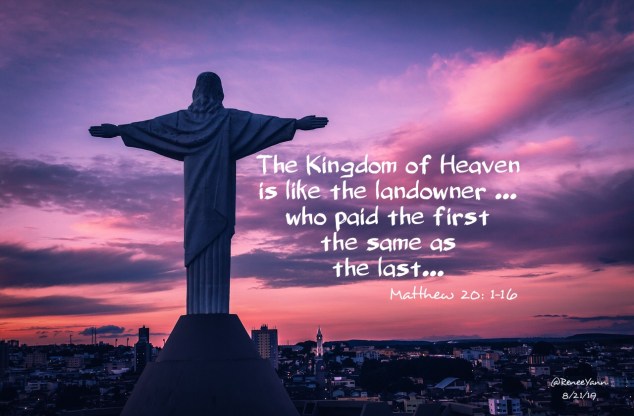
The landowner in Matthew’s Gospel is a leader in the pattern of God. He administers his charge in such a way that all find benefit. His methods are contradictory and irrational to anyone who fails to see the universal creaturehood of the human family. He reigns from mercy not merit, because he knows that all have full merit in God.

wide mercy

Certainly, my prayer leads me to consider how these principles affect my own leadership responsibilities whether within family, community, workplace, or world.

I am also led to consider how I must respond, just as Jotham did, to any leader or administration that stands in contradiction to these principles.

Faith and morality not only mix with politics, they are its core. Bereft of these, politics becomes nothing but a power game in which the poorest and weakest are the chips.

But, in this Gospel parable, Jesus says his “game” is just the opposite. At his table, the first shall be last and the last first.

These readings have much to offer us as we daily try to right our hearts with the God of infinite mercy.

Music: There’s a Wideness in God’s Mercy – written by Frederick Faber in 1862
Rendered here by Nate Macy

https://youtu.be/l5LN1ZvwWfs

Do or Do Not

Monday of the Twentieth Week in Ordinary Time

August 19, 2019

Click here for readings

Today, in Mercy, our readings are about possessions – in every sense of that word.

In today’s reading from Judges, the first of a few this week, we see Israel in the years between entering the Promised Land to the rise of Saul as king. During these four hundred years, a series of judges tries to keep Israel on track with God. It is a frustrating assignment!

As today’s passage describes, the Israelites get caught in an endlessly repeating cycle:

  • worship false gods
  • get zapped by true God
  • feel really bad, say sorry
  • be forgiven
  • repeat cycle

Hmm! I’ve seen this pattern somewhere before. Oh, yeah! It’s just like the one describing all my good intentions that never quite materialized!

do or do not

Many of us can identify with the rich young man in the Gospel. We want to take our relationship with God up a notch. We would like to be better, holier people. But we may also, like the young man, like the ancient Israelites, be caught in a cycle of behaviors and choices which inhibit us.

Mt19_22many possessions

Jesus tells this young man to get rid of his possessions, freeing him to really follow Jesus.

What possesses us, holding us back from that radical following? 

It is not always material goods. They are easy to identify and dispatch. It is our tightly held and hidden illusions, resentments, prejudices, assumptions, entitlements, fears, jealousies, disappointments, angers. These are the heavy chains that cling to us as we try to move deeper into God.

May we be inspired by Matthew’s young man to recognize and break through the cycles that bind us by hearing God’s invitation to wholeness – an invitation always deep within our life circumstances.

Music: Out of the Deep – Julie Bernstein