The Ultimate Gift

The Solemnity of the Most Holy Body and Blood of Christ

Sunday, June 23, 2019

Click here for readings

Today, in Mercy, we celebrate a glorious feast, one through which we can trace the continuing evolution of Eucharistic theology.

CorpusJPG

Some of us will remember celebrating the Feast of Corpus Christi, perhaps as children. The Host, carried in a beautiful monstrance, was processed through the neighborhood, bringing blessing to all who gathered.

process
Where did they get all those men!!!!

While a rare occurrence today, and considered by some a saccharine expression of devotionalism, the practice was intended to convey a central belief of our faith. It is a belief whose theology continues to evolve and deepen with the passing years:

In the gift of Eucharist,
Jesus Christ has made us
one Body with Him.
We are One Body in Christ.


A significant step in the evolution of this theology occured with the issuing of the encyclical MYSTICI CORPORIS CHRISTI ( Pope Pius XII, 1943). In this letter, we see a theology beginning to unfold to include not only Christ’s presence on the altar and in the Host, but in the very lives of the faithful.

The Sacrament of the Eucharist is itself a striking and wonderful figure of the unity of the Church, if we consider how in the bread to be consecrated many grains go to form one whole,and that in it the very Author of supernatural grace is given to us, so that through Him we may receive the spirit of charity in which we are bidden to live now no longer our own life but the life of Christ, and to love the Redeemer Himself in all the members of His social Body.


In his encyclical, ECCLESIA DE EUCHARISTIA (2003), Pope John Paul II, expands this teaching:

By the gift of the Holy Spirit at Pentecost the Church was born and set out upon the pathways of the world, yet a decisive moment in her taking shape was certainly the institution of the Eucharist in the Upper Room. Her foundation and wellspring is the whole Triduum paschale, but this is as it were gathered up, foreshadowed and “concentrated’ for ever in the gift of the Eucharist. In this gift Jesus Christ entrusted to his Church the perennial making present of the paschal mystery. With it he brought about a mysterious “oneness in time” between that Triduum and the passage of the centuries.


The infinite mystery of God’s relationship with us in Jesus Christ continues to call us to deeper understanding of our relationship with one another. Let us pray today for greater love and fuller surrender of our hearts to this awesome, self-emptying mystery.

At the heart of the Christian faith shines an open table without exclusion, where Christ is the chef, the host, and the food of life. The broken bread and the pouring wine manifests the Divine attitude to welcome especially the ones who are brokenhearted, neglected, rejected and crushed. And we are transformed into the body and blood of boundless and creative love, incorporated into the same divine DNA as everyone else – regardless of species, ethnicity, religion, gender, nationality, appearance, or social class. (Ivan Nicolleto)

(Brother Ivan Nicoletto, a Benedictine Camaldolese monk,  author and retreat director residing at Incarnation Monastery in Berkeley. He wrote Journey of Faith, Journey of the Universe. The Lectionary and the New Cosmology, published by Liturgical Press in 2015.)

Music: Somos El Cuerpo de Cristo- Jaime Cortez, Bob Hurd
(Lyrics below)

Somos el cuerpo de Cristo.
We are the body of Christ.
Hemos oído el llamado;
we’ve answered “Yes” to the call of the Lord.

Somos el cuerpo de Cristo.
We are the body of Christ.
Traemos su santo mensaje.
We come to bring the God’s News to the world.

Que nuestras acciones reflejen justicia;
Somos el cuerpo de Cristo.
Stopping abuse and relieving the hungry,
We are the body of Christ.

Vamos al mundo a cuidar su rebaño.
Somos el cuerpo de Cristo.
Serving each other we build up the kingdom;
We are the body of Christ.

What is “Mammon” Anyway?

Saturday of the Eleventh Week in Ordinary Time

June 22, 2019

Click here for readings

Life’s dilemmas confound some of us:

Dickens


Today, in Mercy,  Jesus addresses the confounding problem of spiritual schizophrenia.

No one can serve two masters.
He will either hate one and love the other,
or be devoted to one and despise the other.
You cannot serve God and mammon.

Mammon (μαμωνᾷ), a concept that is rather simplistically translated as “money”, actually connotes a much more complex meaning. Strong’s Concordance of the Bible offers related words that help enrich our understanding of the word “mammon”:

  • Excess
  • Dis-ease
  • Unrighteousness 
  • Imbalance

This is the dissonance Jesus speaks to in today’s Gospel. “Money”, or possessions, – like good wine – in excess can dehumanize us. We can become entangled, addicted and covetous of it. We can forget who we truly are when we allow ourselves to drown in it. We can lose connection to the community in which we exist.

But we need “money”, don’t we? Very few people desire real material poverty. How does Jesus guide us to face this internal dichotomy?

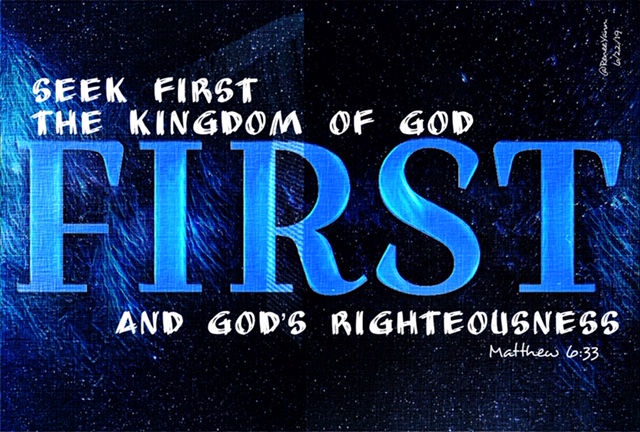
Mt6_33 FIRST

Jesus says that our FIRST concern must be the Kingdom of God. Motivated by that core intention, the rest of our concerns will fall into proper place.  Pope Francis reiterates this truth for our times in the encyclical “Laudato Sì”. Let’s pray with it today:

Christian spirituality proposes an alternative understanding of the quality of life, and encourages a prophetic and contemplative lifestyle, one capable of deep enjoyment free of the obsession with consumption. We need to take up an ancient lesson, found in different religious traditions and also in the Bible. It is the conviction that “less is more”. A constant flood of new consumer goods can baffle the heart and prevent us from cherishing each thing and each moment. To be serenely present to each reality, however small it may be, opens us to much greater horizons of understanding and personal fulfilment. Christian spirituality proposes a growth marked by moderation and the capacity to be happy with little. It is a return to that simplicity which allows us to stop and appreciate the small things, to be grateful for the opportunities which life affords us, to be spiritually detached from what we possess, and not to succumb to sadness for what we lack. This implies avoiding the dynamic of dominion and the mere accumulation of pleasures. (223)

Music: Seek Ye First – Maranatha Singers

Is Scrooge My Hero?

Memorial of Saint Aloysius Gonzaga, Religious

June 21, 2019

Click here for readings

Today, in Mercy, Jesus puts the whole spiritual life in a nutshell:

Luke heart treasure

When I was a kid (and maybe even now), one of my favorite cartoon characters was Uncle Scrooge McDuck.

Scrooge

I was amazed to think that someone could accumulate all that money, and fascinated to see that all he wanted to do was sit on it!

Both Uncle Scrooge and Jesus pose some deep questions to us today.

  • How much do we really need to make us happy?
  • Will having it actually make us happy in the long run?
  • Where does our happiness come from, if we have happiness at all?

We have seen the theme in a hundred books and movies – poor little rich boy or girl starving for love. We all seem to realize that true wealth comes from love. But do we live and choose by that understanding?

Possessions can distract us from what is truly essential for our soul. Greed and selfishness can kill the Spirit within us.

Our coöptation by materialism and greediness doesn’t have to rise to the level of Scrooge’s mounted millions. So often a miserly heart is crippled by things much more complex than money. We can be sinfully stingy with:

  • our attention to those deemed unimportant
  • our kindness to those struggling with life
  • our forgiveness to the unappreciative 
  • our presuppositions about what belongs to whom

The following parable has always shaken me down at the root of my assumed entitlements:

A young woman was waiting to catch a flight in the boarding area of the airport. Given that her wait was going to be several hours she decided to buy a book to read along with a packet of cookies to enjoy. She sat down in an armchair in the VIP room of the airport to relax and read her book in peace. 

Beside the armchair where the packet of cookies lay, a man was seated next to her reading his magazine.  When the woman reached into the packet of cookies to take the first cookie, the man next to her also took one. She was irritated but said nothing. “What nerve this man has!” she thought.  For each cookie she took the man also took a cookie. 

She was infuriated but didn’t want to cause a scene. When only one cookie remained she thought to herself, “what will this horrible man do now?” The man reached down and broke the cookie into even halves and handed one half to her. It was more than she could handle!  She grabbed her things in a huff, refused the half, and stormed off to the boarding area.  

When she got onto her seat on the plane she reached into her purse to get her reading glasses and, to her surprise, her packet of cookies was sitting there untouched and unopened.

We might wish to spend some prayer time considering the application of this story to our own attitudes.

Music: Where Your Treasure Is – Marty Haugen

Be Perfected in Mercy

Tuesday of the Eleventh Week in Ordinary Time

June 18, 2019

Click here for readings

Today, in Mercy, both Jesus and Paul teach us about the true meaning of charity and community.

Mt5_43_48 PerfectJPG

Throughout his journey among the Gentile Christians, Paul conducts a collection for the poor of the Jerusalem Church.


Galatians 2:9-10

James, Cephas, and John, those esteemed as pillars, gave me and Barnabas the right hand of fellowship when they recognized the grace given to me. They agreed that we should go to the Gentiles, and they to the circumcised. All they asked was that we should continue to remember the poor, the very thing I had been eager to do all along.


Romans 15:25-26

Now, however, I am on my way to Jerusalem in the service of the Lord’s people there. For Macedonia and Achaia were pleased to make a contribution for the poor among the Lord’s people in Jerusalem.


In today’s passage, Paul encourages the Corinthians to contribute by holding up to them the generosity of the churches of Macedonia. Great strategy, eh?

In our Gospel, Jesus shows how deep our generosity, hospitality, mercy, forgiveness,  and love should be: boundless. He gives such a reasonable argument:

For if you love those who love you,
what recompense will you have?
Do not the tax collectors do the same?

Jesus tells us that we must far exceed the tax collectors, that we must be “perfect as our Heavenly Father is perfect” – perfected, whole, and completed by Mercy and Love.

For Paul, this meant embracing both the Jewish and Gentile Christians as one community.

For Jesus, it means loving all Creation as God Loves.

Beloved friends, what does it mean for us?

Music: In Perfect Charity – Randall deBruyn (Lyrics below)

Verse 1

O most high and glorious God,
Cast your light into the darkness of my heart.
Give me right faith, and certain hope,
And perfect, perfect charity.
Give me true insight, Lord, and wisdom,
That I may always live within your ever holy will,
Lord may your light within me burn,
Shining out in perfect charity.

Verse 2

O most high and glorious God,
Open wide the door that leads me to your love.
Give me your firm, yet gentle strength;
May I live that perfect charity.
Lord, may your peace be ever in me,
That I may always seek to serve your children here on earth;
That I may find my home in you,
And live in perfect charity.

Verse 3

Then most high and thankful praise
I will sing unto the glory of your name:
To Father, Son, and Spirit bright,
Living Presence, Perfect Charity.
Praise to the Love that shines in splendour,
That lights the pathways of my heart,
And brings me close to you. O Holy One,
Invite me in, where you live in perfect charity.

The Good, The True and The Beautiful

The Solemnity of the Most Holy Trinity

June 16, 2019

Click here for readings

Trinity

Today, in Mercy, we celebrate the feast of the Blessed Trinity, a mystery of our faith beyond full human comprehension. Clearly realizing this, John Wesley, founder of the Methodist religion said this:


Bring me a worm that can comprehend a man,
and then I will show you a man that can comprehend the Triune God.


Still, as we pray, we have some limited conceptualization of this Divine Mystery. We reshape it into human terms we can relate to:


Father, Son, Spirit
Creator, Redeemer, Sanctifier


These give us some insight into the heart of the Triune God, but only from the limits of our human perspective. It is a mystery so infinite that even in heaven we may not plumb its depths.

Many theologians and philosophers have tried to stretch our perspectives. The great Swiss Catholic theologian Hans Urs von Balthasar writes:


The One, the Good, the True, and the Beautiful, these are
what we call the transcendental attributes of Being,
because they surpass all the limits of essences
and are coextensive with Being.


It may be helpful in our prayer to think of the Trinity in these terms- The Good, The True, and the Beautiful. These concepts, while we can experience them clearly in an individual or an object, far surpass that one particular presence or circumstance.

So it is with the nature of the Trinity. We perceive it simply in glimpses. Though Its totality far surpasses our comprehension, perhaps these glimpses are enough:
C.S. Lewis puts it this way:


Any patch of sunlight in a wood will show you something about the sun
which you could never get from reading books on astronomy.
These pure and spontaneous pleasures are ‘patches of Godlight’
in the woods of our experience.


What does all this mean in our daily spirituality? How can we find a Trinitarian spirituality in our daily encounter with God? How can we find the “patches of Godlight”?

Pope Francis brings it down to our experience of family:


All of the love that God has in Himself,
all the beauty that God has in Himself,
all the truth that God has in Himself,
He gives to the family.


So, in the sincere love – given and received – of a family or community, we find the reflection of this immense mystery.

And St. Catherine of Siena confidently prays about this truth in this way:


You, Eternal Trinity, are my Creator,
and I am the work of Your hands,
and I know through the new creation
which You have given me in the blood of Your Son,
that You are enamored of the beauty of Your workmanship.


Music: Amazing Love – Billy Martin, Peggy Dequesnel, Steve Hall

We Are A New Creation

Saturday of the Tenth Week in Ordinary Time

June 15, 2019

Click here for readings

Today, in Mercy,  we are reminded of two fundamentals of our spiritual life.

  1. In Christ, we are a New Creation. (2 Cor.5:17)
  2. We are called to live in the fullness of that Truth  (Mt.5:37)

If we could only believe and act from that power how our lives might be transformed!

2Cor5_7 new

Often, we let the relentless passing of time convince us each day that, rather than “new”, we are an older creation. Some of us tend to meet the cycles of life as challenges rather than opportunities. We use old, comfortable solutions that don’t quite meet the test. We get stuck, because life can be hard work!

But what if we realized that, every morning, God is imagining us into new possibility? That together with God, we have another day to become a sign of the Spirit in the world?

What if we consciously chose to meet any dispiriting situation with the attitude Jesus might take toward it? What if we lived life as an unfolding, glorious mystery rather than a problem?

What if we lived fully in the Truth that we are God’s beloved and, with God, capable of eternal life?

Today’s scriptures invite us to consider these questions with openness and faith.

Music: I Am a New Creation- The Worship Collection

Glory following Glory

Memorial of Saint Anthony of Padua, Priest and Doctor of the Church

June 13, 2019

Click here for readings

Today, in Mercy, we celebrate the feast of St. Anthony. Many of us are close friends with him, as we mislay our keys, glasses, phones and wallets on a regular basis. But we might want to consider St. Anthony’s more universal contribution to the Church. A Franciscan friar, Anthony was noted by his contemporaries for his powerful preaching, expert knowledge of scripture, and undying love and devotion to the poor and the sick – virtues we are called to imitate by his canonization.

On another note, today’s readings for Ordinary Time focus on seeing past the letter of the Law to its Spirit.


In today’s Gospel, Jesus, preaching charity over ritual, says:

Therefore, if you bring your gift to the altar,
and there recall that your brother
has anything against you,
leave your gift there at the altar,
go first and be reconciled with your brother,
and then come and offer your gift.

In the magnificent passage from 2 Corinthians, Paul, describing the Old Law of requirements as a veil over our eyes, writes:

2Cor3_18

Now the Lord is the Spirit and where the Spirit of the Lord is,
there is freedom.

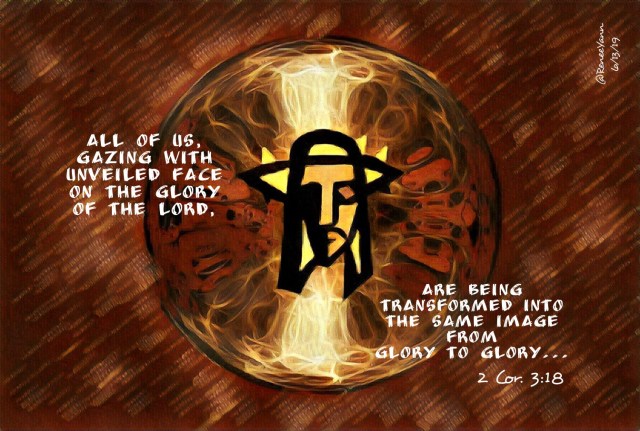
All of us, gazing with unveiled face on the glory of the Lord,
are being transformed into the same image from glory to glory,
as from the Lord who is the Spirit.

glory

May our lives, blessed by the freedom of the Holy Spirit, move gratefully, humbly, and joyously “from glory to glory” – growing ever more deeply into the merciful Heart of God.

Music:  Dwelling Place – John Foley, SJ

A St. Barnabas Music Fest

Memorial of Saint Barnabas, Apostle

June 11, 2019

Click here for Readings

Mk9_49_ salt

Today, in Mercy, we celebrate the feast of St. Barnabas, “a good man”. Reading about his call in Acts, that phrase struck me.

“Barnabas … was a good man,
filled with the Holy Spirit and faith.”

Some of you classic jazz/blues fans may remember an old classic by Bessie Smith, “A Good Man Is Hard to Find.”

That’s a pretty sad song, but apparently it does not reflect the experience of the early disciples. They found several good men in Acts 11:

Now there were in the Church at Antioch prophets and teachers:
Barnabas, Symeon who was called Niger,
Lucius of Cyrene,
Manaen who was a close friend of Herod the tetrarch, and Saul.

What makes someone a “good man (or woman)? I can remember my Dad, a good man himself, using that phrase on occasion about someone he knew. It was a rare benediction – only someone of exceptional character earned it from my Dad.

All of Dad’s designees had these things in common: humble, hard-working, honest, generous, simple and respectful people. They had shown up for life, with a loyalty to those around them. They were God-loving, salt-of-the-earth fellas who would be shocked to think they were special. Barnabas was such a guy.

Jesus loved this kind of soul too. In our Gospel he says

“You are the salt of the earth.
You are the light of the world…
Just so, your light must shine before others,
that they may see your good deeds
and glorify your heavenly Father.”

…or, in Godspell terms:

As we pray these Scripture passages today, let us be inspired by Barnabas to hear Jesus speaking these words to us – because we are good men and good women.

Music: People Let Your Light Shine – Jesse Colin Young

Yes, I’m Talkin’ to YOU!

Saturday of the Seventh Week of Easter 

June 8, 2019

Click here for readings

Today, in Mercy, our Gospel reveals a lot about the relationships and personalities among Jesus and his disciples.

John is described as “the one whom Jesus loved”, indicating that there was a unique affection shared between them. What was that like? John was younger than most of the other men. Perhaps he needed more overt direction and care from Jesus. We know from John’s later extensive contributions to scripture that he was a poet and a visionary, someone with heightened sensitivities. Perhaps John expressed his love for Jesus more openly, triggering a similar response in Jesus.

Peter, once again, appears as the questioner. Throughout the Gospels, he is always asking Jesus to explain, to define, to assure. In today’s reading, Jesus has given Peter the prime call to follow him. But Peter wants more. Looking at John, Peter wants to know, “What about him… will he follow?”

Maybe Peter is a lot like some of us, a little unsure of where we are in God’s love. Maybe he wants to know how he compares to John, the obvious “Beloved Disciple”.

Jesus doesn’t coddle Peter. He wants Peter to “man up”. Peter has immense leadership responsibilities ahead of him. He needs to rely totally on Jesus’s promise to him.

John21_22

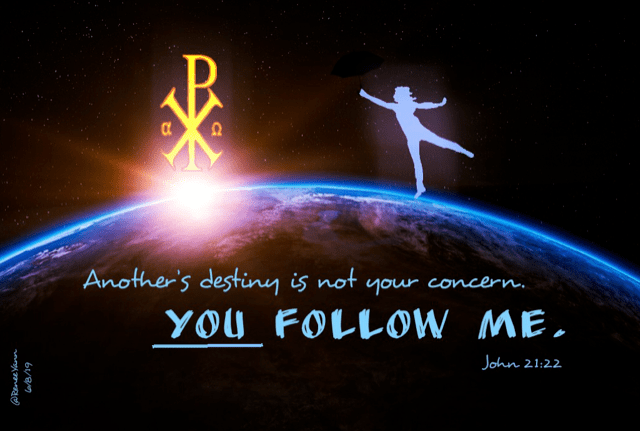
So Jesus tells him not to worry about how others are loved and called by God. He tells Peter, “ You follow me!” – that’s all you have to be concerned about.

Everybody’s call to follow is personal and different. It comes dressed in our particular life circumstances, gifts and awarenesses. God wants Peter and God wants John. He doesn’t want clones of either.

And God wants and calls each one of us in our uniqueness. By entering deeply into our own spirit, we will find our answer to God’s call.

Teresa of Avila said this:

It is foolish to think that we will enter heaven
without entering into ourselves.

May dear, questioning Peter inspire us today to be brave, confident and complete in our own response to God’s call.

Music:  Follow Me – Ray Repp

More? A Resounding “Yes” for These Five!

Friday of the Seventh Week of Easter 

June 7, 2019

Click here for readings

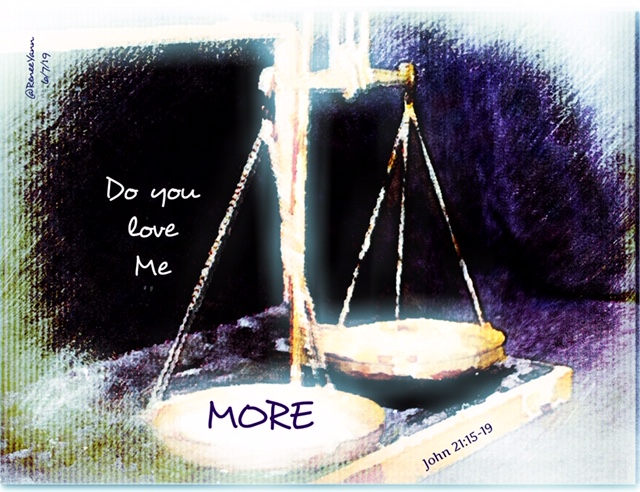
Today, in Mercy, Jesus asks the quintessential question of Peter, “Do you love me more than these?”

Jn21_15_19

The setting is by the morning-dappled sea. Jesus has just cooked his disciples breakfast. Ordinary enough, right?

What is extraordinary is that Jesus has already died, risen from the dead, and is sitting with his buddies once again by their old fishing boats!

In other words, these disciples now know clearly what the love of God means. They have seen, firsthand, what that kind of love does to a life! Mercy, Passion, Death and Resurrection lived out in everyday human experiences.

So Jesus’s question to Peter might really be asking:

After all you’ve seen,
after all is said and done,
do you have the “more”
that it will take to follow me?

Our spiritual life is all about growing to the “more” that will let us live and love in God.

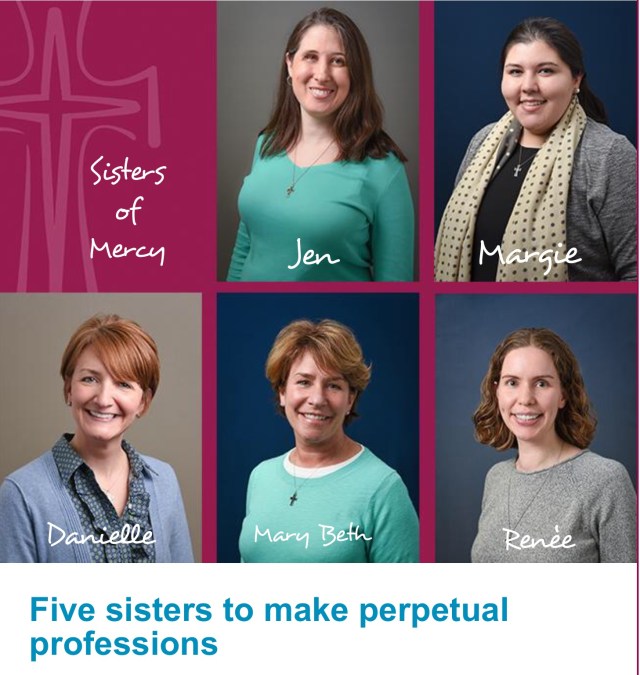
This Saturday, in our Merion chapel, four young women make their perpetual profession of vows as Sisters of Mercy. On July 13th, a fifth woman will make her final profession in the Mid-West Community.

2019 profession

We rejoice that these women have chosen to find their “more” as Sisters of Mercy. Will you join us in prayers of thanksgiving and benediction for them as they take this sacred step?

Let us too have the courage, as we pray today, to listen to Jesus ask us about our love. Let us answer sincerely, and ask for all we need to give the “more” in whatever way God asks of us.

Music: Love Like Jesus – Pawn Shop Kings (This one will wake you up!😀)