The Fiery Wine Press

Tuesday, November 27, 2018

Click here for Readings

Rev 14_19 furyJPG

Today, in Mercy, we are struck with Revelation’s images of the end time!

  • a crowned Christ wielding a sharp sickle
  • angels commanding the final harvest of the earth

and perhaps the most powerful

  • the earth’s vintage thrown into the great winepress of God’s fury!

This author could write! We can almost imagine the scene, filmed with all the pyro-technics of today’s computer age.

But besides the amazing imagery, what does the passage say to our hearts?

In Biblical symbolism, the winepress almost always stands for judgment. The passage reminds us that we all will be judged.  The divine winepress will compress the sinful gaps that plague our human existence.  In the end time, there will be no “other” — no judgmental spaces separating us from one another.  We will all be one, like wine mingled.

We will be judged on how we lived that oneness in this life, on where we have stood in the gap between the:

  • rich and poor
  • well and sick
  • citizen and refugee
  • abled and disabled
  • powerful and vulnerable

Do we live in ignorance or indifference to those who suffer on the other side of the human scale? Have we been impervious to the imbalances of justice and charity in this world?

And how do we respond? The passage suggests that we do some weeding of our spiritual gardens before the harvest of our souls. The intention of this fiery writer is to tell us that we still have a little time.

Music:  The Day Is Surely Drawing Near – written by the prolific 16th century Lutheran hymnist Bartholomaüs Ringwaldt. This piece is a majestic instrumental rendering, but if you would like to see the words, they are below. 

1 The day is surely drawing near
When Jesus, God’s anointed,
In all His power shall appear
As judge whom God appointed.
Then fright shall banish idle mirth,
And flames on flames shall ravage earth
As Scripture long has warned us.

2 The final trumpet then shall sound
And all the earth be shaken,
And all who rest beneath the ground
Shall from their sleep awaken.
But all who live will in that hour,
By God’s almighty, boundless pow’r,
Be changed at His commanding.

3 The books are opened then to all,
A record truly telling
What each has done, both great and small,
When he on earth was dwelling,
And ev’ry heart be clearly seen,
And all be known as they have been
In thoughts and words and actions.

4 Then woe to those who scorned the Lord
And sought but carnal pleasures,
Who here despised His precious Word
And loved their earthly treasures!
With shame and trembling they will stand
And at the judge’s stern command
To Satan be delivered.

5 My Savior paid the debt I owe
And for my sin was smitten;
Within the Book of Life I know
My name has now been written.
I will not doubt, for I am free,
And Satan cannot threaten me;
There is no condemnation!

6 May Christ our intercessor be
And through His blood and merit
Read from His book that we are free
With all who life inherit.
Then we shall see Him face to face,
With all His saints in that blest place
Which He has purchased for us. 

7 O Jesus Christ, do not delay,
But hasten our salvation;
We often tremble on our way
In fear and tribulation.
O hear and grant our fervent plea;
Come, mighty judge, and make us free
From death and ev’ry evil.

The Rapture

Monday, November 26, 2018

Click here for readings.

Today, in Mercy, our first reading from Revelation describes what has come to be known in modern culture as “the Rapture”. It’s a concept probably more popularized by modern fiction than by our devotion to scripture.

Rev 4_1 rapture

Maybe you are one of the  60 million readers of the “Left Behind” books by Jenkins and LaHaye. This popular series captures our fascination with “the end times”. 

The writer of Revelation is doing the same thing. This highly imaginative ancient author -adept at symbols, allegory, and poetry – writes to awake and engage us in our own salvation.

Whether or not his visions predict facts is not the point. The point is that there will come an end time to every life. When it comes to us, we want to have already become God’s familiar and beloved friend.

A second point is that this world, as we know it, is passing. We should not make our heart’s investment here. Our lasting treasure lies in God’s realm which, while present here, is often rendered invisible by our human hungers and distractions.

Revelation enjoins us to wake up, see beyond the visible, and live a life worthy of eternity. 

How? The true and simple answer is in today’s Gospel:

“When Jesus looked up he saw some wealthy people
putting their offerings into the treasure
and he noticed a poor widow putting in two small coins.
He said, “I tell you truly,
this poor widow put in more than all the rest;
for those others have all made offerings from their surplus wealth,
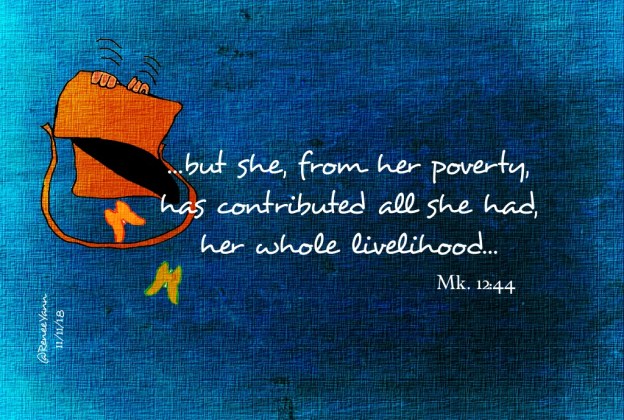
but she, from her poverty, has offered her whole livelihood.”

This blessed widow, even in her impoverished circumstances, understood where her true treasure lay. She was already counted among the sainted  “hundred and forty-four thousand”.

Music: When I read these apocalyptic passages, I like to imagine the scene by listening to compatible music. One of my favorite accompaniments is Richard Wagner: Ride of the Valkyries. Just imagine Jesus riding into our lives on these exalted melodies!

Christ the King

Sunday, November 25, 2018

Click here for readings

Today, in Mercy, we celebrate The Solemnity of Christ the King.

Rev1_7JPG

For some, the lofty, politically-tinged title might obscure the rich devotion offered by this feast. The title “king” carries with it suggestions of exaggerated power, wealth and dominance not compatible with our Gospel perception of Jesus.

We may be more comfortable with images of Christ as infant, brother, shepherd, lamb, vine, gate, way, truth, life…

But what all these images point out is that our ability to comprehend the fullness of Christ is severely limited by our humanity. We usually choose a specific image based on our circumstances and spiritual needs.

Pope Pius XI promoted the concept of Christ the King in his 1925 encyclical Quas Primas, in response to growing international secularism and nationalism. His intent was not to compare Christ to the challenged world leaders of the time. It was to raise the perceptions of all people to the lessons of Divine Leadership: mercy, justice, inclusivity, and peace.

Oh, how we could benefit from the same understanding today! 

In this age with its culture of continual war, the human pain it causes, refugee crises, climate devastation, wealth distortion and indifference to the poor, how our hearts long for just, wise and loving leadership!

In his encyclical, Pius XI wrote:

Christ the King reigns “in the human hearts,” both by reason of the keenness of his intellect and the extent of his knowledge, and also because he is very truth, and it is from him that truth must be obediently received by all humanity. He reigns, too, in our wills, for in him the human will was perfectly and entirely obedient to the Holy Will of God, and further by his grace and inspiration he so subjects our free-will as to incite us to the most noble endeavors. He is King of hearts, too, by reason of his “charity which exceedeth all knowledge.”

— Quas primas, §7[4]

Let’s pray for these virtues for all who are charged with any form of power or leadership:

  • keen spiritual intellect
  • deep heart’s knowledge
  • uncompromising truth
  • obedience to grace
  • holy inspiration 
  • noble character
  • and surpassing charity for all Creation

May Christ the King truly live and reign among us. May we behold the “sweet light in His eyes”!

Music: We Shall Behold Him – offered in American Sign Language by Kayla Seymour; sung by Sandi Patty

Come Down into God’s Arms

Tuesday, November 20, 2018

Click here for readings

Today in Mercy, the author of Revelation says some pretty tough stuff in the name of God!

To the Church at Sardis:
You have the reputation of being alive, but you are dead.

To the Church at Laodicea:
Because you are lukewarm, neither hot nor cold,
I will spit you out of my mouth.

As most of us know from experience, it’s never really easy to accept negative feedback.  But, couched in gentle, encouraging tones, it can be accepted and acted on. John of Patmos, author of Revelation, missed that lesson in coaching techniques! 

How effective his words were with the under-performing churches is a matter left to history.

zaccheus

But in our Gospel, Jesus’s inclusive, forgiving words to Zaccheus proved very effective.  Jesus doesn’t even address any shortcomings (not to make a pun) in Zaccheus.

He just says, “Come down from your tree.  I’m coming to your house for dinner.” In other words, I’m coming into your life — now what’s your response?

Zaccheus is radically changed by Jesus’s lavish mercy. He responds,

“Behold, half of my possessions, Lord, I shall give to the poor,
and if I have extorted anything from anyone
I shall repay it four times over.”

Today, we pray to have a simple, trusting faith. Sometimes, like Zaccheus, we get ourselves “up a tree”, all twisted and stretching to find God in our lives. And all the time, God has been walking straight down the path of our heart, smiling at our efforts, planning to stay with us tonight, tomorrow and forever.

Music: Zaccheus – Medical Mission Sisters

Bread and Roses

Saturday, November 17, 2018

Readings: Click here for readings

Eliz_bread

Today, in Mercy, we celebrate the Memorial of St. Elizabeth of Hungary.  Elizabeth, a princess in Hungary, was married at the age of fourteen to Louis IV of Thuringia, a German state. Both rulers were kind and saintly. 

Elizabeth used her considerable royal resources to help the poor and hungry. She met them outside the walls of the palace, even building a small hospital there to care for the sick among them. 

But there was some controversy within the castle, questioning her charity as a depletion of the governmental treasures. 

Eliz windowJPG

Once, on a charitable journey, Elizabeth met her husband traveling with a band of such questioners. She carried baskets of bread to the poor, covered with her traveling cloaks. They demanded she reveal her cargo at which the bread is said to have been miraculously transformed into roses.

(St Elizabeth of Hungary with her crown and apron full of flowers. Blois château, France. One of a series of female saints in the Oratory (once the queen’s private chapel). Designed by Michel Dumas in 1858, the windows were painted by Claude Lavergne in 1859.)

As indicated by Pope Benedict XVI, Elizabeth is part of that long line of holy ones, whose relationship with Jesus moved them to justice and mercy for all people.

Praying with Elizabeth today, asking for insight on how to be loving and charitable in today’s world, one might consider this:

  • What would it be like to greet our border refugees with baskets of bread rather than barbed wire?
  • What would it be like if we built rose hedges rather than walls?

The caravan of refugees seeking asylum at our border mirrors many similar marchers throughout history, searching for a measure of equality and a livable life.

The music for today, aptly titled “Bread and Roses”, originated in the early 1900s, as women marched for improved working conditions and the right to vote.

Music: Bread and Roses

Peel the Onion

Thursday, November 15, 2018

 Click here for readings

Today, in Mercy, Jesus tells us a secret:

“The coming of the Kingdom of God cannot be observed,
and no one will announce, ‘Look, here it is,’ or, ‘There it is.’
For behold, the Kingdom of God is among you.”

And it remains a bit of a secret, even after He tells it, because it is often very hard to discern the “Kingdom among us”. There is nothing more invisible than something hiding in plain sight.

Lk17_21JPG

Through prayer, we discover that it is about our eyes – not visibility. It is about the power of grace within us to see beyond appearances. We need a soul that can “peel the onion” of experience to find the face of God resident within all things.

  • With that kind of eyes, you don’t just have a business meeting today.
    You have an opportunity to build God’s Kingdom through respect, encouragement and mutuality.
  • You don’t just pass a person begging on the corner.
    You walk near Christ himself accompanying a broken spirit.
  • You don’t just encounter the hurts and challenges of your life.
    You are invited by God into a living faith that finds his will in all things.
  • You don’t live in the world with just other creatures.
    You meet and honor the Divine Presence in every living thing.

Indeed, the Kingdom of God is right here among us.

May we see it!
May we treasure it!
May we reveal it!

Music:  Let Your Kingdom Come – Tommy Walker


But God Does Notice

Sunday, November 11, 2018

 Click here for readings.

Today, in Mercy, we learn lessons from widows – those whose place in biblical times was uncertain and frightening. Without a husband, a woman experienced diminished standing in the legal, financial and political life of the community. 

Mk12_44 miteJPG

She was often dependent on charity, and was deemed fortunate to capture a bit of good will from those in better circumstances. 

There are several examples of widows being blessed by miracles, because they were among those most in need of them.

In today’s first reading and in the Gospel, we meet two widows displaying amazing charity and character strength.  The widow of Zarephath steadfastly prepares for death because she has nothing left to live on. When Elijah asks to share in her last few cornmeal cakes, she does not hesitate to feed him.

In our Gospel, it is significant that, just across the road from the well-stocked treasury, a nearly penniless widow gives her last coins to the poor.

In Elijah’s account, we learn the outcome of the widow’s generosity.  She reaps an abundant reward in perpetual flour and oil to sustain her.

We never learn what happens to Jesus’s widow. We are left to imagine that, in some way, her selflessness is rewarded.

It is so hard to give it all to God, especially if we feel we have little left for ourselves.  It is hard to give our love when we feel empty-hearted.  It is hard to give care when we feel unappreciated.  It is hard to assist others when we ourselves are exhausted. It is hard to do good if no one, not even God, seems to notice.

But God does notice.  Like Jesus on that long-ago afternoon, God is watching as we empty our coffers in service and care for the poor, sick, troubled and lost.

What we have to give may be small — a single corn cake or two little coins. It is the act of giving it that is large — and will make our hearts large by the choice.

One this date in 1841, Catherine McAuley, the first Sister of Mercy, died. She had given everything she had — a fortune actually.. and a life — for God’s poor and needy.  Let’s call on her to inspire us to greater charity and mercy. God knows we need to do something for this aching world!

Music:: Matthew West – Do Something

The Sweet Scent of God

Thursday, November 8, 2018

Click here for readings

Lk15_5 lost lamb

Today, in Mercy, we meet the Shepherd bringing the lost lamb home.  Haven’t we all, at sometime in our lives, been carried on those sacred shoulders?

Whether by our own prayers, or the prayers of those who love us, have we not been rescued from sorrow, foolishness, isolation or fear?

This beautiful Gospel assures us of the one thing we most deeply need – we are cherished, irrevocably, by God.

This morning, if we need to ride those shoulders, let us trust ourselves to them in prayer. 

If, by grace, we are already home, let us pray for those feeling most lost or abandoned – those most beset by a hostile world. May our merciful action help lift them to peace and the sweet scent of God so close beside them.

Music: I Will Carry You – Sean Clive

I will carry you when you are weak.
I will carry you when you can’t speak.
I will carry you when you can’t pray.
I will carry you each night and day.

I will carry you when times are hard.
I will carry you both near & far.
I’ll be there with you whenever you fall.
I will carry you through it all.

My arms are wider than the sky,
softer than a little child,
stronger than the raging,
calming like a gentle breeze.
Trust in me to hold on tight because 

I will carry you when you can’t stand.
I’ll be there for you to hold your hand.
And I will show you that you’re never alone.
I will carry you and bring you back home.

Not pain, not fear, not death, no nothing at all
can separate you from my love.
My arms and hands will hold you close.
Just reach out and take them in your own.
Trust in me to hold on tight.
I will carry you.

The Grace at Our Border

Monday, November 5, 2018

Readings: http://www.usccb.org/bible/readings/110518.cfm

Today, in Mercy,  we continue our readings from Paul’s inspiring letter to the Philippians. Paul sincerely loves this community and wants them to be perfected in Christ. 

This is what Jesus wants for us too.  Today’s Gospel is just one example of Jesus showing his followers the way to holiness. He uses the opportunity of a dinner to remind those gathered that they are very fortunate. Their lives are like a banquet compared with the lives of those who are poor and burdened.

He suggests that his followers do what God would do:

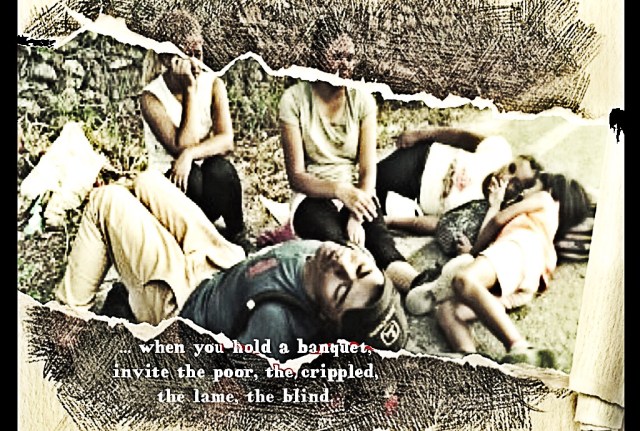
When you hold a banquet,
invite the poor, the crippled, the lame, the blind;
blessed indeed will you be
because of their inability to repay you….

Just such an opportunity to be blessed awaits us, in the USA, at our southern border. A wave of God’s beloved poor and besieged washes toward us. Will we meet them with true mercy and justice born out of Christian charity? Or will we confront them with a brutal show of power born of fear and alienation?

Lk14_14 banquet

Of course, there are legitimate concerns with such a large migration. But these concerns must be met with wisdom and prudence, not prejudice and vilification. This is not a horde of animals attacking us. These are human beings desperately seeking a better life.

Jesus thought that his table companions, gifted as they were by God, had the moral capacity to respond to his challenge. Can he expect the same of us?

Let’s hope so, because our Gospel closes with a very compelling reason:

“For you will be repaid
(one way or the other, I might add)
at the resurrection of the righteous.”

Music: God of the Poor – Graham Kendrick

What Do You Want Me To Do for You?

Sunday, October 28, 2018

Readings: http://www.usccb.org/bible/readings/102818.cfm

Today, in Mercy, our Gospel presents the blind man, Bartimeus. He is an otherwise unknown character in scripture. Yet this short passage suggests so much about him.

Mk 10_51 Bartimeus

It is stated that he was the son of Timeus, apparently someone of note in the community – otherwise, why mention his name? And yet this notable man’s blind son is left to begging on the side of the road. Had disability driven father and son apart? Was Dad unable to accept a son with a physical challenge?

The passage also reveals that Bartimeus knew about Jesus. Perhaps while begging in the public square, he talked and listened. He daydreamed about what he planned to do if he should ever have a chance to meet Jesus!

His cronies in the marketplace were not very supportive. They told him to shut up, even as he pathetically cried for Jesus’s mercy. Still, Bartimues persisted and Jesus heard him.

When he comes to Jesus, Jesus asks, “What do you want me to do for you?” It has always struck me as a strange question. The man is obviously blind, stumbling through the crowd on some disciple’s arm. Why did Jesus bother to ask what Bartimeus wanted?

This might be the lesson hidden in this Gospel. We need to name and claim our needs before God can reach through and transform them. If we don’t even know we’re “blind”, how can we know we’re cured? If we don’t present our needs to God, how can we believe that it is God Who has healed us?

The freshly cured Bartimeus, eyes wide open in grace, now follows along the path with Jesus. All the “shut-uppers” are silenced. Perhaps, Timeus weeps off in a doorway to see the power of his son’s faith and Jesus’s love.

How might our lives be changed if we had that kind of faith… that kind of love?

Music: Don’t Pass Me By – Fred Hammond (lyrics below)

There was a blind man on the road side, and he heard a commotion
It was Jesus passing by with a crowd and it stirred his emotions
He’d been displaced his whole life, should he even try

Don’t bother Jesus (they say you have nothing)
You have nothing to offer (stay in your place)
Right then he knew(he had to choose)
He had nothing to lose

So he cried Jesus (Jesus), I need you,  please don’t pass me by
He cried out Jesus, I’m not ashamed(to tell you) I need you in my life
(I need you in my life)

I’m not much different from that man, and this is the honest truth
Could this sinful one, with this messed up life, could I ever serve you
people and things clutter my mind, should I even try

Don’t bother Jesus (they say you have nothing)
You have nothing to offer (stay in your place)
Right then he knew (he had to choose)
He had nothing to lose

So I cry Jesus(Jesus), I need you
Please don’t pass me by
I’m crying out Jesus, I’m not ashamed to tell you I need you in my life

As the deer (as the deer panted)
Thirsty for the water yeah(thirsty for the water)
My soul desires and longs to be(to be with you)

Jesus, I need you, please don’t pass me by
I don’t mean to waste your time but I can’t listen to the crowd,
Situations in my life telling me to keep it down
But I need you

I know I’m broken, but you can heal me, Jesus, Jesus I’m calling you
(I might not be worth much)might not be worth much, but I’m still willing
Jesus, Jesus, I’m calling you
Songwriters: Fred Hammond / Kim Rutherford / Tommie Walker