Stand Up

Thursday, November 29, 2018

Click here for readings

human circle

Today in Mercy, our readings from Revelation and Luke are truly terrible, in the full meaning of that word: extremely distressing, causing terror.  They’re intended to be.

They describe and warn against times of destruction. Revelation describes the fall of Babylon. The Gospel relates the destruction of Jerusalem.

But neither reading is history. They are not offered so that we get the facts, the way a newspaper or encyclopedia reports a story.

These readings are given to us, and to the audiences they were originally written for, so that we might understand clearly this important reality: we live in two worlds, the material and the spiritual.

These worlds are intended by God to be united in one Creation, joined at the wedding feast of the Lamb. But we humans fail. We exalt and distort the power of the material world to the destruction of the spiritual. We split what God intended to be whole.

In other words, we build both global and personal kingdoms and governments that have no heart, have no soul.

If you think these readings describe only past civilizations, then look to the Mexican-US border. Look at the starving people of Yemen. Look at the devastation of the rainforest. Look at our drug-infested, gun-enthralled culture.

Jesus knew that his followers would battle these forces forever. He tells us that, in the midst of these destructive signs, we should

“ … stand erect and raise your heads
because your redemption is at hand.”

Jesus’s followers must stand as a sign of another way. We must raise our heads to say “No” to the heartless moral choices of our time. We cannot allow ourselves to be swept up in a culture of lies, political expediency, material greed, and dehumanization of whole peoples. We must break through the cabled propaganda we are fed to find God’s Word to us.

Our readings today ask us to take a good look at ourselves. How complicit are we in our own destruction by our failure to choose, speak, and act for Gospel justice in our world?

Music: No Outsiders – Rend Collective

Bread and Roses

Saturday, November 17, 2018

Readings: Click here for readings

Eliz_bread

Today, in Mercy, we celebrate the Memorial of St. Elizabeth of Hungary.  Elizabeth, a princess in Hungary, was married at the age of fourteen to Louis IV of Thuringia, a German state. Both rulers were kind and saintly. 

Elizabeth used her considerable royal resources to help the poor and hungry. She met them outside the walls of the palace, even building a small hospital there to care for the sick among them. 

But there was some controversy within the castle, questioning her charity as a depletion of the governmental treasures. 

Eliz windowJPG

Once, on a charitable journey, Elizabeth met her husband traveling with a band of such questioners. She carried baskets of bread to the poor, covered with her traveling cloaks. They demanded she reveal her cargo at which the bread is said to have been miraculously transformed into roses.

(St Elizabeth of Hungary with her crown and apron full of flowers. Blois château, France. One of a series of female saints in the Oratory (once the queen’s private chapel). Designed by Michel Dumas in 1858, the windows were painted by Claude Lavergne in 1859.)

As indicated by Pope Benedict XVI, Elizabeth is part of that long line of holy ones, whose relationship with Jesus moved them to justice and mercy for all people.

Praying with Elizabeth today, asking for insight on how to be loving and charitable in today’s world, one might consider this:

  • What would it be like to greet our border refugees with baskets of bread rather than barbed wire?
  • What would it be like if we built rose hedges rather than walls?

The caravan of refugees seeking asylum at our border mirrors many similar marchers throughout history, searching for a measure of equality and a livable life.

The music for today, aptly titled “Bread and Roses”, originated in the early 1900s, as women marched for improved working conditions and the right to vote.

Music: Bread and Roses

God Knows Our Hearts

Saturday, November 10, 2018

Click here for readings

Lk 16_45 knows heart

Today, in Mercy, we celebrate the Memorial of Pope St. Leo the Great.  He was a remarkable 5th century leader who consolidated essential elements of theology and administration for the yet emerging Church.

Our first reading today reflects Paul doing the same thing in the very early days of Christianity.  His ministry throughout the Mediterranean basin guided early Christians as the Church planted its first harvest.

Paul lets us know that this ministry of leadership is not easy – that he relies on the good will of the communities he serves:

You were, of course, concerned about me but lacked an opportunity.
Not that I say this because of need,
for I have learned, in whatever situation I find myself,
to be self-sufficient.

Paul seems to refer specifically to material help,  but certainly he values even more the spiritual and moral loyalty of his followers.

In our Gospel, Jesus offers us a sermonette that can, at first, seem a little confusing. His tone, as he speaks to a group of Pharisees, is somewhat ironic. But his bottomline message is this: loyalty to God, not to material things.

The thread running through all these passages?  The work of the Church needs both our spiritual and material loyalty to thrive  – whether in Paul’s time, or Christ’s, or our own.

The Pharisees pretended such loyalty, but Jesus challenged them:

You justify yourselves in the sight of others,
but God knows your hearts …

A sobering challenge against which to measure ourselves!

Music: Thank You for Giving to the Lord _ Ray Boltz

The Grace at Our Border

Monday, November 5, 2018

Readings: http://www.usccb.org/bible/readings/110518.cfm

Today, in Mercy,  we continue our readings from Paul’s inspiring letter to the Philippians. Paul sincerely loves this community and wants them to be perfected in Christ. 

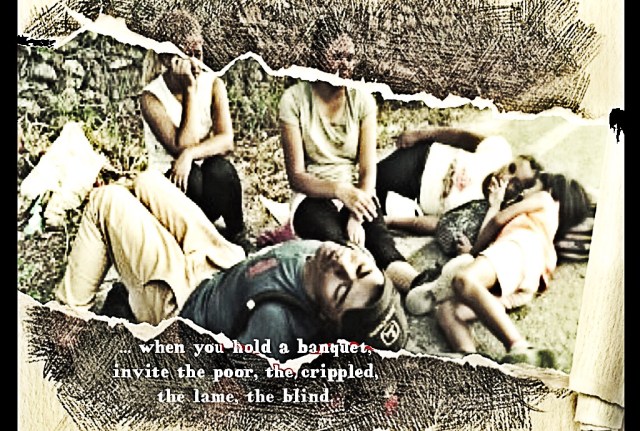
This is what Jesus wants for us too.  Today’s Gospel is just one example of Jesus showing his followers the way to holiness. He uses the opportunity of a dinner to remind those gathered that they are very fortunate. Their lives are like a banquet compared with the lives of those who are poor and burdened.

He suggests that his followers do what God would do:

When you hold a banquet,
invite the poor, the crippled, the lame, the blind;
blessed indeed will you be
because of their inability to repay you….

Just such an opportunity to be blessed awaits us, in the USA, at our southern border. A wave of God’s beloved poor and besieged washes toward us. Will we meet them with true mercy and justice born out of Christian charity? Or will we confront them with a brutal show of power born of fear and alienation?

Lk14_14 banquet

Of course, there are legitimate concerns with such a large migration. But these concerns must be met with wisdom and prudence, not prejudice and vilification. This is not a horde of animals attacking us. These are human beings desperately seeking a better life.

Jesus thought that his table companions, gifted as they were by God, had the moral capacity to respond to his challenge. Can he expect the same of us?

Let’s hope so, because our Gospel closes with a very compelling reason:

“For you will be repaid
(one way or the other, I might add)
at the resurrection of the righteous.”

Music: God of the Poor – Graham Kendrick

May Their Memories Be A Blessing

Thursday, November 1, 2018

Readings: http://www.usccb.org/bible/readings/110118.cfm

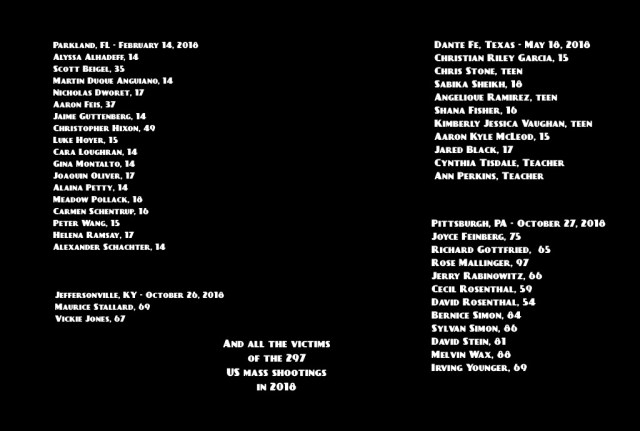
Today, in Mercy, on this Solemnity of All Saints, let us pray especially for our recent saints and martyrs – victims of hate, violence and irresponsible policy. Let us know them to be now in the arms of Love, a Love Whom we beg to heal us who remain, impelling us to true justice and mercy.

All Saints_namesJPG

As we pray, let us reflect on the following hymn for the Holy Innocents, resolving to protect sacred life in ALL its manifold ages and expressions.

1.Salvete, flores Martyrum,
In lucis ipso lumine
Quos sevus ensis messuit,
Ceu turbo nascentes rosas.

2.Vos prima Christi victima,
Grex immolatorum tener,
Aram sub ipsam simplices
Palma et coronis luditis.

3.Qui natus es de Virgine
Jesu, tibi sit gloria,
Cum Patre, cumque Spiritu,
In sempiterna secula.

1. Flowers of martyrdom, all hail!
Smitten by the tyrant foe
On life’s threshold – as the gale
Strews the roses ere they blow.

2. First to bleed for God, sweet lambs!
 In innocence you died!
Rising with your wreath and palms
At the very altar-side!

3. Honor, glory, virtue, merit,
Be to Thee, O Living God,
With Creator, and the Spirit
While eternal ages run. – Amen.

Music: Salvete, Flores Martyrum -Tomás Luis de Victoria · Lluis Vich

Rachel Weeps

Tuesday, October 30, 2018

Readings: http://www.usccb.org/bible/readings/103018.cfm

Today, in Mercy, Jesus poses a question to his followers:

“What is the Kingdom of Heaven like?” It is rhetorical question and he goes on to explain, in beautiful symbols, the joy and fullness of heaven.

But were Jesus walking physically among us today, He might answer his own question by saying:

This is what it is NOT like:

  • the killing of innocents because of their faith, heritage, lifestyle or politics
  • the starvation and incarceration of children from Yemen to Mexico to Syria
  • the fueling of war by an economy of arms sales
  • the destruction of an environment given to us in trust
  • the systematic dehumanization of humanity through violence, lies, greed, and political arrogance
  • the ignorant indifference in “good” people which blindly fosters such dehumanization

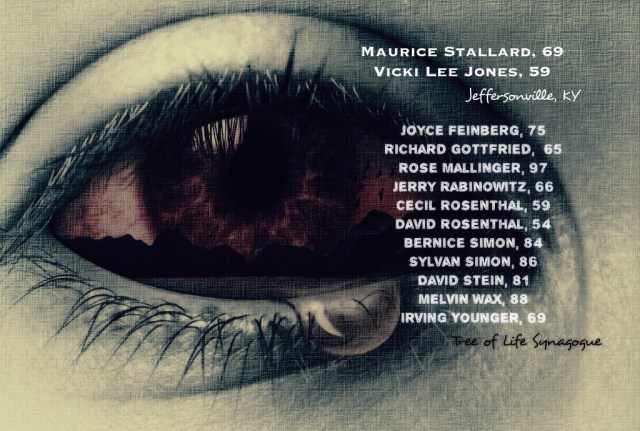
Indeed, Rachel weeps for her beloved martyrs in Pittsburgh, for her dear children in Jeffersonville – as do all of decent and loving heart. And she weeps also for thousands who die daily from the failure of love. She weeps for all of us. In a society this sick with violence and hate, we are all victims.

Let us all choose the only survival — to act in mercy, justice and love. Let us do so to the memory of these martyrs and the many whom they follow.

Music: Shalom Aleichem

https://m.youtube.com/watch?v=gP2S5KPQID4

St. Oscar Romero

Monday, October 15, 2018

Reading: Final Homily of Archbishop Romero

Yesterday in Vatican City, St. Oscar Romero was canonized. This holy man was Archbishop of San Salvador from 1977 until his assassination while offering Mass on March 24, 1980. After Archbishop Romero’s death, a twelve-year civil war ensued in El Salvador, killing an estimated 75,000 people.


The Catholic Church in El Salvador, during these years, became deeply involved in protecting the lives and land rights of the poor who were severely oppressed by a militaristic government. This corrupt government engaged the assistance of the United States to suppress the people by interpreting their struggle as “communism”.

For years, the Salvadoran government received US supplied arms and military training at the School of the Americas in Ft. Benning, Georgia.  It was someone trained with these arms who martyred St. Oscar Romero – and thousands of his poor, over many years.

Romero was not a politician. He averted confrontation wherever possible. But he could not stand by as thousands of his flock were slaughtered  because their human rights threatened the status and greed of the powerful.

Sometimes we hear the empty adage that religion should never mix with politics.
St. Oscar Romero is one of hundreds of women and men who became saints because they believed the opposite.

Our faith is irrevocably entwined with the rest of our lives. Our Gospel demands that we embrace and honor the poor, the oppressed and the marginalized. We may not be called to the level of witness that Oscar Romero was. But we, each in our own way, are called to understand issues of justice, and to act as Jesus would.

We are called to challenge our government, as did many activists during these years, when it is blind to its own sins. The USA is still selling arms to oppressive governments, still supporting regimes and practices that ignore human rights. Our voices and our votes need to be informed, clear, and faith-filled. I find Network and excellent source of education for me on these issues:

Click for Network’s Website

Music: El Salvador ~ Peter, Paul and Mary

Please read the lyrics below first, as they are a little difficult to understand. The images in the video are painful to view, but offer testament to the gross injustices the Salvadoran people endured.

There’s a sunny little country south of Mexico
Where the winds are gentle and the waters flow
But breezes aren’t the only things that blow
In El Salvador

If you took the little lady for a moonlight drive
Odds are still good you’d come back alive
But everyone is innocent until they arrive
In El Salvador

If the rebels take a bus on the grand highway
The government destroys a village miles away
The man on the radio says ‘now we’ll play South of the Border’

And in the morning the natives say,
We’re happy you have lived another day
Last night a thousand more passed away
In El Salvador

There’s a television crew here from ABC
Filming Rio Lempe and the refugees
Calling murdered children the ‘tragedy’
Of El Salvador

Before the government cameras 20 feet away
Another man is asking for continued aid
Food and medicine and hand grenades
For El Salvador

There’s a thump, a rumble, and the buildings sway
A soldier fires the acid spray
The public address system starts to play South of the Border

You run for cover and hide your eyes
You hear the screams from paradise
They’ve fallen further than you realize
In El Salvador

Just like Poland is ‘protected’ by her Russian friends
The junta is ‘assisted’ by Americans
And if 60 million dollars seems too much to spend
In El Salvador

They say for half a billion they could do it right
Bomb all day, burn all night
Until there’s not a living thing upright
In El Salvador

They’ll continue training troops in the USA
And watch the nuns that got away
And teach the military bands to play South of the Border

And kill the people to set them free
Who put this price on their liberty?
Don’t you think it’s time to leave
El Salvador?
Songwriters: Jim Wallis / Noel Paul Stookey

Happy Mercy Day!

Monday, September 24, 2018

       Readings: Click here for readings

Today, as the Mercy Family throughout the world celebrates Mercy Day, we praise and thank God for the call given to Venerable Catherine McAuley to respond to God’s grace by founding the Sisters of Mercy.

mercy2018

On September 24, 1827, Catherine used an unexpected inheritance to open a house for poor and homeless women in Dublin. It began with two, Catherine and Mary Ann Doyle – and that small, vibrant fire has lit the hearts of millions ever since.

Many of you, dear readers, carry that fire and will know Catherine’s story well. But some still unfamiliar with her life might want to explore this website:

https://www.mercyworld.org/catherine/introducing-catherine/

For those of us who treasure a share in Catherine’s call, today’s readings from Proverbs and Psalms offer a picture of what mercy in action looks like. Luke’s Gospel exhorts us that our Mercy light should be raised up to shine for all those seeking refuge from a darkness- whether it be poverty, sickness, ignorance or any kind of isolation or oppression.

To gain courage and energy for that shining, let us reach through time for Catherine’s hand, telling her how we share her dream for God’s Mercy for all Creation. Let us ask her to enliven us each morning with the same passion for justice, the same compassionate tenderness, the same welcoming heart by which she showed others the love of God.

Are there not moments when we are overwhelmed by the Mercy of God welling up within us and around us, flowing from good hearts over the world’s needs? We see and bless this grace in each other, dear Family, as we thank God this day to be called “Mercy”.

May each of your lives be richly blessed and marked by Mercy!


Today, I thought you might enjoy this powerful poem by Denise Levertov.
The music link is beneath it.
❤️ Happy and blessed Mercy Day to all.


To Live in the Mercy of God

To lie back under the tallest
oldest trees. How far the stems
rise, rise
before ribs of shelter
open!

To live in the mercy of God. The complete
sentence too adequate, has no give.
Awe, not comfort. Stone, elbows of
stony wood beneath lenient
moss bed.

And awe suddenly
passing beyond itself. Becomes
a form of comfort.
Becomes the steady
air you glide on, arms
stretched like the wings of flying foxes.

To hear the multiple silence
of trees, the rainy
forest depths of their listening.

To float, upheld,
as salt water
would hold you,
once you dared.

To live in the mercy of God.
To feel vibrate the enraptured
waterfall flinging itself
unabating down and down
to clenched fists of rock.

Swiftness of plunge,
hour after year after century,
O or Ah
uninterrupted, voice
many-stranded.

To breathe
spray. The smoke of it.
Arcs
of steelwhite foam, glissades
of fugitive jade barely perceptible. Such passion—
rage or joy?

Thus, not mild, not temperate,
God’s love for the world. Vast
flood of mercy
flung on resistance.
———-

Music: Mercy ~ Matt Redman

Does God Have Favorites?

Wednesday, September 12, 2018

       Readings: http://www.usccb.org/bible/readings/091218.cfm

Lk6_beatitudesJPG

Today, in Mercy, our readings might lead us to wonder, “Does God have favorites?”

I think Luke’s Gospel today says, “Well, yes, kinda’!”

This passage from Luke is a parallel to Matthew’s Sermon on the Mount. Matthew includes the familiar Eight Beatitudes, delivered in spiritual tones which allow most of us find ourselves somewhere among them. Matthew talks about the “poor in spirit”, the meek, mourning and merciful. At least once in our lives, we probably fall into one of Matthew’s “blessed” categories. Doing so let’s us think we might be among God’s favorites or blessed ones — at least sometimes, right?

But hold up, here comes Luke with a whole different take on blessedness. Luke says just the plain poor, hungry, weeping and hated are blessed. Luke’s sanctifying suffering is material, not just spiritual. Luke suggests that the destitute, bereft and ostracized are clearly God’s favorites.

What does that say to us? I don’t know about you, but I’m not real anxious to join Luke’s blessed group. I don’t like the feeling of poor, hungry, weeping and hated! On the other hand, I do want to be one of God’s favorites, don’t you?

What I think we can do is this: 

  • to love the poor and materially broken as God loves them
  • to do all we can to bring them comfort and healing, mercy and justice 
  • to learn from them what it is like to stand before God with nothing between us but longing and hope
  • to look at our own materially abundant life with a critical eye and discerning heart
  • to see any darkness we endure in the light of God’s illuminating promise
  • to be grateful, humble, and open to the transforming graces God might offer us even in suffering

Music: Blessings ~ Laura Story

Would God Divorce Us?

Saturday, July 28, 2018

Readings:  http://www.usccb.org/bible/readings/072818.cfm

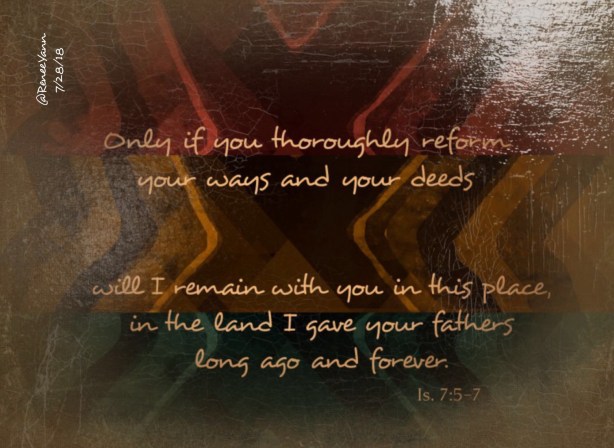
Today, in Mercy, we hear from Jeremiah, a “sock-it-to-‘em” prophet. He lived in a disastrous time for Judah, and had to deliver some difficult challenges to the people. Today’s passage is called the Temple Sermon. It confronts his listeners with the fact that there is a big difference between their professed faith and their daily practice. In other words, they are living a lie.

Jeremiah7_5

The people seem to think that no matter how idolatrous or immoral their choices are, the Temple building will protect them from God’s anger. It’s a mentality that might remind us of the film “The Godfather”, where the mafioso kill and cheat all week but always fulfill their sacramental obligations.

God tells Jeremiah to go stand at the Temple gate and tell the people that their fake piety won’t work. Instead they are to:

  • thoroughly reform their ways and deeds
  • deal justly with their neighbor
  • no longer oppress the resident alien, the orphan, and the widow
  • no longer shed innocent blood in this place (cease human sacrifice)
  • or follow strange gods to their own harm

Otherwise, Jeremiah says, they risk losing God because God will not live in a desecrated Temple.

The message to us that comes wrapped in the ancient words of Jeremiah?

  • Examine your life.
  • Is our faith sincere, proven by our practices?
  • Do we give others not only the benefit of the doubt, but also the benefit of our kindness?
  • Do we support and foster immigrants, orphans, widows … in other words the vulnerable?
  • Do we stand against the suffering of innocents caused by war and unjust policy?
  • Do we resist the “gods” competing for our souls — all the destructive isms and addictions of our time?

Otherwise, Jeremiah says, we risk losing God because God will not live in a heart-temple that is desecrated.

Music: Fill This Temple – Don Moen

https://m.youtube.com/watch?v=r1CIpLFywdc